Obama Weighs Spending to Stem Job Cuts Without Second Stimulus


[Skip to the end]

This does not do much for ‘jobs’ but it is pretty good for financial markets.

Low wages, high productivity growth and a bit of top line growth makes for happy management and investors. And a continuing flow of real wealth from the bottom to the top.


Obama Weighs Spending to Stem Job Cuts Without Second Stimulus

By Mike Dorning and Nicholas Johnston

Oct. 6 (Bloomberg) — President Barack Obama is considering a mix of spending programs and tax cuts to respond to widening job losses that would amount to an additional economic stimulus without carrying that label.

Contradictory Missions

In considering the measures, the administration has to reconcile two potentially contradictory missions: combating rising unemployment through government intervention and the need to hold deficits down.

White House Press Secretary Robert Gibbs yesterday highlighted those political sensitivities, saying there “were no plans” for a second stimulus like the $787 billion package passed earlier this year. Instead, he said, the administration is looking at “extensions” of existing programs.

The Obama administration isn’t near a final decision on additional measures, said Jen Psaki, a White House spokeswoman.

“As they continue to explore the best options, any notion that we are any farther along than preliminary discussions about new proposals is wildly inaccurate,” she said.


[top]

Rental Vacancies


[Skip to the end]


Karim writes:
Rent is 30.5% of headline CPI and 39% of core CPI, a 1% rise in the rental vacancy rate typically leads to about a .7% decline in rent and a .25-0.30% fall in core CPI (with a lag). So rise in rental vacancy rate likely not entirely fed through to CPI yet, plus further increase in vacancies plus ongoing slack in economy to push core inflation down even further. GS and JP both currently estimating 0% core CPI by end-2010.

The U.S. vacancy rate reached 7.8%, a 23-year high, according to Reis Inc., a real-estate research firm that tracks vacancies and rents in the top 79 U.S. markets. The rate is expected to climb further in the fall and winter, when rental demand is weaker, pushing vacancies to the highest levels since Reis began its count in 1980. Nationally, effective rents have fallen by 2.7% over the past year, to around $972. The second and third quarters typically are the strongest periods for rental landlords because they are popular times for people to move. But this year, “vacancies just continued rising,” said Victor Calanog, director of research for Reis. During the third quarter, vacancies increased in 42 markets, improved in 26 markets and remained unchanged in 11 markets. Reis projects that the vacancy rate will peak at well above 8% in mid-2010.


[top]

Darling Says Conservative Plans Risk ‘Crashing’ U.K. Economy


[Skip to the end]

Good to hear this kind of talk:

Darling Says Conservative Plans Risk ‘Crashing’ U.K. Economy

By Gonzalo Vina

Oct. 5 (Bloomberg) — Chancellor of the Exchequer Alistair Darling said the Conservative Party plans to cut spending and welfare programs risked “crashing” the British economy, his strongest attack yet on the opposition as the election nears. Darling said Conservative leader David Cameron’s plan to phase out the “New Deal” welfare programs built up by the Labour government would hurt the nation’s poorest people and that cutting the budget deficit now would threaten the recovery.

“Proposing to end support for the economy and scrap the New Deal is entirely wrong and downright daft,” Darling told reporters in Istanbul today after attending a meeting of finance ministers from the Group of Seven. “Either he doesn’t understand what he is doing or he is not coming clean about what he is doing. Nobody else is advocating what he is proposing.”


[top]

WSJ/Plan U.S Saving more,China less reliant on exports


[Skip to the end]

These proposals present what is perhaps the most serious macro risk to the US standard of living in our history.

It is truly the blind leading the blind.

Seems they’ve all forgotten none of us are on a gold standard,

That exports are real costs, and imports real benefits, and that taxes function to regulate aggregate demand, and not to ‘raise revenue’ per se.

While this has never been understood by the mainstream, but it has never mattered as much as it does today:

# [ The focus is on a U.S. proposal, called the “Framework for
Sustainable and Balanced Growth,” whose details haven’t been previously
disclosed. If implemented, the framework would involve measures such as
the U.S. saving more and cutting its budget deficit, China relying less
on exports,
and Europe making structural changes to boost business
investment.]

# [ But U.S. and European officials say that this time China is on board
because it recognizes that its export-driven model won’t deliver
sufficient growth in the future, and because the new framework would
potentially spread the political pain to trading partners too.]

Nations Ready Big Changes to Global Economic Policy

By Bob Davis and Stephen Fidler

Sept. 22 (WSJ) — The Group of 20 nations is scrambling to finalize a plan before this
week’s Pittsburgh summit that would commit the U.S., Europe and China to
make big changes in national economic policies to produce lasting growth
as the world recovers from the worst recession in decades.

The G-20 summit, the third such gathering in a year, is shaping up as a
test of whether industrialized and developing nations can function as a
board of directors for the global economy.


The focus is on a U.S. proposal, called the “Framework for Sustainable
and Balanced Growth,” whose details haven’t been previously disclosed.
If implemented, the framework would involve measures such as the U.S.
saving more and cutting its budget deficit, China relying less on
exports, and Europe making structural changes to boost business
investment.

“As private and public saving rises,” in the U.S. and other countries,
“the world will face lower growth unless other G-20 countries undertake
policies that support a shift towards greater domestic, demand-led
growth,” senior White House aide Michael Froman wrote
to his G-20
colleagues in a letter dated Sept. 3. In the missive, which has not been
made public, he called the framework “a pledge on the part of G-20
leaders” to press new policies.

The proposal has set off political wrangling among the G-20, with
European countries arguing that the U.S. may be unrealistic about how
rapidly the global economy can grow and with China only reluctantly
agreeing to participate. The U.S. helped bring along the Chinese by
endorsing Beijing’s view that developing countries deserve a bigger
stake in international institutions such as the International Monetary
Fund.

The G-20 countries have yet to decide how detailed to make their pledges
to change. And the U.S. and Europe have different ideas on how to
enforce them. “Implementation is always the issue,” says Timothy Adams,
a former senior Bush Treasury official. “If we wait even one more year,
it may be too late.”
The sense of urgency will have faded, he says.

Past efforts to remedy these issues have collapsed, especially after a
sense of crisis had passed. In the 1980s and early 1990s, the Reagan,
Bush and Clinton administrations regularly pushed for rebalancing —
although Japan was the target then — and never made much headway. Once
Japan plunged into a decade-long slump, the U.S. eased off.

In the days leading up to the Pittsburgh summit, representatives of the
G-20 nations have agreed how to dodge one big issue: devising an “exit
strategy”
to withdraw the monetary and fiscal stimulus deployed to fight
the global recession. The solution is to promote such a strategy as
necessary, while stopping short of articulating specifics.
Any
prescription to phase out various economic programs could spook markets
into anticipating a quick pullback, G-20 officials say.

A compromise is emerging on another, two-pronged issue: How best to keep
financial excess and corporate compensation in check. The summit is
likely to produce support for new limits on compensation, a theme bing
pushed by the Europeans. The G-20 is also expected to approve new
requirements sought by the U.S. that banks hold more capital to
discourage risk-taking and absorb big losses.

G-20 officials say they are counting on sense of camaraderie to keep
them working together rather than pursuing conflicting national goals.

“In this age of deeper globalization, international coordination is
critical,” says Il SaKong, a prominent South Korean economist who
oversees that country’s G-20 effort. “The leaders learned this lesson;
they felt it.”

China, meanwhile, has pressed for more voting power for developing
countries at the IMF. In response, the U.S. is pushing the G-20 to agree
to change IMF voting, so that it’s split nearly 50-50 among
industrialized and developing countries, rather than the current 57% to
43% lineup. Although much of the lost power would come at the expense of
Europe, the European Union leaders said at a recent meeting that they
are willing to support some degree of change.

The move to give developing countries a bigger voice has built a degree
of trust within the G-20 and helped give impetus to make the framework
for growth a central focus. If approved, the framework would require
countries to make specific proposals promising significant change.

Those countries running current account deficits, most notably the U.S.,
would have to define ways to boost savings. Nations running surpluses —
China, Germany and Japan, among others — would detail how they propose
to reduce any reliance on exports. The U.S. would likely need to commit
to a sharp deficit reduction by government.


Europe would need to commit to improving competitiveness. That could
mean passing investment-friendly tax measures and reopening the debate
about making it easier to fire workers — viewed as one way to encourage
employers to hire more freely.

China would face perhaps the biggest challenge: remaking its economy so
it relies far less on exports to the U.S., thereby running up huge
foreign exchange reserves. In the past, China has shied away from such
“rebalancing” efforts
because of the magnitude of the changes and
because it believes it’s being singled out for the world economic woes,
which it feels were caused by regulatory lapses and other failings in
the U.S. and Europe. “They don’t want fingers pointed at them,” says
Nicholas Lardy, a China expert at the Peterson Institute for
International Economics, a Washington D.C., think tank. “It comes up
over and over again.”

But U.S. and European officials say that this time China is on board
because it recognizes that its export-driven model won’t deliver
sufficient growth in the future, and because the new framework would
potentially spread the political pain to trading partners too.

In 2006, the IMF tried its hand at rebalancing by convening talks among
the U.S., euro-zone nations, Japan, China and Saudi Arabia. Specific
proposals were made, but nothing was implemented, as Treasury Secretary
Henry Paulson figured he’d have better luck bargaining bilaterally with
China. He didn’t, especially when each country’s economy was expanding.

“The really hard part is getting an agreement of what the rules should
be and what the penalty is” for breaking them, said Anne Krueger, a
former IMF deputy managing director. G-20 officials argue that if they
don’t succeed this time, the world will remain stuck in economic
patterns that could reduce potential growth and perhaps produce another
crisis down the line.

Any new framework hinges on proper enforcement. To that end, European
sherpas, including the British, are pushing for a “trigger” mechanism.
If country’s current account surplus or deficit goes over a certain
limit, for instance, that would require negotiations to get the country
back in line.

The U.S. is pressing for what it calls a “peer review” process, by which
G-20 countries, with the help of the IMF, would assess whether each
other’s policies are working.

None of the countries, though, are calling for specific redress, such as
trade sanctions or foreign-exchange penalties for countries that don’t
live up to their promises. Threats of penalties have frightened off
Asian nations in the past and would likely sour any deal.

Instead, the G-20 officials point to how they have dealt with
protectionism as a model. Each country regularly pledges it won’t take
any protectionist action. The World Trade Organization calls out
countries that violate their pledge. Generally, G-20 officials believe
the pledges have had a restraining effect on governments.


[top]

Krugman: Mission Not Accomplished


[Skip to the end]

Too bad he doesn’t understand monetary operations and writes this out of paradigm stuff that undoes him in further discussion with the mainstream:

Mission Not Accomplished

By Paul Krugman

What is true is that spending more on recovery and reconstruction would worsen the government’s own fiscal position. But even there, conventional wisdom greatly overstates the case. The true fiscal costs of supporting the economy are surprisingly small.

You see, spending money now means a stronger economy, both in the short run and in the long run. And a stronger economy means more revenues, which offset a large fraction of the upfront cost. Back-of-the-envelope calculations suggest that the offset falls short of 100 percent, so that fiscal stimulus isn’t a complete free lunch. But it costs far less than you’d think from listening to what passes for informed discussion.


[top]

Payrolls


[Skip to the end]

Karim writes:
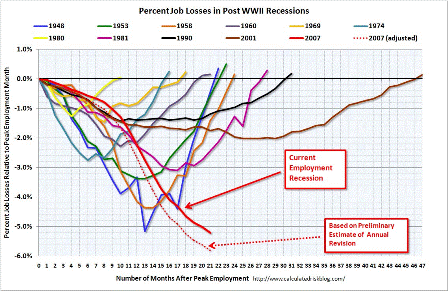
Reaction possible dampened by the recent rally, but this is a really bad number, especially as it relates to consumer income and spending.

But really weak across many metrics and shows a worsening, not just less bad.

  • NFP -263k w/net revisions -13k
  • UE rate up from 9.657% to 9.832%
  • HOURS -0.5%
  • Diffusion Index 34.9 to 31.9
  • AHE +0.1%
  • Total Unemployment (Discouraged workers, would rather be full-time,etc) up from 16.8% to 17%
  • Main weakness was retail (-30k net change), Education (-43k net change) and State and Local Govt (-30k net change)

Labor Income is HoursXJobsXHourly Earnings. Looks like will be down about 0.5% for the month and will drive y/y personal income even more negative.

Tough to see inflation with that background!


[top]

Barro and Redlick on ‘stimulus’


[Skip to the end]

Thanks, at least he’s off most of his prior ‘Ricardian equivalence’ nonsense:

Stimulus Spending Doesn’t Work

The bottom line is this: The available empirical evidence does not support the idea that spending multipliers typically exceed one, and thus spending stimulus programs will likely raise GDP by less than the increase in government spending.

That’s a good thing. It means we can have taxes be that much lower for a given level of spending.

That’s a ‘good thing’ in my book!

Defense-spending multipliers exceeding one likely apply only at very high unemployment rates, and nondefense multipliers are probably smaller. However, there is empirical support for the proposition that tax rate reductions will increase real GDP.

Not to mention a payroll tax holiday. And federal revenue sharing. And funding an $8/hr job for anyone willing and able to work.

Mr. Barro is a professor of economics at Harvard and a senior fellow at Stanford University’s Hoover Institution. Mr. Redlick is a recent Harvard graduate. This op-ed is based on a working paper issued by the National Bureau of Economic Research in September.

Please forward this to Mr. Barro and Mr. Redlick, thanks!


[top]

EU Officials Say Stimulus Exit Unlikely Before 2011


[Skip to the end]

They are worried raising rates will further support the euro.

And they all seek a quick return to ‘fiscal responsibility’

This all should insure the Eurozone remains characterized by high unemployment and elevated systemic risk


EU Officials Say Stimulus Exit Unlikely Before 2011

By Svenja O’Donnell and Chris Burns

Oct. 1 (Bloomberg) — European Union finance chiefs said the pace of recovery means they probably won’t withdraw stimulus measures before 2011 as they grapple with rising unemployment and the effects of the euro’s gains.

“We look with concern to the exchange-rate developments and the impact of our ability to export,” Portuguese Finance Minister Fernando Teixeira dos Santos said today in an interview with Bloomberg Television at a meeting of European finance chiefs in Gothenburg, Sweden. “But we should expect markets to react appropriately to the fundamentals of our economy.”

The finance officials are discussing the form and timing of exit strategies after spending billions of euros in emergency measures to drag the economy out of its worst recession in 60 years. While there are signs the recovery is under way, it may not be sustained enough to permit a withdrawal of these measures before 2011, ministers said.

“We have to prepare exit strategies, of course, and we shall see if these strategies can be implemented then in 2011,” Luxembourg’s Jean-Claude Juncker said after leading a meeting of euro-area finance chiefs today. “We shall see whether this situation becomes more stable by then.”

The euro, which has gained 13 percent in the past seven months against the dollar, traded at $1.4544 at 2:10 p.m. in London today, down from $1.4640 in New York yesterday.

Euro’s Advance

The ministers discussed the euro’s advance in preparation for a Group of Seven meeting in Istanbul this weekend, European Central Bank President Jean-Claude Trichet told a press conference.

“We had a discussion as usual preparing for the meetings in Istanbul,” Trichet said. “There is very strong sentiment that we have a shared interest in a strong and stable international financial system and excess volatility and disorderly movements in exchange rates have adverse implications for economic and financial stability.”

Trichet also said exit plans should be implemented once the recovery is under way, “in our own view the latest in 2011,” he said.

The euro-area economy may expand 0.2 percent in the current quarter and 0.1 percent in the three months through December, the commission said on Sept. 14. In the second quarter, the economy contracted just 0.1 percent as Germany and France returned to growth.

Jobless Rate

Europe’s unemployment rate rose to a 10-year high of 9.6 percent in August, data showed today, as companies continued to cut jobs even as the recession eased. The European Commission forecasts the euro-area jobless rate will reach 11.5 percent next year.

“It’s clear we have to keep economic policy very expansionary in the coming period to really be sure of establishing a recovery,” Swedish Finance Minister Anders Borg said today. “At the same time, this is the time to start designing and communicating exit strategies,” he said, adding that it’s “clear that fiscal policy in Europe is not sustainable.”

France’s budget deficit will widen next year to a record, the government projected yesterday, as President Nicolas Sarkozy cuts business taxes and spending on jobless benefits climbs. Spain this week posted the largest budget shortfall in at least nine years.

This afternoon the euro-area officials were joined by finance ministers from the rest of the European Union as well as central bankers from the 27 EU nations. Included on their agenda is the banking industry and financial- supervision proposals. The Committee of European Banking Supervisors is due to present the results of stress tests carried out on the banking industry.

Reducing Deficits

Officials should focus on reducing deficits over raising interest rates, Jean Pisani-Ferry, director of Bruegel, a Brussels-based study group, said in a presentation to ministers in Gothenburg today.

“In view of the public finance costs of large deficits, budgetary consolidation should be given priority over monetary tightening,” Pisani-Ferry said in the report, co-written with Juergen von Hagen and Jakob von Weizsaecker. “For this to succeed, governments need to start fiscal consolidation swiftly in 2011 with the withdrawal of the stimuli.”

This afternoon the euro-area officials were joined by finance ministers from the rest of the European Union as well as central bankers from the 27 EU nations. Included on their agenda is the banking industry and financial-supervision proposals. The Committee of European Banking Supervisors is due to present the results of stress tests carried out on the banking industry.


[top]

PCE/Claims


[Skip to the end]

Yes, not looking good!


Karim writes:

Attached is the Fed’s favored inflation measure, the core PCE deflator.

Putting aside that 1% is the lower end of their defacto ‘comfort zone’, the speed of the move is as much a concern as the level.

  • M/M Core PCE was 0.09%
  • Personal income and wage and salary income were both 0.2% m/m, but are down -2.6% and -5.2% y/y respectively.
  • Initial claims up 17k to 551k (prior week revised +4k).
  • Total Ongoing Claims (continuing+extended+emergency) +35k


[top]