
Fed’s Williams:Fiscal Policy Actions ‘Badly Needed’

A step in the right direction:

Fed’s Williams:Fiscal Policy Actions ‘Badly Needed’

Fri Nov 18 14:04:45 2011 EST

–The Federal Reserve’s actions have not been enough to deliver a robust recovery

–The recovery has been hurt by the decline in housing and stock prices, tightening of credit and uncertainty in Europe

–Fiscal policy actions to reduce uncertainty and stimulate recovery are ‘badly needed’

By Anusha Shrivastava

NEW YORK-(Dow Jones) — The Federal Reserve’s actions during the past four years have not been enough to deliver a robust recovery so fiscal policy actions are “badly needed”, said a central bank official on Friday.

“What would be especially helpful at this juncture are fiscal policy actions that work in tandem with monetary policy to stimulate the economy,” said John Williams, president of the Federal Reserve Bank of San Francisco, speaking at the Central Bank of Chile in Santiago.

Williams, who expects the U.S. unemployment rate to remain above 7% for three more years, named three “powerful currents” slowing the pace of recovery.

There has been a “massive destruction of wealth” because of the financial crisis, stemming from a housing collapse, he said.

Second, there’s been a severe tightening of credit because of the decline in residential property prices and the wave of foreclosures.

The heightened uncertainty in Europe and overall health of its financial system is another contributory factor diminishing the appetite for risk such that investors are fleeing to safe assets like U.S. Treasurys, he added.

Given the weakness in the economy and the uncertainty impeding recovery, Williams called for fiscal policy actions that work with monetary policy to boost the economy.

One example of such a policy is the recently announced U.S. government initiative to make it easier for homeowners whose houses are now of lower value than when they bought them, to take advantage of very low rates and refinance their mortgages.

“This will trim monthly payments for some households and could reduce foreclosure rates,” Williams said. “It could also eventually provide a modest boost to consumer spending.”
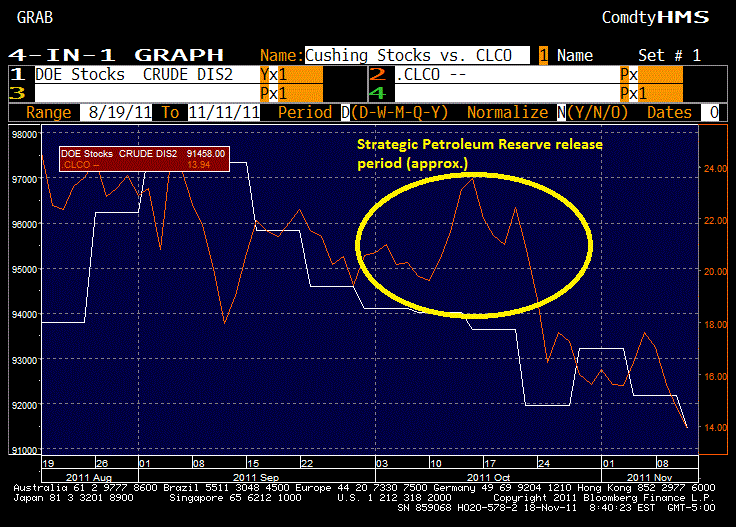
SPR release winding down

This chart of West Texas crude prices vs Brent north sea crude prices was done a few days ago, with the spread subsequently narrowing further to under $10.

As previously discussed a few weeks ago, with the Strategic Petroleum Reserve release initiated by President Obama now winding down, the glut in Cushing that looks to have caused West Texas crude prices to fall to about a $25 discount to Brent crude and world prices in general looks to be coming to an end. Additionally, to help ensure it doesn’t happen again, it was announced the flow in a large pipeline will soon be reversed to allow crude to flow out of Cushing.

As a consequence the WTI price has been rising steadily and looks to me to be reconverging with Brent prices.

And seems to me, watching the news broadcasting, the increase is at best very disconcerting to the US consumer in front of the holiday shopping season.

chart

Posted in Oil

Spanish Voters Set to Throw Out Socialists in Election

As previously discussed, there is virtually no political support to leave the euro,
as it’s not intuitively obvious the euro is the problem.

It is intuitively obvious, however, that the problem was irresponsible govt
and so the move towards responsible govt- aka austerity- continues.

The euro economy can be easily ‘fixed’ and in short order.
The ECB can, one way or another, facilitate all funding needs and end the solvency issue.
And the Stability and Growth Pact (SGP) can be modified to allow deficits sufficient to sustain aggregate demand.

Currently Germany continues to be obstructing the elimination of the solvency issue,
even as market forces are now begining to weaken German bonds.
And there are no member nations yet supporting readjusting the SGP to allow higher deficits.

So my best guess is Germany will soon recognize what most of the financial community has recently been voicing- ECB bond buying combined with austerity is not inflationary- opening the door to the ECB bond buying being an EU sanctioned policy of the institutional structure to ensure solvency.

That will trigger a massive ‘relief rally’ that will fade as the reality of the depressing nature of the
austerity takes over.

It could also sideline the discussion of Greek haircuts and default discussion in general.

Spanish Voters Set to Throw Out Socialists in Election

November 20 (Reuters) — Spaniards are expected to throw out the Socialists they blame for a disastrous economic situation in an election on Sunday and to vote in a center-right party likely to dole out more bitter medicine in the form of public spending cuts.

Opinion polls show the People’s Party (PP), led by Mariano Rajoy, has an unassailable lead over the ruling Socialists, who have led the country from boom to bust in seven years in power.

Voters are angry with the Socialists for failing to act swiftly to prevent the economic slide and then for bringing in austerity measures that have cut wages, benefits and jobs.

Yet people are now resigned to further slashes in spending on health and education in the midst of a European debt crisis that has toppled the governments of Ireland, Portugal, Greece and Italy and pushed Spain’s borrowing costs ever higher.

EU Staff Threaten Strike Action Over Belt-Tightening

Occupy Brussels…

EU Staff Threaten Strike Action Over Belt-Tightening

BRUSSELS (AFP)–European Union staff unions on Friday threatened strike action next week to protest belt-tightening measures as the bloc goes on an austerity diet.

A statement from an “Inter-institutional Joint Front” representing the 55,000 staff across the European institutions has called an assembly on Tuesday following a breakdown in conciliation talks with the European Commission.

European staff wages vary widely: from EUR2,650 per month before tax and social welfare payments, to EUR23,000 gross for each of the 27 national EU commissioners.

Staff are concerned by a bid to overhaul staff rules and by a letter signed by 17 of the 27 EU states that criticizes automatic wage adjustments and links the possibility of wage hikes to the economic situation.

The 17 austerity-driven nations also say an increase in retirement age from 63 to 65 isn’t sufficient.

Staff unions on the other hand criticize working conditions on their Facebook page

Posted in EU

German Foreign Ministry confirms it is considering the possibility of more eurozone “orderly defaults”

In this case default = EU sanctioned debt forgiveness,
which, at this point in time, only reinforces the notion that
no one with any fiduciary responsibility should be buying any euro member debt.

This shortens the time frame between now and when things get bad enough for
Germany to permit the ECB to do what it takes to get past the national govt solvency issue.

Germany confirms it is considering more eurozone “orderly defaults”

Berlin/Brussels (DPA) — The German Foreign Ministry on Friday confirmed that Germany was considering the possibility of more eurozone “orderly defaults” beyond that of Greece, as suggested by a paper leaked by the British press.

The Daily Telegraph published a six-page document, attributed to the Foreign Ministry, suggesting that partial bankruptcy must be made possible for all euro members “unable to achieve debt sustainability.”

“There must also be the option of an orderly default (of a struggling euro member) to reduce the burden on taxpayers” in other eurozone members which are paying for its bailout, the document said.

“There is nothing secret about it,” the ministry said Friday, stressing that it contained ideas on which Foreign Minister Guido Westerwelle had already publicly commented upon.

At the start of the euro debt crisis, EU leaders maintained that no country would ever fail to pay back debts. This year the taboo was broken with Greece, as private lenders were ordered to take a 21 per cent hair cut on Greek bonds. The figure was then raised to 50 per cent.

The memo proposed that “orderly default” procedures should be governed by the European Stability Mechanism, the new euro rescue fund which, under current plans, is due to enter into operation in 2013.

The paper also backed strong EU interference in the economic affairs of eurozone budget sinners, proposing that a country not meeting austerity targets could “have concrete budgetary measures imposed upon it,” such as “specific spending cuts” or new taxes.

But commenting on Dutch proposals to create an EU commissioner with direct powers of intervention in national budgetary policies, it warned that “the constitutional provisions on the budgetary autonomy of the Bundestag (German parliament) must be observed in every case.”

Recalling well-known German positions, the document called for EU treaty changes to implement the budget discipline reforms it advocated, which also include the possible freezing of EU regional aid and taking budget sinners before the EU Court of Justice.

But it also accepted that such course of action may not be possible.

“In case (an EU treaty change) is not politically feasible, an alternative treaty between the member states that is legitimate under international law ought to be considered,” it said.

Goldman- worries about the inflationary impact of debt monetisation are exaggerated

Good to see Dirk at Goldman is pretty much spot on:

German Economic Commentary : Chancellor Merkel not keen on more a proactive ECB stance

Published November 18, 2011

Chancellor Merkel gave a speech in Berlin yesterday where her main message with respect to stabilisation measures was essentially: No! Merkel rejected the introduction of Eurobonds but also any commitment from the ECB’s side to be the lender of last resort for Euro-zone governments.

There are several arguments the German government/Bundesbank are putting forward against a more pro-active stance of the ECB. First, a more pro-active role would not be in accordance with the treaties. Second, it would create moral hazard as it would reduce the incentive for governments to consolidate and reform. Third, debt monetisation, sovereign debt purchases by the ECB, leads to inflation. The latter argument was echoed by the chairman of the council of economic experts Franz, who said in an interview with FAZ newspaper that debt monetisation is a “deadly sin” for a central bank.

These are valid arguments, but only up to a point. In particular the worries about the inflationary impact of debt monetisation are exaggerated. Sovereign debt purchases of a central bank do not necessarily lead to inflation (see the example of Japan, although it can, see the example of Zimbabwe). It can lead to inflation if these purchases are used to finance an expansionary fiscal policy that will lead to strong growth and demand outpacing supply such that price setters will increase their prices. Fiscal policy, however, will be quite restrictive in the Euro-zone in the coming years. Italy, for example, aims at tightening fiscal policy by almost 3% next year on our estimate (we calculate this as the change in the structural primary fiscal balance). And while it remains to be seen whether the fiscal targets will be met, it is a safe bet that fiscal policy will not be expansionary in the Euro-zone for quite some time.

It can also lead to inflation if there is an excessive debt overhang, i.e. the fiscal position of a country is clearly unsustainable. Put differently the expansion of the monetary side is, even in the long run, not backed by a similar expansion of the real side of the economy. As we have argued in the past we see this only as a remote risk.

What the ECB is currently doing under its SMP is essentially swapping one savings instrument (peripheral sovereign debt) for another (cash) as private sector investors, for various reasons, no longer want to hold peripheral debt. But this has no inflationary implications unless one assumes that investors are spending the cash thereby stimulating demand which then leads to inflation. But these investors are not holding cash because they want to increase their spending, but because they think, rightly or wrongly, that cash is more rewarding from an investment point of view.

There are no easy choices and it would have been, no doubt, better if the ECB had never got in the position it is in now. But the current situation demands a careful weighing of the risk involved with any decision taken. The inflationary risk thereby seems to be getting an unduly high weight in the consideration of German policy makers.

Dirk Schumacher

Franco-German Spat on Role of ECB Renewed

Not long ago France would have conducted a nuclear test to make the point.
Today, it takes a core meltdown to make the point:

Franco-German Spat on Role of ECB Renewed

By Tony Czuczka and Mark Deen

November 18 (Bloomberg) — The failure of European leaders to end the debt crisis with their broadest effort yet has revived a Franco-German dispute over theEuropean Central Bank’s role and fueled investor concerns over policy makers’ economic impotence.

ECB chief Mario Draghi today slammed governments for failing to implement policy commitments as holders of Greek debt began talks in Athens on structuring a 50 percent writeoff that was the cornerstone of a deal pieced together last month at an all-night summit. Officials in Berlin and Paris yesterday swapped barbs and European borrowing costs outside of Germany rose to euro-era records.

The discord highlighted markets’ brushoff of a package that included a scaled-up rescue fund, proposed guarantees of sovereign debt and a bid to attract more international loans. The accord, which finance ministers aim to implement next month, was at least the fourth plan billed as a comprehensive strategy to end the crisis born in Greece in 2009, none of which provided a lasting fix.

“Where is the implementation of these long-standing decisions?” Draghi said in a speech in Frankfurt today. “We should not be waiting any longer.”

Stocks slid, dragging the MSCI All Country World Index to a six-week low. The Stoxx Europe 600 Index decreased 0.7 percent. The premium France pays over Germany to borrow for 10 years jumped to a record 200 basis points yesterday, as yields on bonds of countries from Portugal to Finland, the Netherlands to Austria also rose relative to Germany.