
German Majority Ready to Help Pay Down State’s Debts, Poll Shows

In case you didn’t think there’s political support for austerity.

Lemming economics firmly in place.

German Majority Ready to Help Pay Down State’s Debts, Poll Shows

By Alan Crawford

May 3 (Bloomberg) — A majority of German voters said they are prepared to help the state pay down its debt, according to a poll that provides backing for Chancellor Angela Merkel’s stance during the financial crisis.

Fifty-nine percent of respondents said they were ready to accept personal sacrifices so that the federal government, the states and municipalities didn’t have to take out new debts, the TNS Emnid poll for the Berlin-based Initiative for a New Social Market Economy showed today. Voter magnanimity didn’t extend to accepting tax increases.

Ninety percent said it was important that the three levels of government are prevented from piling up more debt, with 55 percent saying it was “very important.” More than half the respondents said they would probably or almost certainly vote for a party that advocates savings, even if it meant having a personal impact. Twenty-three percent said they probably wouldn’t vote for a party with such a platform and 16 percent said definitely not.

The results underscore the domestic backing for Merkel’s insistence that deficits must be addressed to get at the core cause of Europe’s sovereign debt crisis even as international calls grow for her to shift away from austerity. The poll results “are a clear message to politicians,” said Hubertus Pellengahr, head of the INSM.

“Whoever seriously sets about tackling the problem of new debt knows they’ll have the majority of voters behind them,” Pellengahr said in an e-mailed release.

Even so, 72 percent of respondents said tax increases were unacceptable to resolve state debts, the poll found. Eighty percent of voters said any cuts needed to reduce debt should focus on administration and 65 percent said subsidies should be targeted. Thirty-one percent identified cultural spending, 27 percent social benefits, 25 percent infrastructure and 12 percent education and research.

TNS Emnid said it surveyed 1,002 voters in April. No margin of error was given.
Euro zone news headlines

Typical day for euro zone news.
Slow motion train wreck continues.

Headlines:

EU Finance Ministers to Face Off Over Rules to Implement Basel Ill Standards
France’s Hollande Says He Hasn’t Had Parallel Talks With Merkel
Weidmann Says Reforms Are Best Basis for Growth, Zeit Reports
European Unemployment Rate Rises to Highest in Almost 15 Years
Euro-Region Manufacturing Contracts for a Ninth Month
German Unemployment Unexpectedly Rose in April Amid Crisis
Spain Can Finance Itself, Even If Expensive, Fekter Says

2nd hand memo to clients

From an email I received.
And, of course, the global mainstream agrees.
The slow motion train wreck continues.

Main message: A policy deal may be brewing. The possibility may emerge that PM Noda would offer a BoJ Law change in return for LDP support for the tax hike bills.

The main opposition party, the LDP, has already drafted and begun deliberations on a bill to revise the BoJ Law. Meanwhile, the ruling DPJ’s committee on countermeasures for the strong yen has also discussed the same topic. These deliberations suggest that a deal may be possible between the two parties.

The content of both proposals is reportedly very close to that of the bill submitted in 2010 by Your Party – i.e. setting an inflation target and making the tenure of BoJ leadership dependent on not deviating too much from the target.

The outcome of Friday’s BoJ meeting will be important. If BoJ disappoints markets and the Diet, the forces in all parties that favor such a law change may accelerate their efforts.

Once the potential for a deal is clear, PM Noda may propose the deal to the LDP: “Pass my tax hikes, and I’ll support your BoJ Law revision.” If PM Noda were to make this proposal, I believe that the LDP would accept.

Should such a deal pass, the impact on the equity market would likely be highly positive. In my talks with clients, they put far more weight on the BoJ than on the tax hike.

Public employment comparison across administrations

American Austerity

By Paul Krugman

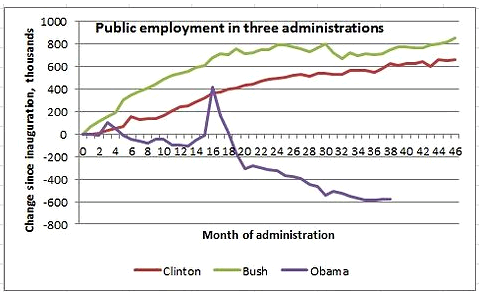
May 1 (NYT) — With all the focus on Europe’s sudden discovery that austerity doesn’t work, we shouldn’t lose sight of just how much de facto austerity we’ve done on this side of the Atlantic. Here’s a comparison of changes in government employment (federal, state, and local) during the first four years of three presidents who came to office amid a troubled economy:

That spike early on is Census hiring; once that was past, the Obama years shaped up as an era of huge cuts in public employment compared with previous experience. If public employment had grown the way it did under Bush, we’d have 1.3 million more government workers, and probably an unemployment rate of 7 percent or less.

Reinharts, Rogoff See Huge Output Losses From High Debt

A black mark on Morgan Stanley

Reinharts, Rogoff See Huge Output Losses From High Debt

By Rich Miller

April 30 (Bloomberg) — The U.S. and other developed economies with high public debt potentially face “massive” losses of output lasting more than a decade, even if their interest rates remain low, according to new research by economists Carmen and Vincent Reinhart and Kenneth Rogoff.

In a paper published today on the National Bureau of Economic Research’s website, they found that countries with debts exceeding 90 percent of the economy historically have experienced subpar economic growth for more than 20 years. That has left output at the end of the period a quarter below where it would have been otherwise.

“The long-term risks of high debt are real,” they wrote. “Growth effects are significant” even when debtor nations are able to borrow “at relatively low real interest rates.”

In spite of those dangers, the economists said they are not advocating rapid reductions in government debt at times of “extremely weak growth and high unemployment.”

Carmen Reinhart is a senior fellow at the Peterson Institute for International Economics in Washington, while her husband, Vincent, works as chief U.S. economist for Morgan Stanley in New York. Rogoff is a professor at Harvard University in Cambridge, Mass., and a former chief economist at the Washington-based International Monetary Fund.

Their paper looked at 26 separate episodes in 22 countries since 1800 in which central government debt exceeded 90 percent of gross domestic product for at least five years. Advanced economies with such big liabilities grew on average 2.3 percent a year, compared with 3.5 percent in the lower debt period, they said. The high-debt period on average lasted 23 years, according to the study.

U.S. Debt

Gross federal U.S. debt has exceeded 90 percent of GDP for the last two years and is projected to remain above that level at least through 2017, according to the White House’s Office of Management and Budget.

Publicly-held debt, which excludes debt held by the Social Security Trust Fund and other government agencies, was 68 percent of GDP on Sept. 30, 2011, the OMB data show.

The lower level of publicly held debt should not be a source of comfort to the U.S. and other heavily-indebted nations because such trust funds generally are “woefully underfunded,” the Reinharts and Rogoff argued in their paper.

They also cautioned the U.S. and other developed nations against taking solace from low levels of interest rates on their debt. The yield on the 10-year U.S. Treasury note stood at 1.92 percent at 3:15 p.m.

‘Warning Signal’

“Contrary to popular perception, we find that in 11 of the 26 debt overhang cases, real interest rates were either lower or about the same as during the lower debt/GDP years,” the economists wrote. “Those waiting for financial markets to send a warning signal through higher interest rates that government policy will be detrimental to economic performance may be waiting a long time.”

Greece and Italy were the two countries in the study that experienced the most instances in which their debt exceeded 90 percent of GDP.

The economists warned that nations with excessive government liabilities now may even fare worse than history suggests because their private and foreign debts also are large.

“The fact many countries are facing ‘quadruple debt overhang problems’ — public, private, external and pension — suggests the problem could be worse than in the past,” they said.

Carmen Reinhart and Rogoff are co-authors of the book “This Time is Different: Eight Centuries of Financial Folly.” Carmen’s husband, Vincent, is a former director of the monetary affairs division at the Federal Reserve in Washington.

U.K. Factory Index Falls More Than Forecast on Export Slump

As expected, the export channel doesn’t look to be able to save Europe this time around. That leaves only domestic demand and net public sector spending via ‘borrowing to spend’ to do the trick, which doesn’t look all that promising either.

U.K. Factory Index Falls More Than Forecast on Export Slump

By Scott Hamilton

May 1 (Bloomberg) — A U.K. factory index fell more than economists forecast in April and U.S. manufacturing probably slowed as the world economy stayed reliant on China to drive economic growth.

The gauge of British factory output dropped to 50.5 from 51.9 in March, London-based Markit Economics said today. The median forecast of 27 economists in a Bloomberg News survey was for a decline to 51.5. The Institute for Supply Management’s U.S. index probably eased to 53 last month from 53.4, according to the median of 77 forecasts. A Chinese purchasing managers’ index rose to 53.3 from 53.1. A level above 50 indicates growth.

Riksbank Says Considering Establishing Krona Bond Portfolio

Huh???

Riksbank Says Considering Establishing Krona Bond Portfolio

By Jonas Bergman

April 27 (Bloomberg) — Sweden’s Riksbank is considering building a portfolio of krona bonds that would help it enact crisis measures faster, officials at the bank’s monetary and financial stability departments said in a commentary.

While the bank’s systems have worked well both in normal times and during the financial crisis, that doesn’t guarantee future success, Heidi Elmer, Peter Sellin and Per Aasberg Sommar said in a commentary on the bank’s website today.

“The Riksbank is therefore now reviewing how to further improve preparedness in the framework in order to be able to deal with future crises that may require different measures,” they wrote. “Acquiring a bond portfolio in Swedish kronor once again could ensure that the Riksbank has the systems, routines and knowledge needed to be able to take extraordinary measures at short notice in the future.”

The Swedish central bank has cut interest rates twice since December to prevent the largest Nordic economy from falling into a recession after output shrank at the end of 2011. The bank left the benchmark repo rate at 1.5 percent at this month’s meeting.

Riksbank crisis measures during the financial turmoil that started in 2007 helped the country achieve the biggest economic rebound in the European Union in 2010.

Something to note…

Spotted by Sean Keane

It was also interesting to note an easily overlooked article in Greek online newspaper Kathimerini saying that the European Commission is pressuring the European Investment Bank to withdraw a clause that it recently inserted into its new loan contracts that were signed with a number of Greek companies. The new clauses allow for the repayment of debt in Greek Drachma instead of Euro, should the Greeks decide to leave the EU at some point in the future. Clearly the EC is displeased at one of the foremost European lending institutions legally embedding the possibility of something happening which the Commissioners all insist is impossible. Commissioner Olli Rehn reportedly called the clauses “unfortunate and incomprehensible2”. A cynic might note that the EIB has taken an appropriately commercial and realistic approach to the loans, free of the politics that surround the EC.

Brussels to relax 3pc fiscal targets as revolt spreads

Yes, larger deficits are needed to support aggregate demand at desired levels.

However, the problem is the national govts are currently like US states and as such are revenue constrained.

So relaxing the deficit limits without some kind of ECB funding guarantees can cause markets to abstain from funding the nat govts.

Said another way, without the ECB the euro members are currently deep into ‘ponzi’.

Brussels to relax 3pc fiscal targets as revolt spreads

By Ambrose Evans-Pritchard

The European Commission is preparing a major shift in economic strategy, fearing that excessive fiscal tightening will inflict unnecessary damage on a string of eurozone countries.

OECD Head Urges Japan To Fix Finances, Hike Consumption Tax

It’s globally unanimous.

And it’s moving the euro zone closer to the waterfall.

OECD Head Urges Japan To Fix Finances, Hike Consumption Tax

By Kelly Olsen

April 25 (Bloomberg) — The head of the Organization for Economic Cooperation and Development said Wednesday that Japan must get its fiscal house in order, and he supports the government’s plan to raise the consumption tax to help achieve that.

Doubling the consumption tax to 10% by 2015 “is an important step,” Angel Gurria, head of the Paris-based organization, said in a speech.

The government of Prime Minister Yoshihiko Noda submitted legislation to parliament in March that would raise the consumption tax from the current 5% in two stages. But the plan has come under fierce criticism from opposition parties and members of Noda’s own ruling Democratic Party of Japan who fear it may damage the fragile economic recovery.

Gurria said the fiscal situation requires action, pointing out that while Japan’s public debt, at more than 200% of gross domestic product, has so far been manageable given relatively low interest rates, that may not always be the case.

“Japan is vulnerable to a run-up in interest rates,” Gurria said. He said the debt situation is in “uncharted territory.”

During a question-and-answer session, Gurria was asked if he would favor raising the consumption tax before 2014 by one percentage point a year.

“I think it makes sense,” he said, noting it would start generating revenue faster, could be combined with adjustments to other taxes, and suits the gradual nature of Japan’s politics. “I think it has less risks than the present formulation,” he said.