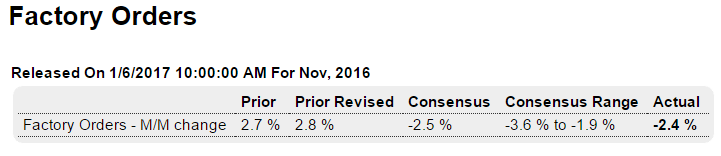
Payrolls, Factory orders, Foreign trade, Retailers, Boston rents

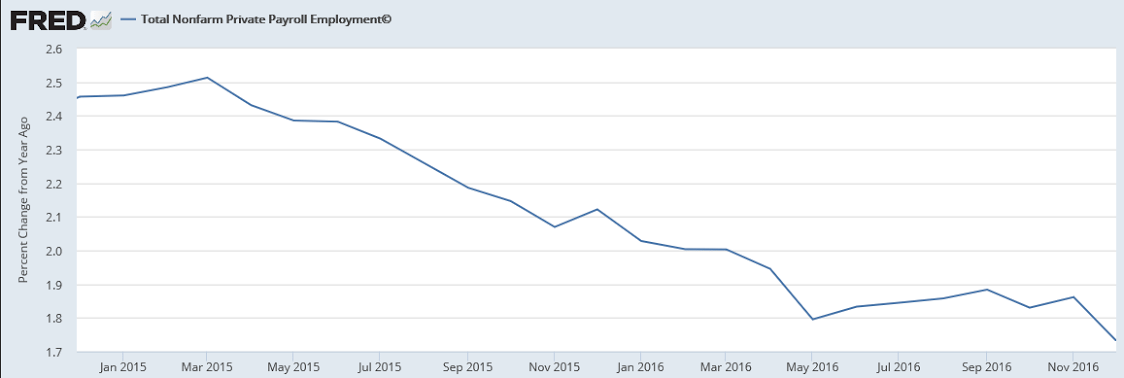
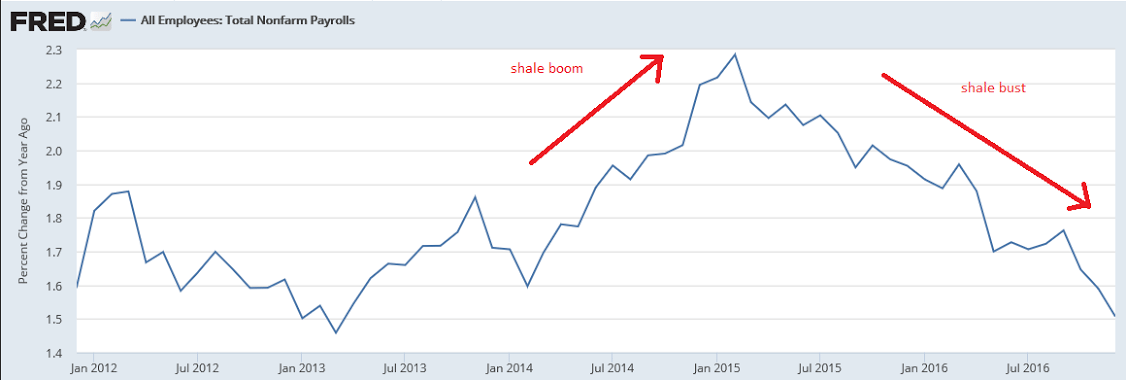
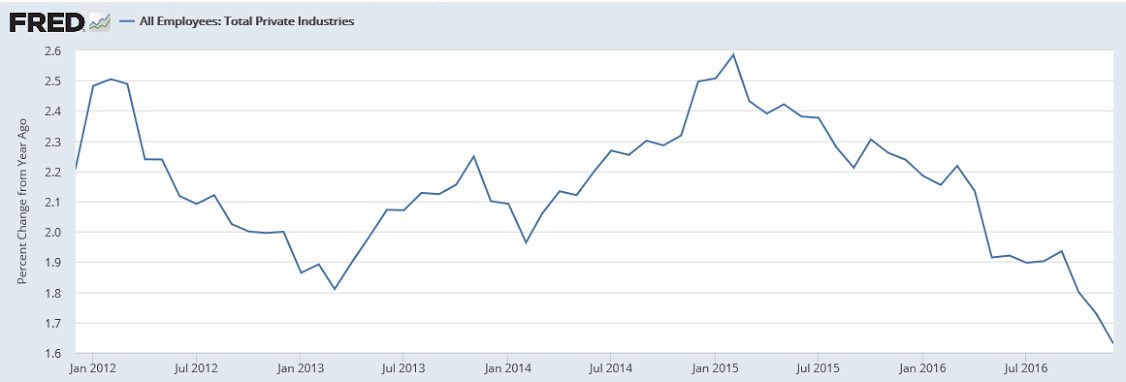
The year over year chart continues its 2 year deceleration unabated. No telling where it ends but the end will coincide with increased deficit spending, private or public:
10601

Highlights

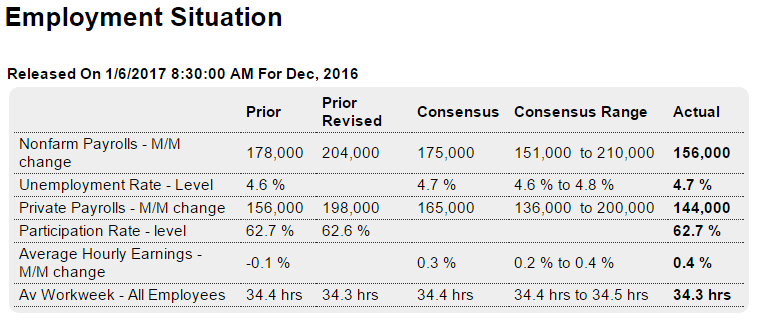
Job growth may be the new economic policy but wage inflation may be the risk. Nonfarm payrolls rose a lower-than-expected 156,000 in December but, in an offset, revisions added a net 19,000 to the two prior months (November now at 204,000 and October at 135,000).

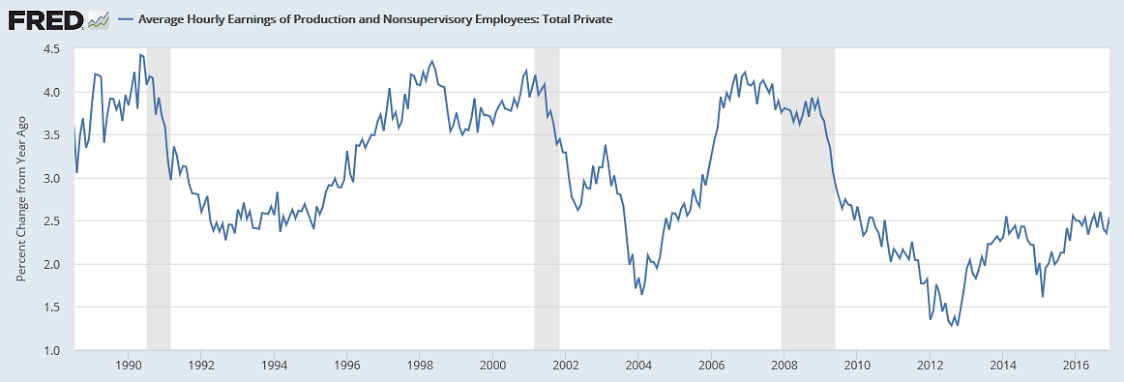
But the big story is another outsized 0.4 percent rise in average hourly earnings, the second such gain in three months. The year-on-year rate is now at 2.9 percent which is a cycle high. A 3 percent rate and above is widely seen as feeding overall inflation.

The unemployment rate is very low though it did tick up 1 tenth to 4.7 percent. Keeping the rate down is low labor participation, at 62.7 percent with the prior month revised down 1 tenth to 62.6 percent.

Sector payrolls show another sizable gain for trade & transportation, up 24,000, and a rare gain for manufacturing, up 17,000. Government added 12,000 jobs while a 15,000 rise for professional & business services is not only on the low side for this reading but includes a 16,000 decline in temporary help, a subcomponent that is especially sensitive to changes in labor demand.

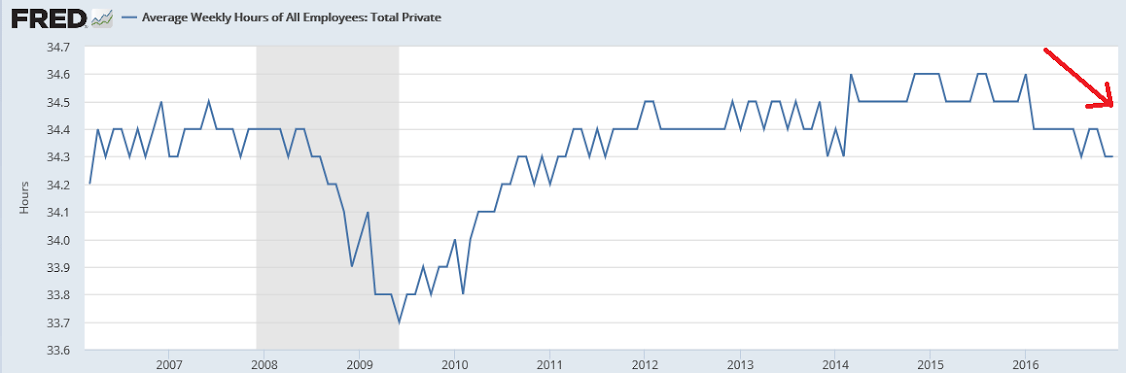
There are hints of slowing job growth in this report but the wage pressure underscores the Federal Reserve’s expectations for three rate hikes during the year and raises the question whether the labor market, even before new stimulus under the incoming administration, is at an inflationary flashpoint. Other details include a lower-than-expected workweek, at 34.3 hours in December which is unchanged from a downwardly revised November.
10602

10603
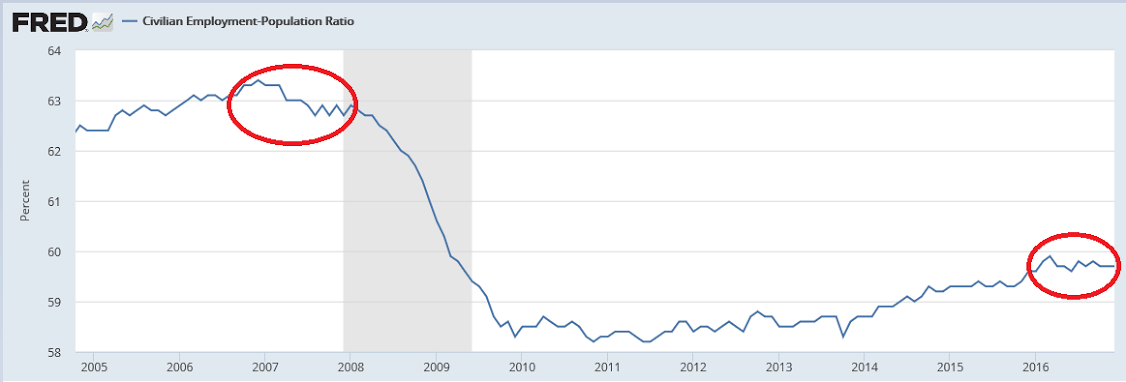
Jobs no longer exceeding up with population growth:
10604
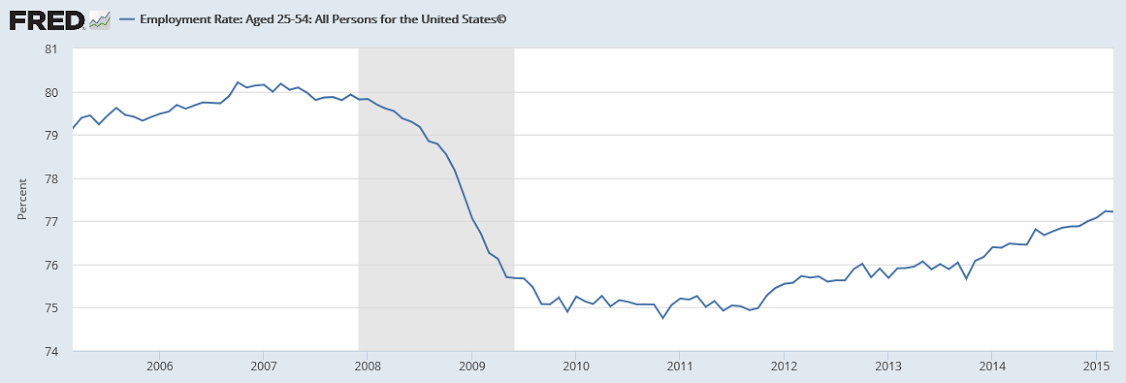
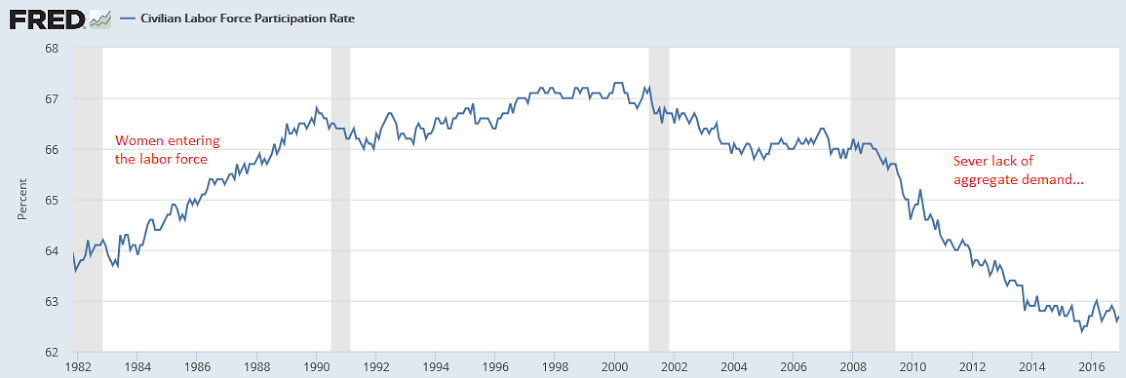
Fewer ‘demographic’ effects here, though the average age of this group has gone up some over time:
10605

10606
You can see that historically wage growth remains depressed, and in any case increased wages are more likely to reduce gross profit margins than to increases consumer prices:
10607
Decelerating back to recession levels:
10608

10609
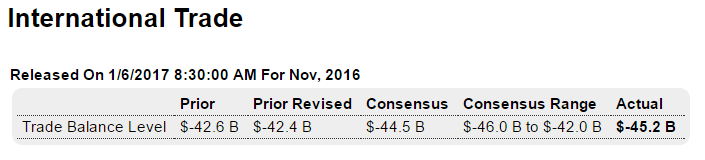
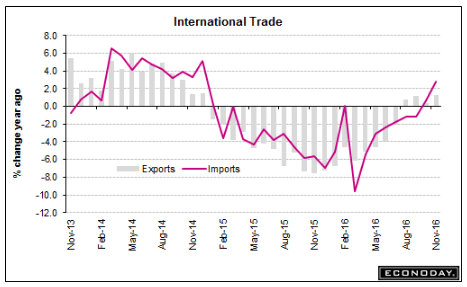
And, as previously discussed, I expect this get a lot more negative:
10610

Highlights

The nation’s trade deficit widened sharply in November, to a higher-than-expected $45.2 billion and well up from a revised deficit of $42.4 billion in October. Exports fell 0.2 percent in November while imports rose 1.1 percent.

The import side shows a significant rise in oil imports, up nearly $1 billion in the month to $9.9 billion (reflecting both an increase in volume and price). Petroleum is a key element for industrial supplies where imports rose $2.3 billion. Other readings are little changed with capital goods imports ticking lower and underscoring the nation’s lack of investment in new equipment.

And capital goods lead the downtick in exports, down $1.8 billion to underscore the lack of global investment in new equipment. Exports of civilian aircraft, which are a subcomponent of capital goods, fell $1.3 billion in the month. Exports of cars and of food products also moved lower, offset by a petroleum-related rise in industrial supplies.

By country, the deficits with Canada (-$2.6 billion) and the EU (-$14.8 billion) both widened sharply while the deficits with China (-$30.5 billion) and Mexico (-$5.8 billion) both narrowed. The deficit with Japan (-$5.9 billion) was little changed.

Today’s report represents a downgrade for fourth-quarter GDP which more and more will depend on how strong consumer spending was during the holidays. Watch next Friday for the retail sales report and the first definitive indication on December consumer spending.
10611

Retail sector tanks as Macy’s and Kohl’s get crushed by weak holiday sales

By Fred Imbert

Jan 5 (CNBC) – Average Boston-area rent falls for the first time in almost 7 years

ADP, ISM non manufacturing

While surveys remain Trumped up, at least so far when it comes to actual numbers the deceleration continues, and can’t reverse without a commensurate increase in deficit spending, public or private:

10501

Highlights

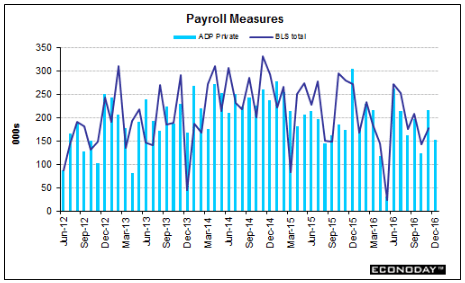
ADP is pointing to a softer-than-expected employment report on Friday. ADP’s estimate for private payrolls is 153,000, a still respectable level of growth but noticeably below the Econoday consensus for 172,000. Private payroll growth in Friday’s December employment report from the government is expected to come in at 165,000 with total nonfarm payroll growth at 175,000.

10502

10503

10504

Highlights

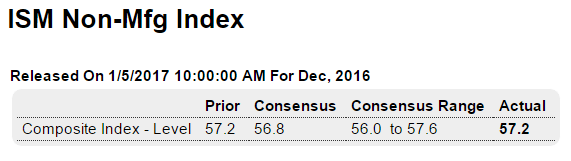
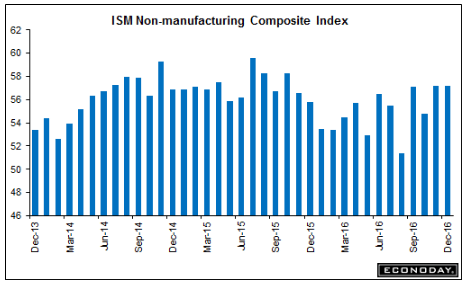
Hiring is less active but new orders are unusually strong in December’s ISM non-manufacturing report where the index, at 57.2, matches November as 2016’s best. New orders are up 4.6 points to 61.6 to signal the strongest rate of monthly growth since the middle of last year. Business activity is also very strong, at 61.4.

But other readings show less strength. Employment is down 4.4 points to 53.8 but is still safely over breakeven 50 and is actually the third best reading of 2016. Backlog orders, however, are not above 50, at 48.0 for a 3.0 point loss that will not raise demand for new employees. And though new orders are strong, export orders slowed by 4.0 points to 53.0 and a 4-month low

10506

Car sales, NYC real estate

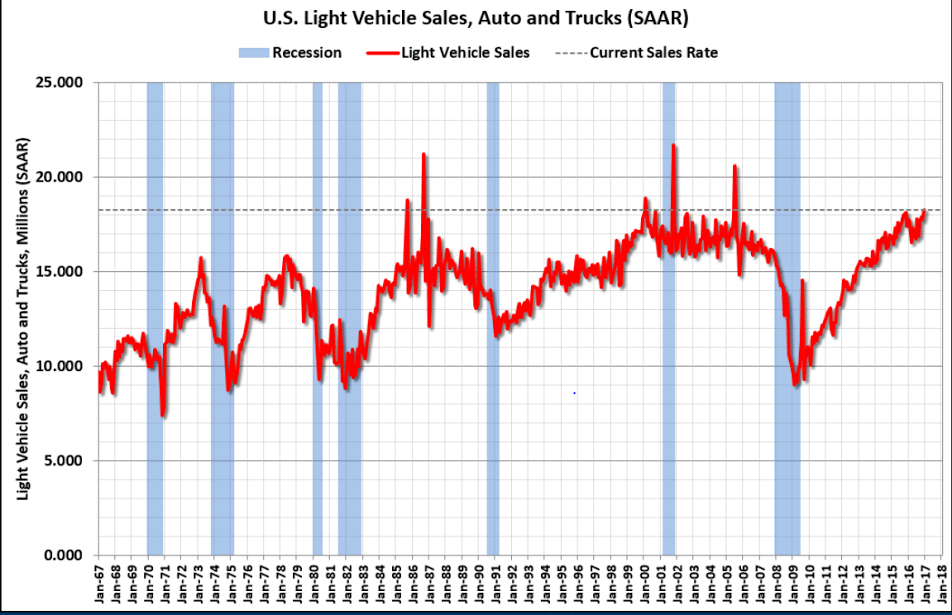
Car sales better than expected, but the annual rate of growth has slowed and 2016 was up less than .5% vs 2015 year. So if vehicles added less than the year before, something else has to add more than it did the year before, or the annual GDP growth slowed:

Sales for 2016 hit a new annual record.

Sales in 2016 were at 17.465 million, up from the previous record of 17.396 million set last year.
Read more at http://www.calculatedriskblog.com/#A7zlBSb83MtA17vJ.99

10406a

Manhattan’s luxury market softened in the fourth quarter, and it isn’t likely to pick up anytime soon

By Robert Frank

Jan 3 (CNBC) — Manhattan real estate sputtered in the fourth quarter, as inflated prices and rising inventories continued to weigh on the high-end market.
The number of residential real estate sales in the borough fell 4 percent year over year in the quarter, to 2,864, according to Douglas Elliman Real Estate and Miller Samuel. While that dip was substantially better than the steep drop in the third quarter, when sales plunged 19 percent on the year, it showed continued softness in the Manhattan market.

Average sale prices notched up 8 percent, to $2.1 million. Median sale prices fell 9 percent, to $1.1 million. Yet even as prices in the luxury market continued to march higher, the number of sales for those properties dipped 3 percent over last year, to 289.

Mtg purchase apps, Redbook Retail sales, Restaurant sales

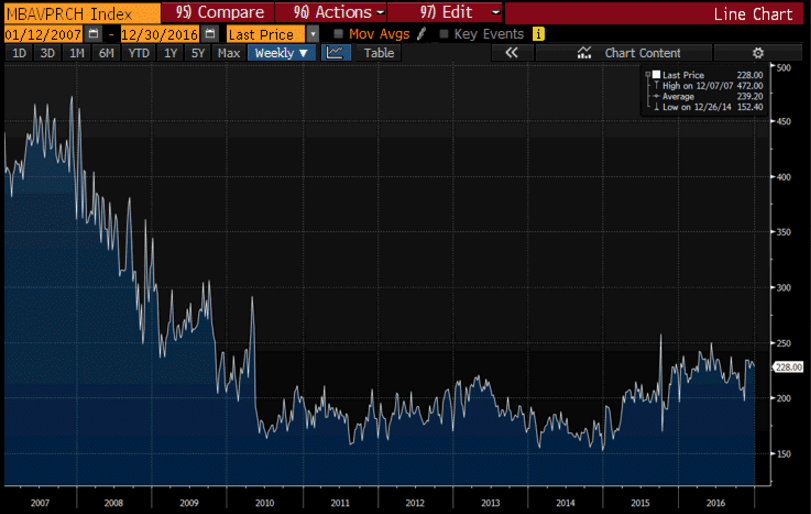
Purchase apps now down year over year, and less than half of what they used to be pre crisis:

10401

Highlights

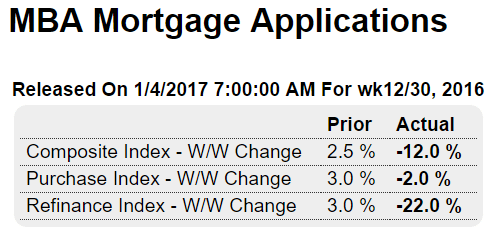
Purchase applications for home mortgages fell 2.0 percent on a seasonally adjusted basis in the December 30 week compared to the level 2 weeks earlier, which was the last prior reading due to the Christmas holiday. The refinance index was down a much sharper 22 percent compared to two weeks ago, as higher interest rates continue to deter refinancing by homeowners to a greater extent than the mortgage applications of home buyers. However, the unadjusted purchase index was down 41 percent compared with two weeks ago, pulling down the year-on-year change into negative territory for the first time in 2016 at minus 1 percent. The average interest rate on 30-year fixed rate conforming mortgages ($417,000 or less) halted its steep climb higher and at 4.39 percent was down 6 basis points from the 4.45 percent recorded in the prior week, the highest rate since May 2014.

10402
A double mini spike up as happened a year ago, but in general growth remains depressed:

10403

Restaurant industry ends 2016 on a sour note

By Sarah Whitten

Jan 4 (CNBC) – While the restaurant industry struggled with weak sales and traffic throughout 2016, it seems that December, in particular, had the worst same-store sales growth of the year.

10404

Construction spending, Manufacturing surveys, China

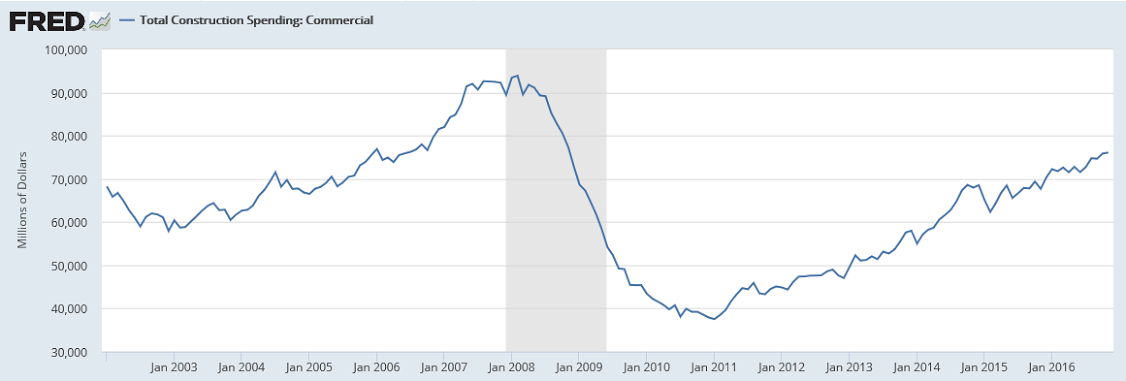
A bit of a bump up going into year end. Could be about expiring tax breaks as has happened in prior years:

10301

Highlights

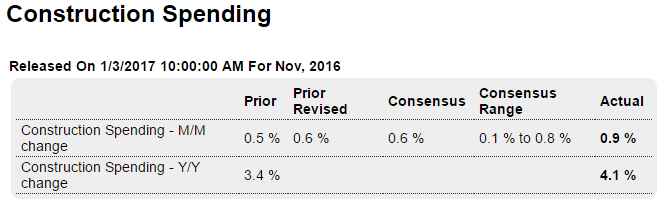
Construction had been lagging through most of 2016 but, like the factory sector, appears to have picked up steam going into year-end. Spending rose 0.9 percent in November which just tops Econoday’s high estimate and is the best reading since June.

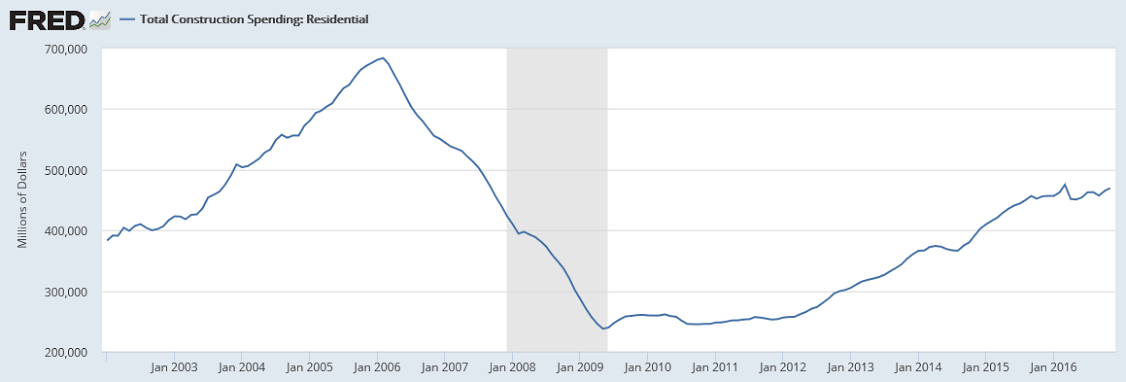
Residential spending rose 1.0 percent in the month on top of October’s 1.6 percent gain. The gain here is concentrated in single-family homes which offset a monthly dip for multi-family units which otherwise have been leading the residential sector. Home improvements added to the spending in November.

Non-residential spending was also strong, up 0.9 percent which most categories showing gains led by office construction and transportation construction. Public spending was also solid including a 3.1 percent monthly jump in Federal spending.

The breadth of gains is most impressive in this report, one that will give a lift to fourth-quarter GDP estimates.

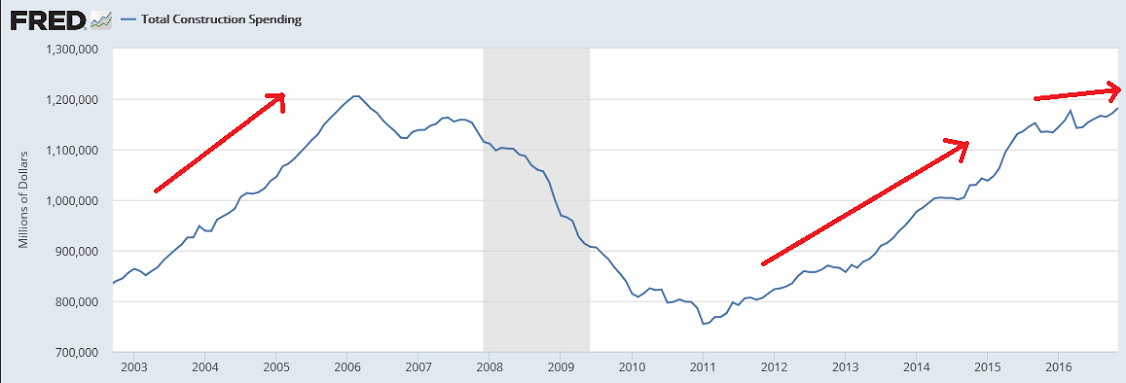
These numbers aren’t inflation adjusted, so in real terms spending is still far below what it was. And during this cycle construction spending grew at a slow pace than prior cycles and seems to have flattened out:

10302

10303

10304
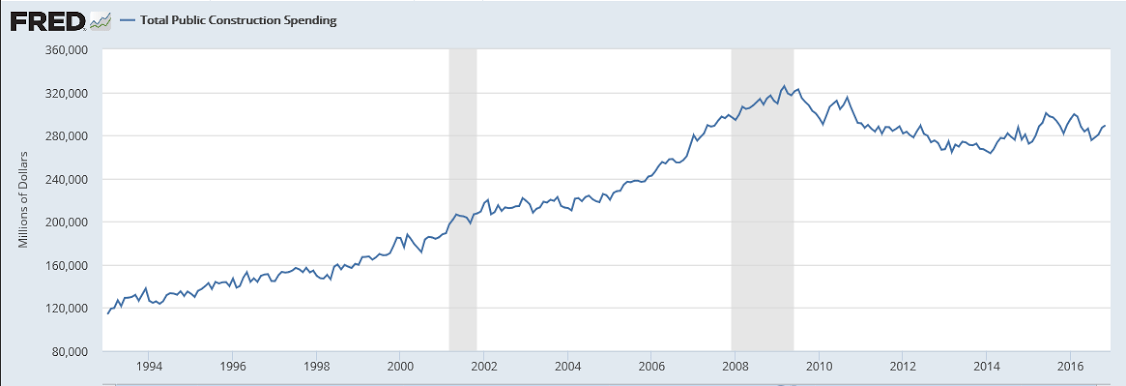
Public construction spending for all practical purposes has been flat nominally, and down when adjusted for inflation:

10305
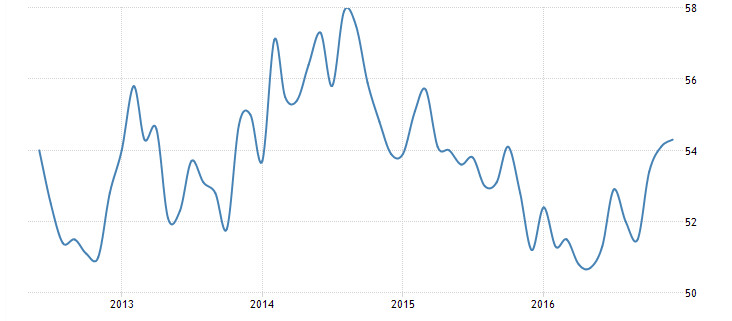
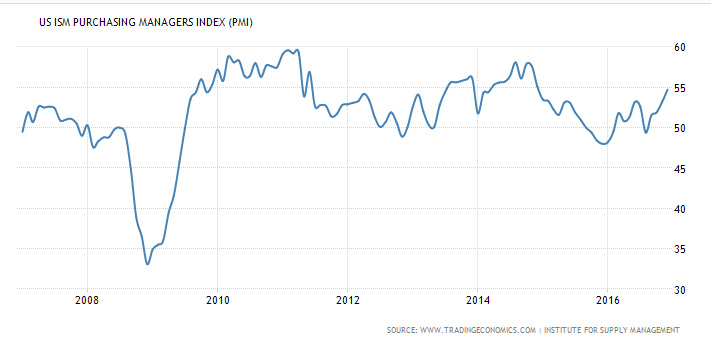
Manufacturing surveys have stabilized at modest levels of growth as previously discussed, and possibly reflecting some post election euphoria:

Market PMI:

10306
ISM manufacturing

10307

Growth in China’s factories, services slows in December: official PMI

Dec 31 (Reuters) — The official PMI stood at 51.4 in December compared with 51.7 in November. Factory output slowed in December, with the sub-index hitting 53.3 compared with 53.9 the previous month. Total new orders were flat at 53.2, logging the same as in November, while new export orders fell to 50.1 from 50.3. Jobs were again lost, with the employment sub-index sitting at 48.9, compared to 49.2 in November. A sub-index for smaller firms fell, and performance for larger companies also worsened. The official non-manufacturing Purchasing Managers’ Index (PMI) stood at 54.5 in December, down from 54.7 in November.

China Caixin manufacturing PMI climbs to 51.9 in December, fastest improvement since January 2013

Jan 2 (CNBC) — In December, the Caixin PMI reading came in at 51.9, up from November’s 50.9. “A further rise in production at Chinese manufacturers supported the higher PMI reading in December. Notably, the rate of output growth accelerated to a 71-month high, with a number of panelists commenting on stronger underlying demand and new client wins,” the Caixin data statement said. “Data indicated that improved domestic demand was the key driver of new business growth, however, as new export sales were unchanged in December.”

Credit check, Publication

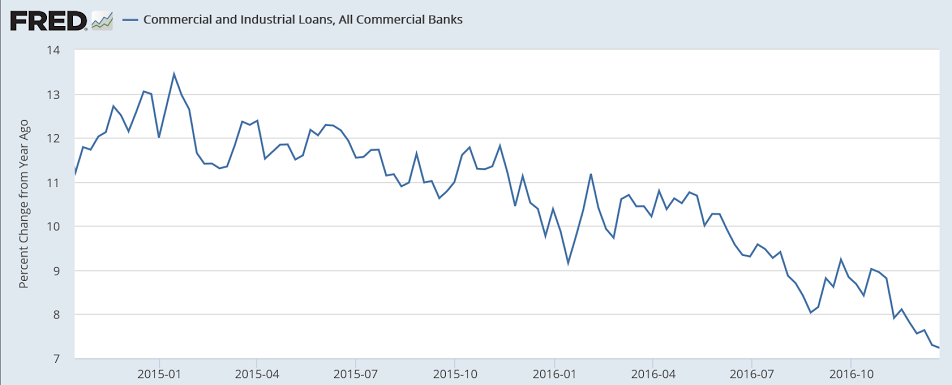
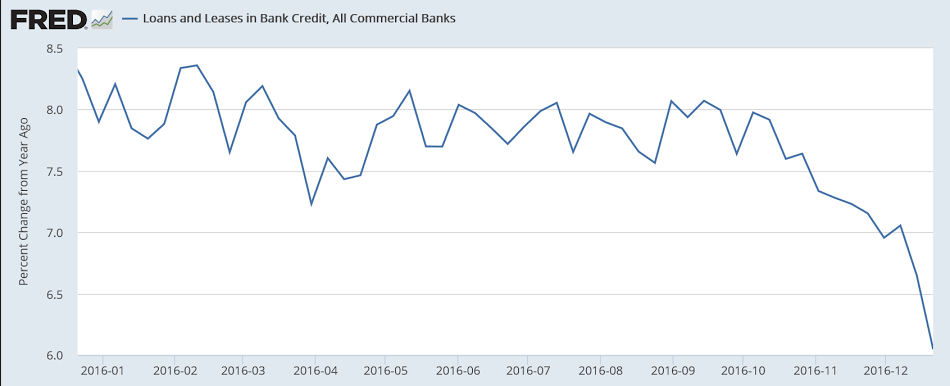
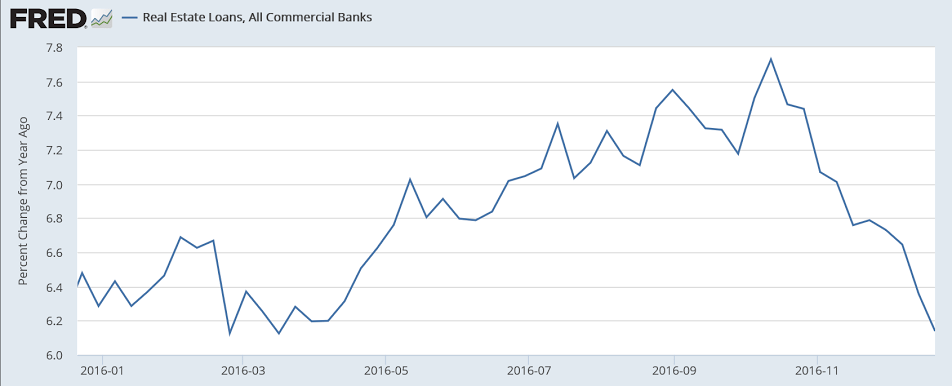
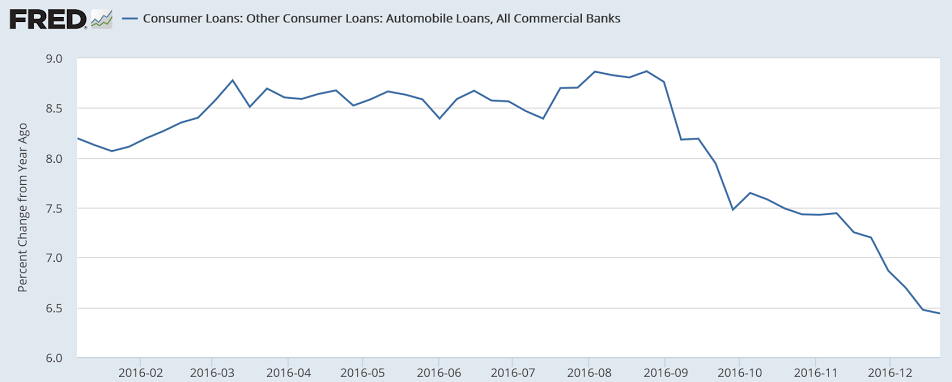
The now two year deceleration continues:

123102

123103

123104

123105

First time published in a ‘mainstream’ economics journal:

Dear Prof. Silipo & Prof. Mosler,

I am happy to inform you that the Board of Editors of the Journal of Policy Models, upon recommendation from 4 referees, has approved the publication of your study:

Maximizing Price Stability in a Monetary Economy

Regards,

Sabah Cavallo
Editorial Assistant
Journal of Policy Models

www.econmodels.com

Putin, Maryland business activity

Best to all for the New Year, and may our trumped up expectations eventuate!

And last chance to make a 2016 PMC donation. Over $47 million raised, and the same $47 million donated. All costs are sponsored so your donation goes directly to Dana Farber for research!

click here to donate:
http://profile.pmc.org/WM0015

Why should he? They spend lots of $ there…
Putin says Russia will not expel anyone in response to US sanctions

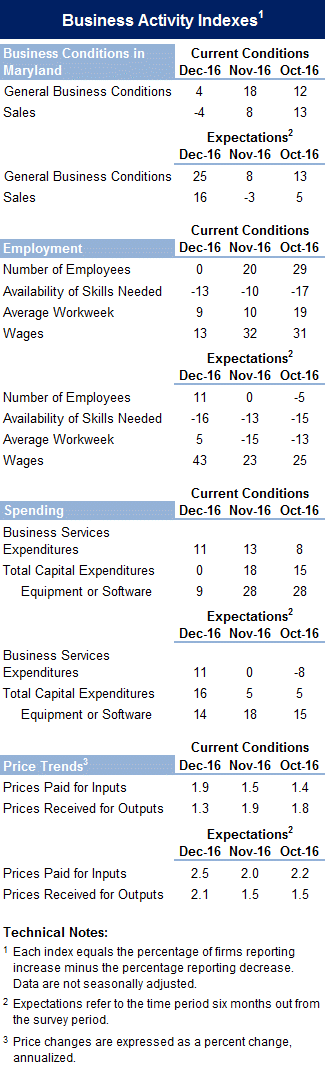
Expectations Trumped up, but current conditions taking a turn for the worse:

Dec. 29, 2016
Business Activity Soft in December; Expectations for Future Conditions and Hiring Pick Up

123101

Trade, Inventories, Proposals before Congress

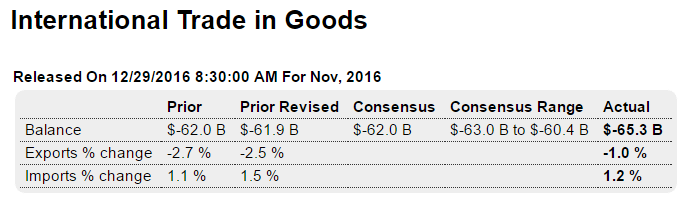
As previously discussed, exports are falling and imports climbing, with lots more to go:

122901

Highlights

Trade looks to be a major negative that will be holding down fourth-quarter GDP. The advance trade deficit in goods widened sharply for a second straight month in November, to $65.3 billion following a revised $61.9 billion deficit in October that was nearly $5 billion higher than the last month of the third quarter, September.

Exports have been very weak so far this fourth quarter, down 1.0 percent in November following October’s 2.5 percent shortfall. Food exports have been especially soft as have vehicle exports, and capital goods exports fell very sharply in the latest report.

Widening the gap have been sharp increases in imports, up 1.2 percent on top of October’s upward revised 1.5 percent increase. Imports of industrial supplies posted a very sharp increase in November as did food imports. Most other readings on the import side are narrowly mixed.

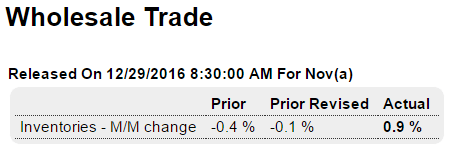
Slowing sales growth caused inventories to increase, which leads to production cuts, as per the cuts in automobile production previously discussed:
122902

Highlights

Wholesale inventories jumped a preliminary 0.9 percent in November following an upward revised 0.1 percent decline in October. Retail inventories also jumped, up 1.0 percent in November following an unrevised 0.4 percent decline in October. The build in wholesale inventories is split evenly between durable and nondurable goods with the build on the retail side concentrated in vehicles. The increases in this report are a surprise and, though a positive for the fourth-quarter GDP calculation and an offset to this morning’s widening in the goods trade gap, will revive talk of unwanted inventories.

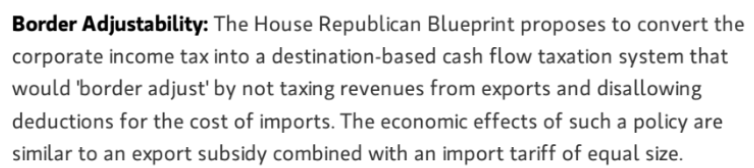
All of this ties into proposed trade policies designed to reduce imports and increase exports, for the further purpose of increasing domestic output and employment:

122903

The questions begin with what this would do to the value of the $US. Mainstream theory concludes that, all else equal, the $ would appreciate to offset the price effects of the ‘border adjustments’. While I agree $ appreciation would offset the price effects, given the forces currently at work I don’t see them pushing things in that direction.

First, mainstream theory would say the current trade balances should ‘fundamentally’ be driving the dollar lower. The US has a large and growing trade deficit, while the euro zone has a large and growing trade surplus, with China also in surplus and Japan working its way back to surplus, etc.

However, while trade has been ‘fundamentally’ working against the $, portfolio shifting, a ‘technical’ force, has been going the other way. (Personally I often use the term ‘savings desires’ to indicate the various desires to hold financial assets of a particular currency.) As previously discussed, for example, the euro area had ‘capital outflows’ of over 500 billion euro over the last year or so, which means portfolio managers of all types with euro financial assets sold them and switched to financial assets denominated in other currencies, such as $US, yen, and Swiss francs (with the Swiss National Bank then selling maybe half of the euros they bought and buying $US). This would be analogous to a crop failure such as the corn crop being reduced by drought, for example. The drop in supply would be a force that would put upward pressure on the price of corn. However, is a company with a very large warehouse full of corn decided to sell it, that selling could dominate and drive the price lower, until the warehouse was empty. Only at that point would the effects of the crop failure dominate, and then drive the price higher.

So technicals (portfolio shifting) can overwhelm fundamentals (trade balances) for long periods of time until the technical force has run its course, and the warehouse is either empty or as low as the portfolio manager wants it to be. In fact, this time around, while the trade flows were presumed to reduce the US trade deficit via lower prices for imported oil, and therefore be supportive of the $, it didn’t work out that way, however, as lower oil prices were partially ‘offset’ by reductions of global income from the lower oil prices, which reduced US exports, and increasing US consumer related imports.

Second, I’m not comfortable with the idea that US export prices will go down if the revenues are no longer taxed. Prices in this case are ‘world prices’ and to the extent the US exporters are ‘price takers’ I don’t see how a lower cost of goods will necessarily result in a drop in global prices any more than, for example, reducing income taxes on oil would cause the price of oil to fall. Yes, longer term, lower costs might bring out more supply, but that’s a different and much longer term story.

Nor do I see the quantities of US exports going up even if the proposed border tax policy results in a reduction in the price of US exports, given the general weakness of global demand. And more specifically, who would buy more US exports if prices were maybe 15% lower, for example? China? Japan? India? I don’t see it.

Third, I do see US imports softening with the proposed import tax, which means an equal reduction of $ revenues to the rest of the world, which means they are likely to buy fewer US exports. This is similar to what happened when the price of oil fell, and the US spent less buying oil from the rest of the world, and that reduction of $ income reduced the demand for US exports.

This is also a strong channel for a general reduction in global aggregate demand.

Now back to the value of the $. Yes, the border tax policy could over time reduce the US trade deficit and thereby be a fundamental force that works towards $ appreciation. However, current fundamentals- the growing US trade deficits- have been and are currently working in the other direction. So what I happening would be a moderation of the fundamental trade flows that have been and are currently working to weaken the $, even as the portfolio managers- the technical forces- continue to deplete their non $ currencies and buy $. And when those currency warehouses are depleted, current trade flows will take over and drive the $ down until they reverse, with the proposed border tax policy perhaps slowing the $’s fall.

To sum up, the way I see it is the current fundamentals overwhelmingly negative for the $, with the proposed border adjustment tax policy at best a much smaller force in the other direction.

Not to mention I’m categorically against it all for more macro reasons. Imports are real benefits and exports real costs, the difference being real terms of trade, which are optimized by running as large a trade deficit as possible. And any lack of aggregate demand for domestic goods and services that results in undesired unemployment if instead best addressed by a fiscal adjustment- lower taxes or more public spending. But in a world where that understanding doesn’t exist, we get these types of highly counterproductive proposals that ultimately and necessarily make things worse.

Post script:

Seems to me it’s just a matter of time before Trump proposes the US start buying and building foreign exchange reserves to counter the strong $, which he has said many time is about ‘currency manipulation’. With the general notion that his other proposals, such as repatriation, will also have strong $ biases, seems to me it’s just a matter of time until we see fx purchases proposed?

Redbook retail sales, Pending home sales, Stock buy backs, Spending, Japan stocks, Bank regulation, UN resolution

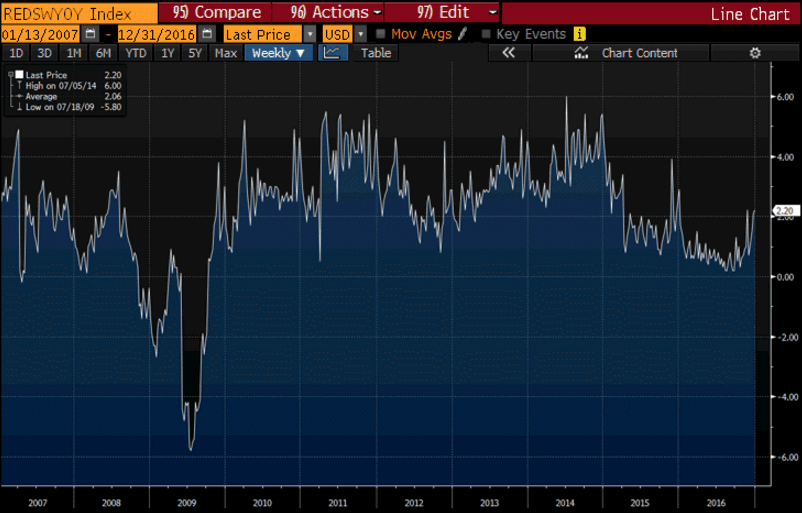
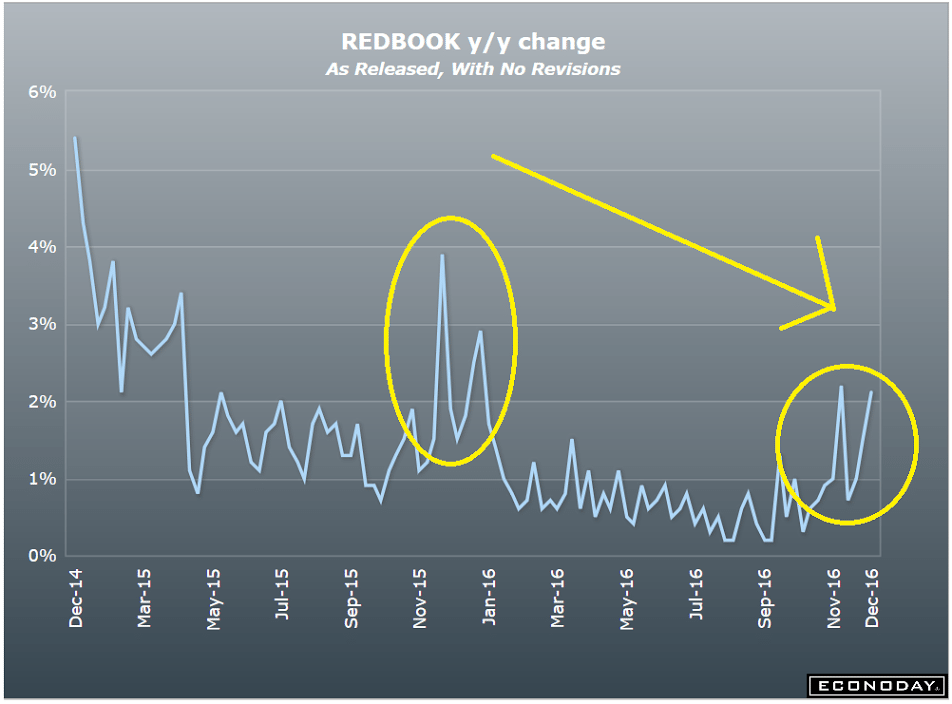
This is the time of year when year over year growth tends to increase, pulling up the rest of the year’s growth. But note how that increase has declined along with the general increases:

122801
Along with what looks to me like Trumped up expectations actual sales remain depressed:

122802

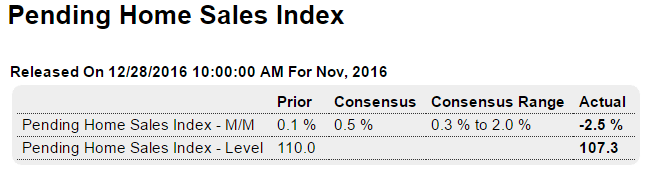
Any expected Trump bump in home sales didn’t materialize in contracts for homes signed in November.

Higher mortgage rates hit home sales, driving the National Association of Realtors Pending Home Sales Index down 2.5 percent in November from October, the NAR reported Wednesday. Analysts had forecast a 0.4 percent gain in the index, which is now 0.4 percent lower than a year ago and at its lowest level since January.

Stock buy backs are an alternative to paying dividends. On difference is that $ paid as dividends constitute income taxable at the going dividend tax rate, while the $ spent to buy back shares are only taxable to the sellers of the shares to the extent there are capital gains. So, just as an educated guess, with buy backs taxable income is reduced by perhaps 90%.

Also, repatriation may or may not happen, and it may or may not result in any change in investment, or even stock buy backs. All it does is reclassify income as domestic rather than foreign, which may or may not lead to further consequent actions by those corporations:

Surging Buybacks Say Stock Boom Isn’t Over

By Corrie Driebusch and Aaron Kuriloff

Dec 26 (WSJ) — Through Dec. 16, companies this month have stepped up their buybacks by nearly two-thirds over the same period last year, according to Goldman Sachs. Goldman forecast that S&P 500 companies will repatriate $200 billion of their $1 trillion in cash held overseas in 2017 and that $150 billion of those funds will be spent on share repurchases. From the start of 2009 to the end of September 2016, companies in the S&P 500 spent more than $3.24 trillion repurchasing shares, according to S&P Dow Jones Indices. In the first three quarters of the year, companies in the S&P 500 spent just over $400 billion on stock buybacks, down from the $426 billion in the same period last year, according to S&P Dow Jones Indices. For all of 2015, $572 billion went to buybacks.

Sales estimates have been revised a bit higher:

Last-minute spending surge lifts U.S. holiday shopping season

By Nandita Bose

Dec 28 (Reuters) — Brick-and-mortar sales in the week ending Dec. 24 rose 6.5 percent year-over-year after having fallen for the rest of the month, according to data from analytics firm RetailNext. Strong demand for furniture, home furnishings and men’s apparel from the start of November through Christmas Eve pushed U.S. retail sales up 4 percent, higher than the previously expected 3.8 percent, according to data from MasterCard’s holiday spending report. Craig Johnson, president of consultancy Customer Growth Partners, now estimates sales growth of 4.9 percent in November and December, up from his initial estimate of 4.1 percent.

The theory is something like “higher stock prices will help the economy”:

BOJ the top buyer of Japanese equities

Dec 25 (Nikkei) — According to data through Thursday, the value of the BOJ’s ETF purchases this year has topped 4.3 trillion yen, up 40% from 2015. Last year, the central bank bought more than 3 trillion yen worth of ETFs. While foreign investors sold more than a net 3.5 trillion yen worth of Japanese shares through Dec. 16, trust banks, including those commissioned by the Government Pension Investment Fund, bought a net 3.5 or so trillion yen worth of shares. This year, the BOJ increased its buying after doubling its annual ETF goal to purchase 3 trillion yen worth of the instruments. The value of the bank’s ETF holdings, based on purchase prices, is 11 trillion yen. Unrealized gains send the market value to 14 trillion yen.

Interesting but backwards, in my humble opinion. That is, if a foreign bank wants to give us $ we can’t pay back, and then the foreign bank fails, and we aren’t insuring their deposits, seems it’s their problem, not ours? In fact, it’s our gain?

Protectionist Walls Are Popping Up…Around Banks

By John Carey

Dec 26 (WSJ) — Financial regulators around the world have increasingly shied away from developing globe-spanning rules in favor of shoring up the financial system in their local purviews. Last month, the European Union proposed rules that would require big foreign banks to hold extra capital within EU borders, a step that echoes a recent U.S. rule for some large, non-U.S. banks. Rules with similar aims also have been rolled out in Switzerland and the U.K. The proliferation of the new rules demonstrate an increasing willingness of banking regulators to act independently of each other to protect the strength of their own financial systems.

Another view on the latest UN resolution the US didn’t veto:

The consequences of not vetoing the Israel resolution

Consumer confidence, Housing prices, Dallas and Richmond Fed manufacturing indexes, Moore comments

Apart from the Trumped up future expectations and the sagging retail sales reports, expectations remain elevated:

122701

Highlights

Consumer confidence shows no sign of slowing. The index is up 12.9 points since the November election in gains driven by older consumers. The level for December is 113.7 which is the highest reading since way back in August 2001.

But not all the indications from the December report point to monthly acceleration. December’s gain is centered in expectations, not in current conditions where the index, at 126.1, is still very strong but down from November’s 132.0. Within this, those saying that jobs are hard to get rose a noticeable 1.3 percentage points to 22.5 percent. This is a closely watched reading that will not heat up expectations for the December employment report.

The expectations index is very strong, up 11.1 points to 113.7. Those seeing more jobs in the months ahead jumped 4.9 points to 21.0 percent while the percentage of consumers expecting their incomes to increase rose 3.6 points to 21.0 percent. These readings are very solid.

But there is a curious negative in the report and that is a big drop in year-ahead inflation expectations, down 3 tenths to 4.5 percent which is very low for this reading. The better times that are coming will not be inflationary, at least according to the consumer.

No set of data have been showing the strength of the various consumer confidence readings. Yet this confidence didn’t help November consumer spending and how much it helped December’s spending has yet to be sorted.

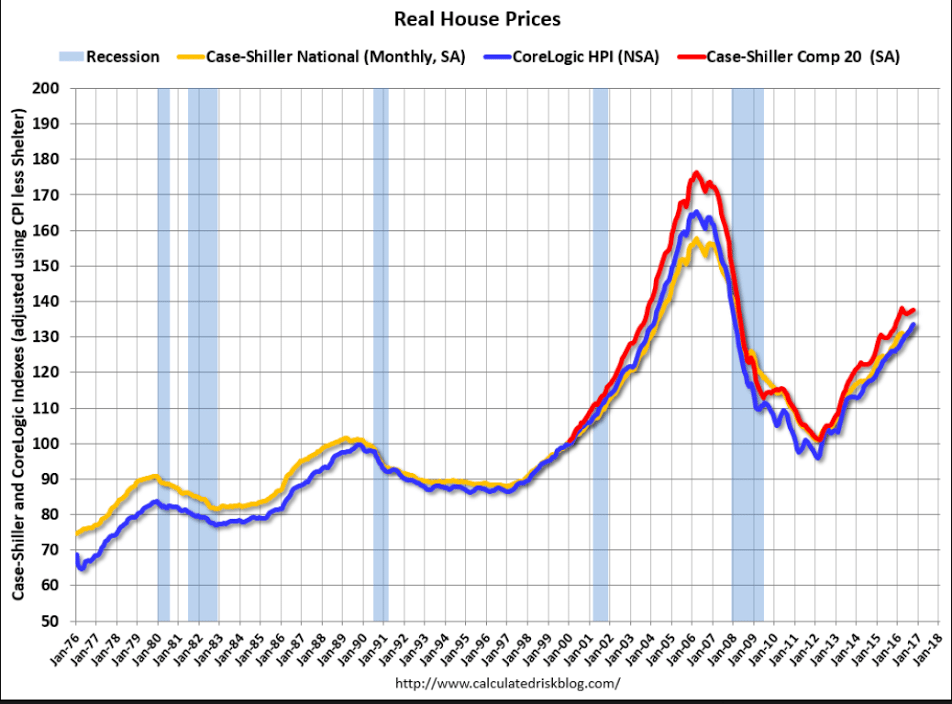
Adjusted for inflation housing prices have yet to recover:

122702
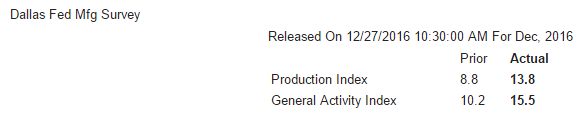
Stabilizing at the lower levels as previously discussed. The surveys indicate the number of firms reporting higher or lower numbers than the prior month. They don’t indicate magnitude:

122703

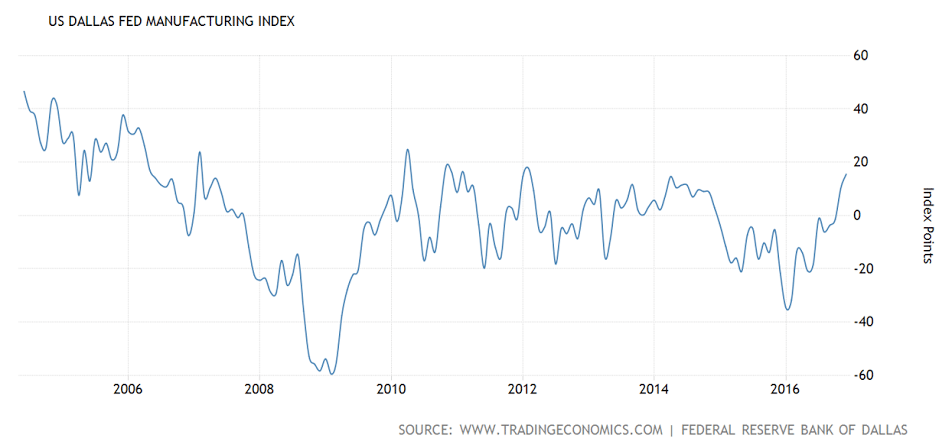
Highlights
The Dallas Fed report joins other advance surveys pointing to year-end strength for the factory sector. December’s readings are broadly higher including a 5.0 point gain for the production index to 13.8 and a 5.3 point gain for general activity to 15.5. Importantly, new orders are up 8.7 points to 7.3 for the first positive score since August.

Held down by weak foreign demand and generally weak demand for new equipment, the factory sector did not enjoy a good year. But momentum has definitely been appearing in what is good news for 2017’s outlook.

122704
Up mainly on Trumped up expectations and even those didn’t extend to capital expenditures:

122705

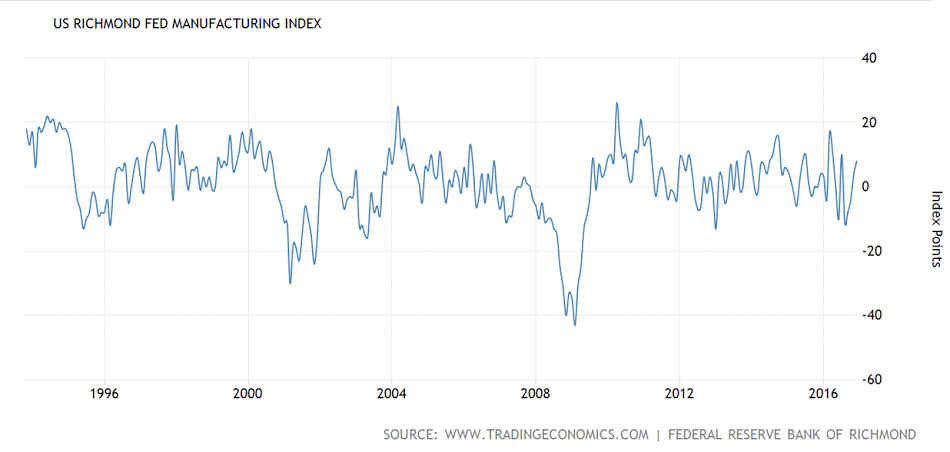
Highlights

Manufacturing activity in the Fifth district expanded further in December, with the Richmond Fed Manufacturing Index rising 4 points to 8, after coming out of contraction in November with a strong 8-point increase. The biggest gains were registered in the backlog of orders, which rose a sharp 20 points from minus 12 to 8, followed by shipments and capacity utilization, with each rising 11 points, from 1 to 12 and minus 1 to 10, respectively. Vendor lead time lengthened in the month, moving the index component up 5 points to 9. On the employment front, hiring softened somewhat, with the number of employees falling to minus 1 from 5, but the average workweek increased, rising from 4 to 12 points, and wage increases were more widespread, with the index rising from 16 to 19 points.

Looking ahead, manufacturers were optimistic about future business conditions, anticipating robust improvement in nearly all of the conditions during the next six months. The index for expected shipments and new orders rose to a very strong 45 from 41 and to 47 from 38, respectively. Producers anticipate more increases in hiring (from 15 to 22) along with broader wage gains (from 26 to 36) and longer workweeks (from 6 to 14) in the next six months. The only expectations component that declined was capital expenditures, which fell from 27 points to 20.

Prices of raw materials rose at an annualized rate of 1.23 percent, slightly more than in the previous month, but the pace of growth in prices received slowed to a 0.22 percent annualized rate.

2016 has been even more volatile but seems to have been averaging around 0:

122706

Just watched Steve Moore, chief Trump transition team economic advisor, on Fox, talking about ‘trillion dollar deficits as far as the eye can see’ etc. and the need for fiscal responsibility, as he then tied it into supporting the new cabinet as people who knew how to cut waste and fraud and able to run things on paygo, etc. And last week he was talking about how the $trillion of infrastructure spending would be large private infrastructure like pipelines and refineries, etc. to be encouraged by govt. policy, rather than govt. spending per se.

Yes, private sector deficit spending for said capex ‘counts’ just as much as govt. deficit spending, but this kind of effort to create incentives won’t happen overnight, and won’t kick in overnight, and in any case $1 trillion over 10 years is only $100 billion per year or about .5% of GDP per year.

Also, their spending cuts ‘to pay for it all’ will be a force in the other direction. And their proposed tax cuts have far lower multiples than their proposed spending cuts.