Chain store sales, Saudi output and pricing, Publication notice

More weak hard data:

20201

Highlights

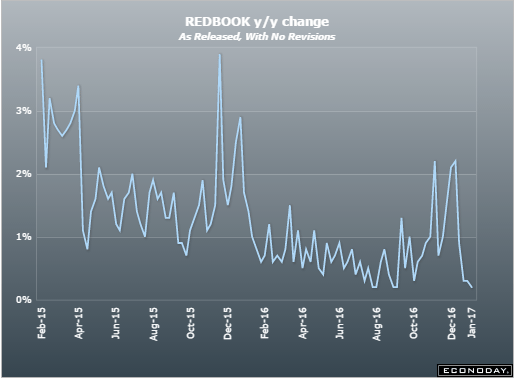
Chain stores are reporting mostly lower sales rates in January than December, in line with Redbook data and hinting at possible trouble for the ex-auto ex-gas reading of the January retail sales report. Looking at the total retail sales report, unit auto sales proved very soft compared to December (data released yesterday) though gasoline stations likely got a January lift from a moderate increase in prices. Yet gasoline makes up only a small part of retail sales which on net, and despite very strong readings for consumer confidence, look to have underperformed during January.

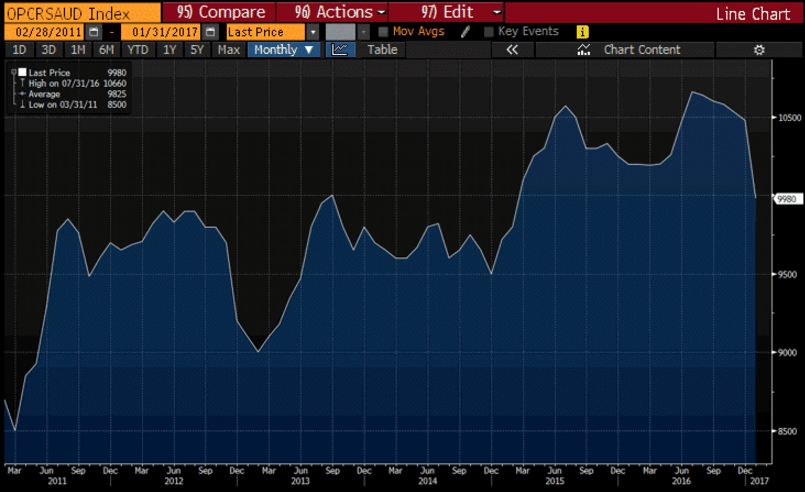
Saudi output down, maybe due to a net drop in residual demand globally as new production came online:

20202
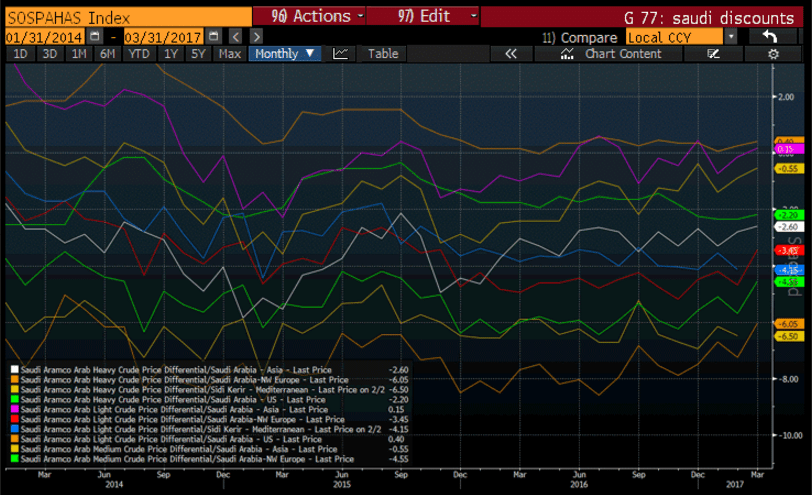
Looks like Saudi policy is now to push prices higher:

20203

‘Maximizing Currency Stability in a Market Economy’ that I co authored with Professor Damiano Silipo is now posted online. This could be the first time an ‘MMT’ author has been published in a ‘mainstream’ economics journal? The download costs $35- can’t say it’s worth anywhere near that much… ;)

We are pleased to inform you that the final corrections to your proofs have been made. Further corrections are no longer possible. Your article is now published online at:

http://authors.elsevier.com/sd/article/S0161893817300017

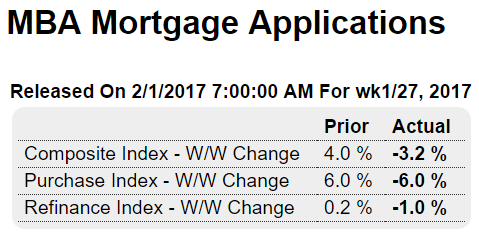
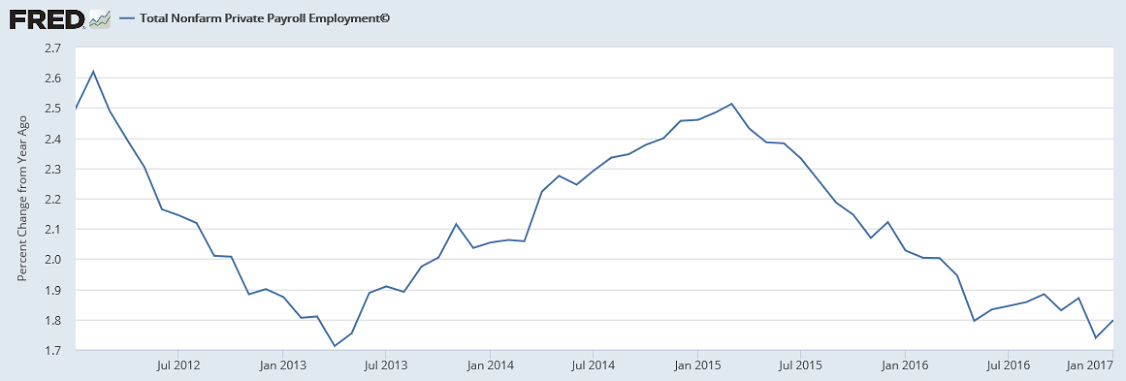
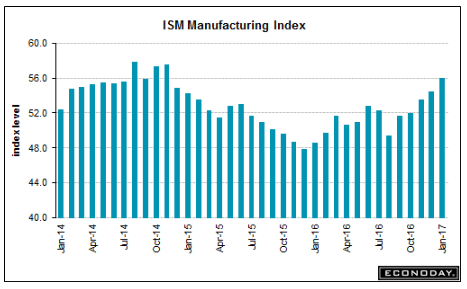
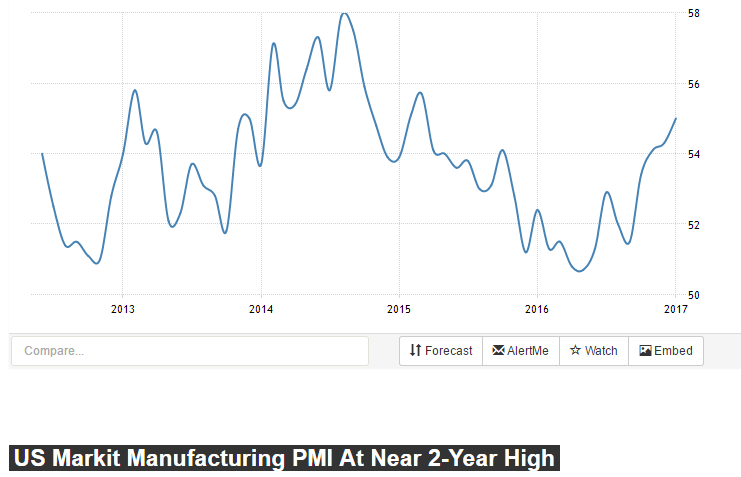
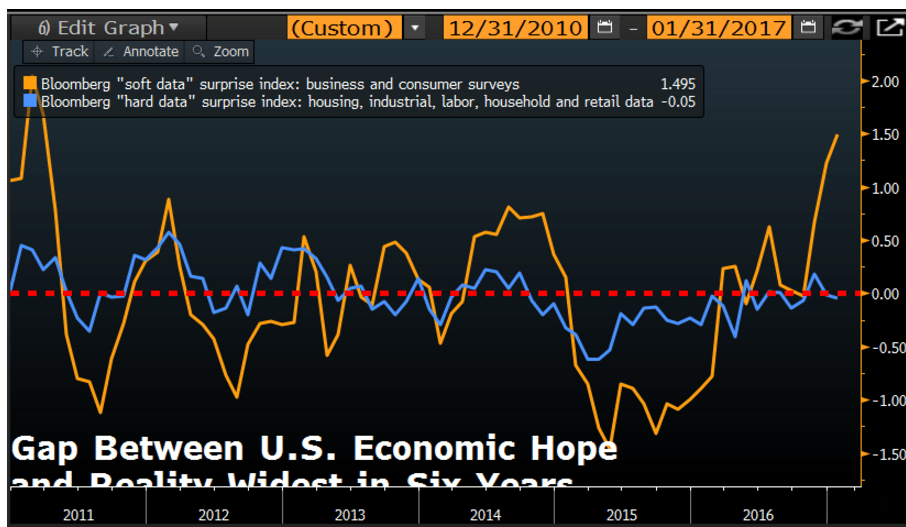
Vehicle sales, Mtg purchase applications, Construction spending, ADP private payrolls, ISM manufacturing, PMI manufacturing

Same story- survey expectations elevated while hard data continues to soften:

20100

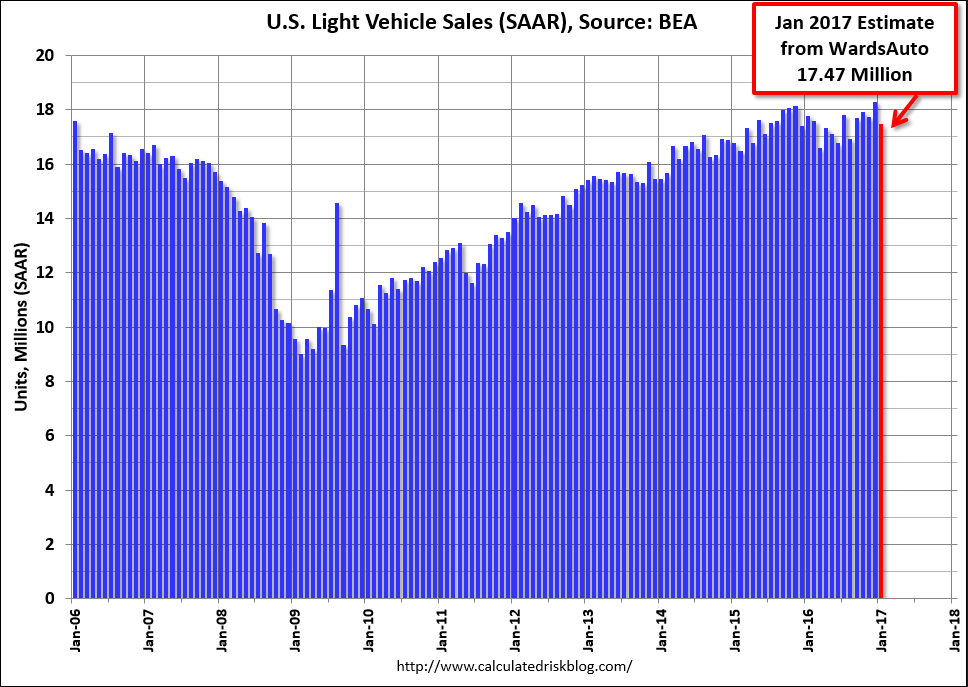
Based on a preliminary estimate from WardsAuto, light vehicle sales were at a 17.47 million SAAR in January.

That is up about 2% from January 2016, and down 4.5% from the 18.29 million annual sales rate last month.
Read more at http://www.calculatedriskblog.com/#qWEO2cMQ2CSiDhiS.99

20101

20102
20103

Highlights

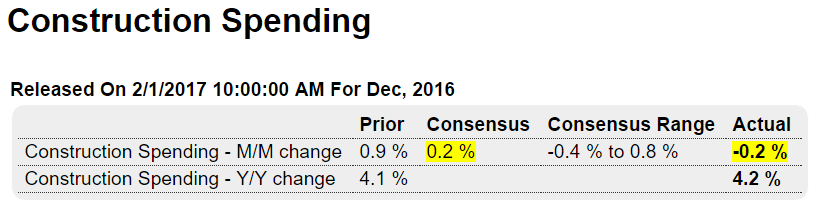
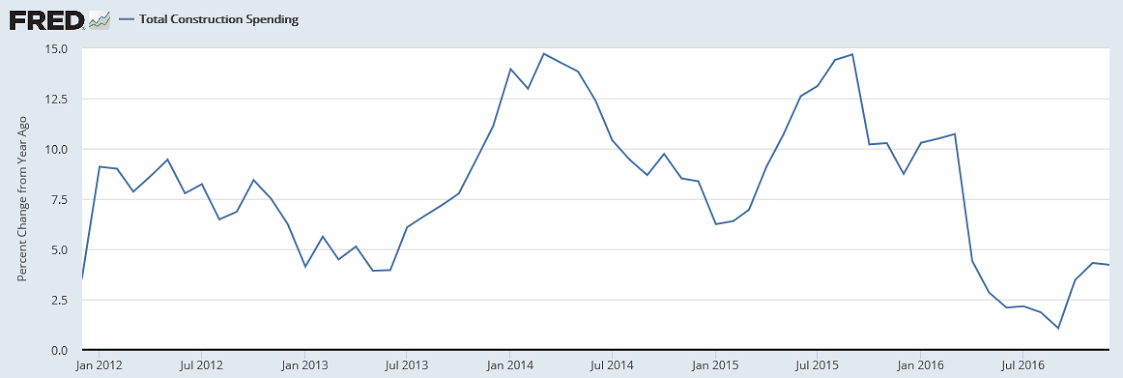
Construction spending fell 0.2 percent in December but details show welcome gains for housing. Spending on new single-family homes rose 0.5 percent in the month with multi-family spending up 2.8 percent. A negative on the residential side, however, is a 0.6 percent dip in home improvements.

More negative pull comes from public construction spending which fell a sharp 1.7 percent in the month. Educational spending fell 2.2 percent with highways & streets down 0.6 percent. Private nonresidential categories are mixed with total spending for this component unchanged in the month.

Spending on new home construction will have to improve further to ease the very tight supply in the new home market. Watch for construction payrolls, one possible highlight of Friday’s employment report.

20104

This is a forecast of Friday’s payroll report:
20105

Highlights

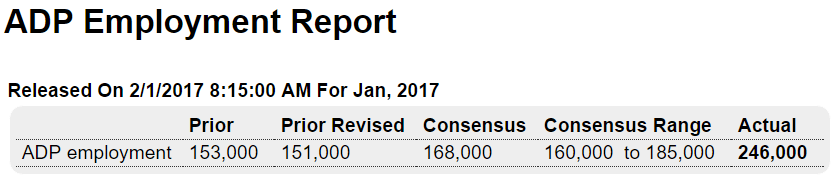
ADP is calling for substantial strength in Friday’s employment report, at 246,000 for private payrolls. This is far beyond expectations and would compare with December private payroll growth in the government’s report of 144,000 (ADP’s count for December is revised slightly lower to 151,000). Today’s data follow positive employment indications in yesterday’s consumer confidence report and may very well pull expectations higher, at least to a degree, for January’s employment report.

20107

This is a survey:
20108

So is this:

20109

Trumped up expectations, Chicago PMI, Consumer sentiment, Redbook retail sales, Executive orders, GDP comment, Trump comments, Income and spending chart

Trumped up expectations vs ‘hard data’:

13101

13102

Highlights

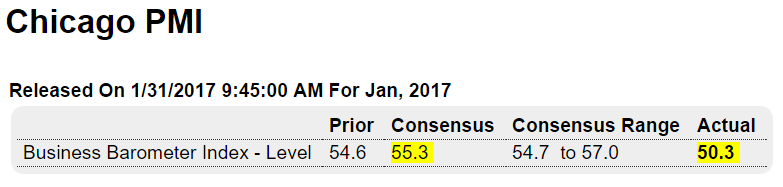
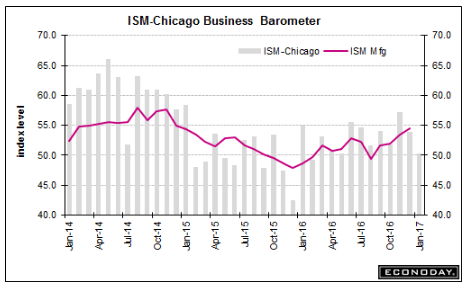
January was a flat month for the Chicago PMI which could manage only 50.3, virtually at the breakeven 50.0 level that indications no change from the prior month. New orders have now joined backlog orders in contraction in what is a negative combination for future production and employment. Current production eased but is still solid though employment is clearly weakening, in contraction for a 3rd straight month. One special note is pressure on input costs which are at a 2-1/2 year high. Business spirits and consumer expectations may be high, but they have yet to give the Chicago economy much of a boost. Watch for the consumer confidence report later this morning at 10:00 a.m. ET.

13103
Trumped up expectations starting to cool:

13104

Highlights

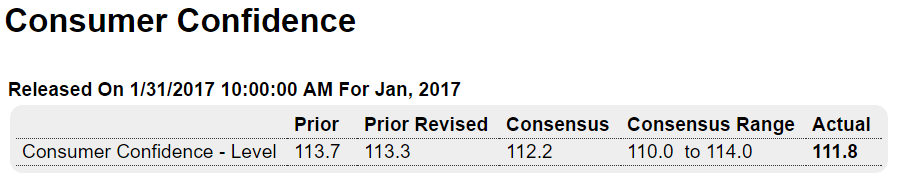
Consumer confidence held strong and steady in January, at 111.8 for only a slight decrease from December’s 15-year high of 113.3 (revised). Details are positive including a noticeable decline in those saying jobs are hard to get right now, at 21.5 percent vs December’s 22.7 percent, combined with a solid rise in those who say jobs are plentiful, at 27.4 vs 26.0 percent.

But the outlook is less upbeat with more saying there will be fewer jobs 6 months from now and fewer saying there will be more. Confidence in income prospects is also down.

And there’s red flags in the details, including a nearly 2 percentage point drop in buying plans for autos. This suggests that auto demand, after several months of very strong sales, may have understandably flattened. Home sales have been less strong than auto sales, but here too buying plans are down sharply.

Back to the lows:

13105

Inventories and Low Deflator Boost Low GDP Estimate

By Rick Davis

Jan 29 (Econintersect) — The BEA’s “bottom line” (their “Real Final Sales of Domestic Product”, which excludes the growing inventories) recorded a sub 1% growth rate (+0.87%), down over 2% (-2.17%) from 3Q-2016.

Real annualized household disposable income was reported to have grown by $177 quarter-to-quarter, to an annualized $39,405 (in 2009 dollars). The household savings rate decreased by -0.2% to 5.6%.

For the fourth quarter the BEA assumed an effective annualized deflator of 2.12%. During the same quarter (October 2016 through December 2016) the inflation recorded by the Bureau of Labor Statistics (BLS) in their CPI-U index was 3.41%. Under estimating inflation results in correspondingly over optimistic growth rates, and if the BEA’s “nominal” data was deflated using CPI-U inflation information the headline growth number would have been much lower, at a +0.62% annualized growth rate.

Trump gives an inaccurate explanation of how pipelines are built and shipped

By Tom DiChristopher

Jan 30 (CNBC) — President Donald Trump on Monday gave an inaccurate explanation of how foreign-made pipes are made and shipped to the United States.
The president made the comments as part of his case to convince oil and gas pipeline makers to use U.S. materials and equipment rather than imported parts.

Speaking to a group of small business leaders, Trump described a process that “hurts the pipe” — suggesting that many miles of America’s pipelines contain substandard parts which presumably would have to be replaced. But he simultaneously indicated that he is not actually familiar with how pipelines are made, using a variation of “I imagine” three times and saying “I assume” as he explained the process.

“These are big pipes. Now, the only way I can imagine they [ship them] is they must have to cut them. Because they’re so big, I can’t imagine — they take up so much room — I can’t imagine you could put that much pipe on ships. It’s not enough. It’s not long enough,” he said.

So I assume they have to fabricate and cut, which hurts the pipe, by the way,” he said.

A spokesperson for the Association of Oil Pipe Lines said he had never heard of foreign pipe makers cutting segments into portions to send them overseas. Manufacturers create pipes in lengths that can be shipped rather than chopping up vast lengths of pipe.

TransCanada, the company behind the controversial Keystone XL pipeline, also told CNBC that pipes it buys from overseas are not cut into smaller segments before being shipped.

So it’s rule by executive orders and tweets supported by alternative facts:

How Islamophobes and “Alternative Facts” Shaped Trump’s Muslim Ban

And as previously discussed, looks like a weak dollar policy is in the works:

Obama

>Euro spikes after Trump’s trade adviser says Germany is using ‘grossly undervalued’ currency

Germany is using a “grossly undervalued” euro to gain advantage over the United States and its own European Union partners, Donald Trump’s top trade adviser told the Financial Times, echoing a sentiment he gave last week on CNBC.

Peter Navarro, the head of Trump’s new National Trade Council, told the newspaper that the euro was like an “implicit Deutsche Mark” whose low valuation gave Germany a competitive advantage over its main partners.

Navarro said that Germany was one of the main hurdles to a U.S.-EU trade deal and that talks over a Transatlantic Trade and Investment Partnership (TTIP) were dead, the newspaper reported.

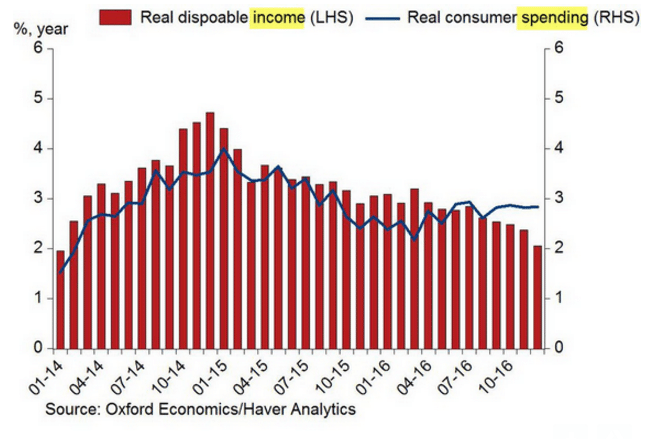
As previously discussed, weak income tends to drag down spending:

As previously discussed, weak income tends to drag down spending:

13106

Personal income and spending, Pending home sales, Dallas manufacturing

Just skip to the chart:

13001

Highlights

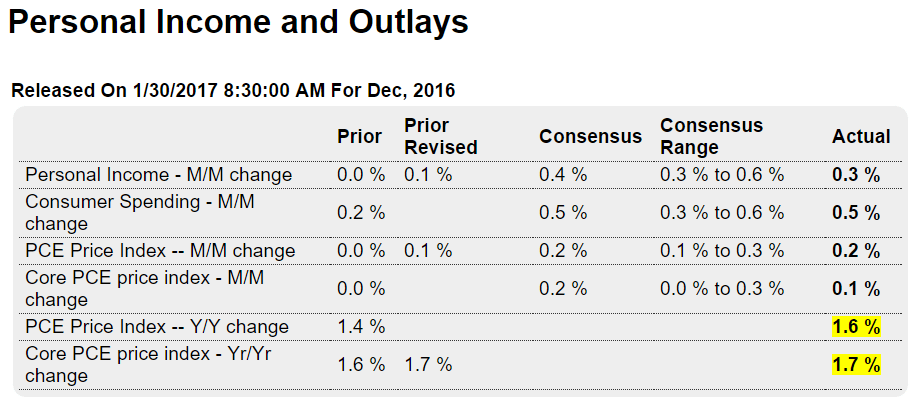
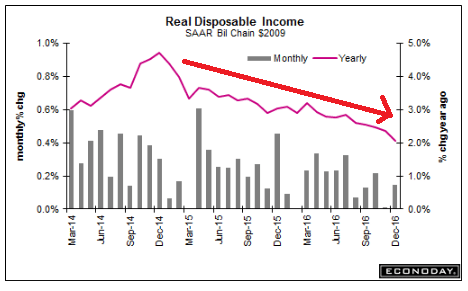
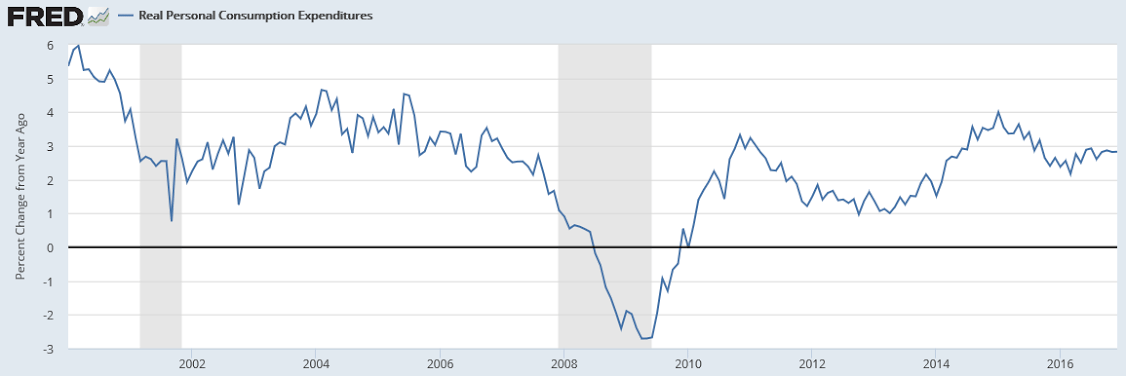
Personal income rose a moderate 0.3 percent in December with the wages & salaries component posting a slightly better gain at 0.4 percent. The savings rate, however, fell in the month, down 2 tenths to 5.4 percent which helped to fund a strong 0.5 percent gain in consumer spending. December’s spending was centered in a 1.4 percent rise for durable goods, boosted specifically by autos, but included a 0.4 percent gain for services and a 0.2 percent for nondurable goods.

Inflation data look tame but nevertheless continue to trend higher. The core PCE (less food & energy) inched only 0.1 percent higher with the year-on-year at 1.7 percent which is unchanged from an upwardly revised November. Total PCE prices, boosted by a 1.7 percent monthly rise in energy, rose 0.2 percent. But this year-on-year rate, which is the most important barometer for price change in the economy, is up 2 tenths to 1.6 percent which is the highest since the oil collapse in 2014 (July 2014).

In sum, income is still moderate and spending is solid though may be getting funded from savings. And for inflation hawks, PCE prices are closing in steadily toward the Fed’s 2 percent target.

The net income deceleration/meltdown continues, with no reason to suspect anything but more of same:

13002
With income currently falling faster than consumption, I wouldn’t be surprised if consumption growth slows as well:

13003
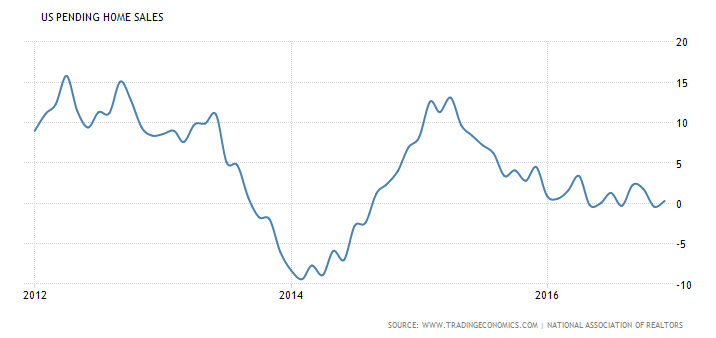
Skip to the chart here as well. The lack of income spills over into just about everything else:

13004

Highlights

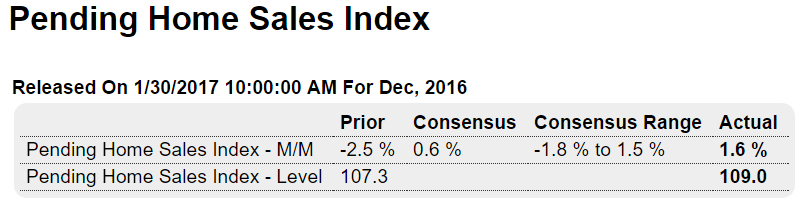
Existing home sales have been at cycle highs but have not been able to move above, yet new gains may perhaps be underway. The pending home sales index rose a very a strong 1.6 percent in December which is just above Econoday’s top estimate. Pending sales track contract signings for resales and the gain points squarely at January and February strength for final sales which are tracked in the existing home sales report..

Regional data for pending sales show the West out in front with a year-on-year gain of 5.0 percent. The Midwest trails with a 3.4 percent year-on-year decline. This is a light week for housing data though the Case-Shiller price report will be a highlight of tomorrow’s calendar.

13005
More signs that the manufacturing sector is now muddling through:

13006

Highlights

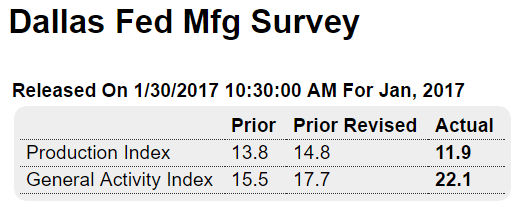
The Dallas Fed joins other regional reports pointing to strength for the nation’s factory sector. The production index did slow but remains in the double digits, at 11.9 in January vs a revised 14.8 for December. And new orders are on the rise, at 15.7 vs December’s 10.1 for the strongest showing since April 2014.

Unfilled orders, at a modest looking 5.2, are the strongest since June 2012. Employment is another positive, at 6.1 vs minus 3.4 for the best showing since December 2015. And the general activity index underscores the strength, at 22.1 vs an upward revised 17.7 and the best reading since all the way back at the beginning of the cycle in April 2010. Price data show slightly increasing pressures while inventories, reflecting the production strength, are on the decline.

This report offers a special look at the oil patch, underscoring that 2-1/2 tough years following the price collapse for oil are finally behind the sector.

GDP, Durable goods, Consumer sentiment, Luxury home sales, Trump comments

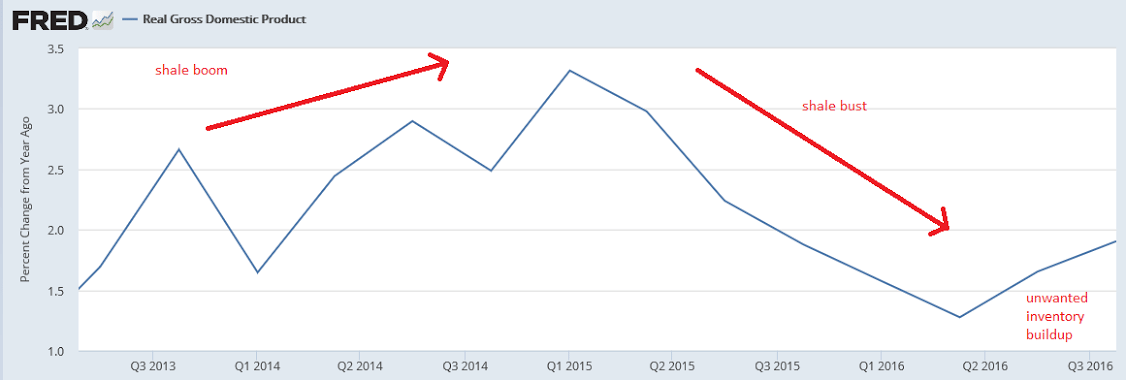
And without the undesired inventory build due to lower sales, it would have only been up .9% for q4, and .25% lower year over year. Personal Consumption (which includes health insurance premiums) has gone from +q2;s 4.3 to q3’s +3.0 to q4’s +2.5 and we’ve kicked off the new year with a big drop in vehicle sales and a big drop in housing starts, etc:

12701

Highlights

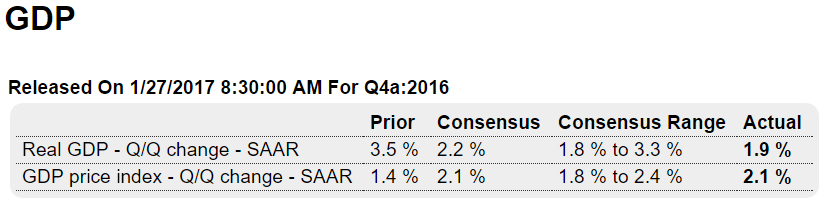
A perhaps unwanted build in inventories drove up fourth-quarter GDP which, however, could only manage 1.9 percent annualized growth. Inventories added 1 percentage point to the quarter in a build that will have to worked off given weakness in final demand which rose only 0.9 percent and down from 3.0 percent in the third quarter.

A positive is personal consumption expenditures which rose at a 2.5 percent pace. Though this is down from 3.0 and 4.3 percent in the prior quarters, it’s still a respectable result that underscores the consumer’s support of the economy. Durable spending showed the most consumer strength in the quarter reflecting strong auto sales.

Other positives include strength in residential investment, at a very strong plus 10.2 percent rate, and an unspectacular but very welcome increase in business investment at 2.4 percent for the third gain in a row.

A one-time negative in the report is an outsized pull lower from net exports, which subtracted 1.7 percentage points from the quarter but reflect unusually strong soybean exports in the third quarter.

Heavy inventories will work to pull back production and employment in the ongoing quarter. But the wildcard is still the consumer who, benefiting from a strong jobs market and strong confidence, can still give the first quarter a lift.

12702
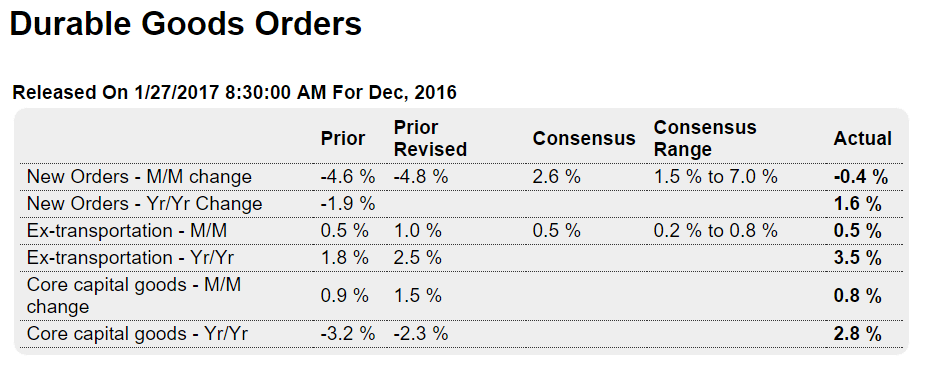
Yes another weak December (post election) release. As previously discussed, however, I expect manufacturing to muddle through with 2-3% growth with weakness in the service sector::

12703

Highlights

Civilian aircraft is the usual culprit behind volatility in the durable goods report but not in December, as defense aircraft makes a second straight appearance. A 64 percent downswing in orders for defense aircraft reversed a similar upswing in November and pulled down total durable goods to a much lower-than-expected 0.4 percent decline in December. But when excluding transportation equipment, orders actually hit the consensus at plus 0.5 percent.

The strength in the report is centered in capital goods where core orders (nondefense ex-aircraft) posted a strong 0.8 percent gain with November’s increase revised 6 tenths higher to 1.5 percent. These gains underscore the increase in the business investment component in this morning’s fourth-quarter GDP report and point to momentum for this closely watched area going into the first quarter.

A significant negative in the report is a 0.6 percent decline in unfilled orders which continue to shrink. Lack of work to do is a negative for employment. Total shipments were strong in December at 1.4 percent with core capital goods also strong at 1.0 percent.

Hard data in sum on the factory sector have not been favorable showing a fizzle, not a burst, at year end. But there are solid hints of strength ahead in this report as well as in regional manufacturing reports which have been on the rise.

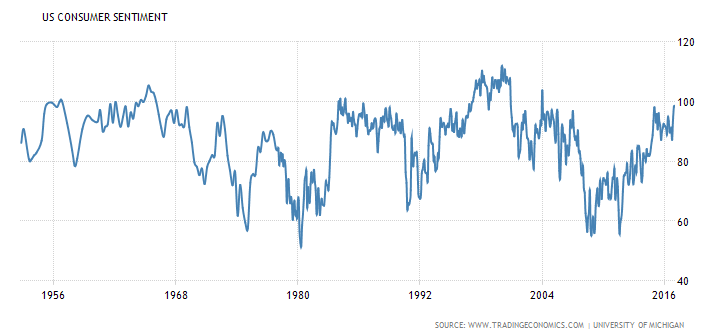
Consumer sentiment remains Trumped up:

12704
Sales and price softening: Luxury home sales continued to slump in the fourth quarter

The worst things you’ll read about Trump come from his own aides

Trump’s own aides seem to dislike him as much Democrats do

In most administrations, senior White House aides save the most embarrassing stories about the presidents they served for their memoirs. That’s not the case with Trump, whose top aides are already giving reporters reams of damaging information about him.

It’s not entirely clear what those aides hope to gain by painting their boss as a conspiracy-minded, easily distracted, TV-obsessed bully prone to paranoia, feelings of inadequacy, and flashes of blind, irrational anger.

Trump pressured Park Service to back his inauguration crowd claims: Report

Trump personally ordered acting NPS director Michael T. Reynolds to produce additional photographs of the crowds on the Mall, according to three individuals with knowledge of the conversation, the report said. The report said the additional photos were secured, but they didn’t support Trump’s assertion, without evidence, that the crowd was larger than the initial photos indicated.

The president also vented anger that the agency used its Twitter account to send side-by-side photos comparing the larger crowd at former President Barack Obama’s 2009 inauguration and Friday’s swearing in, the report said.

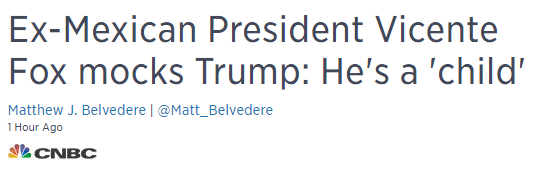
And it’s not that he’s acting like a child, it’s that, mentally, seems to me that he actually is a child. Some kind of arrested development, maybe. So laughing at him and ridiculing him is like laughing at the participants in the Special Olympics, for example.

12705

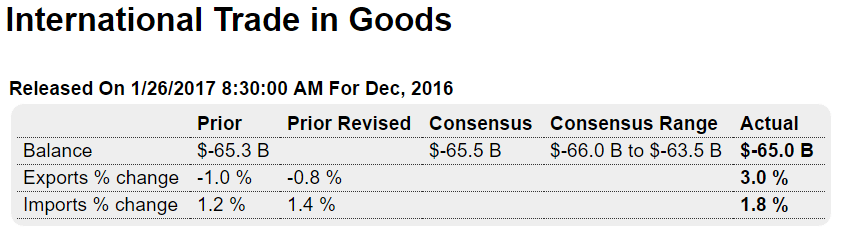
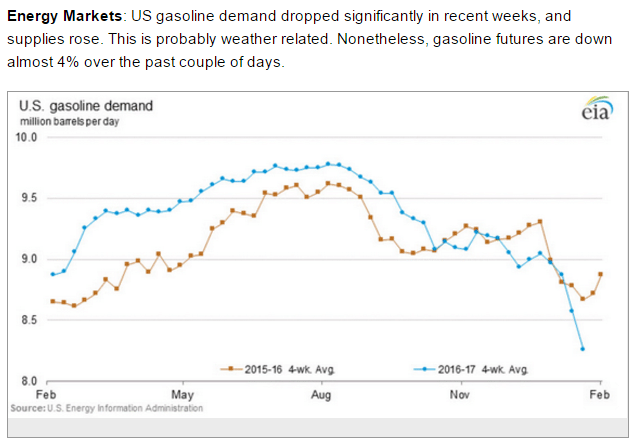
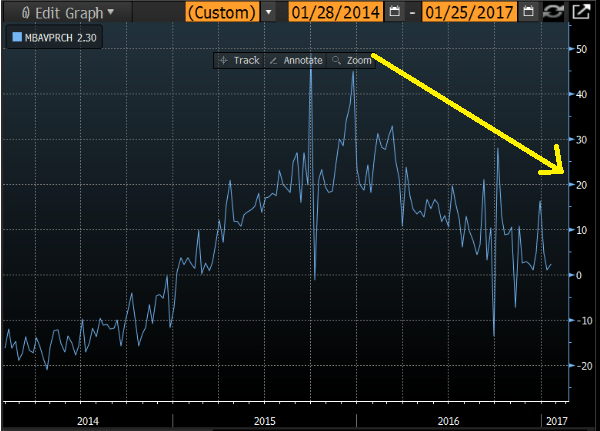
New home sales, Markit PMI, Chicago Fed, Trade, Gasoline demand, Voter fraud investigation

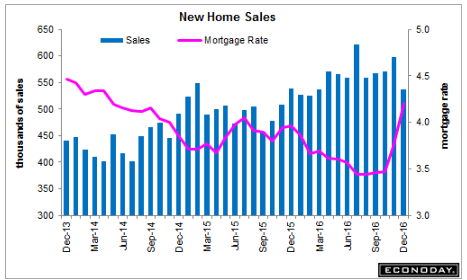
Big miss here. As previously discussed, it’s a case of lenders raising rates due to Fed fears when demand is low, further reducing demand:

12601

Highlights

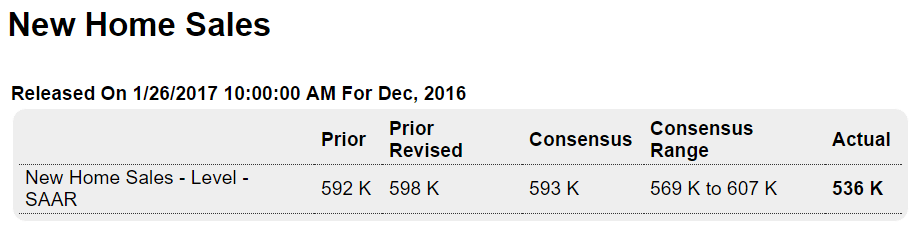
Consistently volatile is the well deserved reputation of the new home sales report. December sales of single-family homes plunged 10.4 percent in the month to a far lower-than-expected annualized rate of only 536,000. In a small offset, the prior two months have been revised upward by a combined 14,000 (to 598,000 for November and to 571,000 for October).

The 3-month average is of top importance when looking at this report and here the news is less downbeat. Yet the average is down, 12,000 lower in the month to 568,000 which is the softest reading since June. And the year-on-year sales rate, which had been in the double digits, is now negative, at minus 0.4 percent.

The good news in the report is supply which rose 10,000 to 259,000 and is 10.2 percent higher than a year ago. And the drop in sales has also eased the squeeze with supply relative to sales rising to 5.8 months from 5.0 months.

One factor behind December’s sluggish sales appears to have been prices where the median, in what is more good news, jumped 4.3 percent to $322,500 for a year-on-year gain of 7.9 percent.

The positives aside, this report follows Tuesday’s soft results on the resale side with both pointing to a housing sector that, instead of rising into year-end, faded instead. This report, specifically its implications for broker fees in the housing sector, may be a marginal negative for tomorrow’s fourth-quarter GDP report.

12602

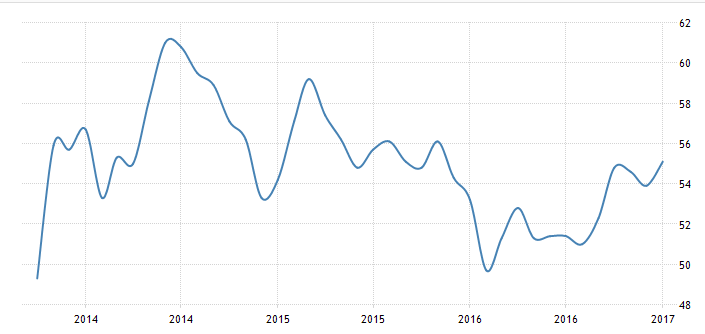
United States Services PMI

The Flash Markit Services PMI in the United States rose to 55.1 in January of 2017 from 53.9 in December, beating market expectations of 54.4. It is the highest reading since November of 2015, due to a robust expansion of business activity and an increase in incoming new work. Employment continued to rise although moderated from December’s 15-month peak and average costs went up. In addition, companies reported the strongest business outlook for just under two years.

12603
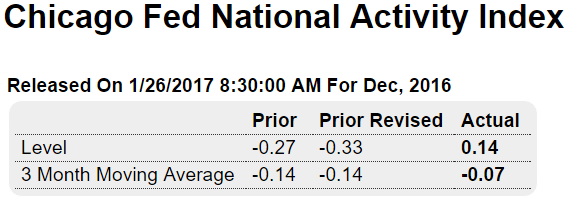
3 month average of this volatile series is still negative:

12604

Highlights

Utility production gave the national activity index a lift in December, to plus 0.14 from a minus 0.33 in November (revised). The production component, boosted by demand for heating, rose to plus 0.20 from November’s minus 0.30. Components for sales, orders & inventories as well as for personal consumption & housing and employment are all flat and little changed. Given the skewing effect from utilities, the 3-month average may be a truer reading of actual activity and it is modestly negative at minus 0.07, a reading that points to slightly lower-than-usual economic growth.

12605

12606
From The New York Times:

Trump’s Voter Fraud Example? A Troubled Tale With Bernhard Langer

The president told lawmakers the pro golfer had seen suspicious people voting while in line to cast his ballot, according to people there. One problem: Mr. Langer, a German, can’t vote.

Mtg purchase apps, Consumer debt comments

Note the trend:
12501

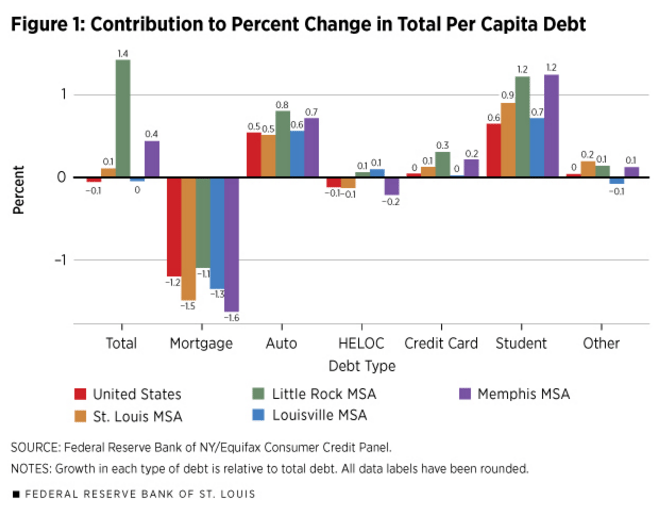
Don Schlagenhauf, chief economist for the St. Louis Fed’s Center for Household Financial Stability, and Lowell Ricketts, the Center’s senior analyst, analyzed consumer credit data and found that a decline in housing-related debt offset growth in other types of consumer debt during the third quarter.

12502

“The latest data suggest that overall growth may have stalled, despite robust student and auto loan borrowing,” Schlagenhauf and Ricketts wrote.

Redbook retail sales, PMI Markit manufacturing, Richmond Fed Manufacturing Index, Existing home sales, Trump budget director, CIA on Trump, Mnuchin on $, Euro area surveys

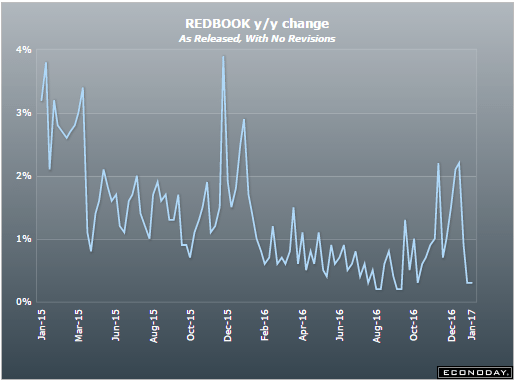
Still back to the lower, pre mini spike levels. Industrial production was up due to elevated utility bills, which might explain why retail sales are low:

12401

Highlights

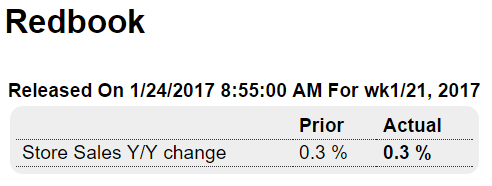
Same-store sales growth continued the glacial pace of the prior week and was up just 0.3 percent year-on-year in the January 21 week, a sharp deacceleration from the 2-percent plus growth seen in the final weeks of December. Versus December, month-to-date January sales were down 3.5 percent, more than twice the decline seen in January last year. Full month year-on-year sales were up just 0.5 percent, down from 1.5 percent in the last week of December and the slowest growth for this reading since early October. The sales growth slowdown in Redbook’s sample continues to point to weakness in core retail sales for January.

12402
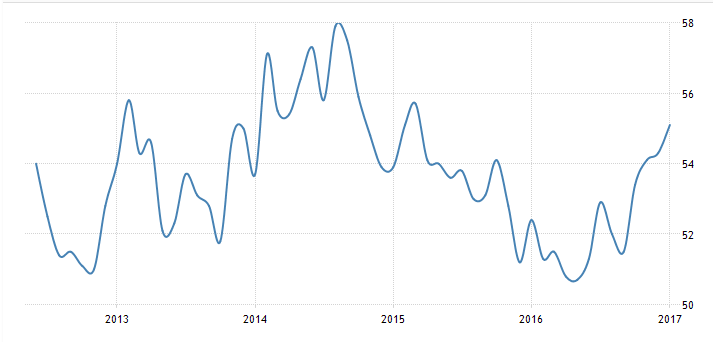
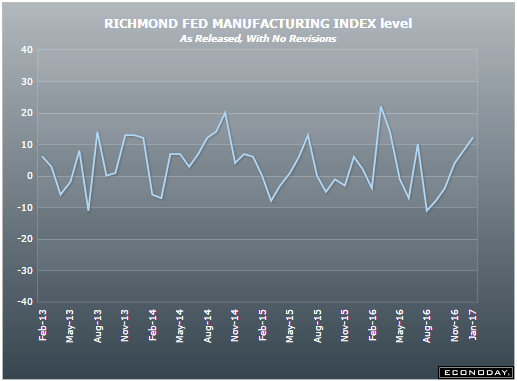
Yes, manufacturing is now muddling through at relative low levels, as weakness has spread to the service sector:

The Flash Markit Manufacturing PMI in the United States increased to 55.1 in January of 2017 from 54.3 in the previous month, beating market expectations of 54.5. It is the highest reading since March of 2015 as new work boosted output and purchasing activity while growth in new export work remained muted and employment eased.

12403

12404
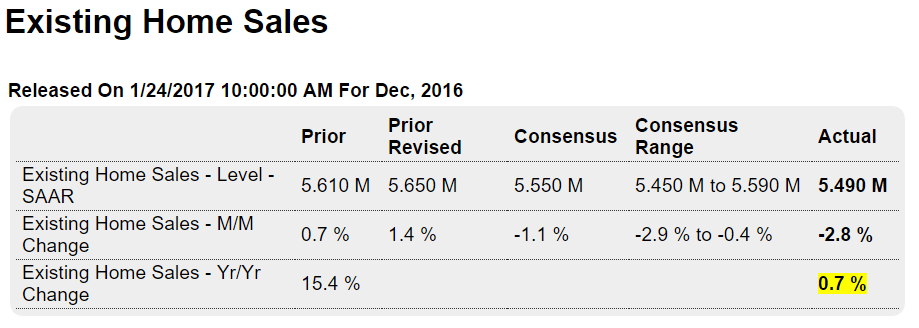
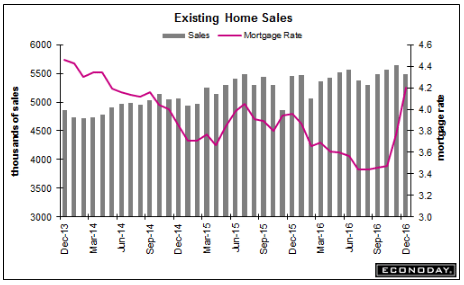
Housing remains depressed, now due to a jump in rates not caused by demand, but by market fears of future Fed actions:

12405

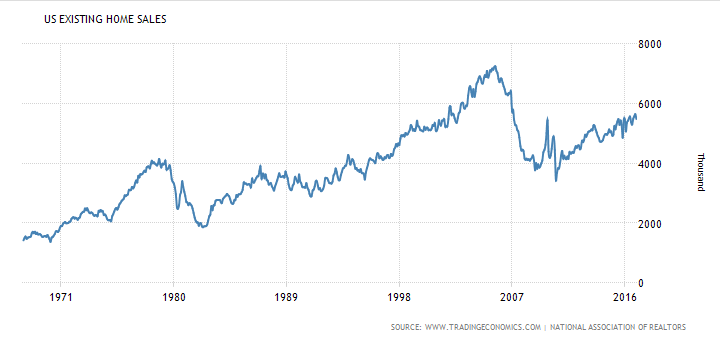
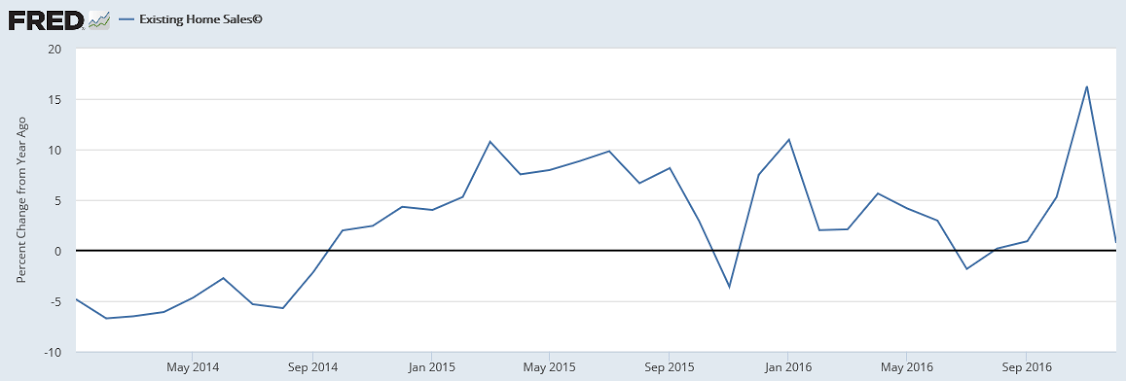
Sales of previously owned houses in the United States slumped 2.8 percent month-over-month to a seasonally adjusted annual rate of 5490 thousand in December of 2016, below market expectations of 5520 thousand. Sales of condos shrank 10.3 percent to 610 thousand and those of single family homes fell 1.8 percent to 4880 thousand. The average price declined 0.9 percent, the months’ worth of supply went down to 3.6 from 3.9 and the supply of houses on the market decreased to 1.65 million, the lowest since 1999. The November figure was revised up to 5650 thousand from 5610 thousand.

12406
A bit of a rush to buy before rates went up, then back down:

12407

12408
Here we go. Net spending cuts or even ‘neutrality’ are likely to be contractionary, as spending generally has a much higher multiple than tax cutting.
And growth has already been decelerating continuously for over two years:

Trump Budget Director Says National Debt Needs Quick Action

By Jennifer Jacobs and Erik Wasson

(Bloomberg) — President Donald Trump’s pick for budget director Mick Mulvaney said the nearly $20 trillion national debt is the equivalent of an ordinary American family owing more than a quarter of a million dollars on their credit cards, a problem that needs to be “addressed sooner rather than later.”
“Families know what that would mean for them,” Mulvaney will say Tuesday in Washington when he faces a pair of Senate committees over his nomination as director of the Office of Management and Budget, according to his prepared testimony. “It is time for government to learn the same lesson.”
A Republican congressman from South Carolina, Mulvaney was part of the wave of fiscal-conservative Tea Party members elected in 2010 and has been one of the most pugilistic advocates for cutting government spending. He is one of eight Trump nominees that Senate Minority Leader Chuck Schumer has placed in “the most troubling” column. More than 50 groups have sent letters to Capitol Hill urging members of Congress to reject Mulvaney’s nomination, arguing he’s too extreme.
Mulvaney has voted against debt ceiling increases and criticized House Speaker Paul Ryan’s budgets for spending too much. If he’s installed in the post — and given the leeway to negotiate his way — the next debt-limit debate could include a fight over whether future spending should be cut to offset money spent in decades past. The debt limit returns in March, so those discussions aren’t far away.
He will appear before the Budget Committee in the morning and the Homeland Security and Governmental Affairs Committee in the afternoon.

Earned Honestly

“I believe, as a matter of principle, that the debt is a problem that must be addressed sooner, rather than later,”
Mulvaney said in the remarks provided in advance of the hearings. “Part of fixing that problem also means taking a hard look at government waste…and then ending it. American taxpayers deserve a government that is efficient, effective, and accountable. American families earn their money honestly; they expect the government to spend it honestly. We owe them that much.”
Still, Mulvaney said he appreciates the safety net that Social Security and Medicare provide, and would like them to be there for his three children, who are triplets.
Mulvaney is a founding member of the House Freedom Caucus, hardline Republicans who have opposed compromising with Democrats just to keep the government operating during budget disputes. He helped lead the 2013 effort that resulted in a government shutdown over Obamacare funding.
“I will be loyal to the facts, and to the American people whom I serve,” he said in the prepared remarks.

At Odds

Mulvaney’s long-held position that new spending must be offset with equal cuts elsewhere could put him at odds with the president when it comes time to make good on Trump’s campaign promise to invest $1 trillion in roads, bridges and other infrastructure. He was on the losing side of a push to ensure spending on Hurricane Sandy relief was matched with reductions in other parts of the government.
Mulvaney has voted for unsuccessful proposals that sought to cut spending deeply enough to bring the federal budget into balance within a five-year window. Those proposals by the Republican Study Committee, a faction of fiscal conservatives, included raising the Social Security full-benefits age to 70 and changing the measure of inflation to reduce the retirement program’s payouts.
On the campaign trail, Trump promised he wouldn’t cut Social Security.
The most recent version of the group’s budget proposal would have given an extra $38 billion to the military while reducing domestic spending by $100 billion, in part by eliminating the National Endowment for the Arts and the Kennedy Center and ending funding for the Washington, D.C.-area’s metro transit system.
While a majority of congressional Republicans supported using a war-funding account for regular military needs, Mulvaney worked with Maryland Democrat Chris Van Hollen to demand all routine Pentagon purchases stay within legal spending caps.
Mulvaney’s opposition to that cap-skirting maneuver could become another pressure point, given Trump’s promise to beef up troop levels and weaponry.
Congress is expecting the administration to send up an emergency military spending request in the next few weeks.

The CIA on how they will ‘manage’ their approach to President Trump:

CIA starts recruiting its newest asset Donald Trump

The key to Trump? “He likes to win. He has a nostalgia for a period in history when U.S. always won,” Medina said. So on climate change, for instance, rather than pointing out that there’s science behind it, or that the U.S. needs to set an example, an analyst could point out that the solar energy business is likely to be a “gazillion-dollar business and the U.S. wants to be the winner,” she said. “That’s not politicizing the intelligence, it’s talking to the consumer.”
If Trump’s style means talking to him rather than giving him a written report, that’s fine, said former Acting CIA Director John McLaughlin.

As previously discussed:

Mnuchin Says Excessively Strong Dollar May Hurt U.S. Economy (Bloomberg) U.S. Treasury Secretary nominee Steven Mnuchin said an “excessively strong dollar” could have a negative short-term effect on the economy. “The strength of the dollar has historically been tied to the strength of the U.S. economy and the faith that investors have in doing business in America,” Mnuchin said in a written response to a senator’s question about the implications of a hypothetical 25 percent dollar rise. “From time to time, an excessively strong dollar may have negative short-term implications on the economy.”

Strong euro stuff:

Private sector growth slows slightly but manufacturing remains buoyant (Markit) Flash Germany PMI Composite Output Index at 54.7 (55.2 in December). Services PMI Activity Index at 53.2 (54.3 in December). Manufacturing PMI at 56.5 (55.6 in December). Manufacturing Output Index at 57.6 (57.0 in December). As was the case with activity, manufacturers outperformed service providers with regard to new order growth. New export work in the goods producing sector rose at the steepest rate since September 2016. Despite robust growth of new work, volumes of outstanding business at German private sector firms rose only fractionally.

Rental tightness, Trump comments

12302

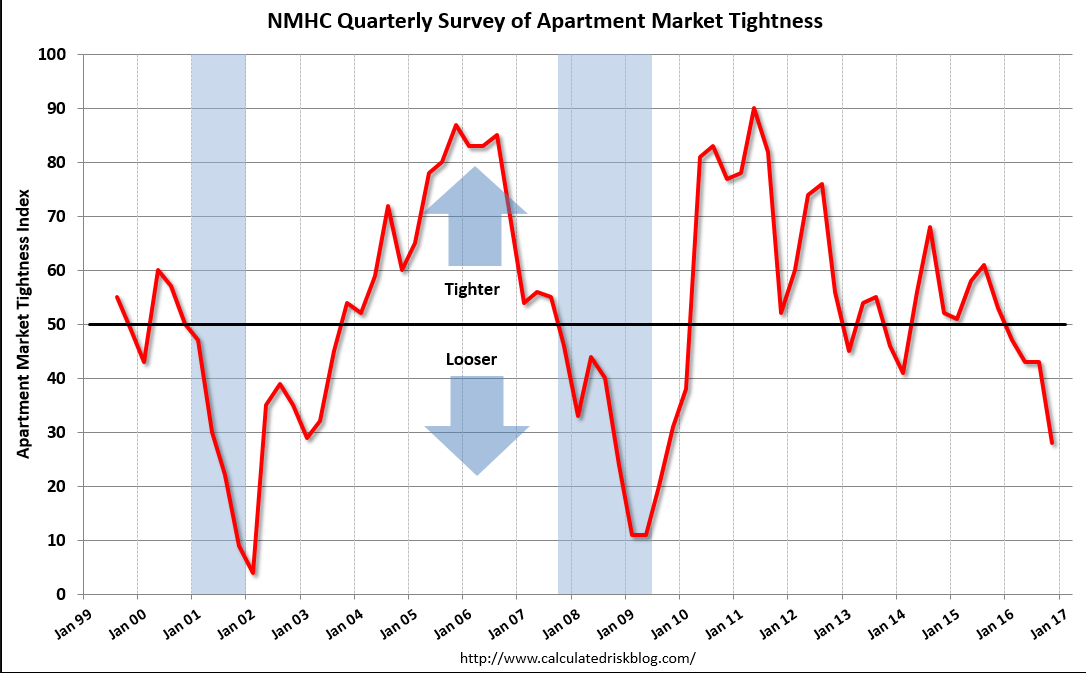
From the National Multifamily Housing Council (NMHC): Apartment Markets Soften in the January NMHC Quarterly Survey

— Apartment markets continued to retreat in the January National Multifamily Housing Council (NMHC) Quarterly Survey of Apartment Market Conditions. All four indexes of Market Tightness (25), Sales Volume (25), Equity Financing (33) and Debt Financing (14) remained below the breakeven level of 50 for the second quarter in a row.

“Weaker conditions are evident across all sectors as the apartment industry adjusts to changing conditions,” said Mark Obrinsky, NMHC’s Senior Vice President of Research and Chief Economist. “Rising supply—particularly during a seasonally weak quarter—is causing rent growth to moderate in many markets. At the same time, the sharp rise in interest rates in recent months was a triple whammy for the industry. First, higher rates directly worsen debt financing conditions. Second, the associated rise in cap rates also put a crimp in sales of apartment properties. Third, higher cap rates following the long run-up in apartment prices caused greater caution among equity investors.”

Read more at http://www.calculatedriskblog.com/#2WgZcWzbFIxpsveW.99

TRUMP’S VAINGLORIOUS AFFRONT TO THE C.I.A.

By Robin Wright

Jan 22 (The New Yorker) — The President’s remarks to the C.I.A. on Saturday, delivered in front of a hallowed memorial, stirred anger and astonishment among current and former agency officials.

The death of Robert Ames, who was America’s top intelligence officer for the Middle East, is commemorated among the hundred and seventeen stars on the white marble Memorial Wall at C.I.A. headquarters, in Langley, Virginia. He served long years in Beirut; Tehran; Sanaa, Yemen; Kuwait City; and Cairo, often in the midst of war or turmoil. Along the way, Ames cultivated pivotal U.S. operatives and sources, even within the Palestine Liberation Organization when it ranked as the world’s top terrorist group. In April, 1983, as chief of the C.I.A.’s Near East division, back in Washington, Ames returned to Beirut for consultations as Lebanon’s civil war raged.

Shortly after 1 p.m. on April 18th, 1983, Ames was huddling with seven other C.I.A. staff at the high-rise U.S. Embassy overlooking the Mediterranean, when a delivery van laden with explosives made a sharp swing into the cobblestone entryway, sped past a guard station, and accelerated into the embassy’s front wall. It set off a roar that echoed across Beirut. My office was just up the hill. A huge black cloud enveloped blocks.

It was the very first suicide bombing against the United States in the Middle East, and the onset of a new type of warfare. Carried out by an embryonic cell of extremists that later evolved into Hezbollah, it blew off the front of the embassy, leaving it like a seven-story, open-faced dollhouse. Sixty-four were killed, including all eight members of the C.I.A. team. It was, at the time, the deadliest attack on an American diplomatic facility anywhere in the world, and it remains the single deadliest attack on U.S. intelligence. (Only one of the thirty attacks on U.S. missions since then, in Nairobi, in 1998, has been deadlier.)

Ryan Crocker, the embassy’s political officer, had met with Ames earlier that day. Crocker was blown against the wall by the bomb’s impact, but escaped serious injury. He spent hours navigating smoke, fires, and tons of concrete, steel, and glass debris, searching for his colleagues.

“This is seared into my mind, irretrievably,” Crocker recalled for me this weekend. “There wasn’t an organized recovery plan, not in the initial hours after the bombing. I was de facto in charge that first awful night, when you dug a little and shouted out in case there was someone alive there, and then dug a bit more. Somewhere that night, I was on that rubble heap, and a radiator caught my eye. There was an object at the foot of the radiator. It looked like a beach ball, covered thick with dust. It was Bob Ames’s head.”

Ames left behind a widow and six children. He was so clandestine that his kids did not know that he was a spy until after he was killed. President Ronald Reagan and his wife, Nancy, saw the flag-draped coffins of the American victims arrive at Andrews Air Force Base, and met with the families of the deceased.

Reagan, who had known Ames, recounted the meetings in his diary, according to Kai Bird’s book about Ames, “The Good Spy”: “We were both in tears—I know all I could do was grip their hands—I was too choked up to speak.” More than three thousand people turned out for the memorial service at the National Cathedral for Ames and the other American victims.

On his first full day in office, President Trump spoke at the C.I.A. headquarters in front of the hallowed Memorial Wall, with Ames’s star on it. Since his election, Trump has raged at the U.S. intelligence community over its warnings about Russian meddling in the Presidential election. After CNN reported on, and BuzzFeed published, an as-yet unsubstantiated dossier about Trump’s ties to Russia and personal behavior, the President erupted on Twitter, “Intelligence agencies should never have allowed this fake news to ‘leak’ into the public. One last shot at me. Are we living in Nazi Germany?”

On Saturday, speaking to about four hundred intelligence officials, Trump blamed any misunderstanding on the media. “They are among the most dishonest human beings on Earth,” he said. (The official White House transcript notes “laughter” and “applause” here.) “They sort of made it sound like I had a feud with the intelligence community. And I just want to let you know, the reason you’re the No. 1 stop is exactly the opposite—exactly.”

Trump vowed greater support for America’s sixteen intelligence agencies than they had received from any other President. “Very, very few people could do the job you people do,” he said. “I know maybe sometimes you haven’t gotten the backing that you’ve wanted, and you’re going to get so much backing. Maybe you’re going to say, Please don’t give us so much backing. Mr. President, please, we don’t need that much backing.” Trump said he assumed that “almost everybody” in the cavernous C.I.A. entry hall had voted for him, “because we’re all on the same wavelength, folks.”

In his remarks, Trump made passing reference to the “special wall” behind him but never mentioned the top-secret work or personal sacrifices of intelligence officers like Ames and the others who died in Beirut, including the C.I.A. station chief Kenneth Haas, and James F. Lewis, who had been a prisoner of war in North Vietnam, and his wife Monique, who was on her first day on the job at the Beirut embassy. Nor did the President refer to any of the dozens of others for whom stars are etched on the hallowed C.I.A. wall of honor. It was like going to the Tomb of the Unknown Soldier and not mentioning those who died in the Second World War.

Trump’s unscripted remarks were, instead, largely about himself, even as he praised Mike Pompeo—a West Point and Harvard Law School graduate, Kansas congressman, and Tea Party supporter—as his choice to lead the C.I.A.

“No. 1 in his class at West Point,” Trump said. “Now, I know a lot about West Point. I’m a person that very strongly believes in academics. In fact, every time I say I had an uncle who was a great professor at M.I.T. for thirty-five years, who did a fantastic job in so many different ways, academically—was an academic genius—and then they say, Is Donald Trump an intellectual? Trust me, I’m like a smart person.”

Apparently as proof, the President noted that he had set an “all-time record” in Time magazine cover stories. “Like, if Tom Brady is on the cover, it’s one time, because he won the Super Bowl or something, right?” he told the intelligence officials. “I’ve been on it for fifteen times this year. I don’t think that’s a record that can ever be broken.” Time told Politico’s Playbook that it had published eleven Trump covers—and had done fifty-five cover stories about Richard Nixon.

Trump spoke briefly about eradicating “radical Islamic extremism,” a cornerstone of his foreign policy. But he devoted more than twice as many words to the dispute over the turnout at his Inauguration. “Did everybody like the speech?” Trump asked. “I’ve been given good reviews. But we had a massive field of people. You saw them. Packed. I get up this morning, I turn on one of the networks, and they show an empty field. I say, wait a minute, I made a speech. I looked out, the field was—it looked like a million, million and a half people.”

Crowd scientists who spoke to the Times estimated that about a hundred and sixty thousand people attended, compared with the record-setting 1.8 million who were estimated to have been at President Obama’s first Inauguration. Trump was defiant. “We caught them, and we caught them in a beauty,” he told the C.I.A. crowd. “And I think they’re going to pay a big price.”

Trump’s remarks caused astonishment and anger among current and former C.I.A. officials. The former C.I.A. director John Brennan, who retired on Friday, called it a “despicable display of self-aggrandizement in front of C.I.A.’s Memorial Wall of Agency heroes,” according to a statement released through a former aide. Brennan said he thought Trump “should be ashamed of himself.”

Crocker, who was among the last to see Ames and the local C.I.A. team alive in Beirut, was “appalled” by Trump’s comments. “Whatever his intentions, it was horrible,” Crocker, who went on to serve as the U.S. Ambassador in Iraq, Syria, Afghanistan, Pakistan, Lebanon, and Kuwait, told me. “As he stood there talking about how great Trump is, I kept looking at the wall behind him—as I’m sure everyone in the room was, too. He has no understanding of the world and what is going on. It was really ugly.”

“Why,” Crocker added, “did he even bother? I can’t imagine a worse Day One scenario. And what’s next?”

John McLaughlin is a thirty-year C.I.A. veteran and a former acting director of the C.I.A. who now teaches at Johns Hopkins University. He also chairs a foundation that raises funds to educate children of intelligence officers killed on the job. “It’s simply inappropriate to engage in self obsession on a spot that memorializes those who obsessed about others, and about mission, more than themselves,” he wrote to me in an e-mail on Sunday. “Also, people there spent their lives trying to figure out what’s true, so it’s hard to make the case that the media created a feud with Trump. It just ain’t so.”

John MacGaffin, another thirty-year veteran who rose to become the No. 2 in the C.I.A. directorate for clandestine espionage, said that Trump’s appearance should have been a “slam dunk,” calming deep unease within the intelligence community about the new President. According to MacGaffin, Trump should have talked about the mutual reliance between the White House and the C.I.A. in dealing with global crises and acknowledged those who had given their lives doing just that.

“What self-centered, irrational decision process got him to this travesty?” MacGaffin told me. “Most importantly, how will that process serve us when the issues he must address are dangerous and incredibly complex? This is scary stuff!”

Trump could have taken a page from Reagan, whom he has often invoked. In 1984, at a groundbreaking ceremony for an addition to C.I.A. headquarters, Reagan told the intelligence community, “The work you do each day is essential to the survival and to the spread of human freedom. You remain the eyes and ears of the free world. You are the ‘trip wire’ over which totalitarian rule must stumble in their quest for global domination. . . . From Nathan Hale’s first covert operation in the Revolutionary War to the breaking of the Japanese code at Midway in World War II, America’s security and safety have relied directly on the courage and collective efforts of her intelligence personnel.”

Bruce Riedel was a protégé of Ames at the C.I.A.; they travelled together in the Middle East. For more than three decades, he has made an annual visit to Ames’s grave at Arlington National Cemetery. He noted one glaring omission from Trump’s comments: a third of the stars are from deaths that have happened since 9/11, “making it more dangerous to work for the agency now than ever before.” He faulted Trump for not visiting the Counterterrorism Center, talking to the team now tracking Al Qaeda and Islamic State leaders, and seeing how drones work—all “invaluable experience when he later needs to make life-and-death decisions,” Riedel, now a senior fellow at the Brookings Institution, told me.

Paul Pillar, a Vietnam veteran, rose to become deputy director of the Counterterrorism Center and later the National Intelligence Officer in charge of the Middle East and South Asia. He, too, was anguished by Trump’s comments. “He used the scene as a prop for another complaint about the media and another bit of braggadocio about his crowds and his support,” Pillar told me Sunday. “That the specific prop was the C.I.A.’s memorial wall, and that Trump made no mention of those whom that wall memorializes, made his performance doubly offensive.”

At 7:35 a.m. on Sunday, Trump responded on Twitter to the negative reactions to his comments. “Had a great meeting at CIA Headquarters yesterday, packed house, paid great respect to Wall, long standing ovations, amazing people. WIN!”

But it’s hard to see how America’s new leader will recoup from a performance so shallow, irreverent, and vainglorious.

Euro area current account, Trump comments

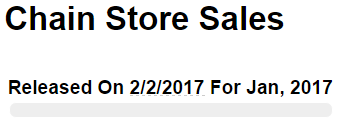
This is very ‘strong euro’ stuff, as in the longer term trade flows do rule:

Euro Area Current Account Surplus At Nearly 1-Year High

Eurozone current account surplus rose to EUR 40.5 billion in November of 2016 from a EUR 30.9 billion surplus a year earlier and reaching the highest since December of 2015. Considering the first eleven months of the year, the current account surplus rose by EUR 38.4 billion to EUR 355.8 billion; the goods surplus increased to EUR 372.6 billion (EUR 345.7 billion a year earllier), the services surplus rose to EUR 68.3 billion (EUR 59.2 billion a year earlier) and the secondary income deficit narrowed to EUR 130 billion (EUR -137.4 billion a year earlier). In contrast, the primary income surplus declined to EUR 44.9 billion from EUR 49.9 billion. If adjusted for seasonal factors, the current account surplus also widened to EUR 36.1 billion from EUR 28.3 billion in the previous month.
12301

“And then they say, ‘Is Donald Trump an intellectual?'” Trump said. “Trust me, I’m like a smart person.”

A former senior CIA officer told NBC News he was embarrassed, watching the remarks, which he called a “free-wheeling, narcissistic diatribe.”