ADP employment, Construction spending, PMI and ISM manufacturing, Car sales

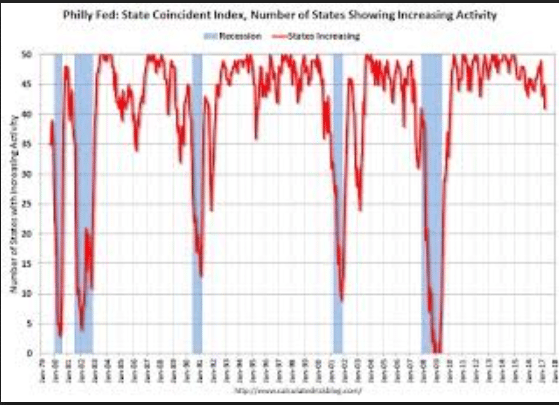
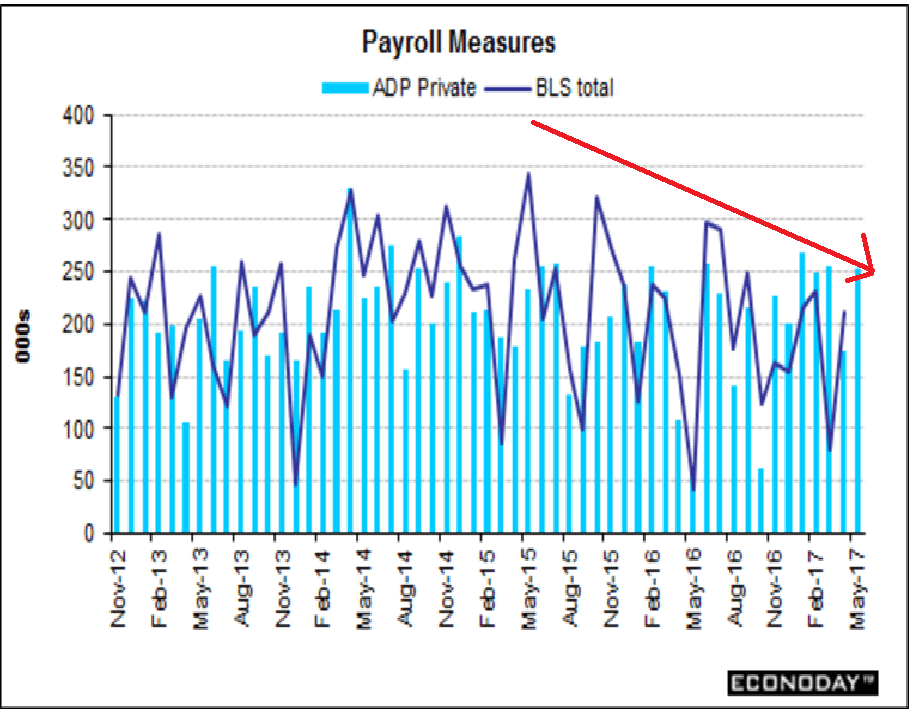
While it did spike up some this week, the downtrend is still intact as per the chart:

Highlights

On the strong side this year, ADP is calling for a resumption of outsized employment gains, at 253,000 for private payrolls in tomorrow’s May employment report vs Econoday’s consensus for 172,000 (Econoday’s consensus has since moved to 173,500 following ADP’s report). ADP has been hitting and missing this year, making remarkably good calls for oversized strength in January and February followed by a very bad call for a third month of strength in March, a month that came up well short. ADP’s call for April was respectably accurate, at 177,000 (now revised to 174,000) vs actual private payroll growth of 194,000.
More stats that supported q1 gdp seem to be reversing for q2:
Highlights

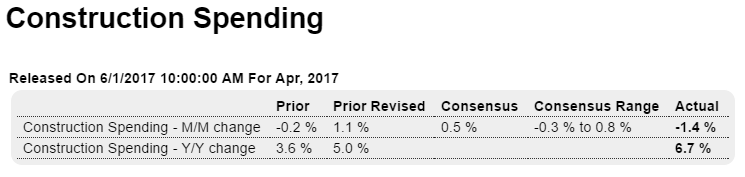
Volatility once again hits the construction spending report where an unexpected sharp decline in April, at minus 1.4 percent, is offset by a giant upward revision to March which now stands at plus 1.1 percent vs an initial 0.2 percent dip.

The residential side of the report, at minus 0.7 percent in April, shows the first decline in 7 months, pulled lower by a sharp drop in residential improvements and spending on new condos that offset a solid 0.8 percent gain for new single-family homes.

The non-residential side shows a 0.6 percent decline for private building, hit by contraction for factories and power plants, and a 2.0 percent dip for public building with both highways and education lower.

This report is yet another bad result for April as the upward revision to March pulled spending out of the second quarter and into the first. And it’s the second quarter that is in focus right now and housing, including sales and starts and now construction, have all been disappointing.

Highlights

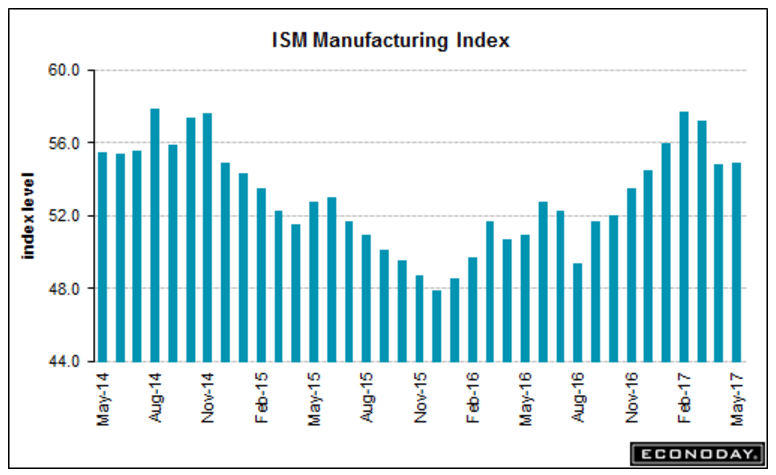
Growth in Markit’s U.S. manufacturing sample is as slow as it has been in 8 months, at 52.7 and little changed from the mid-month flash (52.5) and April (52.8). Growth in this sample peaked in January at 55.0 and has been moving lower as new orders, also at an 8-month low, and employment have slowed. Production is steady at a modest level and the sample, in a sign of caution, continues to work down inventories. Other details include slowing in both input costs and selling prices and weakness in export sales. This report, of all the private manufacturing reports, has been signaling the weakest conditions for a factory sector that opened the year with promise which it has yet to fulfill. Watch for the ISM report coming up at 10:00 a.m. ET this morning.
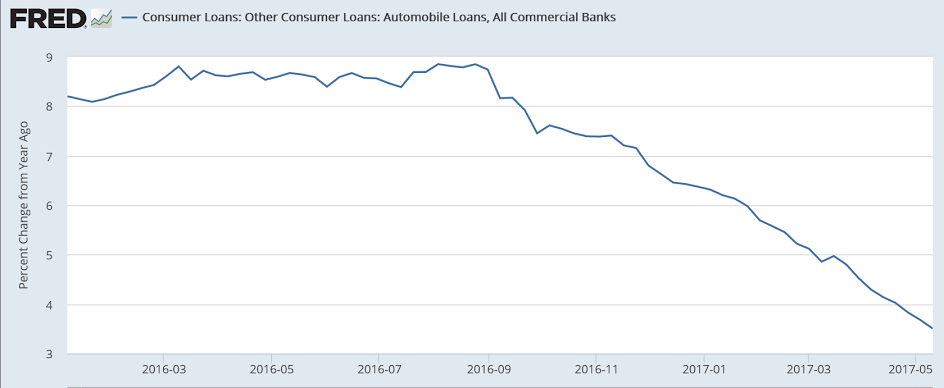
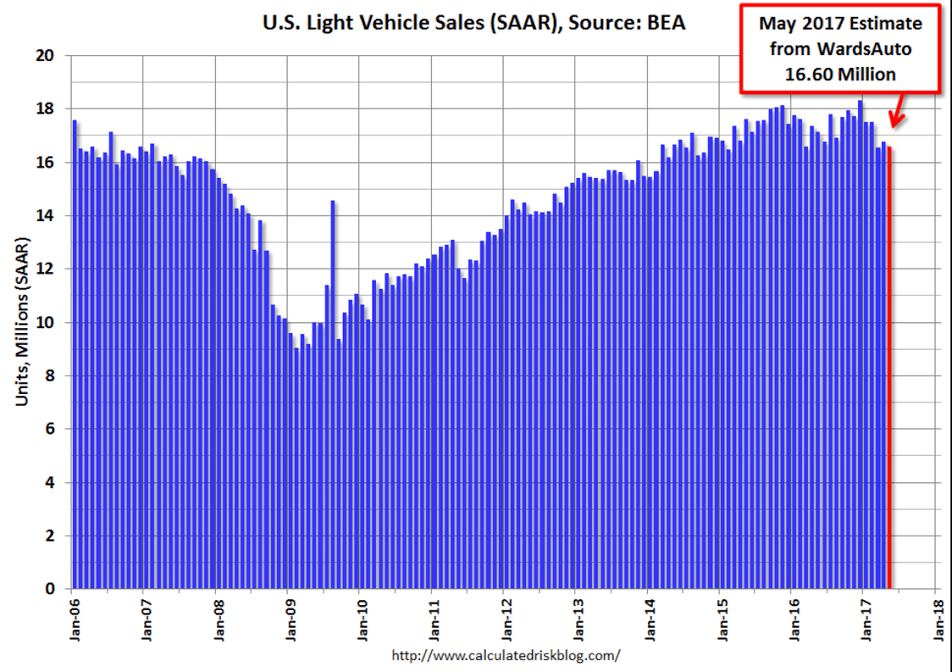
Worse than expected and on the decline. 2017 now forecast to be lower than 2016, all confirmed by the chart showing auto loan growth slowing:
Mortgage purchase applications, ISM Chicago, Pending home sales, Vehicle sales

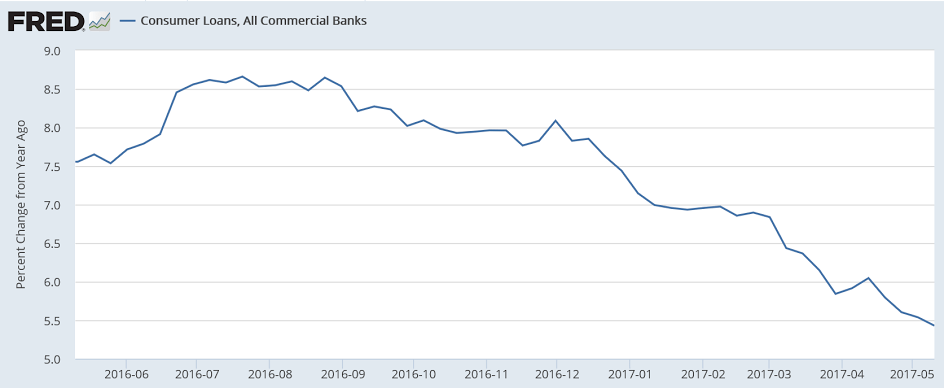
Another down week but still a bit higher than last year. But actual loan growth is far lower than last year:


Trumped up expectations coming down:

Highlights

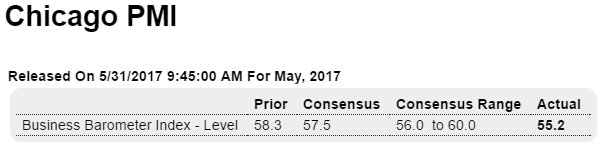
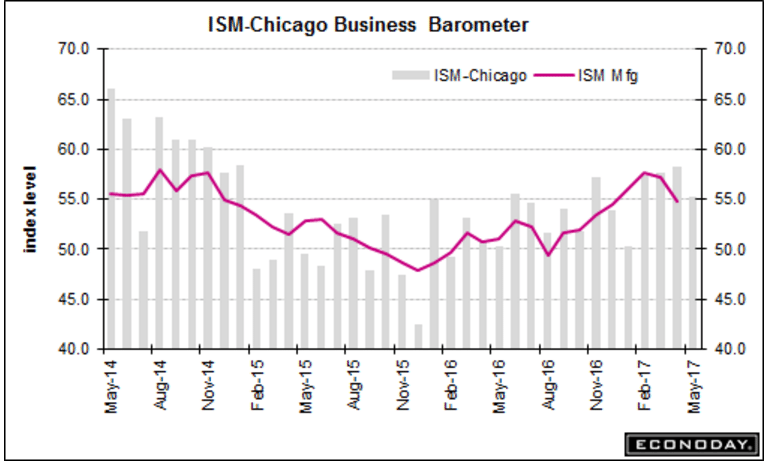
Business growth is slowing in the Chicago area with weakness appearing in orders. The May PMI of 55.2, though down more than 3 points in the month, is still very solid but new orders slowed abruptly in the month to a 4-month low with backlog orders in contraction for a sixth straight month. Employment is flat and production is slowing. A factor that adds to the headline composite is slowing in delivery times which the report attributes in part to lack of inventories among suppliers. Input costs are also easing but remain elevated. This report, which tracks all areas of Chicago’s economy, is not showing the acceleration consistent with general expectations for a second-quarter surge.

This seal it for the housing market:

Highlights

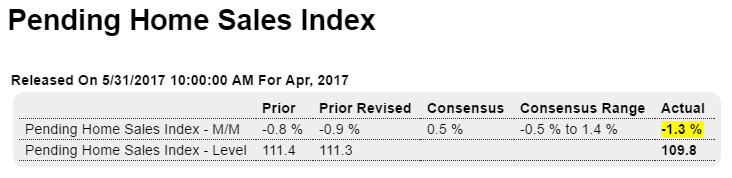
Spring sales data have not been favorable for the housing sector. Pending home sales are down for a second straight month, 1.3 percent lower in April to an index of 109.8 which is 3.3 percent below this time last year. This index tracks contract signings for resales and the results point to weakness for final sales in May and June. Final resales contracted in April as did new home sales while the month’s housing starts were also weak. Spring is the big season for housing and these are not the results of a sector that will be leading the 2017 economy.

Vehicle sales looking weak again for tomorrow’s release:

U.S. auto sales seen up 0.5 percent in May: JD Power and LMC

May 25 (Reuters) — The seasonally adjusted annual rate for the month will be 16.9 million vehicles, down from 17.3 million last year.

The consultancies cut new vehicle sales forecast for 2017 to 17.2 million units from 17.5 million units.

U.S. sales of new cars and trucks hit a record high of 17.55 million units in 2016. But as the market has begun to saturate, automakers have been hiking incentives to entice consumers to buy.

Major automakers posted declines in U.S. new vehicle sales for April, an indication of the long boom cycle that lifted the American auto industry to record sales last year losing steam. (reut.rs/2qnsNQa)

“While consumers will see substantial discounts this Memorial Day weekend, they are not expected to overcome the slowing demand in auto sales,” said Deirdre Borrego, senior vice president of automotive data and analytics at J.D. Power.

The consultancies said consumer discounts averaged $3,583 per unit, a record for the month, surpassing the previous high for the month of $3,342, set in May last year.

The average number of days a new vehicle sits on a dealer’s lot before being sold hit 71 in the first 14 days of May, the highest level for any month since July 2009.

Personal income and spending, consumer confidence, small business hires, gone mainstream…

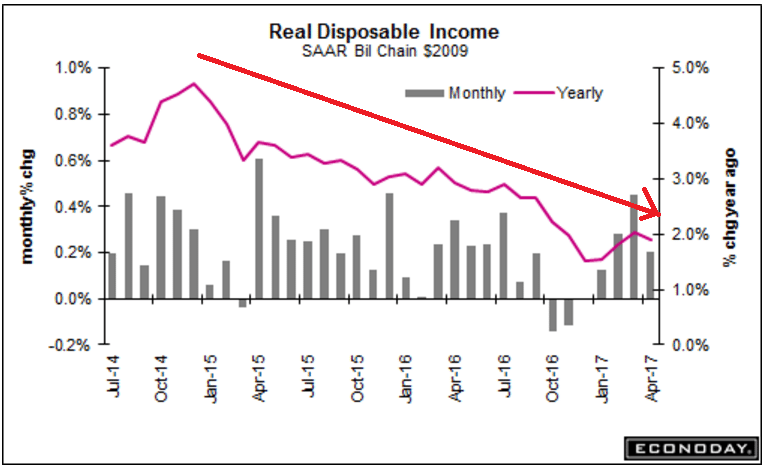
As expected with prior month’s spending revised up .2. Annual growth rates still not looking so good, as per the charts:

Highlights

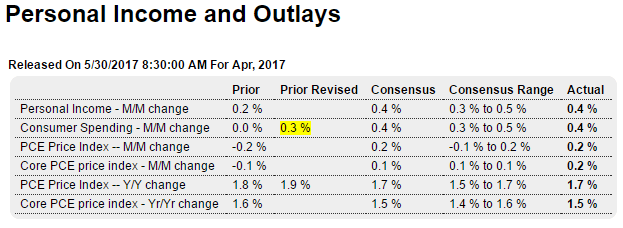
April was mostly a favorable month for the consumer who benefited from strong wage gains, kept money in the bank, and was an active shopper at least compared to the first quarter. Consumer spending opened the second quarter with an as-expected 0.4 percent gain with strength in durables spending, including vehicles, offsetting another subpar increase, however, for services at only 0.3 percent. Personal income rose 0.4 percent in April with the wages & salaries component posting an outsized 0.7 percent gain and offsetting weakness in proprietor income and interest income. The savings rate held at 5.3 percent for a third straight month.

Inflation data in this report, which are the FOMC’s key inflation gauges, are more subdued than the spending readings. The core PCE (less food & energy) managed a 0.2 percent monthly gain but the year-on-year rate slipped another 1 tenth to 1.5 percent. This is the lowest rate since December 2015 with this year’s weak pressures having erased a full year of improvement. Overall prices also rose 0.2 percent with this year-on-year rate also lower, down 2 tenths to 1.7 percent.

A small positive in the report is an upward revision to March spending from no change to plus 0.3 percent. That’s a positive, however, that falls into the first quarter, not the second which is the focus right now. Consumer spending put in a respectable April but nothing spectacular which some had been expecting given positive seasonal factors including the inclusion of Easter. But the inflation readings are very quiet and won’t be raising expectations much further for a rate hike at the June FOMC.


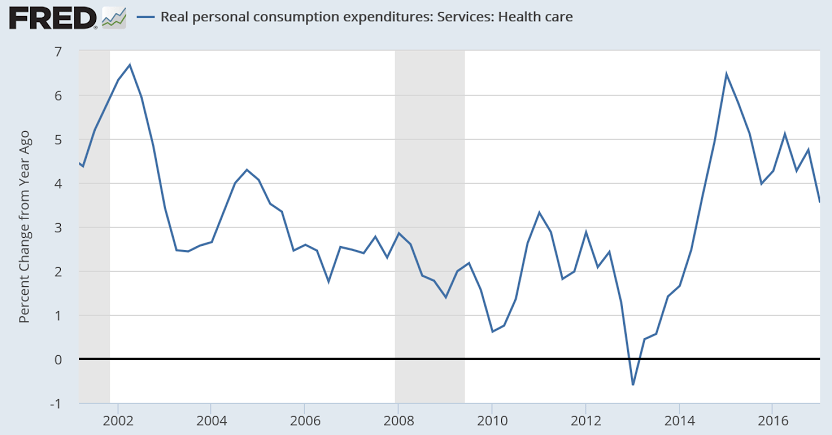
Health care premiums count as personal consumption expenditures and you can see how they have influenced total pce which is now weakening again:


Trumped up expectations coming down:

Small business hires fall in May, but employees got raises, Paycheck survey shows

By Berkeley Lovelace Jr.

May 30 (CNBC) —

  • Small business hiring fell in May, but wages continued to rise, Paychex says.
  • The Small Business Jobs Index now has its weakest three-month change since July 2009.
  • “Small business owners now seem to be taking a more wait-and-see approach to hiring,” Paychex President and CEO Martin Mucci says.
  • Looks like I’m now officially mainstream with the latest paper I wrote with Professor Silipo published in a mainstream economics journal:

    Dear Warren Mosler,

    Your paper “Maximizing price stability in a monetary economy” that has just been published today on “Journal of Policy Modeling” has been found by Peerus.
    Peerus is an App that monitors your scientific field – Journals, Authors (colleagues / competitors), Keywords – and identifies new papers as soon as there are published.

    GDP, Durable goods, Profits

    Real consumer spending revised up a bit, and not to forget that includes health care premiums, and q2 now looking a lot worse than previously expected:

    Highlights

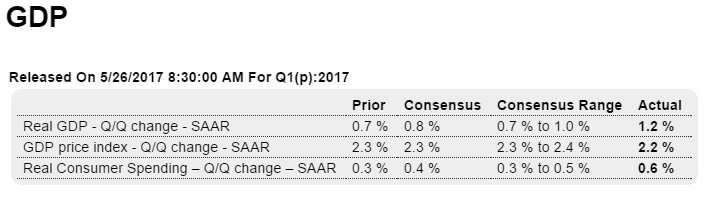
    First-quarter GDP gets a small but much needed upgrade, now at a 1.2 percent rate of annualized growth which is nearly double the advance estimate. The gain is centered where it is best, in consumer spending where the rate did double to 0.6 percent. This is still slow but is an improvement with durable goods, at minus 1.4 percent, showing less contraction and services showing greater growth, at 0.8 percent.

    Boosted by strong and sudden acceleration in both structures and equipment, nonresidential fixed investment is also upgraded, to 11.4 percent for a 2 percentage point gain. Government purchases are also upgraded, down 1.1 percent for a 6 tenths improvement that pulls less on GDP. Other readings are stable with a slowing build in inventories still a major negative (a negative for GDP but not for the second-quarter outlook).

    But the second-quarter outlook, which was once very positive, is mostly in question following a run of weak data for April including this morning’s durable goods report. And the first-quarter is a little less of an easy comparison now for the second quarter where early estimates, once as high as 3 and 4 percent, have been coming down to the 2 percent area.

    Should muddle through at modest levels of growth:

    Highlights

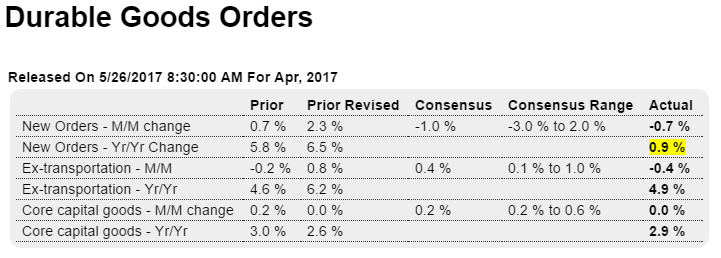
    Yet another piece of the second-quarter puzzle is not favorable. Durable goods orders, down 0.7 percent in April, do not confirm the month’s big jump in industrial production nor all the strength in the regional factory reports. Aircraft is not a factor in today’s report as the ex-transportation reading is also negative, at minus 0.4 percent which is well below Econoday’s low estimate. Also below the estimate are orders for core capital goods (nondefense ex-aircraft) which came in unchanged following a downward revised unchanged reading in March.

    Manufacturing output soared in the industrial production report but shipments in this report fell 0.3 percent and follow March’s 0.1 percent decline. Shipments of core capital goods, which are an important input into second-quarter GDP, also fell 0.1 percent. And the weakness in capital goods orders does not point to shipment strength in June or July.

    Inventories edged only 0.1 percent higher but, given the decline in shipments, the inventory-to-shipments ratio moved one notch higher to a less lean 1.69. A plus in the report is unfilled orders which, after long contraction, have put together two straight positive months, at 0.2 and 0.3 percent.

    Another positive is an upward revision to March, but that was back in the first quarter which was already weak anyway. There really aren’t a lot of positives in today’s report. The nation’s factory sector, despite recovery in energy equipment, is not showing the promise indicated by sentiment reports. Weak foreign demand remains a likely suspect for the struggling performance.

    Philly Fed State index, Pending legislation, North Korea, Basic income

    As previously discussed, seems to me it’s unlikely any of the trumped up expectations will
    come to pass:

    McConnell: ‘I don’t know how we get to 50’ votes on ObamaCare repeal (The Hill) Senate Majority Leader Mitch McConnell says he doesn’t know how Senate Republicans are going to get enough votes to pass an ObamaCare replacement bill. “I don’t know how we get to 50 [votes] at the moment. But that’s the goal,” McConnell told Reuters in an interview Wednesday. McConnell opened the interview by saying “There’s not a whole lot of news to be made on healthcare.” The majority leader expressed more optimism about tax reform, calling chances for passage “pretty good” and saying it is “not in my view quite as challenging as healthcare.”

    So much for the border tax and eliminating business interest deductions:

    Ryan: House could pass bill that doesn’t include border tax (The Hill) Speaker Paul Ryan said Wednesday that he can see a scenario in which the House passes a tax reform bill that does not include a border-adjustment tax. Ryan said that congressional Republicans and the White House agree on about 80 percent of the elements of tax reform and are discussing how to broaden the tax base to pay for lower tax rates. “A border adjustment basically taxes the trade deficit, gets you revenue to lower your tax rates,” he said. “If you’re not going to tax our trade deficit, like every other country does, then you’ll have to get your base broadening from within the country. And that’s the kind of conversation we’re going to have all summer long.”

    Mnuchin wants to keep deduction for businesses’ interest expenses (The Hill) “On the business tax, my preference is to maintain interest deductibility, which is important for small- and medium-sized businesses,” Treasury Secretary Steven Mnuchin said during a House Ways and Means Committee hearing. Mnuchin added, however, that the administration is looking at the deduction “like everything else that’s on the table.” The House GOP blueprint proposes eliminating the deduction for businesses’ net interest expenses because it would instead allow businesses to immediately deduct the full costs of their capital investments.

    Nor has this stuff gone away:

    Freedom Caucus opposes clean debt ceiling increase (The Hill) The conservative House Freedom Caucus said on Wednesday that it opposed a “clean” increase of the debt ceiling. “We oppose any clean raising of the debt ceiling, we call for the debt ceiling to be addressed by Congress prior to the August Recess, and we demand that any increase of the debt ceiling be paired with policy that addresses Washington’s unsustainable spending by cutting where necessary, capping where able, and working to balance in the near future,” an official statement from the caucus said. If all 30 members of the Freedom Caucus oppose a “clean” increase, the House would need Democratic support in order to raise the debt ceiling.

    No comment…
    ;)

    Trump slams North Korea leader as a ‘madman’ who cannot be let on the loose (Reuters) In a call last month with the Philippines’ president, U.S. President Donald Trump described North Korea’s leader Kim Jong Un as a “madman with nuclear weapons” who could not be let on the loose, according to a leaked Philippine transcript of their call.

    And 100 years ago, in the year 2017, we now have evidence that the mighty tech gurus had no idea how their own monetary system worked:

    Mark Zuckerberg joins Silicon Valley bigwigs in calling for government to give everybody free money

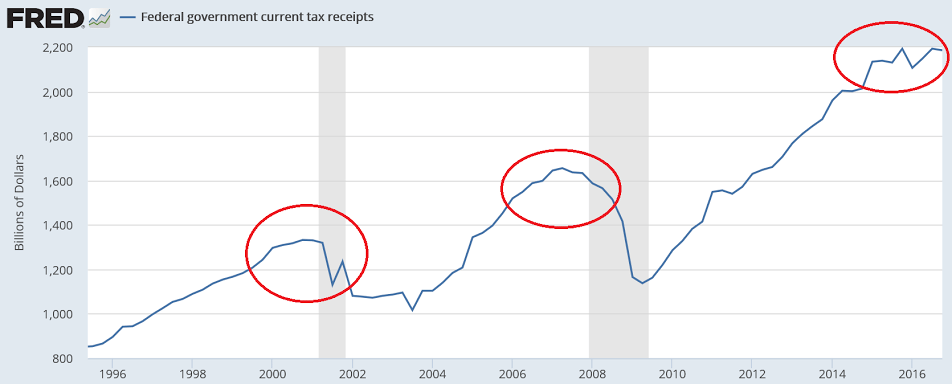
    Trade, Inventories, Tax receipts

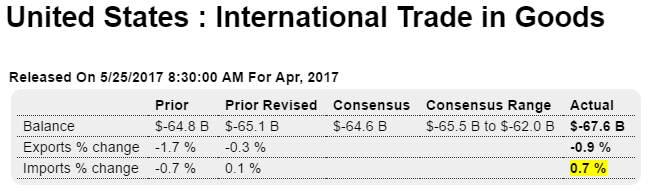
    Larger than expected and last month revised higher, indicating GDP was a bit lower than estimated, and weak sales matched with weak inventories don’t clear the shelves:

    Highlights

    A key early indication on the strength of second-quarter GDP is not favorable as the nation’s goods deficit widened $2.5 billion in April to $67.6 billion. Exports of goods continue to show weakness, down 0.9 percent in the month to $125.9 billion that show sharp declines for vehicles and consumer goods. Imports of goods, which are a subtraction in the national accounts, rose 0.7 percent in the month with consumer goods and agriculture both rising.

    Highlights

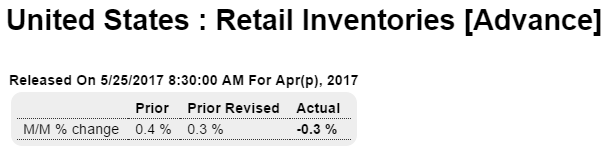
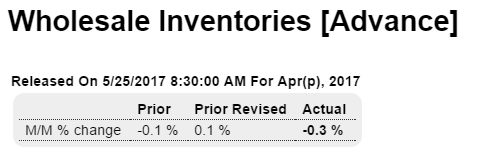
    Also released with this report are advance data on wholesale and retail inventories, both down 0.3 percent in the month and also negatives for GDP.

    A widening trade deficit that includes a weakening in exports is a negative for the economy, pointing to currency outflow and soft global demand. In contrast, the draws in inventories, though negatives for GDP, are positives for the outlook, lowering the risk of unwanted overhang and pointing to the promise of having to rebuild stocks.

    Mnuchin asks for clean debt ceiling increase before August

    “My understanding is that the receipts currently are coming in a little bit slower than expected, and you may soon hear from Mr. Mnuchin regarding a change in the date,” Mulvaney said at a House Budget Committee hearing.

    Mtg purchase apps, Budget, Infrastructure, Healthcare

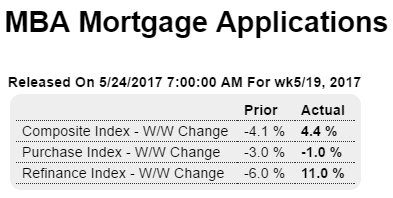
    Not good:

    Highlights

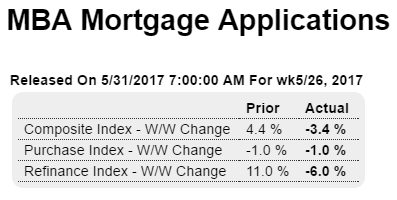
    Purchase applications for home mortgages fell a seasonally adjusted 1 percent in the May 19 week, but refinancing applications rose 11 percent from the previous week to the highest level since March. The drop in purchase applications follows a 3 percent decrease in the prior week and takes the year-on-year purchase index gain down 6 percentage points to 3 percent. Lower rates during the week gave a big boost to refinancing, and the refinancing share of mortgage activity rose to 1.8 percentage points to 43.9 percent. The average interest rate on 30-year fixed-rate conforming mortgages ($424,000 or less) fell to the lowest level since November 2016, down 6 basis points from the prior week to 4.17 percent. The second weekly decline in purchase applications despite more attractive mortgage rates casts further doubts on the strength of the housing market, which opened the year strongly but may be slowing during the Spring selling season, as seen in the significant weakness shown yesterday’s new home sales report for April and housing starts reported last week.

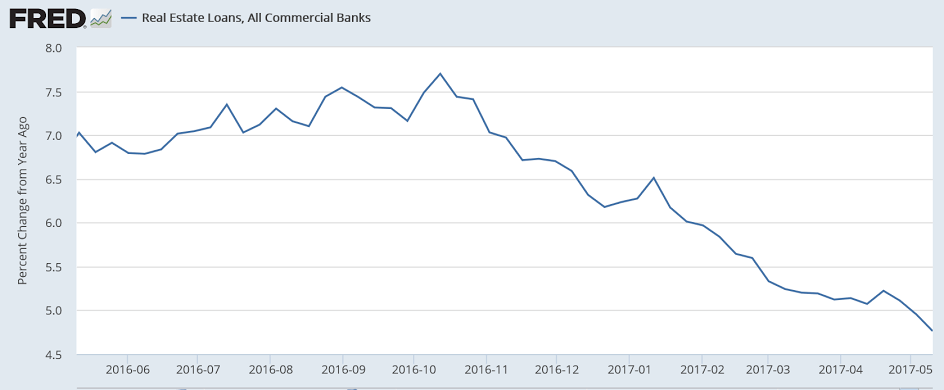
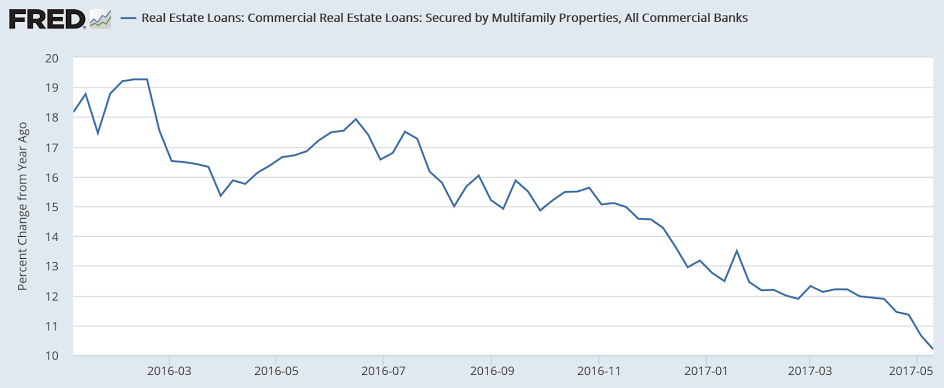
    And this, all confirming the sharp deceleration in mortgage loans as previously discussed:

    If the outcome is anywhere near revenue neutral, seems the tax cuts have far lower multiples than the spending cuts, so it looks to be contractionary overall. Nor do I think ‘mitigating risk for would-be entrepreneurs’ has any chance of overcoming the fiscal drag:
    Trump releases budget that slashes government programs (The Hill) The Trump administration on Tuesday unveiled a budget seeking $1.5 trillion in nondefense discretionary cuts and $1.4 trillion in Medicaid cuts over the course of a decade, while adding nearly half a trillion dollars to defense spending. In 2018, Trump’s budget would shift $54 billion from nondefense discretionary spending to defense by enacting major cuts to government agencies. “We believe in the social safety net. We absolutely do,” Mulvaney said. A well-administered safety net, he continued, could boost economic activity by mitigating risk for would-be entrepreneurs.

    At best a drop in the bucket and even then unlikely to ramp up for at least a year:
    Trump lays out $1T infrastructure vision in budget request (The Hill) The rebuilding plan would inject $200 billion into transportation projects over 10 years, with the goal of creating $1 trillion worth of overall investment. The spending document says the administration would meet its $1 trillion target through a mix of new federal funding, incentives for private sector investment and expedited projects. The proposal will rely on four key approaches: leveraging private sector investment, ensuring federal dollars are targeted toward transformative projects, shifting more services and underused capital assets to the private sector and giving states and localities more flexibility.

    Reads to me like they haven’t made any progress yet and don’t expect to any time soon:

    Senate GOP focused on killing Medicaid expansion (The Hill) “There’s an interest among many of our members having a longer phaseout, a smoother glide path” after repealing the expansion, Sen. John Thune said Tuesday. Thune said the Senate is still likely to change the bill to provide more tax credits to better help low-income people afford health insurance, but acknowledged it’s still a “work in progress.” Thune expressed support for a last-minute provision in the House bill that would allow states to opt out of certain ObamaCare essential coverage requirements. Thune said senators want to have some sort of reinsurance program or high-risk pool to protect people with pre-existing conditions, but haven’t narrowed down their options.

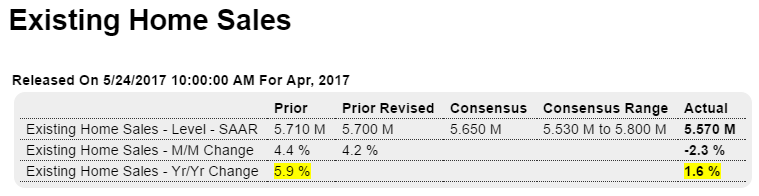
    New home sales, US oil sale, Loan demand, Regulation complaints

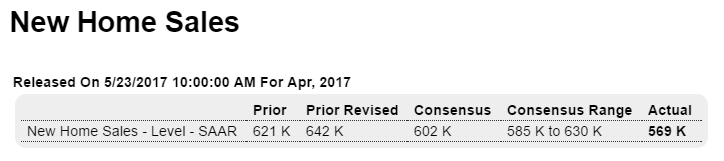
    Seems to be slowing in line with the deceleration in mortgage lending previously discussed:

    Highlights

    In a mixed report that confirms a reputation for unusual volatility, new home sales swung 11.4 percent lower in April to a much lower-than-expected annualized rate of 569,000. The offset is a 40,000 upward revision to March and February, now at 642,000 and 607,000. Averages are essential to evaluate this report and here the news is clearly good, at a 3-month average of 606,000 and just down from March’s expansion high at 611,000.

    But the most recent news for April isn’t so good. Sales slowed even as builders cut prices where the median fell 3.0 percent in the month to $309,200. Year-on-year, the median is down 3.8 percent and is roughly in line with sales which are up only 0.5 percent on the year.

    New supply came into the market but not very much, at 268,000 units for a 4,000 increase. On a monthly sales basis, supply jumped to 5.7 months from 4.9 months to reflect April’s sharp sales decline.

    April was a bad month for all regions especially the West which at a 126,000 sales rate fell 26 percent in the month. Year-on-year, the Midwest is at 73,000 and is far out in front with a 20 percent gain followed by the South at 4.1 percent. The Northeast is down 5.1 percent on the year with the West, in an ominous reading perhaps given the region’s importance to builders, down 13.7 percent.

    One month is never enough to judge new home sales which eases the negative signals from April. But the report does follow last week’s housing starts which also showed significant April weakness. Watch for existing home sales on tomorrow’s calendar for an additional and very important indication on April for a housing sector that opened the year strongly but may be seeing unwanted slowing during the Spring selling season.

    Gets stupider by the day, as the confusion over how the currency works continues to undermine
    underlying public purpose, including national security:

    U.S. plan to sell oil reserve shows declining import needs

    By Henning Gloystein and Dmitry Zhdannikov

    May 23 (Reuters) — U.S. President Donald Trump’s proposal to sell half of the United States’ strategic oil reserve surprised energy markets on Tuesday since it counters OPEC’s efforts to control supply in order to boost prices.

    The White House requested in its budget released late on Monday gradually selling off the nation’s Strategic Petroleum Reserve (SPR) starting in October 2018 to raise $16.5 billion. The U.S. SPR SPR-STK-T-EIA holds 688 million barrels, making it the world’s largest reserve, and a release of half over 10 years averages about 95,000 barrels per day (bpd), or 1 percent of current U.S. output.

    Others taking notice now:

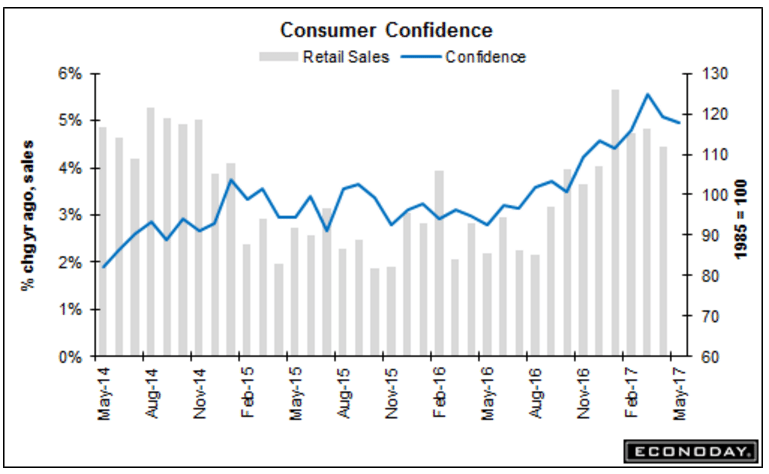
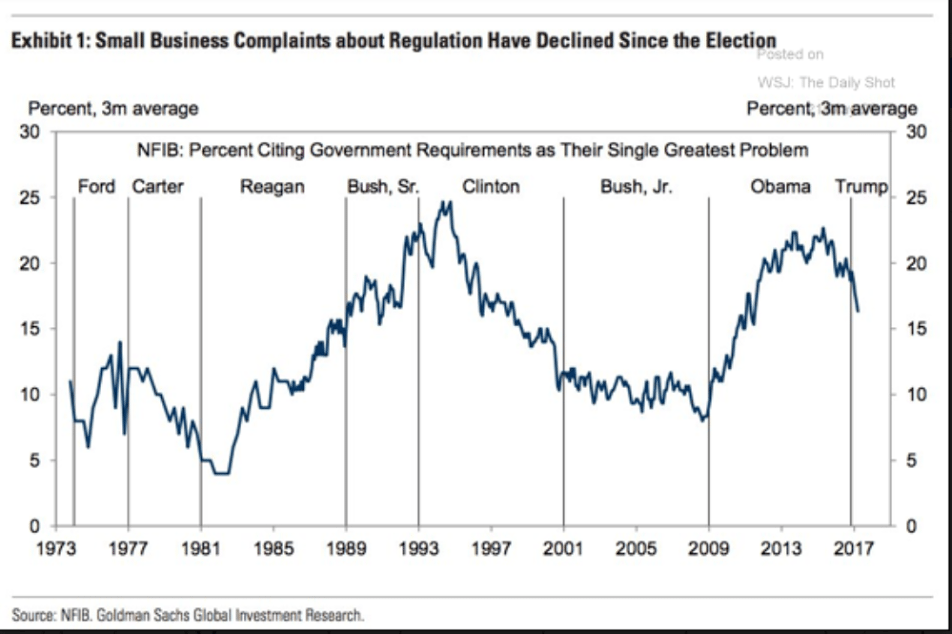
    Tells me how seriously you can take some of these surveys:

    Credit check, Euro area current account

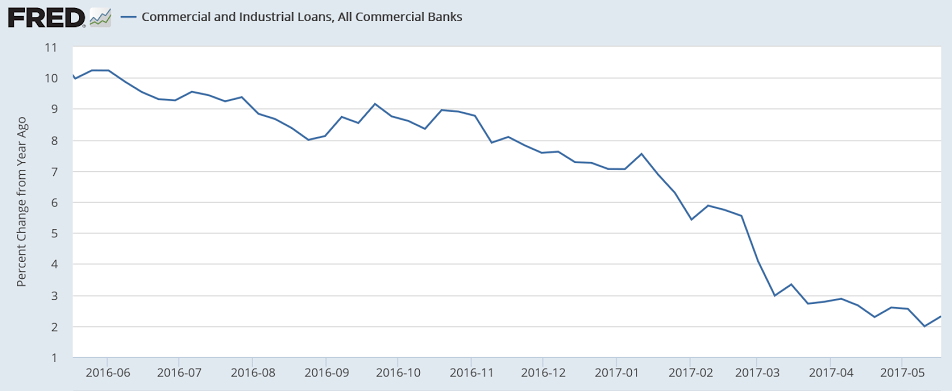
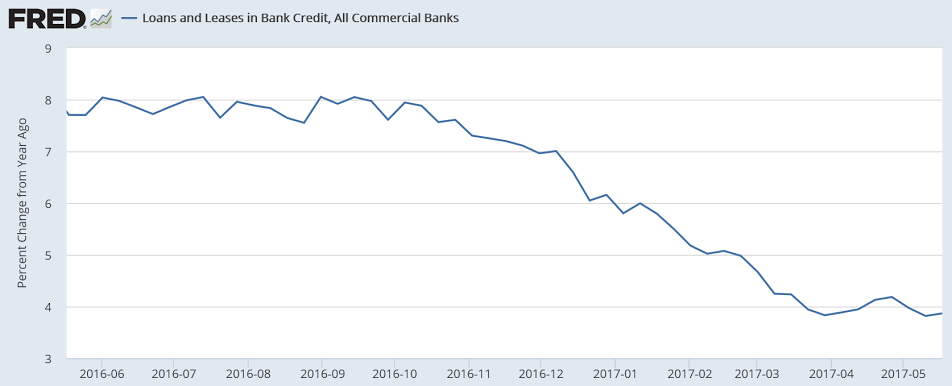
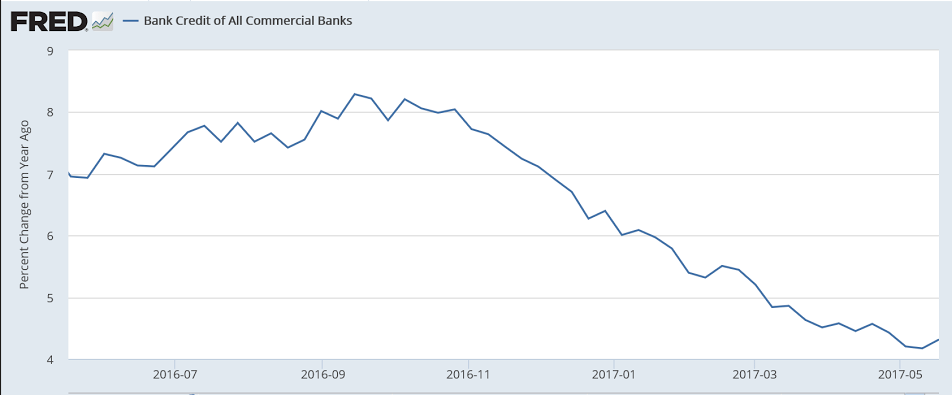
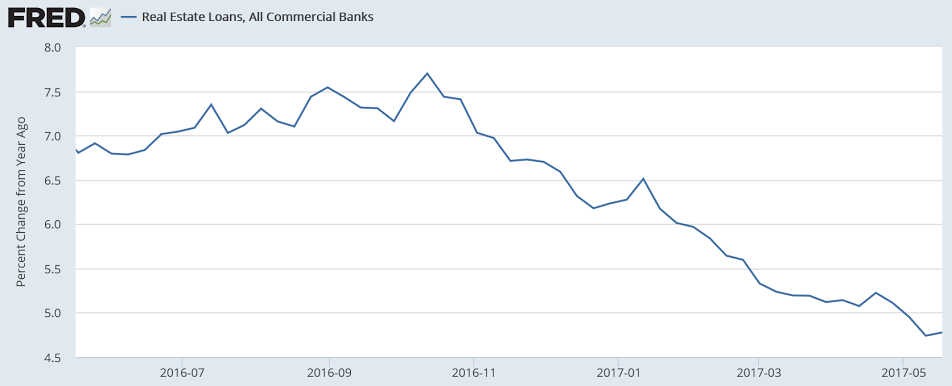
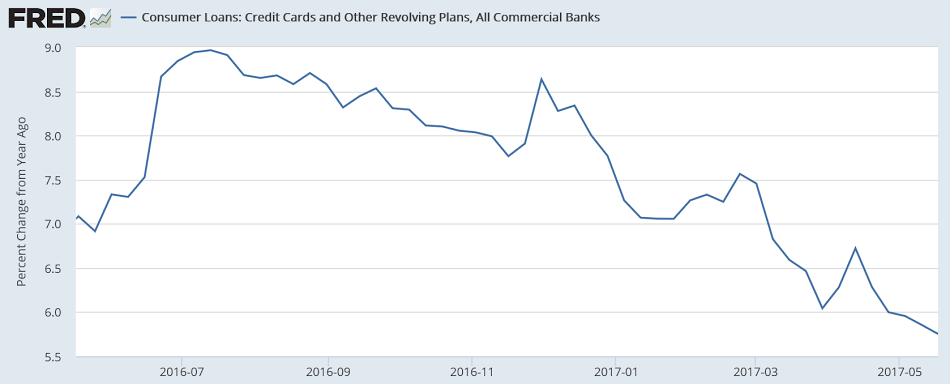
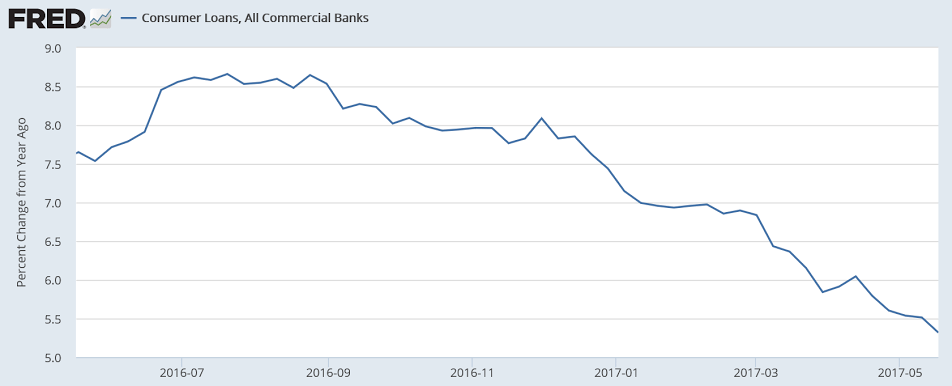
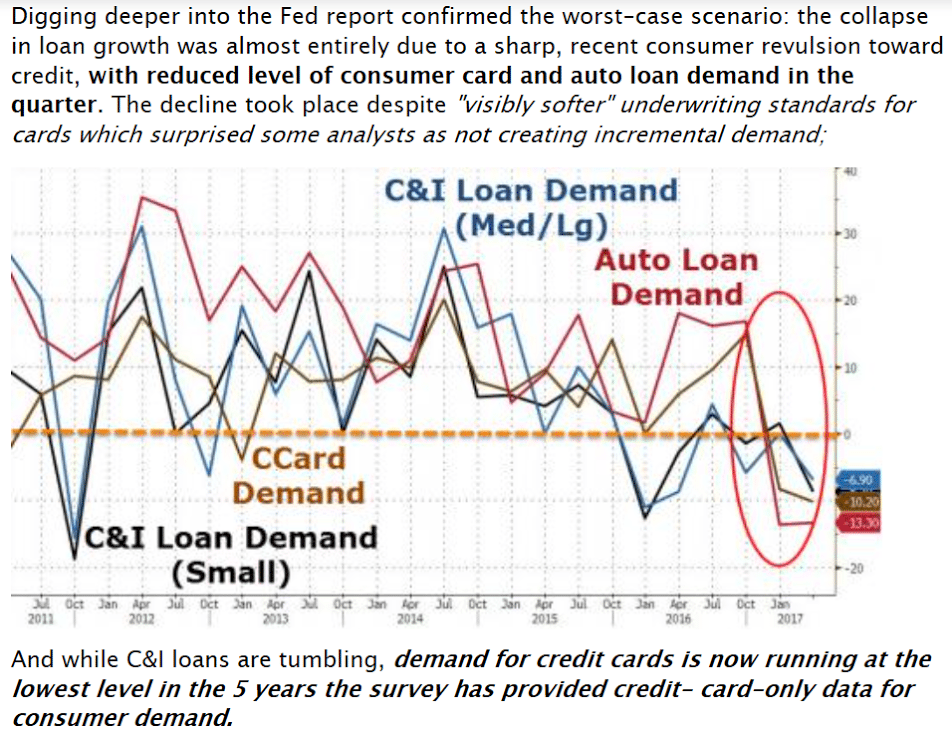
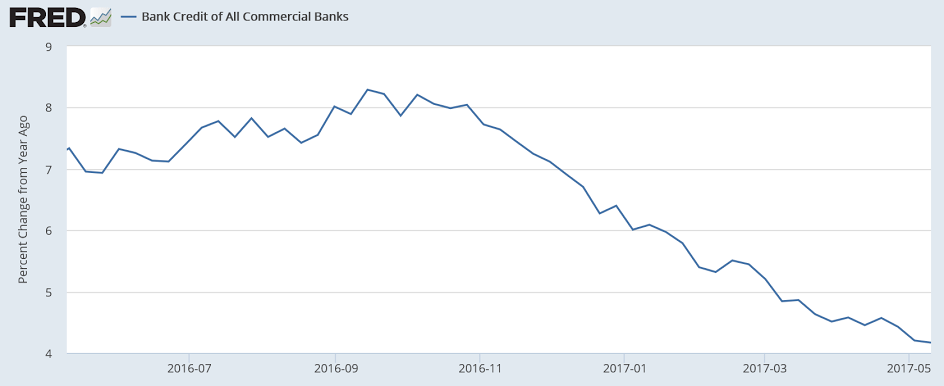
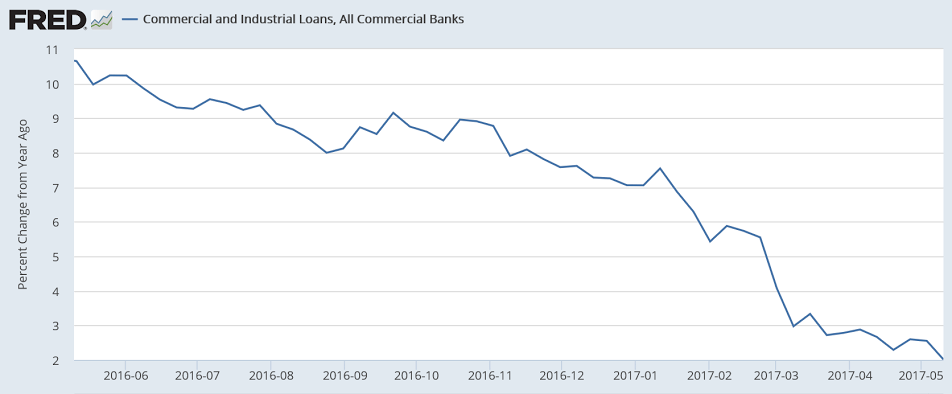
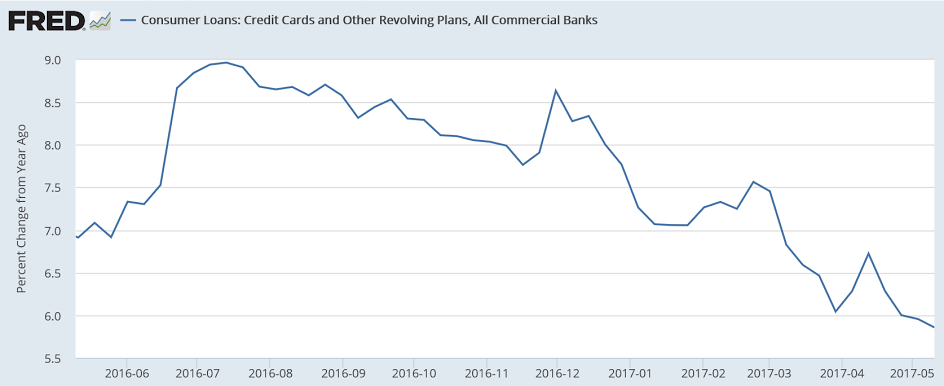
    Going from bad to worse, so the way things are going seems the contribution to year over year GDP growth in q2 from credit expansion will be less than it was in q1:

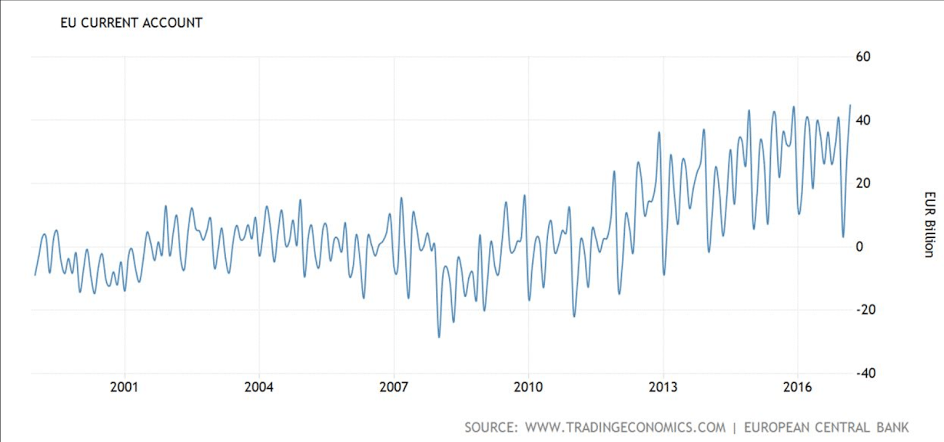
    Never yet seen a current account surplus like this and a weak currency? (Euro area surplus = rest of world deficit, etc.) And the pressure has been building for over 3 years now as fear driven
    portfolio selling, worked to keep the currency down: