Auto sales, Deficit news, Budget news, Germany news, Japan news

Looks like a weak start for 2017:

From WardsAuto: Forecast: January Forecast Calls for Low Sales, High Inventory

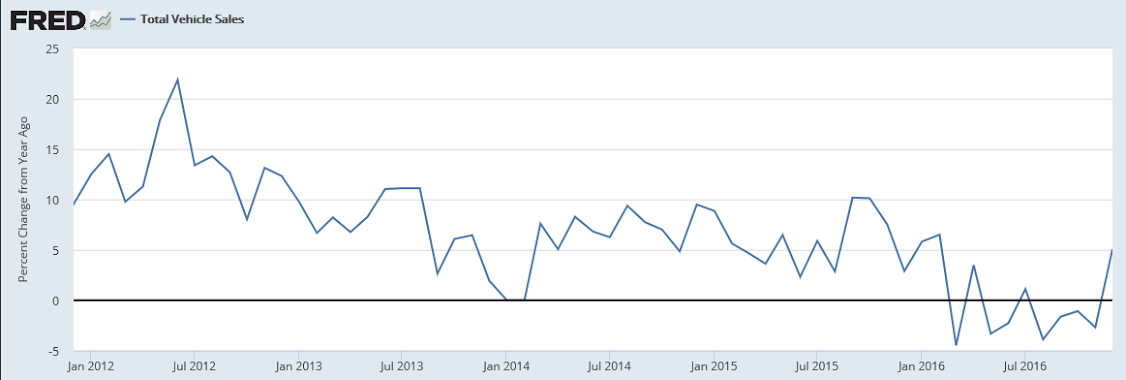
The U.S. automotive industry is expected to a have a slow start in the new year, with January light-vehicle sales down 4.4% from like-2016. … The resulting seasonally adjusted annual rate is 17.0 million units, well below the 18.3 million in the previous month and 17.4 million year-ago.

December inventory was 9.2% above same-month 2015, the biggest year-over-year gap since the summer of 2014. Weak sales in January will keep inventory levels high, 16.0% greater than year-ago. A 93-day supply is expected to be available at the end of the month, a major jump from 62 days in December and 77 in January 2016.
emphasis added

Read more at http://www.calculatedriskblog.com/2017/01/vehicle-sales-forecast-sales-around-17.html#tsmvSK1MApIVDcKE.99

The positive, surprise zig up last month is now forecast to zag back down into negative territory, as previously discussed:
12503

The federal deficit remains far to small meaning the deceleration of the growth of output and employment we’ve seen over the last two years is likely to continue. That said, looks to me like tax revenues will continue to decline over the course of the next year due to earnings and employment weakness and therefore the federal deficit will be larger than this forecast indicates:

U.S. deficit forecast to shrink in 2017 but climb over next decade (Reuters) The CBO projected the deficit to fall slightly to $559 billion in fiscal year 2017, which ends on Sept. 30, compared to $587 billion a year earlier, and it was seen lower still in 2018 at $487 billion. After that, according to the CBO, deficits are expected to grow steadily over the next decade to $1.4 trillion by fiscal 2027. The CBO forecast that $8.6 trillion will be added to the federal debt over the next 10 years. The CBO also forecast U.S. real gross domestic product growth in calendar year 2017 at 2.3 percent, slowing to 2 percent in 2018.

As previously discussed, spending cuts are contractionary/deflationary, and far more potent than the proposed tax cuts:

Conservatives Try to Shape Donald Trump’s Budget Priorities (WSJ) President Donald Trump is expected to release next month the outlines of his first budget that will then be fleshed out later in March or April. Budget experts tasked to oversee the transition at OMB have been using pieces of a budget blueprint advanced by the Heritage Foundation. Altogether, the Heritage plan offers about $97 billion in discretionary spending cuts for the current year, equal to about 8% of discretionary spending and 2% of total spending. It proposed even larger cuts to automatic spending programs, including entitlements, for a combined $10.5 trillion in savings over a decade, or around 20% of all government spending.

More euro friendly news here:

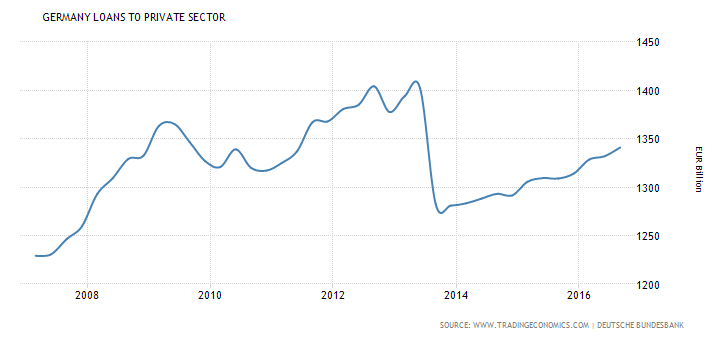
Germany raises growth forecast for 2017 exports, imports (Reuters) Germany expects both exports and imports to grow faster this year than previously forecast, a government source told Reuters on Tuesday, providing an optimistic outlook despite fears of protectionism under U.S. President Donald Trump. The source in the right-left ruling coalition said the government expected exports to grow 2.8 percent in 2017, up from a previous forecast of 2.1 percent. Imports are forecast to grow by 3.8 percent, up from a previous estimate of 3 percent.

Yen friendly news here:

Japan exports up for first time in 15 months, U.S. protectionism poses risks (Reuters) Ministry of Finance data showed on Wednesday that exports rose 5.4 percent year-on-year in December. It followed an annual 0.4 percent decline in November. Shipments in terms of volume also rose 8.4 percent from a year earlier. In December, the value of exports to the United States rose 1.3 percent year-on-year. Exports to China rose 12.5 percent in December to 1.3 trillion yen ($11.44 billion). The data showed Imports fell 2.6 percent in the year to December, resulting in a trade surplus of 641.4 billion yen.
Redbook retail sales, PMI Markit manufacturing, Richmond Fed Manufacturing Index, Existing home sales, Trump budget director, CIA on Trump, Mnuchin on $, Euro area surveys

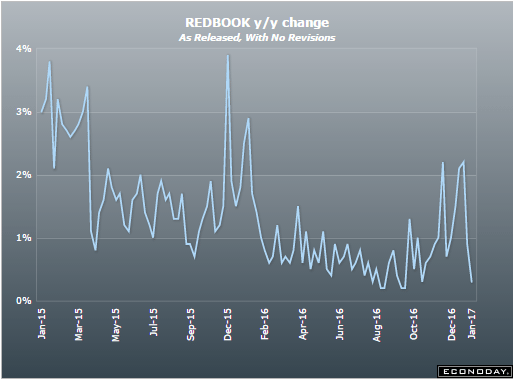
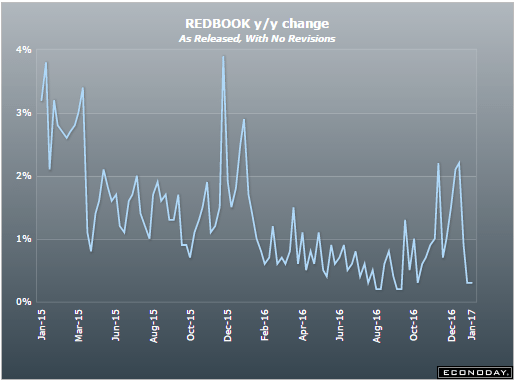
Still back to the lower, pre mini spike levels. Industrial production was up due to elevated utility bills, which might explain why retail sales are low:

12401

Highlights

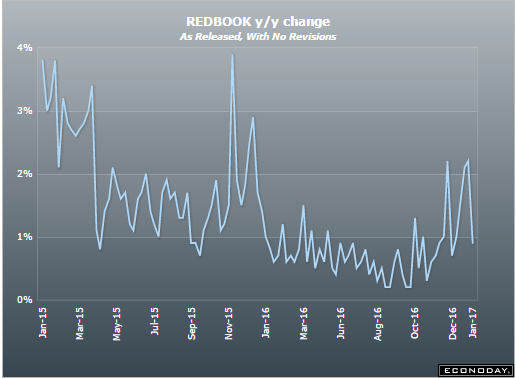
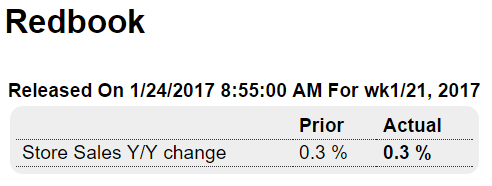
Same-store sales growth continued the glacial pace of the prior week and was up just 0.3 percent year-on-year in the January 21 week, a sharp deacceleration from the 2-percent plus growth seen in the final weeks of December. Versus December, month-to-date January sales were down 3.5 percent, more than twice the decline seen in January last year. Full month year-on-year sales were up just 0.5 percent, down from 1.5 percent in the last week of December and the slowest growth for this reading since early October. The sales growth slowdown in Redbook’s sample continues to point to weakness in core retail sales for January.

12402
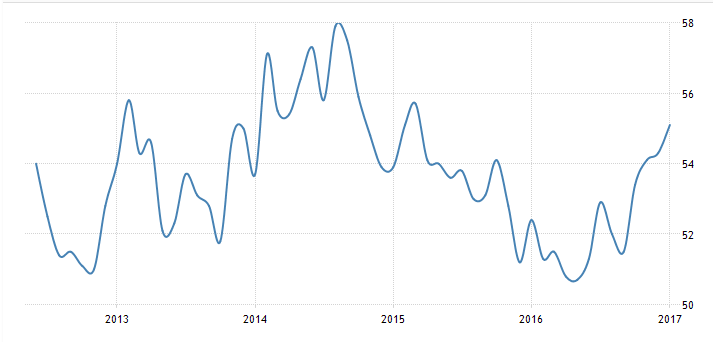
Yes, manufacturing is now muddling through at relative low levels, as weakness has spread to the service sector:

The Flash Markit Manufacturing PMI in the United States increased to 55.1 in January of 2017 from 54.3 in the previous month, beating market expectations of 54.5. It is the highest reading since March of 2015 as new work boosted output and purchasing activity while growth in new export work remained muted and employment eased.

12403

12404
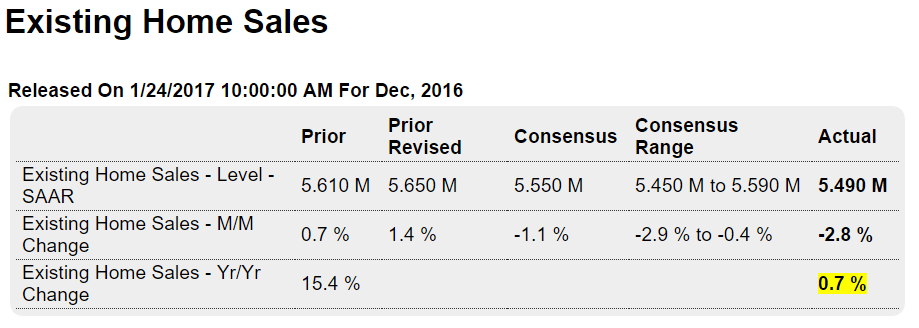
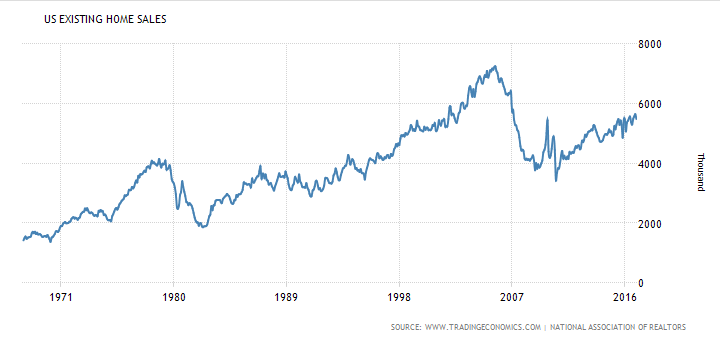
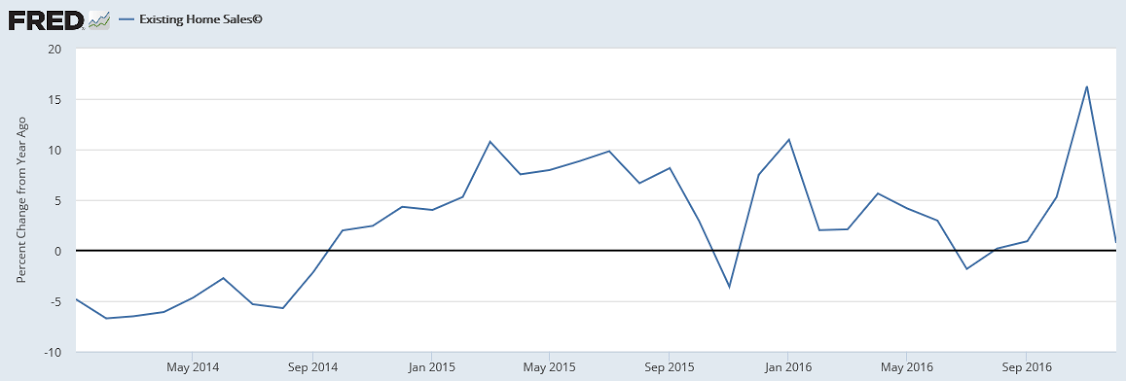
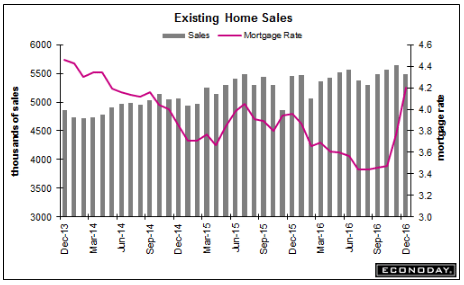
Housing remains depressed, now due to a jump in rates not caused by demand, but by market fears of future Fed actions:

12405

Sales of previously owned houses in the United States slumped 2.8 percent month-over-month to a seasonally adjusted annual rate of 5490 thousand in December of 2016, below market expectations of 5520 thousand. Sales of condos shrank 10.3 percent to 610 thousand and those of single family homes fell 1.8 percent to 4880 thousand. The average price declined 0.9 percent, the months’ worth of supply went down to 3.6 from 3.9 and the supply of houses on the market decreased to 1.65 million, the lowest since 1999. The November figure was revised up to 5650 thousand from 5610 thousand.

12406
A bit of a rush to buy before rates went up, then back down:

12407

12408
Here we go. Net spending cuts or even ‘neutrality’ are likely to be contractionary, as spending generally has a much higher multiple than tax cutting.
And growth has already been decelerating continuously for over two years:

Trump Budget Director Says National Debt Needs Quick Action

By Jennifer Jacobs and Erik Wasson

(Bloomberg) — President Donald Trump’s pick for budget director Mick Mulvaney said the nearly $20 trillion national debt is the equivalent of an ordinary American family owing more than a quarter of a million dollars on their credit cards, a problem that needs to be “addressed sooner rather than later.”
“Families know what that would mean for them,” Mulvaney will say Tuesday in Washington when he faces a pair of Senate committees over his nomination as director of the Office of Management and Budget, according to his prepared testimony. “It is time for government to learn the same lesson.”
A Republican congressman from South Carolina, Mulvaney was part of the wave of fiscal-conservative Tea Party members elected in 2010 and has been one of the most pugilistic advocates for cutting government spending. He is one of eight Trump nominees that Senate Minority Leader Chuck Schumer has placed in “the most troubling” column. More than 50 groups have sent letters to Capitol Hill urging members of Congress to reject Mulvaney’s nomination, arguing he’s too extreme.
Mulvaney has voted against debt ceiling increases and criticized House Speaker Paul Ryan’s budgets for spending too much. If he’s installed in the post — and given the leeway to negotiate his way — the next debt-limit debate could include a fight over whether future spending should be cut to offset money spent in decades past. The debt limit returns in March, so those discussions aren’t far away.
He will appear before the Budget Committee in the morning and the Homeland Security and Governmental Affairs Committee in the afternoon.

Earned Honestly

“I believe, as a matter of principle, that the debt is a problem that must be addressed sooner, rather than later,”
Mulvaney said in the remarks provided in advance of the hearings. “Part of fixing that problem also means taking a hard look at government waste…and then ending it. American taxpayers deserve a government that is efficient, effective, and accountable. American families earn their money honestly; they expect the government to spend it honestly. We owe them that much.”
Still, Mulvaney said he appreciates the safety net that Social Security and Medicare provide, and would like them to be there for his three children, who are triplets.
Mulvaney is a founding member of the House Freedom Caucus, hardline Republicans who have opposed compromising with Democrats just to keep the government operating during budget disputes. He helped lead the 2013 effort that resulted in a government shutdown over Obamacare funding.
“I will be loyal to the facts, and to the American people whom I serve,” he said in the prepared remarks.

At Odds

Mulvaney’s long-held position that new spending must be offset with equal cuts elsewhere could put him at odds with the president when it comes time to make good on Trump’s campaign promise to invest $1 trillion in roads, bridges and other infrastructure. He was on the losing side of a push to ensure spending on Hurricane Sandy relief was matched with reductions in other parts of the government.
Mulvaney has voted for unsuccessful proposals that sought to cut spending deeply enough to bring the federal budget into balance within a five-year window. Those proposals by the Republican Study Committee, a faction of fiscal conservatives, included raising the Social Security full-benefits age to 70 and changing the measure of inflation to reduce the retirement program’s payouts.
On the campaign trail, Trump promised he wouldn’t cut Social Security.
The most recent version of the group’s budget proposal would have given an extra $38 billion to the military while reducing domestic spending by $100 billion, in part by eliminating the National Endowment for the Arts and the Kennedy Center and ending funding for the Washington, D.C.-area’s metro transit system.
While a majority of congressional Republicans supported using a war-funding account for regular military needs, Mulvaney worked with Maryland Democrat Chris Van Hollen to demand all routine Pentagon purchases stay within legal spending caps.
Mulvaney’s opposition to that cap-skirting maneuver could become another pressure point, given Trump’s promise to beef up troop levels and weaponry.
Congress is expecting the administration to send up an emergency military spending request in the next few weeks.

The CIA on how they will ‘manage’ their approach to President Trump:

CIA starts recruiting its newest asset Donald Trump

The key to Trump? “He likes to win. He has a nostalgia for a period in history when U.S. always won,” Medina said. So on climate change, for instance, rather than pointing out that there’s science behind it, or that the U.S. needs to set an example, an analyst could point out that the solar energy business is likely to be a “gazillion-dollar business and the U.S. wants to be the winner,” she said. “That’s not politicizing the intelligence, it’s talking to the consumer.”
If Trump’s style means talking to him rather than giving him a written report, that’s fine, said former Acting CIA Director John McLaughlin.

As previously discussed:

Mnuchin Says Excessively Strong Dollar May Hurt U.S. Economy (Bloomberg) U.S. Treasury Secretary nominee Steven Mnuchin said an “excessively strong dollar” could have a negative short-term effect on the economy. “The strength of the dollar has historically been tied to the strength of the U.S. economy and the faith that investors have in doing business in America,” Mnuchin said in a written response to a senator’s question about the implications of a hypothetical 25 percent dollar rise. “From time to time, an excessively strong dollar may have negative short-term implications on the economy.”

Strong euro stuff:

Private sector growth slows slightly but manufacturing remains buoyant (Markit) Flash Germany PMI Composite Output Index at 54.7 (55.2 in December). Services PMI Activity Index at 53.2 (54.3 in December). Manufacturing PMI at 56.5 (55.6 in December). Manufacturing Output Index at 57.6 (57.0 in December). As was the case with activity, manufacturers outperformed service providers with regard to new order growth. New export work in the goods producing sector rose at the steepest rate since September 2016. Despite robust growth of new work, volumes of outstanding business at German private sector firms rose only fractionally.

Mtg apps, Redbook retail sales, Industrial production, Housing market index, CPI, Euro zone and US sectoral balances

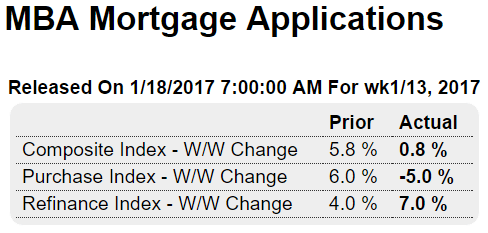
Back down again, in spite of Trumped up expectations, and going nowhere:

11801

Highlights

Purchase applications for home mortgages fell a seasonally adjusted 5.0 percent in the January 13 week, while applications for refinancing rose 7 percent. Unadjusted, the purchase index increased 25 percent compared to the previous week, however, taking the year-on-year comparison up 17 percentage points from the prior week to minus 1 percent, a strong recovery but still sharply below the 10-percent plus readings seen in October.

All the way back down, as previously discussed:

11802
There are Trumped up expectations and undesired auto inventory building, and then there’s the reality of a very weak economy:

11803

Highlights

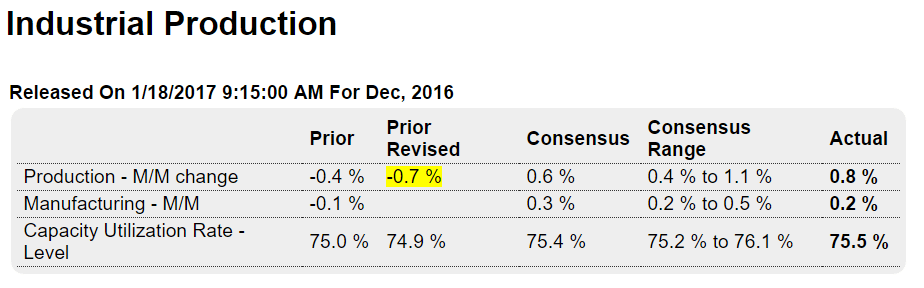
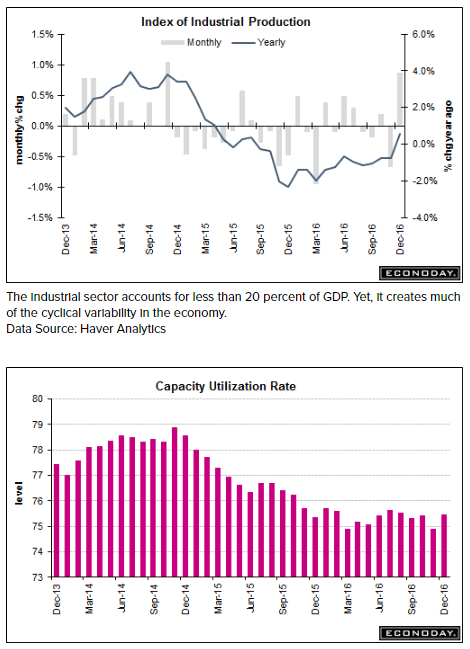
A weather-boosted 6.6 percent surge in utility output fed an outsized 0.8 percent gain in industrial production for December, one that follows however a downward revised and very sharp 0.7 percent decline in November. The monthly surge for utilities is the greatest since December 1989.

The big story in this report, however, is another soft reading for manufacturing production where volumes rose only 0.2 percent in the month. And if it wasn’t for a sharp 1.8 percent gain in the vehicle subcomponent, manufacturing would have shown no change at all.

Mining, which together with utilities and manufacturing, is a main component of the report, and production here was unchanged. Year-on-year rates show mining still at the rear at minus 2.8 percent with utilities at plus 6.2 and manufacturing no better than December’s monthly rate, only 0.2 percent higher.

Overall capacity utilization rose a sizable 6 tenths to 75.5 percent with the manufacturing component, however, up only 1 tenth to a still subdued 74.8 percent rate in a reminder that excess capacity holds down goods inflation.

The factory sector, hit by weakness in exports and also energy equipment, struggled through 2016 and apparently could not manage a solid year-end rally. But yesterday’s Empire State did offer a positive advance look on January’s conditions with the next advance look on Thursday from the Philly Fed.

Industrial Production +0.8% and Capacity Utilization 75.5% in Dec. The monthly increase was driven by a jump in consumer durables, mostly autos, which outweighed the drop in home electronics, to fuel a 1.1% gain, after a 1.0% drop in November. The main impact came from changes in Utilities output, which rebounded 6.6% in December following the 4.6% decline for November as colder weather boosted output.

11804

11805
Trumped up expectations starting to fade:

11806

Highlights

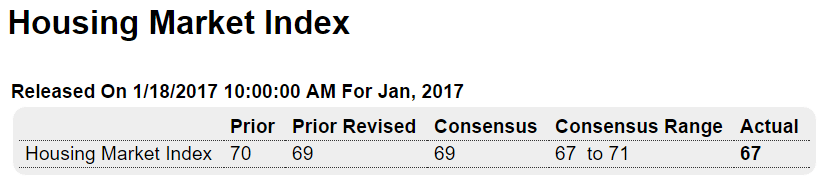
Home builders are as confident as they have been since the sub-prime boom 10 years ago. The housing market index in January is 67, down just 2 points from a revised and cycle high of 69 in December.

All the components are strong but strength at the rear is the big story. Traffic held over 50, edging only 1 point lower to 51 for, along with December, the only plus-50 readings in 11 years. Traffic had been very low all cycle and this improvement is an indication of new demand for new homes.

Sales readings remain very high, at 72 for current sales and 76 for sales 6 months out. These readings hint at strength for tomorrow’s housing starts & permits report.

The West remains the favorite region for home builders with a 3-month average score of 79. The South follows at 67, the Midwest at 64, and the Northeast far back at 52 but coming out of sub-50 contraction.

The rise in mortgage rates isn’t denting any of the enthusiasm among home builders for what they see ahead as another strong year, perhaps an even stronger year.

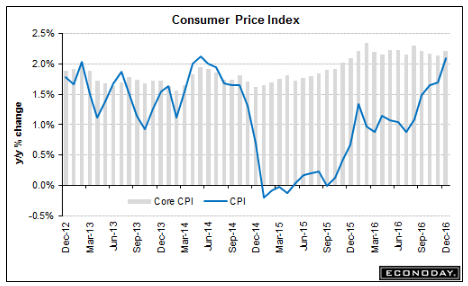
Currently running at about the Fed’s presumed target rate of 2% due to recent hikes in energy prices:

11807

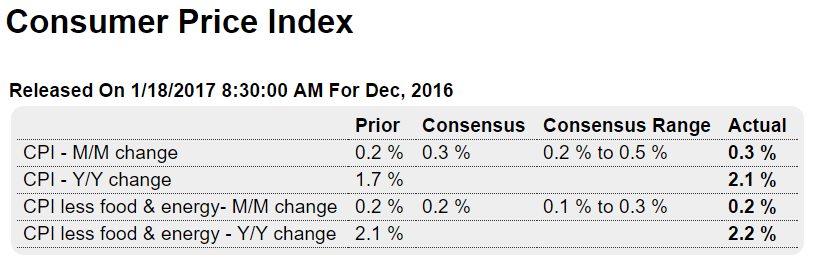
Highlights

Energy prices are moving higher and are lifting the overall rate of consumer inflation, which now nearly matches the core rate (less food & energy). The CPI rose 0.3 percent in December to lift the year-on-year rate by 4 tenths to 2.1 percent. This yearly rate had been badly trailing the core rate for the past 2-1/2 years, since the oil price collapse in the summer of 2014. Now the overall rate compares with 2.2 percent for the core rate which rose a modest 0.2 percent in December.

11808
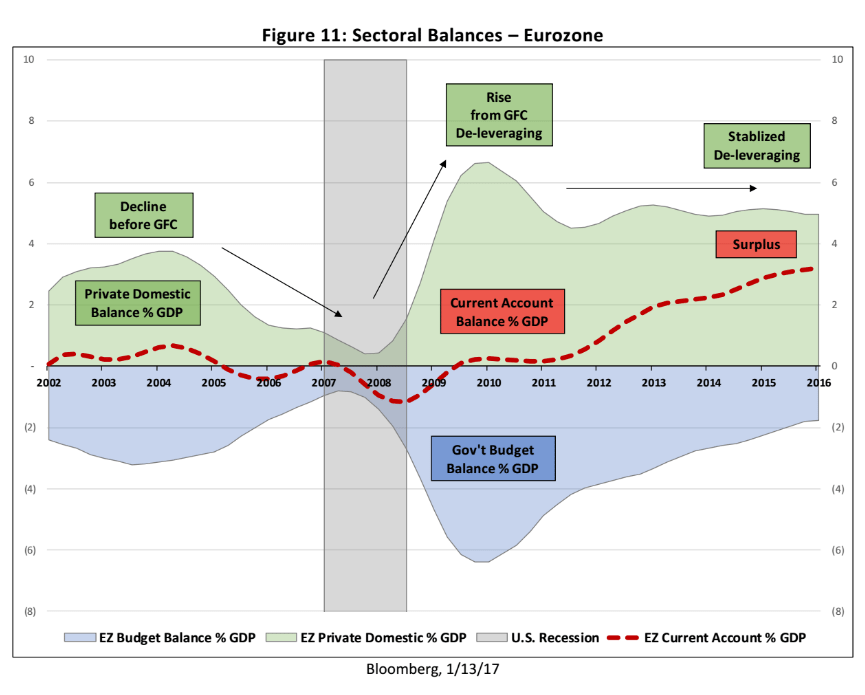
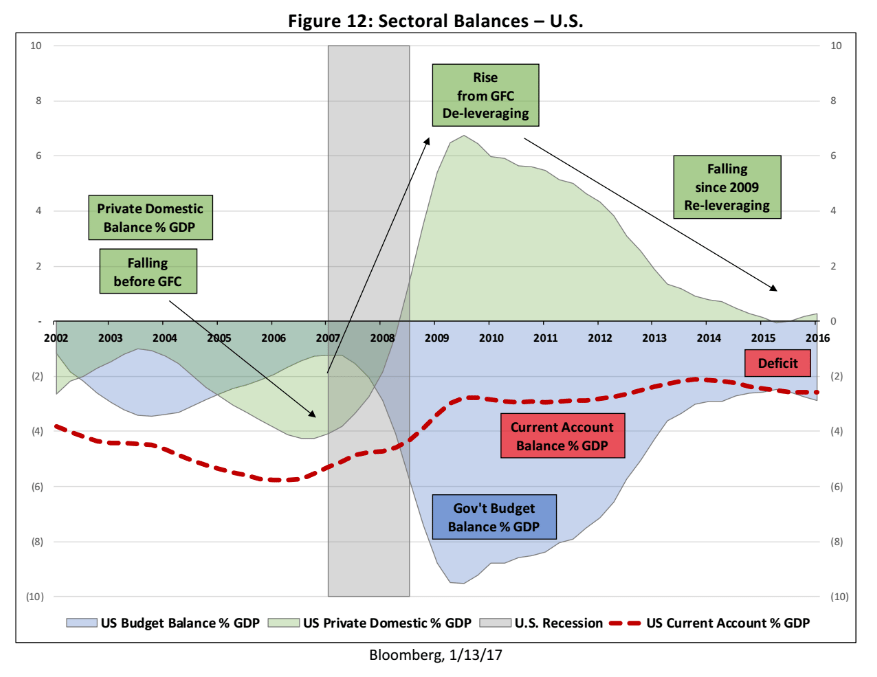
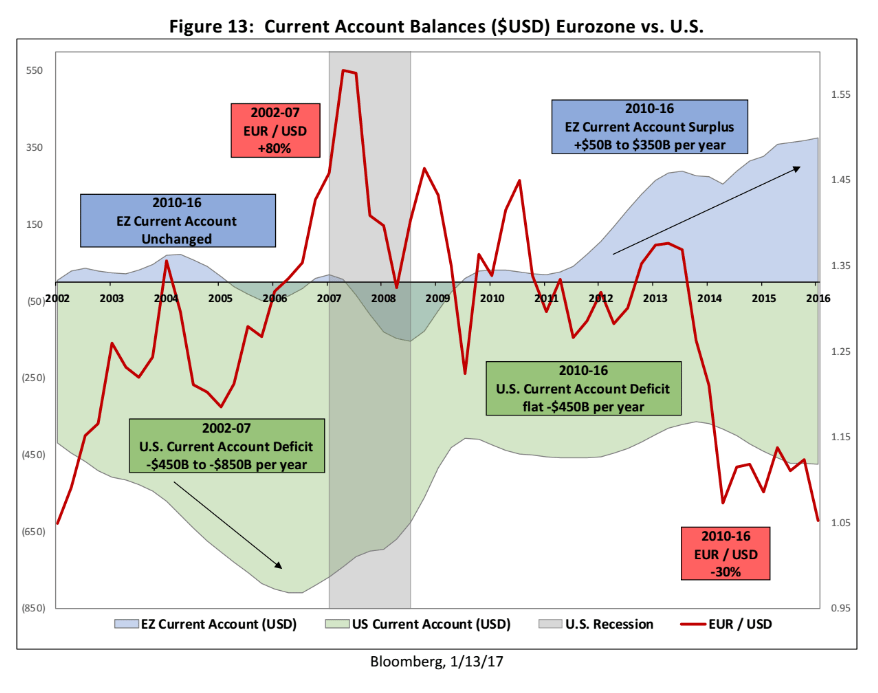
Porfolio managers have driven the euro down to levels that are supporting a large and growing current account surplus, while the US current account deficit has remained elevated even with the decline of oil prices that historically would have reduced the US current account deficit. The difference is due to the decline in domestic oil output and the rise of oil imports that followed the oil price declines.

As long as the current account surplus is sustained, the euro zone economy will have that much support as indicated by the Private Domestic Balance in green below. Likewise, the near 0 US Private Domestic Balance also in green, below, indicates that domestic sector will likely remain depressed.

Should, however, the portfolio shifting run its course, the trade flows will then firm the euro vs the $ until the trade flows reverse course:

11809

11810

11811

(charts from epc)

11812

Retail sales, Business inventories, Consumer sentiment, China exports, German GDP

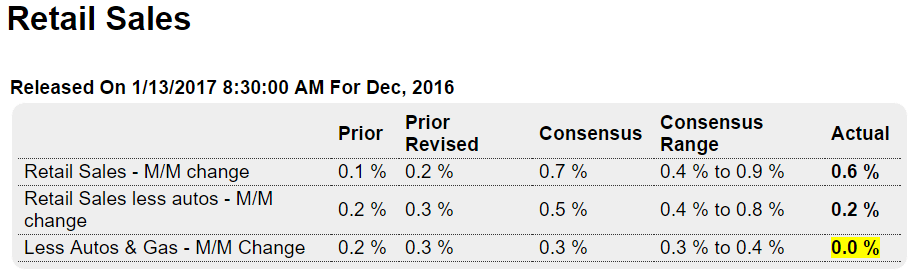
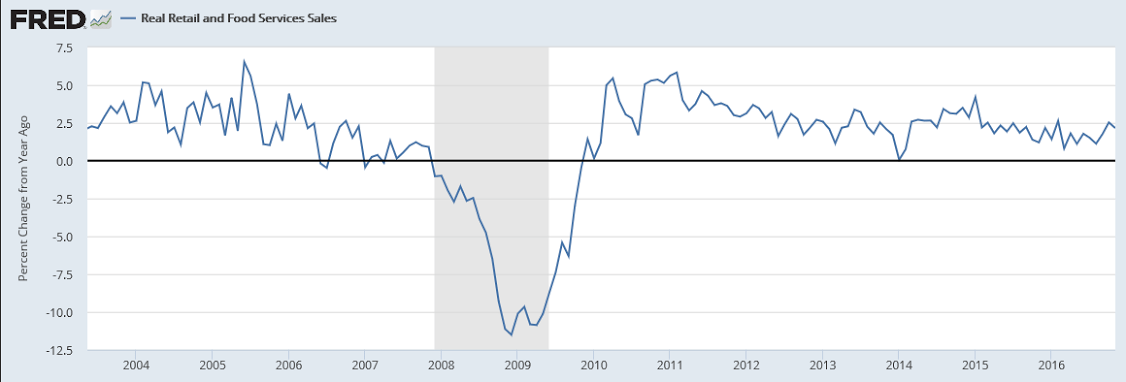
Less than expected and held up by vehicle sales which were about flat for the year and are unlikely to be any better than that in 2017, and therefore not contributing anything to growth:

11301

Highlights

Outside of cars, consumers weren’t in much of a spending mood this holiday season. Retail sales did post a very solid gain in December, up 0.6 percent, but without autos the gain falls to only 0.2 percent. And exclude gasoline as well, which isn’t really a common holiday gift, and sales come in dead flat at zero.

And gifts were on the light side this year based on department store sales which fell 0.6 percent in the month and also electronic & appliance stores where sales fell 0.5 percent. And in a clear sign of discretionary weakness, restaurant sales fell 0.8 percent for the largest monthly decline in a nearly year.

Vehicle sales, which jumped 2.4 percent in the month, pull the report to the upside as do gasoline sales which rose 2.0 percent. But retail sales excluding gasoline do show a very solid 0.5 percent vehicle-driven gain and underscore that this report, despite the softness in holiday categories, is still a solid plus for fourth-quarter GDP. And there are positives led once again by ecommerce as nonstore retailers saw a 1.3 percent monthly rise.

The bottom line is best characterized by apparel where sales were flat, posting no change for the second month in a row. Consumer spirits may be very high, and if this benefited retail sales in December it was mostly isolated to vehicles.

11302
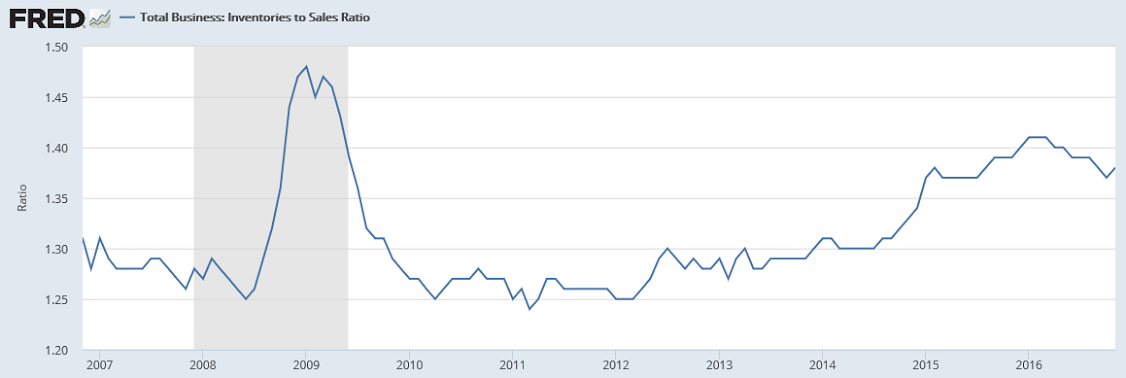
More bad news on inventories which were already way too high:

11303

Highlights

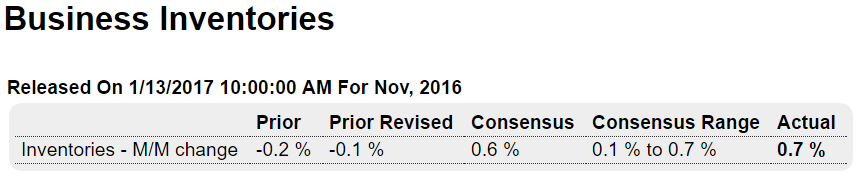
Data on fourth-quarter inventories are looking heavy, up 0.7 percent in November in an offset to a revised 0.1 percent draw in October. Both retailers and wholesalers show large 1.0 percent builds in November with manufacturers at a 0.2 percent build. Given weakness in total sales, up only 0.1 percent, the stock-to-sales ratio rose 1 tenth in the month to 1.38.

11304
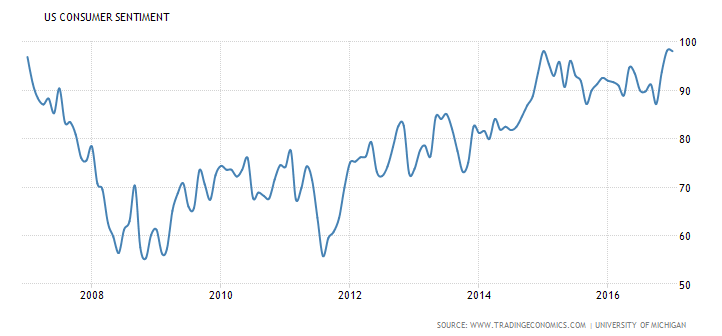
Still trumped up but moderating some:

11305

Post-election confidence readings have been very high but have not equated to the same proportional punch for consumer spending which, nevertheless, has been respectable. The report notes that partisanship is extreme right now with 44 percent of the sample citing the importance of government policies (whether positive or negative). The cycle average for this reference is 20 percent.

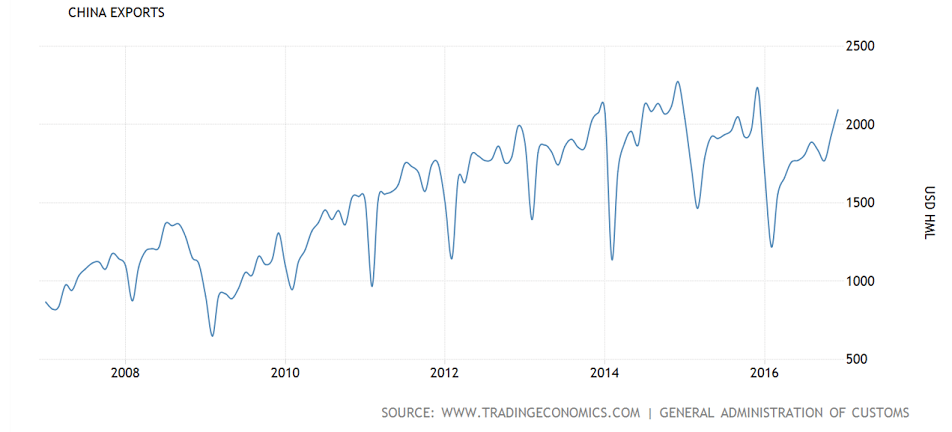
Exports from China declined by 6.1 percent from a year ago to USD 209.42 billion in December of 2016, following a revised 1.6 percent drop in the prior month while markets expected a 3.5 percent drop. Considering the full year of 2016, sales fell 7.7 percent, the second straight year of decline and the worst since the depths of the global crisis in 2009. In yuan-denominated terms, exports rose 0.6 percent from a year earlier, following a 5.9 percent rise in a month earlier. From January to December of the year, sales dropped by 2 percent.

11306
Improving global environment?

German GDP Grows at Fastest Rate in Five Years

By Nina Adams and Andrea Thomas

Jan 12 (WSJ) – Gross domestic product expanded 1.9% in 2016 in inflation-adjusted terms, the Destatis statistics body said on Thursday. This is the highest rate since 2011, beating the government’s own prediction of 1.8% growth. A statistician with Destatis said GDP probably expanded by around 0.5% in the fourth quarter from the third quarter. An official forecast is due Feb. 14. “The restraint seen in the third quarter has been overcome,” the economics ministry said in its monthly report on Thursday, pointing to solid industrial production and an improving global environment.

Interesting divergence?

11307

11308

US budget gap, Jobless claims, Retail employment, Rail cars

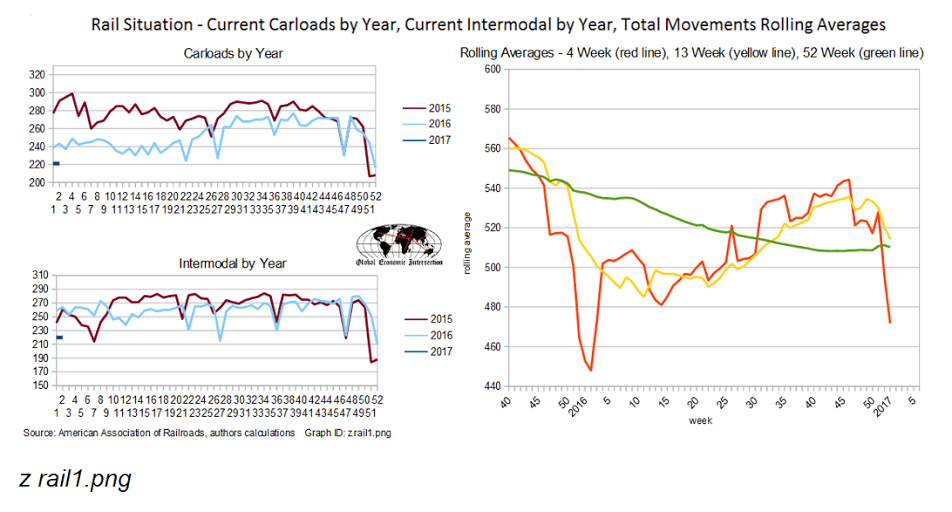
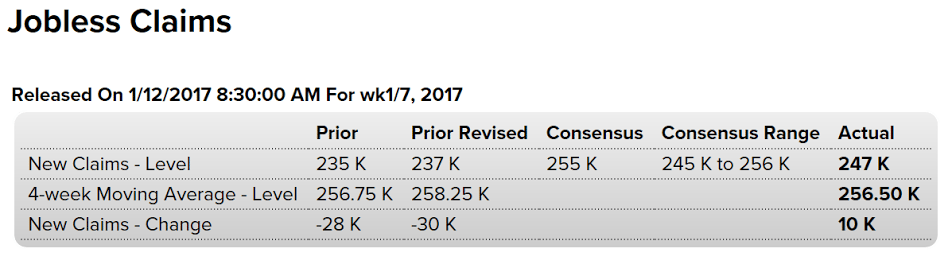
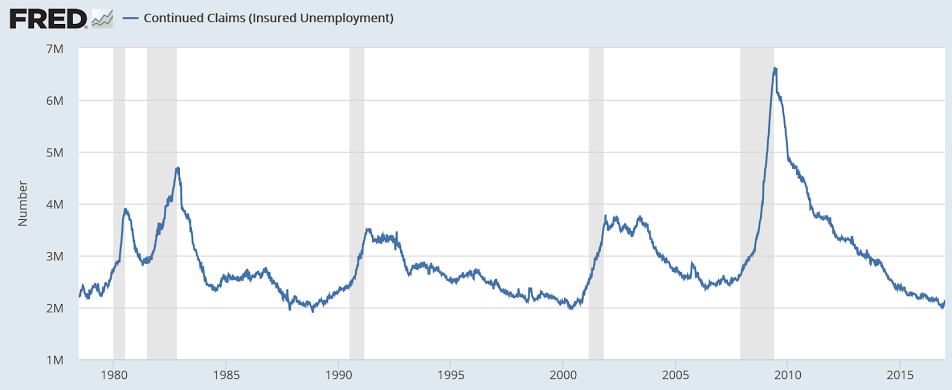
Seems revenues continue to fall indicating the two years of deceleration of growth may have already gone below 0, and with unemployment claims a lot harder to get that source of transfer payments seems to have been reduced, reducing what otherwise would have been that much counter cyclical deficit spending:

US Budget Gap Doubles in December

The US government reported a $28 billion budget deficit in December, a 94.4% increase from a $14.4 billion gap a year earlier and slightly above market expectations of a $25 billion. Receipts slumped 8.9% to $319 billion and outlays fell 4.7% to $347 billion.

Three months into the government’s fiscal year, the budget deficit is at $208.4 billion vs $215.5 billion this time last year. Outlays are down 3.3 percent so far this fiscal year with Medicare down 11 percent to offset a 16 percent rise in net interest. Receipts are down 3.2 percent with corporate income tax down 11 percent. The deficit for December totaled $27.5 billion.

11201

This chart is not population adjusted!

11202

Employment in the sector grew by 672,700 workers during the three-month holiday hiring period of 2016, according to an analysis of government employment data by global outplacement consultancy Challenger, Gray & Christmas, Inc. That was down 9.0 percent from the 738,800 jobs added in 2015.

This marked the third consecutive decline in holiday employment gains. The 2016 -holiday hiring total was the lowest since 647,600 jobs were added to retail payrolls during the closing months of 2010, when the economy was in the first year of recovery following the Great Recession. Said John A. Challenger, chief executive officer of Challenger, Gray & Christmas:

The retail landscape is going through a sea change. The shift toward online shopping has being ramping up for years. It is obvious in the sales numbers and in the falling level of in-store traffic during the holidays. In this environment, retailers simply don’t need as many extra workers during the holidays.

Bad start:

11203

Small business index, Redbook retail sales, Jolts, Consumer credit, Retail sales forecast

Still Trumped up expectations:

11001

Highlights

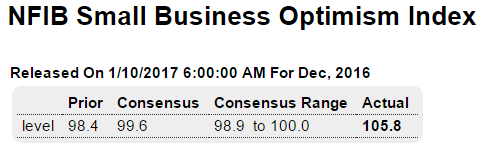
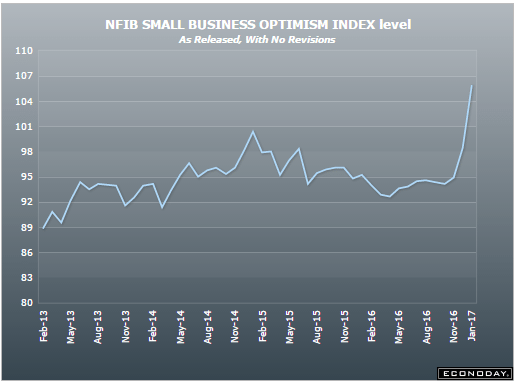
The small business optimism index soared 7.4 points in December to 105.8, the highest reading since December 2004. The outsized increase far exceeds expectations and follows a robust 3.5-point rise in November. NFIB said business owners who expect better economic conditions accounted for about half of the overall increase, with a net 50 percent of respondents expecting that the economy will improve, a 38 point leap up from November.

In a magnified repetition of the survey results for November, all but 2 of the 10 components posted gains. The two other optimism components making a big contribution to the index were higher real sales expectations, up 20 points to 31, and the view that now is a good time to expand, which was up 12 points to 23.

Capital outlays also figured prominently, with plans to increase capital spending jumping 5 points to 29 and 63 percent of respondents reporting outlays in December, 8 points more than in November. Even earnings trends were up 6 points, but remained in negative territory at minus 14.

Optimism was somewhat subdued on the jobs front, however, as plans of owners to increase employment rose just 1 point to 16 and current job openings registered a 2-point decline, albeit to a still strong 29. According to NFIB, the labor market is getting tighter, allowing workers to ask for better wages, but small business owners are not yet confident enough to raise prices to offset any increase in labor costs. Higher interest rates apparently accounted for the drop in the other declining component, expected credit conditions, which fell 2 points to minus 6.

11002
As previously discussed, looking like the spike is probably a one off event, same as last year:

11003
Whatever this is, looks like it’s already rolled over…

11004
Looks like the unsold inventory isn’t under control yet, especially autos where productions cuts are underway:

11005

Highlights

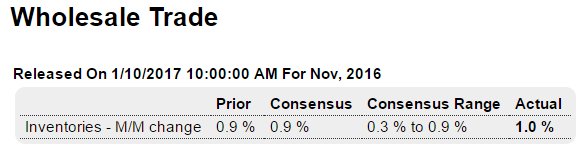
Wholesale inventories rose very sharply in November, up 1.0 percent compared to 0.9 percent in the advance report and a draw of 0.1 percent in October. The good news is that November’s build is centered in autos (+3.2 percent) where retail sales proved very strong in December. Sales at the wholesale level rose 0.4 percent which compared to the larger gain in inventories pulled up the stock-to-sales ratio to a less lean 1.32 from October’s 1.31. Excluding autos, however, the ratio held unchanged at 1.27.

Inventories were heavy going into the fourth quarter and though September proved stable, early indications on November inventories (which also include retail and manufacturing) are pointing to a big build. Whether this build will prove a problem for production and employment in the first quarter will depend on how strong consumer spending was during the holidays. Watch for December retail sales on Friday morning followed at midmorning by the business inventories report.

Production cutbacks building as US momentum slows

OEM discipline will be tested as sales growth slows. Already there are announcements of coming production cuts to manage inventory, writes Megan Lam

11006

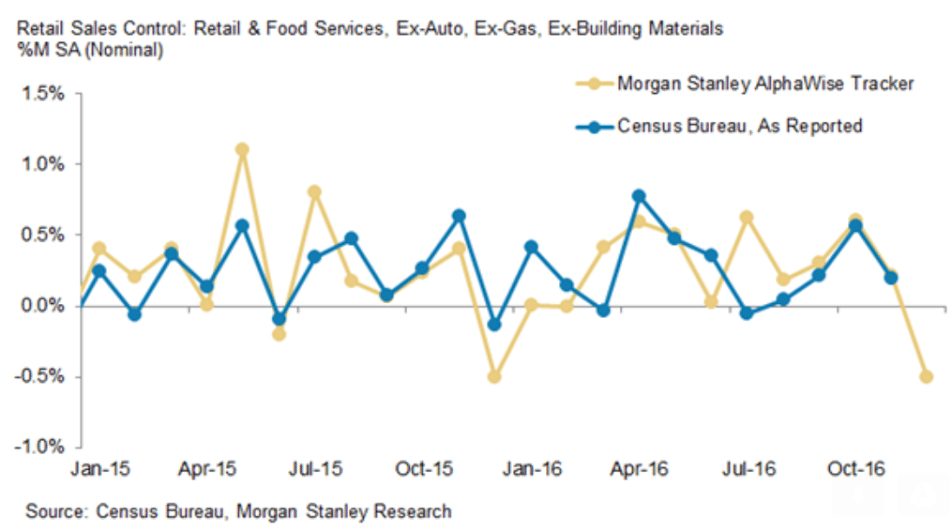
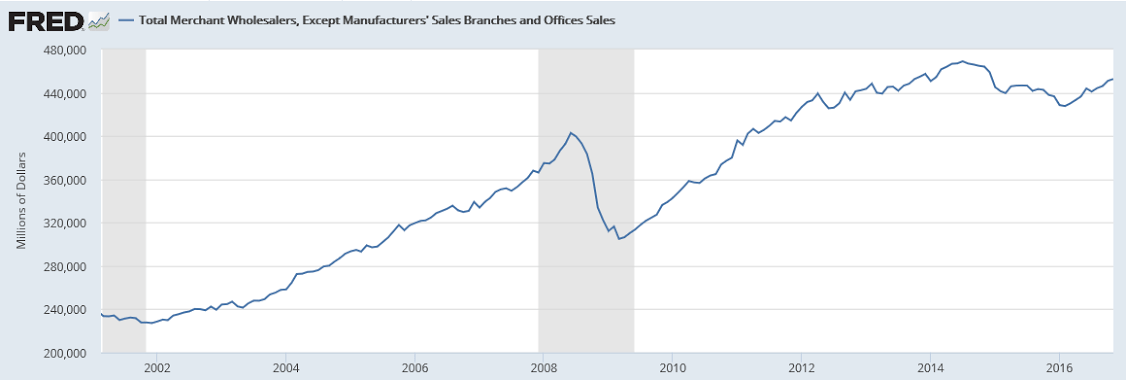
Total sales (not adjusted for inflation) are still below 2014 levels:

11007

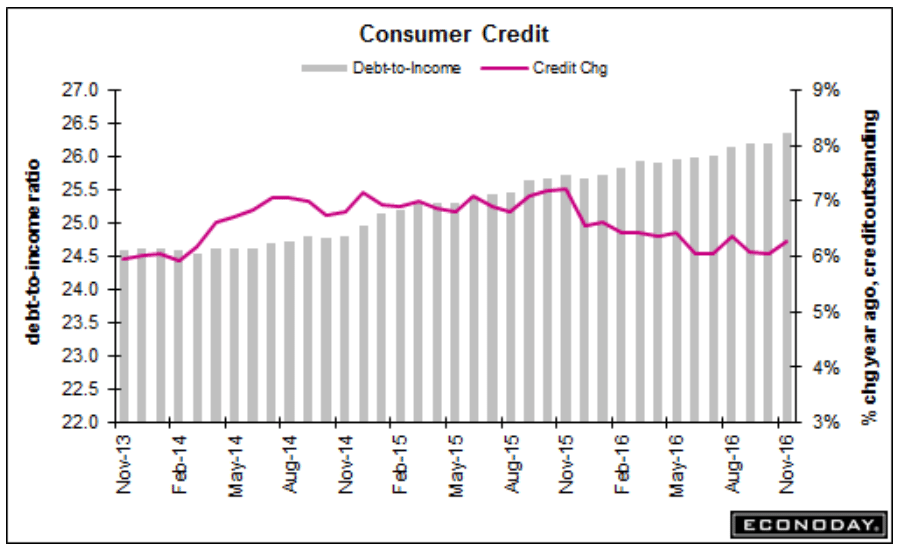
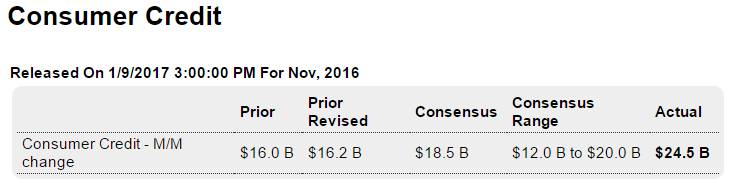
A bit stronger than expected but the year over year rate of growth continues to be trending lower even as the debt to income ratio increases, which could possibly mean consumers are borrowing more to pay monthly bills:

11008

Highlights

A large increase in revolving credit, one of the largest of the cycle, is likely a positive indication for holiday sales. Revolving credit jumped $11.0 billion in data for November to indicate that consumers are increasingly running up their credit-card debt. Non-revolving credit, up $13.5 billion, is also positive, here reflecting demand for vehicle financing and student loans (which are tracked in this report). Total credit rose $24.5 billion in the month, well above the consensus and also above Econoday’s high estimate. Retail sales for December, to be posted Friday, will offer definitive data on the strength of holiday spending.

11009

11010

Payrolls, Factory orders, Foreign trade, Retailers, Boston rents

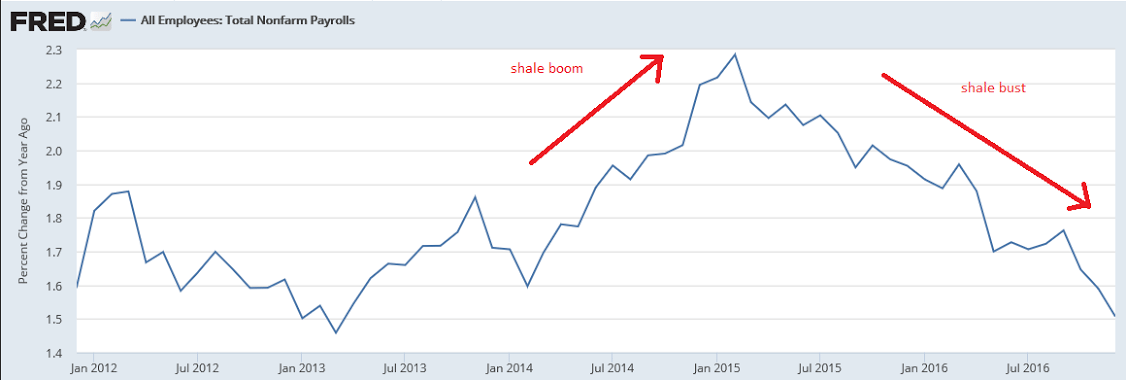
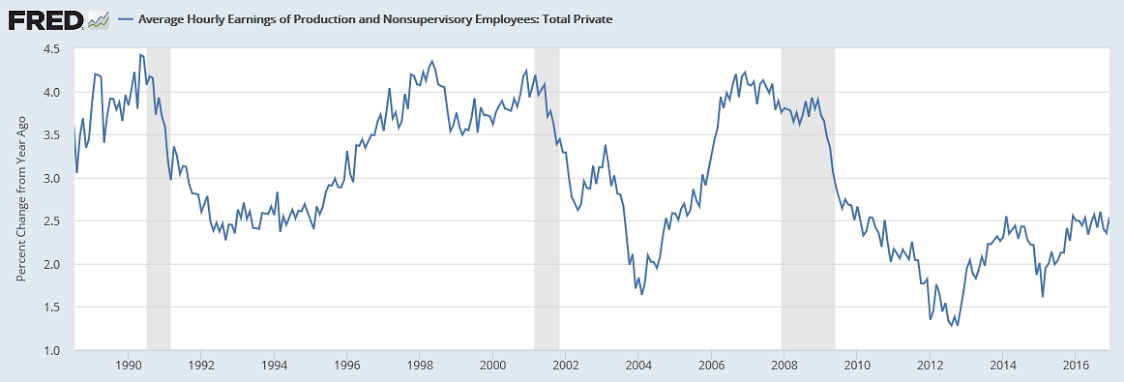
The year over year chart continues its 2 year deceleration unabated. No telling where it ends but the end will coincide with increased deficit spending, private or public:

10601

Highlights

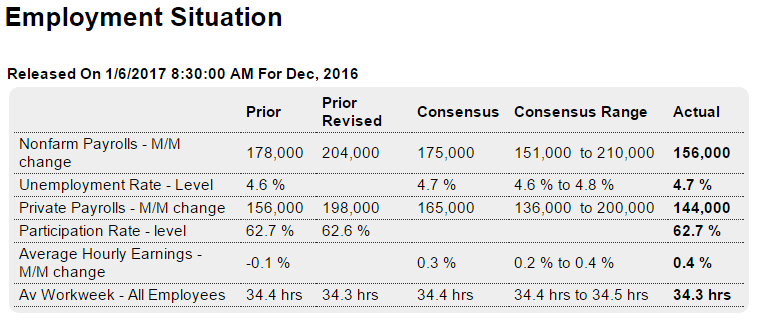
Job growth may be the new economic policy but wage inflation may be the risk. Nonfarm payrolls rose a lower-than-expected 156,000 in December but, in an offset, revisions added a net 19,000 to the two prior months (November now at 204,000 and October at 135,000).

But the big story is another outsized 0.4 percent rise in average hourly earnings, the second such gain in three months. The year-on-year rate is now at 2.9 percent which is a cycle high. A 3 percent rate and above is widely seen as feeding overall inflation.

The unemployment rate is very low though it did tick up 1 tenth to 4.7 percent. Keeping the rate down is low labor participation, at 62.7 percent with the prior month revised down 1 tenth to 62.6 percent.

Sector payrolls show another sizable gain for trade & transportation, up 24,000, and a rare gain for manufacturing, up 17,000. Government added 12,000 jobs while a 15,000 rise for professional & business services is not only on the low side for this reading but includes a 16,000 decline in temporary help, a subcomponent that is especially sensitive to changes in labor demand.

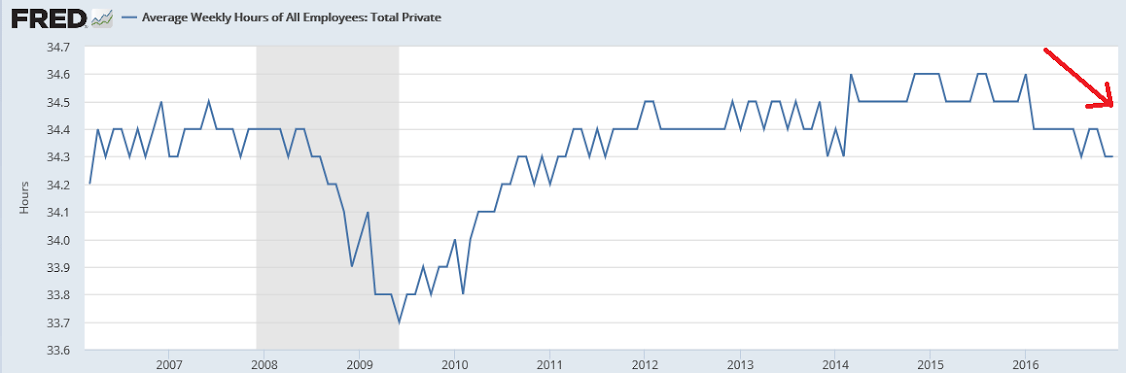
There are hints of slowing job growth in this report but the wage pressure underscores the Federal Reserve’s expectations for three rate hikes during the year and raises the question whether the labor market, even before new stimulus under the incoming administration, is at an inflationary flashpoint. Other details include a lower-than-expected workweek, at 34.3 hours in December which is unchanged from a downwardly revised November.

10602

10603
Jobs no longer exceeding up with population growth:

10604
Fewer ‘demographic’ effects here, though the average age of this group has gone up some over time:

10605

10606
You can see that historically wage growth remains depressed, and in any case increased wages are more likely to reduce gross profit margins than to increases consumer prices:

10607
Decelerating back to recession levels:

10608

10609
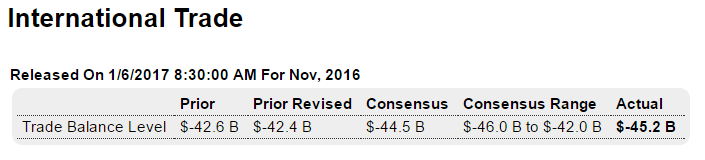
And, as previously discussed, I expect this get a lot more negative:

10610

Highlights

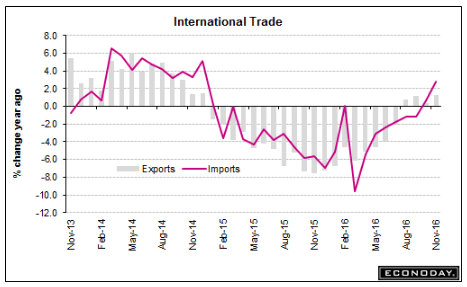
The nation’s trade deficit widened sharply in November, to a higher-than-expected $45.2 billion and well up from a revised deficit of $42.4 billion in October. Exports fell 0.2 percent in November while imports rose 1.1 percent.

The import side shows a significant rise in oil imports, up nearly $1 billion in the month to $9.9 billion (reflecting both an increase in volume and price). Petroleum is a key element for industrial supplies where imports rose $2.3 billion. Other readings are little changed with capital goods imports ticking lower and underscoring the nation’s lack of investment in new equipment.

And capital goods lead the downtick in exports, down $1.8 billion to underscore the lack of global investment in new equipment. Exports of civilian aircraft, which are a subcomponent of capital goods, fell $1.3 billion in the month. Exports of cars and of food products also moved lower, offset by a petroleum-related rise in industrial supplies.

By country, the deficits with Canada (-$2.6 billion) and the EU (-$14.8 billion) both widened sharply while the deficits with China (-$30.5 billion) and Mexico (-$5.8 billion) both narrowed. The deficit with Japan (-$5.9 billion) was little changed.

Today’s report represents a downgrade for fourth-quarter GDP which more and more will depend on how strong consumer spending was during the holidays. Watch next Friday for the retail sales report and the first definitive indication on December consumer spending.

10611

Retail sector tanks as Macy’s and Kohl’s get crushed by weak holiday sales

By Fred Imbert

Jan 5 (CNBC) – Average Boston-area rent falls for the first time in almost 7 years

Mtg purchase apps, Redbook Retail sales, Restaurant sales

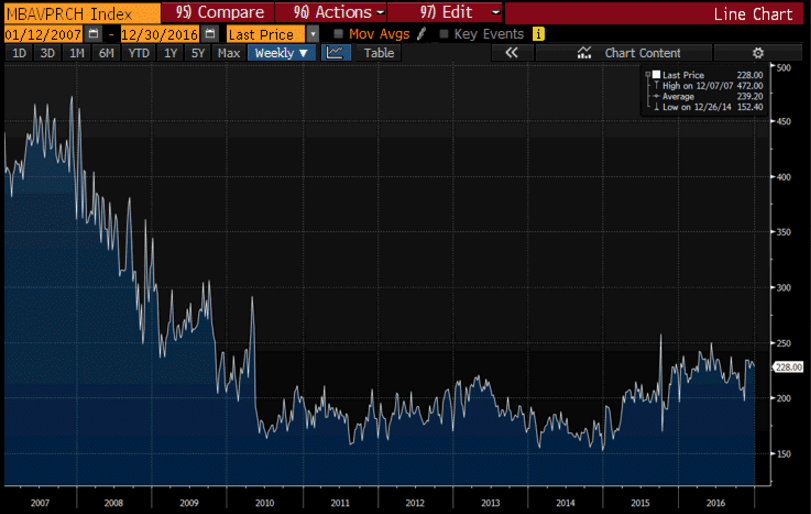
Purchase apps now down year over year, and less than half of what they used to be pre crisis:

10401

Highlights

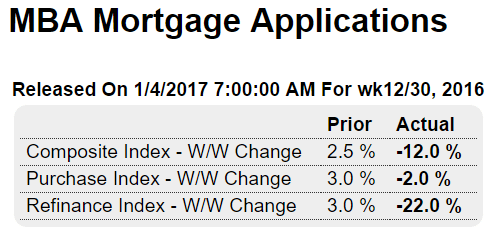
Purchase applications for home mortgages fell 2.0 percent on a seasonally adjusted basis in the December 30 week compared to the level 2 weeks earlier, which was the last prior reading due to the Christmas holiday. The refinance index was down a much sharper 22 percent compared to two weeks ago, as higher interest rates continue to deter refinancing by homeowners to a greater extent than the mortgage applications of home buyers. However, the unadjusted purchase index was down 41 percent compared with two weeks ago, pulling down the year-on-year change into negative territory for the first time in 2016 at minus 1 percent. The average interest rate on 30-year fixed rate conforming mortgages ($417,000 or less) halted its steep climb higher and at 4.39 percent was down 6 basis points from the 4.45 percent recorded in the prior week, the highest rate since May 2014.

10402
A double mini spike up as happened a year ago, but in general growth remains depressed:

10403

Restaurant industry ends 2016 on a sour note

By Sarah Whitten

Jan 4 (CNBC) – While the restaurant industry struggled with weak sales and traffic throughout 2016, it seems that December, in particular, had the worst same-store sales growth of the year.

10404

Redbook retail sales, Pending home sales, Stock buy backs, Spending, Japan stocks, Bank regulation, UN resolution

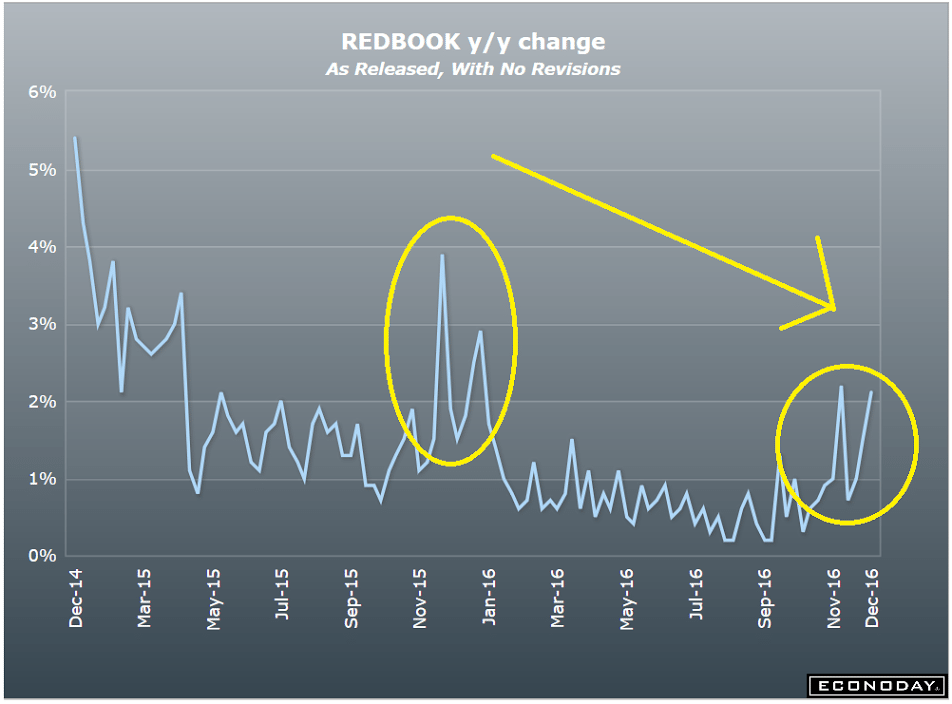
This is the time of year when year over year growth tends to increase, pulling up the rest of the year’s growth. But note how that increase has declined along with the general increases:

122801
Along with what looks to me like Trumped up expectations actual sales remain depressed:

122802

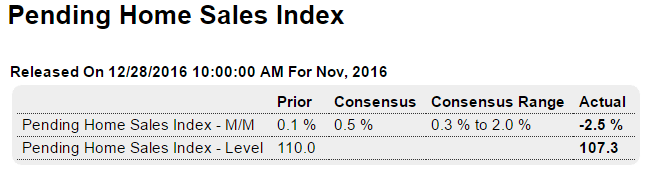
Any expected Trump bump in home sales didn’t materialize in contracts for homes signed in November.

Higher mortgage rates hit home sales, driving the National Association of Realtors Pending Home Sales Index down 2.5 percent in November from October, the NAR reported Wednesday. Analysts had forecast a 0.4 percent gain in the index, which is now 0.4 percent lower than a year ago and at its lowest level since January.

Stock buy backs are an alternative to paying dividends. On difference is that $ paid as dividends constitute income taxable at the going dividend tax rate, while the $ spent to buy back shares are only taxable to the sellers of the shares to the extent there are capital gains. So, just as an educated guess, with buy backs taxable income is reduced by perhaps 90%.

Also, repatriation may or may not happen, and it may or may not result in any change in investment, or even stock buy backs. All it does is reclassify income as domestic rather than foreign, which may or may not lead to further consequent actions by those corporations:

Surging Buybacks Say Stock Boom Isn’t Over

By Corrie Driebusch and Aaron Kuriloff

Dec 26 (WSJ) — Through Dec. 16, companies this month have stepped up their buybacks by nearly two-thirds over the same period last year, according to Goldman Sachs. Goldman forecast that S&P 500 companies will repatriate $200 billion of their $1 trillion in cash held overseas in 2017 and that $150 billion of those funds will be spent on share repurchases. From the start of 2009 to the end of September 2016, companies in the S&P 500 spent more than $3.24 trillion repurchasing shares, according to S&P Dow Jones Indices. In the first three quarters of the year, companies in the S&P 500 spent just over $400 billion on stock buybacks, down from the $426 billion in the same period last year, according to S&P Dow Jones Indices. For all of 2015, $572 billion went to buybacks.

Sales estimates have been revised a bit higher:

Last-minute spending surge lifts U.S. holiday shopping season

By Nandita Bose

Dec 28 (Reuters) — Brick-and-mortar sales in the week ending Dec. 24 rose 6.5 percent year-over-year after having fallen for the rest of the month, according to data from analytics firm RetailNext. Strong demand for furniture, home furnishings and men’s apparel from the start of November through Christmas Eve pushed U.S. retail sales up 4 percent, higher than the previously expected 3.8 percent, according to data from MasterCard’s holiday spending report. Craig Johnson, president of consultancy Customer Growth Partners, now estimates sales growth of 4.9 percent in November and December, up from his initial estimate of 4.1 percent.

The theory is something like “higher stock prices will help the economy”:

BOJ the top buyer of Japanese equities

Dec 25 (Nikkei) — According to data through Thursday, the value of the BOJ’s ETF purchases this year has topped 4.3 trillion yen, up 40% from 2015. Last year, the central bank bought more than 3 trillion yen worth of ETFs. While foreign investors sold more than a net 3.5 trillion yen worth of Japanese shares through Dec. 16, trust banks, including those commissioned by the Government Pension Investment Fund, bought a net 3.5 or so trillion yen worth of shares. This year, the BOJ increased its buying after doubling its annual ETF goal to purchase 3 trillion yen worth of the instruments. The value of the bank’s ETF holdings, based on purchase prices, is 11 trillion yen. Unrealized gains send the market value to 14 trillion yen.
Interesting but backwards, in my humble opinion. That is, if a foreign bank wants to give us $ we can’t pay back, and then the foreign bank fails, and we aren’t insuring their deposits, seems it’s their problem, not ours? In fact, it’s our gain?
Protectionist Walls Are Popping Up…Around Banks

By John Carey

Dec 26 (WSJ) — Financial regulators around the world have increasingly shied away from developing globe-spanning rules in favor of shoring up the financial system in their local purviews. Last month, the European Union proposed rules that would require big foreign banks to hold extra capital within EU borders, a step that echoes a recent U.S. rule for some large, non-U.S. banks. Rules with similar aims also have been rolled out in Switzerland and the U.K. The proliferation of the new rules demonstrate an increasing willingness of banking regulators to act independently of each other to protect the strength of their own financial systems.
Another view on the latest UN resolution the US didn’t veto:

The consequences of not vetoing the Israel resolution

Consumer confidence, Housing prices, Dallas and Richmond Fed manufacturing indexes, Moore comments

Apart from the Trumped up future expectations and the sagging retail sales reports, expectations remain elevated:

122701

Highlights

Consumer confidence shows no sign of slowing. The index is up 12.9 points since the November election in gains driven by older consumers. The level for December is 113.7 which is the highest reading since way back in August 2001.

But not all the indications from the December report point to monthly acceleration. December’s gain is centered in expectations, not in current conditions where the index, at 126.1, is still very strong but down from November’s 132.0. Within this, those saying that jobs are hard to get rose a noticeable 1.3 percentage points to 22.5 percent. This is a closely watched reading that will not heat up expectations for the December employment report.

The expectations index is very strong, up 11.1 points to 113.7. Those seeing more jobs in the months ahead jumped 4.9 points to 21.0 percent while the percentage of consumers expecting their incomes to increase rose 3.6 points to 21.0 percent. These readings are very solid.

But there is a curious negative in the report and that is a big drop in year-ahead inflation expectations, down 3 tenths to 4.5 percent which is very low for this reading. The better times that are coming will not be inflationary, at least according to the consumer.

No set of data have been showing the strength of the various consumer confidence readings. Yet this confidence didn’t help November consumer spending and how much it helped December’s spending has yet to be sorted.

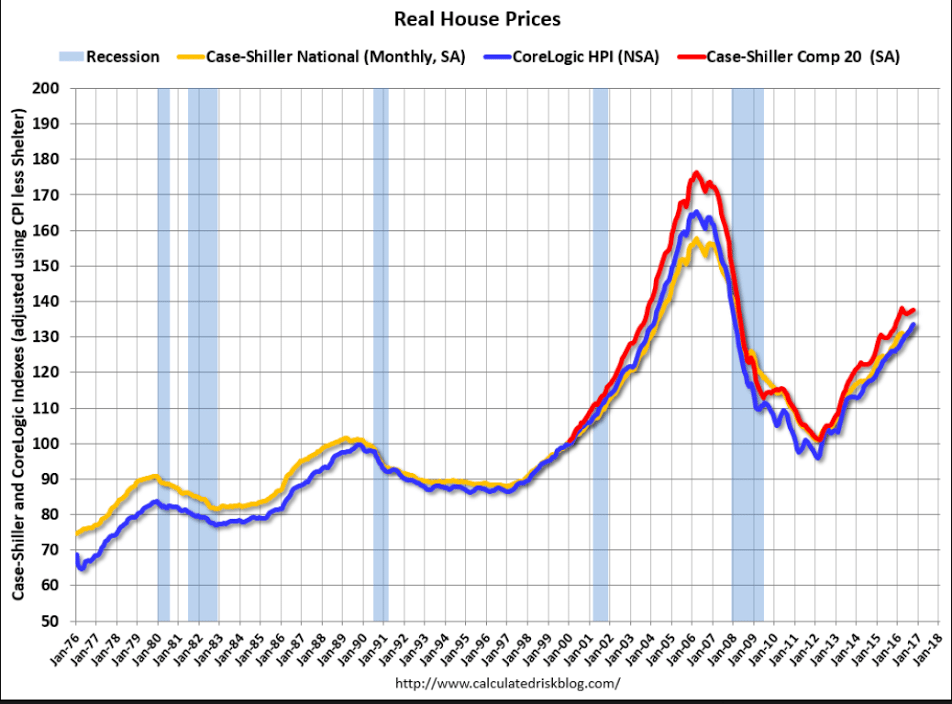
Adjusted for inflation housing prices have yet to recover:

122702
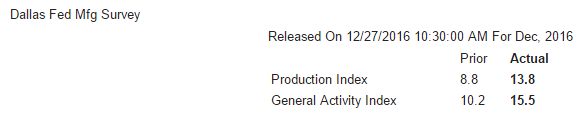
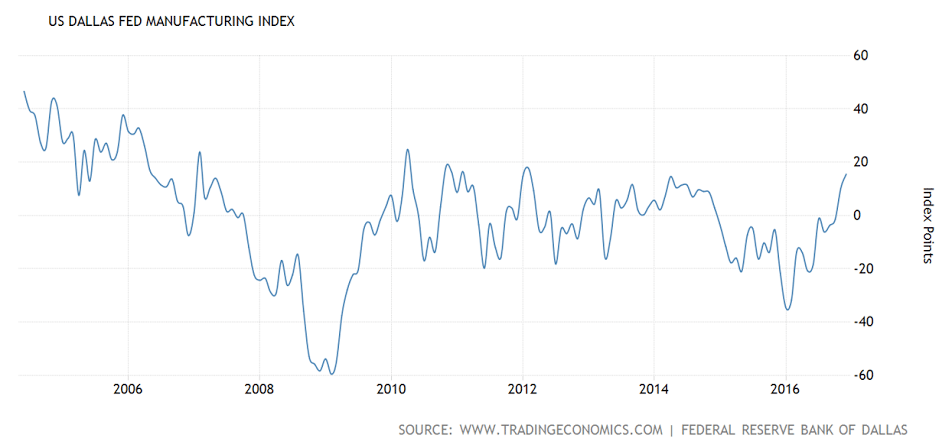
Stabilizing at the lower levels as previously discussed. The surveys indicate the number of firms reporting higher or lower numbers than the prior month. They don’t indicate magnitude:

122703

Highlights
The Dallas Fed report joins other advance surveys pointing to year-end strength for the factory sector. December’s readings are broadly higher including a 5.0 point gain for the production index to 13.8 and a 5.3 point gain for general activity to 15.5. Importantly, new orders are up 8.7 points to 7.3 for the first positive score since August.

Held down by weak foreign demand and generally weak demand for new equipment, the factory sector did not enjoy a good year. But momentum has definitely been appearing in what is good news for 2017’s outlook.

122704
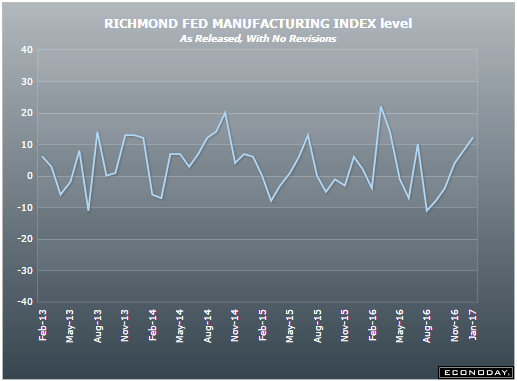
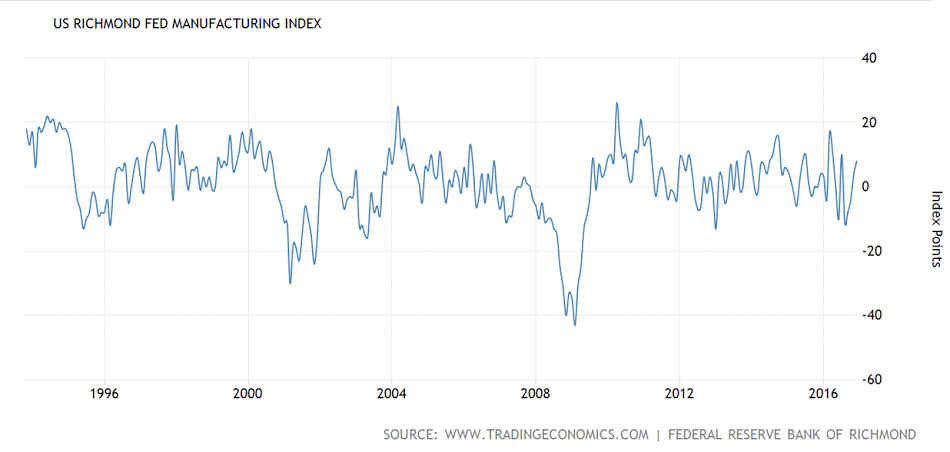
Up mainly on Trumped up expectations and even those didn’t extend to capital expenditures:

122705

Highlights

Manufacturing activity in the Fifth district expanded further in December, with the Richmond Fed Manufacturing Index rising 4 points to 8, after coming out of contraction in November with a strong 8-point increase. The biggest gains were registered in the backlog of orders, which rose a sharp 20 points from minus 12 to 8, followed by shipments and capacity utilization, with each rising 11 points, from 1 to 12 and minus 1 to 10, respectively. Vendor lead time lengthened in the month, moving the index component up 5 points to 9. On the employment front, hiring softened somewhat, with the number of employees falling to minus 1 from 5, but the average workweek increased, rising from 4 to 12 points, and wage increases were more widespread, with the index rising from 16 to 19 points.

Looking ahead, manufacturers were optimistic about future business conditions, anticipating robust improvement in nearly all of the conditions during the next six months. The index for expected shipments and new orders rose to a very strong 45 from 41 and to 47 from 38, respectively. Producers anticipate more increases in hiring (from 15 to 22) along with broader wage gains (from 26 to 36) and longer workweeks (from 6 to 14) in the next six months. The only expectations component that declined was capital expenditures, which fell from 27 points to 20.

Prices of raw materials rose at an annualized rate of 1.23 percent, slightly more than in the previous month, but the pace of growth in prices received slowed to a 0.22 percent annualized rate.

2016 has been even more volatile but seems to have been averaging around 0:

122706

Just watched Steve Moore, chief Trump transition team economic advisor, on Fox, talking about ‘trillion dollar deficits as far as the eye can see’ etc. and the need for fiscal responsibility, as he then tied it into supporting the new cabinet as people who knew how to cut waste and fraud and able to run things on paygo, etc. And last week he was talking about how the $trillion of infrastructure spending would be large private infrastructure like pipelines and refineries, etc. to be encouraged by govt. policy, rather than govt. spending per se.

Yes, private sector deficit spending for said capex ‘counts’ just as much as govt. deficit spending, but this kind of effort to create incentives won’t happen overnight, and won’t kick in overnight, and in any case $1 trillion over 10 years is only $100 billion per year or about .5% of GDP per year.

Also, their spending cuts ‘to pay for it all’ will be a force in the other direction. And their proposed tax cuts have far lower multiples than their proposed spending cuts.