Crude oil prices


[Skip to the end]

I believe the Saudi guy:

Qatar energy official: OPEC willing to cut output

by Adam Schreck

Feb 15 (AP) — A senior Qatari energy official said Sunday that OPEC is watching the oil market closely and stands ready to cut output further when it meets next month.

Mohammed Saleh al-Sada, Qatar’s minister of state for energy and industry affairs, told reporters on the sidelines of a conference in Doha that the Organization of Petroleum Exporting Countries “will respond appropriately” to the rapid drop in oil prices.

“If there is a need, actually, to go down, they will not be hesitant to reduce it further,” he said, without saying by how much.

The oil-producing group, he said, was facing difficulties in setting output because of the “unusual situation” of extreme fluctuation in prices. “The volatility is huge,” said al-Sada.

Al-Sada said a “reasonable price” for oil would be $70 a barrel -well above the $37.51 benchmark light, sweet crude settled Friday.

In Kuwait, however, a senior oil official said crude prices are unlikely to rise above $40 per barrel, even if OPEC decides to cut as much as 2 million barrels per day at its meeting next month.

Moussa Marafi, a member of the Supreme Petroleum Council, Kuwait’s highest oil policy-making body, told Annahar newspaper in comments published Sunday that oil prices are being pressured by surging U.S. crude inventories and a lack of compliance to quotas by some OPEC members.

The comments come a day after the oil minister of Venezuela, a traditional price hawk, said it would support new production cuts. Oil Minister Rafael Ramirez said the group is worried because commercial inventories are still «very high.

OPEC members have agreed to slash production by 4.2 million barrels from September levels in an effort to put a floor beneath prices that have tumbled by nearly three-quarters from the record highs they hit over the summer.

The group, which produces about 40 percent of the world’s oil, said last week it has completed about 80 percent of those previously agreed cutbacks.


[top]
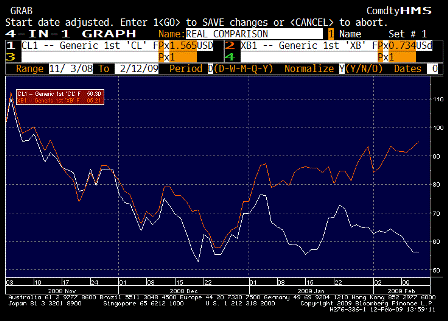
Commodities bottoming as the great Mike Masters inventory liquidation runs its course


[Skip to the end]

It all came to a near halt with the world wide inventory liquidation. Now flows are resuming but will be at lower levels than before, reflecting lower demand.

Prices should recover over time to something above replacement costs.

Look for deteriorating real terms of trade for the US as the modest fiscal adjustment adds to demand, and import prices grow faster than export prices, led by Saudi crude pricing.

Shipping Index Surge Signals Commodity Currency Gains

by Ye Xie and Candice Zachariahs

Feb 17 (Bloomberg) — Shipping costs have more than doubled this year, so it may be time to buy kroner, Aussies and loonies.

The 147 percent jump in ocean-transport prices is evidence that China’s $580 billion stimulus plan will lift raw materials, said Ihab Salib, who oversees $3 billion at Federated Investments Inc. in Pittsburgh. That would benefit countries exporting them, so Salib is “actively trading” Norway’s krone and Australian and Canadian dollars, nicknamed Aussies and loonies.

Salib and other currency traders have started using the Baltic Dry Index’s global gauge of raw-material shipping costs to help make such decisions. The index and the value of a basket of those three resource-rich countries’ currencies are increasingly moving in tandem — 96 percent of the time in the past year, up from 84 percent in the past decade, data compiled by Bloomberg show.

“Historically, the Baltic Dry Index is a good leading indicator for commodity prices,” said Salib, who declined to detail his investments. “Commodities are very depressed right now, and they offer good long-term value. Once they come back, these currencies should do well.”

The shipping gauge is a sign that China’s stimulus spending on housing, highways, airports and power grids will have impact beyond its borders. By Feb. 28, it will have spent 25 percent of its stimulus budget, Deutsche Bank AG said Jan. 20, predicting the country’s economy will grow at a 12 percent annual rate between the fourth and first quarter, after shrinking 2.3 percent between the third and fourth.

Oil Rebound

China is the world’s biggest consumer of copper and iron ore and has helped each rally this year by about 10 percent, benefiting Australia and Canada, which account for 10 percent of world production of the two metals. Oil,Norway’s top export, will average $66 a barrel in the fourth quarter, up from an average of $40.62 since Jan. 1, according to the median forecast of 34 analysts surveyed by Bloomberg. China is the world’s second-biggest energy user.


[top]

Re: Saudi blend leading the way?


[Skip to the end]

Thanks, who would have thought the Saudi blend would lead the way…

>   
>   On Thu, Feb 12, 2009 at 12:09 PM, David wrote:
>   
>   U.S. CASH CRUDE MARS SOUR RISES
>   $1.00 TO RECORD $8.00 ABOVE WTI – TRADER
>   
>   I believe this is the Saudi sour equivalent here in
>   US.
>   


[top]

OPEC January Crude Output Down 1,050,000 Bbl/Day to 28.565 Mln


[Skip to the end]

OPEC January Crude Output Down 1,050,000 Bdl/Day to 28.565M

Feb 3 (Bloomberg) — Crude-oil production from the 12 OPEC members in January declined 1,050,000 barrels a day from December, the latest Bloomberg survey of producers, oil companies and industry analysts shows. Figures are in the thousands of barrels a day.

Opec Production
January 2009

Opec Country Jan Est. Dec. Monthly Output Jan. 1 Change Est. vs. Target* Est. Target Est. Cap. (@)
Algeria 1,275 1,330 -55 1,202 72 1,450
Angola 1,740 1,820 -80 1,517 223 2,000
Ecuador 475 500 -25 434 41 500
Indonesia*
Iran 3,800 3,850 -50 3,336 464 4,100
Iraq* 2,365 2,345 20 2,500
Kuwait# 2,280 2,350r -70 2,222 58 2,650
Libya 1,630 1,660r -30 1,469 161 1,800
Nigeria 1,810 1,900 -90 1,673 137 2,500
Qatar 725 790 -65 731 -6 900
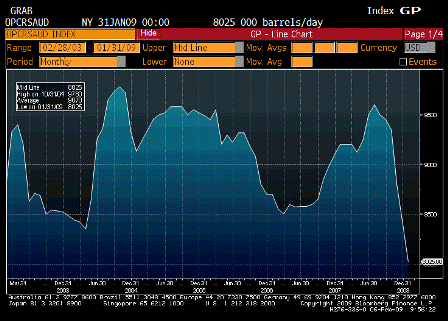
Saudi Arabia# 8,025 8,400 -375 8,051 -26 10,800
U.A.E 2,290 2,350 -60 2,223 67 2,800
Venezuela 2,150 2,320 -170 1,986 164 2,500
Total OPEC-12 28,565 29,615r -1050 34,500
Total OPEC-11* 26,200 27,270r -1070 24,845 1,355 32,000

*Quotas effective Jan. 1, 2009. OPEC agreed at its Dec. 17 meeting in Algeria to cut its quota target by 2.463 million barrels a day from the previous level, to 24.845 million barrels daily from Jan. 1. The quota target excludes Iraq, which has no formal quota, and Indonesia which left OPEC at end-2008.

Totals rounded.
r = revised @ = Capacity attainable within 30 days and sustainable for 90 days.
# Includes Neutral Zone production shared equally between Saudi Arabia & Kuwait.


[top

China- crude consumption


[Skip to the end]

China’s policy stimulus to spur car sales in year of ox

Jan 28 (Xinhua) — Due to bigger-than expected cut in fuel prices at the end of 2008 and halved car purchase taxes in effect just before the Lunar New Year, China’s auto industry can expect the year of the ox to be a bullish one for sales growth, which was in a ten-year low in 2008.

“With the recent policy changes on fuel price, car purchase tax and fees, I can save more than 8,000 yuan ($1,170) to have a car,” said Wang Yong, who just bought a new POLO sedan produced by Shanghai Volkswagen Co Ltd.

Like many other auto makers, the company offered discounts of 5,000 yuan for POLO and LAVIDA models during China’s Lunar New Year to woo the young working class. The prices for the cars are a little higher than 100,000 yuan, which is generally considered affordable for wage earners in China.

More than 3.1 million small-sized cars were sold in China last year, accounting for 61.54 percent of the total 9.35 million units of vehicles sold in the period, when the year-on-year growth slowed to 6.7 percent, the lowest in ten years, according to statistics from the China Auto Industry Association.

Ye Sheng, an auto industry analyst said that China’s auto market is far from saturated — especially for private vehicles.

He expected the government’s stimulus to boost the market sentiment this year.

Ye said despite that the global financial pinch eroded the demand for business cars and drove up the cost for auto production, China’s auto demand would continue to grow with the increase of personal wealth.


[top]

Crude oil inventories


[Skip to the end]

The contango in the futures market continues to come in, as does the spread between WTI and Brent.

The RBOB contango is also coming in, indicating gasoline supplies are also tightening.

This indicates spot supplies are tightening- the OPEC cuts are ‘working’.

Most consumption indicators show crude consumption to be about flat or only down slightly year over year.

The great Mike Masters inventory liquidation that began in July may finally have run its course.

And the Saudis are back to being price setter.

I would strongly recommend any fiscal adjustment that increases aggregate demand be accompanied by policy that immediately and substantially reduces crude oil and gasoline consumption.


[top]

World crude oil demand


[Skip to the end]

This small drop in demand does not dislodge the Saudis from resuming their role as swing producer and price setter when the Masters Inventory Liquidation that began in July has run its course and excess inventories are eliminated:

World oil demand to shrink sharply this year: IEA

by David Sheppard

Jan 16 (Reuters) — World oil demand will contract sharply in 2009 as the global economic slowdown further erodes consumption, the International Energy Agency (IEA) said on Friday.

The Paris-based agency joined the ranks of forecasters predicting a fall in global oil demand this year, revising its previous 2009 estimate by 940,000 barrels per day (bpd) to 85.3 million bpd — a 500,000 bpd year-on-year fall.


[top]

China Dec crude imports up


[Skip to the end]

China Dec crude imports at 3.38 mln bpd – source

by Jim Bai

Jan 12 (Reuters) &#8212 China’s imported 14.37 million tonnes of crude oil in December, or 3.38 million barrels per day, a source familiar with the data said on Monday.

The rate would be 11.6 percent higher than a year earlier, and 4 percent higher than in November 2008 on a daily basis, according to a Reuters calculation.

The imports would bring China’s annual imports to a record high of 178.89 million tonnes, or 3.58 million barrels per day, a rate 9.6 percent higher than a year earlier.


[top]