Lots of garbage, but notice the MMT parts starting to surface.
The Untold Story Of How Clinton’s Budget Destroyed The American Economy

Lots of garbage, but notice the MMT parts starting to surface.
The Untold Story Of How Clinton’s Budget Destroyed The American Economy
Mosler knows!
Thayer knew!
Ruml knew!
Jim Lacey apparently knows, and so did a couple of economists that helped the USA prosecute and win WW2: Robert Nathan and Simon Kuznets.
Keep from All Thoughtful Men: How U.S. Economists Won World War II
I got to page 34.
“Orthodox economic thinking at the beginning of World War II held that taxes should finance wars on a pay-as-you-go basis.”
A fascinating book about what looks to be how MMT won the War. I’m still reading.
And I’m betting that we didn’t need to use all of Great Britain’s gold that they shipped to New York at the start of the war….
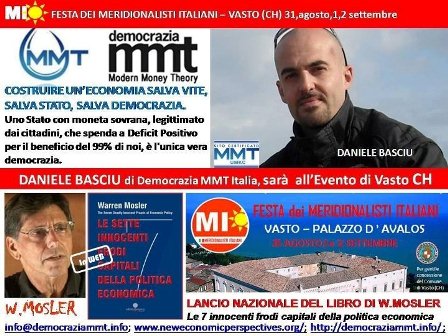
Translation:
The national launching of the book by W. Mosler – The Seven Deadly Innocent Frauds
MI – Feast of the Southern Italians (Meriondalisti italiani)
MMT Democracy
Modern Monetary Theory
To build an economy that saves lives, saves the state, and saves democracy
A state with sovereign money, legitimized by the citizens, that spends with a positive deficit for the benefits of us 99%, that is the only true democracy.
Daniele Basciu of MMT Democracy – Italy will be at the event in Vasto, CH
The national launching of the book by W. Mosler – The Seven Deadly Innocent Frauds
This Could Change Everything
By Dick Wagner
Not that it matters, of course, but all’s that’s needed is for the Fed to guarantee that all US obligations mature at 100. The Fed is fully authorized to buy US tsy securities and can certainly buy them at maturity value on their maturity date, simply by crediting the appropriate accounts. And the ratings agencies fully recognize that authority.
This is from Pavlina’s paper for those of you tracing origins of MMT euro discussion:
Link here.
Notice how in private correspondence Mosler applies the same logic in analyzing the ramifications of the restrictions on deficit spending in the current plan for European Monetary Union:
Operating factors will require reserve adds and drains to keep the system in balance and maintain control of the interbank rate. However, the ECB is able only to act defensively, like all CBs [Central Banks]. It cannot proactively lend Eurosa reserve add, without an offsetting drain. The deficit spending I refer to is needed to offset the need of the private sector to be a net nominal saver in Euros. In the currently proposed system, even the increasing demand for currency in circulation must be accommodated via collateralized loans from the ECB. Net nominal wealth of the system cannot increase. The private sector demand for an increase in net nominal wealth will have to be from the reverse happening at the member nation level. If member nations are restricted from doing this [to deficit spend], a vicious deflationary spiral will result. (Mosler, 1996)
Found this on the net in the PK archives.
Shows MMT was on it well before this date.
Feel free to distribute
To: PKT Academics
Re: Bretton Woods Conference
Confirmed attendance includes senior staff from Deutchebank,
Credit Suisse, J.P. Morgan, Banker’s Trust, Salomon Bros,
Lehman Bros, Harvard Management, III, Petrus, Paine Webber,
Paribas, and BZW. A keynote speaker will be Professor Charles
Goodhart from the LSE. Bernard Connolly will be the historian.
Speakers for each topic are currently being arranged.
There is currently room for two academic representatives.
Please contact me at mosler@xxxxxxxx if you have interest.
A FRAMEWORK FOR ECONOMIC ANALYSIS
An Invitational Conference
Bretton Woods, New Hampshire
June 12-15, 1996
The purpose of this conference is to bring together a selected
group of portfolio managers, analysts, researchers
traders, and academics who have a common understanding
of monetary operations.
The objective of this conference is to achieve agreement on the use
of a common conceptual framework for undertaking
contemporary macroeconomic analysis.
Portfolio managers in attendance are responsible for well over
$50 billion in assets. The economists and analysts from the
international dealer community represent some of the world?s
largest and most sophisticated fixed income trading and sales
operations.
We believe that this group has the potential to establish an international
standard for the presentation and analysis of economic data.
Several of the fundamentals are Post Keynesian…
Deposit money is endogenous
Central Banks set short term rates exogenously
Deposits exist solely as the result of loans
Extension of these fundamentals includes…
Internal sovereign debt functions as interest
rate support
Taxes create a demand for the goverment’s
currency
Fiat currency is defined exogenouslyConference Moderator……..Warren B. Mosler
Wednesday, June 12, 1996
11:30 AM Welcome and Introduction
12:00 PM Luncheon
12:30 PM History of the Awareness of Monetary Operations
Charles Goodheart
MONETARY OPERATIONS
1:00 PM Review of the Fundamentals of Monetary Operations
1:30 PM Monetary Policy Options
MACROECONOMIC FUNDAMENTALS
2:00 PM The function of Government Securities
2:30 PM Currency Definition
3:00 PM Fiscal Policy Options and Implications
EXTERNAL DEBT
3:30 PM Review of Current Conditions
4:00 PM Macro-economic Implications
4:30 PM World Bank, IMF Policy Implications
6:00 PM Hor?s d?ouvres
7:00 PM Dinner
THURSDAY, JUNE 13
ESTABLISHING THE FRAMEWORK
9:00 AM Integrating Foreign Trade, Investment, Fiscal and Monetary
Policy
10:00 AM Full Employment, Zero Inflation Model
11:30 AM Lunch
RAMIFICATIONS OF MONETARY UNION
1:00 PM Current Political Situation
Bernard Connolly
2:00 PM Maastricht Fiscal Criteria Implications
3:00 PM Post 1999 Credit Implications
3:30 PM Functionality of the Euro
4:30 PM Drafting a Consensus
6:00 PM Hor’s d’Ouvres
7:00 PM Dinner
FRIDAY, JUNE 14, 1995
Review and Discussion
Warren B. Mosler
Director of Economic Analysis
III Finance
See “Soft Currency Economics:”
>
> Apparently, MMT is a hard concept for the IIF to grasp.
>
Yes!
Incompetent disgrace.
No reason an exit has to cost them anything in real terms.
But because they believe otherwise they’ll work to keep Greece in.
Dallara Says Greek Euro Exit May Exceed 1 Trillion Euros
By Andrew Davis and Rebecca Christie
May 25 (Bloomberg) — The cost of Greece exiting the euro would be unmanageable and probably exceed the 1 trillion euros ($1.25 trillion) previously estimated by the Institute of International Finance, the group’s managing director said.
The Washington-based IIF’s projection from earlier this year is “a bit dated now” and “probably on the low side,”Charles Dallara said in an interview in Rome today. “Those who think that Europe, and more broadly the global economy, are really prepared for a Greek exit should think again.”
The European Central Bank’s exposure to Greek liabilities is more than twice as big as the ECB’s capital, said Dallara, who represented banks in their negotiations with the Greek government on its debt restructuring. As a result, he predicted the bank would be unable to provide liquidity and stabilize the euro-area financial sector.
“The ECB will be insolvent” if Greece were to exit the euro, Dallara said. “Europe would have to first and foremost recapitalize its central bank.”