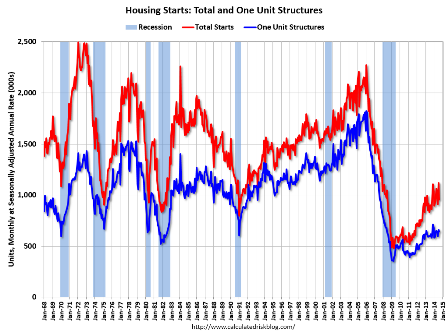
Housing starts

As previously suggested, with fewer cash sales and mtg purchase apps down 10% vs last year seems doubtful sales do much.

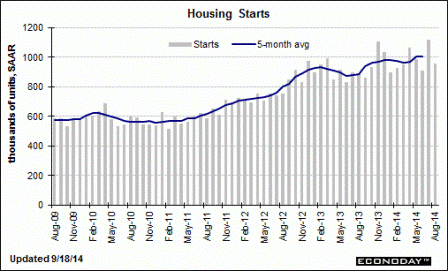
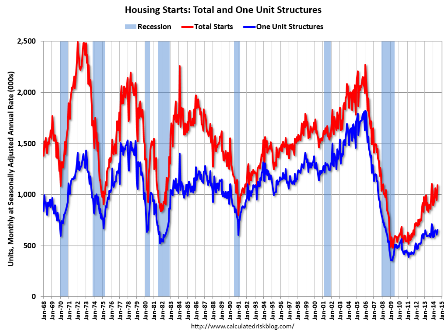
With population growth what it is, ‘normal’ for this point in the cycle would be about double what we are seeing. In fact, we are now back to only what were the lows of prior cycles, and we have a lot more people now:


Highlights
Homebuilders are being cautious as both starts and permits disappointed for August. But August is coming off a strong July.

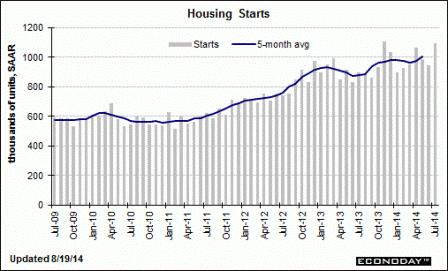
Housing starts for August fell 14.4 percent, following a boost of 22.9 percent the month before. August’s pace of 0.956 million units was short of market expectations for 1.038 million units and was up 8.0 percent on a year-ago basis.

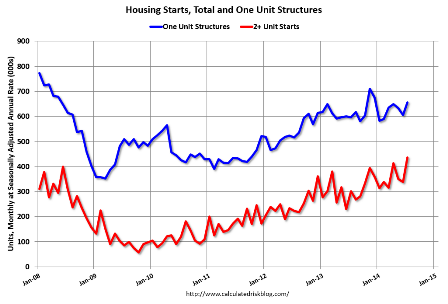
The multifamily component declined a monthly 31.7 after jumping 44.9 percent in July. The single-family component edged down 2.4 percent, following an 11.1 percent surge in July.

Building permits are oscillating, too. Permits decreased 5.6 percent in August, following an 8.6 percent boost in July. Monthly swings have largely been in the multifamily component. The single-family component has been in a modest downturn in recent months.

There has been a lot of volatility in housing data in recent months and the latest starts data likely will lead to some trimming of forecasts for third quarter GDP growth. The trend continues that housing strength is in the multifamily component.


Full size image

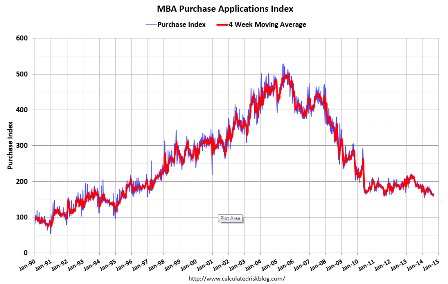
mortgage purchase apps

A welcome increase for the week, but still running a full 10% lower than last year.

And cash purchases are also falling, which means sales can’t be rising, etc.


“Despite adjustments for the Labor Day holiday the previous week, mortgage applications surged last week, even amid rising rates.

Total application volume rose 7.9 percent week-to-week, according to the Mortgage Bankers Association (MBA), driven mostly by refinances, which doesn’t jibe with the rise in rates.

Applications to refinance rose 10 percent from the previous week, but are still down 22.5 percent on year. Mortgage applications to purchase a home rose 5 percent from the previous week but are down 10 percent on year.”


Full size image

Mtg apps down again, cash buyers fading as well

So if mortgage purchase apps are down and there are fewer cash buyers seems sales are staying down?

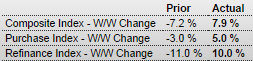
From the MBA: Mortgage Applications Decrease in Latest MBA Weekly Survey

Mortgage applications decreased 7.2 percent from one week earlier, according to data from the Mortgage Bankers Association’s (MBA) Weekly Mortgage Applications Survey for the week ending September 5, 2014. This week’s results included an adjustment for the Labor Day holiday. …

The Refinance Index decreased 11 percent from the previous week, to the lowest level since November 2008. The seasonally adjusted Purchase Index decreased 3 percent from one week earlier, to the lowest level since February 2014. …

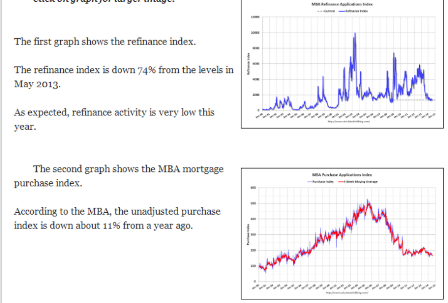
According to the MBA, the unadjusted purchase index is down about 12% from a year ago.


Full size image

Las Vegas Real Estate in August: YoY Non-contingent Inventory up 39%, Distressed Sales and Cash Buying down YoY

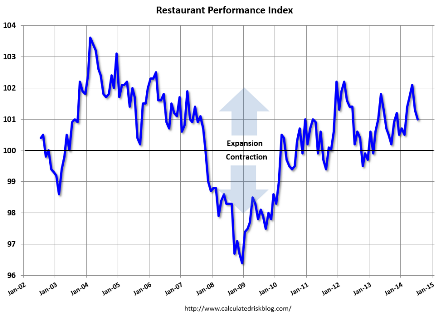
Construction, gasoline prices, manufacturing, state and local contribution to gdp, restaurant performance index, saudi output, sun spots

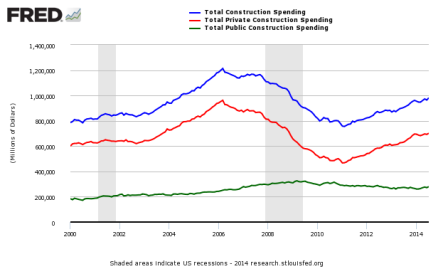
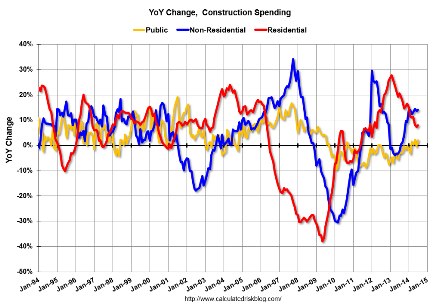
Headlines sound a lot better than the charts look.

Absolute levels and growth rates continue to fall short of prior cycles:

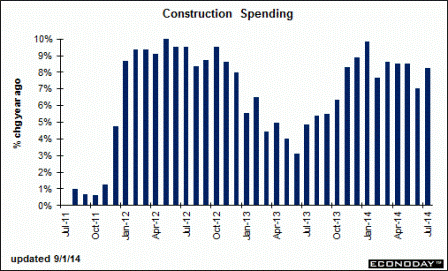
Construction Spending


Highlights
Construction outlays saw a broad-based gain in July. Construction spending rebounded 1.8 percent after a 0.9 percent dip in June. While all broad categories advanced, July’s increase was led by the public sector-up 3.0 percent, following a 1.8 percent decrease in June. Private nonresidential spending rebounded 2.1 percent in July after slipping 0.8 percent the month before. Private residential outlays gained 0.7 percent, following a 0.4 percent dip in June.

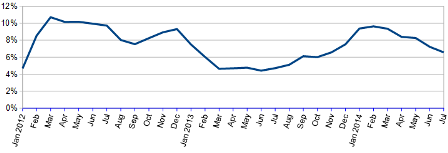
On a year-ago basis, total outlays were up 8.2 percent in July, compared to 7.0 percent the month before.

Overall, the latest construction data add to third quarter momentum. Third quarter GDP estimates will likely be nudged up. There is a lot of recent volatility in construction data but the residential gain is encouraging.

Unadjusted Construction Spending – Three Month Rolling Average Compared to the Rolling Average One Year Ago


Full size image


Full size image


Full size image

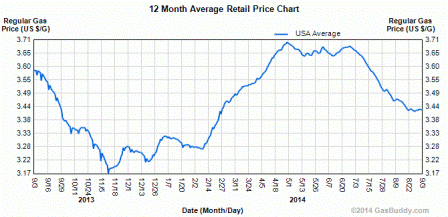
This helps consumers some and also puts downward pressure on ‘inflation’:


Full size image

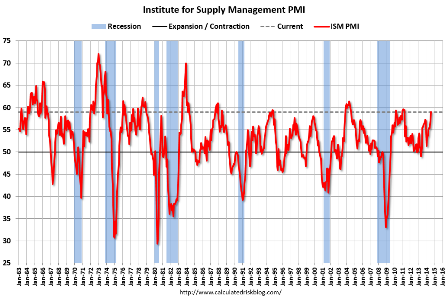
Manufacturing continues to do reasonably well, chugging along about the way it always does until the cycle ends:


Full size image

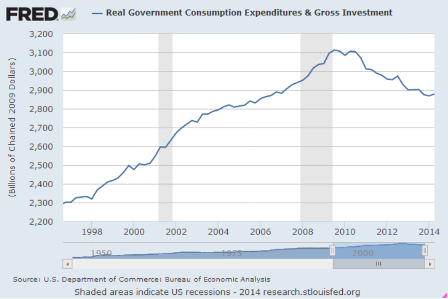
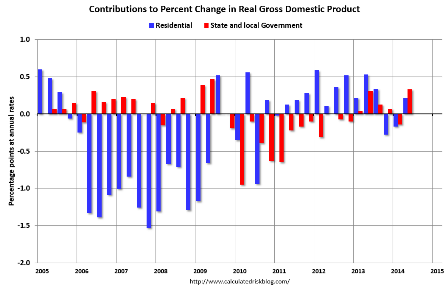
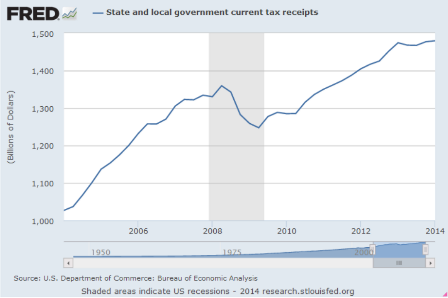
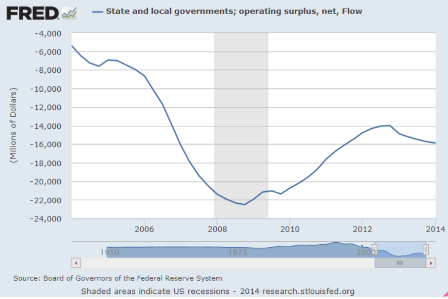
Don’t be misled by the talk of state and local govt contributing to GDP. The spending side is only half the story- they also tax. So you need to look at state and local govt deficits to get an idea of their net contribution:

This is the spending side:


Full size image

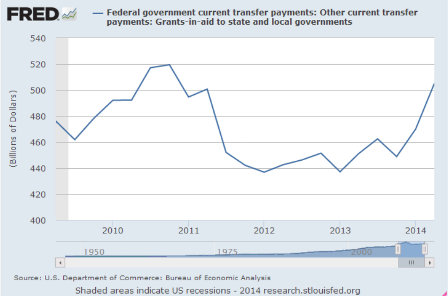
It’s a bit tricky as you don’t want to double count federal $ spent by the states:

Sure enough, tax receipts which tend to be highly cyclical, going up when the economy does better, seem to have stalled, and state and local deficits have gone up. So is that an indicator of growth?

And it looks like state and local deficits did go up a tad, but not a lot:

And this just came out:


Full size image

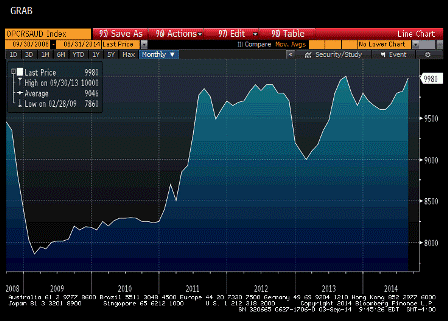
The call on Saudi oil shows no signs of diminishing which they remain as ‘swing producer/price setter’, setting price and letting quantity adjust with demand:


Full size image

And this:
;)


Full size image

Charts and data from the last few days

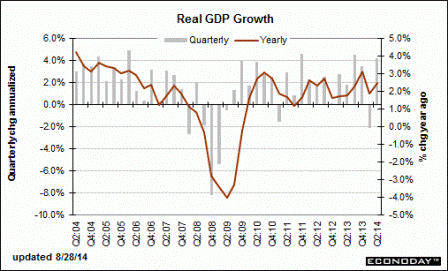
Down for the cold winter then back up some, and a very weak first half of the year, and Q3 fading from Q2:

GDP


Highlights
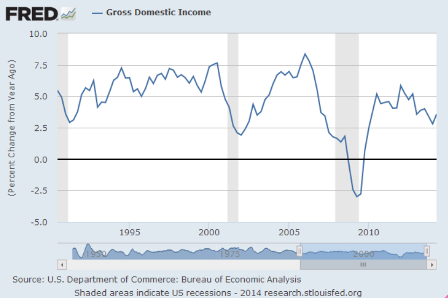
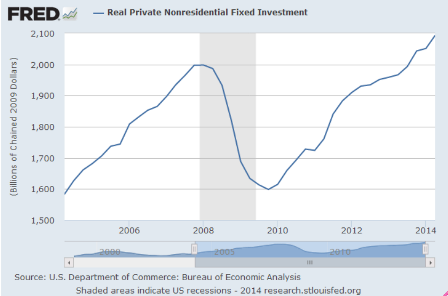
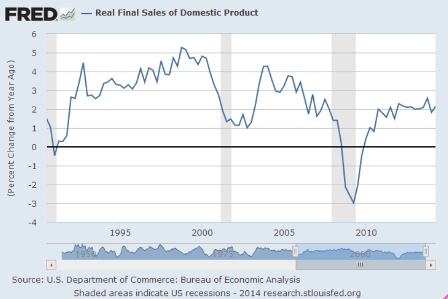
The second estimate for second quarter GDP growth came in a little stronger than expected, rising 4.2 percent annualized versus a 4.0 percent forecast and coming off a 2.1 percent weather related drop in the first quarter. With this second estimate for the second quarter, the general picture of economic growth remains the same; the increase in nonresidential fixed investment was larger than previously estimated, while the increase in private inventory investment was smaller than previously estimated.

Real final sales of domestic product-GDP less change in private inventories-increased 2.8 percent in the second quarter, in contrast to a decrease of 1.0 percent in the first. Real final sales to domestic purchasers gained 3.1 percent versus 0.7 in the first quarter.

Chain-weighted prices gained 2.1 percent annualized, compared to the consensus for 2.0 percent and the first quarter number of 1.3 percent.

Overall, the weather-related rebound in the second quarter was stronger than expected. Personal spending made a comeback and inventories were rebuilt. The economy is gradually regaining momentum-emphasis on gradually.
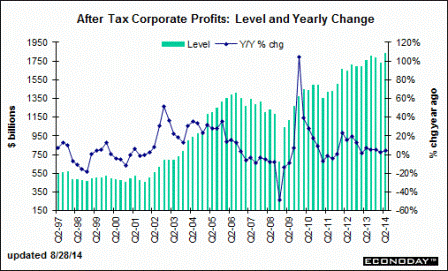
Corporate Profits

Again, for growth this year to exceed last year, all the components on average have to grow more than they did last year:

NAR: Pending Home Sales Index increased 3.3% in July, down 2.1% year-over-year

By Bill McBride

From the NAR: Pending Home Sales Pick Up in July

The Pending Home Sales Index, a forward-looking indicator based on contract signings, climbed 3.3 percent to 105.9 in July from 102.5 in June, but is still 2.1 percent below July 2013 (108.2). The index is at its highest level since August 2013 (107.1) and is above 100 – considered an average level of contract activity – for the third consecutive month.

With purchase apps down 11% year over year and cash purchases down it’s hard to see how total sales can grow?

MBA Purchase Applications
Highlights
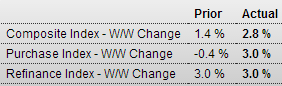
Demand for purchase applications picked up in the August 22 week, rising 3.0 percent. But the trend remains stubbornly flat, down 11.0 percent year-on-year. The index for refinancing applications also rose 3.0 percent in the week. Mortgage rates were little changed in the week with the average for conforming loans ($417,000 or less) down 1 basis point to 4.28 percent.

Falling home prices are not a good sign:

S&P Case-Shiller HPI


Highlights
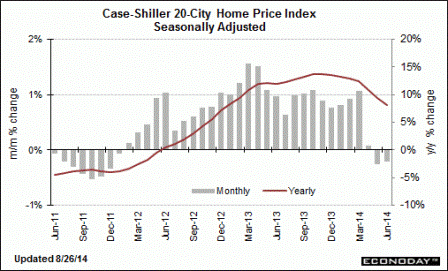
Home price appreciation continues to unwind as S&P Case-Shiller 20-city adjusted data show a 0.2 percent decline in June following a 0.3 percent in May. Year-on-year, the adjusted rate is plus 8.1 percent vs 9.3 percent in May. Monthly declines swept 13 of the 20 cities with Minneapolis, Detroit, Atlanta and Chicago showing special weakness.

Unadjusted data, which are followed in this report, show a monthly gain of 1.0 percent that reflects the relative strength of summer months for sales. But the year-on-year rate, where this effect is offset, tells exactly the same story as the adjusted data, at 8.1 percent vs 9.3 percent in the prior month.

Home prices are weakening, based not only on this report but also on FHFA data, also released this morning, and on yesterday’s new home sales report as well as last week’s existing home sales report. Easing home prices are a plus for sales but a negative of course for homeowner wealth.
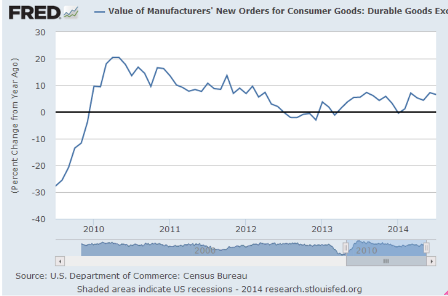
Durable Goods Orders


Highlights
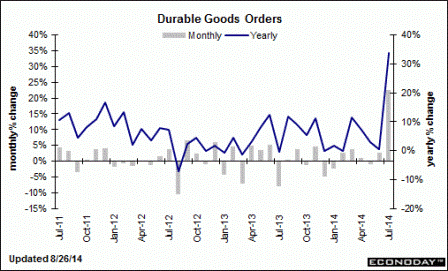
Durables orders soared in July due aircraft orders but otherwise came off a moderately strong core number in June. New factory orders for durables soared a monthly 22.6 percent in July, following a 2.7 percent boost in June. Econoday’s consensus called for a 5.1 percent gain in July. The high end of forecasts was 24.5 percent.

Excluding transportation, durables orders slipped 0.8 percent, following a 3.0 boost in June. Analysts forecast a 0.4 percent rise for July. But June earlier had been estimated to be up “only” 1.9 percent from the full factory orders report.

Transportation spiked a monthly 74.2 percent after rising 2.1 percent in June. Nondefense aircraft (Boeing) surged 318.0 percent (that is not a typo) after gaining 11.1 percent in June. Another but more moderate positive was motor vehicle orders which gained 10.2 percent, following a 1.3 percent dip in June. Defense aircraft fell 28.8 percent in July, following a rise of 9.2 percent the month before.

Outside of transportation, gains were limited with “other” gaining. Other categories slipped but followed upward revisions to June.

Orders for equipment investment edged down in July but followed a strong June. Nondefense capital goods orders excluding aircraft declined 0.5 percent, following a spike of 5.4 percent the month before. Shipments of this series, however, were positive, gaining 1.5 percent in July, following an increase of 0.9 percent in June. The latest shipments numbers suggest a favorable number for business equipment in third quarter GDP.

The Boeing order gets filled over approximately the next 10 years:
new home sales bad

And it’s no longer about prices, which fell, and inventories, which are now plenty high:

New Home Sales


Highlights
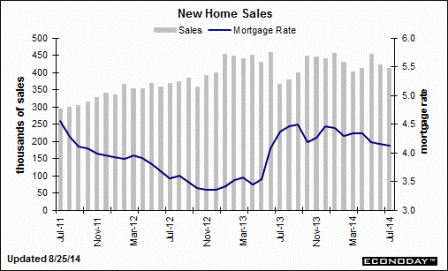
Upward revisions offset a lower-than-expected 412,000 annual sales rate for new home sales in July with the two prior months revised higher by a total of 28,000. July’s gain is centered entirely in the South which rose 8.1 percent in the month. The South is by far the largest region for new home sales, outdistancing all other regions combined.

Lack of new homes on the market has been constraining sales but perhaps less so now. Supply on the market rose to 205,000 vs 197,000 in June, pulling up the monthly supply to 6.0 months at the current sales rate vs 5.6 in June.

High prices have also been constraining sales but, again here too, perhaps no more. The median price fell 3.7 percent in the month to $269,800. Year-on-year, the median price is up only 2.9 percent which is well below the year-on-year sales gain of 12.3 percent.

The Dow is moving to opening highs following today’s report, a key report that, despite the soft headline and concentrated gain in the South, adds to the building evidence of renewed vigor in the housing sector.

Existing home sales up for July, but down yet again year over year

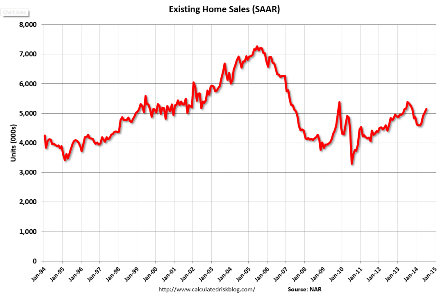
This was spun as a good number, as it exceeded expectations, but check out the year over year chart below,
where sales have been down vs the same month last year for nearly a year:

The NAR reports: Existing-Home Sales Continue to Climb in July
Total existing-home sales, which are completed transactions that include single-family homes, townhomes, condominiums and co-ops, rose 2.4 percent to a seasonally adjusted annual rate of 5.15 million in July from a slight downwardly-revised 5.03 million in June. Sales are at the highest pace of 2014 and have risen four consecutive months, but remain 4.3 percent below the 5.38 million-unit level from last July, which was the peak of 2013. …

Existing Home Sales


Highlights
Existing home sales in July advanced 2.4 percent to an annualized pace of 5.15 million units, topping expectations for 5.00 million. June rose a revised 2.4 percent to a marginally downwardly revised 5.03 million. July sales were down 4.3 percent on a year-ago basis.

For the latest month, strength was in the single-family component which gained 2.7 percent to 4.55 million annualized. Condos were unchanged at 0.60 million.

Supply on the market actually rose faster than sales-up 3.5 percent in July to 2.37 million units. Months’ supply, however, was steady at 5.5 months.

The median price rose 0.4 percent in July to $222,900 (up 4.9 percent year-ago) while the average price increased 0.2 percent to $268,700 (up 3.7 percent year-ago).

Year over year chart:

Full size image


Full size image

Strange report here, but manufacturing in general doing reasonably well:


Highlights
Details do not confirm what at the headline level, at 28.0 vs July’s 23.9, is exceptional acceleration this month in the Philly Fed’s manufacturing sector. New orders have slowed very sharply so far this month, to 14.7 vs July’s 34.2, while shipments are at 16.5, likewise well down from another 34.2 in July.

Unfilled orders are contracting and delivery times are improving, again both pointing to slowing activity. Employment growth is down as are price pressures.

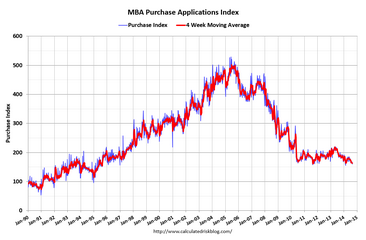
Mortgage purchase apps

Not good- purchase apps now down 11% vs last year.
And cash buyers have been fading as well.
And the size of homes built has leveled off.
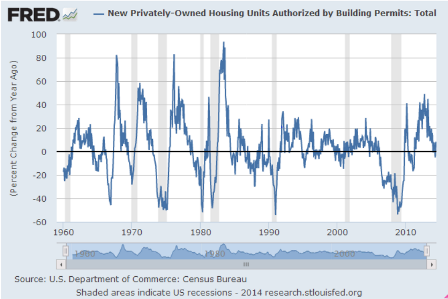
And check out what’s happened to the growth of new building permits.

Fortunately, as per the mainstream economists and analysts, bad news is good news, as it means the Fed will be lower for longer to a fault, triggering a credit led expansion…
:(

MBA Purchase Applications

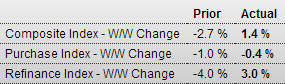
A sizable drop in mortgage rates failed to give a lift to purchase applications which fell 0.4 percent in the August 15 week. The trend remains very weak with the year-on-year rate for the purchase index down 11 percent. Monday’s housing market report cited a rise in serious buyers for new homes, buyers however that are likely to be cash buyers based on mortgage application data.

Applications for conventional mortgages, both for purchases and refinancing, rose in the week but the report notes a 5.9 percent decline in applications for government mortgages that includes an unadjusted 8 percent decline in Department of Veterans Affairs applications. Federal Housing Administration and Rural Housing Service applications also fell.

Total refinancing applications rose 3.0 percent in the week giving a 1.4 percent lift to the composite index. Refinancing applications made up 55 percent of all applications vs 54 percent in the prior week. Rates moved lower with the average for conforming loans ($417,000 or lower) down 6 basis points to 4.29 percent.


Full size image

U.S. Home Size Levels Off, for Now at Least

Lawler: Table of Distressed Sales and Cash buyers for Selected Cities in July

By Bill McBride

Economist Tom Lawler sent me the table below of short sales, foreclosures and cash buyers for several selected cities in July.

Comments from CR: Tom Lawler has been sending me this table every month for several years. I think it is very useful for looking at the trend for distressed sales and cash buyers in these areas. I sincerely appreciate Tom sharing this data with us!

On distressed: Total “distressed” share is down in all of these markets, mostly because of a sharp decline in short sales.

Short sales are down in all of these areas.

Foreclosures are down in most of these areas too, although foreclosures are up a little in few areas like Nevada, Sacramento and the Mid-Atlantic.

The All Cash Share (last two columns) is mostly declining year-over-year. As investors pull back, the share of all cash buyers will probably continue to decline.

Housing and CPI

Reinforces the mainstream narrative of the moment:
The Fed will keep rates low, getting ‘behind the curve’ and causing a run away economy.

My narrative remains that the 0 rate policy is deflationary and also keeps a lid on growth.

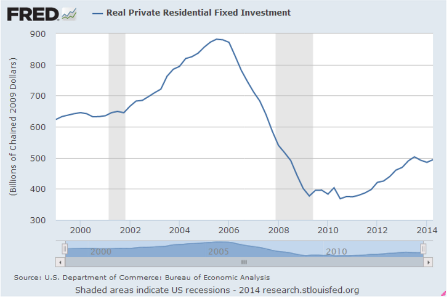
The ‘surge’ in total starts, which remain pretty much at the lows of prior recessions (see charts which are not population adjusted), was in multi family, which is ok, but units tend to be smaller and a lot less expensive than single family, and total expense is what counts for GDP/employement/etc. And it all remains a much lower % of GDP than in prior cycles:

Housing Starts


Highlights
Housing may be making a comeback with the labor market improving and awareness that the Fed is cutting back on mortgage-backed securities-meaning a pending rise in mortgage rates.

Housing starts for July jumped to an annualized pace of 1.093 million units-up from 0.945 million units the prior month. The latest number well topped expectations for 0.963 million units. July was up a sharp 15.7 percent (monthly), after dipping 4.0 percent in June.

Strength was led by the multifamily component which surged 28.9 percent after a 3.1 percent decline in June. But the single-family component showed health with an 8.3 percent rebound after falling 4.4 percent in June.

According to building permits, momentum is building-but largely for the multifamily component. Permits jumped a monthly 8.1 percent to an annualized pace of 1.052 million units. For July, the multifamily component gained 21.5 percent while the single-family component edged up 0.9 percent.


Full size image


Full size image

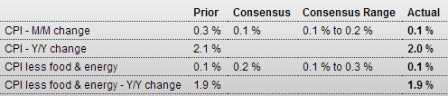
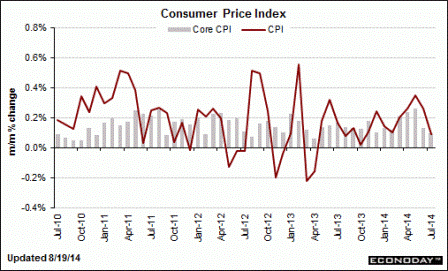
Consumer Price Index