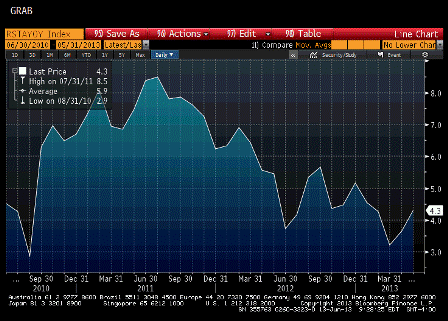
Jobs

Hopefully employment, historically a lagging indicator, somehow leads consumption and GDPthis time.

(As always, I could be wrong, but I wouldn’t bet even your money on it…)

;)

But seems more than enough for the Fed to ‘taper’ which of course is of no further economic consequence of substance.

Of more concern is rising gasoline prices, for example.
And this latest Egyptian drama has only just begun.
Seems the revenge of the Brotherhood is inevitable.

Ireland falls back into recession despite multibillion-euro austerity drive

Classic headline!!!!

Ireland falls back into recession despite multibillion-euro austerity drive

By Henry McDonald

June 27 (Guardian) — Ireland is back in recession for the first time since its 2010 bailout, official figures have confirmed.

Irish GDP shrank 0.6% in the first quarter of 2013, but the recession was confirmed when official data revised down the economy’s performance in the final three months of 2012 to a decline of 0.2%. It means that Ireland has endured three successive quarters of contraction, despite the presence in Ireland of multinationals such as Apple, Google, IBM and several big pharmaceutical companies.

The blow comes as Ireland reels from the unfolding Anglo Irish Bank scandal, in which executives at the bailed-out bank were caught on tape joking about their multi-billion euro rescue in 2008 and, at one point, singing “Deutschland über Alles” as they quipped about German deposits shoring up the bank.

The output drop reflects an ongoing depression in consumer demand, amid unemployment of nearly 14%. Personal expenditure declined by 3% between the fourth quarter of 2012 and the first quarter of 2013. The decrease in demand reflects Irish consumers’ fears for their jobs and a reluctance to get into debt following the credit-fuelled spending boom of the Celtic Tiger years. Exports fell by 3.2% in the first quarter, in a stark reversal for an economy that had enjoyed an export-led recovery.

The slip back into recession will be deeply disappointing for the Fine Gael-Labour coalition, which has slashed public spending in a bid to drive down the country’s debt while placating the troika of the International Monetary Fund, European Union and European Central Bank who bailed out the country in 2010. Ireland’s deputy prime minister, Eamon Gilmore, admitted this week that the Anglo Irish revelations could harm attempts to win further debt relief from the European Union.

On a brighter note, the construction industry in the Republic is showing some signs of recovery. The latest figures point to a 2.1% increase in building across the state in a sector which was devastated by the property crash of 2008-09, and which has been a huge factor in lengthening the country’s dole queues.

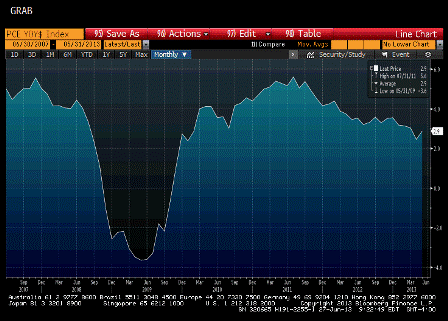
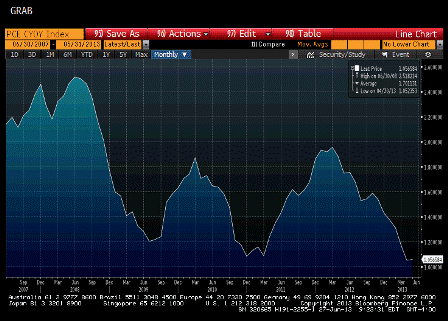
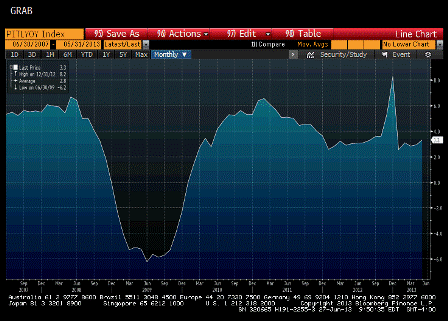
pce, personal income yoy

Maybe it’s just me but to me this looks like it’s still decelerating, as it was before the tax hikes and spending cuts, which are still ongoing.

So I still see downside risk here?

But, of course, bad news for the economy is good news for stock prices for as long as markets think QE supports equity prices.

PCE Y/Y:


Full size image

Core PCE Y/Y:


Full size image

Personal Income Y/Y:


Full size image

Posted in GDP

Carney quotes me again

The Real Reason 1Q GDP Took a Hit

By John Carney

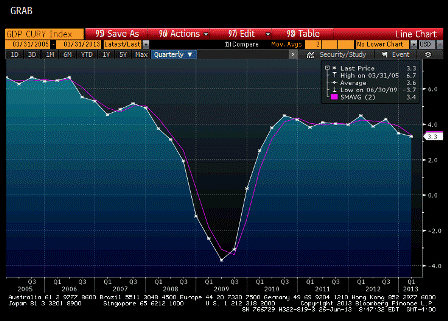
June 26 (CNBC) — The economy grew more sluggishly in the first three months of the year than the government first reported, as higher taxes on payrolls dampened consumer spending and held overall growth down to just a 1.8 percent annual rate.

Make no mistake about it: this is really grim. And to make matters worse, it’s something we did to ourselves.

The Commerce Department had earlier estimated growth at 2.4 percent. Most economists expected that number to remain when the final revision came out Wednesday.

This follows an expansion of just 0.4 percent in the fourth quarter of last year.

The biggest source of the downward revision came from consumer spending. Government economists had estimated that consumer services consumption (excluding housing and utilities) would grow by 2.5 percent, instead it grew at just 0.7 percent.

That’s stall speed for consumers. Far worse, in fact, than the 2.4 percent growth seen in the fourth quarter.

There were also downward revisions to nonresidential structures investment, equipment and software spending, and the change in inventories. Government spending shrunk by slightly less than expected, so the sequester spending cuts weren’t as big of a deal as some predicted. Residential investment was up by far more than expected, 14.0 percent.

The main culprit behind the consumer pullback seems to be what Fed Chairman Ben Bernanke calls “fiscal headwinds.” Specifically, the end of the payroll tax holiday left less money in the hands of consumers to spend. We taxed ourselves out of growth.

“The lower consumption estimate provides some indication that the impact from fiscal austerity may have been more than previously thought, and that the economy started the year on weaker footing than previous estimated,” TD Securities analyst Millan Mulraine wrote in a note.

But don’t entirely discount the federal spending cuts known as “sequester,” which kicked in on March 1. Even though the sequester did not directly diminish government spending by as much as possible, its anticipated effects may have dampened investments.

Gross private investment was revised down to 7.4 percent growth from the estimate of 9.0 percent. Commercial investment fell 8.3 percent, compared with an estimated fall of just 3.5 percent. Business investment was revised down slightly lower to 4.1 percent from 4.6 percent. Those drops likely reflect a projected weakness in the economy going forward.

That growth could fall so low in a quarter in which the Federal Reserve was engaging in a new round of quantitative easing, buying $85 billion of bonds each month, might cast doubt on the effectiveness of the program. That would be bad news for stocks, which rose for the first four months of the year on the idea that QE could prop up a weak economy. (And have recently fallen after the Fed began to explain when it would pare back the program.)

“‘QE on’ was a misguided speculative bubble in any case, as QE is, at best, a placebo, and in fact somewhat of a tax as it removes a bit of interest income,” bond investor Warren Mosler said.

Mosler is a long-term critic of QE. He believes that because the interest paid on bonds the Fed buys under the program gets paid to the Fed instead of private bond holders, it acts as a tax on the private sector. The economic benefits are illusory, according to Mosler.

On the other hand, sluggishness in the economy could mean that expectations about the Fed tapering QE and raising rates get pushed back. Bernanke has stressed that decisions about policy changes would be dependent on economic data.

Wednesday’s news about the first quarter, while backward looking, certainly casts doubt on whether the economy is strong enough to justify lower levels of bond purchases.

Not everyone buys that way of thinking, however. Some doubt that Wednesday’s news will have any effect on the Fed’s plan to reduce the bond-buying program.

“The Fed will presumably continue to maintain its primary focus on labor market data, so while this revision obviously will impact their thoughts at the margin, I highly doubt that it will be a game changer, especially since I am skeptical that policymakers are as data-dependent as they want to believe,” Stephen Stanley of Pierpont Securities wrote in a note Wednesday morning.

GDP Revision

And Q1 was the bounce back from the 0.4% Q4 print?

So now seems the govt deficit reduction happened in the face of even lower levels than previously thought?

And so the question remains of which agents are going to step up and fill that spending gap, as the ‘demand leakages’ are continuous?


Karim writes:

  • The downward revision was due to PCE services; commercial real estate was revised lower but the contribution from residential real estate was revised higher.
  • The ‘surprise’ was due to the fact that details on PCE services don’t come out until tomorrow
  • Of the 20bn downward revision in PCE services, 15bn was from housing services

From SMR:

We wonder whether the downward revision to the PCE for Housing Services was in the “imputed services rendered by owner occupied housing”. If so such may speak to Chairman Bernanke’s comment during the Q&A following the FOMC meeting wherein he said that the deflator for the imputed portions of the PCE may be too low. We will have a better handle on this tomorrow.

Away from the PCE for Services, there were only minor offsetting revisions, not really worthy of comment

What does the downward revision to Q1 GDP and Q1 PCE for Services imply for Q2 GDP?

Friday update- deficits matter, a lot!

So back to basics

For 16t in output to get sold there must have been 16t in spending, which also translates into 16t in some agent’s income.

And (apart from unsold inventory growth), for all practical purposes nominal GDP growth is another way to say sales growth.

To state the obvious, sales = spending, income = expense, etc. Working against growth is ‘unspent income’, also called ‘demand leakages’. Those include pension contributions, insurance reserves, retained earnings, foreign CB fx purchases, cash hoards, etc. etc. etc. And for every agent that spent less than his income, some other agent spent more than his income, to the tune of the 16t GDP.

And GDP growth is a function of that much more of same.

Well, the 2% or so growth we’ve been getting once included the govt spending maybe 10% more than its income to keep sales growing more than the demand leakages were working against sales growth. And with growth, the so called automatic fiscal STABILIZERS work to temper that growth, as growth causes govt revenues to increase and govt transfer payments to decline.

You can think of this as institutional structure that causes the economy to have to go uphill to grow. That’s because as the economy grows, the growth of govt net spending is ‘automatically’ reduced.

So after a couple of years growth the govt went from spending maybe 10% more than its income to something under 6% of its income, which translated into about 2% real growth, and about 3.5% nominal growth.

Well, to keep this going in the face of the demand leakages, some other agents were picking up the slack.

Looking at the charts it seems to me it was the home buyers and car buyers who were consistently spending more than their incomes, driving the nominal GDP growth.

But then on Jan 1 fica taxes went up as did some income tax rates, by about 3.5 billion/week, removing that much income from potential spenders. And a few months later the sequesters hit, both reducing GDP by the amount of those spending cuts and reducing income by about another 1.5 billion per week.

In other words, the govt suddenly reduced the amount it was spending beyond its income by about 1.5% of GDP, which had been working along with the domestic credit expansion to outpace the demand leakages.

So how has domestic credit managed to expand to fill that spending gap caused by the already retreating govt deficit spending proactively dropping another 1.5%?

With great difficulty!

Since January, after climbing steadily, car sales look to have gone sideways. And looks to me like the rate of domestic deficit spending on housing has declined as well. In any case there hasn’t been an the increase these ‘credit expansion engines’ needed to fill the spending gap from the proactive drop in govt deficit spending. And add to that decelerating person income stats (and remember, the pay for additional jobs comes from someone else’s income, and hopefully income spent on output).

And in any case to keep growing at about 2% credit expansion has to overcome the demand leakages and climb the hill of the automatic fiscal stabilizers as with the current institutional structure nominal growth automatically reduces the contribution of govt deficit spending, which is now maybe down to 4% of GDP. Note that with forecasts of 2% growth the forecast for the govt deficit spending falls to only 2% of GDP, implying far more rapid increases of ‘borrowing to spend’ in the domestic sector. And if that net new borrowing doesn’t materialize, the sales don’t either.

Is it possible for housing related credit expansion to suddenly accelerate? Sure, but is it likely, especially in the face of the drag the govt layoffs and tax increases that made the hill the domestic credit expansion needs to climb that much steeper? And sure, the foreign sector could suddenly spend that much more of its income in the US, but is a US export boom likely in the current anemic global economy? I wouldn’t bet on it.

Now add this to the taper nonsense.

As previously discussed, QE is at best a placebo, and more likely a negative as it removes interest income from the economy.

But with none of the name institutions of higher learning teaching this, today’s portfolio managers think it’s somehow a ‘stimulus’ and act accordingly, driving up stock prices globally, supporting global ‘confidence’, even as growth and earnings show signs of fading. And then when the Fed even discusses the possibility of reducing the volume of QE, they all stampede the other way, with bonds reacting to the same misguided QE logic as well. But in any case, these are misguided, one time portfolio shifts, that tend to reverse with time as the reality of the underlying economy/earnings eventuates, refudiating the presumed effects of QE… :)

To conclude, I just don’t see the source of the credit expansion needed for anything more than modest nominal growth, which has now continued to decelerate to maybe 3% of GDP, and a real risk that the domestic credit expansion can’t even keep up with the demand leakages, and real GDP goes negative, along with top line growth and earnings growth.

In fact, with annual population growth running at about 1.25%, per capita GDP is already only about equal to productivity growth, as the labor force participation rate hovers at multi decade lows.

Have a nice weekend!

Ciao!

JPY

Unfortunately what Japan risks is an exit from headline deflation but no growth in output and employment to show for it. What they’ve done might be to cause the currency to depreciate about 25% via ‘portfolio shifting’, which may not expand real domestic demand. In fact, in real terms, it may go down, leaving them with higher prices and a lower standard of living.

Yes, the currency shift makes imports more expensive, which means there will be some substitution to domestic goods which cost more than imports used to cost, but less than they now cost. But for many imports there are no substitutions, so the price increase simply functions like a tax increase.

And yes, exports, particularly nominal, will go up some, but so does the cost of inputs imported. And yes, some inputs sourced elsewhere will instead be sourced locally, adding to domestic employment and output, but not to real domestic consumption.

At the macro level what counts is what they do with regards to keeping the govt deficit large enough to accommodate the need to pay taxes and net save. Net exports ‘work’ by reducing real terms of trade when the govt purchases fx, which adds net yen to their economy. I call the fx purchases ‘off balance sheet deficit spending’. But so far the govt at least says they aren’t even doing that, and the lifers etc. now deny having done much of that either?

What has changed fundamentally is they are importing more energy since shutting down their nukes. Again, this functions as a tax on their economy (taxonomy for short? really bad pun intended!).

On the other hand, as above, buying fx by either the private or public sector is, functionally, deficit spending, which in this case first supports exports, but could add some to aggregate demand, depending on the details of relevant propensities to consume, etc.

The entire point of all this is Japan can cause some ‘inflation’ as nominal prices are nudged up by the currency depreciation, but with only a modest increase in real output via an increase in net exports that fades if not supported by ongoing fx purchases. And all in the context of declining real terms of trade as the same amount of labor buy fewer imports, etc. which is the engine that makes it ‘work’ on paper.

And for the global economy it’s another deflationary shock in a deflationary race to the bottom as other wanna be exporters compete with Japan’s massive cut in real wages.

So yes, they are trying to cause inflation, but not for inflation’s sake, but as a way to increase output and employment. But I’m afraid what they are missing that the causation doesn’t work in that direction.

In conclusion, this was the thought I was trying to flesh out:

Just because increasing output can cause inflation, it doesn’t mean increasing inflation causes real output and employment to increase.

sorry, this all needs a lot more organizing. Will redo later.