Talking points for 11am WRKO radio interview

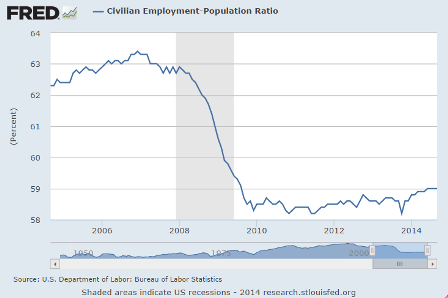
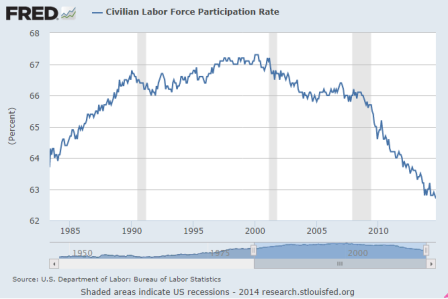
Jobs: Just keeping up with population growth- 59% three months in a row, not at all ‘recovering’ as in prior cycles. So seems the extra jobs are from underestimating population growth?

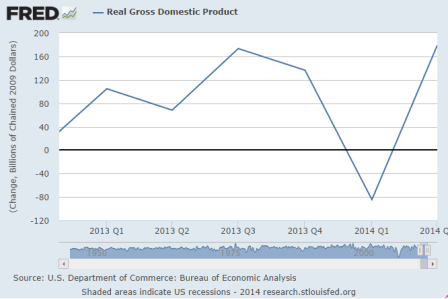
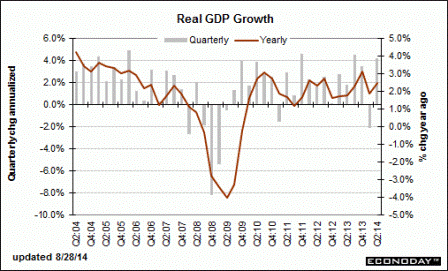
Spending- working its way lower after the tax hikes and sequesters. Q3 201313 was supported by unsold inventories, Q4 13 by expiring tax credits, then down for Q1 2014 as inventories were reduced and cold weather hurt some, and a Q2 bounce that resulted in only 1.2% growth for the first half of this year:

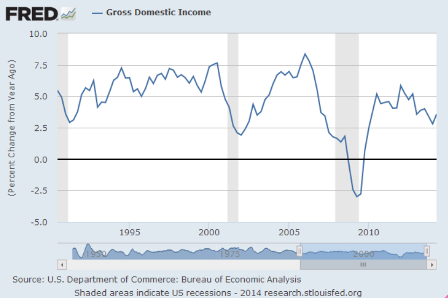
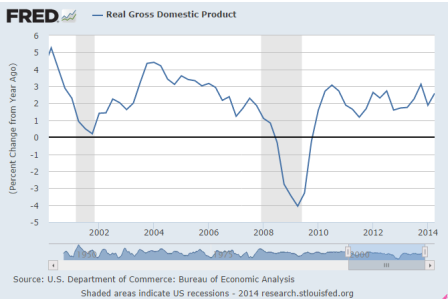
You can see how in the previous cycle the large drop in the growth rate was followed by a rebound to much higher rates of growth. The current cycle saw a much larger decline in GDP that was followed by lower rates of growth that now seem to be further declining:

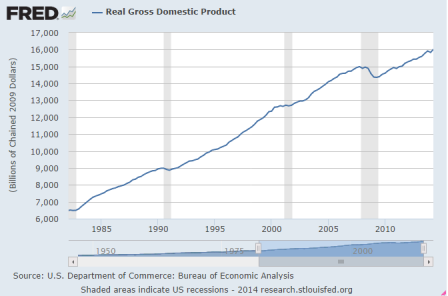
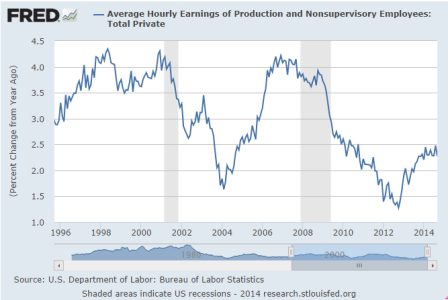
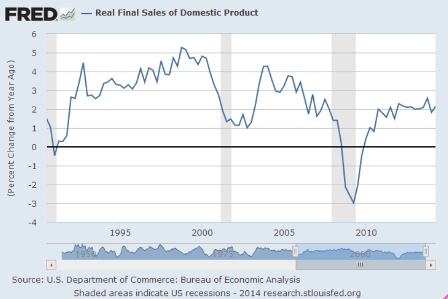
You can see the persistent shift down after the last recession that didn’t happen in prior cycles:

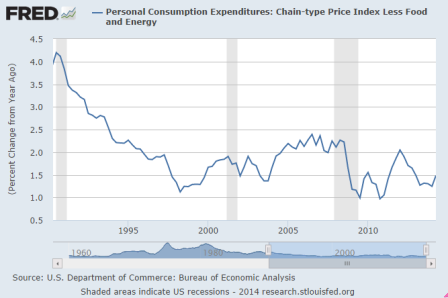
Inflation? 6 years of 0 rates, over 4 trillion of QE, and the Fed still can’t hit it’s 2% target? Maybe it’s not so easy to inflate as most think? And just maybe the Fed has it all backward, and 0 rates and QE are deflationary?

Like the hairdresser said, “no matter how much I cut off its still too short”:

Construction spending, ISM Manufacturing, ADP

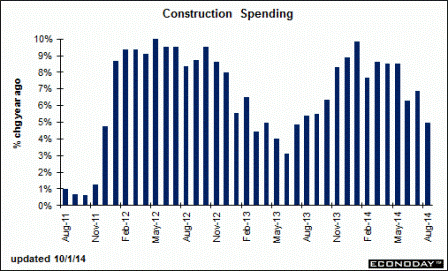
Came in less than expected and the chart looks bad as well, having topped out prior to year end as tax credits expired:

Construction Spending


Recent History Of This Indicator
Construction spending saw a broad-based gain in July. Construction spending rebounded 1.8 percent after a 0.9 percent dip in June. While all broad categories advanced, July’s increase was led by the public sector-up 3.0 percent, following a 1.8 percent decrease in June. Private nonresidential spending rebounded 2.1 percent in July after slipping 0.8 percent the month before. Private residential outlays gained 0.7 percent, following a 0.4 percent dip in June.

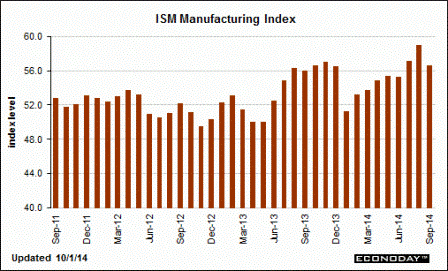
ISM manufacturing less then expected but still at reasonable levels:

ADP Employment Report


Highlights
ADP’s estimate for private payroll growth for September is 213,000 vs the Econoday consensus for 200,000 and vs a revised 202,000 for August. The corresponding consensus for Friday’s jobs report from the government is 215,000 vs August’s 134,000.

ADP contracted with Moody’s Analytics to compute a monthly report that would ultimately help to predict monthly nonfarm payrolls from the Bureau of Labor Statistic’s employment situation.

ADP used to report it’s payroll number, but a while ago ‘switched’ to using its internal numbers to try to forecast Friday’s non farm payroll report, so now we don’t see their actual payroll numbers, just their forecast for Friday

It’s all looking more and more like the ‘unspent income’ is winning, as happened in Q1, and it’s all on the verge of going into reverse.

Q3 GDP estimates hovering around +3%

Current estimates for Q3 GDP are hovering around +3%.

So how wrong can they be? Well, the actual range on Bloomberg is from 1.2-4%

And here’s the April 30 release for Q1, with estimates ranging from +.5- 2.0. The latest revision has it at -2.1.

Just saying it’s not uncommon for estimates to be off by a full 3% or more!


Highlights
Economic growth came to a standstill in the first quarter, largely due to adverse weather slowing production. First quarter GDP rose a meager 0.1 percent annualized after a 2.6 percent gain in the fourth quarter. The advance estimate fell well short of market expectations for a soft 1.1 percent rise.

Posted in GDP

Pending home sales, personal income

Fewer cash buyers and fewer mtg purchase apps also translated into fewer pending home sales:

Pending Home Sales Index


Highlights
The outlook for the used home market remains stubbornly flat, with pending home sales down a disappointing 1.0 percent in August. The Econoday consensus was calling for a 0.8 percent gain. Year-on-year, pending home sales in August were down 2.2 percent which is roughly in line with a 5.3 percent decline for final sales of existing homes in data that were released last week.

A lack of first-time buyers and strong demand for rentals remain key obstacles for home sales. A lack of distressed homes on the market is another negative factor. Mortgage rates for now are still low but are likely to begin to rise as the Fed withdraws stimulus and begins to raise rates, a prospect that points to continued sales weakness ahead.

Regionally, weakness in sales trends for existing homes has been spread evenly with the West lagging slightly. Weakness in today’s report is centered in the Midwest where pending sales fell 2.1 percent for a year-on-year decline of 7.6 percent. The Northeast shows an even steeper 3.0 percent decline in the month though it is the only region with a positive year-on-year rate at plus 1.6 percent. Pending sales rose 2.6 percent in the West though the year-on-year is minus 2.6 percent while the South, which is by far the largest housing region, shows a 1.4 percent decline in the month and no change on the year.

The number of signed contracts to buy existing homes fell 1 percent in August compared to July and is down 2.2 percent from August of 2013, according to the National Association of Realtors

Note that payroll taxes went up Jan 2013, and the sequesters first hit in April, followed by Fed statements that caused mtg rates to gap up about 1% in July or so. We seem to be faltering below the prior 2013 peak and well below prior cycles:

Personal income numbers are not inflation adjusted here:


Highlights
The consumer sector showed improvement in August for both income and spending. Personal income growth posted a 0.3 percent gain in August, following a 0.2 percent rise in July. The latest number matched expectations for a 0.3 percent advance. The wages & salaries component was even stronger with a 0.4 percent boost, following a 0.2 percent increase the month before.

Personal spending jumped 0.5 percent after no change in July. Analysts forecast a 0.5 percent boost. Strength was in the durables component which jumped 1.8 percent after no change in July. August reflected a jump in auto sales. Lower gasoline prices tugged down on nondurables. Nondurable spending declined 0.3 percent after no change in July. Services jumped 0.5 percent in August after being unchanged the month before.

PCE inflation slowed to a monthly no change in August from 0.1 percent in July. The latest figure came in slightly lower than expectations for a 0.1 percent rise. Core PCE inflation posted at 0.1 percent, equaling the pace for July. The median market forecast was for no change.

On a year-ago basis, headline PCE inflation eased to 1.5 percent from 1.6 percent in July. Year-ago core inflation was 1.5 percent in both August and July. Again, PCE inflation remains well the Fed goal of 2 percent but is edging upward.

This is the pre tax personal income:


This is after ‘inflation’/cpi and taxes:

And this is the per capita rate of growth which remains very low:

Here you can see the effect of the Fed’s 0 rate policy and QE on personal interest income, which has stagnated under this policy. Note that I like the 0 rate policy, but I also recognize that it means we need a larger deficit- lower taxes and/or higher spending:

Durable Goods orders

Durable Goods Orders


Highlights
Durables orders fell back in August, coming off July’s surge in aircraft orders. But the core was healthy in August. New factory orders for durables dropped a monthly 18.2 percent, following a spike of 22.5 percent in July. Market expectations were for a 17.1 percent fall. Transportation fell a monthly 42.0 percent in August, following a 73.3 percent jump the month before.

Excluding transportation, durables orders rebounded 0.7 percent, following a decline of 0.5 percent in July. Analysts projected a 0.8 percent gain for August.

Within transportation, nondefense aircraft fell a monthly 74.3 percent, following a 315.6 percent spike in July with both swings essentially reflecting Boeing aircraft orders. Defense aircraft orders slipped 0.6 percent, following a 31.7 percent drop in July. Motor vehicle orders have been moderately volatile but healthy on average, decreasing 6.4 percent after a 10.0 percent boost the prior month.

Outside of transportation, major industries seeing a gain in the latest month were fabricated metals, machinery, computers & electronics, electrical equipment, and “other.” Declines were posted for primary metals.

Orders for equipment investment made a healthy comeback in August. Nondefense capital goods orders excluding aircraft rebounded 0.6 percent in August, following a dip of 0.2 percent the month before. Shipments of this series edged up 0.1 percent but followed a strong 1.9 percent gain in July.

Recent durables orders have shown record volatility. On average, durables orders point to moderate upward momentum in manufacturing.

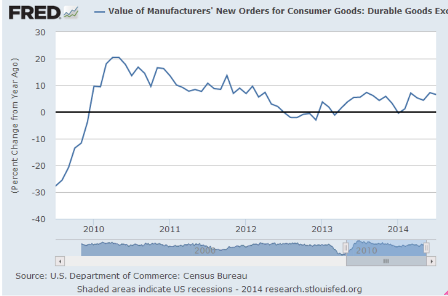
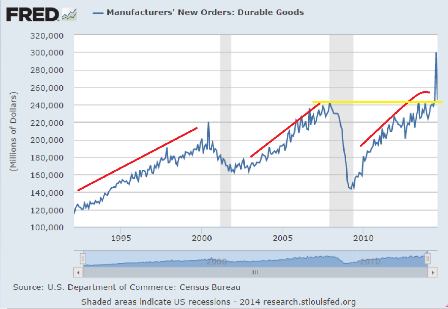
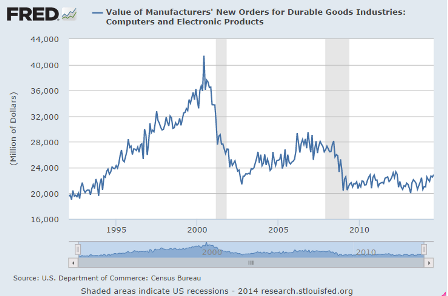
The yellow line is to show that actual orders have just gotten back to pre recession levels, and that’s not inflation adjusted, so in real terms they haven’t yet caught up.

The red lines are roughly the ‘slope’ which is a proxy for the rate of growth, but it should get ever steeper on this arithmetic chart to indicate the same rate of growth. So the growth rate in this cycle is slowing. And also seems last time around we went into recession before this indicator turned south, while the cycle before that it turned down before we went into recession.


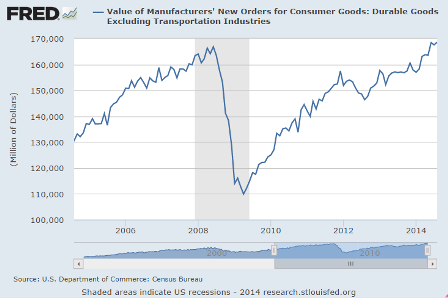
Adjusted for inflation this is still below 2008 levels as well:


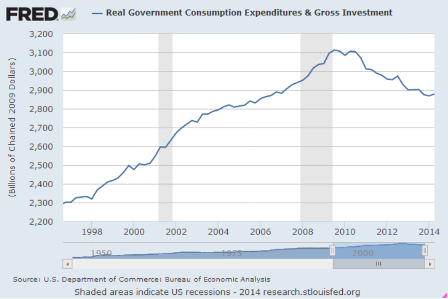
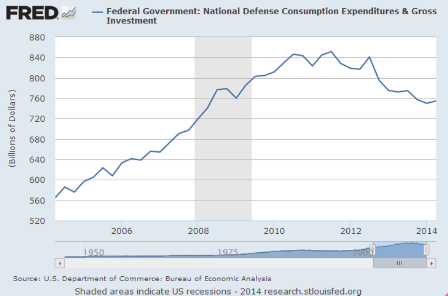
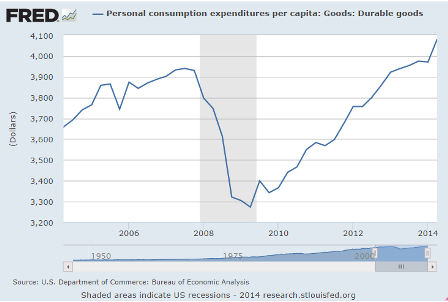
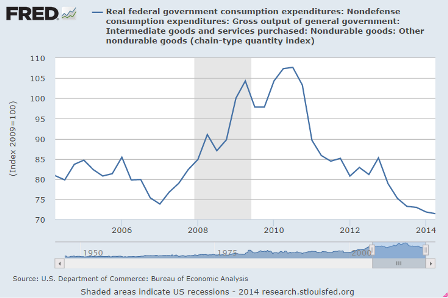
Govt cutbacks in evidence here:

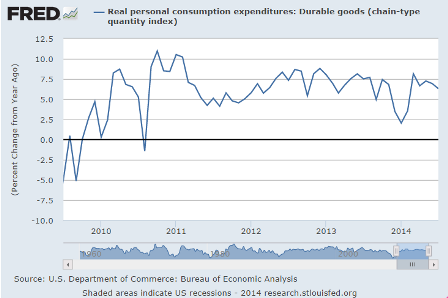
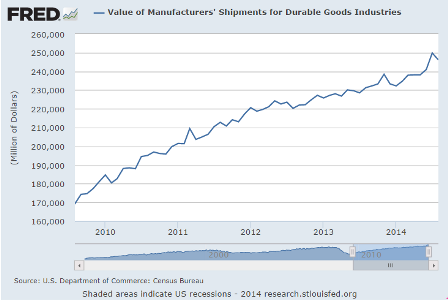
Shipments are what counts for GDP. Last month’s gain increased GDP estimates, this month’s reduction reduces them:

And how about that Y2K/.com mania of the late 90’s!

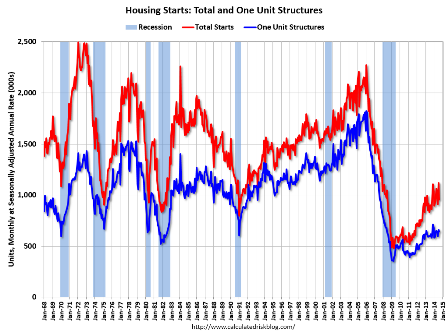
Housing starts

As previously suggested, with fewer cash sales and mtg purchase apps down 10% vs last year seems doubtful sales do much.

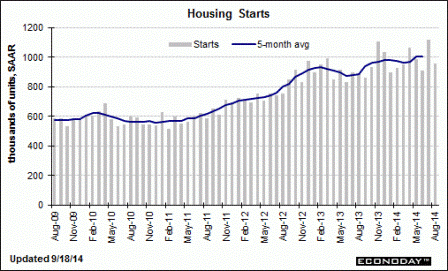
With population growth what it is, ‘normal’ for this point in the cycle would be about double what we are seeing. In fact, we are now back to only what were the lows of prior cycles, and we have a lot more people now:


Highlights
Homebuilders are being cautious as both starts and permits disappointed for August. But August is coming off a strong July.

Housing starts for August fell 14.4 percent, following a boost of 22.9 percent the month before. August’s pace of 0.956 million units was short of market expectations for 1.038 million units and was up 8.0 percent on a year-ago basis.

The multifamily component declined a monthly 31.7 after jumping 44.9 percent in July. The single-family component edged down 2.4 percent, following an 11.1 percent surge in July.

Building permits are oscillating, too. Permits decreased 5.6 percent in August, following an 8.6 percent boost in July. Monthly swings have largely been in the multifamily component. The single-family component has been in a modest downturn in recent months.

There has been a lot of volatility in housing data in recent months and the latest starts data likely will lead to some trimming of forecasts for third quarter GDP growth. The trend continues that housing strength is in the multifamily component.


Full size image

Construction, gasoline prices, manufacturing, state and local contribution to gdp, restaurant performance index, saudi output, sun spots

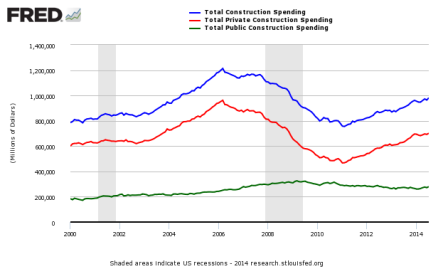
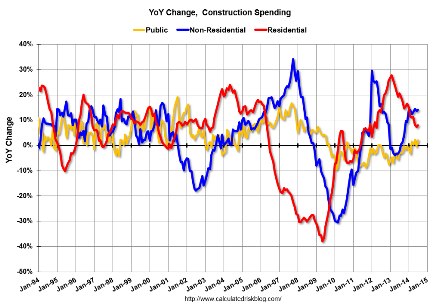
Headlines sound a lot better than the charts look.

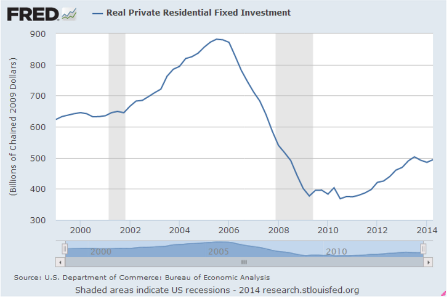
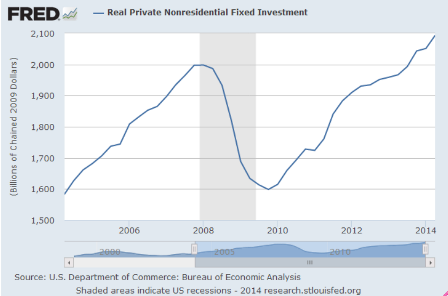
Absolute levels and growth rates continue to fall short of prior cycles:

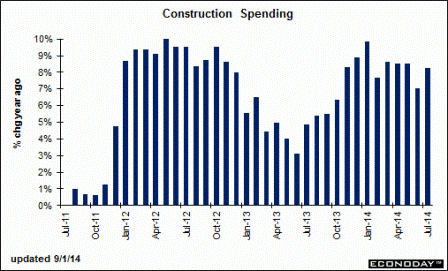
Construction Spending


Highlights
Construction outlays saw a broad-based gain in July. Construction spending rebounded 1.8 percent after a 0.9 percent dip in June. While all broad categories advanced, July’s increase was led by the public sector-up 3.0 percent, following a 1.8 percent decrease in June. Private nonresidential spending rebounded 2.1 percent in July after slipping 0.8 percent the month before. Private residential outlays gained 0.7 percent, following a 0.4 percent dip in June.

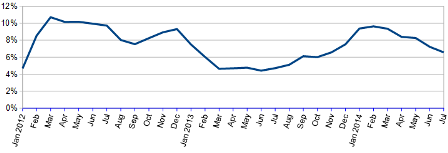
On a year-ago basis, total outlays were up 8.2 percent in July, compared to 7.0 percent the month before.

Overall, the latest construction data add to third quarter momentum. Third quarter GDP estimates will likely be nudged up. There is a lot of recent volatility in construction data but the residential gain is encouraging.

Unadjusted Construction Spending – Three Month Rolling Average Compared to the Rolling Average One Year Ago


Full size image


Full size image


Full size image

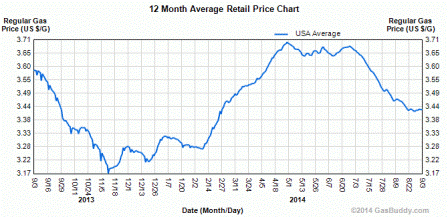
This helps consumers some and also puts downward pressure on ‘inflation’:


Full size image

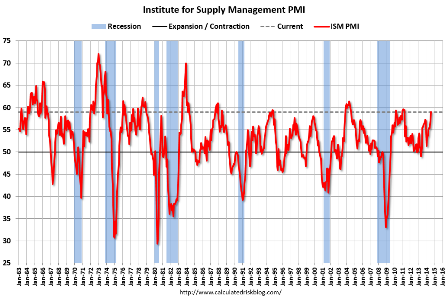
Manufacturing continues to do reasonably well, chugging along about the way it always does until the cycle ends:


Full size image

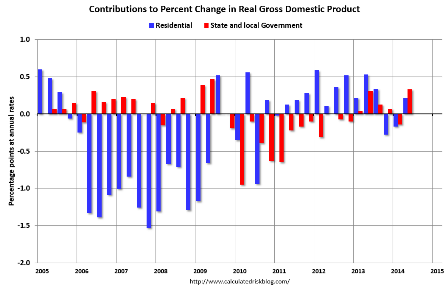
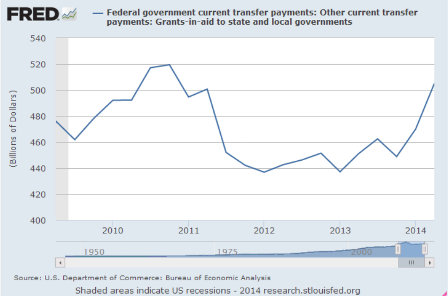
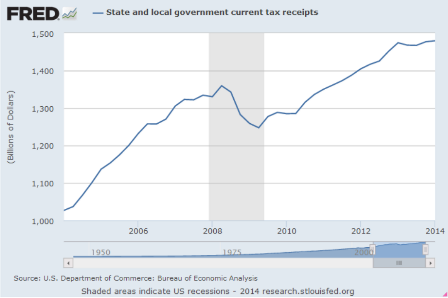
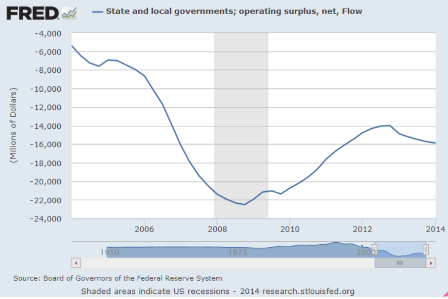
Don’t be misled by the talk of state and local govt contributing to GDP. The spending side is only half the story- they also tax. So you need to look at state and local govt deficits to get an idea of their net contribution:

This is the spending side:


Full size image

It’s a bit tricky as you don’t want to double count federal $ spent by the states:

Sure enough, tax receipts which tend to be highly cyclical, going up when the economy does better, seem to have stalled, and state and local deficits have gone up. So is that an indicator of growth?

And it looks like state and local deficits did go up a tad, but not a lot:

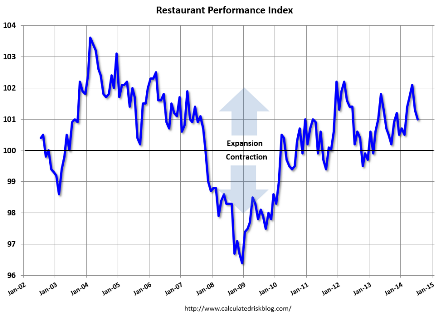
And this just came out:


Full size image

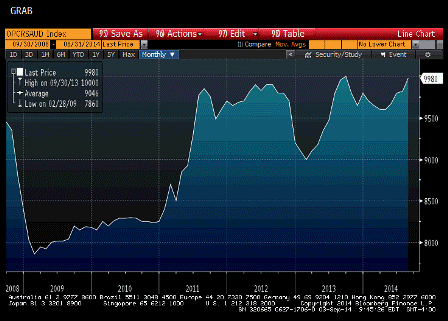
The call on Saudi oil shows no signs of diminishing which they remain as ‘swing producer/price setter’, setting price and letting quantity adjust with demand:


Full size image

And this:
;)


Full size image

Charts and data from the last few days

Down for the cold winter then back up some, and a very weak first half of the year, and Q3 fading from Q2:

GDP


Highlights
The second estimate for second quarter GDP growth came in a little stronger than expected, rising 4.2 percent annualized versus a 4.0 percent forecast and coming off a 2.1 percent weather related drop in the first quarter. With this second estimate for the second quarter, the general picture of economic growth remains the same; the increase in nonresidential fixed investment was larger than previously estimated, while the increase in private inventory investment was smaller than previously estimated.

Real final sales of domestic product-GDP less change in private inventories-increased 2.8 percent in the second quarter, in contrast to a decrease of 1.0 percent in the first. Real final sales to domestic purchasers gained 3.1 percent versus 0.7 in the first quarter.

Chain-weighted prices gained 2.1 percent annualized, compared to the consensus for 2.0 percent and the first quarter number of 1.3 percent.

Overall, the weather-related rebound in the second quarter was stronger than expected. Personal spending made a comeback and inventories were rebuilt. The economy is gradually regaining momentum-emphasis on gradually.
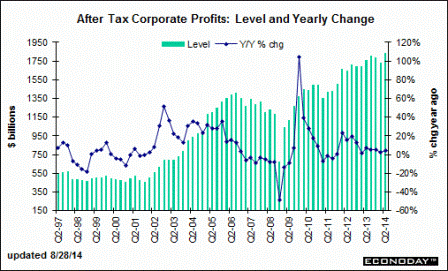
Corporate Profits

Again, for growth this year to exceed last year, all the components on average have to grow more than they did last year:

NAR: Pending Home Sales Index increased 3.3% in July, down 2.1% year-over-year

By Bill McBride

From the NAR: Pending Home Sales Pick Up in July

The Pending Home Sales Index, a forward-looking indicator based on contract signings, climbed 3.3 percent to 105.9 in July from 102.5 in June, but is still 2.1 percent below July 2013 (108.2). The index is at its highest level since August 2013 (107.1) and is above 100 – considered an average level of contract activity – for the third consecutive month.

With purchase apps down 11% year over year and cash purchases down it’s hard to see how total sales can grow?

MBA Purchase Applications
Highlights
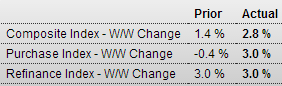
Demand for purchase applications picked up in the August 22 week, rising 3.0 percent. But the trend remains stubbornly flat, down 11.0 percent year-on-year. The index for refinancing applications also rose 3.0 percent in the week. Mortgage rates were little changed in the week with the average for conforming loans ($417,000 or less) down 1 basis point to 4.28 percent.

Falling home prices are not a good sign:

S&P Case-Shiller HPI


Highlights
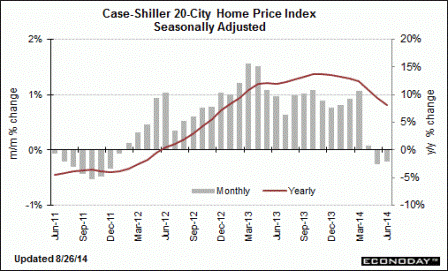
Home price appreciation continues to unwind as S&P Case-Shiller 20-city adjusted data show a 0.2 percent decline in June following a 0.3 percent in May. Year-on-year, the adjusted rate is plus 8.1 percent vs 9.3 percent in May. Monthly declines swept 13 of the 20 cities with Minneapolis, Detroit, Atlanta and Chicago showing special weakness.

Unadjusted data, which are followed in this report, show a monthly gain of 1.0 percent that reflects the relative strength of summer months for sales. But the year-on-year rate, where this effect is offset, tells exactly the same story as the adjusted data, at 8.1 percent vs 9.3 percent in the prior month.

Home prices are weakening, based not only on this report but also on FHFA data, also released this morning, and on yesterday’s new home sales report as well as last week’s existing home sales report. Easing home prices are a plus for sales but a negative of course for homeowner wealth.
Durable Goods Orders


Highlights
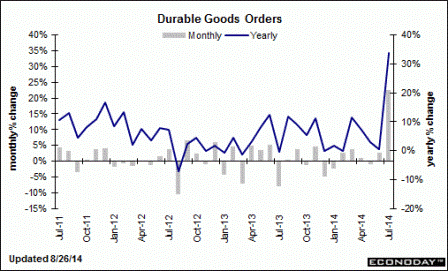
Durables orders soared in July due aircraft orders but otherwise came off a moderately strong core number in June. New factory orders for durables soared a monthly 22.6 percent in July, following a 2.7 percent boost in June. Econoday’s consensus called for a 5.1 percent gain in July. The high end of forecasts was 24.5 percent.

Excluding transportation, durables orders slipped 0.8 percent, following a 3.0 boost in June. Analysts forecast a 0.4 percent rise for July. But June earlier had been estimated to be up “only” 1.9 percent from the full factory orders report.

Transportation spiked a monthly 74.2 percent after rising 2.1 percent in June. Nondefense aircraft (Boeing) surged 318.0 percent (that is not a typo) after gaining 11.1 percent in June. Another but more moderate positive was motor vehicle orders which gained 10.2 percent, following a 1.3 percent dip in June. Defense aircraft fell 28.8 percent in July, following a rise of 9.2 percent the month before.

Outside of transportation, gains were limited with “other” gaining. Other categories slipped but followed upward revisions to June.

Orders for equipment investment edged down in July but followed a strong June. Nondefense capital goods orders excluding aircraft declined 0.5 percent, following a spike of 5.4 percent the month before. Shipments of this series, however, were positive, gaining 1.5 percent in July, following an increase of 0.9 percent in June. The latest shipments numbers suggest a favorable number for business equipment in third quarter GDP.

The Boeing order gets filled over approximately the next 10 years:
Real Fiscal Responsibility Today Radio and TV Show pilots

The Real Fiscal Responsibility Talk Show Pilot Project

This project is for everyone tired of hearing economic commentary from those who got everything wrong. For decades the the doctrine of “Fiscal Responsibility” interpreted as long-term deficit reduction and Government austerity has had a secure place in American politics. The three of us proposing this project believe that this doctrine is the economic equivalent of the medieval notion that patients must be bled to cure them of disease.

The notion that austerity is necessary after running budget deficits caused by economic downturns is false and damaging to economies all over the world. We have opposed targeted deficit reduction and austerity in the blogosphere and in an e-book since 2010. Yet despite our efforts and the efforts of many others who using the Modern Money Theory (MMT) approach to economics, as well as other post-Keynesians, the mythology of austerity still survives, waiting in the wings until the next debt ceiling or budgetary crisis provides an opportunity for austerity partisans to push their nostrums of spending cuts and “Grand Bargains” once again.

We value Real Fiscal Responsibility highly, but that doesn’t lie in targeted deficit reduction, or in spending cuts for their own sake. Instead, it lies in targeting real impacts, real benefits, and real results, and fulfilling the needs of real people. We want to replace the false and damaging austerian accountant’s green eyeshade paradigm of so-called Fiscal Responsibility, evaluated against the arbitrary standards and scare tactics of debt-to-GDP ratios and public debt levels, with the human scale paradigm of Real Fiscal Responsibility, evaluated against the standard of fulfilling public purpose.

We seek funding for a pilot project for a new radio/video series that will present, and advocate for this paradigm change. The project will create six shows that we will then use to get the series picked up by an existing cable network.

Please visit the donation page.