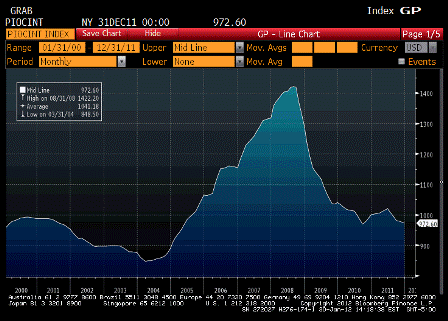
Feel free to forward to your local Fed President, to remind them that rate cuts do remove income from savers and from the economy in general, as the economy is a net saver to the tune of the cumulative govt debt (to the penny). (And not to forget the $80 billion or so per year of lost income due to QE.)
Lower rates remove income from ‘savers,’ with everyone who works for a living and contributes to any kind of retirement plan a ‘saver.’
Yes, with most major corporations, the additional contributions come from earnings, which reduces shareholder incomes rather than employee earnings.
But in any case, contributions to retirement funds are ‘demand leakages’ that directly or indirectly reduce income and, to some degree, reduce spending.
The obvious fiscal response should be along the lines of a FICA suspension to sustain sales, output, and employment…
By Thomas Black
February 28 (Bloomberg) — General Electric Co. (GE), Boeing Co. (BA) and 3M Co. (MMM) will join big U.S. employers in making a record $100 billion in 2012 pension contributions, 67 percent more than two years ago, as low interest rates boost companies’ liabilities.
Payments may total $400 billion from 2011 through 2015 to ease underfunding at the 100 largest defined-benefit programs, according to consultant Milliman Inc., which estimated that assets in January were enough to cover less than three-fourths of projected payouts.
“It’s been called the wall of contributions,” said Alan Glickstein, a senior retirement consultant at Towers Watson & Co. (TW) in New York. “All of a sudden this thing jumps up and stays there for a few years. That’s what it looks like — a wall.”
Companies from defense contractor Lockheed Martin Corp. (LMT) to aviation-electronics maker Honeywell International Inc. are caught in a vise: the Federal Reserve Board’s vow to keep rates at current levels until 2014 means pension plans’ fixed-income investments are stagnating just as new rules shorten the time available to shore up funding.
“They’re going to have to kick money in,” said John Ehrhardt, a consulting actuary at Seattle-based Milliman. “We’re basically seeing historically low interest rates driving historically high employer contribution requirements.”
That’s money that won’t go back to shareholders through dividends or buybacks, or toward expansion, said Kevin McLaughlin, a pension risk management specialist with consultant Mercer in New York.
Seven Years
Under the federal Pension Protection Act, which was passed in 2006 and mostly took effect in 2008, tighter accounting rules gave employers seven years to fully fund their retirement plans and required them to use a specified, market-based rate of return to compute liabilities instead of a company estimate.
Those liabilities are calculated by projecting future payments and discounting to the present based on interest rates pegged to a basket of corporate bonds. Liabilities rise when rates fall — and the Fed has held its discount rate at 0.75 percent since February 2010, down from as high as 6.25 percent in June 2007. The Fed said Jan. 25 it expected rates to stay at current levels until 2014.
3M’s pension plan in the U.S., which started 2011 with assets of $11.6 billion, shows the challenge for employers.
Assets rose to $12.1 billion by year’s end because of investments and contributions, even after payments of $680 million, according to a Feb. 16 filing. At the same time, the funding shortfall more than tripled, to $2.4 billion, because projected benefit obligations rose 18 percent to $14.5 billion.
‘Liabilities Did Increase’
“With the declining interest rates here in 2011, our liabilities did increase,” 3M Chief Financial Officer David Meline said Feb. 23 at a Barclays Plc industrial conference.
While 401(k) savings accounts are more common at younger companies, traditional manufacturers such are among the employers most affected by the pension pinch because they’re still making payments under defined-benefit plans. St. Paul, Minnesota-based 3M’s 2012 pension contribution will almost double to as much as $1 billion.
Pension expense is “a variable that we consider among many when we look at a company and what it could mean to their profitability,” said Mark Luschini, chief investment strategist at Philadelphia-based Janney Montgomery Scott LLC, which manages $54 billion. “If that were something that we said we wouldn’t want to own, we’d probably have a fairly limited universe of companies we could buy.”
S&P Industrials
The Standard & Poor’s 500 Industrials Index (S5INDU), whose 61 companies include manufacturers such as Boeing with defined- benefit programs, climbed 10 percent this year through yesterday, topping the S&P 500’s 8.7 percent gain.
Boeing’s pension cost will jump to $2.6 billion, 63 percent more than a year earlier, the company said in January. GE told investors in December it plans to add $1 billion, the first contribution since 1987, and expects to add about $2.1 billion in 2013. The Fairfield, Connecticut-based company closed its U.S. defined-benefits pension plan to all new hires this year.
Honeywell (HON) probably will make a contribution of as much as $1 billion, after low interest rates dashed a goal of full funding in four years, CFO Dave Anderson said. The plan was 83 percent funded at the end of 2011.
‘Little Bit Longer’
“I’d hoped to be there by 2015 to have more of a full resolution of that issue, but it’s going to take a little bit longer probably,” Anderson said in an interview. “Interest rates are at historic low levels and there’s no change in sight for that.”
Pension sponsors usually average rates over 24 months, so 2012 may be the peak year for companies’ pension contributions, said Glickstein of Towers Watson.
“We have a very unusual governmental intervention in the wake of a financial crisis,” he said. “Whatever other merits it may have, it’s clearly distorting the measures of pension obligations and putting a lot of extra pressure on plan sponsors.”
Lockheed Martin anticipated the rise in liabilities by pumping $6 billion into its plan over the last three years, curbing the projected 2012 contribution to $1.1 billion, according to a company filing.
Many pension plans, including GE’s, were overfunded before the December 2007 onset of the worst recession since World War II. Then pension assets began shriveling as stocks slumped, and lower interest rates increased liabilities.
Funding Levels
For the 100 largest defined-benefit plans, average funding levels sank to 74 percent in January from 105 percent in 2007, according to Milliman. Some companies may need to funnel cash to their pension plans for years.
Pension plan assets at Atlanta-based Delta Air Lines Inc. (DAL) covered only about 40 percent of obligations at the end of 2011, down from 47 percent the previous year, according to the carrier’s latest annual report. The funding shortfall widened to $11.5 billion from $9.3 billion in 2010, the filing showed.
Even after Delta ended pilots’ pensions before its 2007 bankruptcy exit and closed other plans to new hires, CFO Hank Halter said Jan. 25 that the airline still expects to contribute as much as $675 million in 2012. Defined-benefit programs taking new employees fell 26 percent in six years to 20,381 in 2009, according to the latest U.S. Pension Benefit Guaranty Corp. figures for plans with 25 or more workers.
The threat of future contributions is driving many sponsors of defined-benefit plans to seek ways to blunt risk, said Jeffrey Saef, chief of Bank of New York Mellon Corp. (BK)’s investment strategy and solutions group in Boston. That often means using more fixed-income investments to help match pension assets more closely to liabilities, he said in an interview.
Clients struggling with the cash drain from pensions have a universal query, Saef said: “‘When will it go away?’”
With Fed Chairman Ben S. Bernanke’s thumb on interest rates, that won’t be any time soon, said McLaughlin, the Mercer consultant.
“Right now, everybody is hoping for the best, which is equity markets performing and interest rates not falling any lower,” he said.