Re: Letter from Kohn to you, 1994


[Skip to the end]

(an email exchange PLUS pdf of Kohn letter)

consider it public information,
as you can see, he’s one of the few who understand monetary operations

thanks!

>   
>   On Mon, Aug 25, 2008 at 7:58 PM, Steve wrote:
>   
>   Hi Warren,
>   
>   Hope all is well with you.
>   
>   A year or two ago, William Hummel was kind enough to give me a copy of the
>   response you received from Donald Kohn regarding Fed/Treasury money
>   mechanics, confirming what you had laid out in S.C.E.; copy of letter is
>   attached.
>   
>   I might want to use that sometime in the future, if the occasion arises, to help
>   bolster an argument or two — but wanted to ask you permission beforehand.
>   If you’d like to keep it private, I’ll just paraphrase it as necessary.
>   
>   Thanks, and take care,
>   Steve
>   
>   ps- If you still have a copy of your letter to Greenspan, I wouldn’t mind seeing
>   how you worded your questions to him.
>   

Letter from Kohn to Warren, 1994


[top]

Re: Is Fischer correct?


[Skip to the end]

(an email exchange)

Not even close!

>   
>   On Mon, Aug 25, 2008 at 11:54 PM, Russell wrote:
>   
>   I found Fischer’s speech.
>   
>   ”No combination of tax hikes and spending cuts, though, will change the total
>   burden borne by current and future generations. For the existing unfunded
>   liabilities to be covered in the end, someone must pay $99.2 trillion more or
>   receive $99.2 trillion less than they have been currently promised.
>   

Why/how? Show me the debits and credits and how that changes real outcomes!

>   This is a cold, hard fact.

Yes, he believes it.

>   The decision we must make is whether to shoulder a substantial portion of that
>   burden today or compel future generations to bear its full weight.”

Yes, produce goods and services and send them back in time to pay off the debt.

>   ”We know from centuries of evidence in countless economies, from ancient
>   Rome to today’s Zimbabwe, that running the printing press to pay off today’s
>   bills leads to much worse problems later on. The inflation that results from the
>   flood of money into the economy turns out to be far worse than the fiscal pain
>   those countries hoped to avoid. ”
>   

What is ‘the printing press’ as above? Deficit spending? So why was the Fed pushing the latest fiscal package? Is this an attack on Bernanke?

>   ”Right now, we—you and I—are launching fiscal bombs against ourselves. ”

Then why is the Fed forecasting lower inflation over the next two years and beyond?


[top]

Re: Roach motel


[Skip to the end]

(a casual email exchange)

>   
>   On 8/24/08, Russell wrote:
>   
>   I found this an interesting read. Roach argues that economies and the US
>   economy has generally been built on a consumption binge.
>   

Right, consumption is the whole point of working.

Some of the output is consumed, some ‘invested’ for future consumption to be greater than otherwise, but it’s all consumption based. There’s no other point.

>   
>   And the reason why it happened was that the consumption was not based on
>   income, but instead since 1999 is has been based on appreciating asset values
>   and easy access to credit.
>   

The budget surpluses of the late 1990s removed that much income and financial equity (net financial assets) from the non govt sectors.

The only way the economy could continue was accelerating non govt debt. Private sector domestic credit expansion was around 7% of gdp by 2000 before it collapsed due to lack of income and financial equity to support that kind of credit structure.

1% interest rates didn’t turn it around. It was the tax cuts/spending increases/larger govt. deficit that turned it in 03. And as that tail wind was allowed to blow out it all slowed down right up to today. There was a small burst due to the private sector deficit spending due to the sub prime fraud, where lender’s equity fraudulently got spent on houses.

And, again, it was the fiscal package that supported gdp in q2 and q3, along with exports, which resulted from foreign cb’s cutting their accumulation of $US financial assets.

>   
>   Sees a slower global commodity market in the next couple of years as ASIA GDP
>   slows as a result of a slowdown in US consumption.
>   

Consumption will slowdown if agg demand isn’t supported by govts as they all implement demand draining tax advantaged savings incentives (pension funds, ira’s, ins reserves, etc.) that require deficit spending for some other entities sustain demand.

And govt deficits are the only ones that are independently sustainable. Non govt entities have limits they hit periodically.

>   
>   
>   
>    The key question going forward is whether an adaptive and
>   
>    increasingly interrelated global system learns the tough lessons
>   
>    of this macro upheaval. At the heart of this self-appraisal must
>   
>    be a greater awareness of the consequences of striving for
>   
>    open-ended economic growth. The US couldn’t hit its growth
>   
>    target the old fashioned way by relying on internal income
>   
>    generation, so it turned to a new asset- and debt-dependent
>   
>    growth model. Export dependent Developing Asia took its
>   
>    saving-led growth model to excess: Unwilling or unable to
>   
>    stimulate internal private consumption, surplus capital was
>   
>    recycled into infrastructure and dollar-based assets – in effect,
>   
>    forcing super-competitive currencies and exports to become
>   
>    the sustenance of a new development recipe.
>   
>   


[top]

Re: Russian invasion


[Skip to the end]

(an email from my brother)

>   
>   Hi
>   Hope things are going well
>   

yes, thanks!

>   
>   Laugh:
>   I asked Rachel what percentage of her friends thought Russia invaded USA
>   state of Georgia. She said when she heard it the first time she thought he
>   US was invaded. Even now she says over half still think the US was
>   invaded-the other half don’t pay attention!!
>   
>   


[top]

Quick update


[Skip to the end]

(an email sent late this afternoon)

Hi all!

Sorry for this impersonal mass email- would have liked to do each individually.

I’m in Cleveland now, scheduled to get my mitral valve repaired Monday (aka heart surgery).

If so, should be back in this hotel room by Thursday, and home over the weekend. I’ve always had a mitral valve prolapse and at my physical last year testing showed that sometime in the last several years it has deteriorated some and should be repaired before it got worse.

Unfortunately the doctor at the Cleveland Clinic in Miami last year never mentioned this was happening, and if I hadn’t insisted on them forwarding my records for my personal physician Steve Martyak to check out (which took over 6 months) I still wouldn’t know what was going on.

The doc assigned to me here is more than concerned over what happened and is doing what he can to make sure it doesn’t happen again.

I have another test tomorrow, then a consultation Friday with a Dr. Sapik who is scheduled to do the actual surgery.

Will keep you all posted as to any progress/changes.

thanks in advance, no need to respond!

warren


[top]

Re: Crude oil pricing


[Skip to the end]

(an email exchange)

>   
>   On Thu, Aug 7, 2008 at 7:15 AM, Scott wrote:
>   
>   crude moves further in backwardation.
>   

Right, indicating futures buying subsiding and inventories not above desired levels for commerce.

>   
>   CL vs brent now 160 over vs 120 under 2 weeks ago!
>   

Also indicating any excess inventory is gone, thanks!

Might be near the end of the second Master’s sell off.


[top]

Re: Oil prices


[Skip to the end]

(an email exchange)

>   
>   On Wed, Aug 6, 2008 at 4:45 PM, Craig wrote:
>   
>   It seems that the ‘right’ price for them to set oil at is not
>   necessarily the highest price possible.
>   

All the 911 passports were Saudi; so, they might have other agendas.

>   
>   If I were them it would seem like the best policy to maximize
>   the total value of their oil holdings over the life of those
>   holdings. By cranking the price up ‘too high’, they incent
>   substitution and potentially kill their sales in the long term.
>   

Right, classic monopoly analysis.

>   It would seem their goal would be to keep the price as high
>   as they could w/o setting off a chain of
>   substitution/invention/philosophy which would move the world
>   meaningfully away from oil (or towards increased oil exploration
>   or towards invading them). There is also the little matter of
>   how much money do they really need (a somewhat silly question
>   but this situation does create an embarrassment of riches/market
>   dislocations in excess of where a rational accumulation might lie).
>   

Yes, understood.

>   
>   It looks to me that on the highs they got everybody’s attention.
>   There may still be political responses towards
>   innovation/substitution/conservation at these levels, but it seems
>   likely that at or above the old highs, US folks will be making their
>   next car a hybrid, beating their government to get prices down
>   (including pluggables/nuclear – a long term threat to Saudi
>   dominance) and the like. Then there’s China’s slowdown and food
>   riots. I’d have thought quietly bleeding the world would be better
>   business than actually setting it on fire.
>   

Yes, but again, it’s their ‘political choice.’ There is no ‘market price’.

Also, with only 1.5 million bdp in total excess capacity, it might be too close to the line for them, and they might want to get prices high enough to build their excess capacity by a million or two bpd.

Otherwise they risk losing control of price on the upside, as happened a couple of years back when output briefly hit 10.5 million bpd when the funds were buying intensely enough to cause builds of physical inventory and a large contango as storage went to a premium.

>   
>   Of course, even if this is all true, they may be looking at it
>   differently.
>   

Worst case for us is they understand that they can hike all they want if they spend the extra revenues on imports of real goods and services. This keeps foreign GDPs muddling through in positive territory as they exact ever higher real terms of trade and they increasingly prosper at our expense.

And out leaders think more exports and less consumption is a good thing and are encouraging more of same.

Almost seems from the data this is exactly what they are up to?

Think they read my blog???

:)

warren

>   
>   Craig
>   


[top]

NYT: Mortgages


[Skip to the end]

(an email exchange)

>   
>   On Mon, Aug 4, 2008 at 7:50 AM, Russell wrote:
>   
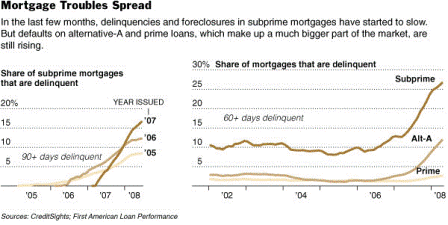
>   I am more and more convinced housing is not near a bottom.
>   Granted, I have no idea what the recent Housing Bill will do. But I
>   think housing problems are going to cover the entire swath of
>   America – not only Subprime, but also Alt A and even Prime.
>   
>   

could be, but would be very unusual in an economy with a growing gdp supported by what may now be endless fiscal packages.

the actual housing slump could be mostly old news unless/until gdp softens again as most are forecasting in q4.


[top]