Sweden Pledges to Keep Budget Balanced as Economy Slows

In case you thought Sweden knew how it worked:

Sweden Pledges to Keep Budget Balanced as Economy Slows

 
Sept. 20 (Bloomberg) — Sweden pledged to keep budget
surpluses intact as Europe’s debt crisis and slowing U.S. growth
threaten to stifle the largest Nordic economy’s expansion.
Sweden’s budget will be in balance next year after a
surplus of 0.1 percent this year, Finance Minister Anders Borg
said today at a presentation of the 2012 budget in Stockholm.
The economy will grow 4.1 percent in 2011 and 1.3 percent in
2012, the same as estimated in August, he said.
“We now have the freedom to act and room to maneuver that
we need if the situation deteriorates,” Borg said. “If we end
up with a really serious downturn we should of course have some
kind of deficit but those deficits should not be so big that
they create uncertainty.”
Prime Minister Fredrik Reinfeldt said last week that his
minority government will ensure the budget steers clear of
deficits in case more stimulus is needed should the European
debt crisis deepen and global growth slows. The government last
month scrapped planned income tax cuts amid narrowing surpluses
and opposition from a majority of parliament.

Deficit reduction super committee now in session

With the super committee on deficit reduction now in session,
let’s not forget that at year end
both parties showed that they will violate their presumed ‘core values’ when convenient.

This was written in February.
At year end I was suggesting the year end tax package might slow the economy due to ‘multipliers’ even though the headline numbers showed a tax reduction.

http://tax.com/taxcom/taxblog.nsf/Permalink/UBEN-8E3J74?OpenDocument

Obama and the GOP: United Against the Working Poor
David Cay Johnston | Feb. 14, 2011 11:57 AM EST

 
Who says bipartisanship is dead?

 
On Capitol Hill, the Democrats and Republicans may no longer play cards and drink together, but that does not seem to stop them from working together to shift tax burdens down the income ladder even when it violates their promises on the campaign trail.

 
Grover Norquist calls bipartisanship the political equivalent of date rape. But there is one group that President Obama, many congressional Democrats, and all congressional Republicans ganged up on in December — the working poor.

 
The tax compromise passed in December has been hailed everywhere as a payroll tax cut combined with an extension of the Bush tax cuts, despite the fact that it raised taxes on a third of Americans. The killing of Obama’s Making Work Pay tax credit, which the White House called the biggest middle-income tax cut ever, and the replacement of it with the Republicans’ payroll tax cut raised taxes on single workers whose wages come to $20,000 or less and married couples with less than $40,000 in wages.

 
That’s 51 million taxpayers, the Tax Policy Center estimated. (See Table T10-277.)

 
Among the poorest fifth of tax units, whose annual cash income is less than $17,878, two-thirds got hit with a tax increase. On average, their taxes went up $134, which is 1.3 percent of this group’s total cash income.

 
Consider a single worker who makes $6,000. That was the average wage of the bottom third of workers in 2009, the Medicare tax database shows. Killing the Making Work Pay credit in favor of the payroll tax cut amounted to a tax increase of $252, or 4 percent of total income.

 
Looked at another way, some workers will labor for 23 days this year and next just to pay increased taxes.

 
The pattern of the Republican-Obama tax plan is a clear stepladder in which the more you make, the more you benefit, and the less you make, the more you pay. This is a form of socialism: upward redistribution to enrich those at the top.

 
While two-thirds of the poorest Americans — the ones getting by on less than $1,500 a month — face a tax increase, the share of people hit with tax increases falls off quickly as you move up the income stepladder.

 
In the next lowest quintile, taxpayers with cash incomes of under $35,000, 40 percent saw their taxes rise, while in the middle quintile (under $64,000), one in five got a tax increase. In the fourth quartile (under $104,600), one in eight got a tax hike, and in the top quartile, one in 20 did.

 
At the top, just 1.8 percent of the top 1 percent (more than $564,600) were hit with a tax increase. Just 1.3 percent among the top tenth of 1 percent (more than $2 million) got a tax hike. These best-off one in 1,000 Americans got a tax cut worth on average $45,000 each, all financed with borrowed money.

 
In raising taxes on the working poor (and the just plain poor), our supposedly socialist president proved himself at one with Ronald Reagan, the subject of all sorts of hagiography this month on what would have been his 100th birthday. Hardly any of the effusive praise points out that while Reagan polished his image as a tax cutter, he was in fact a tax raiser par excellence who presided over a massive expansion of government spending that primarily benefited the affluent and rich.

 
Reagan raised taxes in seven of the eight years he was governor of California, including when he abandoned his “taxes should hurt” rhetoric to impose withholding so he could expand state spending on the Highway Patrol and other policing. In Washington, Reagan presided over 11 increased levies.

 
The perpetually obsequious Washington press corps let his administration call these tax increases “revenue enhancers.” The late Murray N. Rothbard, a hero to libertarians and self-proclaimed dean of the Austrian school of economics, called this Reaganism “a nice touch of creative Orwellian semantics.”

Social Security is not ‘in Ponzi’

Ponzi would be if the govt. was dependent on borrowing to make payment.

The US Congress spends by instructing the Fed to credit someone’s member bank account at the Fed.
This process is operationally independent from taxing and/or borrowing.
It is not dependent on revenues of any sort.

All Social Security payments are a matter of the Fed entering data on its computer.

That is, all Federal spending can be said to be ‘printing money’.
And Federal taxing can be said to be ‘unprinting money’.

Also, Federal borrowing is nothing more than the shifting of dollars from reserve accounts at the Fed to securities accounts at the Fed.
And paying down the Federal debt is nothing more than the shifting of dollars from securities accounts at the Fed to reserve accounts at the Fed.
Neither is involved in the actual making of payments by the Fed.

Bottom line, the notion of Ponzi isn’t applicable when it comes to the issuer of the currency.

Greece, the US states, corporations, and individuals are users of the currency and can be in Ponzi.
The Fed, Bank of Japan, Bank of England, and European Central Bank are issuers of their own currency,
so for them Ponzi does not apply.

Please forward this to the Republican candidates, the President, and all members of Congress, thanks.

July CPI Shows 1st Increase In 2.5 Years

Bet they’re sorry now for all that deficit spending, two decades of 0 rates, and untold QE ‘money printing’- inflation is finally ripping!

Not

July CPI Shows 1st Increase In 2.5 Years

May 25 (Dow Jones) — Japan’s core consumer price index rose 0.1% in July from a year earlier for the first time in two and a half years, despite a revision to the data’s base year giving a downward bias to the index, government data showed Friday.

The outcome was higher than the median forecast for a 0.1% drop in a poll of economists surveyed by Dow Jones and the Nikkei. The index declined 0.2% from a year earlier in June.

Core CPI for the Tokyo metropolitan area–an early indicator of price trends for the rest of Japan–fell 0.2% on year in August, compared with a forecast 0.1% fall. In July, it declined 0.1%.

The results came after the government changed the data’s base year to 2010 from 2005, which was expected to produce a lower-than-usual figure.

DGO

Right, and still looks to me that with an 8%+ US federal budget there won’t be a major collapse in aggregate demand.


Karim writes:

Main story is in the revisons

  • July durables -1.5% ex-aircraft and defense (up 4% headline)
  • But the core measure was revised from -.4% to +.6% for June and from 1.7% to 1.9% for May
  • Shipments (matters more for current quarter GDP) up 0.2% ex-aircraft and defense (2.5% headline)
  • Core shipments for June revised from 1% to 1.9%
  • 3mth annualized rate for core shipments up from 11.1% to 13.6%
  • Big caveat is this is July data

Japan To Cut Policy Spending By 10% Under FY12 Budget

Continuing the policy that got it to where it is:

Japan To Cut Policy Spending By 10% Under FY12 Budget

August 23 (Kyodo) — Finance Minister Yoshihiko Noda instructed other Cabinet members Tuesday to cut policy spending by 10 percent in the fiscal 2012 budget from the current year, aiming to secure funds that would help cover burgeoning welfare costs in Japan and reflect the policy priority of a new prime minister.

The government decided to delay by a month the deadline for its offices to submit their request for the state budget, in a move to concentrate more on reconstruction work following the March earthquake and tsunami.

Noda also ordered government spending of no more than 71 trillion yen ($924.5 billion), excluding costs to service existing debt, in the year starting next April and capping the issuance of new bonds at 44 trillion yen, both at the same level as the fiscal 2011 budget.

But spending and debt issuance necessary for quake-relief efforts will be managed separately from the capping rules, as the government intends to issue reconstruction bonds that would be serviced with proceeds from provisional tax hikes, although there remains opposition to the idea even within the ruling coalition.

The envisaged 10 percent policy spending cut would lead the government to secure 1.2 trillion yen.

Combined with some tax revenue hikes, the government will secure 1.7 trillion yen to cover an annual increase of nearly 1.2 trillion yen in social security costs, which have been growing amid the aging population, and 600 billion yen which would reflect the policy priority of a new prime minister succeeding the incumbent, Naoto Kan, who is certain to step down within this month.

The instruction came before the Cabinet approves in mid-September the guidelines for submission of budget requests by ministries and agencies, a process that has been delayed this year due to the March 11 disaster.

The government offices normally file their requests with the Finance Ministry at the end of August and the government formulates a national budget in December for a new fiscal year starting April 1.

The Cabinet decided Tuesday on a government ordinance to postpone the deadline for submission, effective Friday.

The delay comes as the government focuses on reconstruction work, which has required it to make separate budgetary arrangements. Japan has already implemented two extra budgets for fiscal 2011 and is considering a third that could be bigger than the previous two.

payroll tax hike on the way?

GOP may OK tax increase that Obama hopes to block

By Charles Babington

August 22 (AP) — News flash: Congressional Republicans want to raise your taxes. Impossible, right? GOP lawmakers are so virulently anti-tax, surely they will fight to prevent a payroll tax increase on virtually every wage-earner starting Jan. 1, right?

Apparently not.

Many of the same Republicans who fought hammer-and-tong to keep the George W. Bush-era income tax cuts from expiring on schedule are now saying a different “temporary” tax cut should end as planned. By their own definition, that amounts to a tax increase.

Former Massachusetts Gov. Mitt Romney did not flatly rule out an extra year for the payroll tax cut, but he “would prefer to see the payroll tax cut on the employer side” to spur job growth, his campaign said.

Romney completely misses the point, unless he wants it known he’s for favoring employers over employees?

Jobs come mainly from sales, and cutting payroll taxes for workers increases spending, sales, and jobs.

Cutting payroll taxes for business also has benefits, as that reduces costs which puts downward pressure on prices which helps consumers and does thereby add to sales, but in a much smaller way.

I continue to propose we suspend FICA entirely.

Looks to me like this latest discussion will only strengthen suspicions that Republicans are trying to keep the economy from improving to hurt the President’s chances of winning next year.

From Professor Andrea Terzi, MMT’s non-gnome soldier in Lugano

Andea Terzi is a former student of Paul Davidson, now a professor of economics at Franklin College, Lugano, Switzerland.

The institutional structure in the euro zone has been it’s own undoing since inception, very much like we all described at that time.

Current policy responses continue to support the same repressive fiscal policies that again look to be driving the otherwise prosperous euro zone into negative GDP growth.

The glimmer of hope may be that they have discovered the sector balance approach.

The next step in the right direction would be a recognition of the actual causations.

From Professor Tezi:


Does the ECB understand sector financial balances?

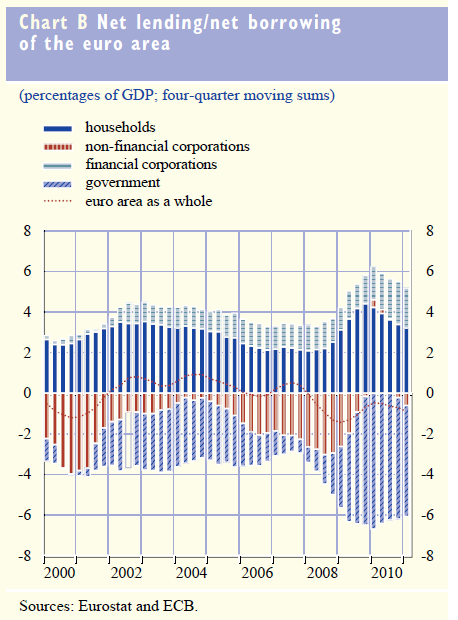
The August 2011 Monthly Bulletin of the European Central Bank has an interesting chart of financial balances of different sectors in the euro area. The chart is reproduced below.

chart


The figure shows how rising deficits in Europe in 2008 and 2009 have produced higher net financial savings in the private sector.

This is evidence that automatic (anti-cyclical) stabilizers worked as usual: as growth declines, or goes negative, tax revenues fall, government deficits increase, and this stops the economy from falling further. This can only work, however, until market-constrained governments in the euro area begin acting pro-cyclically. Governments acting pro-cyclically during recessions means that deficit reductions will reduce private savings below the desired level, and this means a further fall of demand and incomes.

Looking at 2010, and considering that the euro area’s current account balance is marginally negative, there is evidence of this pro-cyclical effect, as government deficits declined, and net private lending inevitably declined.

What is remarkable is how the ECB interprets the chart:

With euro area total investment growing faster than saving, the net borrowing of the euro area increased (to 0.9% of GDP, expressed as a four-quarter sum). From a sectoral point of view, this masked further rebalancing between sectors, with another reduction in government net borrowing (the government de?cit falling to 5.5% of GDP on a four-quarter moving-sum basis, from a peak of 6.7% in the ?rst quarter of 2010) and a further decline in households net lending, while the net borrowing of NFCs increased sharply. (ECB, Monthly Bulletin, August, 2011, pp. 37-8)

The ECB is assuming that savings are needed to finance investment and sector rebalancing is always a good thing. And it makes no reference to the connection between financial balances and nominal GDP growth.

In plain language, this is what the ECB is telling us:

In 2010, Euro area’s savings were insufficient to finance investment. Business needed to borrow to finance their investments and households savings were not enough to fill the gap. This is why the euro area runs a current account deficit, and is a net borrower. European governments, however, are doing their part by reducing their own net borrowing, thus contributing to a progressive rebalancing in financial deficits/surpluses across sectors.

For the ECB, the government net borrowing bar getting shorter (in the chart above) is a reason for optimism. In our reading, this optimism is unwarranted, and what the ECB calls “rebalancing between sectors” is a most worrying financial development of the euro area.

comments on Krugman’s post

Franc Thoughts on Long-Run Fiscal Issues

By Paul Krugman

August 11 (NYT) — Regular readers of comments will notice a continual stream of criticism from MMT (modern monetary theory) types, who insist that deficits are never a problem as long as you have your own currency.

Right, ability to pay is not an issue.

I really don’t want to get into that fight right now, because for the time being the MMT people and yours truly are on the same side of the policy debate. Right now it really doesn’t matter at all whether the United States issues zero-interest short-term debt or simply prints zero-interest dollar bills, and concern about crowding out is just bad economics.

Right.

But we won’t always be in a liquidity trap.

We don’t have one now. It’s a fixed fx concept at best.

But we won’t always be in a liquidity trap.

Someday private demand will be high enough that the Fed will have good reason to raise interest rates above zero, to limit inflation.

Yes, because they ignore the interest income channels.

And when that happens, deficits — and the perceived willingness of the government to raise enough revenue to cover its spending — will matter.

Yes, deficit spending adds to aggregate demand and nominal savings to the penny. Add too much and you get ‘demand pull inflation’

With fixed fx, that can drive up interest rates and threaten reserves. With floating fx it only causes the currency to fluctuate.

I have a specific example that illustrates my point: France in the 1920s, which I wrote about in my dissertation lo these many years ago. Like many nations, France came out of World War I with very large debts, peaking at 240 percent of GDP according to this recent IMF presentation (pdf, slide 17). And France was unable politically to raise enough taxes to cover the cost of servicing that debt. And investors lost confidence in the government’s solvency.

If it was a floating fx policy, interest rates would have been wherever the bank of france set them. If it was a fixed fx policy, rates would be market determined, as the tsy had to compete with the option to convert at the CB.

And taxes falling short of spending is the norm in most nations. Japan for example has one of the largest debts and deficits and one of the strongest currencies. So there’s more to it.

Various expedients were tried, including — late in the game — creation of monetary base, which was advocated by a finance minister on the (very MMT) grounds that the division of government liabilities between currency and short-term bills made no difference. But it turned out that it did: the franc plunged, and the price level soared.

He still hasn’t indicated whether it was a fixed or floating fx policy, and I don’t recall, so I can’t comment.

Now as it turned out this was just what the doctor ordered: because France’s budget problem was overwhelmingly the debt overhang rather than current spending, inflation eroded the real value of that debt and made possible the Poincare stabilization of 1926.

Yes, if a nation goes to a fixed fx policy at the’wrong’ price a further adjustment can address that, though it still doesn’t address the fundamental difficulties of living with a fixed fx policy.

So what does this say about the United States? At a future date, when we’re out of the liquidity trap,

that we aren’t in

public finances will matter — and not just because of their role in raising or reducing aggregate demand. The composition of public liabilities as between debt and monetary base does matter in normal times —

Yes, it determines the term structure of risk free rates.

hey, if it didn’t, the Fed would have no influence, ever.

True, and it doesn’t have much in any case, apart from shifting income between savers and borrowers and altering the interest income of the economy, which is a net saver to the tune of the govt debt, to the penny.

So if we try at that point to finance the deficit by money issue rather than bond sales, it will be inflationary.

Only under a fixed exchange rate policy, which we don’t have.

And unlike France in the 1920s, such a hypothetical US deficit crisis wouldn’t be self-correcting: the biggest source of our long-run deficit isn’t the overhang of debt, it’s the prospective current cost of paying for retirement, health care, and defense. So such a crisis — again, it’s very much hypothetical — could spiral into something very nasty, with very high inflation and, yes, hyperinflation.

Highly unlikely. It would probably take annual deficit of well over 20% to get that kind of inflation from excess demand.

Now, all of this is remote right now. And notice too that France in the 1920s stabilized with debt of 140 percent of GDP — far higher than the numbers that are supposed to terrify us now. So none of this is relevant to the current policy debate.

But since the MMTers seem to have decided to harass those of us who want stronger action now but think there really is a long-run fiscal issue, I needed to put this out there.

MMT explains the difference between fixed and floating fx policy.