Hussman view of equity valuation

What’s new here is somehow Hussman has picked on the idea that corporate profits fall as the federal deficit falls. He stops short of suggesting we need a higher federal deficit, of course.

After all his endless inane out of paradigm raving against federal deficits it might take him a few months to reverse course. ;)

Nor does he mention the well known Levy Profit Equation from maybe 75 years ago that shows same, or Wynne Godley’s work or any of the MMT sources that he no doubt perused regarding sector balances.

An Open Letter to the FOMC: Recognizing the Valuation Bubble In Equities

By John Hussman
Fannie and Freddie plan gets Washington attention

First, it’s a step in the wrong direction. My proposal is for the FFB to offer fixed rate financing with no prepay penalty to the agencies at the govt’s ‘policy rate’ for said mortgage funding.

Second, they are only doing this because after decades of successfully getting people into houses who arguably wouldn’t have been there, presumably serving numerous aspects of public purpose, they suffer ‘losses’ when in 2008 govt policy causes 8 million people to lose their jobs pretty much all at once.

Nor are those offering to ‘help’ doing out of charity…

Fannie and Freddie plan gets Washington attention

November 25 (FT) — Bob Corker, the Republican senator co-sponsoring a bill to wind down Fannie Mae and Freddie Mac, has become the first senior politician to express openness to a hedge fund proposal to take over core operations of the US mortgage finance giants. He found the plan interesting, he added, saying that it validated his legislation because it would work only in a reformed housing finance system. The Fairholme plan would eliminate Fannie and Freddie, and transfer their future mortgage guarantee business to two new private sector companies. The new entities would be capitalised with assets equivalent to the $34.6bn face value of Fannie and Freddie’s preferred shares, plus the proceeds of a $17.3bn rights issue, potentially backed by private equity.

household debt

Just noticed this. The question is whether it was proactive/desired and ongoing or one time/forced due to sequester and FICA hike income reductions.

“Household debt jumped US$127 billion in the third quarter, the biggest increase since the first quarter of 2008. The rise was across the board as Americans went into greater debt to buy everything from houses to cars to schooling. Household debt is now growing faster than both gross domestic product and disposable income, returning to the pattern that drove both economic growth and serial bubbles in the past decade.”

(Thanks Edward Harrison)

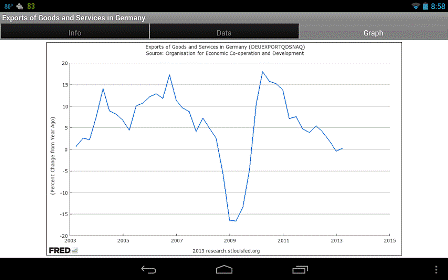
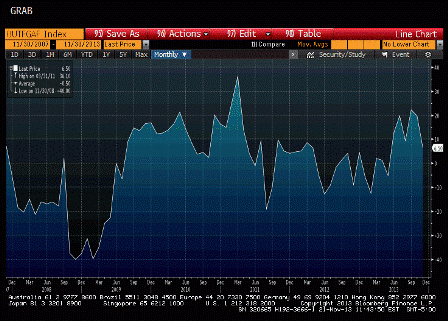
German export growth and household income growth

German domestic demand better hurry up and improve before there’s no household income growth left to support it. Or export growth.

That said, Germany output and employment has been outperforming the rest of europe, much the way Texas and North Dakota may outperform in the states. When the federal deficit is too small as evidenced at the macro level by unemployment and excess capacity in general, it doesn’t necessarily have the same effect on all members.

German Household Income Y/Y:


Full size image
German Exports Y/Y:

Full size image

Morgan Stanley on eu

German IFO, GDP & Eurogroup: After last month’s drop to 107.4, MS Research expects the IFO business climate to decline by further 0.4 points to a reading of 107.0 in November. They would expect both business expectations for the next 6 months and current business conditions to have corrected, with the expectations component losing more. The drop in sentiment underscores the fragile nature of the economic recovery and the rising concerns of business leaders about the economic policies likely to be pursued by the Grand Coalition. The PMIs yesterday confirmed that growth in the euro area has stalled in 2H. That said, a surprise shock to the downside will further strengthen case for further ECB measures. We also have the release of Q3 GDP where MS research expects growth to have decelerated materially, with headline growth declining from 0.7%Q to just 0.3%Q. On the policy front, Eurogroup finance ministers will discuss the European Commissions recommendations on the 2014 draft budgets. Market participants are likely to pay close attention to France, Italy and Spain.

FOMC’s Bullard coming around to what I posted in 2008?

“I think the December 2008 FOMC decision unwittingly committed the U.S. to an extremely long period at the zero lower bound similar to the situation in Japan, with unknown consequences for the macroeconomy,” Bullard said. Pointing to the Bank of Japan’s long struggle against deflation and slow growth, Bullard said he has seen “no evidence” that a faster economic recovery results from quickly lowering interest rates to near zero.

Posted in Fed

Bernanke and Yellen pushing back on higher mortgage rates

Seems to me the Fed is making an all out effort to push back on the higher longer term rates, particularly mortgage rates. However, at least so far those rates remain elevated and at least so far mortgage purchase applications remain down year over year.

Again, seems to me it comes down to the notion that if forward guidance works to firm the economy, rates will move higher/sooner than if it doesn’t work to firm the economy.

This means forward guidance works to bring long rates down only if markets don’t believe it helps the economy.

So what’s a Fed to do to bring long rates down?
Seems to me the only tool left is unconditional guidance or purchasing securities on a price basis, rather than a quantity basis. Which does of course work, to the basis point.

That is, if the Fed announced it had a 2% bid for unlimited quantities of 10 year notes they would not trade higher than 2% while that bid was active. My recollection was that this was done during WWII.

And that we didn’t lose.
;)