expiring benefits and job related data

Lots of talk on how the expiring unemployment benefits will alter January jobs numbers.

Size of labor force?
Participation rate?
Will they suddenly accept low paying service sector jobs?
Go on disability?
Etc. etc.

In theory total jobs should be about the same, as this type of thing for all practical purposes doesn’t cause anyone to increase head count. It can, however, put downward pressure on labor should these people ‘substitute’ for whoever would have been hired otherwise, but a lower rate of pay.

Time will tell. But in any case, it’s a cut in govt spending that thereby gradually results in fewer jobs than otherwise:

Extended Unemployment Aid Likely to End (WSJ) A financial lifeline for people who have exhausted their state unemployment benefits is on the verge of coming to an end, after Republicans and Democrats clashed in budget talks over how to cover the cost of extending emergency benefits that have aided workers since the financial crisis. The program, which provides aid for the long-term unemployed, was left out of a budget deal announced by Republican and Democratic negotiators Tuesday night. Democrats and the White House sought an extension of the plan, but the $25 billion cost have reduced the chance it will be continued. Top Democrats in both the House and Senate acknowledged the benefits would expire at the end of the year. The White House estimates that 1.3 million people will lose emergency federal jobless assistance on Dec. 28, with another 1.9 million people losing the aid in the first half of 2014.

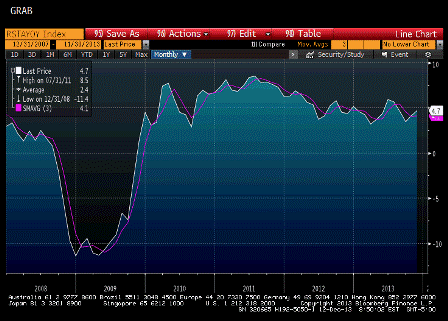
Headline retail sales with 3 mo moving average indicated, claims

Looks like the general drift to lower growth rates may still be in progress.

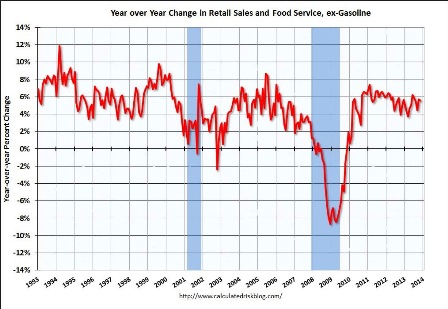
Headline retail sales year-over-year with 3 mo moving average:


Full size image

Longer term chart:


Full size image

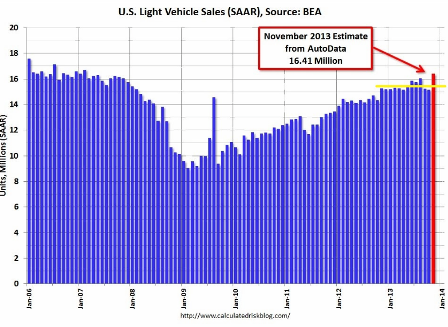
And auto sales chart shows how they sagged during the October govt. shutdown with lost sales subsequently recovered, but on balance relatively flat for 2013:


Full size image

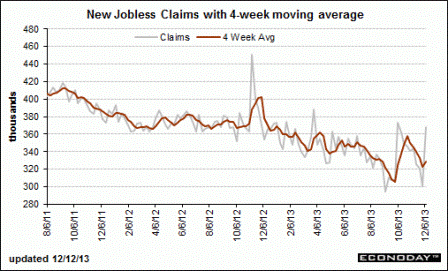
Lots of noise in claims data this time of year, but, again, claims are about separations, not new hires, though correlation has been pretty good:


Full size image

fed rate setting

Of course all they have to do is pay interest on all reserve balances…

Fed Moves Toward New Tool for Setting Rates (WSJ) An experimental bond-trading program being run at the Federal Reserve Bank of New York could fundamentally change the way the central bank sets interest rates. Fed officials see the program as a potentially critical tool when they want to raise short-term rates in the future to fend off broader threats to the economy. Launched this year, it is still in a testing stage and isn’t expected to be fully implemented for years. The Fed would use the facility to raise short-term interest rates by borrowing in the future against its large and growing securities portfolio. When it does want to raise rates, it will use securities it accumulated through its bond-buying stimulus programs as collateral for loans from money-market mutual funds, banks, securities dealers, government-sponsored enterprises and others. The rates it sets on these loans, in theory, could become a new benchmark for global credit markets.

Budget Deficit in U.S. Narrows

Budget Deficit in U.S. Narrows as Job Gains Bolster Revenue

By Kasia Klimasinska

December 11 (Bloomberg) — The budget deficit in the U.S. last month narrowed more than economists forecast as rising employment and a rallying stock market boosted revenue to a November record.

Spending exceeded revenue by $135.2 billion, compared with $172.1 billion in November 2012, the Treasury Department said today in Washington. The median estimate in a Bloomberg survey of 17 economists was for a $140 billion gap. Receipts rose 12.8 percent to the highest ever for the month, while spending fell 4.8 percent.

Declining unemployment has helped reduce the countrys deficit as a share of gross domestic product by more than half in the past four years to $680.3 billion in fiscal year ended Sept. 30 from a record $1.42 trillion in 2009. The Congressional Budget Office has projected the shortfall will shrink further this year and next as stronger economic growth lifts individual and corporate taxes.

Weve seen spending come down and tax receipts outperforming, based off of a little bit better economic growth, said Michael Brown, an economist at Wells Fargo Securities LLC in Charlotte, North Carolina. As long as we maintain a pace of job growth that is consistent with what weve seen over the last couple of months, that trend of increase in revenue should continue.

TOL call, mtg purchase apps

>   
>   Here’s Bob Toll on the TOL conference call yesterday. Given its
>   market niche, I would expect TOL to be the strongest of the
>   homebuilders—and note that 20% of sales were all cash. (I don’t
>   know how that compares with historical experience, but it seems
>   high.) This was from the prepared remarks, fyi.
>   

Since August 1, 2013, the beginning of our fourth quarter, through this past weekend, which is halfway through our first quarter, our business has been basically flat compared to the same period of time one year ago. During that 19-week timeframe last year, two weeks were highly unusual. Hurricane Sandy hit on Thursday, October 25, 2012, and wiped out sales in about half our markets that weekend. The contracts which would have been signed that last weekend of October 2012 were pushed into the first week of November 2012. Because November is a new fiscal quarter for us, our reported results and comparisons to last year are affected. Excluding this first week of November 2012, our last five weeks of business have been flat to one year ago.

And as mentioned, the full 19-week period since August 1 has also been flat. We believe this leveling of demand will prove temporary based on still significant pent-up demand, the gradual strengthening of the economy and the improving prospects of our affluent customers.


Highlights
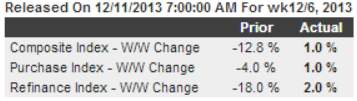
A big jump in rates held back mortgage applications in the December 6 week which, after very steep declines in the prior week, inched only 1.0 percent higher for purchase applications and 2.0 percent higher for refinance applications. Down 10 percent year-on-year, the purchase index remains especially depressed in a what is a negative indication for underlying home sales. The average rate for 30-year mortgages with conforming loans ($417,500 or less) jumped a steep 10 basis points in the week to 4.61 percent.

Budget deal includes 1.2% gov. payroll tax hike

Pension contributions function as taxes:

Increased pension contributions

On Monday, a senior Senate Democratic aide said that workers would not have to increase their own contributions toward their pensions as much as previously thought.

The Congressional Budget Office had previously estimated that if each employee contributed an additional 1.2 percent of their salaries to get the same retirement annuities, it would save the government $19 billion over 10 years.