Retail sales and jobless claims

From CS:

JAY FELDMAN : Q4 GDP revision is now tracking 2.4 on our estimates. It was tracking 2.7 before retail sales… and down from the initially reported 3.2.


Note October/November/December all marked down lower as well in US retail sales…and even prior to this period as well – will bring down Q4 GDP tracking for consumption.

Again, the income to support sales just doesn’t seem to be there, as the sub 3% federal deficit doesn’t seem to have been providing the spending needed to offset the demand leakages (unspent income):

Retail Sales

Highlights
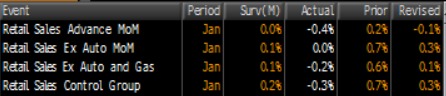
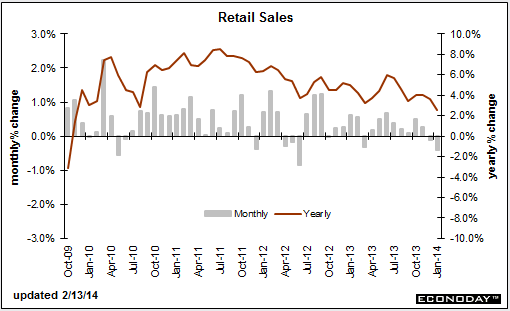
Overall retail sales in January fell 0.4 percent, following a decrease of 0.1 percent in December (originally up 0.2 percent). The market consensus was for a 0.1 percent dip.

Autos pulled down the total. Motor vehicle & parts declined 2.1 percent, following a decrease of 1.8 percent in December. Excluding autos, sales were unchanged after gaining 0.3 percent the month before (originally up 0.7 percent). Analysts called for a 0.1 percent rise. Gas station sales increased 1.1 percent after jumping 1.5 percent in December. Excluding both autos and gasoline, sales slipped 0.2 percent after rising 0.1 percent in December. The consensus was for a 0.2 percent rise.

In the core, strength was seen in electronics & appliance stores; building materials & garden equipment; and grocery stores. Declines were seen in furniture & home furnishings; health & personal care; clothing; sporting goods, hobby, et al; department stores; nonstore retailers; and food services & drinking places.

The latest report suggests that fourth quarter GDP may be revised down and that first quarter GDP could be soft. Again, atypically adverse weather likely affected the data. Equity futures declined on the news.
When I squint at this chart if anything it seems to have bottomed and nudging irregularly higher:
MBA Mortgage Applications


Highlights
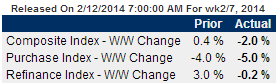
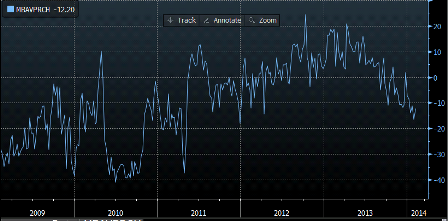
The purchase index, down 2.0 percent in the February 7 week, continues to signal weakness for underlying home sales. The index is down a very sizable 13.0 percent year-on-year underscoring the importance of all cash buyers in the housing market. The refinance index edged 0.2 percent lower. Rates moves slightly lower in the week with average rate for 30-year conforming loans ($417,500 or less) down 2 basis points to 4.45 percent.

Mortgage purchase applications Y/Y:


Full size image

Fed Chair Yellen on fiscal

Good grief
:(

*YELLEN: IN 30 YEARS DEBT-TO-GDP RATIO WOULD BE UNSUSTAINABLE
*YELLEN: UNSUSTAINABLE DEFICITS HAVE NEGATIVE ECONOMIC IMPACT

From the speech:

“a long-term plan is needed to reduce deficits and slow the growth of federal debt”

And from 2010:

“In a nutshell, the problem is that, in the absence of significant policy changes, and under reasonable assumptions about economic growth, demographics, and medical costs, federal spending will rise significantly faster than federal tax revenues in coming years. As a result, if current policy settings are maintained, the budget will be on an unsustainable path, with the ratio of federal debt held by the public to national income rising rapidly.

A failure to address these fiscal challenges would expose the United States to serious economic costs and risks. A high and rising level of government debt relative to national income is likely to eventually put upward pressure on interest rates, thereby restraining capital formation, productivity, and economic growth. Indeed, once the economy has recovered from its downturn, fiscal deficits will crowd out private spending. Large fiscal deficits will also likely put upward pressure on our current account deficits with the rest of the world; the associated greater reliance on borrowing from abroad means that an increasing share of our future income will be required to make interest payments on federal debt held abroad, thereby reducing the amount of income available for domestic spending and investment. A large federal debt will also limit the ability and flexibility of policymakers to address future economic stresses and other emergencies, a risk that is underscored by the critical fiscal policy actions that were taken to buffer the effects of the recent recession and stabilize financial markets in the wake of the crisis. And a prolonged failure by policymakers to address America’s fiscal challenges could eventually undermine confidence in U.S. economic management.”

Posted in Fed

Fed is not swayed by any single number, Fisher tells CNBC

What about 2 consecutive numbers, like Dec and Jan jobs?
;)

Fed is not swayed by any single number, Fisher tells CNBC

February 7 (Reuters) — The U.S. central bank is unlikely to reverse its decision to wind down its bond-buying program in reaction to the weaker-than-expected January jobs report released on Friday. “I will say this about the rest of our committee, is they are not swayed by a single number. They are thoughtful people,” Dallas Federal Reserve Bank President Richard Fisher said on CNBC, referring to the Fed’s policy-setting Federal Open Market Committee.

Jobs, productivity

It’s going to take more than two weak prints to sway the Fed…

I see the odds of this expansion cycle being over increasing with each release, as the drivers of H2 continue to fade- housing, cars, income, inventory, and, at least for now, jobs.

And the federal deficit- the economy’s ‘allowance’ from Uncle Sam- is no longer enough to offset the demand leakages/unspent income inherent in the institutional structure.

That is, we’re flying without a net.

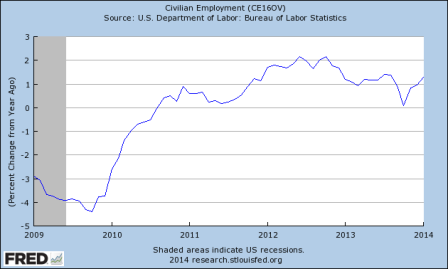
*note that the household survey was about 1 million jobs short of the payroll survey over the last year and routinely dismissed as an inferior indicator, and the rate of growth remains well below the Nonfarm Payroll report even after today’s release:


Full size image

The jump in productivity is making the rounds. It takes a lot more top line growth to need 200,000 new employees every month with this kind of productivity growth. Could be the ‘extra’ jobs we’ve seen, implying much lower productivity increases, were due to getting ‘over lean’ during the recession, and that ‘deficiency’ may now be behind us.

And note that the lower average job growth as per the household survey has been more in line with productivity over the last year.

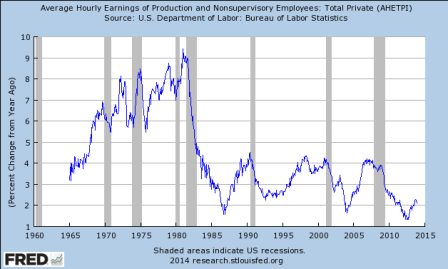
I’m also thinking those with expiring benefits suddenly willing to take lower paying jobs will simply displace others already working in those job, which will work to keep hourly wages lower than otherwise.

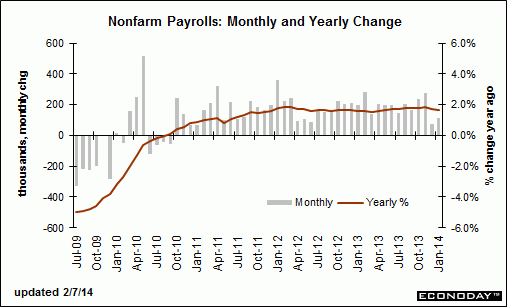
Not updated for today’s yoy print of +1.9%:


Full size image

Trade, Claims, Unit labor costs

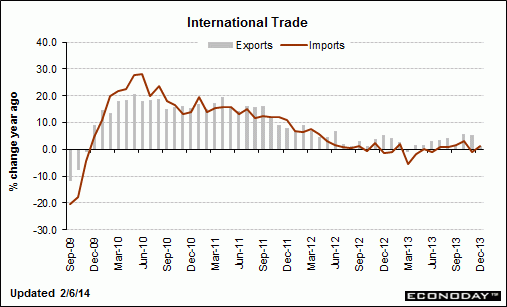
Dec trade deficit larger than expected= downward revisions to Q4 GDP

International Trade


Highlights
The trade deficit in December reversed course but still was relatively low. The trade gap widened to $38.7 billion from $34.6 billion in November. Market expectations were for a $36.0 billion deficit. Exports declined 1.8 percent in December, following a gain of 0.8 percent the month before. Imports edged up 0.3 percent after dropping 1.3 percent.

The expansion of the trade gap was led by goods excluding petroleum which jumped to $42.0 billion from $37.9 billion in November. The petroleum deficit worsened slightly to $15.6 billion from $15.3 billion in November. The services surplus improved to $19.8 billion from $19.5 billion.

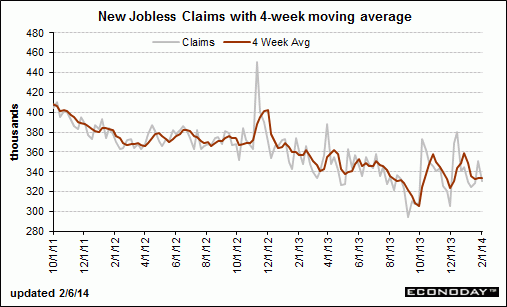
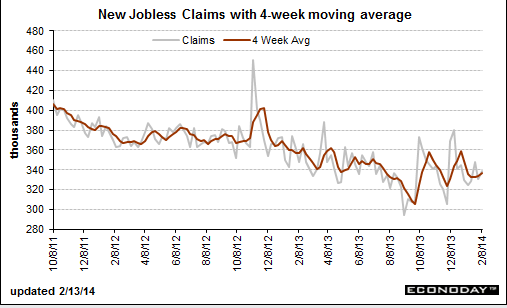
Not impossible that claims have bottomed and are turning up.

Jobless Claims


Highlights
A clean look at initial jobless claims points to improvement. Initial claims for the February 1 week fell a sharp 20,000 to a lower-than-expected 331,000. The 4-week average, at 334,000, is trending 15,000 below the month-ago comparison.

Continuing claims, however, are not showing improvement. Continuing claims for the January 25 week rose 15,000 to 2.964 million with the 4-week average up 26,000 to a 2.986 million level that is more than 100,000 above the month-ago trend. The unemployment rate for insured workers, which had been at 2.1 percent as recently as November, is unchanged for a 4th week at 2.3 percent.

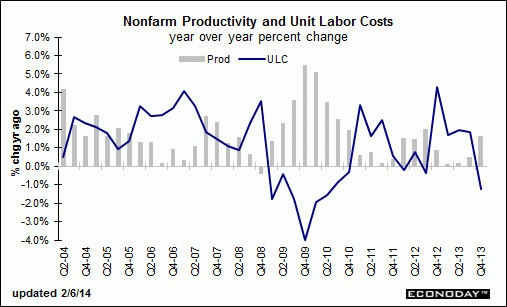
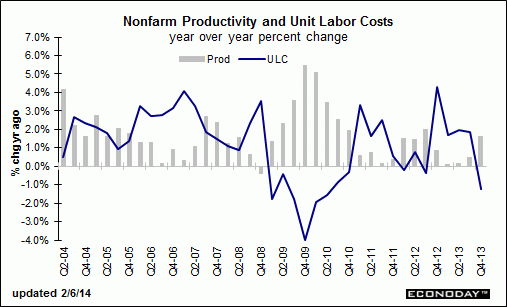
Doesn’t look like the Fed has much to worry about regarding ‘inflation’ from unit labor costs just yet:

bill gross on credit expansion

It used to grow pre-Lehman at 810% a year, but now it only grows at 34%. Part of that growth is due to the government itself with recent deficit spending. A deficit of one trillion dollars in 20092010 equaled a 2% growth rate of credit by itself. But despite that, other borrowers such as households/businesses/local and foreign governments/financial institutions have been less than eager to pick up the slack. With the deficit now down to $600 billion or so, the Treasury is fading as a source of credit growth. Many consider that as a good thing but short term, the ability of the economy to expand and P/Es to grow is actually negatively impacted, unless the private sector steps up to the plate to borrow/invest/buy new houses, etc. Credit over the past 12 months has grown at a snails 3.5% pace, barely enough to sustain nominal GDP growth of the same amount.

Full text