The newly appointed Italian “Ministry of the Economy” had said…

truly insulting!

The euro zone is at risk of snatching defeat from the jaws of victory by abandoning efforts to cut budget deficits and fix long-standing economic problems.

The growing perception that austerity has been futile is incorrect.

Fiscal consolidation is producing results, the pain is producing results

Euro-zone policy makers need to do a better job of communicating their successes to a weary population.

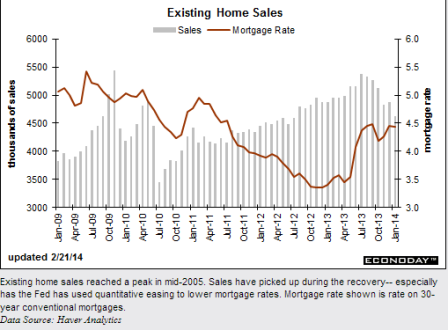
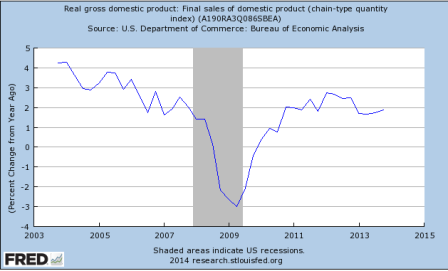
existing home sales chart, real final sales chart (pre weather)

Yes, the Fed doesn’t like QE and wants to taper, but seems to me they don’t want mortgage rates this high either. They know the only way the market will ‘bring down rates’ is if the economic weakness persists. And they suspect it very well may persist unless rates come down.

Their remaining option is TIRT (term interest rate targeting) which has yet to be discussed.

Existing Home Sales

Highlights
It’s more than just weather that’s clobbering the housing market. High prices and tight inventory aren’t helping either as existing home sales fell 5.1 percent in January to a 4.620 million annual rate. The year-on-year rate is also at minus 5.1 percent, a sharp contrast to the year-on-year median price which is up 10.7 percent.

Supply of homes relative to sales did rise to 4.9 months from 4.6 months but the improvement is tied mostly to the drop in sales. Prices did come down in the month but from already high levels with the median price down 4.5 percent to $188,900.

Weather was especially cold in January and no doubt contributed to the sales weakness, especially in the Midwest, where sales fell 7.1 percent in the month, and also the Northeast where the decline was 3.1 percent. But weather in California wasn’t a problem, yet sales in the West fell 7.3 percent which the National Association of Realtors points to as evidence of non-weather constraints.

Unattractive mortgage rates are another factor holding down sales. All cash buyers continue to hold up the market, accounting for 33 percent of all sales vs 32 percent in December. In contrast, first-time buyers, who are especially sensitive to the soft jobs market, continue to account for less sales, at 26 percent vs December’s 27 percent.

This is the 5th decline in the last 6 months for this series and lack of improvement in the jobs market, not to mention this month’s severe bout of heavy weather, point to more trouble for February. For the economy, the housing market needs to snap back sharply this spring. The Dow is showing little initial reaction to today’s report.

Full size image

Not exactly gang busters even before the weather reduced incomes.

And the bad weather it’s like hurricane sandy but without the insurance spending and federal relief spending.

Full size image

Housing start narrative

The data isn’t contradicting my narrative about construction being started in Nov/Dec ahead of the tax credits expiring at year end, which explains the higher starts in Nov/Dec followed by the sharp in January. The expiring credits likely altered the timing of non residential construction as well.

U.S. Housing Starts Fell 16% in January (WSJ) U.S. housing starts fell 16% last month to a seasonally adjusted annual rate of 880,000. That was down from an upwardly revised December rate of 1.05 million new homes built, marking the largest month-over-month decline since February 2011. Starts on single-family homes sank 15.9% in January to an annual pace of 573,000. Building permits, a sign of future construction, fell 5.4% to a seasonally adjusted annual rate of 937,000 last month from December’s upwardly revised rate of 991,000. The pace of housing starts last month actually rose in the chilly Northeast by 61.9%. But it fell 67.7% in the Midwest to the lowest pace on record. Starts also fell 12.5% in the South and 17.4% in the West, which has experienced relatively warm weather. Building permits were still up 2.4% in January from a year earlier, though housing starts last month were down 2% from a year ago.

The austerity narrative

Early in 2013 my narrative was the tax hikes as well as the subsequent sequesters were likely to cause growth to slow to maybe a 2% rate from what might have otherwise been a 4% rate, with downside risk from there.

Take a look at the charts below and notice how these key elements of the economy seemed to ‘go sideways’ during 2013.

And, unfortunately, real disposable personal income took a hit as well and doesn’t look to me like it can support any kind of ‘bounce back’:

(the last yoy print is ‘exaggerated’ by the ‘outlier’ a year earlier, but the trend is clear to me)

[note from poster: apologize for format- should be amended shortly]

Real disposable income

Architecure billings index

Housing starts

MBA purchase applications

Vehicle sales

Retail Sales

summers on obama

Not even a hint of a suspicion it’s by Presidential design:

“The cumulative effect of all these developments is that the U.S. may well be on the way to becoming a Downton Abbey economy. President Barack Obama is right to be concerned. Those who condemn him for ‘tearing down the wealthy’ and engaging in un-American populism are, to put it politely, lacking in historical perspective,” Summers wrote.

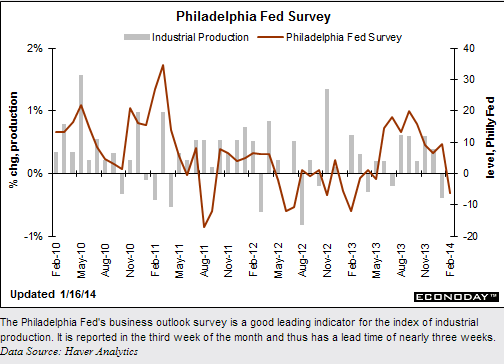
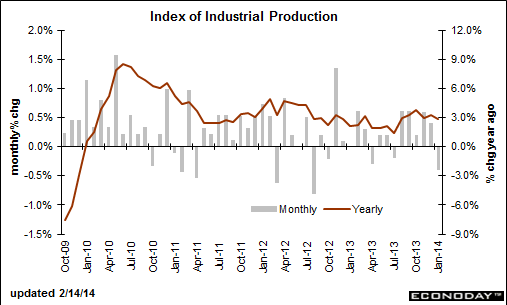
IP Chart

More downward revisions on the way, with expectations of a reversal when the weather issues subside.

But with the federal deficit probably south of 3%, which seems to be struggling to keep pace with the demand leakages, the income lost due to the reduced growth of sales/output/employment means there is that much less support for any post weather rebound in spending/GDP.

“But freezing temperatures boosted demand for heating last month, causing utilities production to jump 4.1 percent.”

Industrial Production

Highlights
The manufacturing sector is losing traction-weather related or not. Overall industrial production fell 0.3 percent in January, following a 0.3 percent gain the month before. Analysts expected a 0.3 percent rise for the latest month.

Turning to major components, it was worse for manufacturing which dropped 0.8 percent after a 0.3 percent increase in December. The consensus projected a 0.1 percent increase for January. Atypically adverse weather helped the overall number from being weaker as utilities jumped 4.1 percent in January, following a 1.4 percent dip the prior month. Mining slipped 0.9 percent after gaining 1.8 percent.

Looking at detail for manufacturing, durables fell 0.8 percent in January, led down by a 5.0 percent drop in motor vehicles and parts. Nondurables declined 0.8 percent in January.

Manufacturing excluding motor vehicles decreased 0.5 percent in January, following a 0.3 percent rise in December.

Capacity utilization declined to 78.5 percent from 78.9 percent in December.

Today’s report adds to the argument that the first quarter will be sluggish. It also calls to attention as to whether the Fed will pause in its “measured steps” for tapering quantitative easing. But the Fed clearly will watch the next employment report before making that decision in mid-March.

The traditional non-NAICS numbers for industrial production may differ marginally from the NAICS basis figures.