NFIB index, Redbook retail sales

Tough to give this a positive spin…

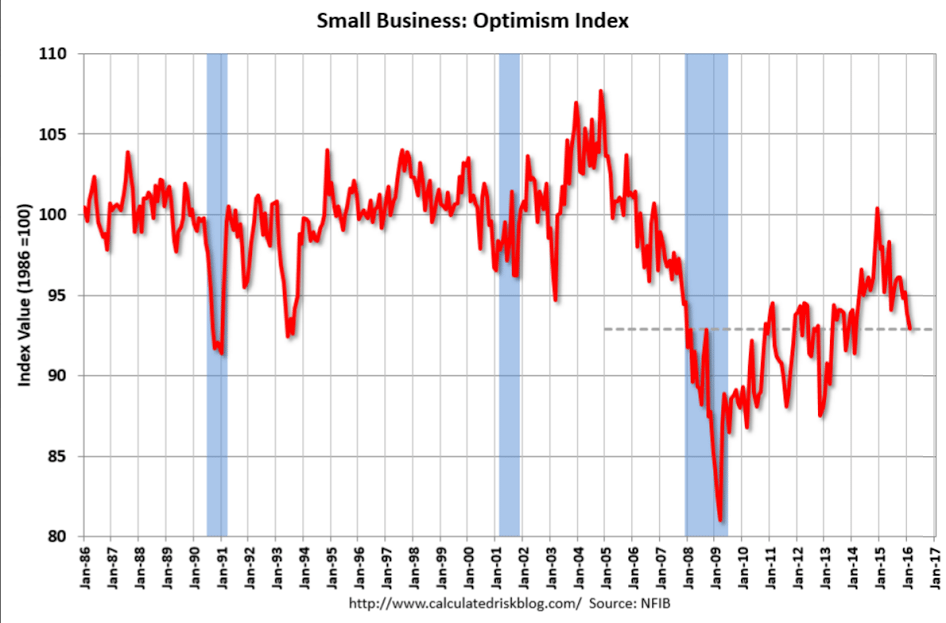
And note the downward slope of the chart, as weakness continues to spread from oil capex to the rest of the economy:

NFIB Small Business Optimism Index
er-3-8-1
Highlights
The small business optimism index slipped 1 point in February to 92.9, a 2-year low that reflects incremental declines across six of 10 components. The report’s two employment components both inched 1 point lower with plans to increase employment still at a positive reading of 10 and job openings hard to fill still at a very strong 28 which leads all components. Earnings trends, however, are very weak, down 3 points to minus 21 and reflecting what the report cites as higher labor costs that are not being passed through to selling prices. Sales expectations also fell 3 points but are doing better than earnings which are at the zero level. Weak earnings and sales are negatives for business investment with plans for capital outlays and expansion intentions both down 2 points but with both readings still strongly positive at 23 and 8 respectively. Underlying strength for business investment and employment, however, is not likely to hold up for very long given weakness in earnings and sales.

Below levels of the prior recession:
er-3-8-2
er-3-8-3

Consumer Credit, Lumber prices, Inventories

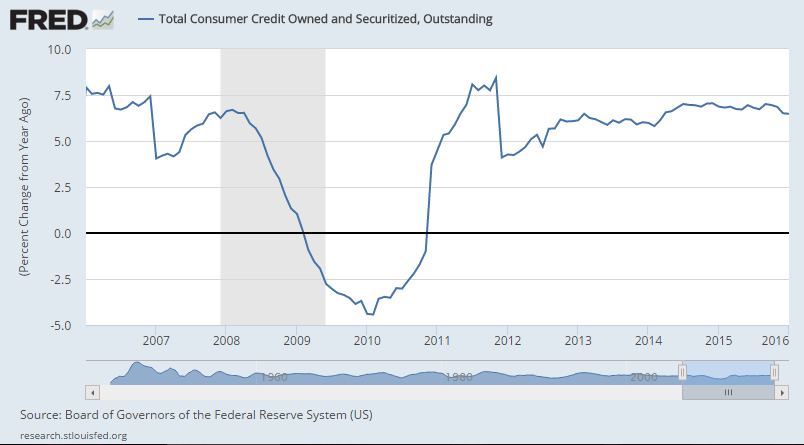
Another weak number, and the series was revised as well. And for GDP to grow the same as last year, all the ‘pieces’ have to grow the same, and this one isn’t keeping up:

Consumer Credit
er-3-7-2
Highlights
Breaks in the consumer credit series, due to changes in source data or methodology, are not uncommon, leading to sudden swings such as in mid-2011. Such a break is responsible for a big revision to December, now at a revised increase of $6.4 billion from an initial $21.3 billion. The revision is centered in the non-revolving component, which tracks vehicle financing and student loans and is now at a very slight increase of $0.9 billion vs an initial gain of $15.4 billion. January’s increase in total outstanding consumer credit is an initial $10.5 billion vs Econoday’s consensus for $16.5 billion. Revolving credit, the component that tracks credit cards, fell $1.1 billion in January following December’s nearly unrevised $5.5 billion increase. Even with January’s dip, revolving credit has been showing strength and has been, in a positive for consumer spending, hinting at greater willingness, if not the necessity, of the consumer to take on credit-card debt.

er-3-7-3
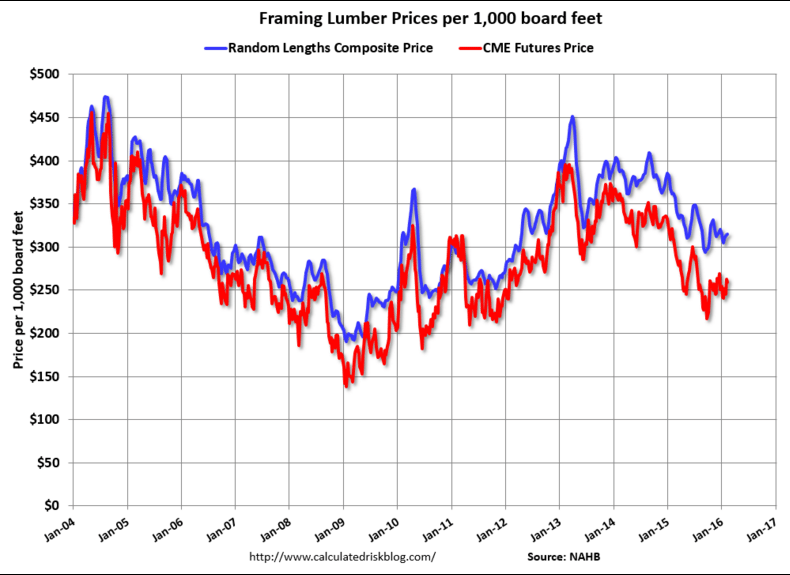
Sometimes this says something about housing:
er-3-7-4
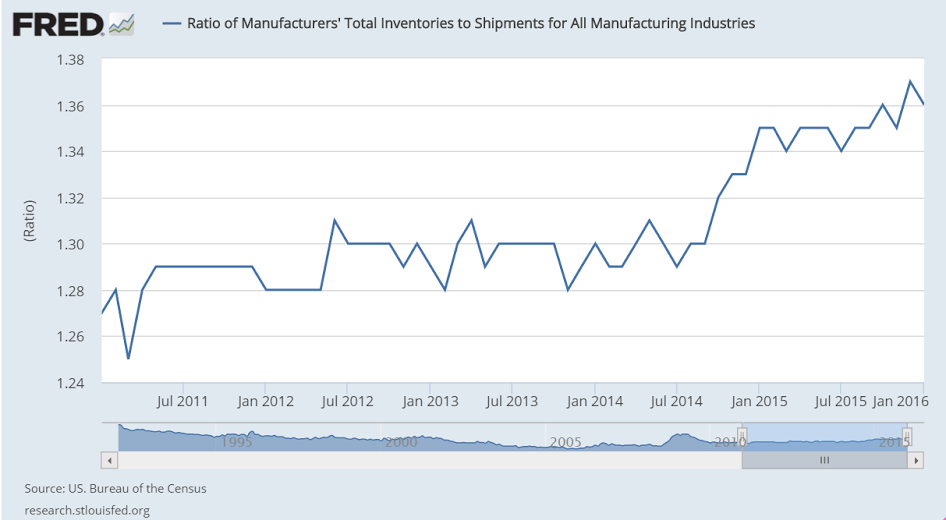
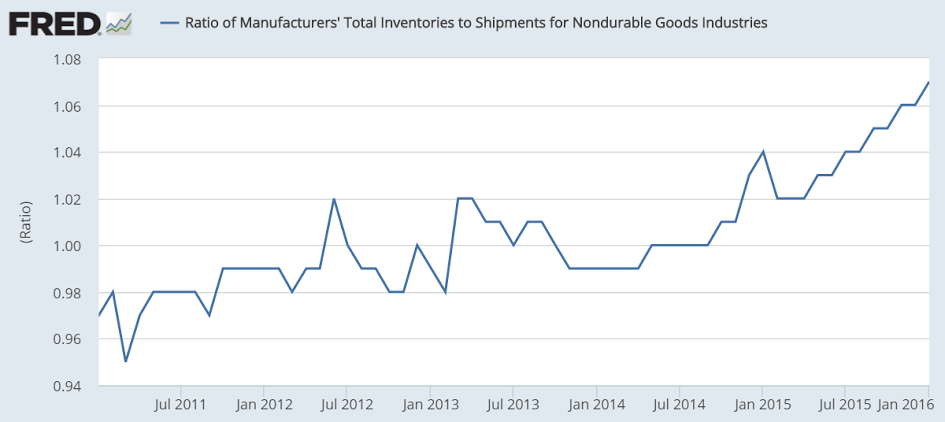
Here’s something up from last year…
er-3-7-5
er-3-7-6

Mexico car production, oil prices

Not a good sign for US sales:

Mexico Car Production

Mexico’s auto production decreased by 4.1 percent on the year in February of 2016 following a 0.4 percent rise in January and exports dropped 1.2 percent. Automakers produced about 271 thousand units during the month, while exports totaled 220 thousand. Car Production in Mexico averaged 179.92 Thousand Units from 1999 until 2016, reaching an all time high of 330.16 Thousand Units in October of 2014 and a record low of 81.53 Thousand Units in January of 2009. Car Production in Mexico is reported by the AMIA – Associacion Mexicana de la Industria Automotriz.

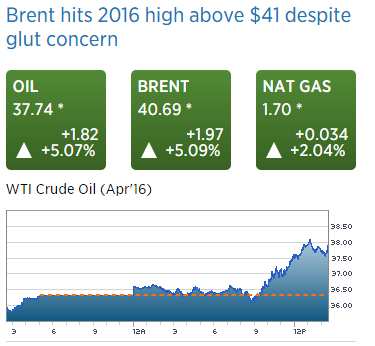
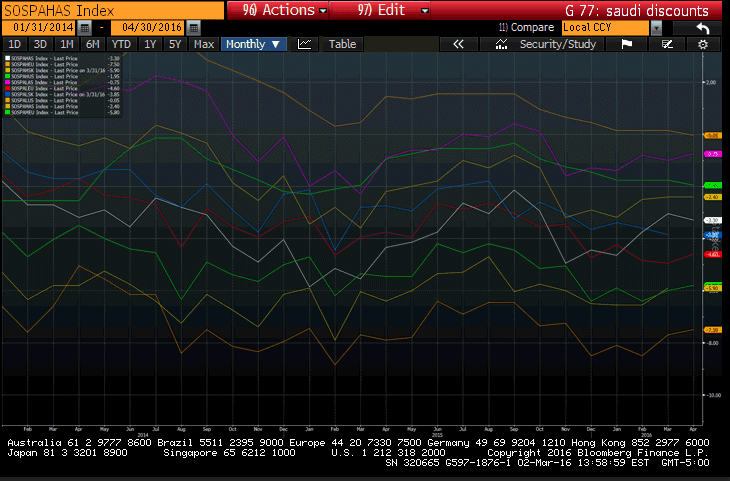
With ‘excessive’ Saudi discounts reportedly still in place, it’s hard to believe prices won’t be again falling until the Saudis change their pricing. Meanwhile, the higher prices will add to the US import bill, as will the increased imports that are replacing declining domestic production.

er-3-7-1

Posted in Oil

Employment, Trade

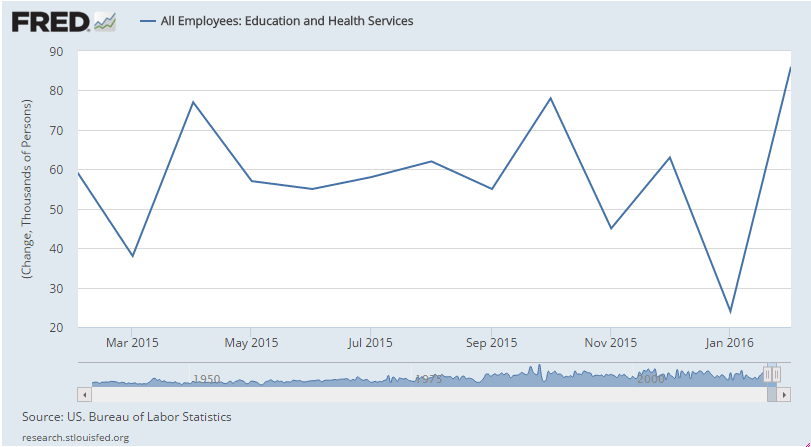
Education employment was mysteriously down big last month and up big this month, so best to average the two months, which would mean about 205,000 new jobs each month, which is about where it’s been.

However, in any case hours worded and average pay were both down, which means personal income and probably output is that much less, which is not good. Additionally, the downward revision in earnings for last month and the negative print this month tell me ‘the market’ is telling us there’s still substantial ‘slack’ in the ‘labor market’:

Employment Situation
er-3-4-1
Highlights
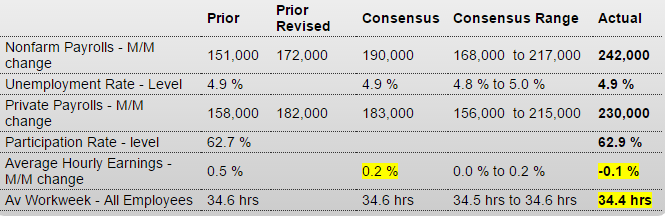
The labor market is adding jobs at a very strong rate. Nonfarm payrolls rose 242,000 in February vs the Econoday consensus for 190,000 and a high estimate of only 217,000. Adding to the punch are upward revisions to the two prior months totaling 30,000.

A negative in the report is a 0.1 percent decline in average hourly earnings that follows, however, January’s outsized 0.5 percent gain. Year-on-year, average hourly earnings are down 3 tenths to 2.2 percent. Another negative is a dip in the workweek to 34.4 hours which also, however, follows strength in the prior month when it rose to 34.6 hours.

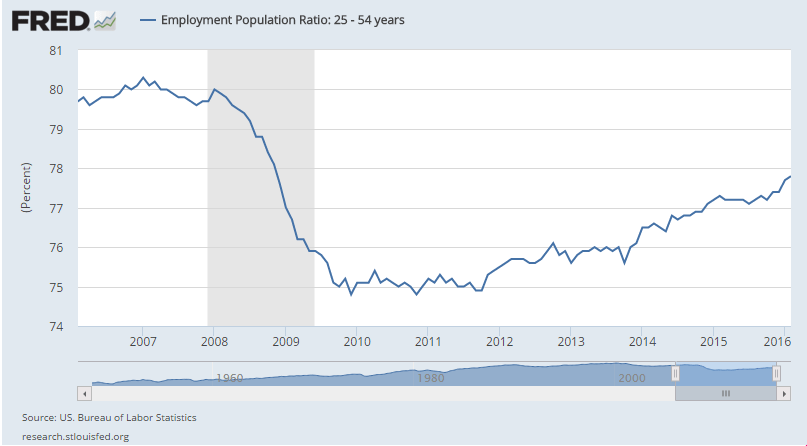
The unemployment rate remains low at 4.9 percent while the labor participation rate continues to rebound, up 2 tenths in the month to 62.9 percent and boosted by new entrants and re-entrants into the labor market. The U-6 unemployment rate, which is cited frequently by Janet Yellen, is down a full 2 tenths to 9.7 percent.

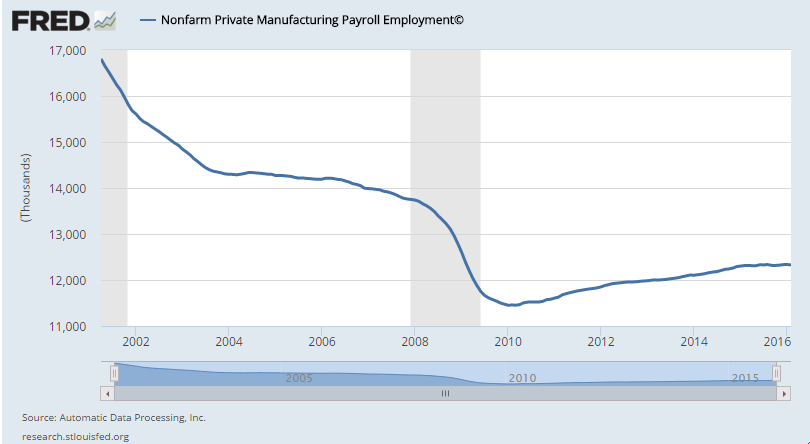
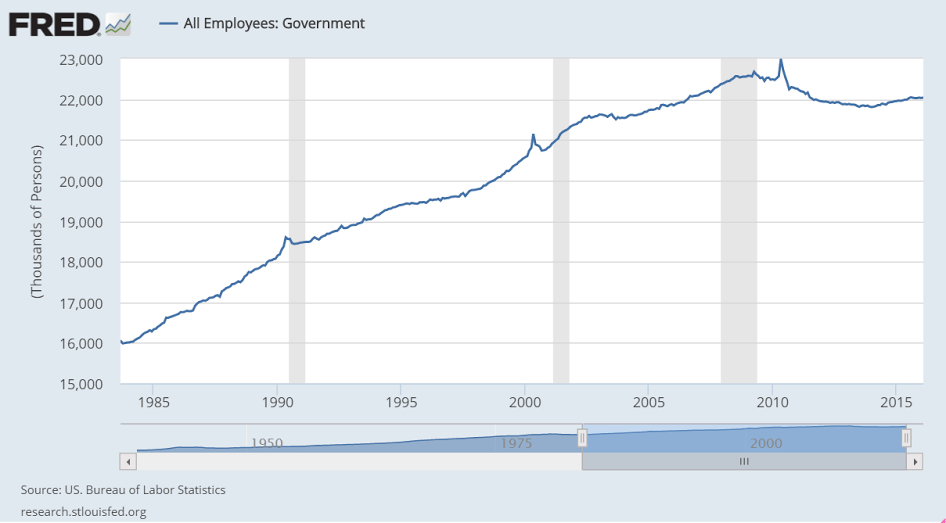
Payroll strength by industries includes a second straight strong month for retail, up 55,000, and another strong month for trade & transportation, up 53,000. Professional & business services rose 23,000 but temporary help services fell for a second straight month, down 10,000 following a 22,000 decline in January. Government added 12,000 to payrolls while construction, where spending is solid, rose 19,000. Mining and manufacturing contracted, down 19,000 and 16,000 respectively.

The earnings numbers are setbacks but do follow prior strength. Payroll gains are unquestionably impressive and today’s report will very likely revive at least the chance for a rate hike at this month’s FOMC.

This is why using a two month average makes sense this month:
er-3-4-2
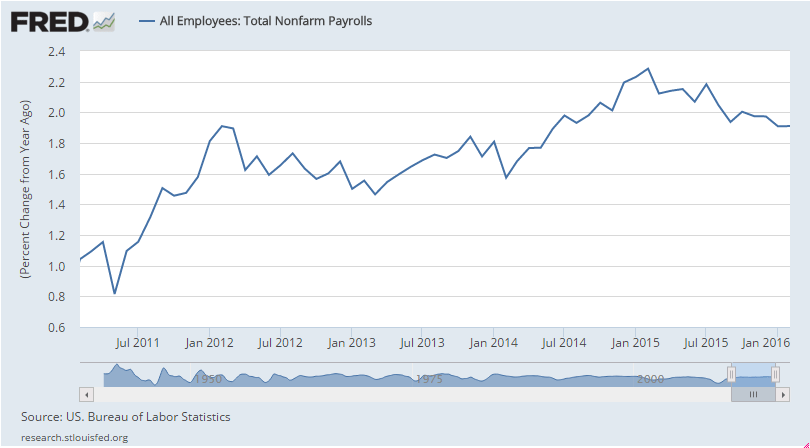
The chart shows the rate of growth continues the deceleration that began just over a year ago when oil capex collapsed:
er-3-4-3
Still some serious ‘slack’ here:
er-3-4-4
Worse than expected and so not good for GDP forecasts, and with vehicle sales down from last year’s highs rising auto imports mean even weaker domestic car sales:

International Trade

er-3-4-5
Highlights
January was a weak month for cross-border trade with exports down a steep 2.1 percent and imports down 1.3 percent, making for a wider-than-expected trade imbalance of $45.7 billion. Exports of capital goods were especially weak as were imports of capital goods, both pointing to weakness in global business investment. Exports of industrial supplies were also down as were exports of consumer goods and also food products. Imports of industrial supplies were also down as were imports of consumer goods. Imports of autos, however, continue to rise to underscore the ongoing strength in vehicle sales.

The goods gap widened to $63.7 billion from $62.6 billion and when excluding petroleum where the gap narrowed, the goods gap widened to $57.8 billion from $55.5 billion. The nation continues to run a strong surplus on services, at $18.0 billion for a small gain in the month.

The gap with China widened in the month to $28.9 billion for a $1 billion increase while the gap with Europe narrowed sharply, to $8.8 billion from $13.7 billion. The gap with Japan narrowed to $4.9 billion from $6.6 billion while the gap with Canada widened to $2.4 billion from $2.2 billion.

Today’s report will lower early estimates for first-quarter GDP and no less importantly is the latest indication that global traffic is stalling, which is not a plus for global policy efforts to raise inflation.

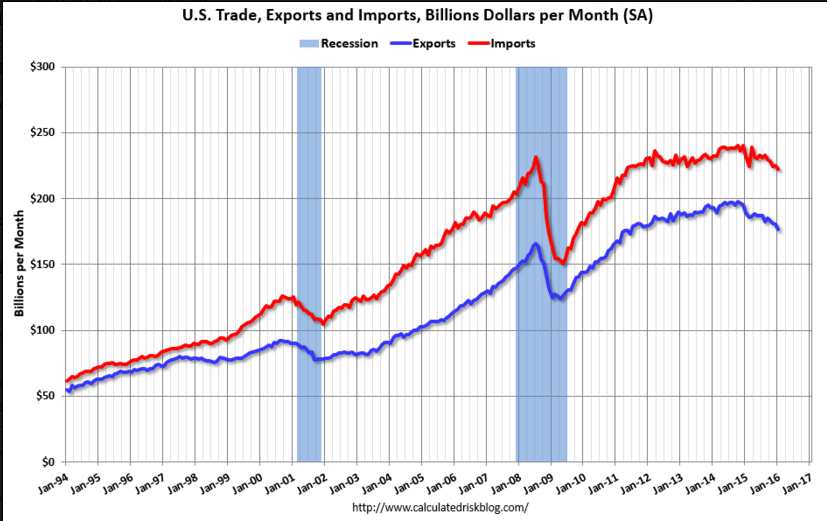
In past cycles these declines in trade were indicative of recessions:
er-3-4-6
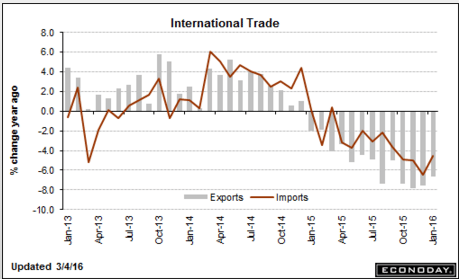
Trade also went bad as oil capex collapsed:
er-3-4-7

Oil price, Radio interview, Fed Atlanta, Canada

Some commentary on the latest Saudi price changes:

Saudi raises crude price to Europe, Asia, cuts it for US

Saudi Arabia, the world’s largest crude exporter, Wednesday raised the April prices of its oil to Asia and Europe but cut it slightly for shipments to the United States.

My quick WRKO radio interview

Down some more, as previously discussed:

er-3-3-10
He’s going the right way, but it’s relatively small and he’s unfortunately still out of paradigm which puts it all at risk of ‘losing the debate’ with critics:

Trudeau’s Message to World: Let Government Spending Do the Work

By Josh Wingrove

March 3 (Bloomberg) — Canadian Prime Minister Justin Trudeau is urging global leaders to rely more on government spending and less on monetary policy to spur growth as he prepares a budget that will push his country into deficit.

In a wide-ranging interview Wednesday in Vancouver, Trudeau highlighted the importance of infrastructure spending and measures to bolster incomes of middle classes he says are critical to driving growth. He also defended his plan to go willingly into the red.

“My message to other government leaders is don’t fall into the trap that thinking that balancing the books” is an end in itself, he said. “It’s a means to an end.”

Trudeau’s arrival on the global scene and his endorsement of deficits marks a sharp about face from his predecessor, Stephen Harper. Along with German Chancellor Angela Merkel and U.K. Prime Minister David Cameron, Harper championed the budget austerity alliance within the Group of Seven that often clashed with the U.S. on fiscal policy.

President Barack Obama will hear a new message next week when he hosts a state dinner for Trudeau at the White House. The Canadian leader’s debut also coincides with an increasing sense in global circles that monetary policy is reaching its limit, fueled in part by Japan’s surprise move to adopt negative interest rates that caused turmoil in currency markets.

“Making sure monetary policy and fiscal policy are aligned and complementary is obviously a benefit to any economy. But at the same time I don’t want to be overly preachy,” Trudeau said. Other countries should consider balanced budgets when feasible “but don’t make it the be-all and end-all because you may be missing out on opportunities to grow your economy — to help citizens prosper — that too much rigidity would actually interfere with.”

G-20 Consensus

At a Group of 20 meeting in Shanghai last week attended by Trudeau’s finance minister, Bill Morneau, officials from the world’s top economies committed their governments to doing more to boost growth amid mounting concerns over the potency of monetary policy.

Trudeau, 44, hinted he is considering expanding on pledges that have his country on pace for a deficit of nearly C$30 billion ($22.3 billion) in the fiscal year that begins April 1. Having promised C$10.5 billion in new spending during the campaign, Morneau delivered a fiscal update last month showing the government is starting from a deficit of C$18.4 billion as Canada grapples with the oil-price shock.

“It’s to me even more of a reason why we need to be investing intelligently in infrastructure, in money in the pockets of the middle class, to grow the economy,” Trudeau said of the fiscal situation he inherited after his majority win in the Oct. 19 election.

Debut Budget

He offered no detail on what new spending may be included in the budget, due March 22, but ruled out big-ticket surprises. “I don’t think we need massive stimulus,” he said. “There’s a limit on how much you can flow infrastructure dollars in a short time frame from a standing start.”

A C$30 billion deficit would be 1.5 percent of gross domestic product. That’s a swing of 1.4 percentage points, from an expected deficit of 0.1 percent of GDP in the current year. Since the end of World War II, there have been only four one-year expansionary fiscal swings of more than 1.4 percentage points of GDP.

Even with C$30 billion in red ink, Canada’s debt-to-GDP ratio would remain among the lowest in the G-7. “That leaves us with more flexibility,” Trudeau said. “If we were sitting at 90 percent debt to GDP, we probably wouldn’t be contemplating the kinds of things we know we’re able to do. If interest rates were radically different — much higher, to take money to invest in our economy — we’d be looking at different kinds of investments.”

Factory orders, ISM non manufacturing, Consumer comfort, PMI services index

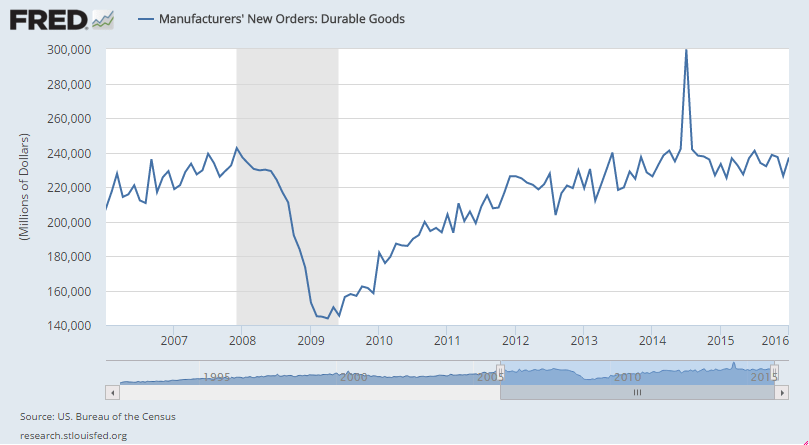
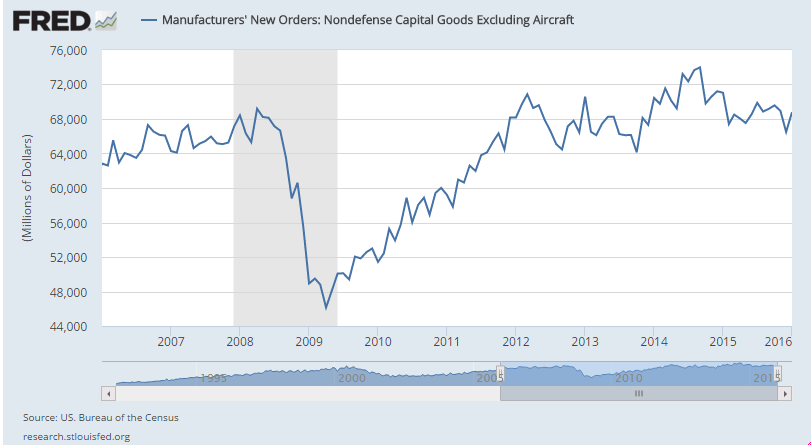
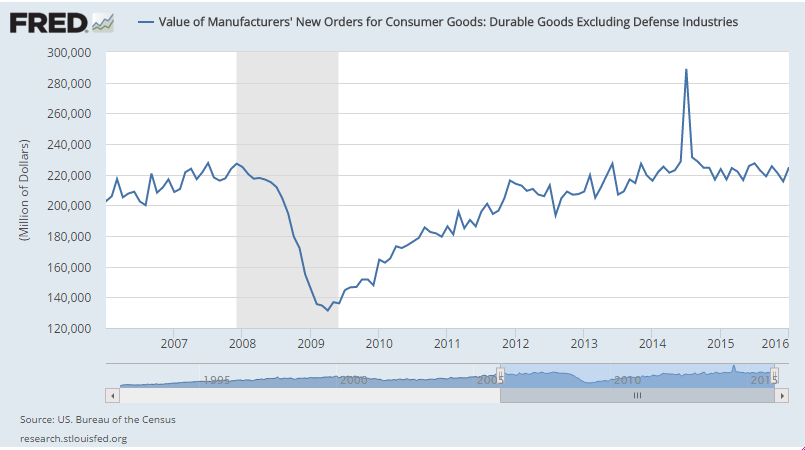
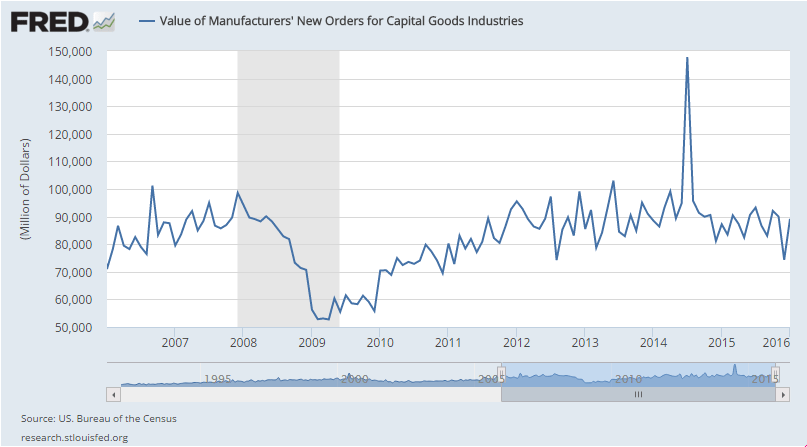
As per the charts, a big dip last month was followed but a partial recover this month, but overall it’s going nowhere:

Factory Orders
er-3-3-9

er-3-3-8
er-3-3-7
er-3-3-6
er-3-3-5

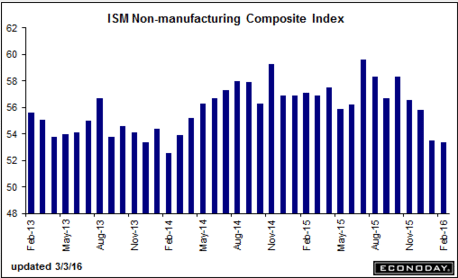
Employment dropped from 52.1 to 49.7- not good:

ISM Non-Mfg Index
er-3-3-4
Highlights
The great bulk of the nation’s economy enjoyed a solid February based on ISM’s non-manufacturing report where the headline index held solidly over breakeven 50, at 53.4 vs January’s 53.5.

New orders came in at 55.5, down 1 point from January but still very solid. And backlog orders continue to expand, at 52.0 for a second month in a row. Strength in orders points to future strength in employment which, however, in the report’s only negative dipped 2.5 points to 49.7 for the first sub-50 reading since February 2014.

Other details include a nearly 4 point rise in output (defined as business activity in this report) which is a solid indication for first-quarter growth. Prices for inputs remain in contraction and inventories continue to expand modestly. Export sales are also up though exports for this sample, in contrast to manufacturing, are limited.

The dip in employment is one of the few hints of trouble for tomorrow’s employment report, but it may prove a one-month event. Otherwise, readings in this report are positive, a contrast to this morning’s PMI services report and an indication of extending strength for the domestic economy.

er-3-3-3

Bloomberg Consumer Comfort Index
er-3-3-2
Highlights
The consumer comfort index is now below 44 for the first time this year, at 43.6 in the February 28 week. Consumer confidence readings have held mostly steady this year though the decline in this report may hint at an uneasiness perhaps tied in part to uncertainty in the election campaign.

PMI Services Index
er-3-3-1
Highlights
Markit Economics’ U.S. service sample reported unusually flat activity in February with the final PMI at 49.7 vs 49.8 for the February flash and against 53.7 in January. This is the weakest reading since the government shutdown of 2013.

New orders are still growing but, after three months of slowing, are at their weakest pace since January last year. The 12-month outlook, though still positive, is the least positive in 5-1/2 years. Hiring, in an upbeat indication for tomorrow’s employment report, is still solid but how long it can sustain strength is in question. Price data are not favorable with inputs down and selling prices down at a 5-month low.

Slowing in the service sector would leave the economy without a central point of strength. The declines in this report, though possibly reflecting weather factors during the month, do raise the important question whether domestic demand is on the downswing and falling in line with sinking demand overseas.

Saudi April pricing, Mtg purchase apps, ADP

Some up a bit, some down a bit, overall looks to me like downward price pressure continues:
er-3-2-1
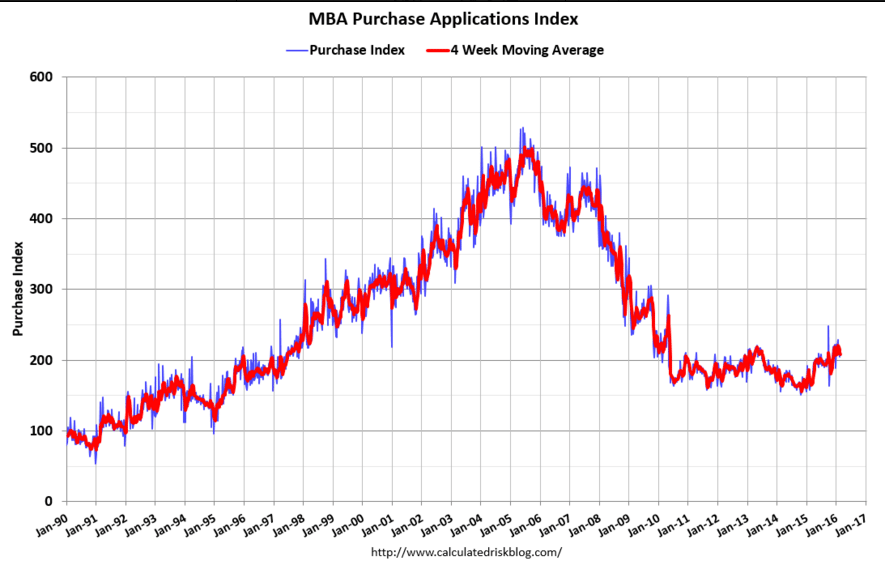
Down this week and still moving largely sideways:
er-3-2-2

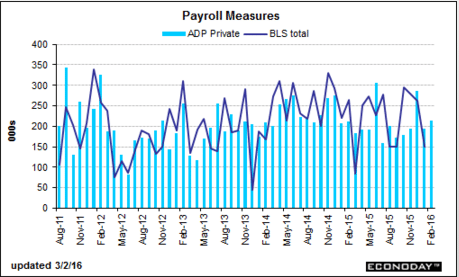
This is a forecast for Friday’s employment report. It was a little better than expected:

ADP Employment Report
er-3-2-3
Highlights
Friday’s employment report may be on the strong side based on ADP’s private payroll count for February which is a stronger-than-expected 214,000. ADP isn’t always an accurate barometer of the government’s data but it has been the last two reports, pointing to a surge in December followed by a retreat in January.

er-3-2-4

Vehicle sales

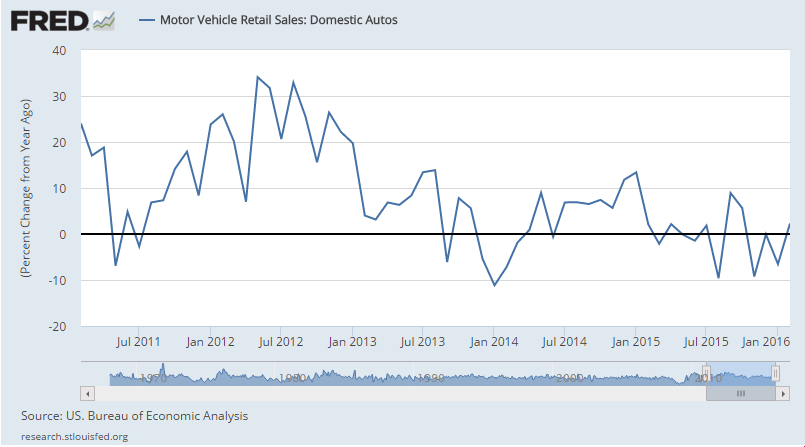
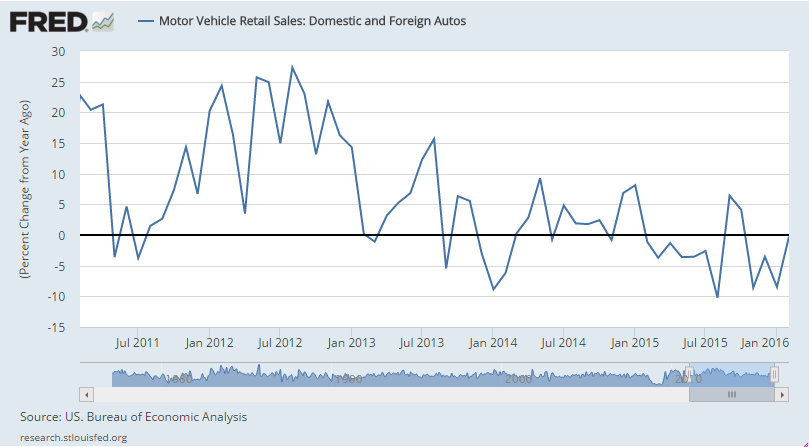
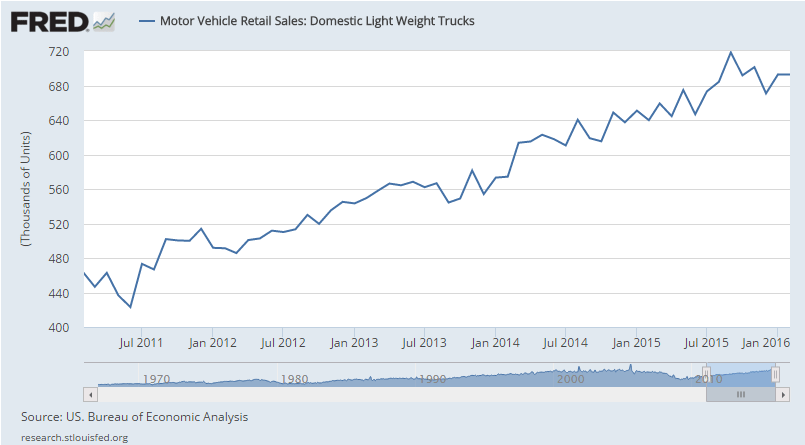
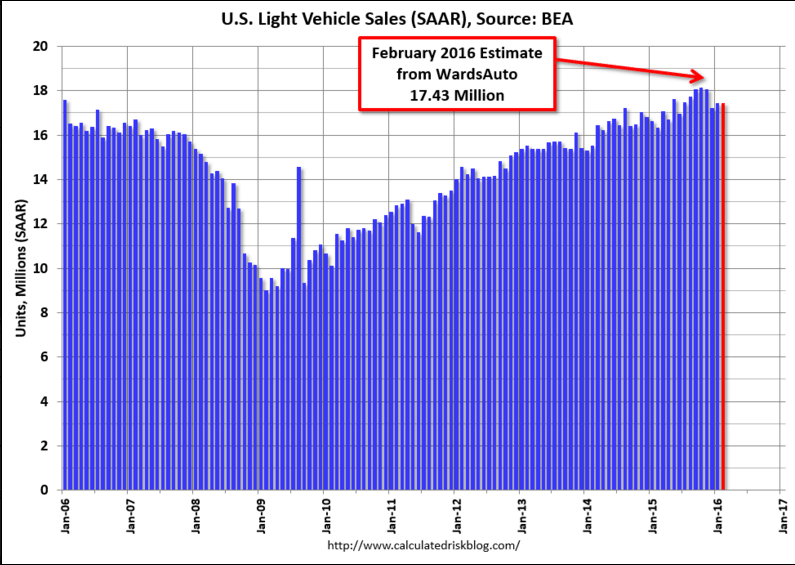
Whoops, less than expected, and as the chart shows the seasonally adjusted rate of sales continues to decelerate from the prior peak months as weakness that began with the collapse of oil capex continues to spread to the rest of the economy:

er-3-1-10
From another source that spins flat to down sales as a positive for continued growth. Seems to me that if any of the ‘pieces’ grow at a lower rate than last year, some other ‘piece’ has to grow at a faster rate than it grew at last year to make up for it. This level of car sales will not be at all supportive of growth to the retail or factory sector:

Motor Vehicle Sales
er-3-1-11
Highlights
Vehicle sales held at strong levels in February, at a 17.5 million annualized pace for total sales and at a 14.1 million pace for North-American models. Both rates are only fractionally lower than January and offer a sign of continued strength, though not accelerating strength, for the motor vehicle component of the government’s retail sales report. All readings show only the smallest fractional change with light trucks at a 10.1 million rate and cars at a 7.4 rate. Vehicle sales remain a central strength for the economy, boosting both the retail sector and helping to support the factory sector as well.

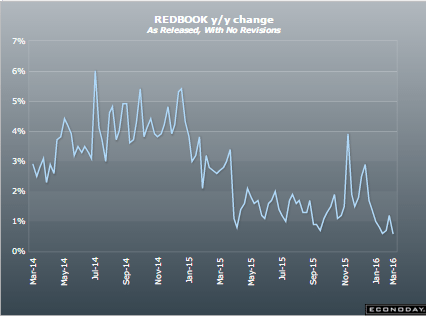
Redbook retail sales, PMI manufacturing, ISM manufacturing, Construction spending, Draghi comment

er-3-1-9

PMI Manufacturing Index
er-3-1-2
Highlights
Growth in Markit Economics’ manufacturing sample is slowing to a crawl, at 51.3 for final February which is, next only to February’s flash of 51.0, the second lowest reading since October 2012. January, at 52.4, was a good month for the manufacturing sector with industrial production up and durable orders up, but the early indications on February are uniformly negative.

Production in this report slowed as did new orders where growth is at a 3-1/2 year low. Export orders fell the most since April last year. Backlog orders are also down and employment growth moderated for a second straight month. Respondents in the sample are citing caution among their customers as a key negative. In a convincing kicker, selling prices are down the most in more than 3-1/2 years.

This report, which runs hot compared to other manufacturing reports, is sitting near recovery lows and is offering its own signal of renewed trouble for manufacturing, a sector that continues to get hit by weak exports and weak energy-related demand.

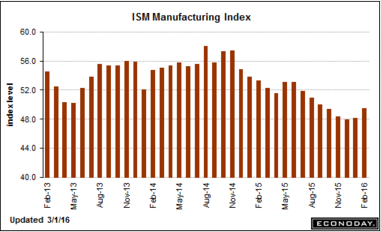
And this continues to be in contraction mode:

ISM Mfg Index
er-3-1-3
Highlights
Early indications on the February factory sector are all negative but the most closely watched one, ISM’s manufacturing index, perhaps shows the least weakness. The index rose 1.3 points to a 49.5 level that is nearly at 50.0, the breakeven level between positive and negative monthly change. This index hit 50.0 back in September and has since been underwater.

Not underwater, however, are new orders which held unchanged at a respectable enough level of 51.5. This index had been below 50 going into last year. Contraction in backlog orders slowed which is another plus though contraction in new orders for exports deepened slightly to 46.5 for the weakest reading since September. Employment has been very weak in this report but here to there’s improvement, up 2.6 points to 48.5. Production is also a positive in the report, up 2.6 points to 52.8 for the best reading since August last year.

This report should help limit concern that February was a breakdown month for what is still, however, a fragile factory sector.

er-3-1-4
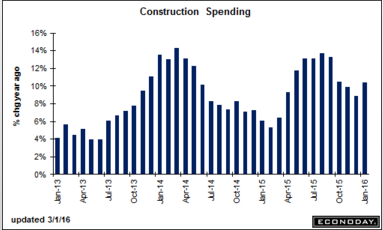
The headline number looks ok, but note the details. And you can see from the charts that growth has been decelerating and will likely continue to do so as the collapse of oil related capital expenditures spreads to the rest of the economy:

Construction Spending
er-3-1-5
Highlights
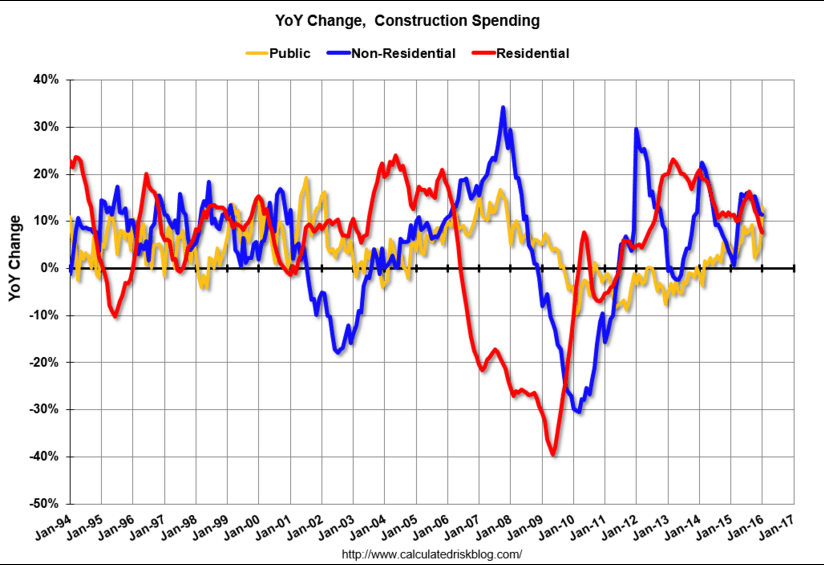
Construction spending rose a strong 1.5 percent in January in strength, however, that does not include housing. A one-month surge in highway & street spending skewed the headline higher as did gains for manufacturing and on Federal construction projects.

The residential component was unchanged in the month as a 0.2 percent slip in single-family homes offset another jump in the much smaller multi-family subcomponent which rose 2.6 percent in the month. Demand on the multi-family side, reflecting strength in rental prices, has been very strong with year-on-year spending up 30.4 percent vs 6.6 percent for single-family homes. Together, residential spending is up a year-on-year 7.7 percent.

Other year-on-year rates include an impressive 33.9 percent gain for highways & streets which is a big category. Federal, a far smaller category, is up 9.9 percent. Turning to the private nonresidential components, offices lead at a 24.8 percent year-on-year gain.

The median-to-high single digit year-on-year gain for residential spending is roughly in line with gains in both sales and prices. Historically, these are moderate rates of growth for the housing sector but, right now, are among the very highest for the economy as a whole. On the non-residential side, today’s gains are a very good start for first-quarter business investment.

er-3-1-6
Note the surge in public sector spending referenced above, while the private sector spending continues to decelerate.
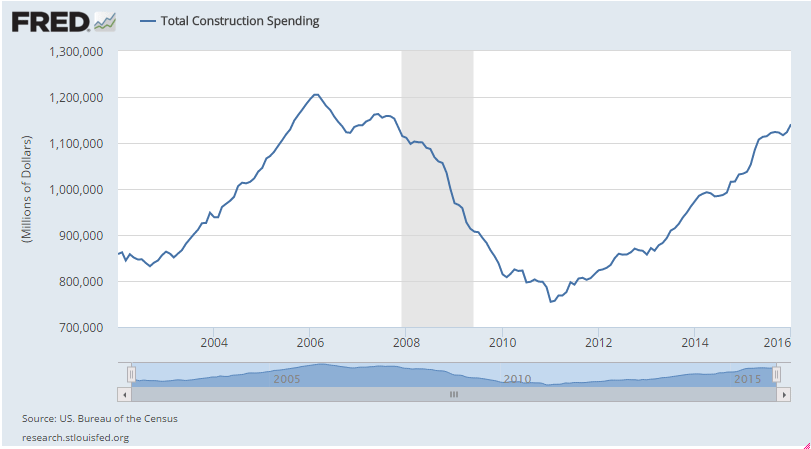
Recall that NY tax benefits expired in June with roughly coincides with the peak in growth seen in both charts:
er-3-1-7
This chart is not adjusted for inflation, so construction spending in real terms has yet to reach pre recession levels and it’s growing at lower rate than before as well:
er-3-1-8
As the carpenter said about his piece of wood, “No matter how much I cut off it’s still too short”:

DRAGHI SAYS EURO AREA INFLATION DYNAMICS CONTINUE TO BE WEAKER THAN EXPECTED

DRAGHI SAYS THERE ARE NO LIMITS TO HOW FAR WE ARE WILLING TO DEPLOY OUR INSTRUMENTS WITHIN OUR MANDATE TO ACHIEVE OUR OBJECTIVE OF INFLATION RATES BELOW, BUT CLOSE TO, 2% OVER THE MEDIUM TERM