
Hopefully this reverses soon!
Monthly Archives: August 2013
IMF on Japan’s debt
Just when you think they are coming around…
IMF report cites concerns over Japan’s fiscal situation
August 3 (Jiji Press) — The International Monetary Fund has expressed concern about the fiscal situation in Japan, where public debt keeps soaring.
Simulations by the IMF “suggest that global output losses could reach 2 percent of GDP” if Japan is “exposed to a reconsideration of sovereign risk by investors” and experiences a long-term interest rate jump of two percentage points, the IMF said in a report.
The international body called for a credible fiscal consolidation plan by Japan in the report on the spillovers of the domestic economic and monetary policies of major contributors to the global economy.
Prime Minister Shinzo Abe’s three-pronged economic policy, Abenomics, is believed to have “positive, albeit small” spillover effects on the global economy in the short term if all three arrows are successfully deployed, the report said.
But the IMF also said, “The pickup in growth provided by short-term fiscal and monetary stimulus is expected to wind down after a year or so.”
In the absence of a successful reform package including fiscal consolidation, structural reforms and achievement of the new inflation target, the IMF’s simulations “suggest that output in Japan will be 4 percent lower after 10 years,” the report said.
In a different report, focusing on major nations’ external positions, the IMF said it can see “moderate undervaluation” of the yen relative to medium-term fundamentals and desirable policies, in the wake of the currency’s sharp drop since autumn last year.
But in the spillover report, the global body said, “The effects of the yen’s depreciation on competitiveness in other countries is broadly offset by the positive effects of higher growth in Japan and lower interest rates in trading partners as a result of greater capital inflows and lower sovereign risk in Japan.”
At a teleconference, an IMF economist said it has become very difficult to analyze developments in Japan because of volatile market movements and a sharp deterioration in the nation’s trade balance due to soaring imports of energy sources.
PMC
And don’t forget to consider a donation for the Pan Mass Challenge this weekend! Feel free to donate whatever you think this free blog has been worth to you. FYI, the PMC is anticipating turning over about $40 million to the Dana Farber Cancer Institute for primary research this year, thanks to Billy Starr and Co!
:}!!!
Donate Here
With friends like this who needs enemies…
Right on top of the wall of shame:
A message from Larry Kotlikoff
Dear Fellow Economists,
I write to ask you to join 11 Nobel Laureates in Economics, other leading economists, and former government officials in endorsing the INFORM ACT (Intergenerational Financial Obligations Reform Act) at www.theINFORMact.org. The bill was introduced on a bipartisan basis in the Senate last week, and we expect bipartisan introduction in the House next week.
All endorsements will be included in a letter to Congress, posted on the website, that will appear early this fall in a full-page ad in the New York Times.
The INFORM ACT, which I drafted in large part with the assistance of Alan Auerbach, requires the Congressional Budget Office (CBO), the Government Accountability Office (GAO), and the Office of Management and Budget (OMB) to do fiscal gap and generational accounting on an annual basis and, upon request by Congress, to use these accounting methods to evaluate major pieces of proposed legislation.
While no measure of fiscal sustainability and generational equity is perfect, fiscal gap and generational accounting offer significant advantages relative to conventional measures of official debt. First, they are comprehensive and forward-looking. Second, they are based on the government’s intertemporal budget constraint, which is a mainstay of our dynamic models of fiscal policy. Third, do not leave anything off the books.
Fiscal gap and generational accounting have been done for roughly 40 developed and developing countries either by their treasury departments, finance ministries, or central banks, or by the IMF, the World Bank, or other international agencies, or by academics and think tanks. Fiscal gap accounting is not new to our own government. The Social Security Trustees and Medicare Trustees have been presenting such calculations for their own systems for years in their annual reports. And generational accounting has been included in the President’s Budget on three occasions.
According to recent IMF and CBO projections, the U.S. fiscal gap is many times larger than the official debt and compounding much more rapidly. The longer we wait to close the fiscal gap, the more difficult will be the adjustment for ourselves and for our children. This said, acknowledging the government’s fiscal gap and deciding how to deal with it does not rule out productive government investments in infrastructure, education, research, or the environment, or in pro-growth tax reforms.
We cannot change or fully avoid politics. But our profession has a responsibility to the truth, as best we can describe it, that transcends politics –– a responsibility that becomes a moral imperative when our nation’s economic future and our children’s welfare are at stake.
Please join me in endorsing this critically important bill at www.theINFORMact.org, and please use whatever social media and communication tools you have available to encourage your colleagues, friends, and associates to do the same.
With deep appreciation for considering this request,
Larry Kotlikoff
Professor of Economics
Boston University
US equity funds see highest-ever inflows in July
This kind of flow could drive even Lehman Bros. and Bear Stearns stock prices to new highs:
US equity funds see highest-ever inflows in July
By Ansuya Harjani
August 4 (CNBC) — U.S. equity funds saw a record inflow of $40.3 billion in July, according to data from TrimTabs, as the S&P 500 and Dow Jones Industrial Average scale new heights in what some are calling an “invincible summer” for the country’s stocks.
“Fund flows in the past two months were by far the most volatile we have ever measured. After ignoring equities and dumping bonds at a record pace in June, fund investors poured record sums into U.S. equities and continued to sell bonds in July,” the investment research firm wrote in a report published late Sunday.
Fund investors ended their “love affair” with bonds this summer, pulling $21.1 billion out of debt mutual funds and exchange-traded funds (ETFs) in July, after record outflows of $69.1 billion in June. The outflows in June and July brought an end to 21 straight months of inflows.
Fed’s Plosser
Here’s what we’re up against. The only thing between today’s economic catastrophe and unimaginable prosperity is the space between their ears, as we continue to lose the battle vs the demand leakages.
Fiscal Policy and Monetary Policy: Restoring the Boundaries
By Charles I. Plosser, President and Chief Executive Officer, Federal Reserve Bank of Philadelphia
Fiscal Imbalances
August 5 (Philadelphia Fed)— During the past several years, we have witnessed the ongoing saga of governments, both in Europe and in the U.S., struggling with large deficits and soaring public debt. For the most part, these challenges are self-inflicted. They are the result of governments choosing fiscal policies that they knew would be unsustainable in the long run. Financial market participants remain skeptical about whether the political process can come to grips with the problems.
So far, this skepticism appears to be wholly justified. Neither the European nor the American political process has developed credible and sustainable plans to finance public spending. Instead, politicians continue to engage in protracted debates over who will bear the burden of the substantial adjustments needed to put fiscal policies back on a sustainable path. In my view, these prolonged debates impede economic growth, in part, due to the uncertainty they impose on consumers and businesses. Moreover, the longer the delay in developing credible plans, the more costly it becomes for the respective economies.
Given the magnitude of the fiscal shortfalls, the way in which the political process restores fiscal discipline will have profound implications for years to come. Will there be higher taxes on investments by the private sector that risk reducing productive capacity and output in the future? Will there be higher taxes on labor that discourage work effort or hiring? Will there be cutbacks in government expenditures on defense or basic research that might force significant resource reallocations and affect a wide array of industry sectors? Will there be cutbacks on entitlements that could affect health care, social insurance, and other aspects of our safety net? Or will a viable fiscal plan combine various types of tax increases and spending cuts?
These are important questions that involve hard choices and trade-offs between efficiency and equity. Yet, until fiscal authorities choose a path, uncertainty encourages firms to defer hiring and investment decisions and complicates the financial planning of individuals and businesses. The longer it takes to reach a resolution on a credible, sustainable plan to reduce future deficits and limit the ratio of public debt to gross domestic product, or GDP, the more damage is done to the economy in the near term.
Some observers say cyclical factors and the magnitude of the recent global recession caused the current fiscal crisis. It is certainly true that the policy choices made by governments to deal with the financial crisis and ensuing recession have caused a significant deterioration in fiscal balances and debt levels in many countries. However, the underlying trends that are at the root of unsustainable fiscal deficits in many countries, including the U.S., have been in place and known for some time. In the U.S., for example, the major long-run drivers of the structural deficit at the federal level are entitlements such as health care and Social Security.[2]
Thus, even after cyclical effects play out, many countries will continue to have large structural budget deficits. In this sense, the financial crisis and recession have simply exacerbated the underlying problems and perhaps moved up the day of reckoning. In some cases, such as Greece, that day has come. In light of these realities, market participants have begun to question the solvency of governments and their ability to honor their sovereign debt obligations in the absence of deep structural reforms. In Europe, the doubts have greatly complicated the political problems as various countries debate the question of “who pays” for the anticipated bad debts of individual countries. Here, too, the protracted nature of the political debate creates uncertainty, which undermines economic growth and exacerbates the crisis.
Byron Wien’s August 2013 Commentary
The usual muddled mainstream confusion, but worth reading as to how it all now maybe points to a weaker 2nd half.
That is, if mainstream thought is now transitioning from improvement to weakness markets should react accordingly.
Byron Wien is Worried About Rest of Year
By Byron Wien
August 2 (Barron’s) — At the beginning of the year most economic observers had a realistic view of the pace of economic growth for the United States. As usual there were positive and negative cross-currents, but the consensus was that real growth would be about 2% for 2013. The Federal Reserve was engaged in a vigorous program of monetary easing, however, and a substantial amount (perhaps three-quarters of the total) of that money flowed into financial assets, driving the price of equities higher and keeping interest rates low. As a result of the strong stock market performance, some economists increased their growth estimates for the second half and the full year. Now, with two quarters behind us, it is time to take a hard look at how the year is playing out.
The first quarter came in at 1.8% real growth; second-quarter estimates indicate some slowdown from that rate, but 1% is probably a good working number at this point. Year-over-year growth is running at 1.62%. That is hardly an impressive number when you consider that the Federal Reserve is putting money into the economy through bond purchases at an annual rate of $1 trillion. In 2008, when the accommodative monetary policy began, the entire balance sheet of the Federal Reserve, accumulated in the 95 years since its founding in 1913, was $1 trillion, so the degree of monetary stimulus is unprecedented.
If growth is less than 2%, you have to wonder about the structural problems holding the economy back. In my view the economy is suffering from a lack of demand. Companies are reluctant to hire workers when the order book is thin. The global competition is intense in every product category. There are too many folks making too much stuff around the world. There are also structural problems in employment. Following past recessions, at the same point in the recovery, four years from the trough, the unemployment rate would have been close to 5%, but it is now 7.6%. The workforce participation rate is only 63.5%, which is down two full points from the level before the 2008–09 recession. Many able workers have given up looking for a job because they are so frustrated and disillusioned by their failure to find one. Yet there are several million unfilled jobs out there, jobs that require a certain level of technical skill which many jobseekers do not have.
First-half growth may have been held back by several factors. At the beginning of the year taxes on America’s top earners went up and the 2% payroll tax holiday ended. In April the sequestering of government funds for health care and defense went into effect. These changes are estimated to knock 1.5% off nominal Gross Domestic Product (GDP) of 4%, bringing it down to 2.5%. Taking 2% inflation off that number (inflation has recently been running closer to 1%), you are down to .5% real growth. The weather was unusually cold during the winter which also dampened growth. There are some important positives, though. Housing has been strong and domestic oil production has increased significantly. These two factors and some other minor ones could bring real growth back up to 2% for 2013.
One notable fiscal factor which should provide some encouragement to investors is the improvement in the budget deficit. In 2010 the deficit of $1.5 trillion was 10% of GDP. This year, because of tax increases and spending cuts, it should only come in at $700 billion on a $17 trillion economy or slightly more than 4% of GDP. This improvement is likely to continue next year. With the budget deficit declining, Congress has some room to engage in long-deferred infrastructure, research and development and job training programs. It is unclear whether this legislation will be introduced, however.
In spite of the lackluster performance of the economy in the first half, there is a general feeling that the second half will be better. The impact of the sequester may not be as severe and there is a general perception that both corporate executives and consumers are more positive on the outlook. The market hit some rough spots in May–June when Federal Reserve Chairman Ben Bernanke indicated that the central bank might reduce its bond buying program as early as September. From May 1 to July 5, the 10-year U.S. Treasury yield rose from 1.7% to 2.7%, but by July 18 it was back down below 2.5%. Even if the Fed only bought $60 billion of securities rather than $85 billion, it would still be engaged in a significant program of monetary easing, but talk of tapering scared the fixed income market. When Treasury yields moved higher, Bernanke softened his language and calmed down the bond traders.
I know there is a feeling among policymakers at the Fed that the current high degree of monetary accommodation is excessive and should be restrained when the economy has regained its natural momentum. I do not believe we have come anywhere near that point yet. Moreover, the Fed’s own targets for implementing a program of restraint have not been met. The unemployment rate is not near the 6.5% threshold target that the Fed has set for itself and neither has inflation reached 2%. Since the economy is running well below its potential, I believe the Fed should maintain its current level of security purchases. Any reduction in the program is a form of tightening and neither the market nor the economy is really ready for that.
Although there is a palpable degree of optimism about corporate performance in the second half of this year, I wonder if it is justified. Companies have generally beaten analysts’ estimates more than two-thirds of the time so far this year, but I think that is mostly because management guided estimates lower so the results would compare favorably. That was certainly the case for Alcoa and Coca-Cola. United Parcel Service did not prepare the market for disappointment and the stock declined sharply. In the technology sector Microsoft, Intel and Google missed estimates. Second-quarter earnings are only expected to be up 2% over 2012 levels and full-year estimates are only projected to grow 4%–6% over last year, with much of that improvement coming from stronger performance in the second half.
It is unlikely that we are going to see better earnings if sales don’t improve. Second-quarter sales are only expected to rise 1.25% over last year and full-year estimates are for a 2.75% increase. If there is some pressure on margins from modestly higher labor costs, depreciation and energy prices, that meager level of revenue improvement may not be enough to keep margins from eroding. It has been my view that profit margins are peaking and we should see if that observation is correct in the second half of 2013.
There are other reasons to be concerned. In 2010 world real growth was running at 4% as a result of the post-recession recovery in the United States and strength in the emerging markets. It is only at a 2% rate of increase now. We know that economic activity in China is slowing, but nobody seems to know by how much. China is the engine of growth for the emerging markets, so there is a negative reflective impact there. Europe remains in a recession. Reduced emphasis on austerity should help push the Eurozone into a position of very modest expansion in 2014 but the region is not likely to be an important contributor to overall world growth. Only Japan is providing favorable surprises. Shinzo Abe’s policy of heavy fiscal and monetary stimulus should be successful in bringing the country out of its deflationary recession in 2014. Japan’s monetary stimulus is $600 to $700 billion and its economy is less than half the size of that of the United States, so it is putting money into its economy one and a half times faster than the Fed is doing so in the U.S. There is also a vigorous fiscal stimulus program taking place in Japan at the same time. Abe’s recent success in the Japanese election should give him the confidence to continue his aggressive stimulus program.
There are other signs of trouble which have implications for second half economic performance. The increase in interest rates has moved 30-year mortgage yields up 100 basis points to 4.5%. While this is low on an historical basis, it is substantially higher than recent levels and should have an effect on housing which has been one of the clear positives in the U.S. economy this year. We have seen some evidence of this in slower housing starts and mortgage applications, but that condition may be temporary.
The composite Purchasing Managers’ Index, which includes both manufacturing and services, has shown some signs of weakness, reflecting disappointing demand. The National Federation of Independent Business sentiment, which had been favorable recently, has weakened. Retail sales have shown signs of softness in spite of the fact that household net worth is at an all-time high. The rises in the stock market and luxury real estate have benefited the portion of the population that has the lowest propensity to spend in relation to their income. In contrast we have 45 million Americans on food stamps, substantially higher than ever before. Railcar loadings and bank loans, two important indicators of business activity, have also weakened. First Call earnings revisions have turned down, indicating more disappointments may lie ahead.
I still think the economy will grow at 2% this year, but I worry that final sales will not be enough to offset some margin deterioration. As a result I fear that earnings will be below estimates. I have been worried about economic growth and earnings all year and the Standard & Poor’s 500 has kept working its way higher. The liquidity being provided by the Fed is responsible for that. Valuations are still reasonable and if the easy money policy continues, I recognize that stocks can move up more from here. I think earnings will be below estimates, but investors may not care as long as the Fed’s bond buying program continues. Right now the S&P 500 is trading somewhat above 15 times consensus earnings and slightly more than 16 times the earnings level that reflects a reasonable degree of disappointment. This is not an extreme level of overvaluation, even considering the recent rise in interest rates. Investor sentiment is in optimistic territory, near the level that has signaled a likely decline in the past. Companies have considerable cash on their balance sheets, some of which will be used to buy back stock. That could increase earnings per share, offsetting earnings shortfalls.
According to a report in Barron’s (July 24) by Mark Hulbert, which was supported by considerable academic research, since the 1920s the average multiple for the S&P 500 at market top is 18.7, close to where we are now. Moreover, the market tends to rise sharply just before the top rather than forming a plateau, indicating exhaustion. The average bull market gained 21% in the twelve months before the top; the current 12-month return is 23%. In a blow-off the market multiple could rise to 20, and each multiple point is 100 points on the index. I don’t expect that to happen, but if the Fed keeps pumping money into the economy, anything is possible. While a higher high may be ahead, at some point the Fed will slow its accommodation and investors will recognize the implications of slow economic growth and very modest earnings improvement. That is why I believe a degree of caution is warranted.
Employment Report
So there’s a math thing that says for the total to increase at least one of the components has to increase.
This means that if Q3 GDP is going to grow faster than Q2 the growth of the components has to add up, etc.
So while it’s just one data point subject to revision, etc. we are opening Q3 with a weaker NFP report, and the .3 personal income isn’t all that supportive, either. Nor are the anecdotal reports of mortgage originations falling off sharply encouraging.
And Q2 consumption was already less than Q1, exports decelerating, July car sales disappointing yesterday, etc. as reasons to expect Q3 to be better than Q2 begin to fade, just as initial hope has faded all year? Remember the initially higher GDP estimates being touted as ‘proof’ that tax hikes and sequesters didn’t hurt as feared? Even the President backed off on his warnings about what they would do to the economy?
And what about the idea that ‘when the govt gets out of the way’ fiscal drag is reduced and that negative to growth will be removed and growth will accelerate? Not true either, as that depends on private sector credit expansion rising to the occasion, which isn’t happening, especially with housing and cars going the wrong way.
And when the fiscal initiatives end, it doesn’t mean the deficit goes back up to where it was, but in fact it remains at the lower level, offering reduced ongoing support for aggregate demand, with that support fading via the automatic fiscal stabilizers should growth somehow continue.
Have a nice weekend!
And don’t forget to consider a donation for the Pan Mass Challenge this weekend! Feel free to donate whatever you think this free blog has been worth to you. FYI, the PMC is anticipating turning over about $40 million to the Dana Farber Cancer Institute for primary research this year, thanks to Billy Starr and Co!
:}!!!
www.pmc.org
Hit “donate”
Type “Mosler”
US Labor Force Participation SA
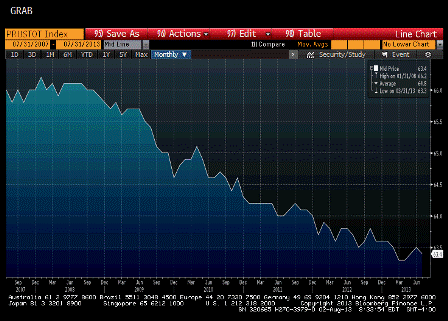
Full size image
Company Pensions in Peril as Shortfalls Hit Record
Demand leakages…
Company pensions in peril as shortfalls hit record
By Jeff Cox
July 31 (CNN) — Young workers may want to start counting on something other than company pensions to fund their retirements.
It turns out that the plans of S&P 500 companies are underfunded to the tune of $451.7 billion, a number that has grown some 27 percent in just the last year alone, according to data released Wednesday by S&P Dow Jones Indices.
While firms have plenty of cash to cover older workers currently on the payroll or in pension plans, that may not be the same once the younger generation gets ready to stop working.
US economy should be growing at 3-4%: Former Fed governor
Says problem is not enough drilling!
US economy should be growing at 3-4%: Former Fed governor
By Katie Holliday
July 31 (Bloomberg) — The U.S. economy has the ability to grow at a rate of 3-4 percent if policy makers removed the constraints obstructing its potential, former Federal governor Robert Heller told CNBC on Thursday.
Heller’s comments follow better-than-expected gross domestic product (GDP) figures on Wednesday, which showed the world’s largest economy expanded 1.7 percent growth in the second quarter from the year before, exceeding expectations of a 1 percent rise and an increase on the first quarter’s downwardly revised 1.1 percent.
“We may be out of the woods, but we are [still] walking in a mud field,” said Heller, who served on the Fed’s board from 1986 to 1989 under President Reagan.
“We are stuck in a range of 1-2 percent growth, which is not where we should be. If you would take some of the constraints off the U.S. economy, it could be growing a lot faster at 3-4 percent,” he added.
Heller said one of the key constraints was restrictions on drilling activity on government-owned land which has prevented oil and gas companies from expanding at the pace they should be.