Re: FDIC Emergency Idea

(email exchange)

Yes!

“There is a way to get money flowing through the banking system and financial markets almost instantaneously. The Federal Deposit Insurance Corp. has the authority to declare an emergency in the financial markets if the secretary of the treasury requests it. If an emergency is declared, the FDIC could announce that until the crisis abates, all depositors and other general creditors will be protected if an FDIC-insured bank fails.”

This presumably can include Fed deposits at member banks, which opens the door for Fed unsecured lending which is currently illegal.

Now the trick is to get the word to the right people at Treasury!

Along with, of course, a payroll tax holiday to sustain aggregate demand.

Warren

>   
>   On Thu, Oct 9, 2008 at 12:32 PM, Jeff wrote:
>   

We need to get it right

by William M. Isaac

Political leaders told us last week that if the Wall Street bailout bill did not pass, the stock market would drop by 1,000 points and millions of people would lose their homes, jobs and credit cards.

Congress passed the bill, yet the markets have gotten worse.

I believe the problem is that the bailout package does not deal with any of the four fundamental issues that must be addressed immediately: fear, bank capital, fiscal stimulus and help for homeowners.

Fear: The financial markets are frozen throughout the world. Banks will not lend to other banks and, to the extent they do, the cost is exorbitant. There is a lot of liquidity but it is being hoarded.

Which banks will fail and how will their creditors be treated? Will the government protect just the insured depositors or will it protect the uninsured depositors, bond holders, and other general creditors? The government has handled these claims in different ways in the failures to date, so there is considerable anxiety in the markets.

There is a way to get money flowing through the banking system and financial markets almost instantaneously. The Federal Deposit Insurance Corp. has the authority to declare an emergency in the financial markets if the secretary of the treasury requests it. If an emergency is declared, the FDIC could announce that until the crisis abates, all depositors and other general creditors will be protected if an FDIC-insured bank fails.
What would this cost taxpayers? In my view, nothing — indeed, it should save taxpayers a lot. It will get the financial markets working, help put the economy back on track and reduce the bank failure rate.

We already have an implicit guarantee in place for the largest banks, which control the bulk of our banking assets. Making the guarantee official during this crisis and extending it to the rest of the banks is essential and reasonable.

As I write this article, Ireland has guaranteed its banking system and Denmark and several other European countries appear headed in that direction. If enough follow, the U.S. will have no choice but to act.

Bank capital: The Securities and Exchange Commission adopted fair value accounting in the 1990s. This rule required financial institutions to mark their securities to market. I have argued against fair value accounting for more than two decades because I know that we could not have contained the severe banking problems of the 1980s if we had to deal with fair value accounting rules.

A bad idea became highly destructive when the SEC decided to continue fair value accounting after the market for mortgage securities evaporated last year. In the absence of a market, the SEC forced banks to mark these assets to an arbitrary index.

Mortgage securities were marked to a fraction of their true economic value, which destroyed $500 billion of capital in our financial system. Since banks lend about $10 for each dollar of capital, the SEC’s rule diminished bank lending capacity by $5 trillion. Is it any wonder we have a severe credit contraction?

Even now, the SEC continues to fiddle while the financial system and the economy burn. The SEC needs to suspend fair value accounting — act now, study it later. This will begin the process of restoring bank capital so banks can start lending again. Instead of the Treasury and Federal Reserve taking over our lending markets, we need to help our private banks do the job.

Another readily available tool to restore bank capital is one that the FDIC used in the banking crisis of the 1980s to give capital-short, but otherwise viable, banks injections of capital to help them get through difficult economic times. The program was a big help in the FDIC’s resolution of the $100 billion market insolvency in the savings bank industry at a total cost of less than $2 billion. A precursor of the 1980s program was the Reconstruction Finance Corporation, created to provide capital to banks during Great Depression.

The FDIC should resurrect this program immediately. It will limit the failures of community banks and put them back into the lending business more quickly.

Fiscal stimulus and help for homeowners: The bailout bill will not solve our banking crisis because it is not attacking the right problems. Instead, we should direct a good portion of the bailout money to providing permanent stimulus to the economy and to helping families who are in danger of losing their homes.

I believe Congress should get off the campaign trail and get back to Washington to get the bill right this time. The world is looking to us for leadership.
Re: NZ gets your payroll tax holiday…

(email exchange)

Yes, looks like they are on the right track with what looks like a substantial fiscal package.

>   
>   On Thu, Oct 9, 2008 at 6:01 PM, Steve wrote:
>   
>   W
>   
>   Not quite the same wording. But the same idea. (skip to
>   highlighted line.
>   
>   Steve
>   

Report outlines plan to save NZ economy

October 10, 2008 – 7:46AM

The current global financial crisis is one of the most serious events the New Zealand economy has faced for decades, according to a new report.

The draft report, released Friday by the New Zealand Institute and NZX, said New Zealand’s response to the crisis needed to be “deliberate, serious and proportionate”.

“The response must be about more than battering down the hatches … We should see this as an opportunity to position the economy for the longer term, as well as manage the risks.”

The report suggested provisional tax payments be deferred for 24 months, capital investment be “prioritised and incentivised”, a two-year income cap tax at 20 per cent for New Zealanders returning home, firms be attracted to New Zealand with two years of no company tax and the Research and Development tax credit be retained.

In the longer term the report said a company should be created to manage commercial state owned enterprises, a taxpayer savings vehicle be created to manage financial assets, KiwiSaver be made compulsory and the biases in the tax code that promotes housing speculation be removed.

New Zealand’s response to past crises were the “insular” policies of Think Big and protectionism, the report said.

“Our lack of appropriate response then led us to the economic brink a decade later. We now face the same risk.

“We believe there is little we can do about Northern Hemisphere banks, there is a lot we can do to determine how well the New Zealand economy copes with permanent changes to global credit markets and a global economic slowdown.”

2008-10-10 USER


[Skip to the end]


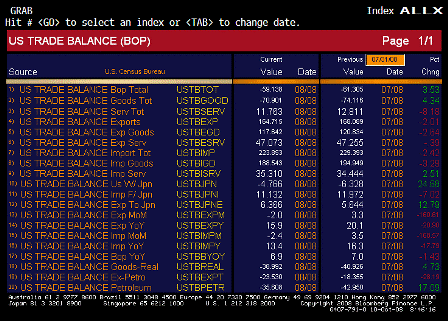
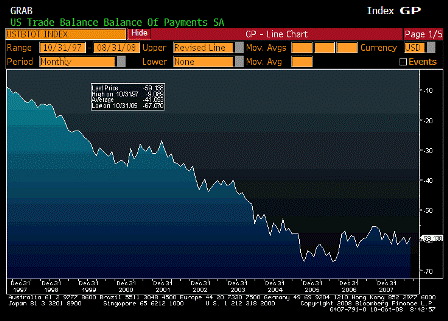
Trade Balance (Aug)

Survey -$59.0B
Actual -$59.1B
Prior -$62.2B
Revised -$61.3B

 
If oil prices don’t rise and the foreign sector’s desire to accumulate $US stays down this will go a lot lower.

[top][end]

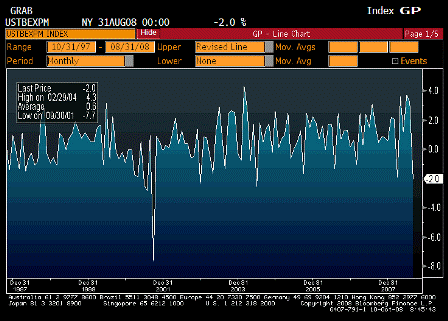
Exports MoM (Aug)

Survey n/a
Actual -2.0%
Prior 3.3%
Revised n/a

 
World economy takes pause.

[top][end]

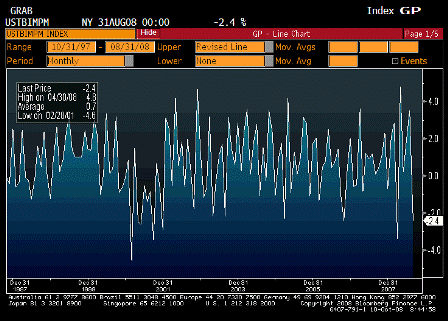
Imports MoM (Aug)

Survey n/a
Actual -2.4%
Prior 3.5%
Revised n/a

 
US economy pauses.

[top][end]

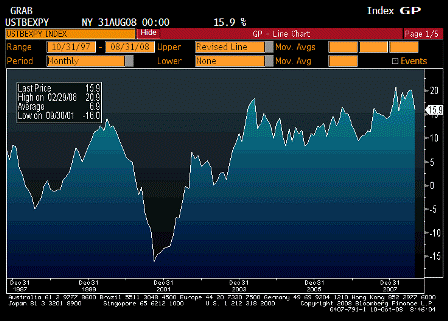
Exports YoY (Aug)

Survey n/a
Actual 15.9%
Prior 20.1%
Revised n/a

 
Still way high.

[top][end]

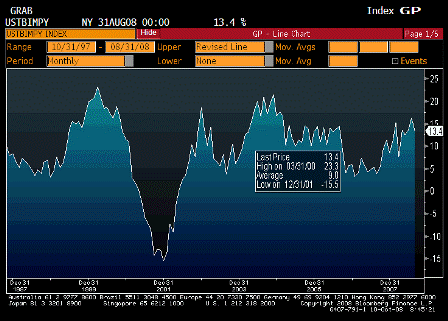
Imports YoY (Aug)

Survey n/a
Actual 13.4%
Prior 16.3%
Revised n/a

 
Still growing fast, but largely oil prices.

[top][end]

Trade Balance ALLX (Aug)

[top][end]


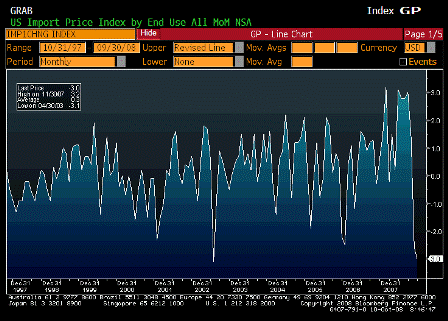
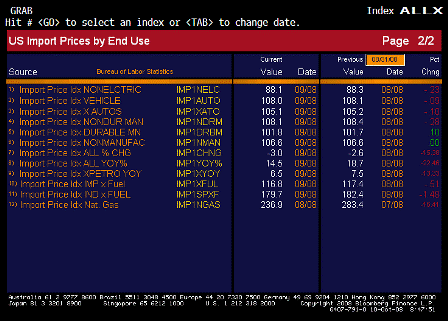
Import Price Index MoM (Sep)

Survey -2.8%
Actual -3.0%
Prior -3.7%
Revised -2.6%

 
Big drop.

[top][end]

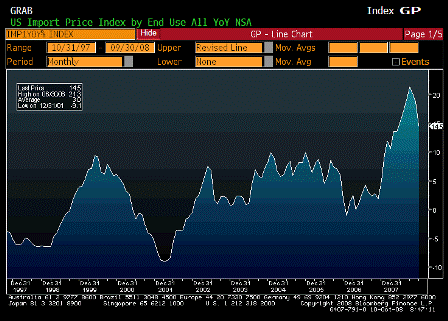
Import Price Index YoY (Sep)

Survey 12.2%
Actual 14.5%
Prior 16.0%
Revised 18.7%

 
Still very high.

[top][end]

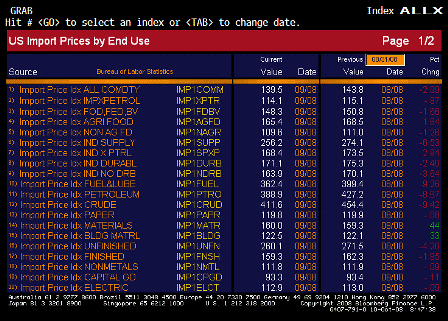
Import Price Index ALLX 1 (Sep)

[top][end]

Import Price Index ALLX 2 (Sep)


[top]

2008-10-09 USER


[Skip to the end]


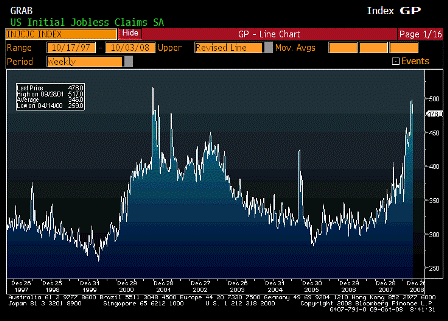
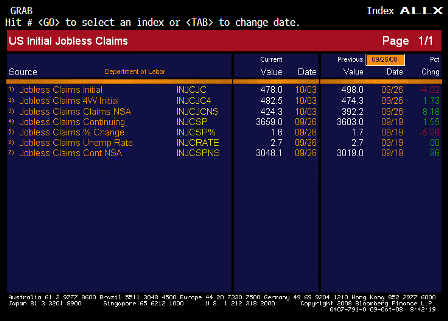
Initial Jobless Claims (Oct 4)

Survey 475K
Actual 478K
Prior 497K
Revised 498K

 
Still around 450,000 adjusted for storms.

Need another week or so to normalize.

[top][end]

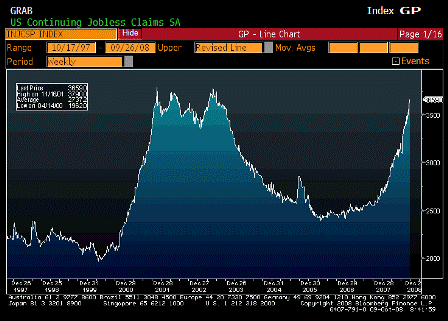
Continuing Jobless Claims (Sep 27)

Survey 3608K
Actual 3659K
Prior 3591K
Revised 3603K

 
Still rising.

No one seems to know how much the extended benefits added.

[top][end]

Jobless Claims ALLX (Oct 4)

[top][end]


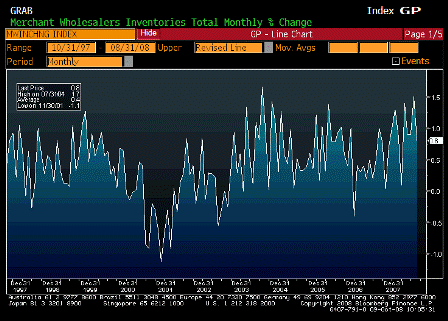
Wholesale Inventories MoM (Aug)

Survey 0.4%
Actual 0.8%
Prior 1.4%
Revised 1.5%

[top][end]

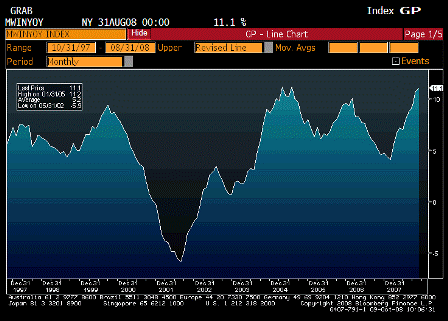
Wholesale Inventories YoY (Aug)

Survey n/a
Actual 11.1%
Prior 10.8%
Revised n/a

[top][end]

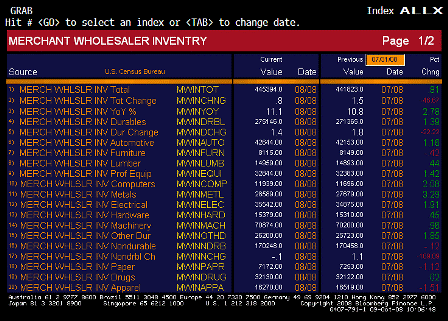
Wholesale Inventories ALLX 1 (Aug)

[top][end]

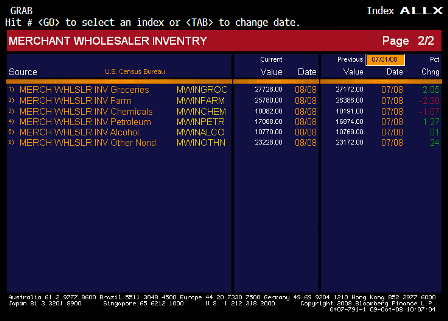
Wholesale Inventories ALLX 2 (Aug)


[top]

EU CDS


[Skip to the end]

EU Credit Default Swaps

Country 5 yr. 5 yr. 10 yr. 10 yr.
Germany 20 25 26 31
Italy 69 79 82 92
France 26 31 32 37
Spain 61 71 74 84
United Kingdom 31 41 39 49
Greece 78 88 90 100
USA 27 33 34 40
Portugal 61 71 74 84
Finland 20 30 27 37
Ireland 64 74 68 78
Netherlands 23 33 29 39
Belgium 39 49 49 59
Sweden 28 38 36 46
Austria 28 38 37 47
Norway 12 20 18 26
Denmark 30 40 37 47


[top]

End game for the euro


[Skip to the end]

Europe is even worse off than I thought.

And it looks to me like the Fed’s loan (via swap lines) to the ECB is noncollectable:

  1. Seems Eurozone got caught short USD much like AIG got caught short credit. Now the squeeze is on as the euro falls vs the USD rises. It’s an old fashioned external currency debt problem.
  1. The ECB has borrowed perhaps over $400 billion from the Fed via swap lines, secured by euros, to lend to its banks. Functionally, this is unsecured borrowing. And the amount approved by the Fed grows with each FOMC meeting. To pay it back the ECB has to sell euro and buy $400b, which might be problematic, at best.
  1. National budget deficits are now rising rapidly due to falling revenues and rising transfer payments. They will soon have their hands full funding themselves and will be incapable of funding the needs of the banking system.
  1. Should a run on the banks force the euro payments system to close; the question is how it re-opens.
  1. Reopening the ECB in euros will mean the national governments will have to repay the Fed $400 billion.
  1. If the national governments abandon the ECB and euro, the ECB’s debt to the Fed debt is noncollectable. The Fed’s debt is only with the ECB and not the national governments.
  1. This gives the national governments a powerful incentive, and perhaps no other choice, but to abandon the euro should the payment system fail.
  1. It will also likely mean the national governments will technically default on their euro debt, as they convert the debt to a new currency (or currencies).

 
Their only hope is a large enough US fiscal package that restores demand for world output.

Like my proposed payroll tax holiday that immediately adds maybe 5% to US GDP.

But the odds of that are not promising.

And the US economy continues to weaken rapidly.

(I own some German credit default insurance and wish I had bought a lot more.)


[top]

2008-10-08 USER


[Skip to the end]


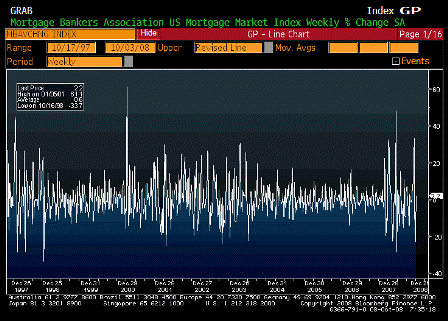
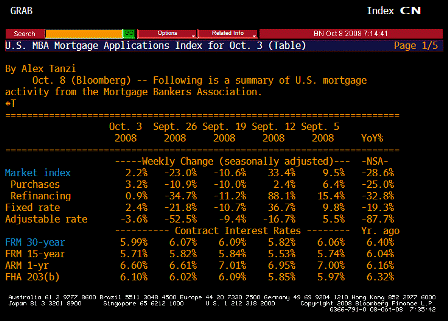
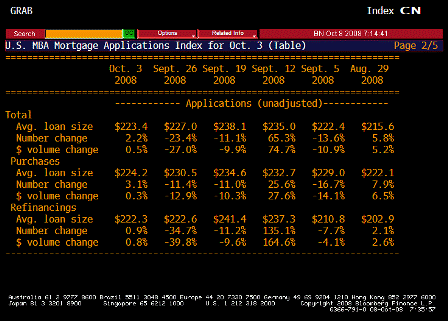
MBA Mortgage Applications (Oct 3)

Survey n/a
Actual 2.2%
Prior -23.0%
Revised n/a

[top][end]

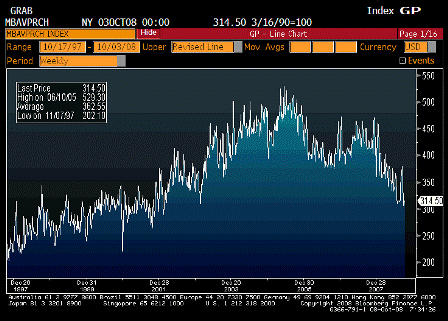
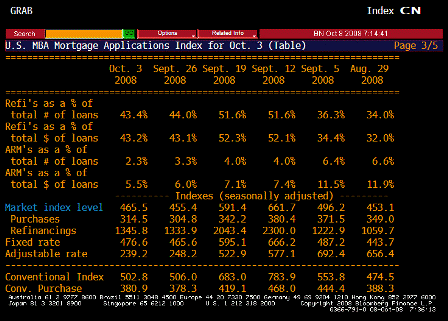
MBA Purchasing Applications (Oct. 3)

Survey n/a
Actual 314.50
Prior 304.80
Revised n/a

 
Didn’t go down.

[top][end]

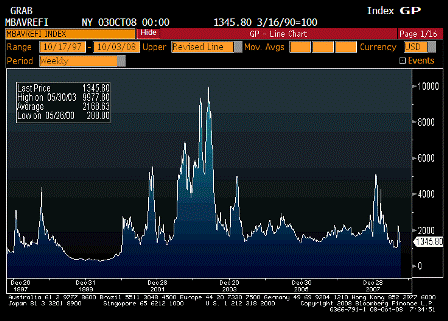
MBA Refinancing Applications (Oct. 3)

Survey n/a
Actual 1345.80
Prior 1333.90
Revised n/a

[top][end]

MBA TABLE 1 (Oct 3)

[top][end]

MBA TABLE 2 (Oct 3)

[top][end]

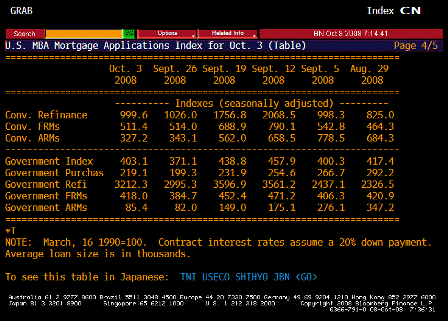
MBA TABLE 3 (Oct 3)

[top][end]

MBA TABLE 4 (Oct 3)

[top][end]

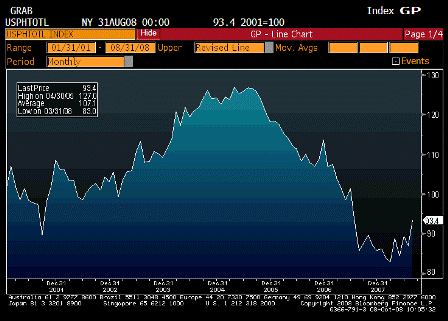
Pending Home Sales (Aug)

Survey n/a
Actual 93.4
Prior 87.0
Revised n/a

 
And moving up?

[top][end]

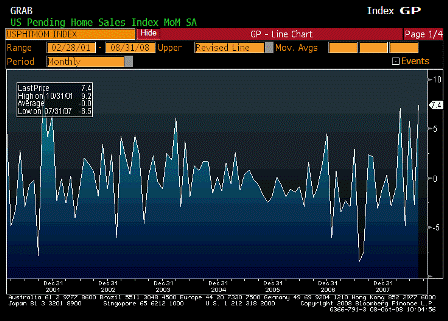
Pending Home Sales MoM (Aug)

Survey -1.3%
Actual 7.4%
Prior -3.2%
Revised -2.7%

 
Full blown housing boom underway! (OK, not yet)

[top][end]

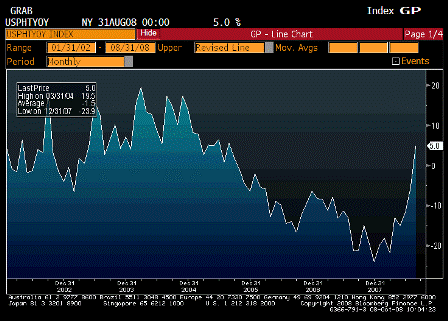
Pending Home Sales YoY (Aug)

Survey n/a
Actual 5.0%
Prior -5.9%
Revised n/a

 
Went positive!

September will be the test with the intensified credit crunch, but if this stuff holds, the economy may be in better shape than assumed.


[top]

Time to go unconventional?


[Skip to the end]

1. Fed needs to lend unsecured to any member bank in unlimited quantities and set term as well as ff borrowing rates.

This will normalize bank liquidity, and should have been done as soon as we went off the gold standard domestically in 1934(?).

To keep solvency accounting with FDIC the FDIC can insure all fed deposits at member banks.

This does not ‘create money’ or ‘inflation’ or have any macro economic effect beyond normalizing liquidity.

2. Congress needs to declare a ‘payroll tax holiday’ and drop the regressive social security and medicare deduction rates to 0% to restore demand from the bottom up.

This increases take home pay and cuts costs for business some, allowing both the means to make their payments to the financial sector and support it via reduced delinquency and rising credit quality.

It will also support growth and employment as the higher wages are also spent on real goods and services.

As this happens banks will very quickly resume lending to corps either directly or via commercial paper.

If people want to work and produce and not spend their income (for any reason) the government can either ‘spend it for them’ or increase their income via tax cuts until they spend sufficiently.

And don’t forget the need for an energy policy to prevent any recovery from merely driving up gasoline prices.

>   
>   
>   On Tue, Oct 7, 2008 at 9:19 AM, Davidson, Paul
>    wrote:
>   
>   Good comment — but what is the most unconventional thing
>   the FED can do? I think by now the FED can only prevent
>   things from getting exceedingly bad– but bad it will get–
>   What we need now is fast fiscal policy– but until a new
>   administration comes in, I do not see that happening.
>   
>   Anyone got something in there head that can save the world?
>   
>   By the way did you see Bill Black’s wonderful performance in
>   the Obama Keating 5 video released yesterday?

>   
>   Sent: Tue 10/7/2008 12:10 AM
>   
>   The U.S. economic data began to show signs of an outright
>   cumulative contraction before the September/October credit
>   crisis.
>   
>   The September/October events are a massive shock to the
>   system. The only thing I can compare it to is the combination
>   of a 20% Fed funds rate and a call for curbs on credit card use
>   in late winter 1980. In the months that followed aggregate
>   demand fell faster than at any time in the post war period.
>   
>   I believe the Fed realizes all of this.
>   
>   Bernanke realizes that if income falls the financial crisis, already
>   almost unimaginably severe, will also get much worse.
>   Fed Chairman Bernanke went before Congress and said that if
>   the Paulson Bailout Bill was not passed and the stock market
>   fell, there would be economic Armageddon. The Bailout bill has
>   passed. The stock market has fallen. Credit spreads have
>   widened. Based on Bernanke’s own public statements, he
>   should be thinking we are entering economic Armageddon. I
>   believe there is a raging hedge fund crisis, knowledge of which
>   is being suppressed. There are other unrecognized crises. I
>   think the Fed is aware of all of this.
>   
>   Meanwhile, the Fed has not changed its policy rate. But in
>   fact, Fed funds have been trading below the policy rate

>   target. Also, the Fed is expanding its balance sheet in a
>   spectacular way, and it has announced this morning that it will
>   expand it much further with newer, larger auctions.
>   
>   It would seem that Rome is burning and the Fed is fiddling. It
>   is my assessment that the Fed sees more of the burning than
>   we do. It realizes that all the conventional policy responses do
>   not fit the current monstrous circumstances. It is being held
>   back because it must come up with a more dramatic policy
>   response that we can conjure out of the precedents from the
>   past.
>   
>   Forget coordinated rate cuts. If it happens it will be cosmetic.
>   Japan has almost no interest rate to cut. The ECB will, but
>   Europe will prefer to resort to government guarantees of bank
>   deposits and will not hesitate to quasi nationalize banks.
>   
>   The Fed has no more time to stay its hand. Something will have
>   to be done very shortly.
>   
>   Based on Bernanke’s writings of the past several years, I would
>   expect a shocking policy change from the Fed which will
>   probably result in an almost unimaginable increase in its balance
>   sheet.


[top]

My letter in the Times UK today


[Skip to the end]

Sir,

A ‘Payroll Tax Holiday’ as a follow up the ‘Troubled Asset Relief Programme’ (TARP).

I agree with Tim Congdon’s “Harsh arithmetic behind the banking crisis” (The Times, 2nd October, 2008). However, while the TARP may marginally improve asset prices, it does not directly address interbank liquidity nor aggregate demand.

While the Fed has relaxed collateral requirements, at this late stage, it needs to simply lend unsecured to its member banks to normalize bank liquidity.

To support aggregate demand- an even more pressing need- Congress can declare a ‘payroll tax holiday’ and reduce social security and medicare payroll deduction rates to zero, until aggregate demand is sufficiently restored. This would immediately end the current crisis via the ‘trickle up’ process of increasing take home pay for workers who can then make their mortgage payments, pay their bills, and sustain the domestic demand needed to support the US as well as the Euro economy.

Remaining issues include the increased demand for energy consumption as the world economy recovers, and associated price pressures, which are a separate matters.

Yours faithfully,

Warren Mosler
Senior Associate Fellow, Cambridge Centre for Economic and Public Policy
University of Cambridge; Chairman Valance Co.
5000 Estate Southgate, Christiansted, St. Croix, USVI 00820


[top]

Consumer Credit


[Skip to the end]

The consumer is petrified by our leadership.
Time for a payroll tax holiday!

U.S. Consumer Credit Dropped by the Most on Record (Update1)

By Vincent Del Giudice

Oct. 7 (Bloomberg) — Borrowing by U.S. consumers unexpectedly fell in August by the most on record as banks shut off access to loans, a report from the Federal Reserve showed.

Consumer credit fell by $7.9 billion, the most since statistics began in 1943, to $2.58 trillion, the Fed said today in Washington. In July, credit rose by $5.2 billion, previously reported as a $4.6 billion gain. The Fed’s report doesn’t cover borrowing secured by real estate.

Consumer spending, the biggest part of the economy, is likely to keep faltering as banks hoard cash, job losses mount and property values drop. The decline in borrowing underscores why Fed policy makers today announced they will create a special fund to purchase commercial paper in a bid to open the flow of credit to the nation’s businesses.

“This is what happens when consumers are fearful and banks tighten lending standards to all applicants,” said Richard Yamarone, chief economist at Argus Research in New York. “No one borrows, no one lends. It’s a classic example of a frozen credit channel.”

Economists forecast an increase of $5 billion in consumer credit during August, according to the median of 29 estimates in a survey conducted by Bloomberg News.

According to the Fed, total consumer borrowing dropped at a 4.3 percent annual rate in August, the most since January 1998, during the Asian financial crisis.

Revolving debt such as credit cards decreased by $612 million during August and non-revolving debt, including auto loans, dropped by $7.3 billion.

Late Payments

The number of credit card bills paid late increased in the second quarter, according to the American Bankers Association, rising to 4.54 percent from 4.51 percent in the first quarter. The average bank card delinquency rate over the last two years is 4.44 percent.

Discover Financial Services, the credit-card company spun off from Morgan Stanley, said third-quarter profit declined 11 percent as late payments increased, the Riverwoods, Illinois company announced Sept. 25. Discover has lost almost half its market value since it was spun off in June 2007.

Figures released last week show auto sales tumbled 27 percent in September as the credit crisis and slowing economy dragged the industry to its worst month since 1991.

A quarterly Fed report issued on Sept. 18 showed household wealth fell from April to June for the third consecutive quarter and borrowing slowed as home prices dropped and lenders pulled back. Net worth for households and non-profit groups decreased by $438 billion in the second quarter to $56 trillion, the lowest since the end of 2006, according to the Flow of Funds report. Real estate-related assets declined by $258.8 billion, following a $299.5 billion loss.


[top]