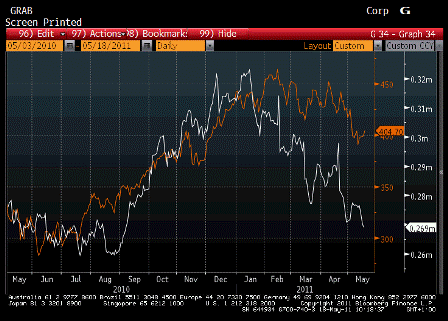
With its capital constraints FDI has been channel for speculative inflows to facilitate bets on yuan appreciation.
While month to month numbers are volatile, they’re worth keeping an eye on.
In the long run inflation weakens a currency.
Also, JPM yesterday suggested increased risk of what they called a hard landing
Growth of foreign direct investment in China slowing
May 18 (Global Times) – Foreign direct investment (FDI) in China rose to $8.46 billion in April, driven largely by investment in the property sector. The figure is 15.21 percent higher than the previous year but represents a slower rate of growth than seen in March, according to official data released Tuesday.
The slowdown of FDI growth as well as other economic indices this month showed that the economy is cooling down, economists warned Tuesday.
April’s figure was lower than the $12.52 billion invested in March and represented less than half of March’s year on year growth rate of 32.9 percent. The ministry did not elaborate on the reasons for the fall.
The property sector attracted about 24 percent of April’s investment flows, Ministry of Commerce spokesman Yao Jian said at a press briefing.
During the first four months of the year, FDI rose 26.03 percent over levels of the previous year to $38.80 billion, the data showed.
During this period, 10 Asian economies including Japan, Singapore and Hong Kong set up 6,487 new businesses, up 9.87 percent from the previous year, and invested $32.9 billion, up 31.23 percent from the previous year.
EU countries set up 562 new businesses in China, up 16.36 percent from the previous year, while investment from the EU rose 23.42 percent to reach $2.6 billion.
“Despite the financial crisis, European companies are still expanding and investing abroad, including in China. We encourage further market access in China to attract even more EU companies to invest there and indeed we also encourage Chinese companies to invest in Europe,” William Fingleton, a spokesman for the Delegation of the EU to China, told the Global Times in an email.
However, investment from the US dropped 28 percent during the first four months of this year to $1.03 billion in April.
FDI in China plunged after the financial crisis in 2008 but rebounded strongly last year to reach $105.7 billion.
“If the figures released in the first three months are regarded as volatile, April’s FDI figure as well as the month’s imports, manufacturing and other economic indices reported earlier showed a cooldown has firmly set into the economy,” Tian Yun, director of the research center of China Society of Macroeconomics, told the Global Times.
“The economy risks a further slowdown if the government’s monetary tightening policy continues and the country’s employment situation, which should always come before inflation issues, will remain worrisome,” Tian warned.
Inflation Outlook
Governor Zhou Xiaochuan said China’s central bank was focused on controlling prices, without mentioning threats to growth, an indication that he has been more concerned about inflation than any risk of a growth slowdown.
The central bank will “control the monetary conditions behind excessively rapid gains in prices,” Zhou said in comments dated April 18 and released yesterday in the central bank’s annual report. The comments tally with a monetary policy report released May 3 and were before data showing industrial output growth weakened last month.
Home prices rose in China’s 67 of 70 cities monitored by the government in April from last year, led by smaller cities that are defying efforts to control property prices nationwide. Housing prices increased at a faster pace in smaller cities and slowed in major ones, data posted on the statistics bureau’s website today showed.
Rising Coal Demand
Shenhua, the nation’s largest coal producer, rose 0.9 percent to 28.53 yuan. Yanzhou Coal Mining Co., the fourth biggest, advanced 0.9 percent to 32.99 yuan.
Demand for thermal and coking coal may increase between 8 percent and 10 percent this year as less rainfall curbs supplies of hydropower and boosts demand for coal-fired electricity, Luo Zeting, an analyst at Citic Securities, wrote in a report today.