Chrysler Obamanation


[Skip to the end]

Chrysler Lenders Include Yale, Gates Foundation

by Katherine Burton, Sree Bhaktavatsalam and Pierre Paulden

May 1 (Bloomberg) — Chrysler LLC’s secured lenders include Yale University,Oaktree Capital Management and assets managed for the University of Kentucky, Halliburton Co., Kraft Foods Master Retirement and the Bill and Melinda Gates Foundation,, according to a court filing in the carmaker’s bankruptcy.

Demons!!!

Chrysler, the nation’s third-largest carmaker, yesterday filed for Chapter 11 bankruptcy after a group of 20 Chrysler secured lenders calling itself the “Committee of Chrysler Non- Tarp Lenders” rejected an offer by the government that would have paid them $2.25 billion on $6.9 billion of debt, or 33 cents on the dollar. The government plans to ask the bankruptcy judge to let it pay the creditors in that group $2 billion, or 29 cents on the dollar to end their claims.

“A group of investment firms and hedge funds decided to hold out for the prospect of an unjustified taxpayer-funded bailout,” President Barack Obama said yesterday in Washington before Chrysler’s bankruptcy filing.

The list of more than 100 secured lenders, filed yesterday in the U.S. Bankruptcy Court in Manhattan, includes those that initially declined the government offer as well as others, including the U.S. Treasury.

First the Fed is the one who approved the AIG bonuses, and now the Treasury is trying to claw back some of the funds it’s giving Chrysler.

Some investors, including OppenheimerFunds Inc. and Perella Weinberg Capital Management LP’s Xerion hedge fund, bought the debt of the automaker before last July. On June 30, Chrysler auto loans were trading at about 49 cents on the dollar. Xerion, run by Daniel Arbess, OppenheimerFunds and Stairway Capital Advisors, were all part of the dissident group. Hedge funds including Elliott Management Corp. and York Capital Management LP, supported the government’s deal.

Perella Statement

Perella and Xerion issued a statement yesterday after the president’s comments saying it accepted the government offer and would attempt to persuade other lenders to do the same.

They probably bought it even cheaper.

“We believe that this is in the best interests of all Chrysler stakeholders, and our own investors and partners,” the Perella statement said. “We are working with other non-TARP Lenders to encourage broad participation in the settlement.”

Goldman Sachs Group Inc. sold off about $500 million of the loans they had underwritten in April 2008 at 63 cents on the dollar, telling clients they would get a yield 25 percent if they held the paper for four years.

Executives at the lenders declined to comment or didn’t return calls seeking a comment.

The Obamanation continues.

Chrysler is not a strategic business, the courts can handle it as needed, and government can sustain full employment in desperately needed services at will with fiscal adjustments.


[top]
Obama’s Chrysler speech


[Skip to the end]

First impression: thoroughly depressing at all levels.

Particularly the public purpose aspect.

Less critical but also highly disturbing are issues like:

Looks like a nearly free call for Fiat because Obama believes their technology is critical.

Obama: Bankruptcy is ‘path to Chrysler’s revival’ in new partnership with Fiat

Apr 30 (Delaware Online) — “Fiat is getting its stake in Chrysler for giving the company access to its fuel-efficient technology, a move toward cleaner cars that the Obama administration thinks is critical to Chrysler’s future survival.”

“But Fiat, which the Obama administration hopes can jump start Chrysler with its fuel-efficient and lower-emission technology, could end up the majority stakeholder. Fiat would initially get 20 percent, a share that could rise to 35 percent if certain benchmarks are met.”

“Fiat said Thursday it could get an additional 16 percent by 2016 if Chrysler’s U.S. government loans are fully repaid. The company has committed to building Fiat cars in Chrysler factories, to be sold as Chryslers.”

And if Fiat gets paid for its cars and engines with US subsidy funds maybe no downside at all?

And somehow, and not that I personally care one way or the other, handing over a subsidized Chrysler to Fiat heralds the revival of an American company?

The same Fiat that has failed miserably each time its attempted to enter the American markets, and often over quality and reliability issues is going to save Chrysler?

Somehow Chrysler switching from Mercedes engines to Fiat cars and engines gives it some kind of advantage?

On to the public purpose issues.

Major emphasis on what the company has done for the workers- housed, fed, and clothed them, sent their kids to college, pay their bills.

Same can be said for industries building nuclear weapons, tobacco products, and dangerous toys.

It’s about the output. It’s not like there’s some kind of natural job shortage.

Every worker could have been doing something else for the same compensation.

Public purpose is about opportunity costs under full employment conditions.

Obama also defended this plan not on public purpose, but on the issue of whether there will be losses of ‘taxpayer money’.

He said ‘no company can be supported on an endless stream of taxpayer dollars’.

What about the defense industry, or other institutions of public purpose?

The difference is Chrysler’s output has no public purpose.

Obama says “this is about supporting tens of thousands of jobs”.

Yes, to create output that has no public purpose.

In fact, for years there has been substantial excess capacity in the automobile industry.

And then there was the vicious attack on the legally secured creditors who wouldn’t take less than the face amount of their debt, like those who received tarp money were apparently pressured to do.

Why would anyone even remotely expect or even desire that to happen?

Was there any consideration, for example, to what would happen to credit availability and interest rates for private borrowers if secured lenders expected to have to take discounts if the borrowers got in trouble? There would be no lending as we know it.

Yet the President of the US attempted to coerce these secured lenders to ‘sacrifice’ because unsecured creditors and employees were settling for less? How are those related?

And after a recent speech about how he’s going to help unions, Obama follows up with this:

“Along with the Fiat deal, the UAW ratified a cost-cutting pact Wednesday night.”

Can’t have it both ways.

Nor is there any discussion on how the government’s failure to sustain aggregate demand and let car sales fall in half resulted in substantial losses for all the world’s car companies.

And that only the restoration of aggregate demand is what ultimately supports profitability.

Instead, with full authority and the voice of intellectual superiority:

“For too long,” Obama said at the White House, “Chrysler moved too slowly to adapt to the future, designing and building cars that were less popular, less reliable and less fuel efficient than foreign competitors.”

Obama closes by saying he hopes we buy American cars, completely missing another economic fundamental of public purpose- imports are real benefits and exports real costs.

He fails to understand that the flood of net imports has made a major contribution to the American standard of living, to the detriment of the net exporters.

Yes, removing debt and reducing obligations to workers makes a company financially stronger and gives it a competitive advantage.

But done this way it’s also a transfer of nominal wealth previously subject to contract law.

And determining that Government can suspend contract law also has consequences on private investment and risk assessment.

To some degree it’s also a fallacy of composition- if you do it for all the car companies nothing is gained vs each other, and excess capacity persists.

This was a chilling speech on many levels, and does not bode well for the public purpose of our real standard of living.

And perhaps worst of all, the continuous, faulty logic was all delivered with an arrogant voice of authority, confidence, and intellectual and moral superiority.

Scared me into selling my stocks today. Continuing government attacks on shareholders can’t be ruled out. Markets are way off their lows and already seem to know the ‘good news’ of GDP maybe going flat. And I’m getting worried that Obama means what he says regarding ‘fiscal responsibility.’


[top]

Gasoline demand holding steady year over year


[Skip to the end]

Crude Oil Little Changed as Inventories Gain, Equities Retreat

by Mark Shenk and Samantha Zee

Apr 30 (Bloomberg) — Total daily fuel demand in the U.S. averaged 18.4 million barrels in the four weeks ended April 24, down 6.8 percent from a year earlier, the department said. Consumption of gasoline was down 0.5 percent and distillate use was 11 percent lower.


[top]

2009-05-01 USER


[Skip to the end]


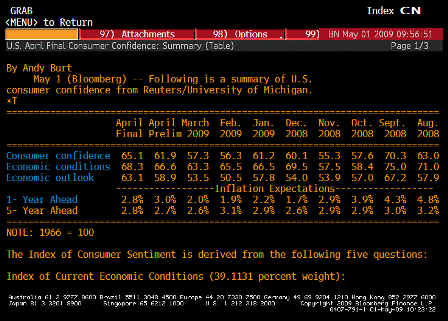
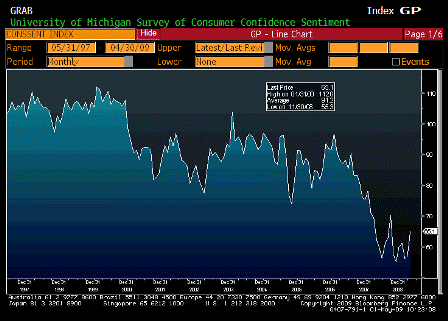
U of Michigan Confidence (Apr F)

Survey 61.9
Actual 65.1
Prior 61.9
Revised n/a

 
Karim writes:

  • Final April rises to 65.1 from prelim 61.9
  • Inflation expectations edge down from 3.0% to 2.8% for 1yr fwd; edge up from 2.7% to 2.8% for 5yr fwd

[top][end]

U of Michigan Confidence TABLE Inflation Expectations (Apr F)

[top][end]

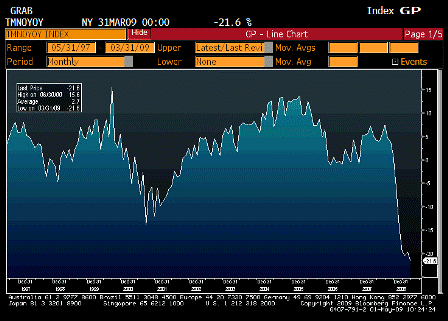
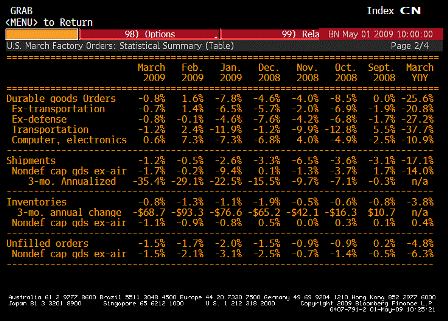
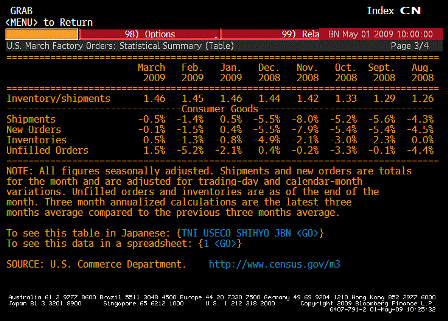
Factory Orders YoY (Mar)

Survey n/a
Actual -21.6%
Prior -19.7%
Revised n/a

[top][end]

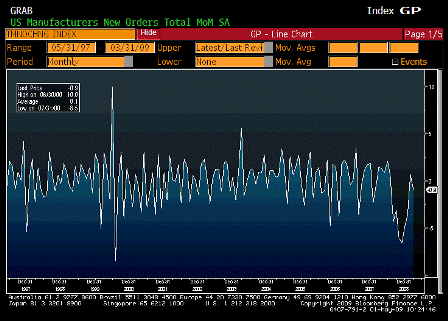
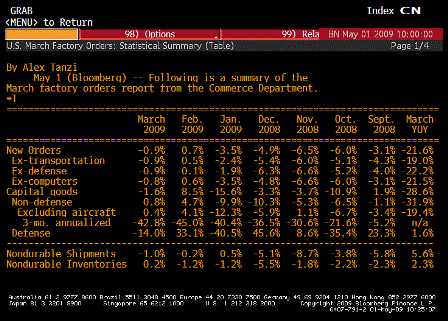
Factory Orders MoM (Mar)

Survey -0.6%
Actual -0.9%
Prior 1.8%
Revised 0.7%

[top][end]

Factory Orders TABLE 1 (Mar)

[top][end]

Factory Orders TABLE 2 (Mar)

[top][end]

Factory Orders TABLE 3 (Mar)

[top][end]

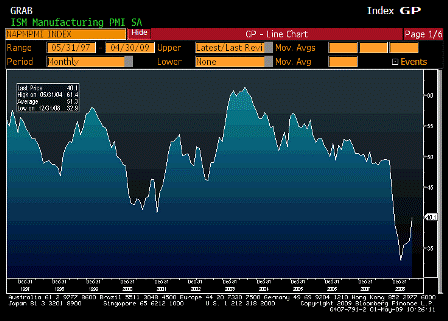
ISM Manufacturing (Apr)

Survey 38.4
Actual 40.1
Prior 36.3
Revised n/a

 
Karim writes:

  • In line with signal provided by Chicago PMI yesterday. Improvement to a still contractionary level; orders boosted by some new found availability of cash/credit, though not all the way back (see anecdote below).
  • All sub-components up;16 or 17 industries still contracting.

Commodities Up in Price

Copper is the only commodity reported up in price.

Commodities Down in Price

Aluminum; Aluminum Based Products; Caustic Soda; Corrugated Containers; Fuel Surcharges; Natural Gas; Scrap Metal; Steel; and Steel Products.

Commodities in Short Supply

No commodities are reported in short supply.

  • “International customers are having trouble getting cash for new orders, even though they need/want the equipment.” (Computer & Electronic Products)
  • “Starting to see some signs of increased production and demand from some automotive customers.” (Fabricated Metal Products)
  • “Business conditions continue to be soft, but agriculture-related products are still quite bullish.” (Machinery)
  • “We are optimistic that things will change for the better in 3Q.” (Chemical Products)
  • “Starting to hear of slight upticks in orders from some sectors of our business but not all.” (Electrical Equipment, Appliances & Components)

[top][end]

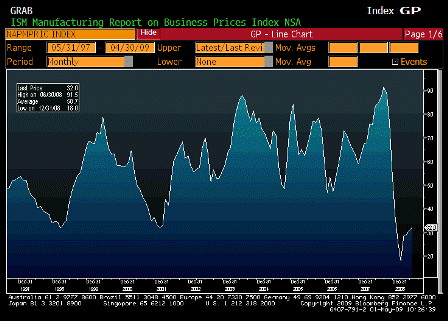
ISM Prices Paid (Apr)

Survey 34.0
Actual 32.0
Prior 31.0
Revised n/a


[top]

Re: financial market outlook


[Skip to the end]

>   
>   On Thu, Apr 30, 2009 at 7:01 AM, Joshua wrote:
>   
>   The 82-83 Reagan rally was good for roughly 70% to the upside from trough to
>   peak. I clearly have been too pessimistic.
>   
>   At this point, are you looking for substantial upside in equities from here in light of
>   7% deficit/GDP? My concern has been that the decimation in non-bank lending
>   (roughly 75% of prior total lending) would be more than enough to offset the
>   positive effects of deficit.
>   

That caused the economy to weaken/inventory liquidation to intensify until the deficit got high enough to reverse that effect. And now proactive deficit spending is kicking in.

>   
>   Are Bernanke’s programs really reinvigorating securitization markets? Clearly
>   something is working for them.
>   

It’s mainly the increased deficit spending that’s turning the tide. Yes, the Fed did a few things that helped some, but overlooked what they could have done (and should still do) to ‘normalize banking’.

Also, we can get a V shaped financial market recovery as it was pricing oblivion, while the real economy looks more L shaped.

And we are also always subject to external shocks like swine flu, wars, supply shocks, etc.


[top]

China allowing state enterprise to invest in Taiwan


[Skip to the end]

Cheaper to buy Taiwan than to invade?

China Makes First Taiwan Investment as Relations Thaw

by Tim Culpan and Janet Ong

Apr 30 (Bloomberg) — China Mobile Ltd. agreed to buy 12 percent of Far EasTone Telecommunications Co., the first investment by a Chinese state-owned company in Taiwan since a civil war ended six decades ago.

Taiwan’s benchmark Taiex index surged 5.7 percent, the biggest gain since Oct. 30, today on speculation more Chinese companies will invest on the island. The NT$17.8 billion ($529 million) purchase, announced by China Mobile yesterday, underscores how warming political relations between the two sides are leading to closer economic ties.

“This is a landmark deal. China Mobile will lead the way for other Chinese companies that have been waiting to invest in Taiwan but were hesitating,” said C.Y. Huang, vice chairman of Polaris Securities in Taipei. “This will open the floodgates for more Chinese investments into Taiwan.”

The Chinese government said this week it would end a ban on investments in the island on May 1 following an agreement to open cross-border operations for financial-services companies, expand direct flights and cooperate in fighting crime.

China Mobile agreed to pay NT$40 a share, or 14 percent higher than Far EasTone’s closing price yesterday, for the stake in Taiwan’s third-largest phone company. China Mobile will get a seat on the Taipei-based company’s board and become its second- largest shareholder, Far EasTone spokeswoman Alison Kao said. The deal is subject to approval from regulators and shareholders.


[top]

Japan industrial output up more than expected


[Skip to the end]

The Great Mike Masters Global Inventory Liquidation pretty much ran its course by year end, and now depleted inventories are beginning to be replaced as high and rising government deficits support incomes and savings:

Japan’s Factory Output Rises as Twice Predicted Pace

by Jason Clenfield

Apr 30 (Bloomberg) — Japan’s industrial output rose for the first time in six months, twice the pace predicted by economists, adding to evidence the worst of the recession may be over.

Factory production climbed 1.6 percent from February, when it dropped 9.4 percent, the Trade Ministry said today in Tokyo. The median estimate of 33 economists surveyed by Bloomberg News was for a 0.8 percent gain.

Companies plan to increase production in April and May to replenish inventories that fell 3.3 percent last month, the report showed. Stocks rose after yesterday’s U.S. gross domestic product figures showed consumer spending jumped the most in two years in the first quarter.


[top]

2009-04-30 USER


[Skip to the end]

 
Karim writes:

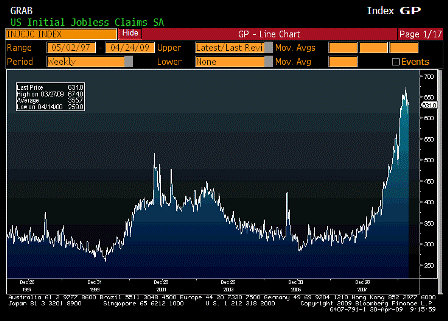
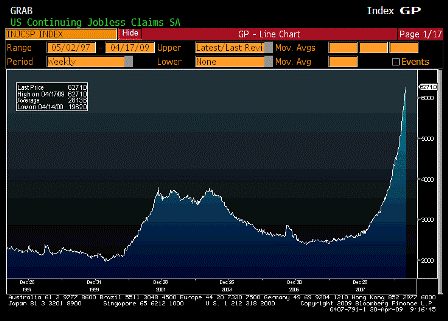
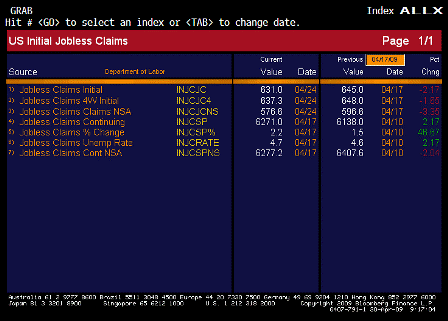
  • Initial claims -13k to 631k; continuing claims up another 133k (up every week this year) to 6271k
  • Suggests another 650-700k drop in payrolls and rise in ue rate from 8.5% to 9% for April employment report
  • Those numbers will in turn cause the data we received today on incomes and wages for March, to worsen from already historically weak levels.
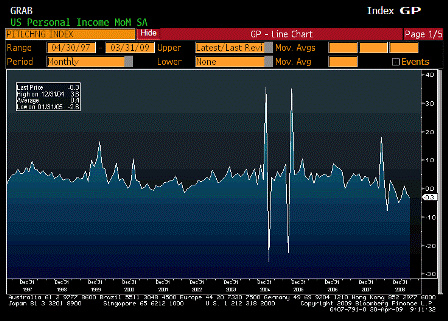
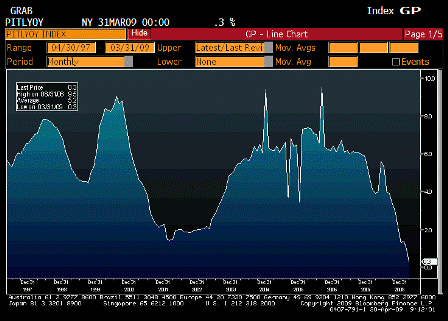
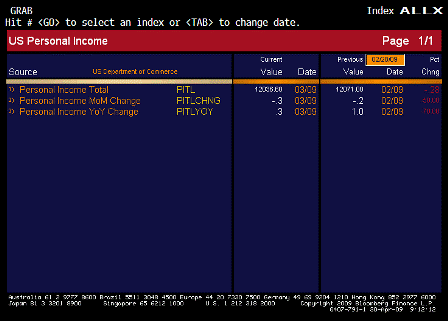
  • Personal income -0.3% m/m and +0.3% y/y
  • Wage and salary component of income -0.5% m/m and -1.2% y/y (prior all-time low was -0.3% y/y)
  • Personal spending -0.2%. Q1 profile for real personal spending= +0.9% in Jan, +0.1% in Feb, and -0.2% in Mar. This will create a challenge for the PCE component of GDP for Q2.
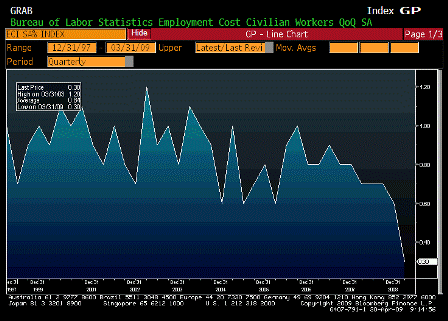
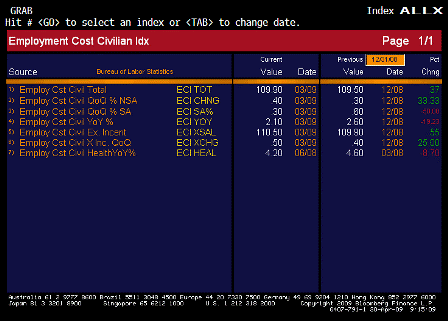
  • ECI up 0.3% q/q and 2.1% y/y in Q1, both all-time lows
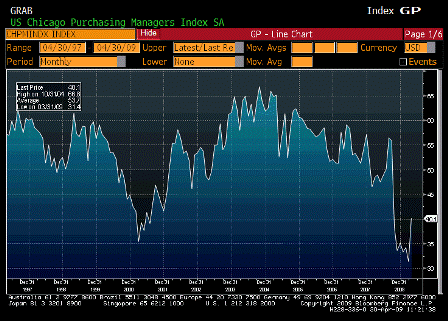
  • Chicago PMI for April up from 31.4 to 40.1
  • Looks like national ISM should bounce to about 39-40 tomorrow after 36.3
  • Fed comments yesterday seem to echo what I heard from ECB/BOE: Recent bounce in PMIs seem unrelated to prospects for recovery in late 2009/early 2010.


Personal Income MoM (Mar)

Survey -0.2%
Actual -0.3%
Prior -0.2%
Revised n/a

[top][end]

Personal Income YoY (Mar)

Survey n/a
Actual 0.3%
Prior 1.0%
Revised n/a

[top][end]

Personal Income ALLX (Mar)

[top][end]

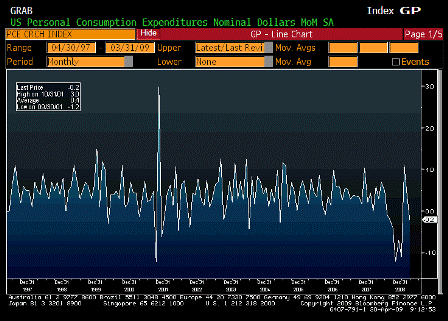
Personal Spending (Mar)

Survey -0.1%
Actual -0.2%
Prior 0.2%
Revised 0.4%

[top][end]

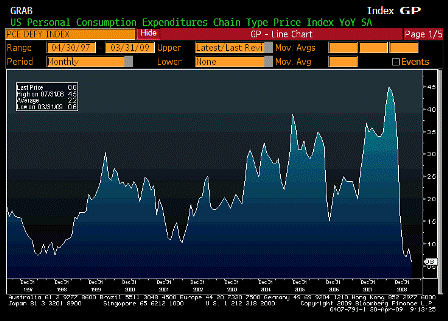
PCE Deflator YoY (Mar)

Survey 0.7%
Actual 0.6%
Prior 1.0%
Revised 0.9%

[top][end]

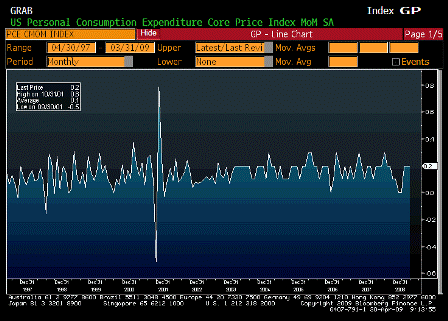
PCE Core MoM (Mar)

Survey 0.1%
Actual 0.2%
Prior 0.2%
Revised n/a

[top][end]

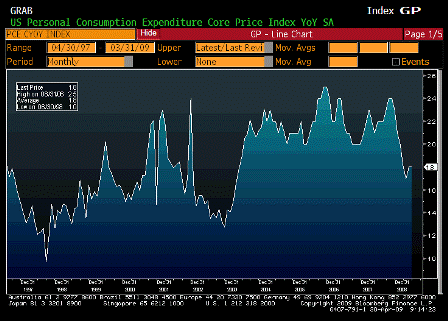
PCE Core YoY (Mar)

Survey 1.8%
Actual 1.8%
Prior 1.8%
Revised n/a

[top][end]


Employment Cost Index (1Q)

Survey 0.5%
Actual 0.3%
Prior 0.5%
Revised 0.6%

[top][end]

Employment Cost Index ALLX (1Q)

[top][end]


Initial Jobless Claims (Apr 25)

Survey 640K
Actual 631K
Prior 640K
Revised 645K

[top][end]

Continuing Claims (Apr 18)

Survey 6200K
Actual 6271K
Prior 6137K
Revised 6138K

[top][end]

Jobless Claims ALLX (Apr 25)

[top][end]


Chicago Purchasing Manager (Apr)

Survey 35.0
Actual 40.1
Prior 31.4
Revised n/a

[top][end]

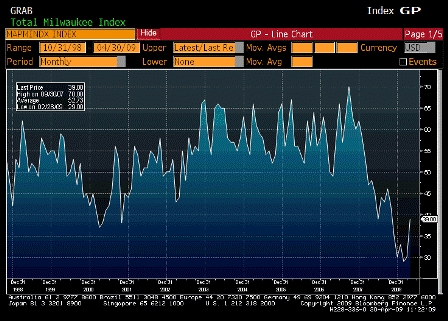
NAPM Milwaukee (Apr)

Survey n/a
Actual 39.0
Prior 30.0
Revised n/a


[top]

Note on quantitative easing


[Skip to the end]

Note written by an ‘in paradigm’ associate:

Growth in the size of the Fed’s balance sheet indicates that it is acting as a financial intermediary, but it doesn’t say anything useful about real economic activity or prospects for inflation. Even when the Fed buys Treasury debt from the private sector in return for cash, it is only substituting one financial claim on government for another of identical nominal value. This transaction doesn’t change the net financial assets of the private sector – so there is no obvious economic impact. Similarly, the Fed can encourage or even require banks to hold more and more excess reserves, but to what end ? Bank lending is not constrained by a lack of reserves, it is limited by capital ratios and the opportunity set for profitable lending. In this context, reserve growth increases gross balance sheets, but has no economic consequences.

What might be said about quantitative easing (QE), is that the Fed has to bid up bond prices (forcing yields down)in order to acquire Treasuries in the secondary market. At the margin, this has the potential to induce changes in portfolio preferences and push investors into more risky assets. So, QE might have some second order effects on financial assets prices, but still no logical or direct connection to generalized price inflation.

Some potential causes of inflation going forward might include sustained fiscal stimulus of sufficient proportion to more than offset the spontaneous decline in private sector demand that we are witnessing. If this were to use up existing capacity, then the probability for inflation goes up. Furthermore, even before we reach full capacity domestically, some of the growth in aggregate demand will leak overseas. Many of our imports have low elasticities and their prices could rise quickly. The most obvious example is crude oil. This would result in upward pressure on reported inflation even with broader economic growth below trend. In other words, a partial recovery of aggregate demand without energy policy reform could be inflationary.

I would hasten to add that none of this is original thinking and most of it is common sense. I found it odd that so many of the brilliant and successful people that you assembled last week relied on vague notions of “monetarism” or “Keynesianism” to frame their views and reverted to jargon rather than analysis to argue their points.


[top]