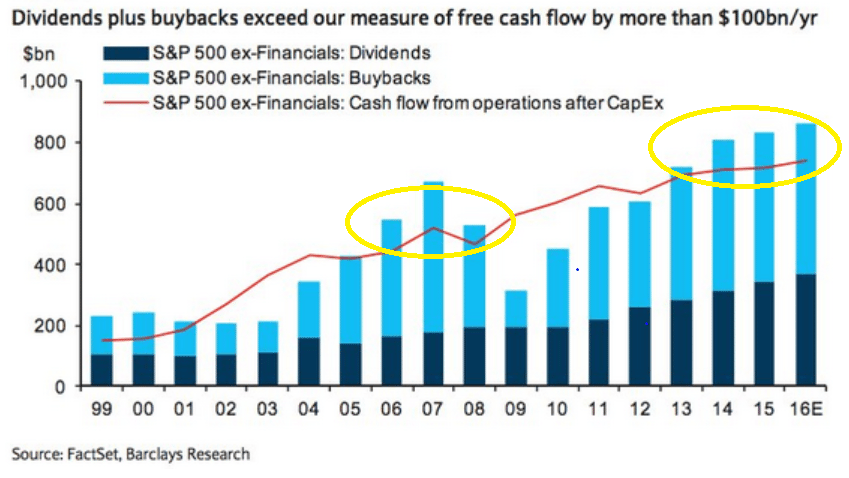
US balance of trade, New home sales, PMI health care premiums, ECB statement, German consumer morale

A bit fewer than expected and prior month revised down bringing it more in line with permits:
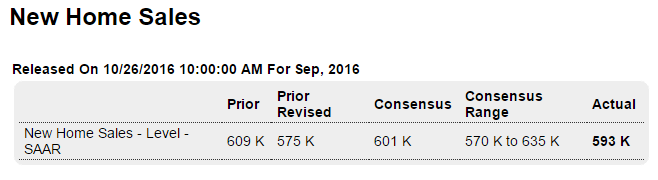
102607
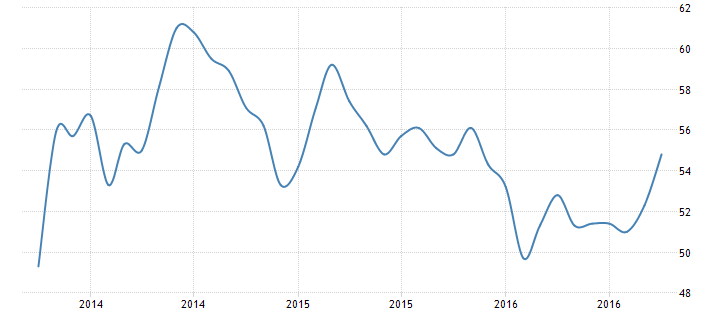
A nice uptick here, but as per the chart too soon to say the downtrend has reversed. And notice, again, how employment is faltering as has been the case in most of the surveys:
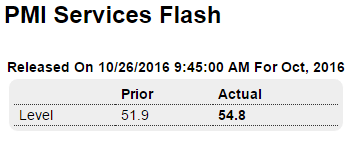
102608

Highlights

Markit Economics’ U.S. samples are reporting a sharp upturn in business this month, first with Monday’s manufacturing report and now with the service flash where the headline index is up nearly 3 points to 54.8 for the strongest rate of composite growth this year. New orders are at an 11-month high as is business activity, and year-ahead expectations are at their best level since August last year. The rise in demand is being reflected in inflation readings with input costs moving up from a nearly 2-year low and with selling prices also moving higher. Not showing much life, at least yet, is employment where job creation did improve but still remains near a 3-1/2 year low. The report attributes this month’s strength to rising hopes for improvement in the domestic economy. The sharp gains for Markit’s samples are a surprise but are still only anecdotal indications. Definitive data on October will be posted next week with the month’s unit auto sales and of course the monthly employment report.
102609
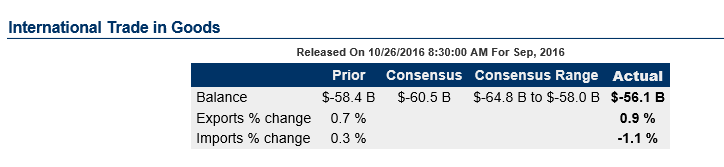
August revised higher which lowers GDP estimates, Sept higher than expected which increases estimates. I suspect Sept (like August) will be revised lower next month when October is released. And note the highlighted details that don’t bode well for domestic demand:
102610

Highlights

In a positive for Friday’s third-quarter GDP report, the nation’s trade gap in goods narrowed sharply in September, to $56.1 billion vs a revised $59.2 billion in August. Exports in September rose a solid 0.9 percent led by the largest component, capital goods, which rose 3.8 percent in what is a positive indication for global business investment. Exports of consumer goods also rose, up 4.4 percent, with industrial supplies up 2.3 percent. Also helping the deficit is a 1.1 percent decline in imports where most components fell with the exceptions of autos, up 4.3 percent, and other goods, up 0.8 percent. In a negative indication of retail expectations for the holidays, imports of consumer goods fell 1.8 percent following a 0.6 percent decline in August. And in a negative indication for domestic business investment, imports of capital goods fell 3.6 percent. Also released this morning are advance data on September inventories in the wholesale and retail sectors, up 0.2 percent for the former and up 0.3 percent for the latter.

This will be counted as increased consumption, but will take away from other consumption:

U.S. government says benchmark 2017 Healthcare.gov premiums up 25 percent

By Caroline Humer

Oct 24 (Reuters) — The average premium for benchmark 2017 Obamacare insurance plans sold on Healthcare.gov rose 25 percent compared with 2016. The average monthly premium for the benchmark plan is rising to $302 from $242 in 2016, the Department of Health and Human Services said. The government provides income-based subsidies to about 85 percent of people enrolled, and those credits will increase with the higher premiums. It said 72 percent of consumers on HealthCare.gov will find plans with a premium of less than $75 per month.

If anything, it’s the weak euro that’s added some support to GDP, but not to consumption:

Draghi hits back at critics of QE and negative rates

By Claire Jones

Oct 25 (FT) — “We have every reason to believe that, with the impetus provided by our recent measures, monetary policy is working as expected: by boosting consumption and investment and creating jobs, which is always socially progressive,” ECB president Mario Draghi said. “I find it hard to reach the conclusion that, over a longer timeframe, the outcome of our policies has been — or will be — to redistribute wealth and income in an unfair or unequal way,” the ECB president said. “That is certainly not true across countries, and there is not much to suggest it is true within countries either.”
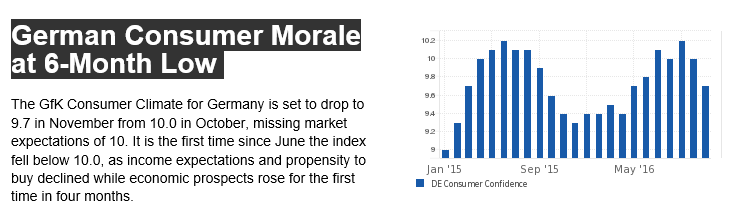
102611

Germany Inc. Sits on $500 Billion in Cash Amid Weak Outlook

By Nina Adam

Oct 25 (WSJ) — Germany’s nonfinancial businesses have saved more than they have invested for the past seven years, piling up about €455 billion ($500.4 billion) in cash and deposits, German central bank data show. Of 11 companies in the DAX-30 stock index that disclosed their investment plans, five said they plan no increase in capital expenditure this year or next. Five others said they plan increases, but mostly outside Germany. Volkswagen said it was canceling or delaying all investment projects that it doesn’t consider “core.”
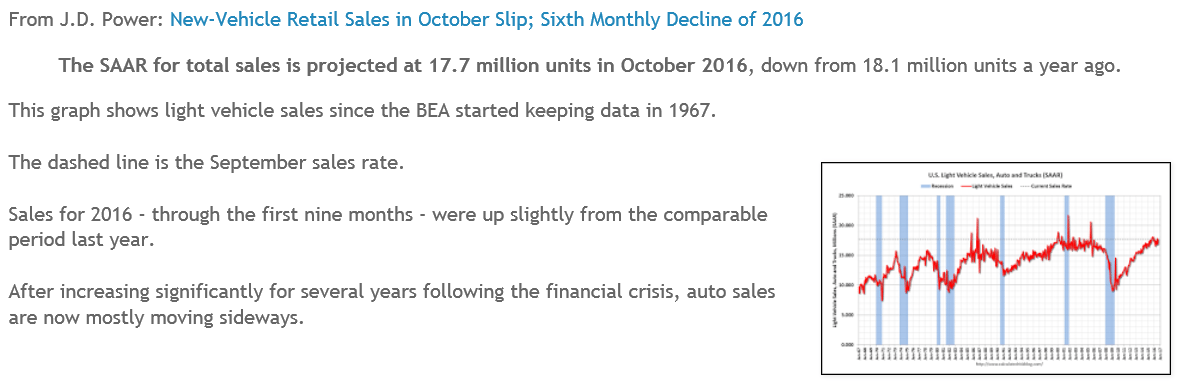
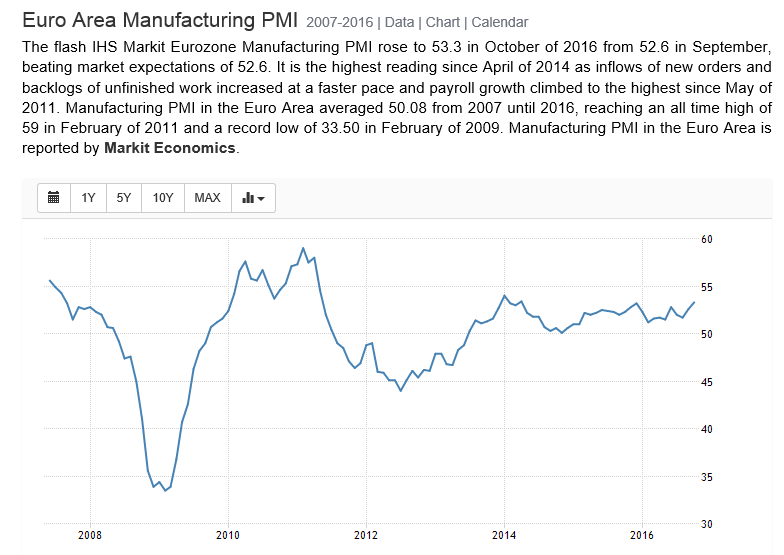
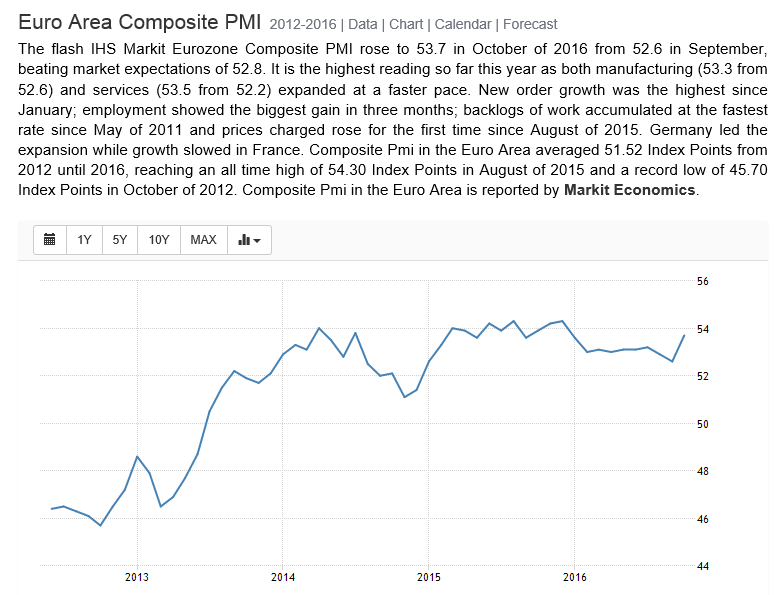
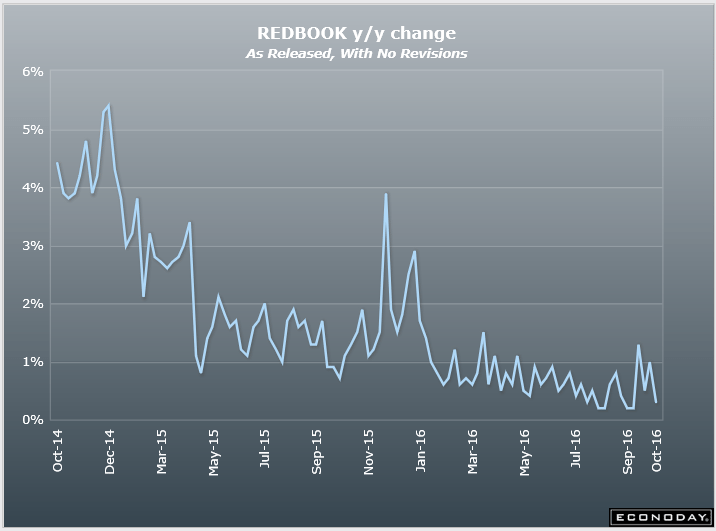
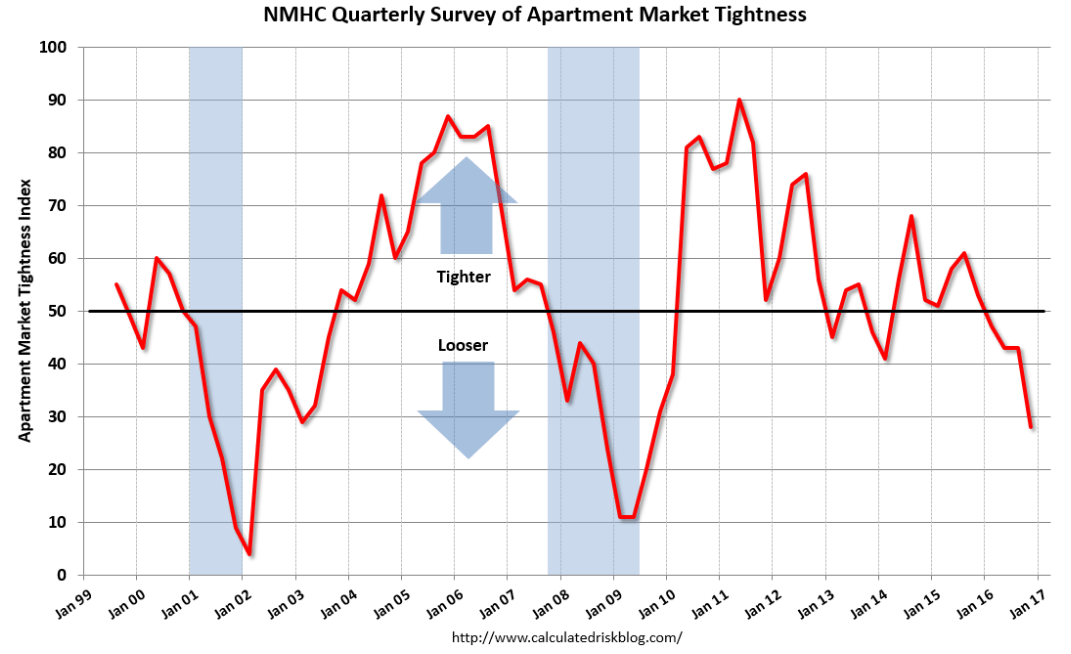
Auto sales forecast, Euro area manufacturing and composite PMI, Redbook retail sales, Consumer confidence, Richmond Fed

Still negative:

102601
Should hold up as long as the euro stays relatively weak due to portfolio selling, which has been all but continuous for the last couple of years or so. At some point ‘fundamentals’ including relative prices and the current account surplus ‘drain the swamp’ and take over:

102602

102603
Back down again:

102604
Back down:

102605
Still negative:

102606

Presidential poll, Euro area current account, Saudi output, Russian nukes

Clinton Vs. Trump: IBD/TIPP Presidential Election Tracking Poll (IBD/TIPP) The IBD/TIPP poll — a collaboration between Investor’s Business Daily (IBD) and TechnoMetrica Market Intelligence (TIPP) — has been the most accurate poll in recent presidential elections (About IBD/TIPP Poll). The latest results for the IBD/TIPP Presidential Election Tracking Poll will be released each morning by 6 a.m. ET.

Trump Leads Clinton By 1 Point Going Into Debate (IBD/TIPP) Donald Trump has managed to pull ahead of Hillary Clinton by a 1.3 percentage point margin — 41.3% to 40% — in a four-way matchup. Libertarian Gary Johnson got 7.6% and Green Party Jill Stein got 5.5%. In a two-way matchup, Clinton is up by 3 points — 43.6% to 40.6%. 67% of Trump backers saying they strongly support him, compared with 58% of Clinton supporters who say they strongly back their candidate. Clinton does much better among women — 47% to 37% — but Trump’s lead among men is just as strong at 47% to 32%.

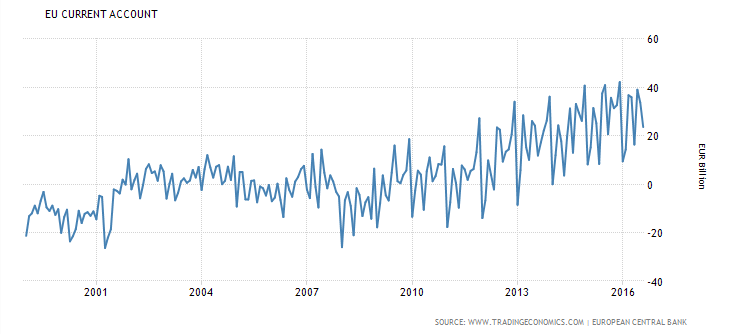
Euro Area Current Account

Eurozone’s current account surplus increased to €23.6 billion in August 2016 from a €20.7 billion a year earlier. If adjusted for seasonal factors, the current account surplus rose to €29.7 billion compared to €27.7 billion in August 2015, as the goods surplus widened to €30.9 billion (from €26.2 billion a year earlier) and the primary income surplus rose to €6.6 billion (from 3.4 billion). Meanwhile, the services surplus narrowed to €4.8 billion (from €5.3 billion) and the secondary income deficit increased to €12.6 billion (from €10.6 billion).

102010

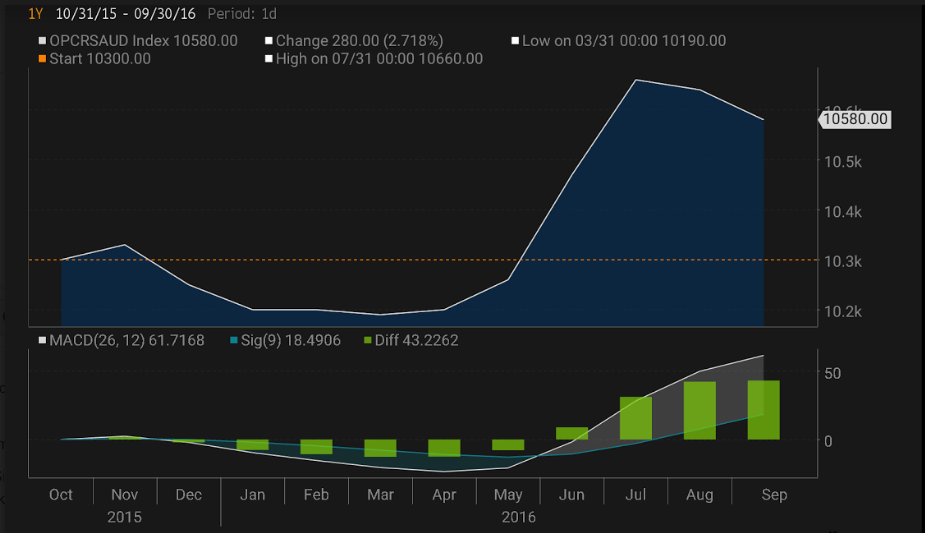
Saudi output went down some, indicating a lack of residual net global demand, as they set prices (via discounts or premiums to benchmarks) and let the market buy all it wants at those prices:

102011

As if our government has any ideas on what we can do anything about this:

U.S. says Russia broke nuclear missile treaty – The U.S. has summoned Russia to a mandatory meeting before a special treaty commission to answer accusations that Moscow has violated a Cold War-era pact that bans the production, maintenance or testing of medium-range missiles, according to U.S. and Western officials. {http://on.mktw.net/2emOBY8}

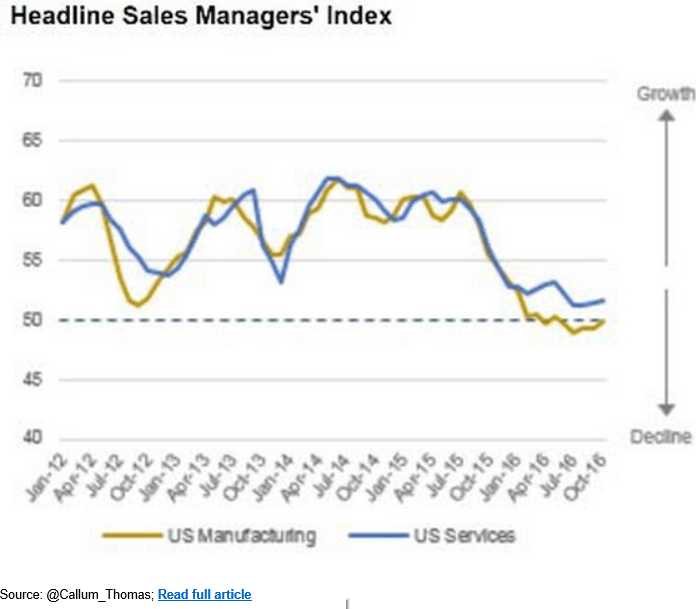
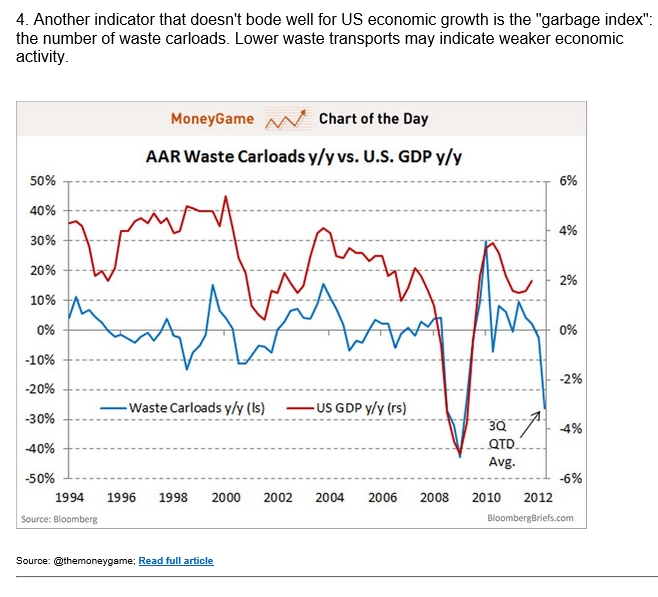
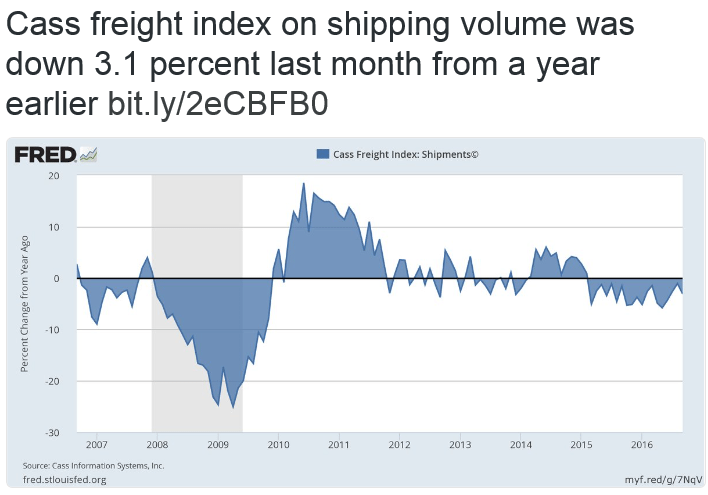
Housing starts, Mortgate purchase apps, Sales managers index, Garbage carloads, Cass freight index

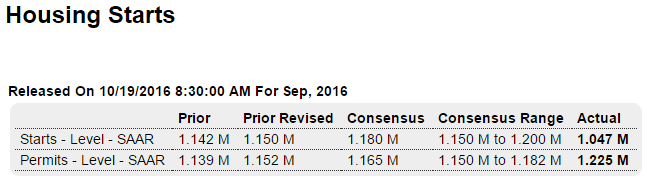
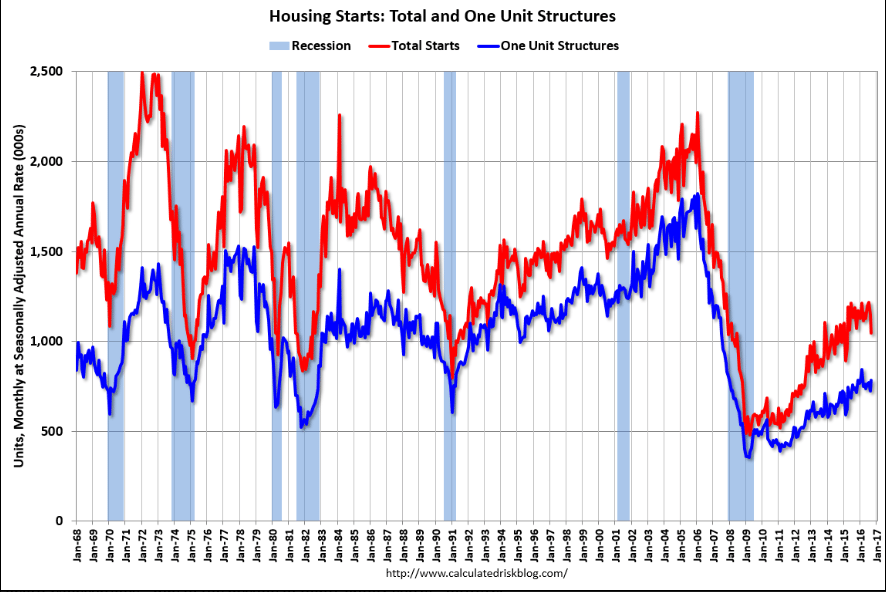
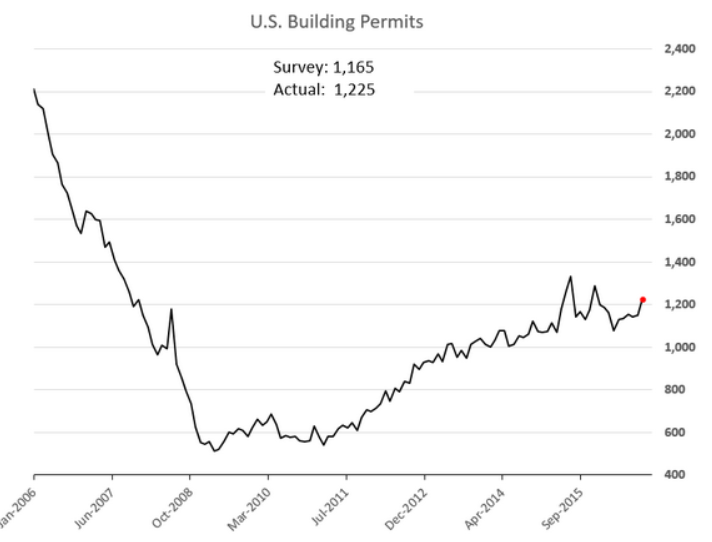
Starts very weak, but permits up. It’s about permits, so we’ll see if they level off or continue to rise:

102001

Highlights

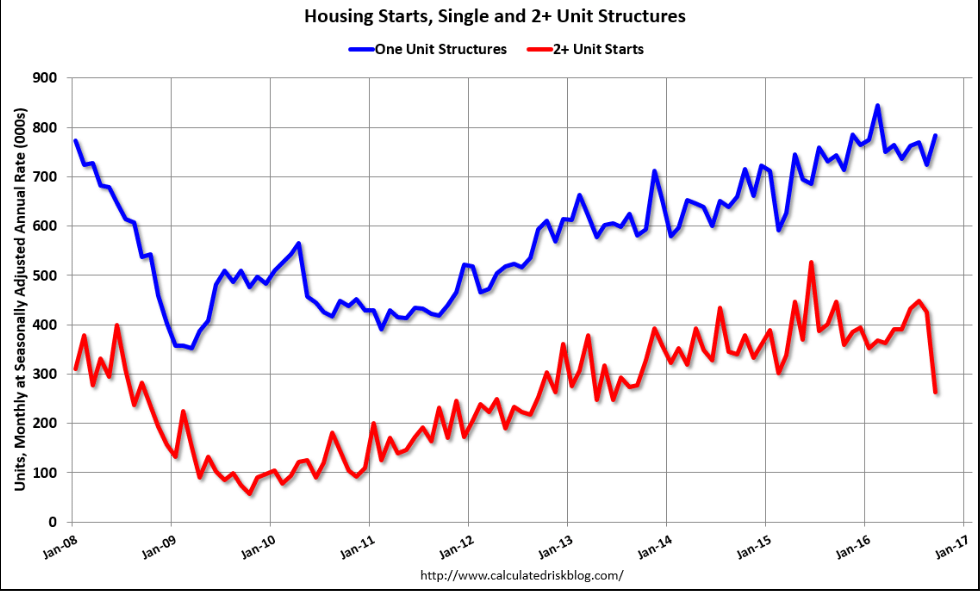
Starts are mixed but permits are up in what is a deceptively solid housing starts & permits report. Starts plunged what looks like a shocking 9.0 percent in September, to a 1.047 million annualized rate. But the drop is tied entirely to the volatile multi-family component where starts fell a massive 38 percent in the month to a 264,000 rate. The more important single-family component is up sharply in its own right, 8.1 percent higher to a 783,000 rate.

Permits for both components are up with single-family 0.4 percent higher to a 739,000 rate and with multi-family, in contrast to the big decline in starts, up 17 percent to 486,000. Together, permits are up 6.3 percent to a 1.225 million rate that far exceeds Econoday’s top estimate of 1.182.

By region, year-on-year starts are down the most in the Northeast (minus 32 percent) and the South (minus 16 percent) while permits are up the most in the Northeast (plus 13.9 percent) and West which is a focused region for the nation’s builders (plus 13.3 percent). The negative headline aside, there are more positives in this report than negatives, positives that include gains for single-family starts and permits in what are pluses for new home sales.

102002
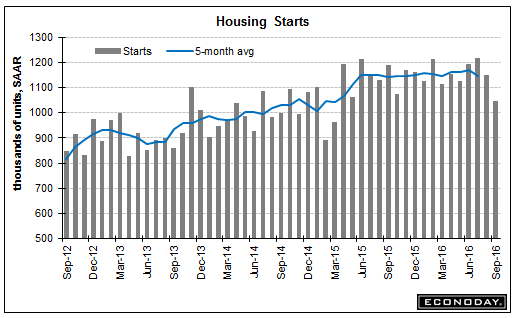
Neither of these looks like anything better than flat to me in what remains a depressed housing market:

102003

102004
Permits have been volatile, sometimes spiking higher temporarily due to tax considerations, and with year end coming up that could be the case again:

102005
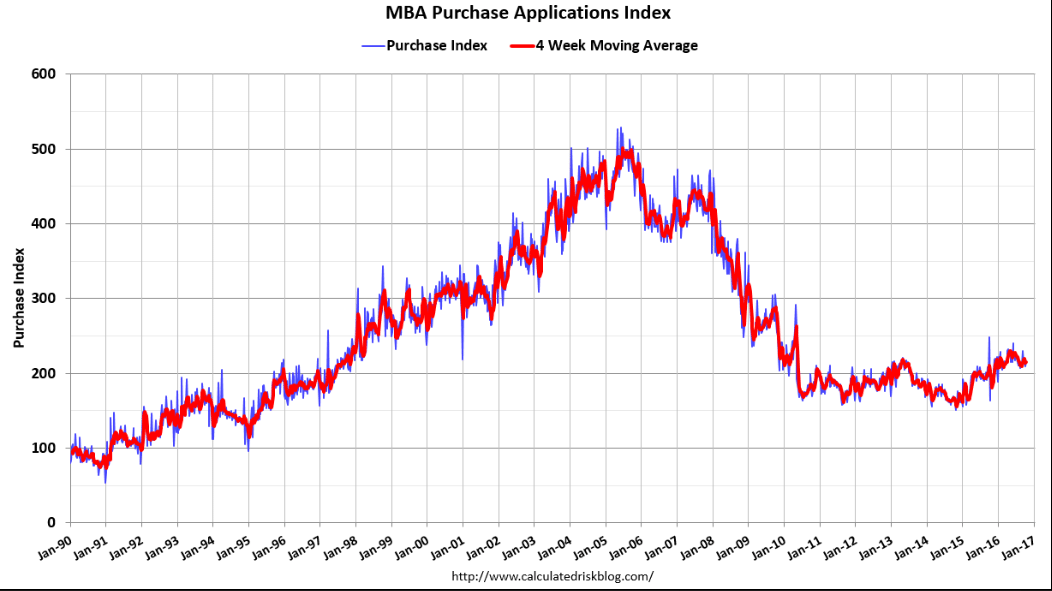
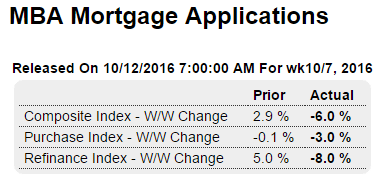
Nor do mortgage purchase applications show any sign of meaningful growth:

102006

102007

102008

102009

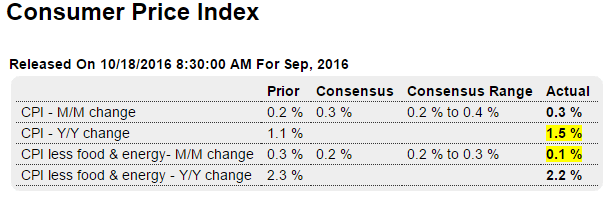
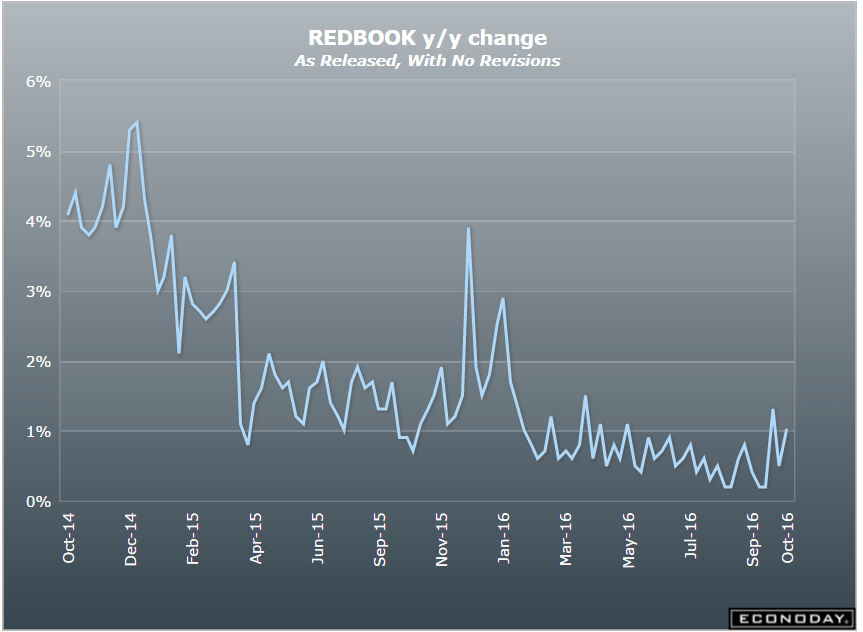
CPI, Redbook retail sales, Consumer spending comments, Voter turnout comments

Fed continues to fail to achieve it’s 2% target:

101901

101902
No sign here of housing growth picking up from where it’s been:

101903

Highlights

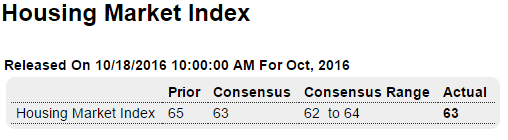
The new home sector picked up steam in the third quarter and looks to end the second half with strength. The housing market index held on to the bulk of its 6-point surge in September, coming in at 63 for October in only a 2 point slip. Home builders are very optimistic about future sales, the leading component of the report which is at 72 and up 1 point in the month. Current sales are down 2 points but are very strong at 69. Traffic continues to lag, down 1 point to 46 but with the trend still showing slight improvement.

Regional data show the West out in front, at a 3-month composite average of 75 followed by the South at 65. These two regions are top priorities for the nation’s home builders. The Midwest is also positive at 56 while the Northeast, which is already densely developed, remains well below the break-even line, at 43.

The lack of traffic is a concern, perhaps reflecting the lack of new homes coming on the market and also a lack of prospective first-time buyers many of whom are content to rent. But the new home market is a major highlight of the economy right now, where expansion is being limited by construction constraints but is still pointing to spillover into the still muted resale market.

101904

As Voters Tune Out, Worries Grow About Turnout

By Aaron Zitner

Oct 17 (WSJ) — Overall, 72% of registered voters rate themselves highly interested in the election, down 4 percentage points from this point in 2012 and 15 points from 2008. Some 65% of African-Americans rate themselves as highly interested in the election, down 18 points from the 2012 election and down 28 points from 2008, the Journal/NBC News survey found. Only 54% of voters under age 35 say they have high interest in the election, down 6 points from the 2012 election and nearly 30 points from 2008. Some 69% of Hispanic voters rate themselves as highly interested in the campaign, up 1 point from 2012 and nearly equal to the electorate overall.

NY state mfg survey, Tsy budget, Sea container counts

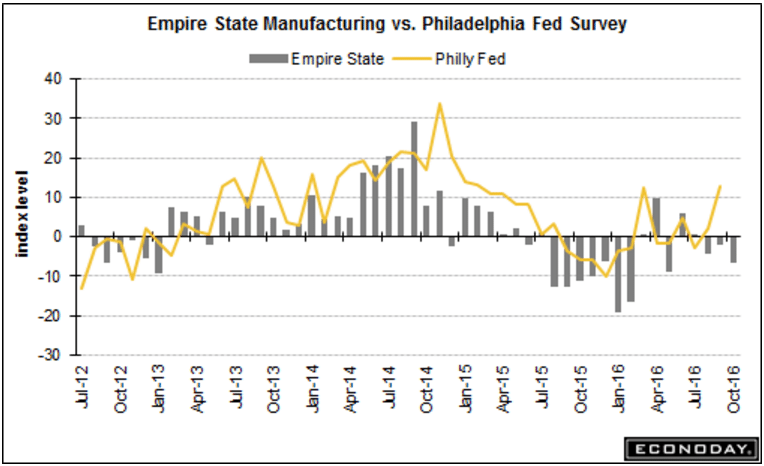
Well below expectations and further contraction:

101701

Highlights

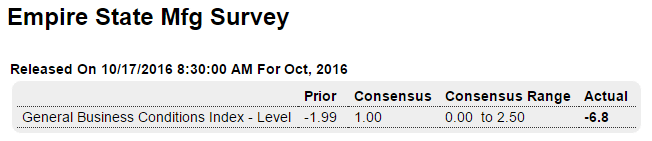
The first indication on October’s factory conditions is negative. The Empire State index is below zero for a third month in a row, at minus 6.80 vs similar readings in September and August. And the details are almost entirely negative with new orders at minus 5.60 for a second sub-zero score in a row. Shipments are at minus 0.60 with employment in reverse for a fourth straight month, at minus 4.70. Unfilled orders and inventories are almost always in contraction in the Empire State sample and they are again in the October report, in low double digits which is even weaker than usual.

But there are positive signs including life for prices. Input costs rose nearly 6 points to 22.60 which signals the greatest month-to-month pressure in more than 2 years, since September 2014. Pressure also appears in selling prices, which rose nearly 3 points to 4.70 for their best showing since July 2015. The 6-month outlook is also a positive, at a respectable 36.00 though down about 2 points from last month.

Positives aside, the trends in this report are pointing to continued sputtering for manufacturing, a sector that has been flat all year on weak demand for machinery and generally weak demand from overseas.

101702
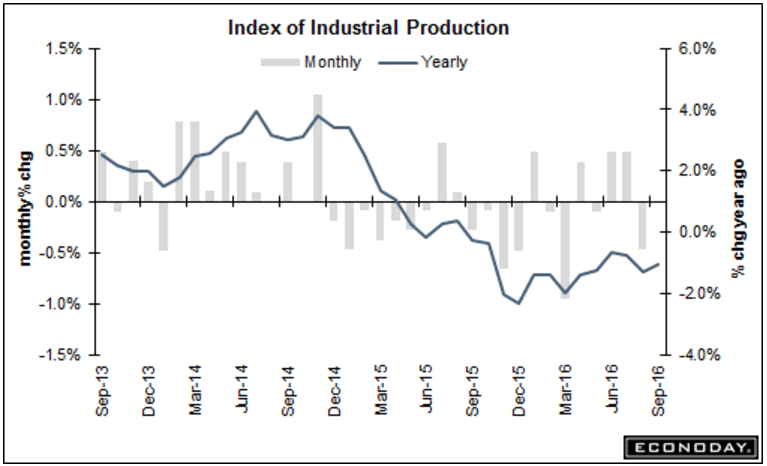
Nor is there any support for higher growth here:

101703

Highlights

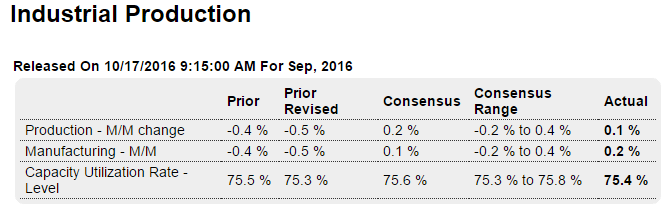
Flat is the best word to describe the factory sector right now. The latest evidence is the industrial production report which inched up only 0.1 percent in September with August revised 1 tenth lower to minus 0.5 percent. These two months follow, however, solid 0.5 percent gains in June and July which, when averaged all altogether however, extend what has been a flat two years for the industrial economy.

Manufacturing production did rise a nearly respectable 0.2 percent but follows a downwardly revised 0.5 percent decline in the prior month. Motor vehicle production, which was strong during the summer, was flat in September, up 0.1 percent. High-tech production bounced 0.6 percent higher to help drive the overall gain for manufacturing. A negative, however, is a second straight decline in business equipment, down 0.2 percent and 0.5 percent the last two reports.

Mining is a positive in the report, up 0.4 percent though following a 1.0 percent decline in August. Year-on-year, mining production is down 9.4 percent. Utility production is a negative in the September data, down 1.0 percent. Here, the year-on-year decline is only 0.4 percent. Capacity utilization came in at 75.4 percent vs a downwardly revised 75.3 percent in August.

Year-on-year, industrial production is down 1.0 percent with manufacturing dead even at zero percent. The 2014 collapse in oil prices and its hit on demand for energy equipment pulled the factory sector into low single digit contraction, which is where it continues to struggle.

101704
Not looking so good for personal income numbers?

101705

Highlights

The Treasury ended its 2016 fiscal year with a surplus of $33.4 billion in September, one that however only shaves what is a 34 percent surge in the full-year deficit to $587.4 billion. Receipts were flat on the year, up only 0.6 percent as corporate income taxes, in part reflecting slowing profits, fell 12.9 percent. Individual income taxes, which make up the vast bulk of receipts, rose only 0.3 percent. The spending side rose 4.5 percent in the year, led by an 8.8 percent rise in Medicare and a 7.8 percent gain in net interest payments which reflects low rates overseas.

September 2016 Import Sea Container Counts Contraction Troubling

By Steven Hansen

Oct 15 (Econintersect) — This month exports trend lines accelerated further into positive territory – something positive is happening in international markets. On the other hand, imports are trending deeper into contraction – normally this is a sign of recession in the USA.

Retail sales, Atlanta Fed, Consumer sentiment, Business inventories, Unemployment claims, Freight transportation services

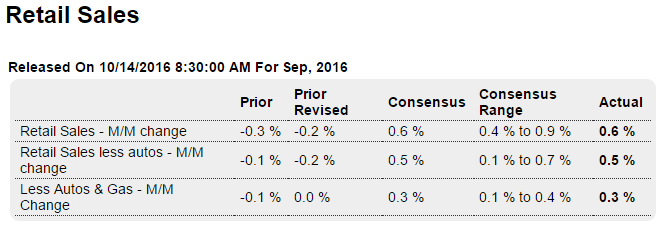
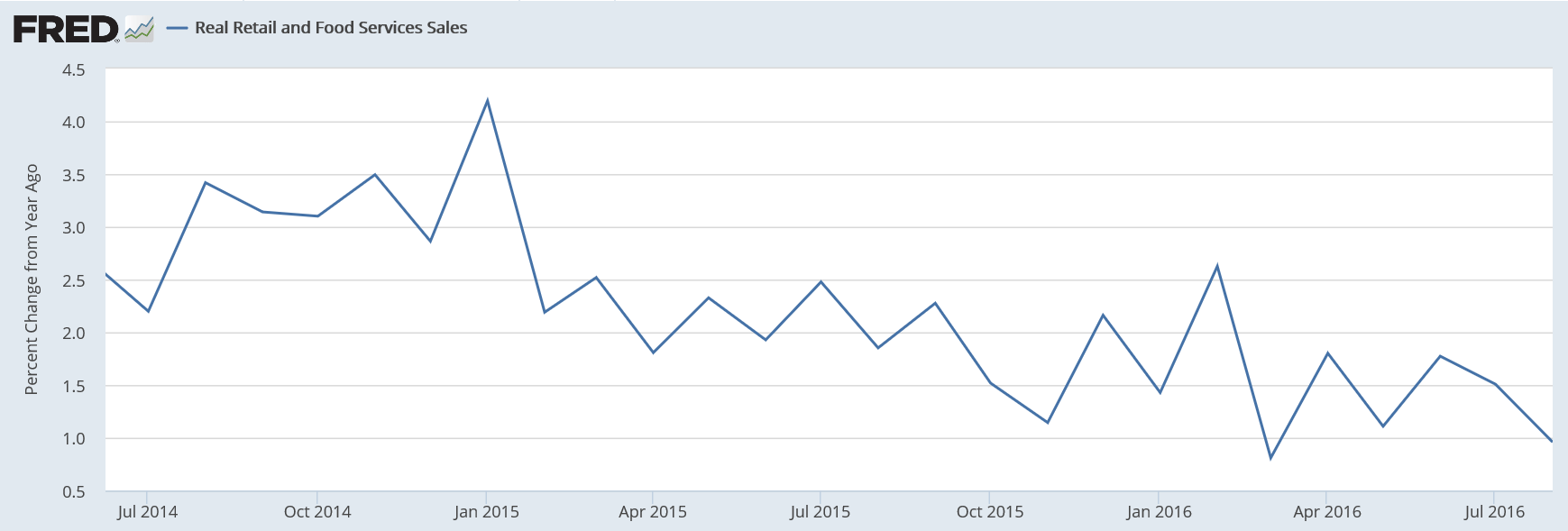
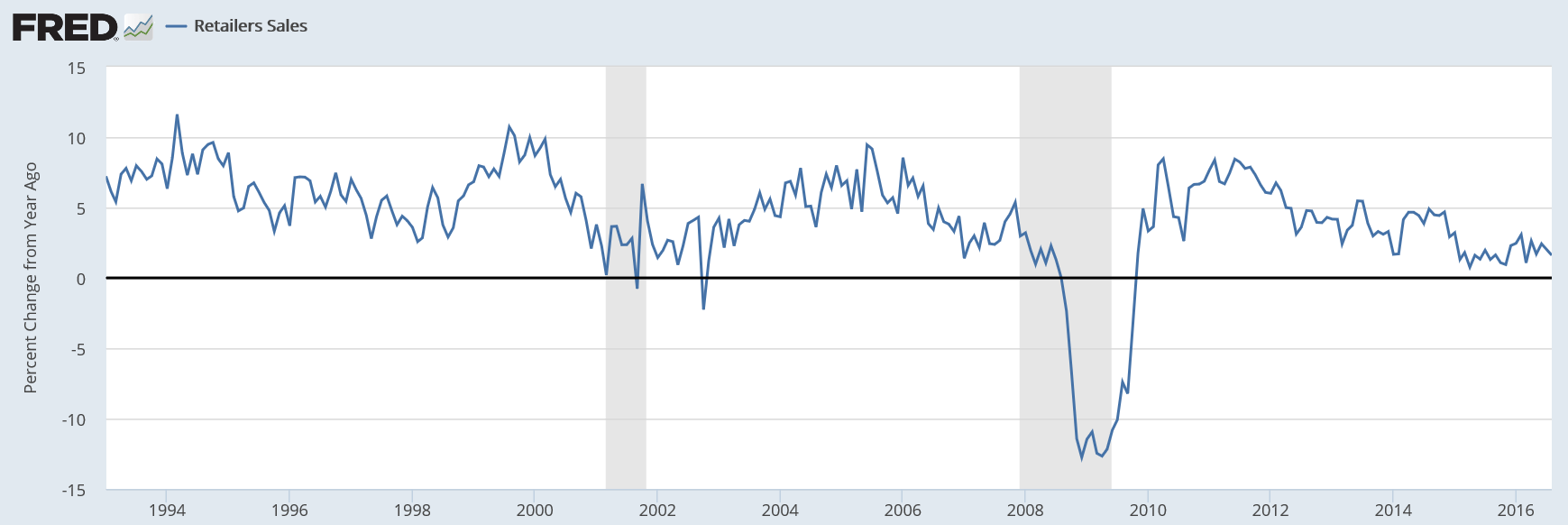
All numbers as expected. Notice the use of the word ‘solid’ for all the reports? And no one talking about year over year, which eliminates much of the seasonal factors and month to month volatility. Nor do they mention that these numbers are not adjusted for inflation, which pushes the year over year numbers down to stall speed. See charts below:

101401

Highlights

Retail sales proved solid in September hitting the Econoday consensus across the board: total up 0.6 percent, ex-auto up 0.5 percent, ex-auto ex-gas up 0.3 percent. Auto sales as expected are the highlight of the report, up 1.1 percent to reverse the prior month’s 0.3 percent decline. Auto sales, a discretionary category, have been solid this year though down from last year’s peak. Restaurants, another discretionary category, are also strong, up 0.8 percent to add to August’s 0.7 percent gain.

Other positives include two related to housing, furniture which rose 1.0 percent and building materials & garden equipment, up 1.4 percent. This latter reading will give a boost to the residential investment component of the third-quarter GDP report.

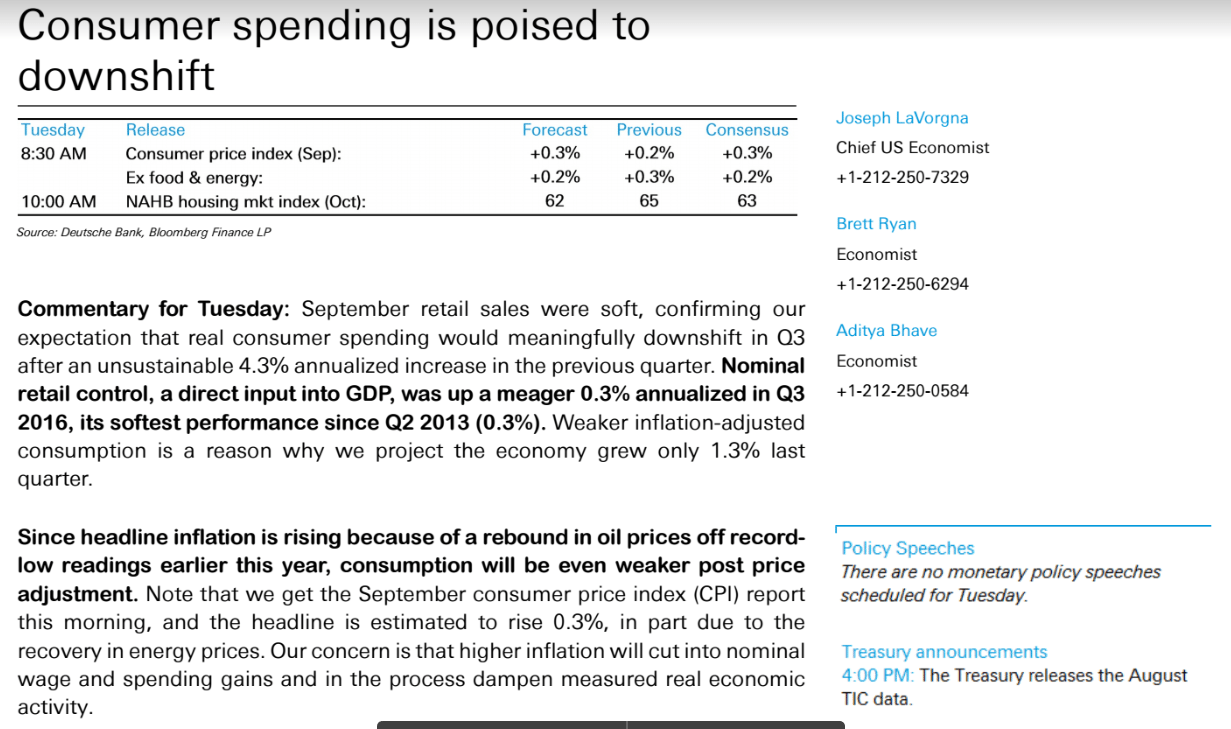
This whole report in fact will give a lift to GDP, providing a quarter-end pop to consumer spending which was soft in the quarter’s first two months. Strength in retail sales ultimately reflects strength in the labor market and today’s report will further build expectations for an FOMC rate hike at the December meeting.

101402
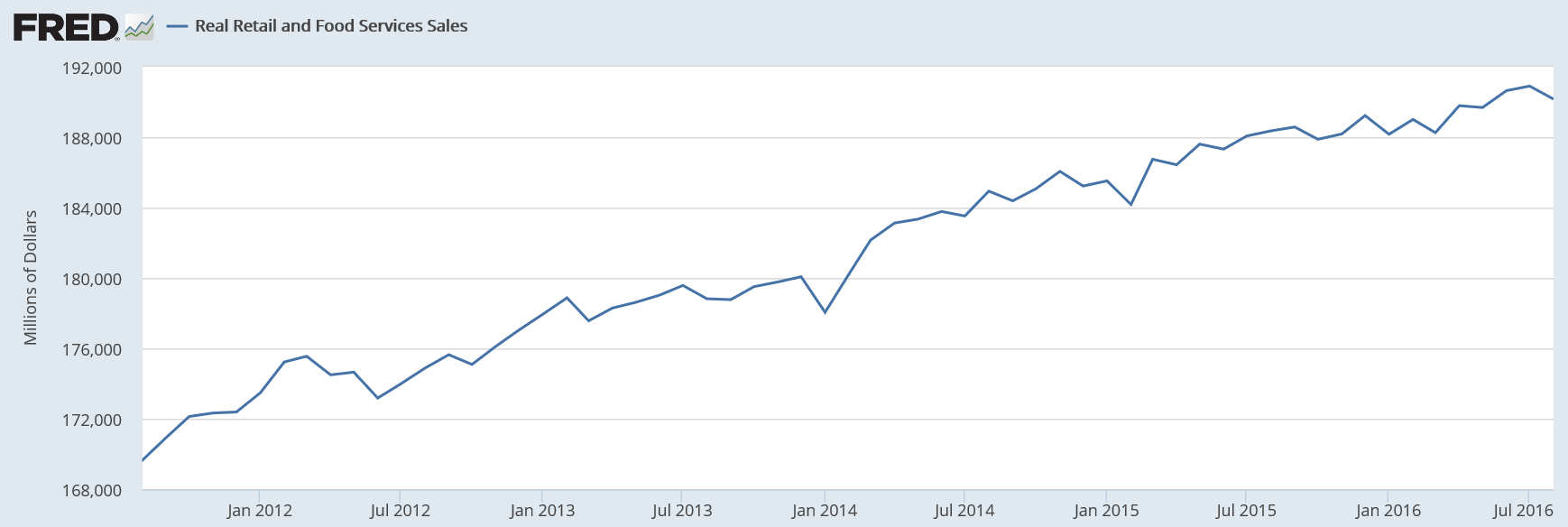
How ‘solid’ do these look?

Inflation adjusted:

101403
Not adjusted for inflation doesn’t look good either:

101404
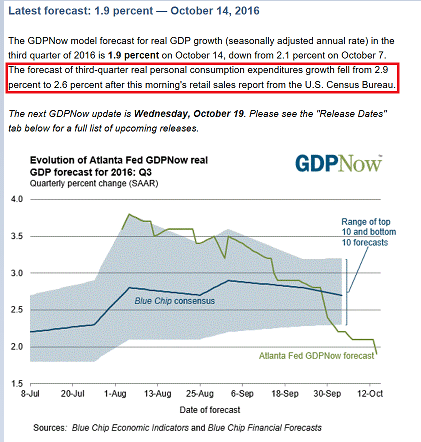
The Atlanta Fed lowered their q3 estimates further on today’s news:

101405
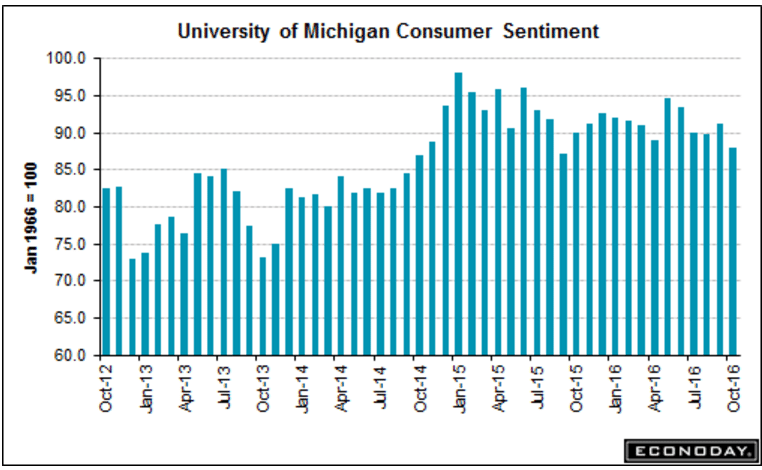
Looks like last month’s move higher that lifted hopes has more than reversed to instead follow the down trend of the last several months:

101406
Inventories remain elevated and are keeping a lid on output:

101407

Highlights

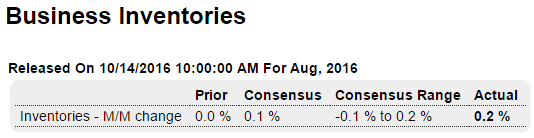
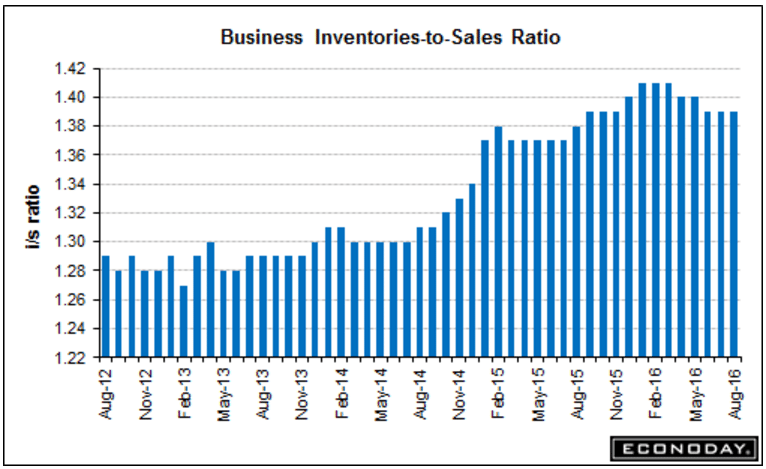
Inventories continue to edge incrementally higher, up 0.2 percent in August and in line with a 0.2 percent rise in sales to keep the inventory-to-sales ratio unchanged for a third month at a lean 1.39. Inventories at wholesalers fell 0.2 percent in August while inventories at manufacturers rose 0.2 percent. Inventories at retailers, boosted by swelling at auto dealers, rose a sharp 0.6 percent in a build, however, that looks manageable given this morning’s solid retail sales report for September, one that is headed by strength in vehicle sales.

An inventory correction to the 1.30 level isn’t out of the question:

101408
Wondering when they begin to suspect this is more about being made a lot harder to get, and less about labor market conditions:

101409

Highlights

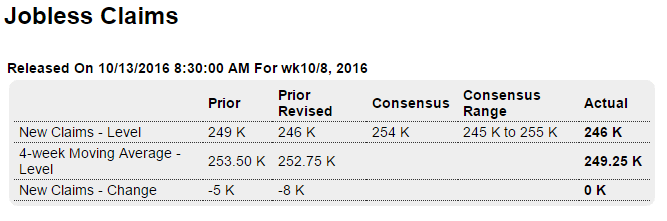
Unemployment claims remain at or near historic lows, indicating a lack of layoffs and quick turnaround for those who do lose their jobs. Initial claims came in near the low end of expectations in the October 8 week, at 246,000 with the 4-week average at 249,250. Both of these averages are down roughly 10,000 from a month-ago, comparisons that offer early indications of strength for the October employment report. Continuing claims are trending roughly 100,000 below a month ago, at 2.046 million and a 16,000 decline in the latest data which are for the October 1 week. Hurricane Matthew had only limited impact on initial claims with only one state in the affected area, Virginia, having to be estimated. Louisiana was also estimated in this report. Records of note in this report is a 43-year low for the weekly level of initial claims and an 8th straight decline for the 4-week average which is also at a 43-year low.

Looks like the move up was only a blip, but too soon to tell:

101410

JOLTS, Mall closings

So does the fed somehow see this as ‘improvement’ and ‘solid’? More likely to me that the Fed gets criticized for waiting too long to cut. Not that it would matter, of course…

101204

Highlights

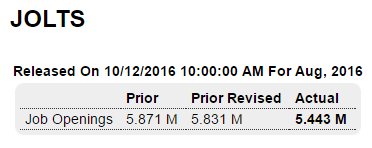
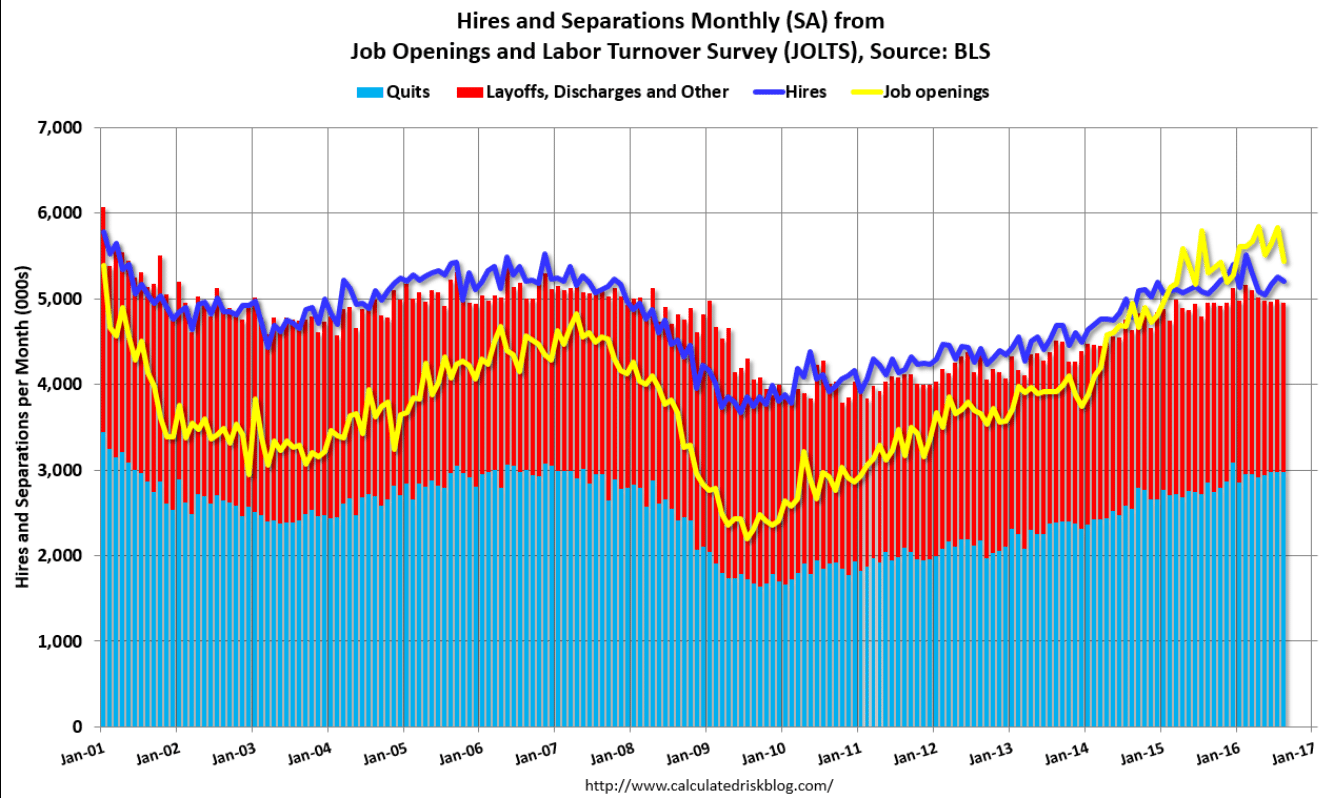
In downbeat indications on the labor market, job openings fell a sharp 7.3 percent in August to 5.443 million at the same time that hiring, instead of rising, slowed by 0.9 percent to 5.210 million. The openings number is the lowest since December last year while the hiring number is more respectable, ranking as the fourth highest so far this year. Turning to rates, job openings fell to 3.6 percent from the prior month’s 3.9 percent while hiring held unchanged, also at 3.6 percent. Both rates are unchanged from a year ago. The separations rate fell to 3.4 percent from 3.5 percent with quits unchanged at 2.1 percent and layoffs unchanged at 1.1 percent. Though readings in this report remain healthy, the drop in openings and the lack of hiring are consistent with slowing jobs growth, as seen in both the August and September employment reports.

101205

Yes, these have been replaced by online shopping, but total shopping isn’t increased by the closings. At the macro level it’s a cost cutting move that removes that much spending from the economy. My policy response would be reduced FICA taxes, but you already know that… ;)

Chattanooga, Tennessee–based CBL & Associates, which owns or has a hand in 89 regional malls and open-air shopping centers, will close the doors at nearly all of its properties until 6 a.m. Black Friday.

At its enclosed malls, the only tenants allowed to open are department stores, movie theaters, restaurants or others that have an exterior entrance. All access to the centers’ common areas will be restricted. CBL’s open-air centers will also be closed; however since all of those tenants have exterior entrances, they will have the option to stay open.

The company notified all the individual centers Wednesday afternoon. (For a full list of CBL centers that will be closed, see below.)

The closings will allow about 1,500 mall employees and between 750 and 2,000 retail workers per property to celebrate the holiday.

CBL’s announcement comes one week after the Mall of America said it would close on Thanksgiving.

“We think that for our employees and for the store employees, they deserve the day off and to be able to spend the day with their families,” CBL CEO Stephen Lebovitz told CNBC in an exclusive interview. “Thanksgiving is a special holiday, and it’s unfair for them not to be able to enjoy it like everyone else can.”