
Chain store sales, PMI and ISM surveys, Construction spending, Auto sales, Delinquencies

120110

Highlights

Chain stores are reporting mixed to lower year-on-year rates of November sales compared to October. Today’s results do not hint at another month of strength for the government’s ex-auto ex-gas retail sales reading which posted very strong monthly gains of 0.6 percent and 0.5 percent in October and September.

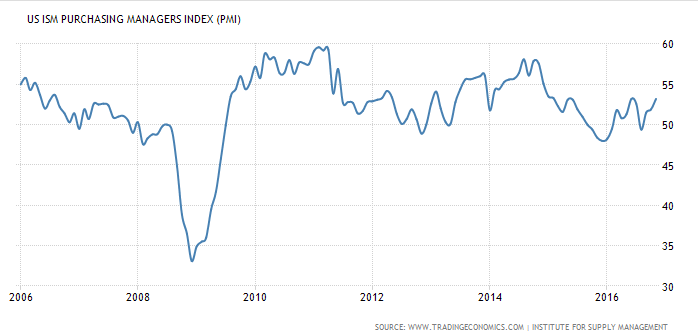
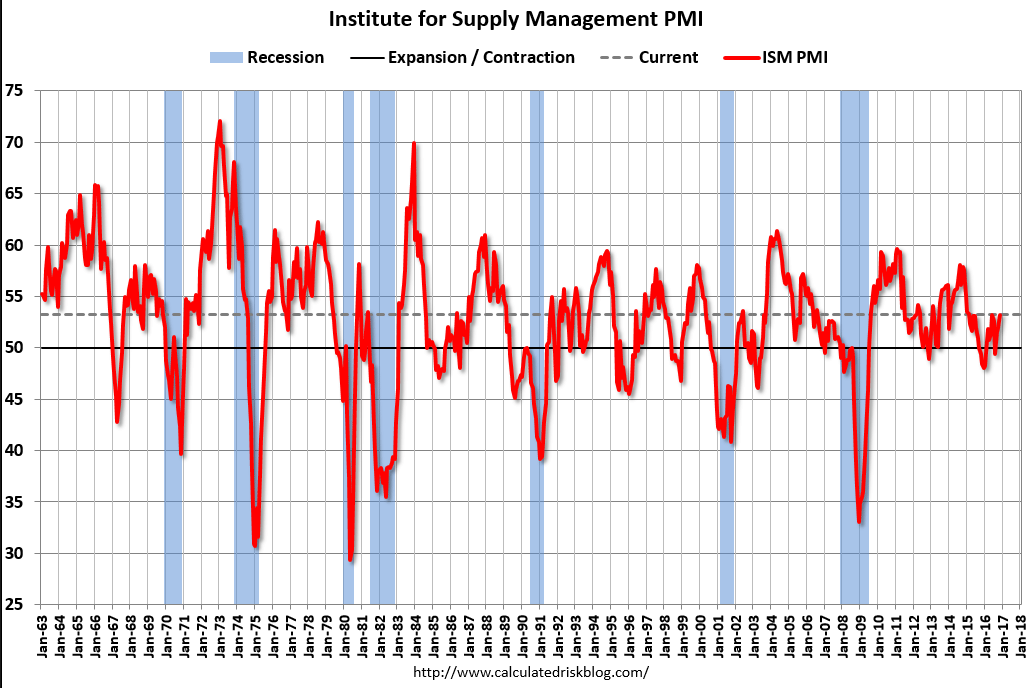
Manufacturing muddling through at current levels:

Markit Manufacturing PMI:
120101

120102

120103

120104

Highlights

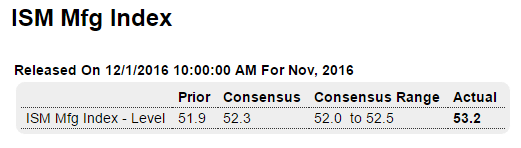
Durable orders picked up in October and the momentum appears to have extended to November, based on the sum of advance indications on the month including the ISM manufacturing composite which is up a solid 1.3 points to 53.2. Growth in new orders improved 9 tenths to a more respectable 53.0 with export orders holding over break-even 50 at 52.0. Production rose 1.4 points in the month to 56.0 with supplier deliveries showing significant delays and perhaps demand-related congestion in the supply chain, up 3.5 points to 55.7 and contributing significantly to the strength in the headline composite.

Other details include little change for inventories or backlog orders and modest growth in employment, down 6 tenths to 52.3. Prices paid shows moderate upward pressure, unchanged at 54.5.

This report is a little less hot than other November indications including from the Philly Fed, but the direction it points to is favorable.

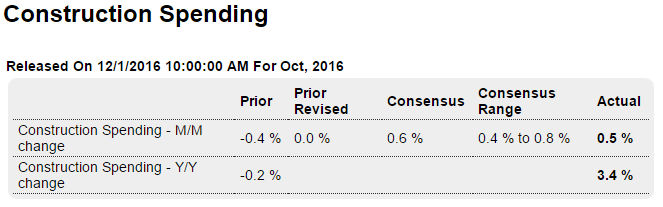
Up, and last month revised higher as well. Year over year up 3.4%, remaining historically low:
120105

Highlights

Construction spending rose a solid 0.5 percent in October with the prior two months both revised sharply higher, up 4 tenths from the initial estimate for September to unchanged and up a full percentage point for August which, like October, now stands at 0.5 percent. Today’s revisions point to an upward revision for third-quarter GDP.

Residential is the strong suit in the October report with both single-family and multi-family homes up 2.8 percent in the month, gains offset in part by a contraction in home improvements. Private nonresidential fell 2.1 percent in the month though public spending shows solid gains led by the Federal government and including highways and streets.

This report is noted for its volatility and the October edition only adds to the reputation. Construction may not be quite as flat as it appeared in prior months in what may perhaps be a positive not only for fourth-quarter GDP but even perhaps for construction payrolls in tomorrow’s employment report.

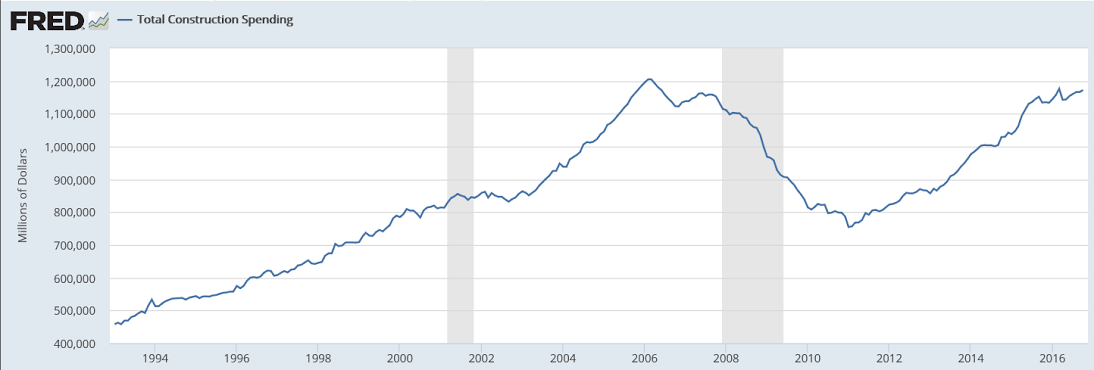
This is not adjusted for inflation:
120106
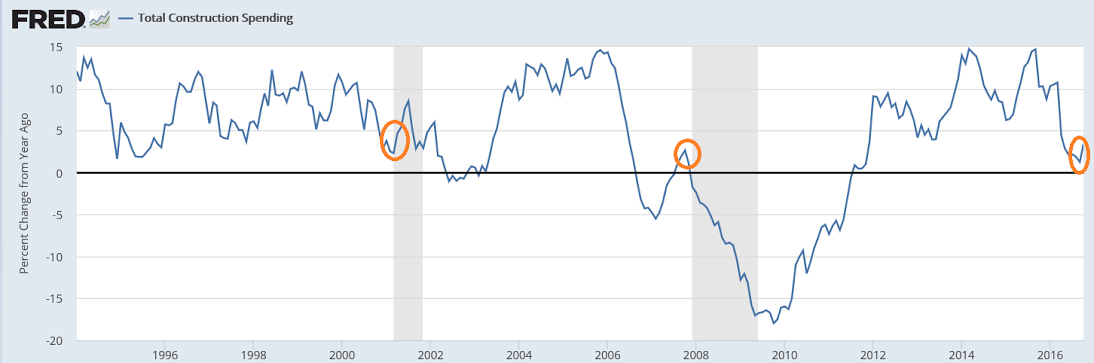
Anything under 5% annual growth has been associated with recession:
120107

Highlights

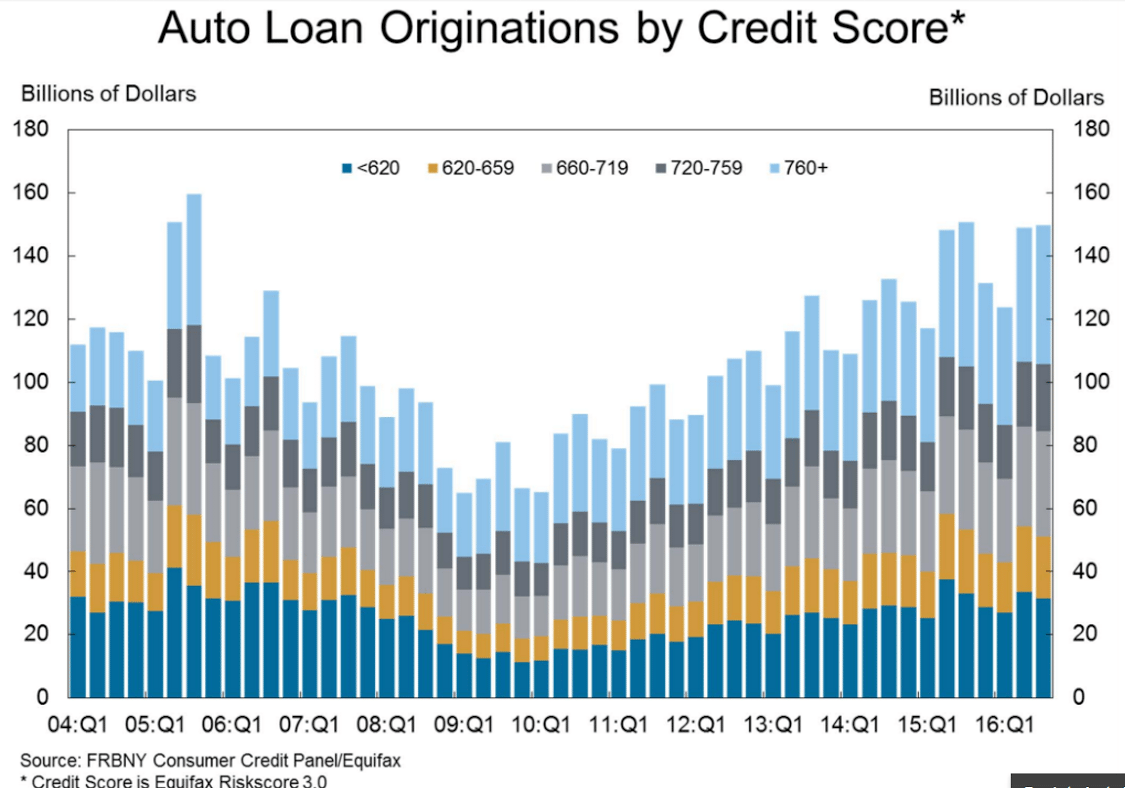
With about half the results in, November unit vehicle sales are trailing October’s results and are about in line with the Econoday consensus for a 2.7 percent decline to a 17.8 million annualized rate. The early results point to softness for the motor vehicle component of the government’s retail sales report which posted very strong gains of 0.8 percent and 0.7 percent in October and September.
120108
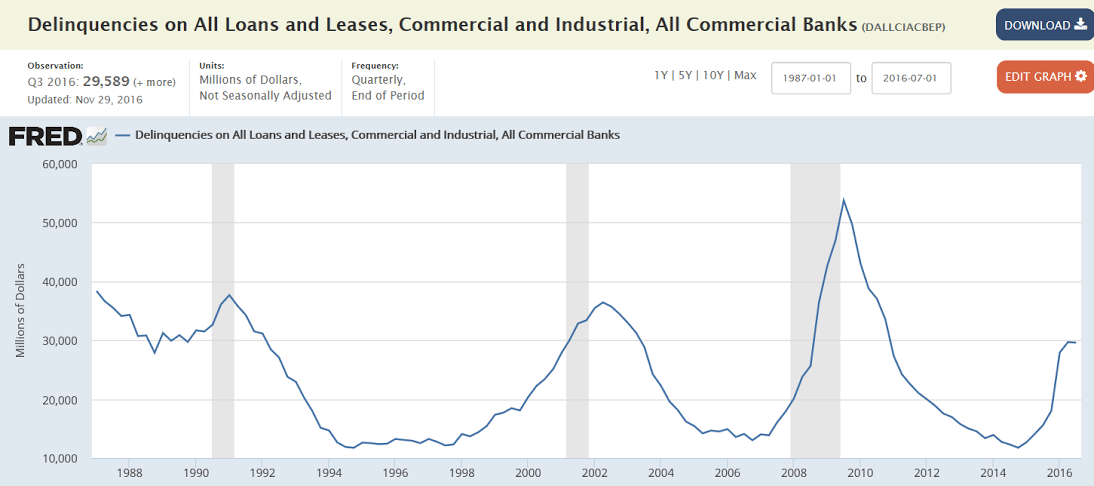
Rising bank loan delinquencies have historically been associated with recessions:
120109

Mortgage applications, Pending home sales, ADP payrolls, Personal income and spending, Chicago PMI

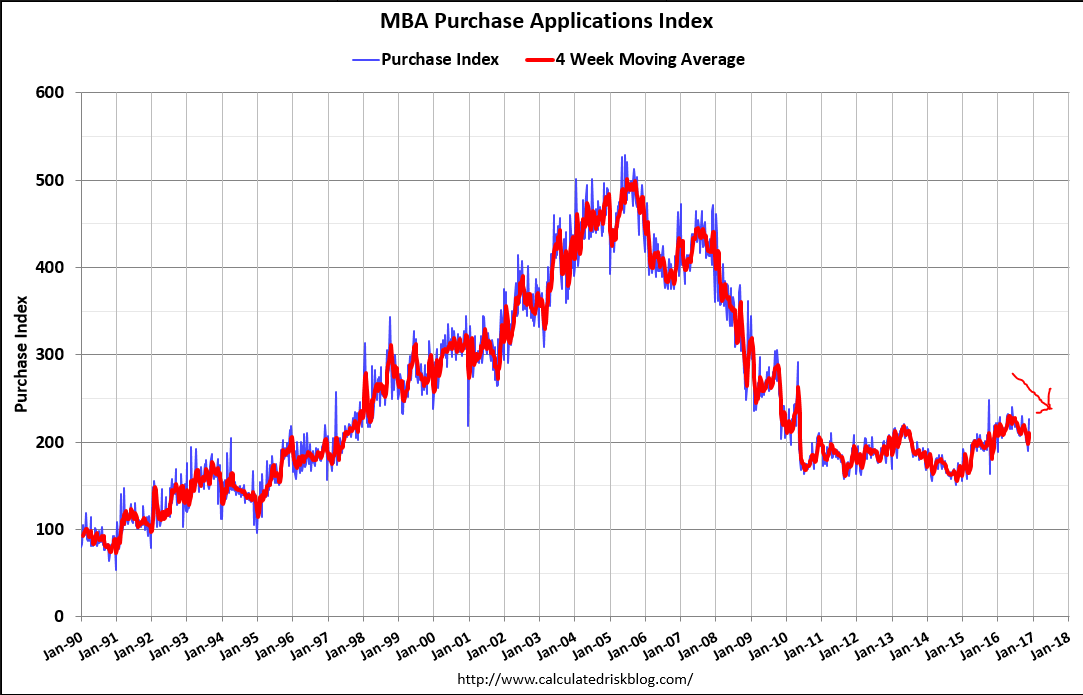
So mortgage applications for purchases rose during the first half of the year, then reversed and are looking to be at best flat vs the year before come year end:

113001

Highlights

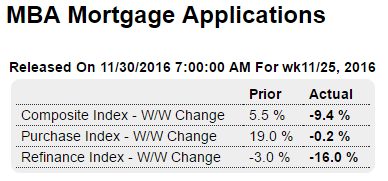
Purchase applications for home mortgages fell just 0.2 percent on a seasonally adjusted basis in the November 25 week following the prior week’s outsized 19-percent increase. But applications for refinancing were down 16 percent from the prior week, as the sharp post-election increase in interest rates continues to muffle mortgage activity among homeowners seeking to refinance at lower rates. The weekly drop took the purchase index to just 3 percent above the level a year ago, far less than the double-digit gains seen earlier this year, which in March reached more than 30 percent. Mortgage rates continued their climb higher during the week, with the average interest rate on 30-year fixed-rate conforming mortgages ($417,000 or less) moving up 7 basis points to 4.23 percent.

113002
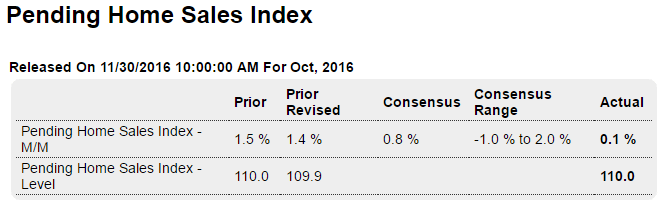
Pending home sales aren’t doing any better than mortgage purchase apps, so looking like a no growth year for housing and cars:

113003

Highlights

Pending sales of existing homes rose only 0.1 percent in October, pointing to flat results for the rest of the year in final sales. Pending sales in October were held down by weakness in the South that offset gains elsewhere. The resale market has been soft in contrast to new homes which are having a good year.

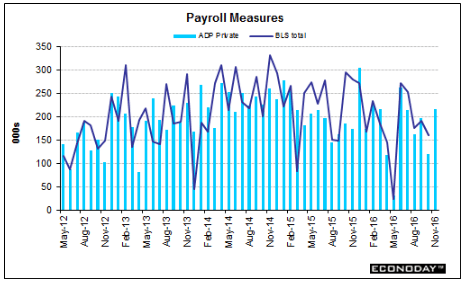
This is their forecast for tomorrow’s number. Note the large downward revision to last month’s release, which continued the downtrend as shown on the chart. Two things- First, this month’s number is subject to the same kind of revision. Second, the average of the last two months as reported today is just over 160,000 which keeps the pattern of deceleration intact:

113004

Highlights

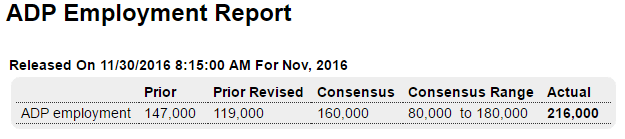
ADP has had a good year forecasting private payroll growth and its November estimate is very strong, at 216,000 which is far above Econoday’s consensus for 160,000. The 216,000 is nearly double ADP’s revised estimate for October of 119,000. Econoday’s consensus for Friday’s private payrolls is 155,000 with total nonfarm payrolls expected at 170,000.

113005

113006
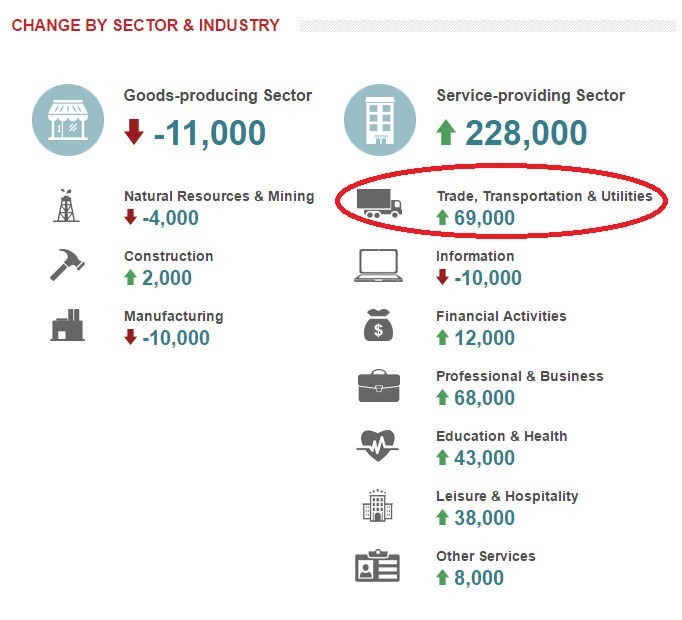
And the jump in trade, transportation, and utilities looks a bit suspect as well:

113007
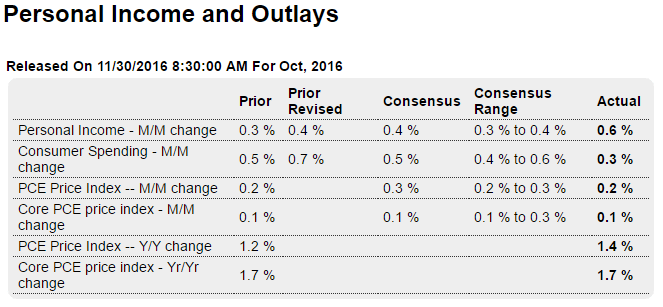
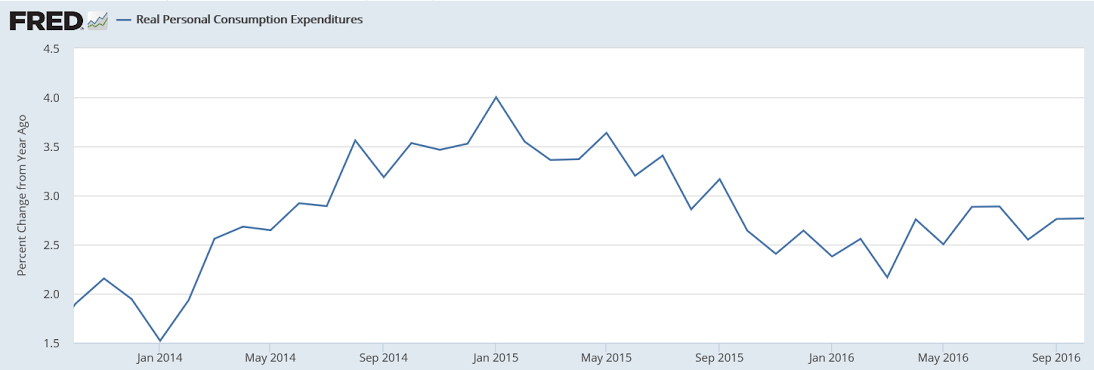
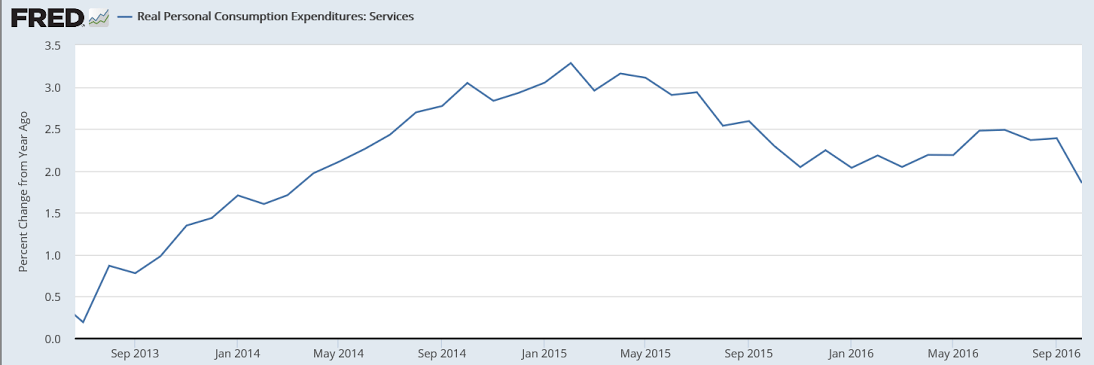
Here it’s the income side that seems a bit suspect, especially with last month’s jobs report just getting revised lower. But in any case it continues to decelerate on a year over year basis. Also note the relative weakness in spending on services. As previously discussed, I expect goods will muddle through reasonably well from this point, as the macro weakness works its way through the service sector:

113008

Highlights

A decline for services held down consumer spending in October, coming in at plus 0.3 percent vs Econoday’s consensus for 0.5 percent. Strong spending gains of 1.0 percent for durables (auto related) and 1.4 percent for nondurables (gasoline related) compare with a 0.2 percent decline for services. A partial offset is an upward revision to September’s consumer spending which now stands at a very strong 0.7 percent.

The income side is the best news in the October report, rising 0.6 percent to beat expectations by 2 tenths. An upward revision to September, now at plus 0.4 percent, is another positive. The wages & salaries component shows back-to-back gains of 0.5 percent which is very solid. And October spending would have been greater if not for savings as consumers moved their money into the bank with the savings rate up a sharp 3 tenths in the month to 6.0 percent.

Inflation data are showing some life with the total price index, boosted by energy, up 0.2 percent in the month with the year-on-year rate moving to a two-year high at 1.4 percent. But the core rate shows less life, up only 0.1 percent with the year-on-year rate unchanged at 1.7 percent.

Though the spending headline softens the look, the meat of this report is very solid as the strong jobs market is making for increasingly strong income gains and continued strength in spending.

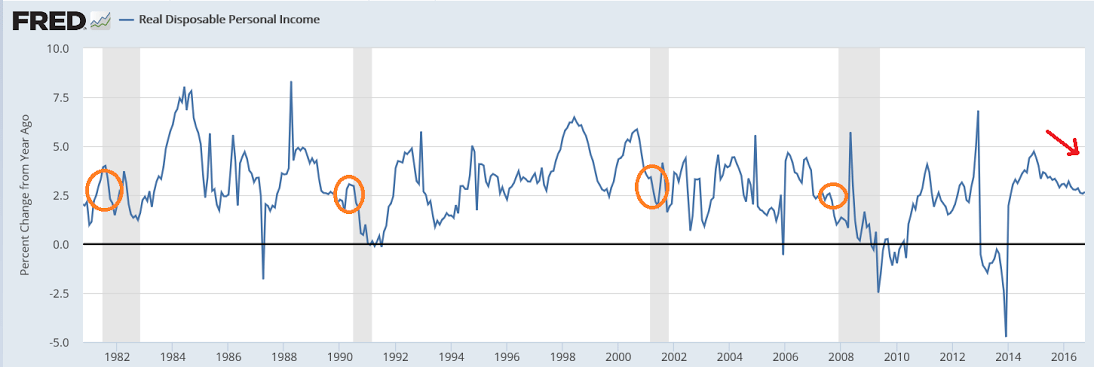
Real disposable personal income continues to decelerate and has reached ‘stall speed’ vs prior recessions:
113009

113010

113011
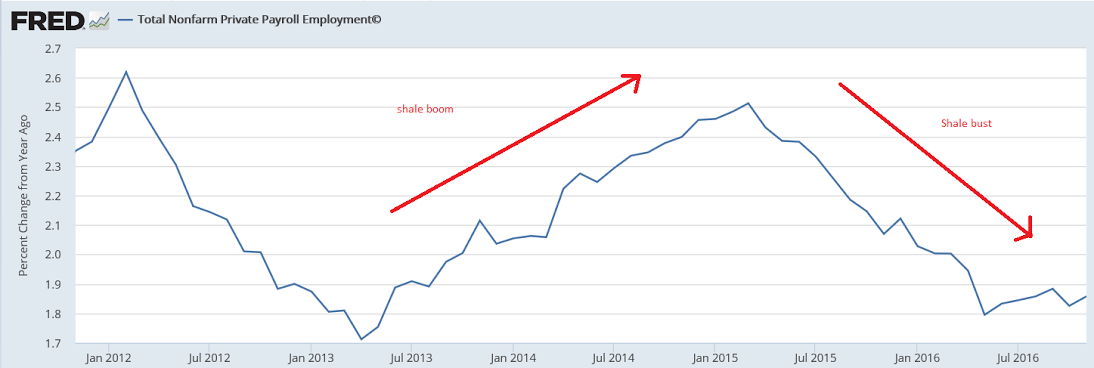
A bit of Trumpet blowing here, but note that employment went negative:

113012

Highlights

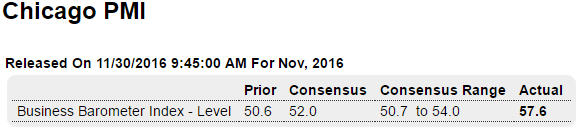
The Chicago Fed’s business barometer is showing its volatility once again, surging 7 points in November to 57.6 to signal the strongest rate of monthly growth in nearly two years (since January 2015). New orders, as they have been in other early reports on November, are the center of strength with backlogs, which are often in contraction, once again building. Up-and-down is the theme of the report and a negative is employment which is back in reverse. Volatility aside, the report’s overall message is consistent with other advance data this month, that is a significant upturn in activity has followed the November 8 election.

GDP, Consumer confidence, Redbook retail sales, Headlines

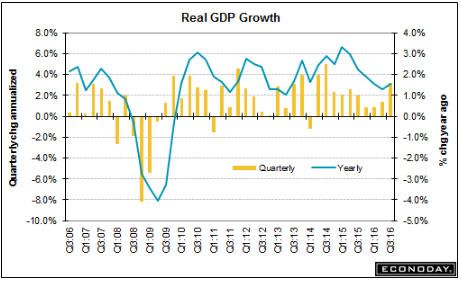
Revised up a bit as expected, pretty much all from revising up consumer spending. And it’s still a soybean export and inventory building story:

112901

Highlights

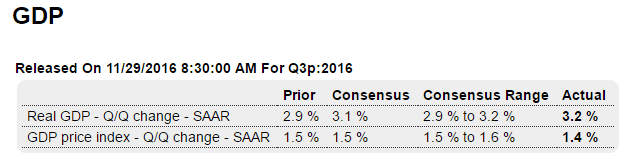
The third quarter has gotten a meaningful upgrade. The second estimate is 3 tenths higher than the first, at a plus 3.2 percent annualized rate and which includes an upgrade for consumer spending and, in further good news, a downgrade in inventory growth. Personal consumption expenditures rose at a 2.8 percent pace in the quarter, up 7 tenths from the initial estimate and, outside the 4.3 percent surge in the second quarter, the best showing by the consumer since second quarter last year. Inventories added $7.6 billion in the quarter, down from an initial $12.6 billion in a revision that held down the quarter’s GDP but which will ease concerns of unwanted overhang that could slow fourth-quarter production.

Other details include less downward pull from residential investment, a component that had been strongly positive in prior quarters, and a downgrade for nonresidential investment which is now only marginally in the plus column. Net exports shaved $521.0 billion from the quarter’s total, little changed from the initial estimate, with government purchases a small positive. Price data were shaved lower with the GDP price index revised down 1 tenth to only 1.4 percent.

This report points to greater-than-expected consumer momentum going into the current quarter, helping to explain the big 0.8 percent surge in retail sales for October. The consumer has jobs and is the driving force of the economy.

112902
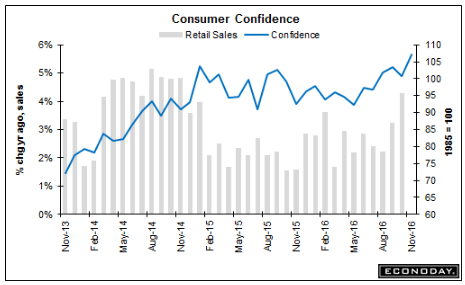
An early show of confidence in the new President:

112903
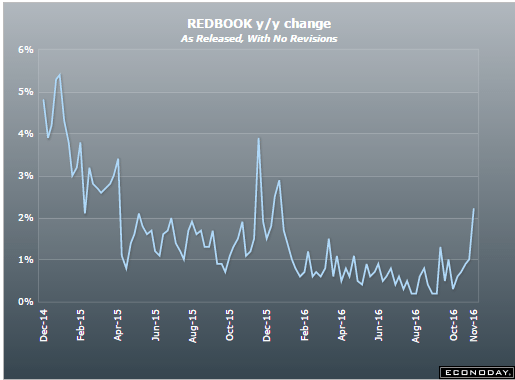
Looks hopeful, but didn’t work out so well last time there was a mini spike like this:
112904

Smartphone sales set for a screeching slowdown across the globe this year, IDC says

UBS warns of ‘near-term’ iPhone weakness as data shows Apple being cautious with inventory

The market’s newest risk: Trump venting ‘frustrations through his Twitter account’
Why Donald Trump won’t change – CNN
Winning the presidency didn’t change Donald Trump — and it’s increasingly clear that actually being president won’t change him either.

Trump hasn’t had a news conference since July – USA Today
Trump hasn’t had a news conference since July. On Monday afternoon, a lectern with “Trump” written in gold letters was wheeled upstairs inside Trump Tower.

Black Friday, Trump comments, Dallas Fed Survey

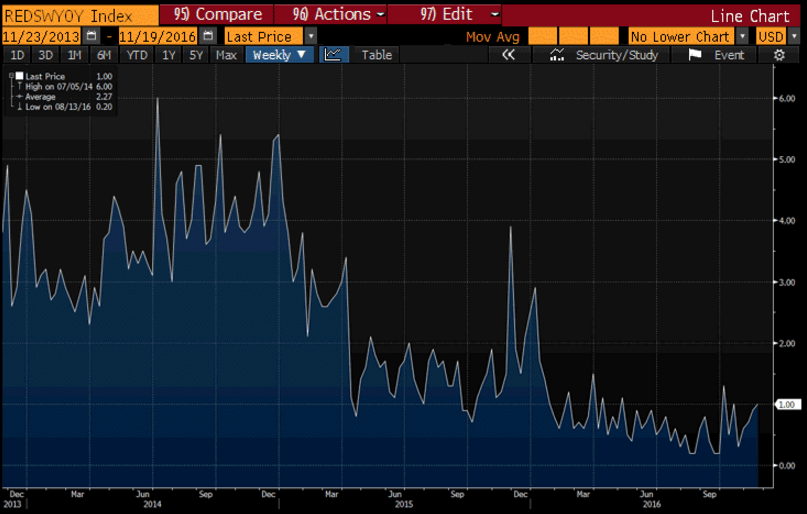
Total Black Friday sales down vs last year:
http://www.reuters.com/article/us-usa-holidayshopping-idUSKBN13L0ZH?il=0

The Trump thing looks to be going to go from bad to worse. I understand that sometimes it makes sense to vote in the village idiot. But then you do have to deal with him being the President. It’s like having an 8 year old loud mouthed spoiled brat boy king without a regent. So my advice is to not get your hopes up too high for anything rational coming out of the oval office. Instead, look for the likes of the latest childish tweets and offhand statements:

Trump threatens to terminate US-Cuba deal if ‘Cuba is unwilling to make a better deal’

In Tweet Flurry, President-Elect Donald Trump Calls Election Recount Efforts ‘Sad’

Trump ‘furious’ over Kellyanne Conway comments on Sunday shows about Romney: Sources

Trump mocks Clinton for aiding in recount; without evidence, suggests vote fraud

WASHINGTON – President-elect Donald Trump spent Sunday ridiculing Hillary Clinton’s presidential campaign for joining a recount effort in Wisconsin, ending his day on Twitter by parroting a widely debunked conspiracy theory that her campaign benefited from massive voter fraud.

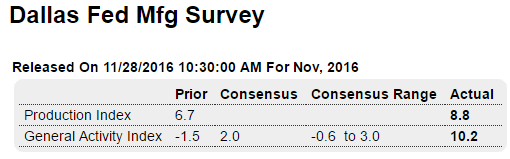
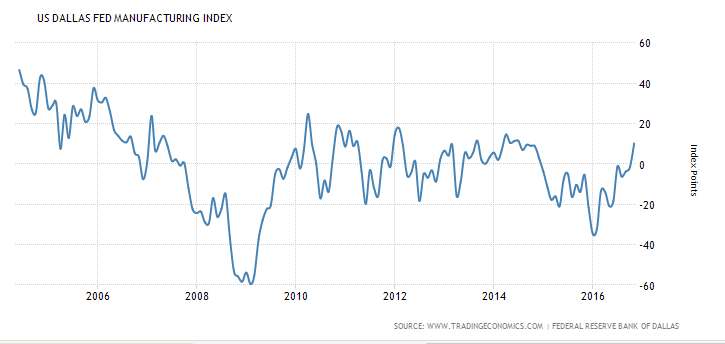
After two years of contractions at least for now things seem to have leveled off at the lower levels:

112801

112802

Rail week, Trucking data, Bank lending

http://econintersectllc.cmail2.com/t/r-l-yhuudyld-jutdvkyuh-jy/

112601
http://econintersect.com/pages/releases/release.php?post=201611250637&utm_medium=email&utm_campaign=Daily%20Global%20Economic%20Intersection%20Newsletter%20Feed&utm_content=Daily%20Global%20Economic%20Intersection%20Newsletter%20Feed+CID_2c6311bc7e868470eee44c0357c5f143&utm_source=newsletter&utm_term=Trucking%20Data%20Mixed%20In%20October%202016

112602
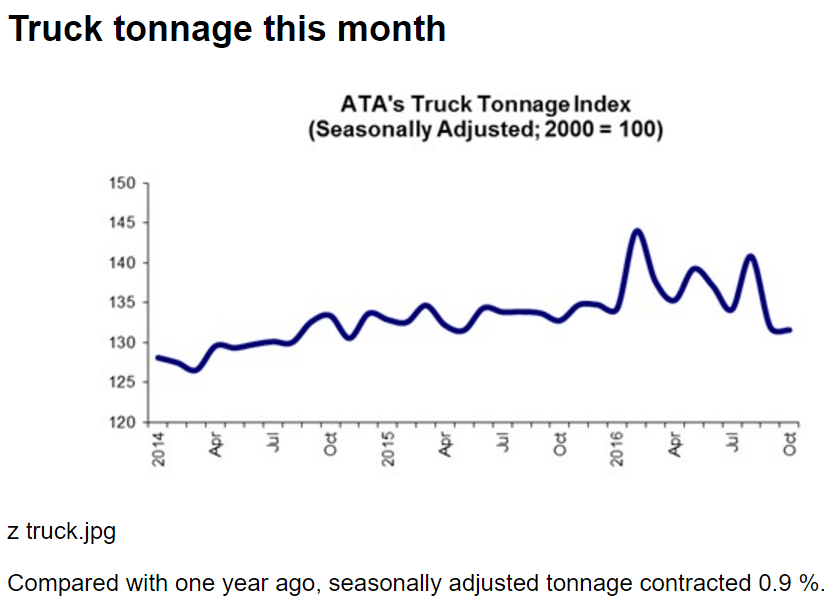
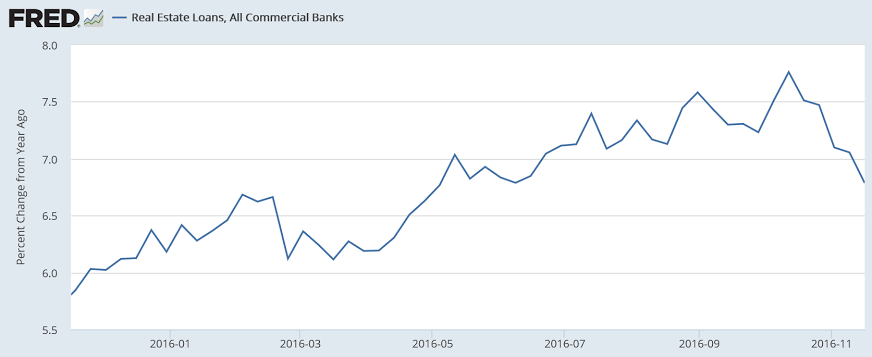
Not looking good:

112603

112604

Trade, Composit PMI, Credit check

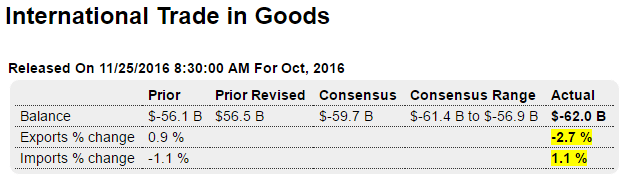
Higher trade deficit than expected, and last month revised higher. And just getting going:

112501

Highlights

The advance international goods deficit widened to $62.0 billion in September from minus $56.5 billion in August. The increase in the deficit was bigger than the anticipated deficit of $59.7 billion. Exports were down 2.7 percent on the month while imports increased 1.1 percent. In August exports increased 0.6 percent while imports declined 1.0 percent.

The biggest decline in exports — 11.8 percent was for foods, feeds & beverages – followed a 12.0 percent decline in August. Industrial supplies, which include petroleum, declined 4.1 percent after increasing 1.5 percent. Capital goods slipped 0.1 percent after increasing a robust 3.7 percent the month before. Consumer goods exports also dropped, declining 5.9 percent after increasing 4.6 percent in August.

On the import side, autos were unchanged on the month after sinking 4.7 percent the month before. However, capital goods imports rebounded 1.9 percent after dropping 3.4 percent. Consumer goods imports were up 3.7 percent after declining 1.7 percent in August. Industrial supplies (including petroleum) were down 1.2 percent and slipping 0.1 percent the month before.

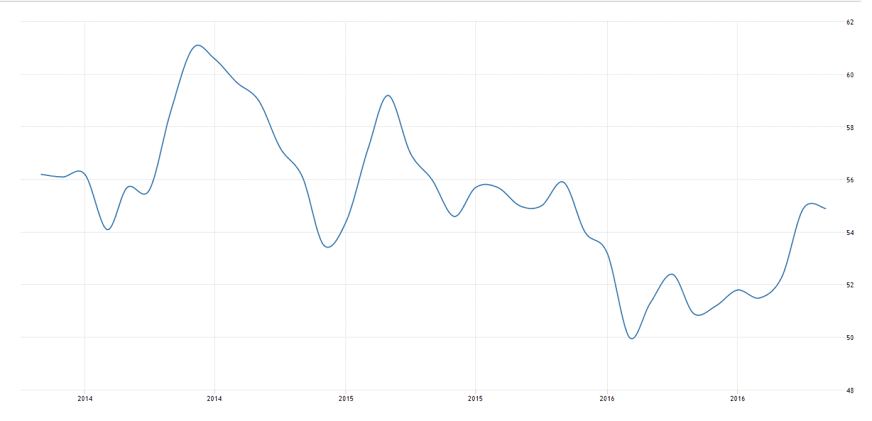
This composite of Services and Manufacturing purchasing manager’s index looked like it might have been moving to higher levels but just rolled over some:
112502
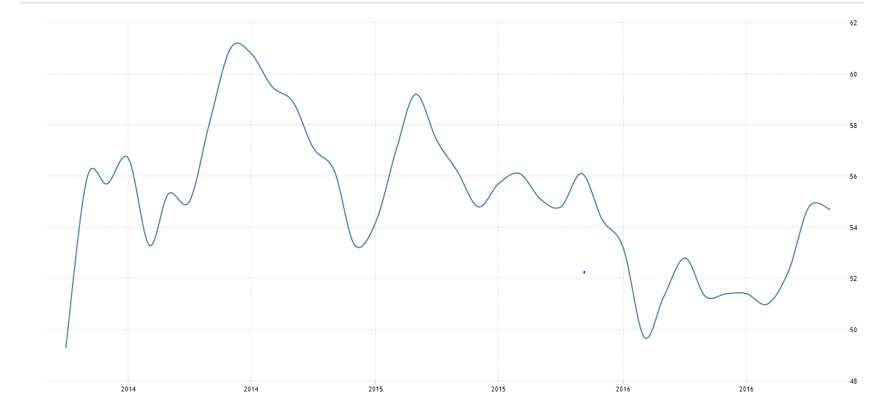
This is just the service sector and looks to me like it’s still working its way lower, as weakness that began in mining and manufacturing due to the oil capex collapse spilled over into the service sector:

112503
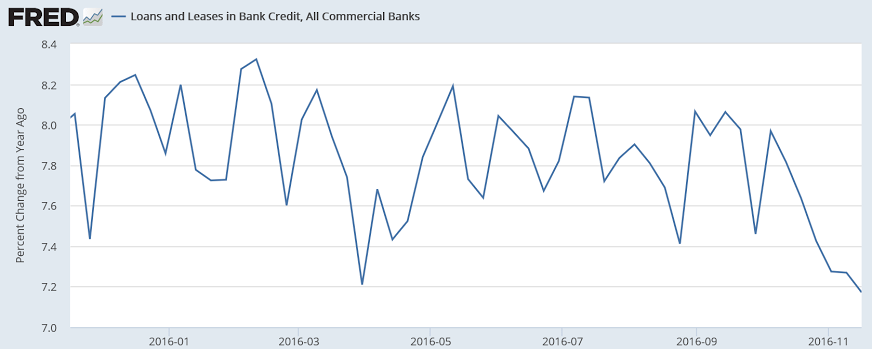
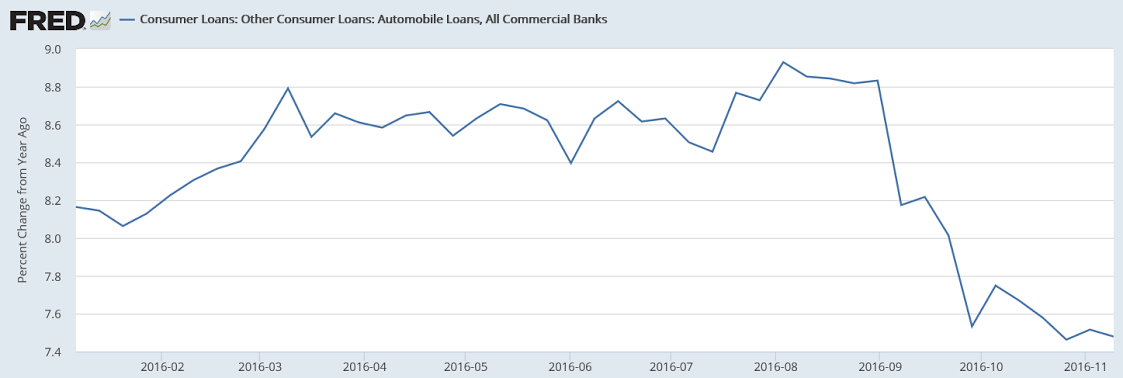
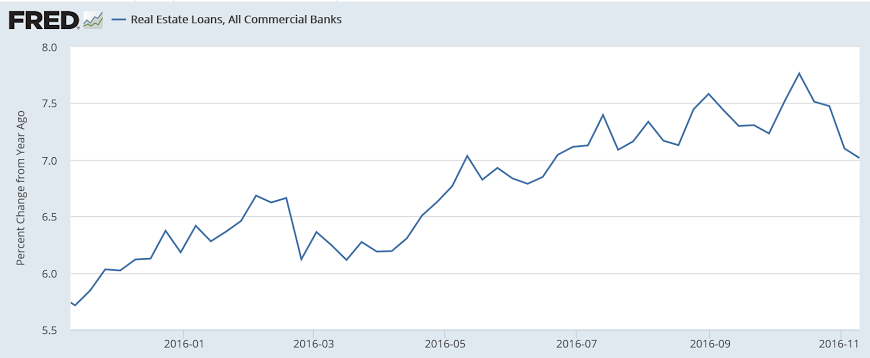
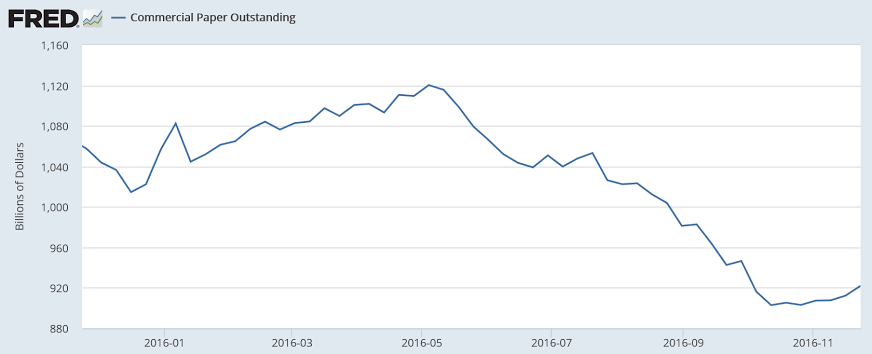
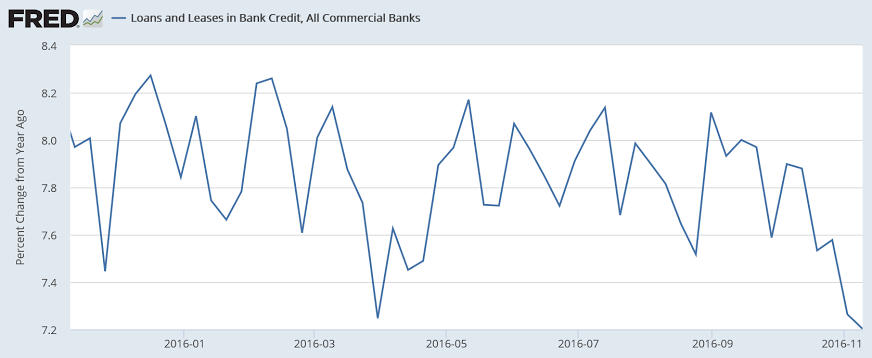
And still looks to me like overall credit growth continues to decelerate:

112504
These two are from from 6 days ago:

112505

112506
The drop here is partially due to Dodd/Frank regs:

112507

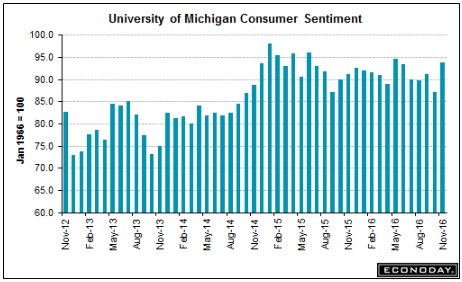
Redbook retail sales, Mortgage purchase apps, PMI manufacturing, Consumer sentiment, New home sales

Notable only in that analysts are calling the latest 1% increase ‘strong growth’…

112301
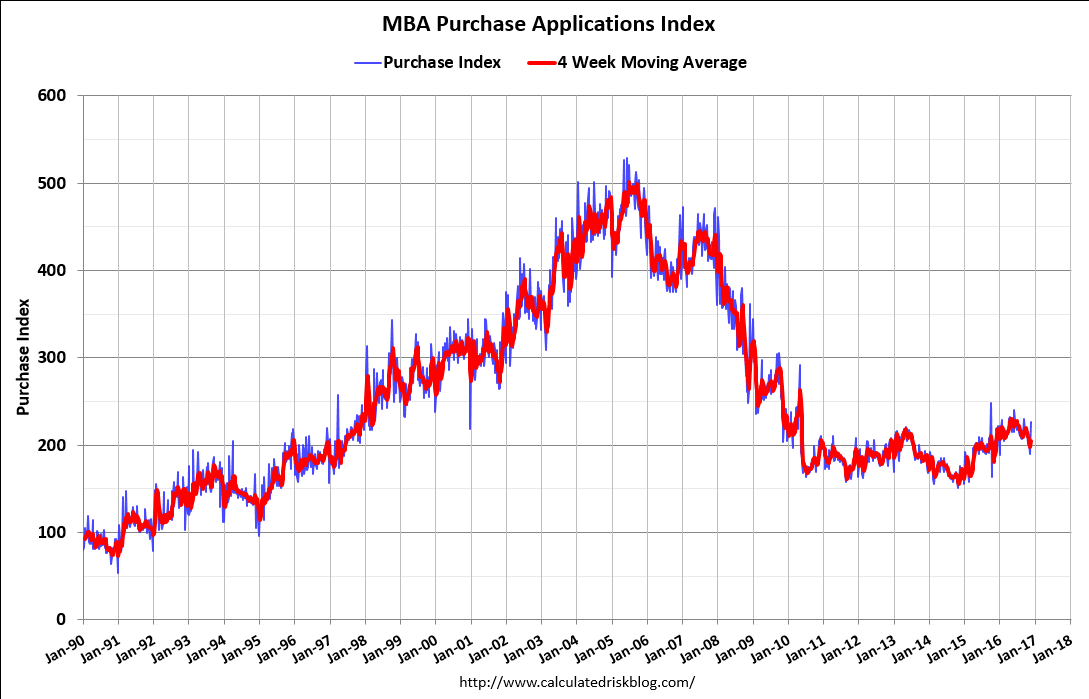
First a big move down, now a rush to get in ahead of fed rate hikes. But still remains depressed by historical standards:

112302

Highlights

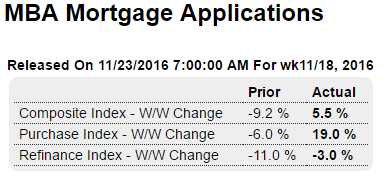
Rising interest rates are causing some volatility in mortgage activity, with purchase applications for home mortgages increasing by an outsized, seasonally adjusted 19 percent in the November 18 week after falling 6 percent in the prior week, while refinancing applications declined by 3 percent following an 11 percent fall. The weekly change put the Purchase Index back up to 11 percent above the level a year ago. The average interest rate on 30-year fixed-rate conforming mortgages ($417,000 or less) jumped 21 basis points to 4.16 percent following the prior week’s 18-basis-point increase.

112303
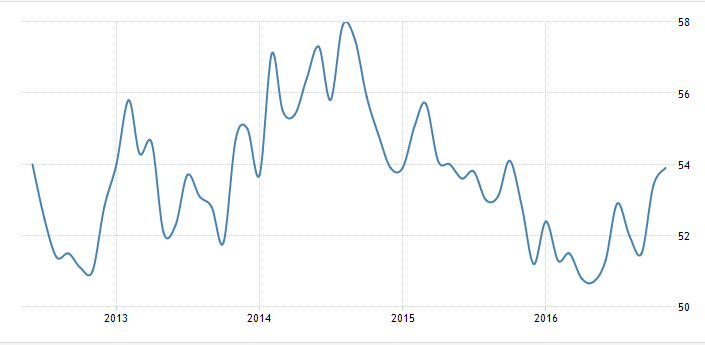
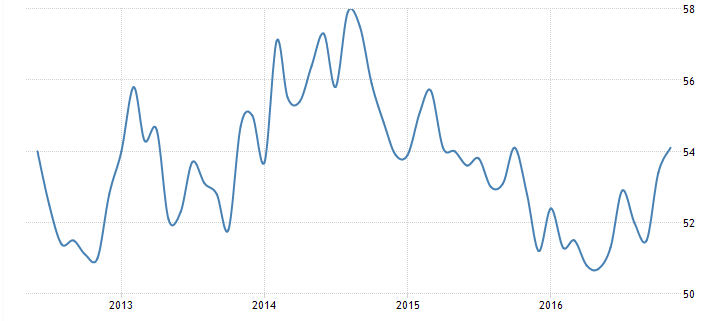
A bit better than expected, as manufacturing chugs along at the lower levels:

112304

Highlights

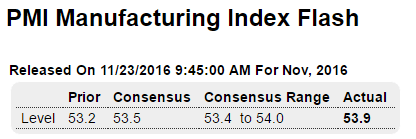
November flash manufacturing PMI reading climbed to 53.9 from 53.4 in October, signaling a further solid improvement in overall business conditions across the manufacturing sector. The headline index was the highest since October 2015, largely reflecting robust output and new business growth during the latest survey period.

Production volumes have now increased for six consecutive months and the latest rise was the strongest since March 2015 thanks to improving underlying demand and generally supportive domestic economic conditions. New order growth picked up to its fastest for 13 months in November. Anecdotal evidence suggested that increased sales to domestic clients had driven the latest upturn in new work. However, new export orders rose only marginally, which manufacturers linked to competitive pressures and the strong dollar in particular.

Higher levels of incoming new business resulted in a further increase in unfinished work. The rate of backlog accumulation was the fastest since July, which some firms attributed to capacity pressures and stronger-than-expected sales. This contributed to a modest rebound in payroll numbers, although the pace of staff hiring remained slightly weaker than its post-crisis trend.

Manufacturers indicated that cost pressures remained subdued with the latest rise in input prices softer than during October and well below the long run survey average.

112305
Popped back up with the election:

112306
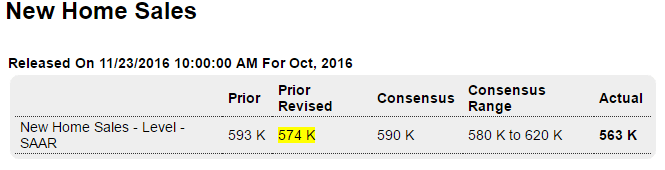
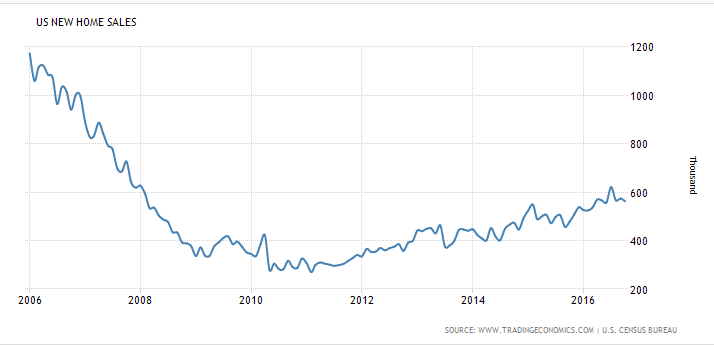
New home sales fall in line with permits, which have been relatively flat, so makes sense that sales have flattened out:

112307

Highlights

October sales of new single family houses declined 1.9 percent to a weaker than expected an annualized rate of 563,000. On the year, sales were up 17.8 percent. Expectations were for an annualized rate of 590,000. September sales were revised down substantially to 574,000 from 593,000. The October pace was behind the third quarter pace but in line with the second quarter average.

Three of the four regions saw a decline in sales. Sales declined 9.1 percent in the Northeast, dropped 13.7 percent in the Midwest and were 3.0 percent lower in the South. However, sales were up 8.8 percent in the West.

The supply of new homes on the market increased 2.9 percent to 246,000 and the strongest since September 2009. The supply of new homes on the market climbed to 5.2 percent from 5.0 percent.

112308
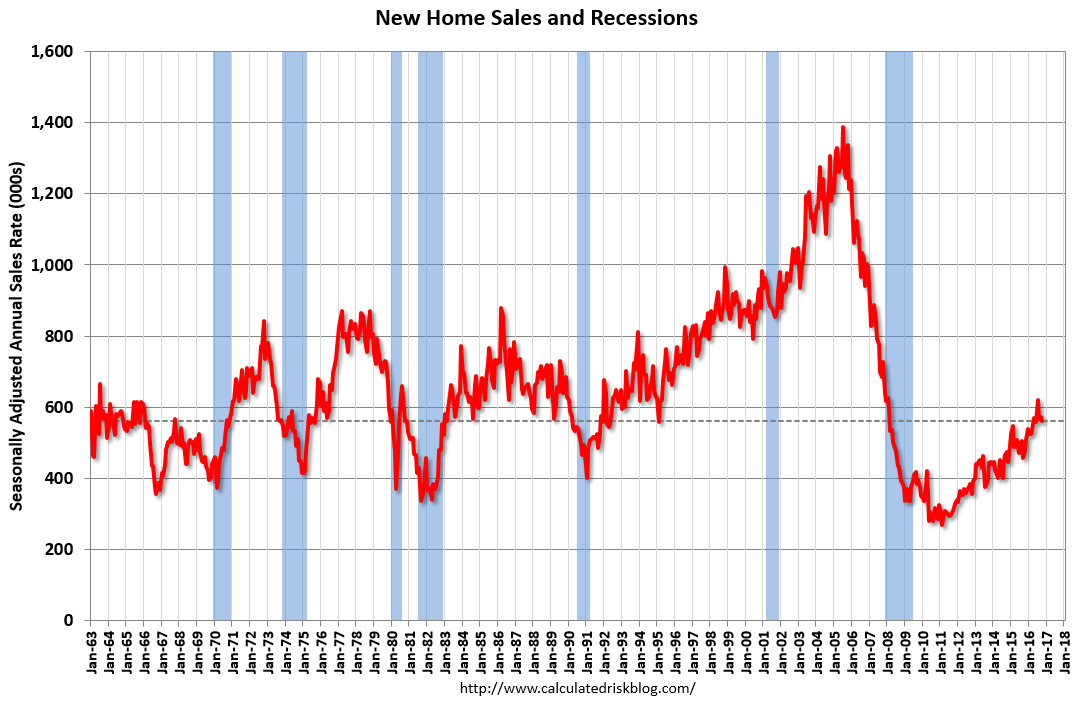
Longer view shows how depressed housing is, and this chart is not population adjusted:

112309

Existing home sales, UK headline, Vehicle sales, India, Trump tweeting

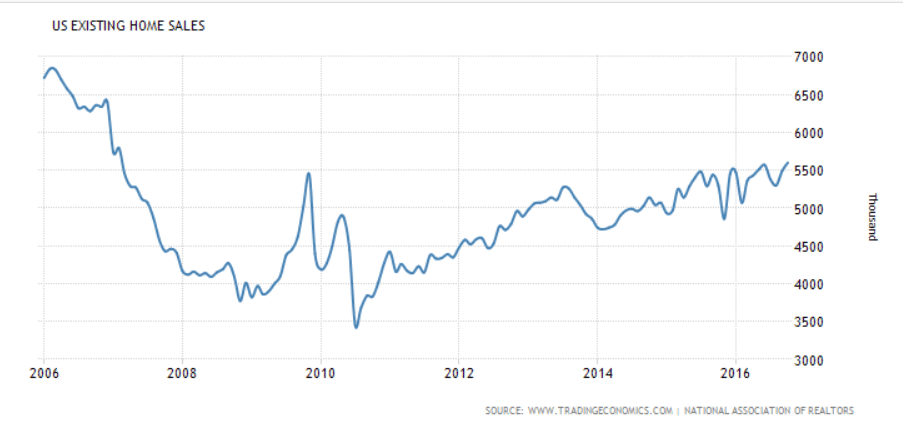
These sales are reported based on actual closings, and they look to have flattened around the 5.5 million/yr rate. But that was before lenders hiked mortgage rates due to Trumpenomics frears, and mortgage purchase apps did drop a full 6% last week. And this number is not ‘population adjusted’:

112201

Talk about cheerleading- the order book remains in contraction:

UK Factory Orders Rise in November: CBI

The Confederation of British Industry order book balance rose to -3 in November 2016 from an eight-month low of -17 the previous month and beating market expectations of -9. It was the strongest reading since June this year, before the Brexit vote, amid higher expectations for output growth in the next three months (+24 from +13 in October) and inflation (+19 from +8), while export orders fell (-11 from -6).

In other words, 0 or very near 0 growth forecast for 2016 vs 2015:

With an upward bias, November sales are forecast to end at a 17.7 million-unit seasonally adjusted annual rate, the third consecutive month the SAAR finished above the year-to-date total, which stands at 17.3 million through October.

If November’s outlook holds firm, year-to-date volume will total 15.8 million units, a smidgeon above 11-month 2015’s 15.7 million, but keeping the prospect alive that 2016 could end as a record year.
Read more at http://www.calculatedriskblog.com/#yQFj4O6LyjwloQYQ.99

Pain and gain for India’s economy after drastic withdrawal of cash supplies: Analysts

By Saheli Roy Choudhury

Nov 21 (CNBC) — HSBC’s chief India economist, Pranjul Bhandari, said in a note that about 60 percent to 80 percent of India’s consumption basket is cash-intensive, including food, transport, real estate and restaurants. “We assume that growth for these components halve on the back of the monetary shock,” Bhandari wrote. She expected India’s full fiscal year gross domestic product (GDP) growth to be 0.7 to 1 percentage point lower.

A chief target of Modi’s demonetization efforts is India’s burgeoning shadow economy, which Bank of America Merrill Lynch (BAML) research analyst Sanjay Mookim estimates at 25 percent to 30 percent of GDP. In a note, Mookim said the immediate impact on the black economy could lead to a “much slower consumption,” especially once a new India goods and services tax (GST) kicks in next year.

Analysts pointed out there could still be some beneficial outcomes – first, it would cut the supply of black money circulating the economy and bring some of it into the formal economy over time. Secondly, the government could see tax gains if it succeeds in “unearthing unaccountable money” from the shadow economy, according to analysts from Singapore’s DBS Bank.

As they say, seems he’s ‘not quite right’…

Donald Trump is attacking foes on Twitter like he’s campaigning

Donald Trump tweeted 37 times between the election and Monday afternoon, and nearly half could be considered hostile or defensive.

Chicago Fed, Japan, China, UK, US container counts, Euro area savings desires, Fed comment, Dividends comment

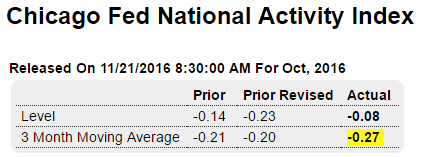
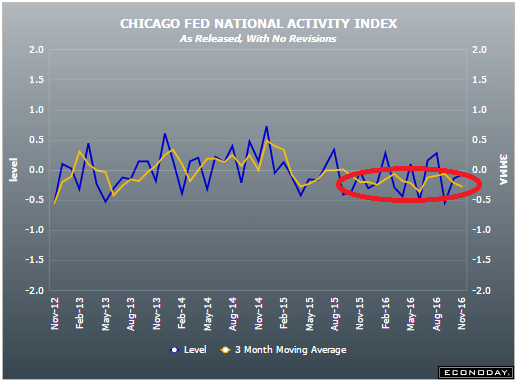
Still in the red:
112101

112102
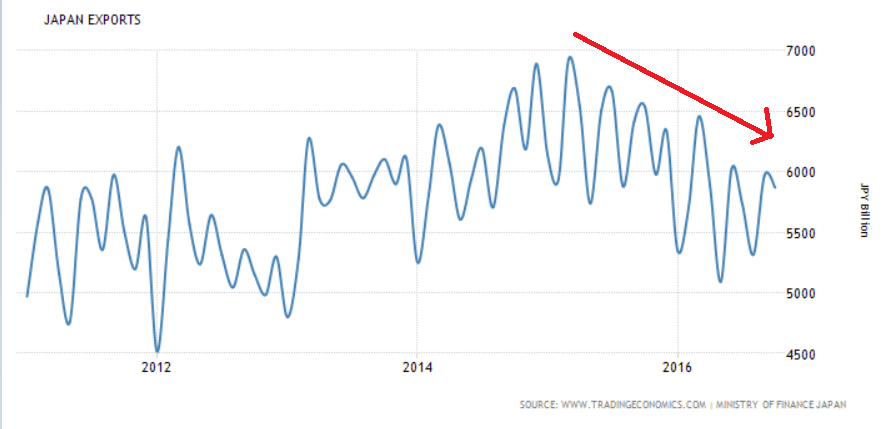
This is not a good sign for global demand. And Japan’s continuing trade surplus recently enhanced by the falling yen isn’t a positive for US GDP:

Japan’s trade surplus grows 4.7-fold in October

Nov 21 (Kyodo) — Japan’s trade surplus expanded 4.7-fold in October from a year earlier to 496.17 billion yen ($4.5 billion). The value of exports dropped 10.3 percent from a year earlier to 5.87 trillion yen while imports plunged 16.5 percent to 5.37 trillion yen. Exports to China fell 9.2 percent to 1.07 trillion yen while imports dived 17.9 percent to 1.42 trillion yen. Japan’s shipments to the United States dropped 11.2 percent to 1.20 trillion yen while imports fell 9.9 percent to 616.82 billion yen. Exports to the European Union declined 9.5 percent to 650.49 billion yen while imports shed 12.0 percent to 674.89 billion yen.

Weak foreign demand since the collapse of oil capital expenditures:

112103

Same with China, and no word yet from President Trump on ‘currency manipulation’ and ‘competitive devaluation’:

China Devalues Yuan For Longest Streak Ever To 8 Year Lows – ZeroHedge – http://bit.ly/2fwiIMc
…(6.8985 vs. Friday at 6.8796) For the 12th consecutive day, China has weakened the official fix of the Yuan against the USD, slashing its currency by over 2.2% in that time

And no push back on this statement tells me global demand can’t go anywhere but down:

UK’s Hammond says budget options constrained by high debt – http://reut.rs/2gsIZzg
…Britain’s first budget plan since the Brexit vote will not include a big new spending push because of “eye-wateringly” high public debt levels, but will have some help for the economy and struggling families, the country’s finance minister said.

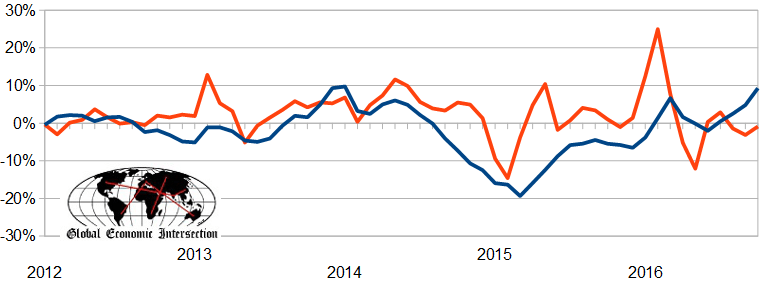
The red line, imports, remain in negative territory on a year over year basis:

112104

As previously discussed, with govt. a large net payer of interest to the economy, rate cuts remove material levels of income from the economy, which constrains borrowing:

Negative Rates Are Failing to Halt Savings Obsession in Europe – http://bloom.bg/2g7ONK6

Why would we want to compete with billions of other consumes for real resources?

Fed’s Powell says Asian economies should boost domestic demand – http://reut.rs/2fiHF05

Consequences of the collapse in global oil capital expenditure continue:

Global dividends stumble as US growth drops to post-crisis low -Telegraph – http://bit.ly/2fwd253

Yellen statements

Not good:

Said Yellen: “The long-run deficit probably needs to be kept in mind.”
http://www.usatoday.com/story/money/2016/11/17/yellen-fed-track-dec-rate-hike/93991628/

http://www.bloomberg.com/news/articles/2016-11-17/yellen-signals-fed-won-t-be-cowed-after-trump-s-election-victory

“In addition, with the debt-to-GDP ratio at around 77 percent there is not a lot of fiscal space should a shock to the economy occur, an adverse shock that did require fiscal stimulus,” she said.

Feb 25, 2015:

Importantly, that rise in debt over the long term could mean that policymakers would have more limited options in needing to stimulate the economy if it fell into another deep recession.

I also worry that if we were to again be hit by an adverse shock, that there’s not much scope to use fiscal policy. It was used in the early years after the financial crisis — we ran large deficits — but in the course of doing that, the debt-to-GDP ratio rose. And were another negative shock to come along, it’s questionable how much scope we would now have to put in place even on a temporary multiyear basis expansionary fiscal policy, and I think it’s important to deal with these issues — for the Congress to do so.

This is a key point we have made as to why current projections are problematic and stabilizing debt is an insufficient goal. The high level of debt may constrain our ability to respond as necessary to emergencies, whether they be recessions, natural disasters, or conflicts. Lawmakers should not get complacent about debt stabilizing over the next few years as it could become a greater problem beyond then.

Nov 29, 2011:

“It is crucial that the federal budget be put on a sustainable long-run trajectory, and we should not postpone charting that course. A failure to put in place a credible plan to address our long-run budget imbalance would expose the United States to serious economic costs and risks in the long term and possibly sooner. Timely enactment of a plan to put the federal budget onto a sustainable trajectory will make it easier for individuals and businesses to prepare for these adjustments. In addition, the sooner our longer-term budget problems are addressed, the less wrenching the adjustment will have to be and the more control that policymakers – rather than market forces or international creditors – will have over the timing, size, and composition of the necessary adjustments.”

June 22, 2016:

“I feel the consequences for the United States and the global economy of defaulting on Treasury debt would be very severe,” Yellen said. “U.S. Treasury securities are the safest and most liquid benchmark security in the global financial system. They play a critical role in financial markets, and the consequences of such a default, while they’re uncertain, I think there could be no doubt that it would be long-run harmful to the U.S. interests and, at a minimum, result in much higher borrowing costs for American households and businesses.”