Eurozone- quantitative easing VS fiscal adjustment


[Skip to the end]

Thanks, they all have it wrong regarding quantitative easing.

Net financial assets of the non government sectors remain unchanged.

There is no ‘monetary’ consequence apart from the resulting somewhat lower long term interest rates.

And the idea that it helps delays fiscal responses that do help.

Europe needs its politicians to drive a new fiscal stimulus

by Julian Callow

Mar 31 (FT) — As international pressure intensifies on the European Central Bank to print money by adopting a programme of aggressive asset purchases, it is worth questioning whether Europe has got its priorities in the right order. So far, the ECB has been doing most of the heavy lifting in terms of injecting stimulus into the euro area.

Looking ahead, it is preferable that opportun- ities to undertake radically further fiscal easing are fully exploited before requiring the ECB to go down the route taken by the Federal Reserve, Bank of England and Swiss National Bank (ie. undertaking “pure” quantitative easing via extensive asset purchases financed by the creation of new central bank money).

This implies quantitative easing is more powerful than fiscal and should be saved for last. Not true.

In short, if the euro area is to err on the side of being a little reckless in terms of policy,

Quantitative easing is totally tame, not reckless. It’s just part of the CBs role in setting the term structure of risk free rates.

it is preferable this be in a fiscal, rather than monetary, direction.

For the eurozone, with the national governments credit sensitive agents, fiscal is unfortunately the reckless pass under current institutional arrangements.

This is for three reasons.

First, well devised and appropriately targeted fiscal incentives can prove very efficient, both in terms of stimulating demand and even in timeliness. For example, a modest €1.5bn scheme to encourage new car purchases via subsidies to scrap older cars (just 0.06 per cent of German GDP) has already led to about 350,000 new orders being placed in Germany. That represents 11 per cent of German registrations last year.

Yes, fiscal works!

Second, the fiscal framework is much better established, including a possible exit strategy.

Just the thought of an exit strategy shows a lack of understanding of how aggregate demand works and is managed by fiscal policy. It also shows deficit myths are behind the statement.

For decades, economists have built up a good understanding of fiscal multipliers and lags. The cost of such measures is transparent,

There is no ‘cost’, only nominal ‘outlays’ by government.

unlike a strategy of central bank asset purchases, where the impact and exit strategy are uncertain and future costs are obscured.

Yes, few understand this simply thing. It’s about price (interest rates) and not quantities.

Third, for the euro area there is a particular reason why aggressive quantitative easing could prove hazardous.

It can’t be hazardous.

This results from the unique status of the ECB and euro as icons of European integration. Even though it may have happened more than 80 years ago, the collective memory of the hyperinflation experienced by Germany and Austria during the 1920s – and of its consequences, which ultimately gave birth to the euro – still casts a long shadow over European perceptions of paper money.

The mainstream believe that it is inflation expectations that cause inflation, and we pay the price via their errant analysis.

Here, we should not forget that, in contrast to the dollar, the pound and the Swiss franc, the euro has been in physical cash circulation for only seven years. As well, it is worth noting that the proportion of EU citizens saying they tend not to trust the ECB has tended to shift upwards – to 31 per cent in the most recent survey (autumn 2008), the highest in EMU’s history. This compares with 48 per cent saying that they tend to trust the ECB (source: Eurobarometer 70).

In short, were the ECB to adopt a strategy of aggressively printing money through an extensive asset purchase programme, this would risk significantly undermining the euro’s credibility, particularly if this strategy was not well communicated.

Credibility is way overrated!

That said, the ECB is in a neighbourhood where most of its peers have embarked on a strategy of aggressively printing money.

The term ‘printing money’ is a throwback to the gold standard and fixed FX in general where the CB prints convertible currency in excess of reserves. This has no applications with today’s non convertible currency.

This risks pushing up the euro on a trade-weighted basis further, at least in nominal terms, which would represent another negative shock to euro area exporters. In this context, if fiscal policy was used more aggressively as a means of providing new stimulus to the economy, it should seek in part to compensate businesses whose outlook could be further weakened by currency appreciation.

Increasing deficits does not strengthen a currency. If it did Zimbabwe would have the word’s strongest currency.

Without doubt, reaching agreement on sufficiently robust fiscal stimulus in Europe is harder to accomplish than a policy of leaving the bulk of policy stimulus up to the ECB.

True. And too bad the ECB doesn’t have any policy variables at hand to add to aggregate demand.

The measures, rather than having a small committee to determine the appropriate level of stimulus, must be decided by politicians, who face political constraints and competing interests. But the transparency that gives a strategy of fiscal stimulus its rel>ative appeal also hampers the ability of politicians to execute it. Also, we are presented with an adverse starting position, with the euro area budget deficit likely this year to be close to 6 per cent of GDP.

That’s the good news. The automatic stabilizers are causing the deficits to grow to the point where they will trigger a recovery. Hopefully before the point where the national governments become insolvent trying to fund themselves.

Nonetheless, this should not mean that the aggressive use of additional fiscal stimulus is insuperable. We have lived through desperate times, which call for desperate measures. Central banks, including the ECB, have already responded with far-reaching measures. In order to stimulate economic recovery in Europe, its political leaders need to take up the baton.

Europe could also assist its cause by several other measures. For one thing, it seems odd that the European Commission has launched “soft” excessive deficit procedures against several euro area countries. As well, European governments, including the European Commission, could do a much better job of outlining to the rest of the world, in a clear and concise way, the details of their stimulus actions so far. For, encompassing the full range of monetary and financial system support measures, these are far from being negligible – with the discretionary fiscal stimulus measures alone amounting to about 1 per cent of euro area GDP in 2009.

Julian Callow is chief European economist at Barclays Capital


[top]
2009-03-27 USER


[Skip to the end]


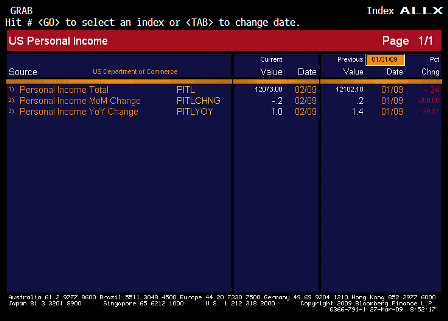
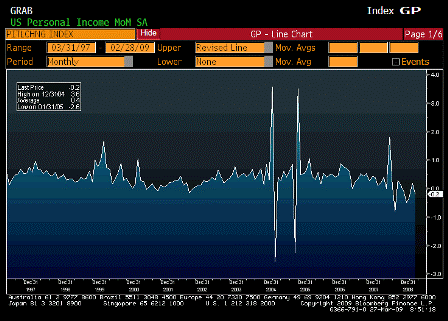
Personal Income MoM (Feb)

Survey -0.1%
Actual -0.2%
Prior 0.4%
Revised 0.2%

 
Karim writes:

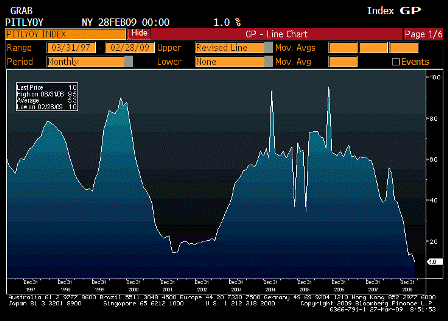
  • Personal income down 0.2%, down 4 of last 5mths, and up 1% y/y
  • Wage and salary income down 0.4%, down 4mths in a row, and -0.2% y/y
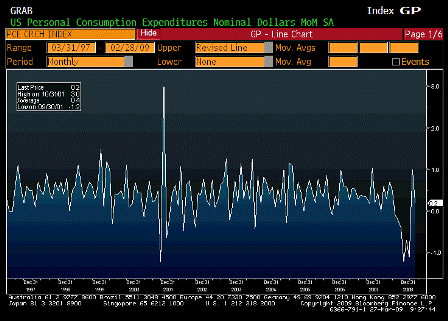
  • Personal spending up 0.2%, and down 0.2% in real terms
  • Based on Jan-Feb data, real Q1 spending may be flat from -4.3% in Q4
  • But because of weakening trend thru Q1, sets up for another negative in Q2
  • Saw one forecaster change Q1 estimate from -7.2% to -6.5% and leave Q2 estimate unch at -4.8%

[top][end]

Personal Income YoY (Feb)

Survey n/a
Actual 1.0%
Prior 1.4%
Revised n/a

[top][end]

Personal Income ALLX (Feb)

[top][end]

Personal Spending (Feb)

Survey 0.2%
Actual 0.2%
Prior 0.6%
Revised 1.0%

[top][end]

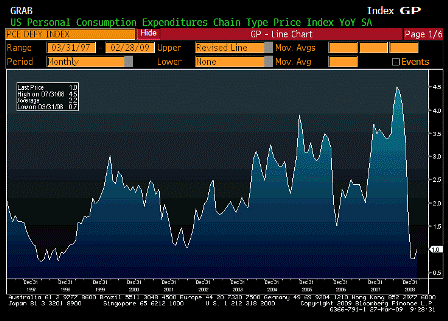
PCE Deflator YoY (Feb)

Survey 0.8%
Actual 1.0%
Prior 0.7%
Revised 0.8%

[top][end]

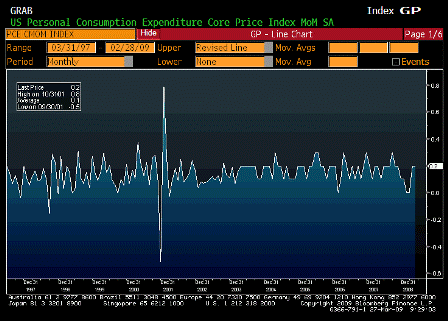
PCE Core MoM (Feb)

Survey 0.2%
Actual 0.2%
Prior 0.1%
Revised 0.2%

[top][end]

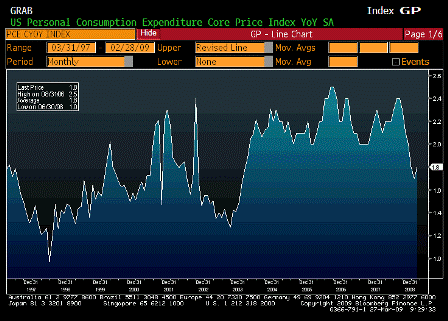
PCE Core YoY (Feb)

Survey 1.6%
Actual 1.8%
Prior 1.6%
Revised 1.7%

[top][end]

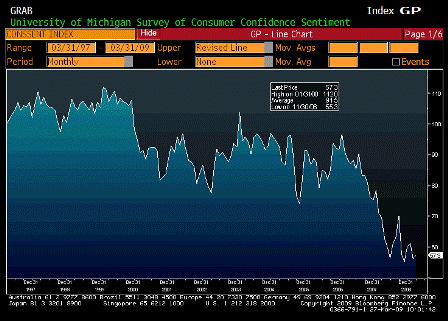
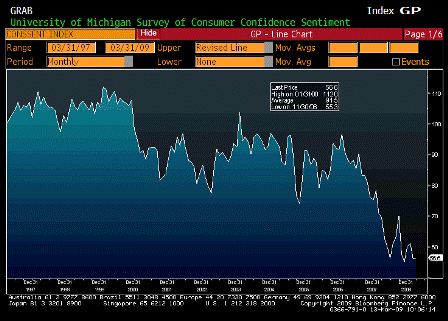
U of Michigan Confidence (Mar F)

Survey 56.8
Actual 57.3
Prior 56.6
Revised n/a

 
Karim writes:

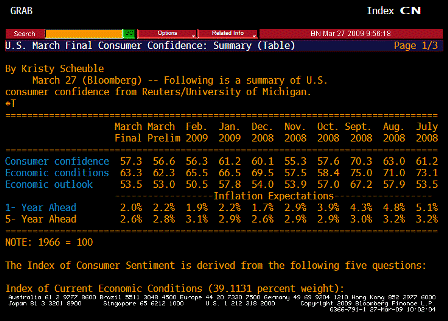
  • Final Michigan survey for March showed small upward revision in confidence: 56.6 to 57.3 (Feb was 56.3)
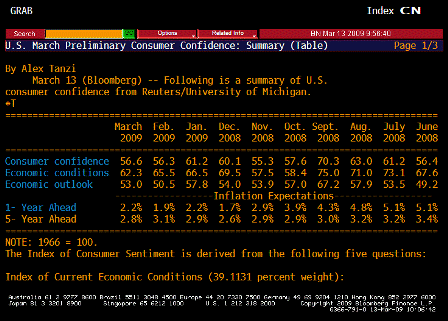
  • 5-10yr inflation expectations revised lower: 2.8 to 2.6 (Feb was 3.1)
  • [top][end]

    U of Michigan Confidence TABLE Inflation Expectations (Feb)


    [top]

UK inflation 3.2%


[Skip to the end]

Looks to me like the theory that a large output gap/high unemployment will control ‘inflation’ (for anything more than the very short term) is about to fall by the wayside, just like the theory that a small output gap would cause higher inflation fell by the wayside in the late ’90s.

UK Inflation Rate Unexpectedly Rose in February

by Svenja O’Donnell

Mar 24 (Bloomberg) — The U.K. inflation rate unexpectedly rose in February after higher food costs and the weakness of the pound sustained price pressures even as Britain’s recession deepened.

Consumer prices rose 3.2 percent from a year earlier, the Office for National Statistics said today in London. The median forecast of 28 economists was for 2.6 percent. Officials said that Bank of England Governor Mervyn King will explain the increase in a letter to the government today after the rate breached its 3 percent upper limit.

“We’ve got such huge spare capacity in the economy,” James Knightley, an economist at ING Financial Markets in London. “Inflation pressures are going to be very weak indeed in the months to come. The process will continue through this year and into the next.”

Maybe.


[top]

In case you thought the Swiss National Bank understands its monetary system


[Skip to the end]

Interesting the legendary Swiss National Bank doesn’t yet understand it’s own monetary system.

Seems their understanding has yet to move beyond the days of the gold standard.

SNB Moves Are Defense Against Deflation, Jordan Says

by Simone Meier

Mar 19 (Bloomberg) — Swiss central bank Governing Board member Thomas Jordan comments on the economic outlook, the SNB’s use of unconventional policy tools and deflation risks. He made the remarks in a speech in Zurich today.

On currency measures:

“From the SNB’s point of view, the current currency-market measures are serving as an insurance against the threat of an unwelcome strong appreciation of the franc. At the same time, they’re serving as defense against deflation.”

Yes, the ‘deflation’ from lower costs of falling export prices that drive down domestic wages, profitability, and asset prices.

“The SNB’s currency purchases don’t have anything to do with a ‘beggar thy neighbor’ policy and must not be interpreted as the beginning of a currency war. It’s not about Switzerland creating advantages with a weak franc.”

He can call it whatever he wants. Functionally it’s a policy to keep their currency weak enough to keep export prices from falling. ‘Beggar thy neighbor’ is not a matter of degree. It means leaning on your neighbors domestic demand for your own employment purposes.

This is what happens when those running a government don’t understand how their non convertible currency works.

“Our purchases on the currency market are only to be seen as an additional instrument in times of zero-rate policy to fight the deflation threat.”

Call it what you want, mate. It’s a dead on beggar thy neighbor policy by ‘previous’ definition.

On unconventional tools:

“The use of unconventional measures doesn’t go without risks. On one hand, effects and side effects aren’t as well known as those of the conventional monetary policy.

First, they are highly unsure of the effects of ‘conventional monetary policy’ as per their own econometric research and theory.

Second, the effects of ‘unconventional measures’ are not only not well known, they are not understood at all.

Ironically, however, they are easier to understand, they alter the term structure of rates and remove interest income from the non government sectors.

And selling your currency to buy FX is an inflationary bias that drives down your currency and increases local currency prices of imports and exports.

On the other hand, it’s an intentional over-supply of the economy with liquidity.

Whatever that means in this context. Close questioning of what this means operationally reveals it’s empty rhetoric, all based on the backwards notion that the banking system needs reserves to be able to make loans.

There needs to be an immediate exit of unconventional measures once the monetary stimulus can be reduced. The assessment of the current crisis means that the SNB has to take these risks.”

There are no such risks. They don’t know how their own monetary system works.

The SNB “has to already engage itself with the question of a timely exit of these measures, however. Even with all uncertainty in forecasts, there’s certainty that there will be quieter times in the future. The exit of unconventional measures has to immediately happen once the monetary stimulus can be reduced. That’s the case when tensions on money and credit markets are over and inflation risks are increasing along with an economic recovery.”

“The dosage of monetary policy isn’t easy in the current environment. The assessment of current risks is clearly in favor of rather too much monetary stimulus than too little.”

The SNB is “confident” it will be able “reduce liquidity” when the time comes.

This is all non-sensical.


[top]

Re: Comment on Fed Balance Sheet


[Skip to the end]

(email exchange)

>   
>   On Thu, Mar 19, 2009 at 6:15 PM, Mauer wrote:
>   
>   Just to clarify: are there any circumstances in which the Federal Reserve
>   could “create” inflation or hyperinflation a la the Bank of Zimbabwe?
>   

Yes, if they raised rates high enough.

Seriously!

That would mean a large jump in government deficit spending on interest and a hike in the marginal cost of production. This is what happened after Volcker raised rates to over 20%. That inflation broke only because deregulation of natural gas in 1978 brought out enough supply to replace 15 million barrels per day of crude that was being burned for power, which broke the Saudi monopoly.

>   
>   Or does the unique privilege accorded to the central bank having the
>   reserve currency always preclude that?
>   

Just the way any non convertible currency works. Inflation isn’t all that much of a function of interest rates.


[top]

Paulson & Co Buys Anglo American


[Skip to the end]

Might be the idea I’ve had for a while- if you own a gold mine, you incur expenses mining and don’t get taxable income until the gold is sold, and often you can sell it far forward at more than the carry and then roll the forwards as well to further defer taxable income?

Paulson & Co Buys Anglo American AngloGold Stake

by Jeffrey Sparshott

Mar 17 (Dow Jones) — Hedge-fund firm Paulson & Co. has paid $1.28 billion to buy Anglo American PLC’s (AAUK) remaining stake in South African miner AngloGold Ashanti Ltd. (AU), as the firm run by John Paulson beefs up its bet on gold.

Paulson, a merger-focused investor who became a hedge fund legend for making billions of dollars betting against subprime mortgages in 2007, has been piling up his gold holdings recently with stakes in several miners, including more than $450 million worth of stock in Kinross Gold Corp. (KGC), according to securities filings. He even introduced to investors a new share class pegged on the price of gold.

It’s unclear why Paulson has been upping his bet on gold, but he and several other hedge-fund managers have been getting more into gold recently, including David Einhorn of Greenlight Capital. A bet on gold is typically a flight to safety against an expected drop in the value of currencies.

Many of the hedge funds that have been buying stakes in mining companies, as well as physical bars of gold, have been doing so in anticipation of nations defaulting on their debt, which could lead to higher gold prices. Inflation and even deflation can also lead to rising gold prices.

Paulson spokesman Armel Leslie said: “We believe AngloGold Ashanti is one of the best managed and most undervalued of the major global gold mining companies. We look forward to the implementation of their global expansion strategy.”

Anglo American’s long-standing policy has been to sell down its stake in the South African gold miner. But the disposal of a large block of shares was an “opportunistic” sale made after advisers at Deutsche Bank brought Anglo American in contact with the U.S. hedge fund, people with knowledge of the transaction said.

As recently as Feb. 19 Anglo American said in a regulatory filing that it “intends to remain a significant shareholder in AngloGold Ashanti in the medium term.”

Uncertainty about when Anglo American would sell down its stake weighed on AngloGold’s shares.

“The Anglo American share overhang, with its depressing effect on our share price, has now gone and I’m excited about the opportunities that lie ahead for us,” AngloGold Chief Executive Mark Cutifani said.

Cutifani welcomed Paulson as one of AngloGold’s biggest shareholders. The fund bought 39.91 million shares from Anglo American, or 11.3% of outstanding shares.

“We’re extremely pleased that someone with John Paulson’s track record and reputation has chosen AngloGold Ashanti as one of his investments through which to increase his exposure to the gold market,” Cutifani said.

Anglo American said it would use the funds for general corporate purposes.

The miner’s net debt – about $11 billion at the end of 2008 – has weighed on its share price.

Anglo American now holds no shares in the gold miner, the company said.

Paulson paid $32 per share.

Anglo American has reduced its stake in AngloGold several times since announcing it would relinquish its majority holding in 2006. Anglo held 42% of AngloGold in April 2006, 17.3% as of Oct. 9, 2007 and 13.3% as of Feb. 5, and 11.88% as of Feb. 18, according to filings with the U.S. Securities and Exchange Commission.


[top]

Swiss National Bank


[Skip to the end]

>   
>   On Thu, Mar 12, 2009 at 9:10 AM, EDWARD wrote:
>   
>   In conjunction with lowering rates to 0.25% (3m libor target- this is important- its NOT
>   the overnight or refi rate) and maintaining a 0-75bp range they also announced the following:
>   
>   *SNB PLANS TO BUY WISS FRANC BONDS
>   *SNB SAYS TO BUY CURRENCIES TO AVOID FRANC APPRECIATION
>   

Beggar thy neighbor export driven policy here too- yet another player trying to drive down their currency!

Failing to see the advantages of increasing domestic demand, seems most are turning to policies to drive exports.

Too bad we don’t have the leadership to take advantage of this once in a lifetime opportunity ratchet up our real standard of living.

>   
>   *SNB TO BUY SWISS FRANC BONDS BY PRIVATE SECTOR
>   
>   With the following statements:
>   
>   *SNB SAYS RISING FRANC COMMENTS TIGHTENS MONETARY CONDITIONS
>   *SNB TO COUNTERACT RISK OF DEFLATION, ECONOMIC WORSENING
>   *SNB SAYS SWISS FRANC APPRECIATED SUBSTANTIALLY SINCE AUGUST 07
>   *SNB SEES ANNUAL INFLATION AT CLOSE TO ZERO FOR NEXT TWO YEARS
>   *SNB EXPECTS INCREASED CONTRACTION IN 1Q
>   *SNB SAYS SWISS EXPORT SECTOR PARTICULARLY HIT
>   *SNB SAYS ECON WORSENING HAS CONTINUED IN PAST TWO MONTHS
>   *SNB: SWISS AVG 2009 INFLATION SEEN -0.5%, 2010 INFLATION 0%
>   *SNB SAYS MAGNITUDE OF ECONOMIC CONTRACTION IN 4Q UNEXPECTED
>   
>   They are deploying all weapons, rightly perceiving the vast threat to their economy
>   and stepping up to the front lines- unlike the ECB who would still prefer to discuss
>   targeted limits to easing rates and inflationary threats which do not exist.
>   


[top]

Barker Says BOE Should Print Money


[Skip to the end]

And yet another central banker who doesn’t understand monetary operations…

Has to be a new low for the BOE.

Barker Says BOE Should Print Money as U.K. Recession Worsens

by Jennifer Ryan and Brian Swint

Mar 13 (Bloomberg) — Bank of England policy maker Kate Barker said the bank’s decision to buy assets with newly created money is necessary to prevent deflation as Britain’s recession shows signs of worsening.

Printing money “is the best course in order to achieve our objective of keeping inflation to target in the medium term.” “The downside risks to growth, and therefore to inflation, identified in the February inflation report were in danger of crystallizing,” she said. Barker said the impact of the reduction in the benchmark to lower levels had become “successively reduced” with each cut, and lower rates on their own would be insufficient to revive growth.


[top]

Re: In case you thought Romer knows how anything works


[Skip to the end]

(email exchange)

>   
>   On Thu, Mar 12, 2009 at 3:31 PM, Tom wrote:
>   
>   Christina Romer gave a speech on Monday at Brookings in which she
>   strongly argued for dollar devaluation as a tool to create economic
>   recovery.
>   

Continues the beggar they neighbor policies that Paulson pushed.

>   
>   This is the sort of thing that provides political cover for Fed Chairman Ben
>   Bernanke to pursue a more aggressive quantitative easing policy.
>   

Yes, of course he doesn’t matter for anything of consequence, but that’s another story.

>   
>   Romer, who is chair of the Council of Economic Advisors, praised FDR’s
>   1933 decision to allow the gold price to float up from $20.63/oz. to
>   $34.85/oz.
>   

Yes, should have floated it entirely.

Back then, the gold standard constrained even the US Treasury from borrowing.

We don’t have that issue, so moving the USD down for that reason is moot.

>   
>   That decision offers a template for what the Fed could do today, she said
>   (italics mine):
>   
>   This monetary expansion [in the wake of the 1933 devaluation] couldn’t
>   lower nominal interest rates because they were already near zero. What it
>   could do was break expectations of deflation.
>   

That pesky, ridiculous, ‘inflation expectations theory’ again!

>   
>   Prices had fallen 25% between 1929 and 1933. People throughout the
>   economy expected this deflation to continue. As a result, the real cost of
>   borrowing and investing was exceedingly high.
>   

Expectations had nothing to do with it. Lack of aggregate demand did. And the Treasury was revenue constrained due to the gold standard.

>   
>   Consumers and businesses wanted to sit on any cash they had because
>   they expected its real purchasing power to increase as prices fell.
>   

Not the reason. When on a gold standard, a rising value of gold is expressed by falling prices for everything else as gold is fixed.

Hence the revaluation upward of the price of gold which was a devaluation of the dollar. (Dollar buys less gold)

>   
>   Devaluation followed by rapid monetary expansion broke this deflationary
>   spiral. Expectations of rapid deflation were replaced by expectations of
>   price stability or even some inflation. This change in
>   expectations brought real interest rates down dramatically.
>   

No, deficit spending supported demand and broke the deflation.

>   
>   The change in the real cost of borrowing and investing appears to have had
>   a beneficial impact on consumer and firm behavior. The first thing that
>   turned around was interest-sensitive spending. For example, car sales
>   surged in the summer of 1933. One sign that lower real interest rates were
>   crucial is that real fixed investment and consumer spending on durables
>   both rose dramatically between 1933 and 1934, while consumer spending
>   on services barely budged.
>   

Must have been something else going on.

>   
>   Romer’s analysis of the Roosevelt devaluation parallels Bernanke’s almost
>   exactly.
>   

Comforting!

>   
>   Bernanke also has written that loose monetary policy was the key to the
>   economic recovery of 1933-34. Further on in her speech, Romer cautions
>   against letting up on stimulative measures too quickly, lest the economy
>   plunge back into recession, such as happened to the U.S. in 1937.
>   

In 1937 there was a new whopping social security tax that was ‘off budget’ and sent the economy into a tailspin as it drained billions of financial assets from the private sector.

Doesn’t anyone in DC know how any of it works?????


[top]

2009-03-13 USER


[Skip to the end]


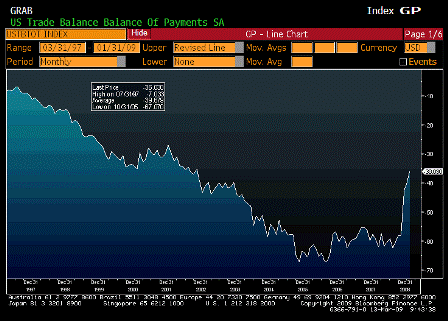
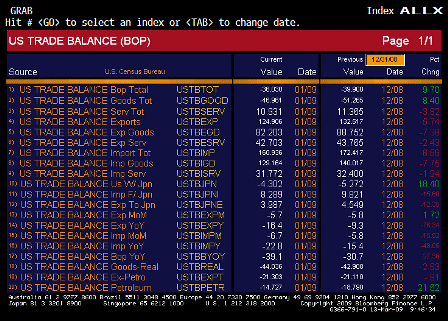
Trade Balance (Jan)

Survey -$38.0B
Actual -$36.0B
Prior -$39.9B
Revised n/a

[top][end]

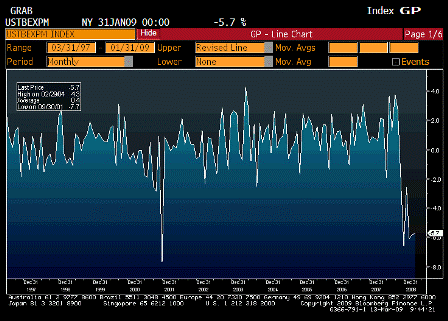
Exports MoM (Jan)

Survey n/a
Actual -5.7%
Prior -5.8%
Revised n/a

[top][end]

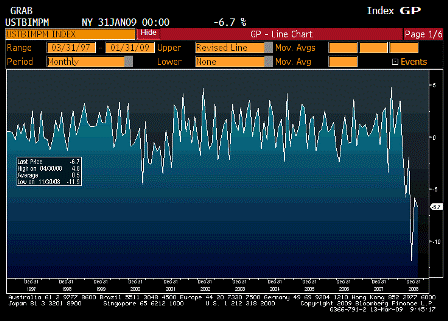
Imports MoM (Jan)

Survey n/a
Actual -6.7%
Prior -5.8%
Revised n/a

[top][end]

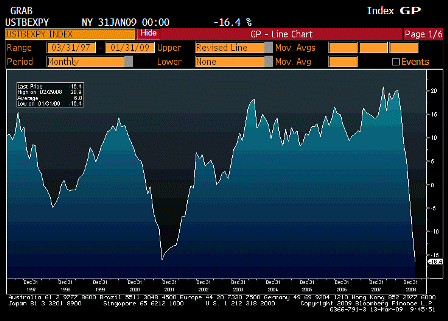
Exports YoY (Jan)

Survey n/a
Actual -16.4%
Prior -9.3%
Revised n/a

[top][end]

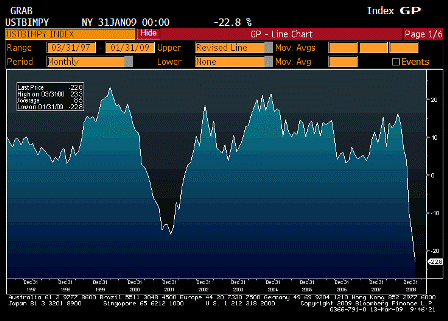
Imports YoY (Jan)

Survey n/a
Actual -22.8%
Prior -15.4%
Revised n/a

[top][end]

Trade Balance ALLX (Jan)

[top][end]


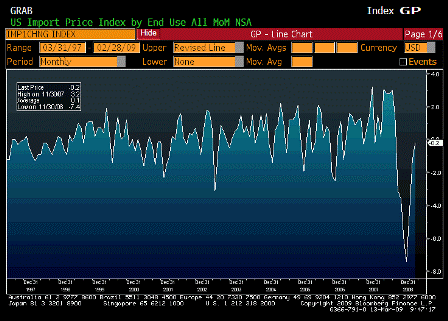
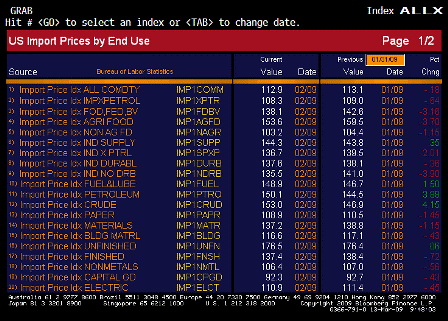
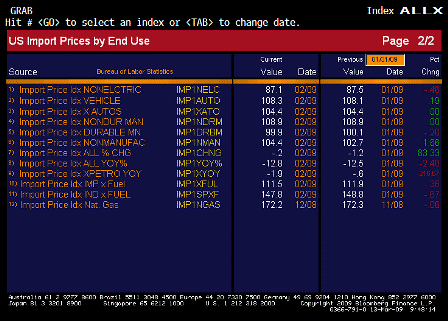
Import Price Index MoM (Feb)

Survey -0.7%
Actual -0.2%
Prior -1.1%
Revised -1.2%

[top][end]

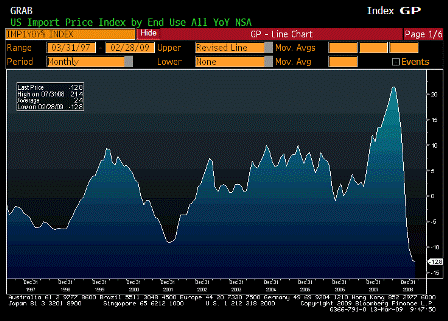
Import Price Index YoY (Feb)

Survey -13.5%
Actual -12.8%
Prior -12.5%
Revised -12.5%

[top][end]

Import Price Index ALLX 1 (Feb)

[top][end]

Import Price Index ALLX 2 (Feb)

[top][end]


U of Michigan Confidence (Mar P)

Survey 55.0
Actual 56.6
Prior 56.3
Revised n/a

[top][end]

U of Michigan TABLE Inflation Expectations (Mar P)


[top]