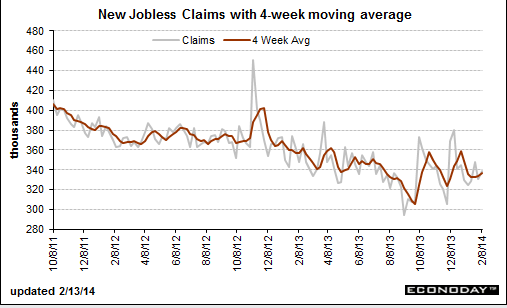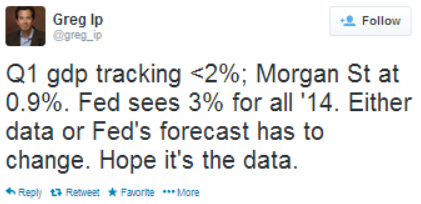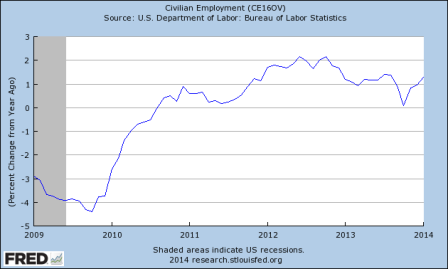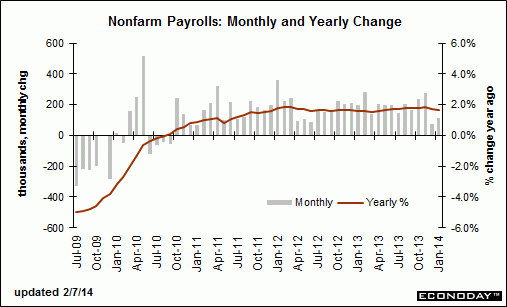
Charts from the last few days

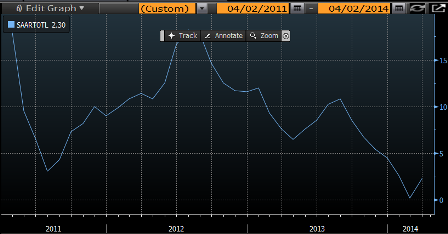
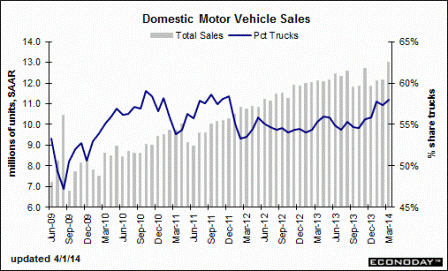
Total vehicle sales year over year showed some post winter bounce.

The narrative was that March started off slow but picked up due to large incentives for the last week.

We’ll see if it all holds up for April.

Full size image

Full size image

Full size image

Factory orders ‘bounced’ from large declines but not yet enough to ‘make up’ for the declines.

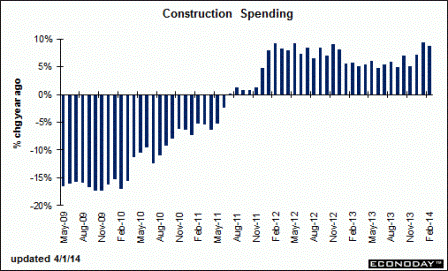
And regarding capital goods, as with construction measures, I remain concerned that what looked like a year end spike was tax driven and ‘borrowed’ from this year.


Highlights
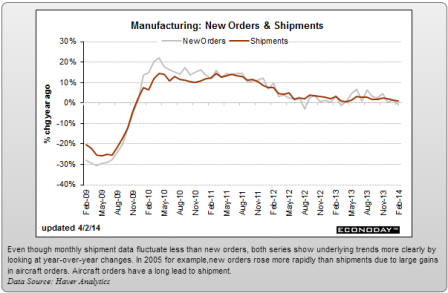
Factory orders bounced back strongly in February, up 1.6 percent to edge above the high end of the Econoday consensus. The month got a major lift from a 13.4 percent upswing in commercial aircraft orders. A 3.0 percent gain in motor vehicle orders also helped the total. But the total excluding transportation orders, which is a closely tracked reading, is also healthy, up 0.7 percent following 0.1 percent declines in the prior two months.

There is, however, a negative in the February numbers and that’s a sizable 1.4 percent decline in nondefense capital goods orders excluding aircraft. This is considered a core reading on the outlook for business investment. February’s decline more than reverses a 0.8 percent rise in January. Orders for this reading were especially weak in December, at minus 1.6 percent.

Other data include a weather-related bounce in shipments, to plus 0.9 percent following January’s 0.7 percent decline. Inventories rose 0.7 percent, in line with shipments and keeping the factory sector’s inventory-to-shipment ratio unchanged at 1.30. Unfilled orders are a positive, up 0.3 percent.

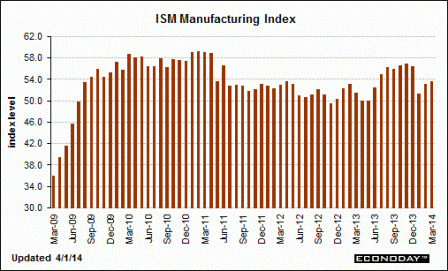
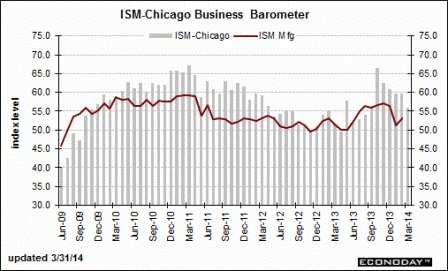
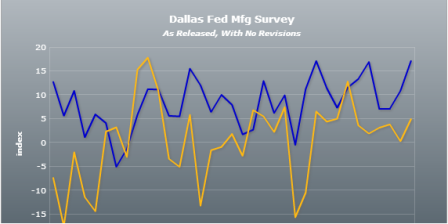
This report is mostly positive if it weren’t the decline underway in core capital goods orders, a decline that points to weakness in the business outlook. Early indications on the manufacturing for March have also been mostly positive, with the exception of yesterday’s slowing in the ISM employment index.

Full size image

Full size image

Full size image

Full size image


Highlights
Global manufacturing has softened in recent months. At 52.4 in March, down from 53.2 in February, the J.P.Morgan Global Manufacturing PMI fell to a five-month low, but remained above its average for the current 16-month sequence of expansion.

Global manufacturing production increased for the seventeenth consecutive month in March. However, the rate of expansion eased to a five-month low, mainly on the back of a slowdown in Asia. Growth of total new orders also eased slightly, despite improved inflows of new export business.

Full size image
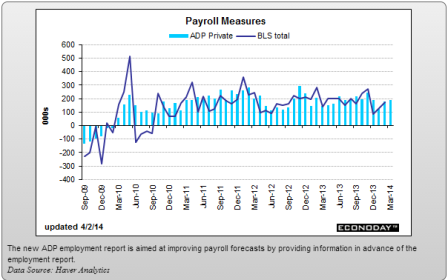
Employment, generally a lagging indicator, was up some, but the chart still seems ‘uninspiring’ at best:
Full size image
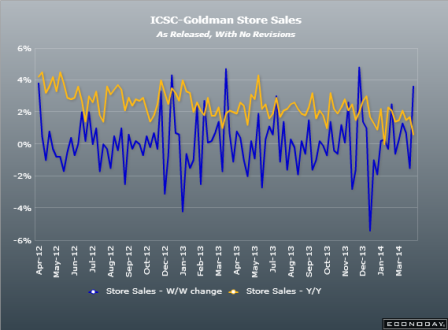
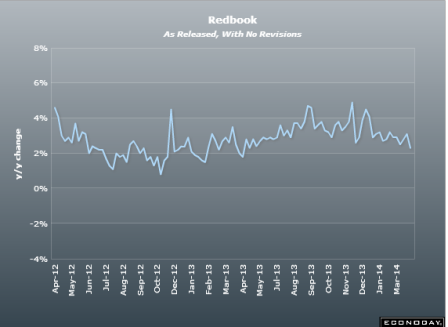
Not to give this all that much weight, and they are limited surveys with Easter distortions as well, but the year over year lines aren’t showing any rebound yet:
Full size image

Full size image

Purchase Mortgage applications up 1% for the week but down 19% vs last year.

What I’m saying is that Jan and Fed were weather depressed. And with the federal deficit now running maybe below 3% of GDP, down several % from last year, some pro active and some from the auto stabilizers, my concern is that the underlying support for a bounce is no longer there and the rate of growth continues to decelerate. Yes, lending is up some, but it could be the financing of utility bills and inventory/reduced cash flow growth, which takes away from future sales.
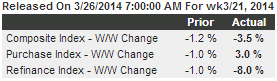

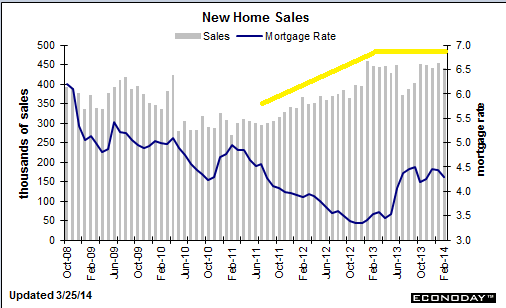
Mtg purchase apps, New Home Sales, Durable goods orders still not performing

MBA Purchase Applications


Highlights
Purchase applications rose 3.0 percent in the March 21 week but failed to lift the year-on-year rate which is down a very sharp 17.0 percent. The year-on-year rate is a reminder of how important cash buyers are right now in the housing market and also a reminder that mortgage rates this year are less favorable than this time last year. The refinance index fell 8.0 percent in the week. Rates rose in the week with the average 30-year mortgage for conforming loans ($417,500 or less) up 6 basis points to 4.56 percent.

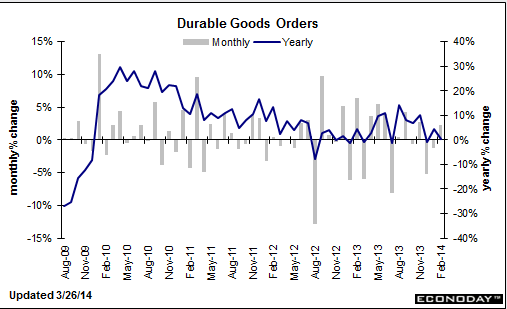
Durable Goods Orders


Highlights
The latest durables orders report was mixed with the headline strong and the core slowing. New factory orders for durables in February rebounded 2.2 percent, following a decrease of 1.3 percent in January. Analysts projected a 1.0 percent rise. Excluding transportation, durables orders slowed to a 0.2 percent rise in February, following a 0.9 percent boost the prior month.

The transportation component jumped a monthly 6.9 percent after dropping 6.2 percent the month before. Within transportation, the gain was led by increases in orders for defense aircraft although nondefense aircraft and motor vehicles also were strong.

Outside of transportation, orders were up slightly but very mixed by subcomponents. Gains were seen in primary metals, fabricated metals, computers & electronics, and “other.” Notably offsetting were declines in machinery and electrical equipment.

There was slippage in investment plans. Nondefense capital goods orders excluding aircraft decreased 1.3 percent in February, following a rebound of 0.8 percent the month before. Shipments for this series advanced 0.5 percent, following a 1.4 percent drop in January.

The latest durables report suggests that manufacturing is not as strong as indicated by recent manufacturing surveys.

Note the year over year line:

From yesterday, the charts looks like sales were rising nicely before being flattened by the tax hikes and spending cuts:

Still too early to tell, but so far charts aren’t showing much of a ‘bounce’ from the weather yet.

Wholesale trade

Worse than expected, and only one number subject to revision, with the govt deficit at only 3% of GDP this kind of slowdown can turn pro cyclical:

Wholesale Trade


Highlights
Rising inventories, tied in part to weather-related shipping snags, are a rising threat to economic growth. Wholesale inventories rose 0.6 percent in January against a 1.9 percent plunge in sales, a heavy mismatch that drives the sector’s stock-to-sales ratio up 2 notches to 1.20 which is one of the heaviest readings of the recovery.

Details show large builds in autos, metals, and machinery, three groups where January sales were weak. Nondurable goods show especially large builds against especially soft sales including paper, drugs and petroleum.

Data on factory inventories, which were released last week with the factory orders report, showed an unwanted build and a dip in sales that pushed the stock-to-sales ratio near its heaviest level of the whole recovery. Inventories in the retail sector, with December the latest available report, are the heaviest of the recovery and are building at a time when sales are slowing — not accelerating. Retail data for January will be posted with the business inventories report on Thursday.

Market Consensus before announcement
Wholesale inventories showed a 0.3 percent build in December and were well matched by a 0.5 percent rise in wholesale sales that left the stock-to-sales ratio for the wholesale sector unchanged at 1.17. This ratio has held between 1.18 and 1.17 since May.

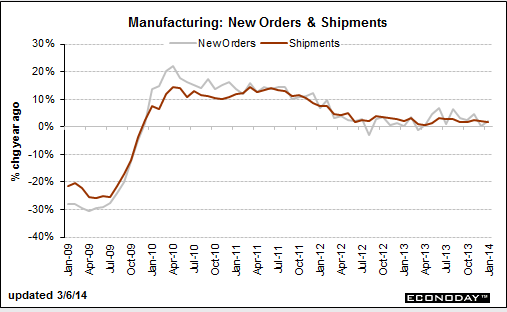
Factory orders- another Dec print revised down


Highlights
Frigid weather in January didn’t help the factory sector where orders fell 0.7 percent following a downwardly revised 2.0 percent decline in December. Also revised lower is the ex-transportation reading for January, to a slim plus 0.2 percent vs an initial reading (in last week’s durable goods report) of plus 1.1 percent. Non-durables are the new data in today’s report which show a 0.4 percent decline on weakness in chemical products.

Orders for primary metals show a third month of contraction, at minus 1.2 percent in January, with transportation equipment a second month of contraction, at minus 5.7 percent vs a 12.1 percent plunge in December. The bulk of the weakness in transportation is tied to the ups and down of commercial aircraft orders but also to motor vehicles, where orders fell 0.9 percent following December’s 1.2 percent decline. Machinery also shows a decline in January along with electrical equipment and furniture, the latter two of which are tied to housing. The plus side shows a big gain for fabricated metals, one however that follows a big loss in December, and a gain for computer equipment that doesn’t offset a much larger December decline.

Shipments fell 0.3 percent for a second month in a row while inventories rose 0.2 percent, a moderate build but enough, given the weakness in shipments, to raise the inventory-to-shipments ratio one notch to the heavy side to 1.30. Unfilled orders were unchanged in the month.

There is a positive in the report and that’s capital goods orders excluding aircraft, a core reading on business investment that rose 1.5 percent. Still, the gain isn’t enough to offset a 1.6 percent decline for this reading in the prior month.

Factory orders are a choppy series, sometimes up and sometimes down, but the trendline has been flat at best. Anecdotal indications on February point to another month of weakness for shipments, weakness tied to heavy weather, but, in what hopefully points to a bounce back for the spring, respectable strength for orders.

Chart looks like the weather turned bad in May:

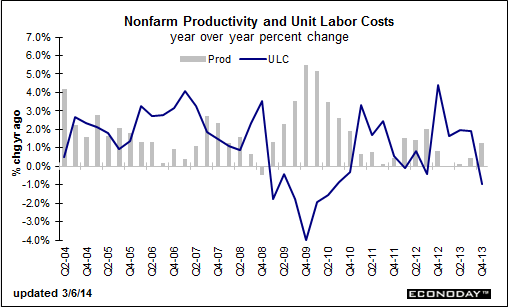
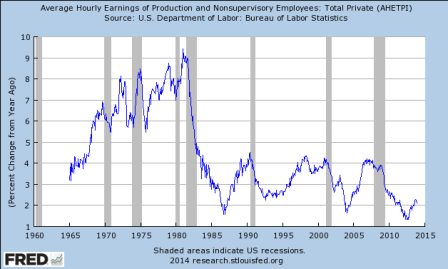
Lots of talk about ‘wage inflation’ but not showing up for real so far:


Highlights
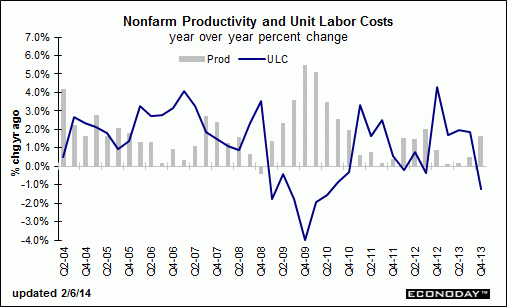
Productivity in the fourth quarter rose a revised1.8 percent after a 3.5 percent boost the prior quarter. Expectations were for 2.4 percent increase. Unit labor costs declined an annualized 0.1 percent, following a decrease of 2.1 percent in the third quarter. The market forecast was for a 0.5 percent decline.

The rise in productivity reflected a 3.4 percent jump in non-farm output, following a boost of 5.4 percent in the third quarter. Hours worked increased 1.6 percent in the fourth after rising an annualized 1.9 in the third quarter. Compensation firmed to a 1.7 percent rate after rising 1.3 percent in the third quarter.

Year-on-year, productivity was up 1.3 percent in the fourth quarter versus up 0.5 percent in the third quarter. Year-ago unit labor costs were down 0.9 percent, compared to up 1.9 percent in the third quarter.

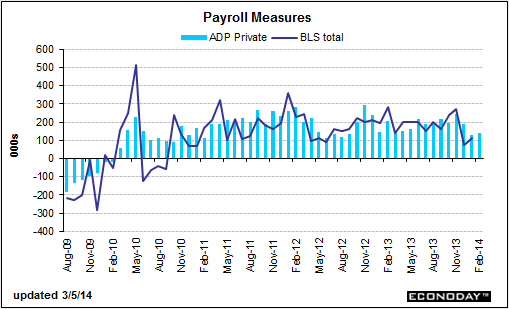
ADP, purchase apps, ISM

Prior months revised down as well:

ADP:

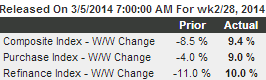
MBA Purchase Applications:

Highlights
Wild swings appear to be the rule for weekly mortgage application data. The purchase index jumped 9.0 percent in the February 28 week following declines of 4.0 percent and 6.0 percent in the two prior weeks. Though the latest week is higher, the year-on-year rate fell 4.0 percentage points to minus 19 percent. The refinance index jumped 10.0 percent in the week following an 11.0 percent decline in the prior week.

The latest week got a lift from a drop in mortgage rates, down 6 basis points for 30-year conforming mortgages ($417,500) to an average 4.47 percent.

It’s hard to make much of this report, but the year-on-year rate for purchase applications does point to continued weakness for home sales.

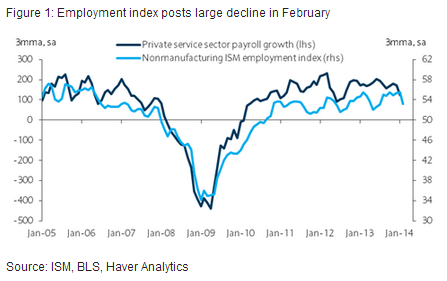
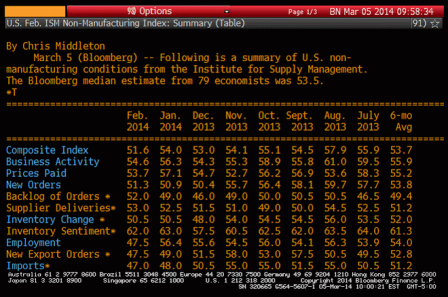
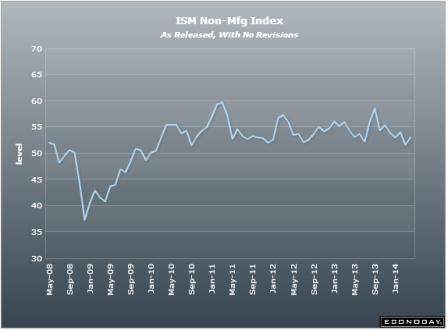
In particular, there was a significant drop in the employment index, which plunged 8.9 points to 47.5. This is its lowest level since 2010 and commentary from respondents suggests that some of this effect could be due to the implementation of the Affordable Care Act.

Outside of the employment index, however, the new orders index climbed to 51.3 (previous: 50.9), and the headline index has now remained above the breakeven level of 50 for 49 consecutive months. Overall we would suggest that this is a softer report than January, but we do not yet think that it marks a significant slowdown in the pace of nonmanufacturing activity growth.

Note export orders down again.

Forecasters have been counting on an increase in export growth:


Full size image

Lawler on Hovnanian: Net Home Orders Far Short of Expectations; Sales Incentives Coming

By Bill McBride

March 5 — From housing economist Tom Lawler:

Hovnanian Enterprises, the nations sixth largest home builder in 2012, reported that net home orders (including unconsolidated joint ventures) in the quarter ended January 31, 2014 totaled 1,202, down 10.6% from the comparable quarter of 2013. The companys sales cancellation rate, expressed as a % of gross orders, was 18% last quarter, up from 17% a year ago. Home deliveries last quarter totaled 1,138, down 4.2% from the comparable quarter of 2013, at an average sales price of $351,279, up 6.1% from a year ago. The companys order backlog at the end of January was 2,438, up 6.0% from last January, at an average order price of $368,243, up 4.3% from a year ago.

Hovnanians net orders in California plunged by 43.4% compared to a year ago. Hovnanians average net order price in California last quarter was $653,366, up 46.8% from a year ago and up 83.2% from two years ago. Net orders in the Southwest were down 10.0% YOY.

Here is an excerpt from the companys press release.

“While our first quarter is always the slowest seasonal period for net contracts, the strong recovery trajectory from the spring selling season of 2013 has softened on a year-over-year basis. Net contracts in the months of December, January and February have not met our expectations. In addition to the lull in sales momentum, both sales and deliveries were impacted by poor weather conditions and deliveries were further impacted by shortages in labor and certain materials in some markets that have extended cycle times,” stated Ara K. Hovnanian, Chairman of the Board, President and Chief Executive Officer.

“We are encouraged by the fact that we have a higher contract backlog, gross margin and community count than we did at the same point in time last year. Furthermore, we have taken steps to spur additional sales in the spring selling season, including the launch of Big Deal Days, a national sales campaign during the month of March. Our first quarter has always been the slowest seasonal period and we expect to report stronger results as the year progresses. We believe this is a temporary pause in the industry’s recovery, and based on the level of housing starts across the country, we continue to believe the homebuilding industry is still in the early stages of recovery,” concluded Mr. Hovnanian.

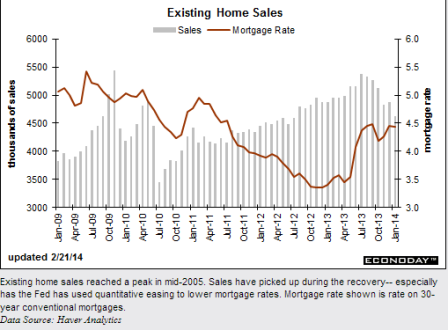
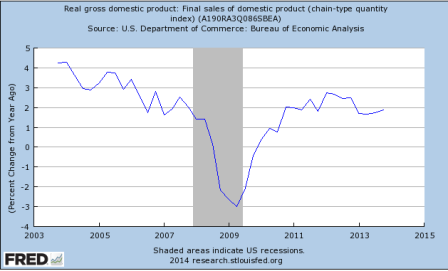
existing home sales chart, real final sales chart (pre weather)

Yes, the Fed doesn’t like QE and wants to taper, but seems to me they don’t want mortgage rates this high either. They know the only way the market will ‘bring down rates’ is if the economic weakness persists. And they suspect it very well may persist unless rates come down.

Their remaining option is TIRT (term interest rate targeting) which has yet to be discussed.

Existing Home Sales

Highlights
It’s more than just weather that’s clobbering the housing market. High prices and tight inventory aren’t helping either as existing home sales fell 5.1 percent in January to a 4.620 million annual rate. The year-on-year rate is also at minus 5.1 percent, a sharp contrast to the year-on-year median price which is up 10.7 percent.

Supply of homes relative to sales did rise to 4.9 months from 4.6 months but the improvement is tied mostly to the drop in sales. Prices did come down in the month but from already high levels with the median price down 4.5 percent to $188,900.

Weather was especially cold in January and no doubt contributed to the sales weakness, especially in the Midwest, where sales fell 7.1 percent in the month, and also the Northeast where the decline was 3.1 percent. But weather in California wasn’t a problem, yet sales in the West fell 7.3 percent which the National Association of Realtors points to as evidence of non-weather constraints.

Unattractive mortgage rates are another factor holding down sales. All cash buyers continue to hold up the market, accounting for 33 percent of all sales vs 32 percent in December. In contrast, first-time buyers, who are especially sensitive to the soft jobs market, continue to account for less sales, at 26 percent vs December’s 27 percent.

This is the 5th decline in the last 6 months for this series and lack of improvement in the jobs market, not to mention this month’s severe bout of heavy weather, point to more trouble for February. For the economy, the housing market needs to snap back sharply this spring. The Dow is showing little initial reaction to today’s report.


Full size image

Not exactly gang busters even before the weather reduced incomes.

And the bad weather it’s like hurricane sandy but without the insurance spending and federal relief spending.


Full size image

Retail sales and jobless claims

From CS:

JAY FELDMAN : Q4 GDP revision is now tracking 2.4 on our estimates. It was tracking 2.7 before retail sales… and down from the initially reported 3.2.


Note October/November/December all marked down lower as well in US retail sales…and even prior to this period as well – will bring down Q4 GDP tracking for consumption.

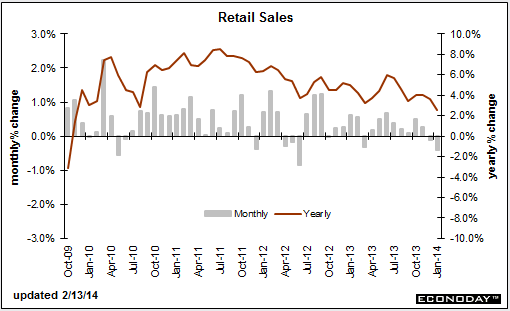
Again, the income to support sales just doesn’t seem to be there, as the sub 3% federal deficit doesn’t seem to have been providing the spending needed to offset the demand leakages (unspent income):

Retail Sales

Highlights
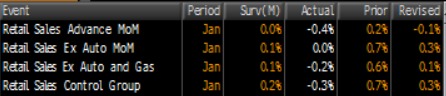
Overall retail sales in January fell 0.4 percent, following a decrease of 0.1 percent in December (originally up 0.2 percent). The market consensus was for a 0.1 percent dip.

Autos pulled down the total. Motor vehicle & parts declined 2.1 percent, following a decrease of 1.8 percent in December. Excluding autos, sales were unchanged after gaining 0.3 percent the month before (originally up 0.7 percent). Analysts called for a 0.1 percent rise. Gas station sales increased 1.1 percent after jumping 1.5 percent in December. Excluding both autos and gasoline, sales slipped 0.2 percent after rising 0.1 percent in December. The consensus was for a 0.2 percent rise.

In the core, strength was seen in electronics & appliance stores; building materials & garden equipment; and grocery stores. Declines were seen in furniture & home furnishings; health & personal care; clothing; sporting goods, hobby, et al; department stores; nonstore retailers; and food services & drinking places.

The latest report suggests that fourth quarter GDP may be revised down and that first quarter GDP could be soft. Again, atypically adverse weather likely affected the data. Equity futures declined on the news.

When I squint at this chart if anything it seems to have bottomed and nudging irregularly higher:

Jobs, productivity

It’s going to take more than two weak prints to sway the Fed…

I see the odds of this expansion cycle being over increasing with each release, as the drivers of H2 continue to fade- housing, cars, income, inventory, and, at least for now, jobs.

And the federal deficit- the economy’s ‘allowance’ from Uncle Sam- is no longer enough to offset the demand leakages/unspent income inherent in the institutional structure.

That is, we’re flying without a net.

*note that the household survey was about 1 million jobs short of the payroll survey over the last year and routinely dismissed as an inferior indicator, and the rate of growth remains well below the Nonfarm Payroll report even after today’s release:


Full size image

The jump in productivity is making the rounds. It takes a lot more top line growth to need 200,000 new employees every month with this kind of productivity growth. Could be the ‘extra’ jobs we’ve seen, implying much lower productivity increases, were due to getting ‘over lean’ during the recession, and that ‘deficiency’ may now be behind us.

And note that the lower average job growth as per the household survey has been more in line with productivity over the last year.

I’m also thinking those with expiring benefits suddenly willing to take lower paying jobs will simply displace others already working in those job, which will work to keep hourly wages lower than otherwise.

Not updated for today’s yoy print of +1.9%:


Full size image