Yes, the Fed can set mortgage rates if it wants to!

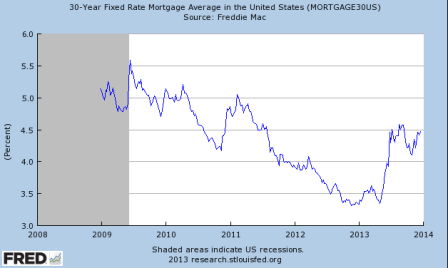
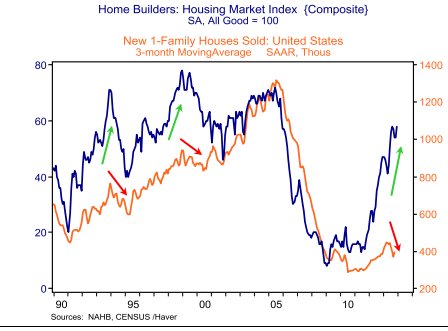
One of the main reasons for the Fed’s (near) 0 rate policy is to support the housing market. And after nearly 5 years of 0 rates, and mortgage rates dipping below 3.5%, though ‘off the bottom’ housing remains far below what would be considered ‘normal’.

And then, not long ago, and immediately after the Fed first hinted at reducing its QE purchases, mortgage rates spike by over 1%:

Full size image

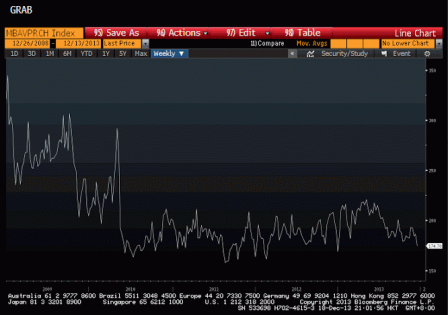
And, since then, mortgage refinance activity has all but vanished, and the number of mortgage applications for the purchase of homes swung from increasing nicely to decreasing alarmingly:

Full size image

The ‘Fed speak’ for this rise in rates ‘tightening financial conditions’. And one of the Fed’s concerns about tapering QE purchases was the concern that higher mortgage rates would slow the recovery. Therefore, in addition to announcing the reduction in purchases of Treasury securities and mortgage backed securities, they were careful to emphasize what’s called their ‘forward guidance’ with regard to the Fed funds rate. That is, they stated that they expected to be keeping short term rates low for the next couple of years or so, and maybe even longer than that, maybe even after unemployment goes below 6.5%, and presuming their inflation measure stops decelerating and moves back up towards their target.

Unfortunately for the Fed mortgage rates moved higher after the announcement, and not due to a burst of mortgage applications (see above charts), and not due to any immediate drop in Fed purchases, which continue in large size. Instead, what the Fed sees is a market that believes the Fed changed course because it believes the economy is recovering, and with recovery just around the corner rate hikes will come sooner rather than later. And with rate hikes on the way, investors would rather wait for the higher yields they believe are just down the road, than take the lower yields today.

Therefore, if you want to borrow today to buy a house, you have to pay investors a higher interest rate. And if you don’t want to pay the higher rate today, investors are willing to wait for those higher rates, and the house doesn’t get sold. And when the house doesn’t get sold the Fed leaves rates low for that much longer and their forecast again (they’ve been over estimating growth for 5 years now) turns out to be wrong.

So with ‘forward guidance’ not doing the trick, is there anything else can the Fed can do if it wants mortgage rates back down? Yes!

First, they can simply announce that they are buyers of 10 year treasury notes at, say, a yield of 2%, in unlimited quantities.

This would immediately bring the 10 year yield down from 2.92% to no more than 2%, and most likely the Fed would buy few if any at that price. That’s because when people know the Fed will buy at a price, they know they can then buy at a slightly lower interest rate, knowing that ‘worst case’ they can always sell to the Fed at a very small loss. That way they can earn the, say, 1.99% yield for as long as they hold the 10 year Treasury note. And there’s always a chance yields come down further as well, which means their securities increased in value as well.

And the lower 10 year rate would quickly translate into much lower mortgage rates as well. And, of course, the Fed could also do the same thing with the mortgage backed securities its already buying, which more directly targets mortgage rates.

So why isn’t the Fed doing this? Probably out of fear of offering to buy unlimited quantities might lead to them buying ‘too many’ Treasury securities. This fear, unfortunately, stems from their lack of understanding of their own monetary operations. Treasury securities are simply dollar balances in securities accounts at the Fed. When the Fed buys these securities they just debit the owner’s securities account and credit the reserve account of his bank. And when the Treasury issues and sells new securities, the Fed debits the buyer’s bank’s reserve account and credits his securities account. Whether the dollars are in reserve accounts or securities accounts is of no operational consequence and imposes no particular risk for the Fed, so those fears are groundless.

Second, the Fed (or Treasury or the Federal Financing Bank) could lend directly to the housing agencies at a fixed rate of say, 3% for the further purpose of funding their mortgage portfolio of newly originated agency mortgages. The agencies would then pass along this fixed rate, with some permitted ‘markup’ and fees to the borrowers. The Fed would then be repaid by the pass through of the monthly payments including prepayments made by the new mortgages. This would target mortgage rates directly and, as these mortgages would be held by the agencies and not sold in the market place, dramatically reduce what I call parasitic secondary market activity.

Has any of this been discussed? Not publicly or seriously that I know of.

Here’s a piece I wrote several years ago on these and other proposals:
Proposals for the Banking System, Treasury, Fed, and FDIC

And this which includes why it’s the Fed that sets rates, and not markets:
The Natural Rate of Interest Is Zero
How Concerned is Bernanke about his possible legacy?

I suspect the Chairman is seriously concerned about living out his life with his legacy, as told by the mainstream, going something like this:

“Blindsided by an intense financial crisis, the Chairman, a champion of full employment and student of the Great Depression, did everything he could come up with to support growth and employment. However, after nearly 5 years of 0 rates and massive QE were beginning to hint at positive results, and just as his term ended, he fell asleep the switch, allowing mortgage rates to spike by over 1%, sending the economy back into recession.”

;)

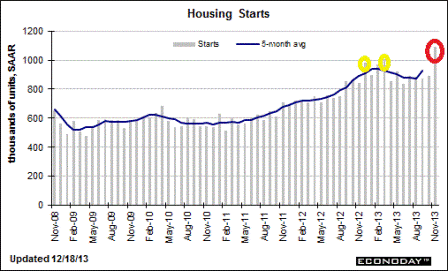
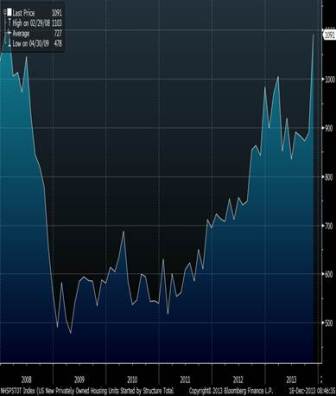
The latest housing starts spike seems most likely to be revised lower or followed by a big drop.


Full size image

Purchase Applications:


Full size image

Housing Starts:


Full size image


Full size image

Blinder editorial in WSJ

The Fed Plan to Revive High-Powered Money

Don’t only drop the interest rate paid on banks’ excess reserves, charge them.

That would be a tax that reduces aggregate demand

By Alan S. Blinder

December 10 (WSJ) — Unless you are part of the tiny portion of humanity that dotes on every utterance of the Federal Open Market Committee, you probably missed an important statement regarding the arcane world of “excess reserves” buried deep in the minutes of its Oct. 29-30 policy meeting. It reads: “[M]ost participants thought that a reduction by the Board of Governors in the interest rate paid on excess reserves could be worth considering at some stage.”

They don’t realize paying interest on Fed liabilities is a subsidy to the economy any more than Professor Blinder does.

As perhaps the longest-running promoter of reducing the interest paid on excess reserves, even turning the rate negative, I can assure you that those buried words were momentous. The Fed is famously given to understatement. So when it says that “most” members of its policy committee think a change “could be worth considering,” that’s almost like saying they love the idea. That’s news because they haven’t loved it before.

So what exactly are excess reserves, and why should you care? Like most central banks, the Fed requires banks to hold reservesmainly deposits in their “checking accounts” at the Fedagainst transactions deposits. Any reserves held over and above these requirements are called excess reserves.

Not long agosay, until Lehman Brothers failed in September 2008banks held virtually no excess reserves because idle cash earned them nothing.

No, because Fed policy was to keep banks net borrowed, and then implement its policy rate via the Fed’s interest rate charges for the subsequent ‘reserve adds’ which were functionally loans from the Fed.

But today they hold a whopping $2.5 trillion in excess reserves, on which the Fed pays them an interest rate of 25 basis pointsfor an annual total of about $6.25 billion. That 25 basis points, what the Fed calls the IOER (interest on excess reserves), is the issue.

Yes, thereby supporting their policy rate decision, which happens to be a ‘range’ a bit above 0, which also happens to be a display of the Fed’s failure to understand monetary operations.

Unlike the Fed’s main policy tool, the federal-funds rate, the IOER is not market-determined. It’s completely controlled by the Fed. So instead of paying banks to hold all those excess reserves, it could charge banks a small fee, i.e., a negative interest rate, for the privilege.

At this point, you’re probably thinking: “Wait. If the Fed charged banks rather than paid them, wouldn’t bankers shun excess reserves?” Yes, and that’s precisely the point. Excess reserves sitting idle in banks’ accounts at the Fed do nothing to boost the economy. We want banks to use the money.

Reserves are assets. They can’t be ‘used’ to boost the economy. Banks can sell their reserves to other banks, but in any case the total persists as Fed liabilities. Nothing the banks can do will change that.

If the Fed turned the IOER negative, banks would hold fewer excess reserves, maybe a lot fewer. They’d find other uses for the money. One such use would be buying short-term securities. Another would probably be lending more, which is what we want.

When banks buy securities or lend, their reserve account is debited and the bank of the seller of the securities or of the borrower gets its reserve account credited. That is, the assets called reserves are merely shifted from one bank to another, with the quantity of reserves held by the banking system remaining unchanged.

A second reason for cutting the IOER answers some of the criticisms the Fed has taken for its asset-buying programs called quantitative-easing: Doing so would stimulate the economy without increasing the size of the Fed’s balance sheet. In fact, the Fed could probably shrink its balance sheet.

Why would charging banks a fee stimulate the economy?

And further note that, before the current budget agreement, these ‘fees’ were called taxes, and for a good reason! ;)

To understand why, think back to the good old days, when excess reserves were zero. When the Fed injected reserves into the banking system, banks would use those funds to increase lending, thereby creating multiple expansions of the money supply and credit. Bank reserves were called “high-powered money” because each new dollar of reserves led to several additional dollars of money and credit.

I’ll give Professor Blinder the benefit of the doubt and assume the ‘good old days’ were the days of the gold standard, a fixed fx regime, where banking was continuously reserve constrained, interest rates were market determined, and bank lending was thereby constrained by the necessity to keep ‘real dollars’ on hand to meet depositors potential demands for withdrawals.

With today’s floating fx policy none of this is applicable.

The financial crisis short-circuited this process. As greed gave way to fear, bankers decided to store trillions of dollars safely at the Fed rather than lend them out. High-powered money became powerless money.

Here it seems he conflates the issue of liquidity and interbank lending with the issue of lending to the real economy, along with more inapplicable gold standard analysis.

Banking is always a case of loans creating deposits. And with today’s institutional structure, when deposits carry reserve requirements, in the first instance those requirements are functionally overdrafts in that bank’s reserve account at the Fed. And an overdraft is a loan, and booked as a loan from the Fed on statement day if it persists. So in fact loans create both deposits and any required reserves at the instant the loan is funded.

So rather than ‘high powered money’ as is the case with a gold standard, reserves today are best thought of as residual.

The Fed compounded the problem in October 2008 by starting to pay interest on reserves. And these days, the 25-basis-point IOER looks pretty good compared with most short-term money rates.

As it always is due to ‘market forces’. The entire term structure of rates continuously adjusts to the Fed’s policy rate which generally imposed by targeting the Fed funds rate.

If banks were charged rather than paid 25 basis points, they would find holding excess reserves a lot less attractive. As some of this excess central-bank money became “high-powered” again, the Fed would want less of it. So its balance sheet could shrink.

I don’t follow this part at all. Banks always find holding reserves ‘unattractive’ as the Fed funds rate is likewise their marginal cost of funds. So reserves are, in general, never a profitable investment, and banks are always looking for investments that yield more, on a risk adjusted basis, than their cost of funds.

What are the arguments against turning the IOER negative? Over the years, Fed officials have made three, none of them cogent.

One is that cutting the IOER would have only modest stimulative effects. Well, probably. But are there more powerful tools sitting around unused? Besides, there is at least a chance that we’d get more new lending than the Fed thinks.

There’s a much larger chance that this new tax, though modest, will nonetheless reduce aggregate demand. With the economy a large net saver, and the govt a large net payer of interest, in general higher rates increase income and lower rates decrease income.

Second, there is a limit to how far negative the IOER can go. After all, banks can earn zero by keeping paper money in their vaults. So if the Fed charged a very high fee for holding excess reserves, bankers might find it worthwhile to pay the costs of bigger vaults and more security guards in order to keep huge stockpiles of cash. Sure. But a mere 25 basis point fee is not enough incentive for them to do so.

If it was realized negative rates are a tax, the argument would never get this far.

Third, a negative IOER could drive short-term interest rates even closer to zero, as banks moved balances from their reserve accounts into money market instruments. And that, we are told, would wreak havoc in the money markets. Really? Perhaps that was a legitimate concern three years ago, but we have now lived with money-market rates hugging zero for years, and capitalism has survived.

And if we eliminated the FDIC deposit insurance cap there would be no need for money market funds in the first place.

Besides, the Fed paid no interest on reserves for the first 94 years of its existence, the European Central Bank has been paying its banks nothing since July 2012, and the Danes have been charging a fee since then. In no case did anything terrible happen.

Instead the banking system was kept net short reserves, and the Fed- the monopoly supplier of net reserves- used the rate charged to cover that ‘overdraft’ to set its policy rate.

That said, suppose the policy failed. Suppose the Fed cut the IOER from 25 basis points to minus 25 basis points, and banks didn’t react at all; they just held on to all their excess reserves. In that unlikely event, cutting the IOER would neither provide stimulus nor enable the Fed to shrink its balance sheet. However, the Fed would start collecting about $6.25 billion per year in fees from banks instead of paying them $6.25 billion in interesta swing of roughly $12.5 billion in the taxpayers’ favor. Some downside.

Like any other tax…

Mr. Blinder, a professor of economics and public affairs at Princeton University and former vice chairman of the Federal Reserve, is the author of “After the Music Stopped: The Financial Crisis, the Response, and the Work Ahead” (Penguin, 2013).

fed rate setting

Of course all they have to do is pay interest on all reserve balances…

Fed Moves Toward New Tool for Setting Rates (WSJ) An experimental bond-trading program being run at the Federal Reserve Bank of New York could fundamentally change the way the central bank sets interest rates. Fed officials see the program as a potentially critical tool when they want to raise short-term rates in the future to fend off broader threats to the economy. Launched this year, it is still in a testing stage and isn’t expected to be fully implemented for years. The Fed would use the facility to raise short-term interest rates by borrowing in the future against its large and growing securities portfolio. When it does want to raise rates, it will use securities it accumulated through its bond-buying stimulus programs as collateral for loans from money-market mutual funds, banks, securities dealers, government-sponsored enterprises and others. The rates it sets on these loans, in theory, could become a new benchmark for global credit markets.

FOMC’s Bullard coming around to what I posted in 2008?

“I think the December 2008 FOMC decision unwittingly committed the U.S. to an extremely long period at the zero lower bound similar to the situation in Japan, with unknown consequences for the macroeconomy,” Bullard said. Pointing to the Bank of Japan’s long struggle against deflation and slow growth, Bullard said he has seen “no evidence” that a faster economic recovery results from quickly lowering interest rates to near zero.

Posted in Fed

Bernanke and Yellen pushing back on higher mortgage rates

Seems to me the Fed is making an all out effort to push back on the higher longer term rates, particularly mortgage rates. However, at least so far those rates remain elevated and at least so far mortgage purchase applications remain down year over year.

Again, seems to me it comes down to the notion that if forward guidance works to firm the economy, rates will move higher/sooner than if it doesn’t work to firm the economy.

This means forward guidance works to bring long rates down only if markets don’t believe it helps the economy.

So what’s a Fed to do to bring long rates down?
Seems to me the only tool left is unconditional guidance or purchasing securities on a price basis, rather than a quantity basis. Which does of course work, to the basis point.

That is, if the Fed announced it had a 2% bid for unlimited quantities of 10 year notes they would not trade higher than 2% while that bid was active. My recollection was that this was done during WWII.

And that we didn’t lose.
;)

Fed statement

Accordingly, the Committee decided to continue purchasing additional agency mortgage-backed securities at a pace of $40 billion per month and longer-term Treasury securities at a pace of $45 billion per month. The Committee is maintaining its existing policy of reinvesting principal payments from its holdings of agency debt and agency mortgage-backed securities in agency mortgage-backed securities and of rolling over maturing Treasury securities at auction. Taken together, these actions should maintain downward pressure on longer-term interest rates, support mortgage markets, and help to make broader financial conditions more accommodative, which in turn should promote a stronger economic recovery and help to ensure that inflation, over time, is at the rate most consistent with the Committee’s dual mandate.

Hence the conundrum. On the one hand policy should cause lower rates, but it should also promote the higher rates of growth and inflation desired by the Fed, which in turn would trigger a ‘removal of accommodation’/rate hikes that much sooner than if the QE hadn’t been conducted.

Pending home sales drop 5.6 percent in September

Problem is the private sector is path dependent/pro cyclical. When sales slow incomes slow sales slow, employment slows, etc. etc.

Govt can be/is counter cyclical. When sales slow tax payments fall and unemployment comp. rises, etc. etc. AKA ‘automatic fiscal stabilizers.’

This cycle’s prior slowdowns had a safety net of govt deficit spending of near 10% of GDP, then a year or so later maybe 7%, etc. As the automatic fiscal stabilizers cut back that govt support with the modest recovery raising tax liabilities and cutting transfer payments.

But today, after this year’s proactive deficit reduction measures, we’ve gapped down to maybe a 3% deficit for ‘support’ when things slow. And it feels to me like the demand leakages have begun ‘winning’ when govt proactively stepped back to ‘make room for the private sector’.

What that actually means is the private sector now must (deficit) spend increasingly more than its income on goods and services to offset those agents spending less than their incomes (demand leakages), or the output doesn’t get sold. By identity. To the penny.

Well, sure doesn’t look like it’s going to come from housing. And while cars remain up some it’s not nearly enough. And capex isn’t coming through as hoped for and as needed to fill the spending gap left by the govt cutbacks. And the 126,000 print for NFP private sector job growth fits the same narrative as well- no top line growth = no job/income growth, etc.

Not to mention QE and low rates in general from the Fed remain a source of drag via the interest income channel, and all as Congress continues to fight for bragging rights with regard to deficit reduction.

It’s all nothing that a big fat tax cut and/or spending increase wouldn’t reverse, of course, as the slow motion train wreck continues.

Be the Fed

So imagine you are a moderate FOMC member.

Mortgage apps are down, new home sales marginal, and private sector job creation sagging. And you keep revising your GDP forecast lower at each meeting. Likewise inflation remains low, and you believe the risks are asymmetrical. That is, you know you can stop inflation and growth with rate hikes, but you’re not so sure about fighting deflation.

And so, as an FOMC member, you’d like to see mortgage rates back down. So how do you get them there? You might not like QE, and at least highly suspect it doesn’t have any first order effects, and you fear there are unknown costs, but you know tapering, for whatever reason- almost to the point the reason doesn’t matter- causes rates to go higher. And you know not tapering brought them down some, but not enough. Fed funds are already close to 0% so there’s no room there. Forward guidance, etc. has kept the short end low but not the long end. You are afraid to simply peg long rates with an unlimited bid for securities at your target rate. You know a weaker economic forecast will bring long rates down but that it would be intellectually dishonest to manipulate a forecast.

And maybe worst of all, if you do something that causes markets to believe the economy will do a lot better, mortgage rates go higher, presuming Fed rate hikes will accompany growth, and thereby make things worse instead of better.