EU Finance Chiefs Rebuff US Calls to Boost Economic Stimulus


[Skip to the end]

Yes!

Europe Snubs US Calls for More Stimulus Before G-20

by Jennifer Ryan and Agnes Lovasz

Mar 10 (Bloomberg) — European finance ministers rejected calls from the U.S. to do more to battle the economic crisis, saying stimulus plans already in place need time to work.

“Recent American appeals insisting that the Europeans make an additional budgetary effort to combat the effects of the crisis were not to our liking,” Luxembourg Finance Minister Jean-Claude Juncker said yesterday after leading a meeting of euro-area finance chiefs in Brussels. “We want to see what the effect of the recovery package is going to be.”


[top]

The euro falls again


[Skip to the end]

Each time the euro falls like it has done over the last several days suspicions arise that ‘this is it’ and it’s on the way towards 0, with a wholesale exit by individuals and institutional investors afraid of everything from inflation to a total breakup of the currency union.

The cross currents are enormous, and the range of predicted outcomes wide.

What’s sure as always is in the end someone will have had the right forecast, but it will be because of ‘statistics’- the forecasts cover all possibilities- or maybe inside information, but not greater wisdom.

Partial list of cross currents:

Euro positive:

  • The eurozone has relatively tight fiscal policy, with no proactive fiscal package of consequence. This keeps the euro strong, and promotes deflationary domestic conditions as the economy tries to export to gain needed financial assets.
  • Fed swap lines tend to support the euro vs the dollar, as institutions that otherwise would need to sell euros and buy dollars to cover dollar losses can instead buy time and borrow them cheaply via the swap line arrangement. This kept the region from collapse in the fall.

Euro negative:

  • The dollar losses don’t go away with the swap lines, unless dollar asset prices and credit quality improve, which has not been the case. So any euro strength tends to see sellers of euro vs dollars to cover some of the losses.
  • In a breakup of the eurozone there is a risk euro securities get redenominated to the new national currencies which may be subject to high levels of deficit spending to support domestic demand and promote high inflation, high interest rates, and falling currencies as in the past.
  • Euro governments could default and payments be suspended indefinitely.
  • Bank deposits could be frozen indefinitely with major bank failures too large for any national govt. to politically or even operationally write the check.
  • The low price of crude supports the dollar by keeping dollars ‘hard to get’ for the foreign sector.

The exit from the euro includes those who buy gold, which has been driving gold to extremes vs other commodities even though you can’t eat it and it doesn’t pay interest, and it’s been a very long time since it was what you needed to pay taxes.

This is a major bubble in progress that ends in a very sharp collapse when the buying has run its course, and as those owning gold need it for payment purposes and begin to sell.

Along with the real buyers who are exiting the euro (and other currencies) are the usual specs and trend followers who exacerbate every trend on the way up and the way down.

And the fact remains that all the ‘money’ in the world is nothing more than spread sheet entries of what is needed to pay taxes.

And there aren’t a lot of practical alternatives to storing ‘wealth’ apart from inherently worthless gold, and various forms of ‘property’ that can all be taxed and therefore demands currency for payment.

Ironically, it is a spreadsheet crisis- there is no shortage of real resources- and therefore readily ‘fixed’ by the right data entry by governments on their own spreadsheets.

For the US that means something like:

  1. A full payroll tax holiday where the treasury makes all payments for employers and employees- why are we taking $1 trillion per year from workers and business struggling to make their payments?
  2. $300 billion to the states on a per capita basis with no strings attached- the per capita distribution concept removes the need for specific federal oversight.

Those two spreadsheet entries would end the ‘crisis’ in very short order.

And a government funded $8/hour job for anyone willing and able to work begins to replace the current unemployed labor buffer stock with an employed labor buffer stock, which is both a superior price anchor and potentially a source of increased useful output and reduction of the high real social costs of our current system.

But deficit myths are likely to remain the obstacle to making the spread sheet entries readily available to restore output and employment.

The latest ridiculous bit of non sense is that government borrowing takes ‘money’ from one place and puts it in another.

Government deficit spending adds exactly that many NEW ‘bank balances’ to non government financial assets, and government borrowing subsequently offers those NEW, ADDITIONAL bank balances CREATED BY DEFICIT SPENDING alternative financial assets called Treasury securities.

At the end of the day there are NEW financial assets called Treasury securities added to the existing stock of financial assets in the non govt sectors by federal deficit spending.

Spread the word!


[top]

Trichet says rising deficits are ‘problem’


[Skip to the end]

Agreed!

They are risking the solvency of the national governments.

The national governments are beyond the point where they can write the check should any of their major banks be declared insolvent.

Trichet Says Rising Deficits are ‘Problem,’ Osnabruecker Reports

by Matthew Brockett

Feb 12 (Bloomberg) &#8212 European Central Bank President Jean-Claude Trichet said rising budget deficits in the euro region are an “important problem” and urged governments to respect the Stability and Growth Pact, the Neue Osnabruecker Zeitung reported, citing an interview.

Trichet also said the situation in the banking sector remains “difficult” and should be monitored closely by governments and central banks, the newspaper reported on its Web site today. Measures such as so-called bad banks should be competition neutral, Trichet said, according to Neue Osnabruecker.


[top]

CDS SOVS


[Skip to the end]

RBS SOVEREIGN $$ CDS Indicative levels

Reference Entity 5 yr 10 yr
Germany 53/63 55/65
France 57/67 59/69
Austria 145/160 142/156
Ireland 275/310 270/308
Italy 175/195 175/195
Netherlands 110/128 110/130
Greece 285/310 280/280
Belgium 110/135 108/133
Spain 140/155 138/152
Portugal 138/152 133/150
UK 130/140 120/145

 
** Another leg of aggressive widening in SOV CDS with UK out 20bps, Ireland out 40bps, Portugal/Spain/Italy/Greece out 15/20bps! Seen small buying flows in Belgium/Austria & Italy.


[top]

2009-01-16 EU News Highlights


[Skip to the end]

The news just keeps getting worse over there.

They are unlikely to make up for lost exports with domestic demand due to structural constraints on proactive fiscal policy.

This put deflationary forces in place that drive relative prices down until exports resume.

And with national government solvency in question, there is no ‘safe haven’ for euro financial assets.

Overly tight fiscal currency keeps it strong, but a reduction in the desire to save in that currency works the other way.

Highlights

European Exports Drop Most in Eight Years as Downturn Deepens
Trichet Denies ECB Will Cut Rates to Zero Percent, NHK Says
Trichet Vision Unravels as Italy, Spain Debt Shunned
German Government Sees 250,000 More Jobless in 2009, FAZ Says
German Union Chief Sommer Says New Pay Deals Will Mirror Crisis
German Economy May Shrink 2.5% in 2009
French Business Confidence Index Falls to 21-Year Low
France’s Woerth Says 2009 Deficit to Widen on Lower Tax Revenue
France Cuts Tax-Free Savings Rate to 2.5% as Inflation Slows
Italian Economy Will Shrink Most Since 1975, Central Bank Says
Italy’s Tremonti Says Further Stimulus Packages Are Pointless
European Government Bonds Drop; Stock Rally Saps Safety Demand


[top]

Re: More talk of prepherals trouble and euro break-up


[Skip to the end]

(email exchange)

Yes, as well as this:

Pros Say: German Stimulus ‘Irrelevant’

Jan 13 (CNBC) — The euro remained under pressure Tuesday despite the German government approving a second stimulus package worth $64 billion to help Europe’s largest economy.

Experts tell CNBC the rescue package is “irrelevant” and that the euro will remain under pressure ahead of the European Central Bank rate decision on Thursday.

It’s irrelevant regarding economic recovery, but can accelerate the rate of credit deterioration of the German state.

And the falling euro once again distorts USD exposure as a percentage of capital that is expressed in euros.

>   
>   On Tue, Jan 13, 2009 at 8:01 AM, Dave wrote:
>   
>   France and Italy under performing Germany 5
>   bps today and Greece under performing 12 bps
>   in 10yrs
>   
>   DV
>   

Greeks Bearing Gifts

by John Authers

Jan 12 (FT) – The market fears the Greeks, even when bearing gifts. It is also scared about the Irish and the Spanish.

Greece has always been treated as a peripheral eurozone member, not only in geography. Even before last year’s civil unrest, its bonds traded at a significantly higher yield than those of Germany – showing a higher perceived default risk.

A eurozone country defaulting and leaving the euro is close to an
unthinkable event. But Friday’s news from Standard & Poor’s that Greece and Ireland were on review for a possible downgrade, followed on Monday by Spain, left many thinking the unthinkable.

The spread of Greek bonds over German bunds is 2.32 percentage points, almost 10 times its level of two years ago. Spanish spreads on Monday rose above 90 for the first time. An Intrade prediction market future puts the odds on a current eurozone member leaving the euro by the end of next year at about 30 per cent.

And German default swaps cost nearly 10 times as much as they did not long ago as well.

The euro dropped more than 1 per cent against the dollar within minutes of the Spanish news, and is down 9.8 per cent in the last few weeks.

A crisis over Greece might be the euro’s ultimate “stress test” (to
borrow a phrase from Daniel Katzive of Credit Suisse). If the eurozone
could find a way to deal with a default, that might confirm the euro’s
status as the world’s next reserve currency.


[top]

Sector Analyis Update


[Skip to the end]


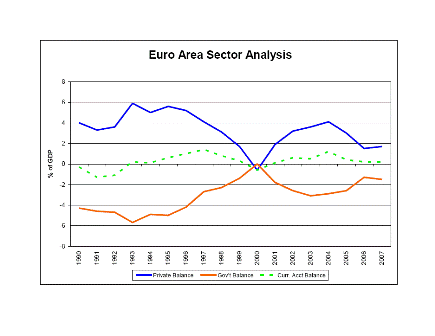
Euro Area Sector Analysis (Dec 17)

 
Karim writes:
Euro-middle of historical range. But with government deficits nearing Maastricht limits (though those limits will be bent, it will be grudging), not much chance for large enough fiscal stimulus to make a difference to private demand.

Yes, deficits seem too small to support higher levels of output and employment.

[top][end]

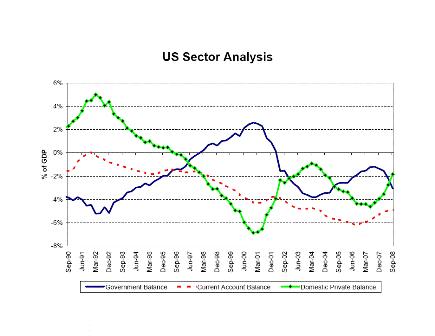
US Sector Analysis (Dec 17)

 
Karim writes:
U.S.-still far below peak of early 90s. Nearing levels of earlier this decade, but much private demand growth in recent years fueled by credit (unlikely to be repeated, certainly not to same extent).

Yes, we are still paying the price for allowing the budget to go into surplus. The deficit needs to be substantially higher to restore output and employment, to ‘make up’ for the surplus years that drained the financial equity needed to support the credit structure.

[top][end]

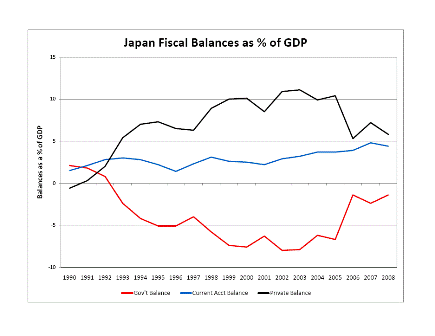
Japan Fiscal Balance as % of GDP (Dec 17)

 
Karim writes:
Japan-well off recent peaks, in some part due to some fiscal tightening in recent years. Fiscal policy starting to be loosened, but private savings still have ways to go to get back to levels that were associated with the moderate period of domestic demand growth from 2003-2006.

Yes, and with their higher propensity to not spend income they require a higher deficit to sustain output and employment.


[top]

ECB’s Hurley Says Euro Economy to Contract Next Year


[Skip to the end]

Several months back, the eurozone national governments fell into ‘Ponzi’ as growth prospects went negative.

They now seem to be in that downward spiral of falling revenues, rising transfer payments, and rising credit default premiums.

Without a fiscal response to restore growth this will only get worse, and the National governements are, by treaty and by market dependence, in no position to enact a meaningful fiscal expansion.

Highlights

Trichet Says Decline in Oil Prices Is Helping Global Economy
ECB’s Trichet Says ‘Fragility’ of Financial System Is Challenge
Nowotny Says ECB Is Keeping Some ‘Fire Power’ on Interest Rates
ECB’s Hurley Says Euro Economy to Contract Next Year
Bini Says ECB’s Rate Decision Data Driven, Ansa Says
Italy’s EU20 Billion Bank Plan Wins Approval From EU
Germany Scales Down Second Stimulus Package, Sueddeutsche Says
Sarkozy Will Announce Measures to Help Auto Industry by Jan. 31
European Bonds Open Little Changed; Two-Year Yield 1.75 Percent


[top]

Re: View from Europe (cont.)


[Skip to the end]

(email exchange)

>   
>   On Tue, Dec 23, 2008 at 2:43 PM, Russell
>   wrote:
>   
>   Warren:
>   
>   You have known I have been negative on this
>   market collapse for a long time.
>   

Yes!

I was more hopeful for the right political response after it went bad in July. :(

>   
>   And what happens on a day to day basis only
>   stirs the pot. The reason for trucks not being
>   able to lift anything at the ports is that trade
>   finance has disappeared and the reason why
>   the Baltic Dry Index declined 98% in 90 days.
>   The banks are technically bankrupt. I said that
>   about Citi way back when.
>   

Yes, they weren’t bankrupt back then, and they were open for business. Now that the government has let it go bad after an OK Q2, previously sort of OK/money good assets have further deteriorated and are no longer money good if this is left to its own ways.

A $1 Trillion of the right fiscal response turns it all around.

Idle Cranes From Long Beach To Singapore

Idle shipping cranes at Frozen Ports From Long Beach to Singapore portend a bleak 2009-2010.

Chris Lytle, chief operating officer of the port of Long Beach, California, took in a panorama of the slumping world economy from his rooftop observation deck one day this month. Shipping cranes stood still, truck traffic trickled and a cargo vessel sat idle, moored to a pier.

“You never see that,” Lytle said. “It’s quiet. Too quiet.”

Port traffic has slowed from North America to Europe and Asia as a recession erodes consumer demand and the credit crisis chokes off loans to export-dependent companies. International trade is set to fall by more than 2 percent next year, the most since the World Bank began measuring it in 1971. Idle ports around the globe are showing how quickly a collapse in trade can spread, undermining growth in each country it reaches.

“Everybody expects 2009 to be a bleak year,” said Jim McKenna, chief executive officer of the Pacific Maritime Association, a San Francisco-based group representing dock employers at U.S. West Coast ports. “Now, it looks like 2010 is going to be just as bleak.”

Coal is piling up at the Mozambique port of Maputo. Brazil’s exports of cars, household appliances, machinery and furniture fell in November from a year earlier. The port in Singapore, the world’s busiest for containers, posted its first month-over-month decline in seven years in November, at 1.5 percent.

“You take it for granted until it blows up,” said Bernard Hoekman, trade economist at the World Bank, in an interview. “Now it’s blowing up.”


[top]

Re: Emergency Liquidity Assistance in the euro area


[Skip to the end]

Very interesting.

Seems the ECB can use this facility to ‘replace’ lost deposits of any bank, which would seem to remove the ‘bank run’ risk.

However, it is supposed to be only for very short term liquidity needs.

>   
>   On Wed, Dec 3, 2008 at 2:54 AM, Dave wrote:
>   
>   Not sure if any of the following is new info but was an interesting read
>   
>   DV
>   

Emergency Liquidity Assistance in the euro area

A Belgian newspaper (La Libre Belgique) is currently running a fascinating series of articles on the collapse of Fortis and Dexia.

In one article (lalibre.be/economie/actualite/article/464148/chapitre-7-la-trahison-des-hollandais.html) it mentions that Fortis benefited from an Emergency Liquidity Assistance from the NBB at the end of September for an amount of about €50bn. This confirms our own findings that showed such a loan on the balance sheet of the NBB (most of it was in $, see NBB loans to Fortis: About €50bn at the end of September 2008, 16 October 2008).

What is interesting is that it sheds a bit more light on a mechanism that is available on a euro area basis, and that up until now had been referenced only infrequently by the ECB. For example, the December 2006 edition of the Financial Stability Review (p.171) has the following description:

“One of the specific tools available to central banks in a crisis situation is the provision of emergency liquidity assistance (ELA) to individual banks. Generally, this tool consists of the support given by central banks in exceptional circumstances and on a case-by-case basis to temporarily illiquid institutions and markets. This support may be warranted to ease an institution’s liquidity strains, as well as to prevent any potential systemic effects, or specific implications such as disruption of the smooth functioning of payment and settlement systems. However, the importance of ELA should not be over-emphasised. Central bank support should not be seen as a primary means of ensuring financial stability, since it bears the risk of moral hazard. Furthermore, ELA rarely needs to be provided, and is thus less significant than other elements of the financial safety net, which have increased in importance in the management of crises.”

Apparently, these credit lines can be given by the various national banks, against collateral (including all the buildings of the retail banks network, in the case of Fortis!) and a ‘high’ rate of interest. But these credit lines need to be approved first by the ECB Governing Council and all 15 governors of the individual central banks. According to press reports, in a few days at the end of September, there were no less than 15 ECB teleconference calls to approve such ELAs to Belgian banks (Fortis and Dexia) but also German and Irish banks (probably Hypo Re since the bailout was at about the same time).

Looking at the balance sheets of the individual central banks it is quite difficult to have a complete picture of how much of these ELAs have been extended: while it was relatively clearly identified on the NBB balance sheet, it does not look like it was the case on the Bundesbank balance sheet, and to our knowledge the ECB as such has not given any figure on such credit lines. It is interesting, though, that such a mechanism existed. It is still available if needed in case of emergency, even if to a certain extent the existence of the guarantee schemes (introduced after this) may make its use slightly less necessary.

In addition it seems that Trichet was quite involved in the discussions, warning that Fortis did not have enough liquidity even after the capital injection that occurred over the weekend of 27-28 September (the ELA was probably extended from the Monday onwards, and it was after the next weekend that the Fortis share price really took a dive to below 1).


[top]