AFP: Burning up more food for fuel


[Skip to the end]

The monetary system will burn up the world’s food supply for fuel until the marginal individual about to starve to death has enough political influence to stop the process.

I’m pretty sure that’s not the millionth one to die of starvation. And probably not the ten millionth.

As more and more acreage goes to biofuels, expect the real price of food to continue to rise.

Lula and Indonesian president pledge biofuel cooperation

by Zulhefi

(AFP) Brazilian President Luiz Inacio Lula da Silva and his Indonesian counterpart pledged cooperation on biofuels during talks here Saturday in a bid to take advantage of surging oil prices.

Lula and President Susilo Bambang Yudhoyono signed off on an agreement to share knowledge on biofuel technology after meeting at Jakarta’s presidential palace.

The Brazilian leader called spiralling global commodity prices a “great opportunity” for developing countries such as Indonesia and Brazil, both of which are major producers of biofuel.

“The developing countries that have the characteristics that Indonesia and Brazil have should not analyse this crisis as only a problem. We have to see this moment as a great opportunity,” Lula said.

“We have land, we have sunlight, we have water resources, we have technology and, thanks to God, the poor of the world have started to eat more, three meals a day, so they will demand more food production.”

The two leaders signed memoranda of understanding that would see the countries exchange experts and students to share knowledge on biofuels. Yudhoyono will also make an official visit to Brazil in November.

“In the energy sector, both countries are cooperating in the field of alternative energy. Brazil has succeeded in developing bio-ethanol and Indonesia can learn from Brazil to develop bio-ethanol,” Yudhoyono said.


[top]

2008-07-11 US Economic Releases


[Skip to the end]


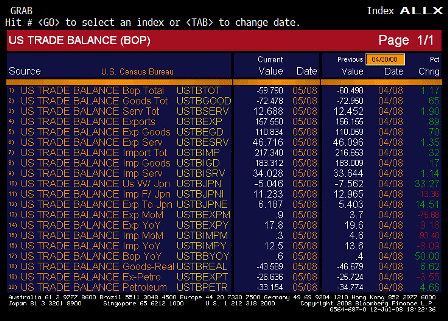
Trade Balance (May)

Survey -$62.5B
Actual -$59.8B
Prior -$60.9B
Revised -$60.5B

[top][end]

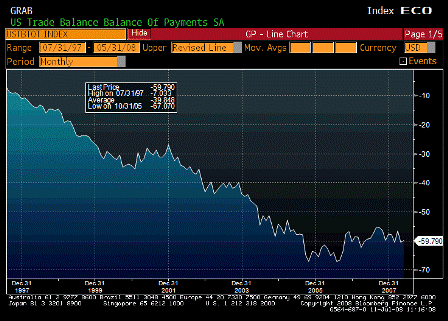
Trade Balance (May)

Seems to be working its way lower, but rising import prices are a moving target.
Without CBs and monetary authorities buying to help their exporters, I don’t think the rest of the world wants to accumulate $60 billion a month of financial assets, which means the USD will continue to fall and US prices will continue higher until the real trade gap falls to desired levels.

[top][end]


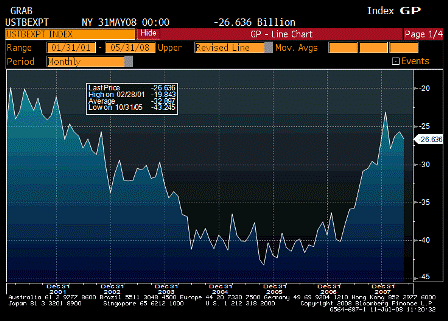
Trade Balance Ex Petroleum (May)

Survey n/a
Actual -$26.636B
Prior -$25.724B
Revised n/a

This has come down quite a bit and should continue to fall over time.

[top][end]


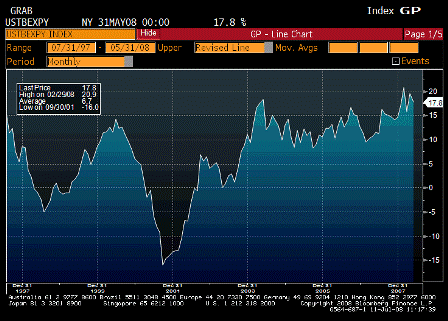
Exports YoY (May)

Survey n/a
Actual 17.8%
Prior 19.6%
Revised n/a

Booming!

[top][end]


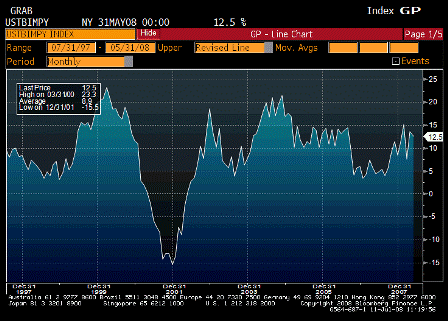
Imports YoY (May)

Survey n/a
Actual 12.5%
Prior 13.6%
Revised n/a

Working their way to lower rates of increase, even with energy prices rising.

[top][end]


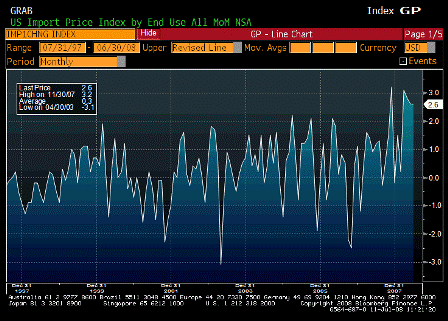
Import Price Index MoM (Jun)

Survey 2.0%
Actual 2.6%
Prior 2.3%
Revised 2.6%

‘Inflation’ pouring in through the open window.

[top][end]


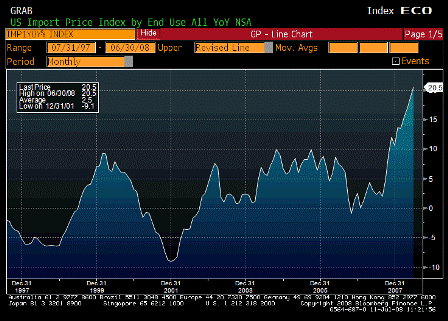
Import Price Index YoY (Jun)

Survey 18.6%
Actual 20.5%
Prior 17.8%
Revised 18.8%

Inflation pouring in through the open window.

[top][end]


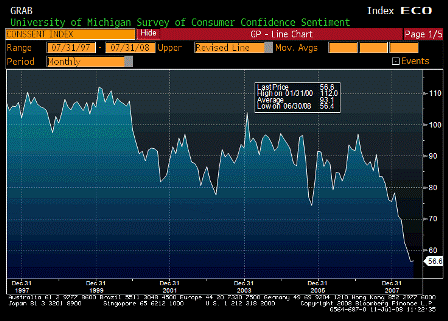
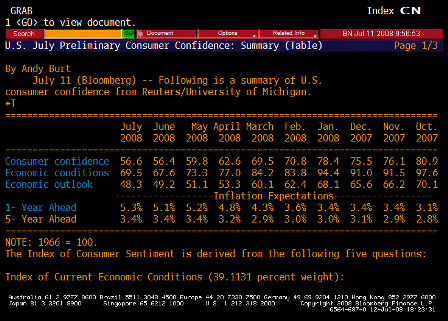
U. of Michigan Confidence (Jul P)

Survey 55.5
Actual 56.6
Prior 56.4
Revised

[top][end]

U. of Michigan Confidence TABLE (Jul P)

Inflation hurting confidence even as current conditions have improved some.

[top][end]


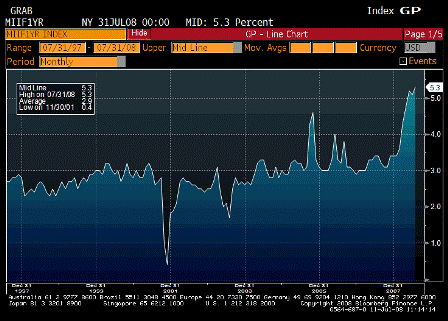
Inflation Expectations 1yr Fwd (Jul P)

Survey n/a
Actual 5.3%
Prior 5.1%
Revised n/a

Fed considers this reason for alarm.

[top][end]


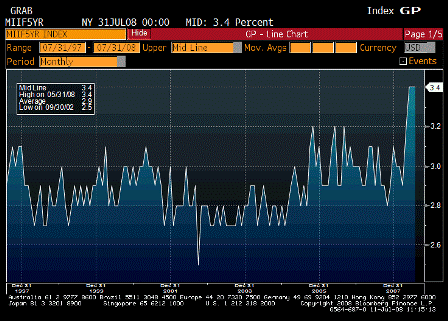
Inflation Expectations 5y Fwd (Jul P)

Survey n/a
Actual 3.4%
Prior 3.4%
Revised n/a

Way too high for the Fed and going the wrong way.

[top][end]


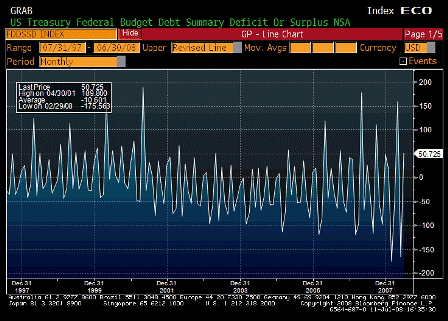
Monthly Budget Statement (Jun)

Survey $34.0B
Actual $50.7B
Prior $27.5B
Revised n/a

Haven’t seen the detail. This can be very volatile due to timing issues.


[top]

Chatter about US solvency risk


[Skip to the end]

The world has enough actual issues without tossing in a few contrived ones.

The fact that the ratings agencies will actually do this also testifies negatively to their state of knowledge while there is no threat of solvency, there is a threat of downgrades and secs getting cheaper by a few basis points, as happened in Japan.

And, worse, as the government has the same fears as the ratings agencies that there is risk of counter agenda policy decisions for the wrong reasons.


[top]

2008-07-10 US Economic Releases


[Skip to the end]


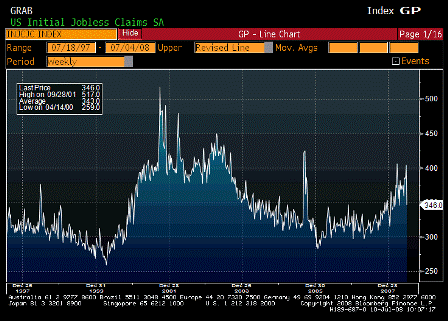
Initial Jobless Claims (Jul 5)

Survey 395K
Actual 346K
Prior 404K
Revised n/a

[top][end]

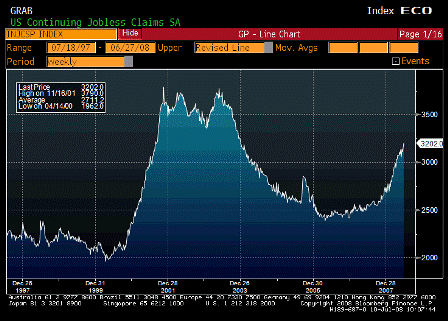
Continuing Jobless Claims (Jun 28)

Survey 3140K
Actual 3202K
Prior 3116K
Revised 3111K

Karim writes:

Initial claims down 58k to 346k; number distorted by seasonal adjustments related to expected annual maintenance at auto factories.

Claims number was adjusted to anticipate more seasonal layoffs in autos than occurred. When the expected add back doesn’t occur as expected, claims should return to prior level, all else being equal. Labor department official states the decline ‘a question of timing’,

Yes, it all comes out in the wash, but it takes a while; so, the 4 week moving average is a more useful indicator.

4wk avg drops to 380.5k from 390.5k.

Continuing claims jumps 91k to new cycle high of 3.202 million, highest since 12/03.

Higher continuing claims reflects lack of hiring and is related to longer duration of unemployment (and likely more tepid wage demands from those looking to find a job).

Also, with productivity running higher than GDP growth, by definition that means the growing real output can be accomplished with slightly fewer workers.

Twin themes remain: weakness due to lack of demand and higher prices due to higher costs of fuel/food/imports.

The numbers also show business would rather hire people already working than the unemployed, so the long term trend of more and more persistent long-term unemployment continues.

See ‘Full Employment and Price Stability‘ for ‘the answer’ and also the ‘base case’ for analysis.

[top][end]


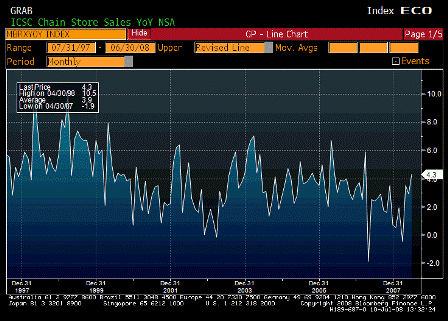
ICSC Chain Store Sales YoY (Jun)

Survey 3.3%
Actual 4.3%
Prior 3.0%
Revised 2.9%

Way better than expected. Hard for mainstream economists to believe fiscal policy will do much. They put their faith in interest rates, which never have done much, at least not in the intended direction.


[top]

Bloomberg: World’s new rich outbid US lower income groups for fuel

Small consolation – declining real terms of trade helping insurers.

Progressive Gains as Record Gasoline Curbs Driving

by Erik Holm

Americans are driving less for the first time since 1980, data compiled by the Federal Highway Administration show. The rate of accidents per insured vehicle fell 0.5 percent in the first quarter from a year earlier after increasing in 2007, according to Insurance Services Office Inc. in Jersey City, New Jersey.

“We may be at a very special point where things have changed dramatically,” Progressive Chief Executive Officer Glenn Renwick said at an investor meeting last month.

Americans drove about 20 billion fewer miles during the first four months of 2008, down 2.1 percent from a year earlier, according to the Federal Highway Administration in Washington. Progressive of Mayfield Village, Ohio, was the top performer on the 24-member KBW Insurance Index during the three months through yesterday, gaining 21 percent.

The number of drivers probably fell again in May when gas prices approached $4 a gallon, said Meyer Shields, a Baltimore- based analyst at Stifel Nicolaus & Co.

2008-07-09 US Economic Releases


[Skip to the end]


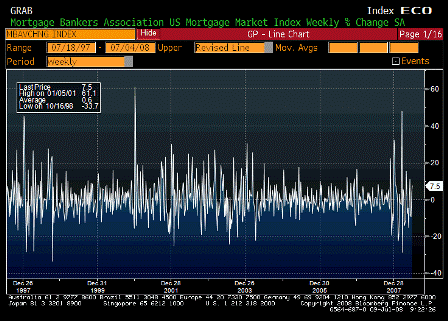
MBA Mortgage Applications (Jul 4)

Survey n/a
Actual 7.5%
Prior 3.6%
Revised n/a

[top][end]


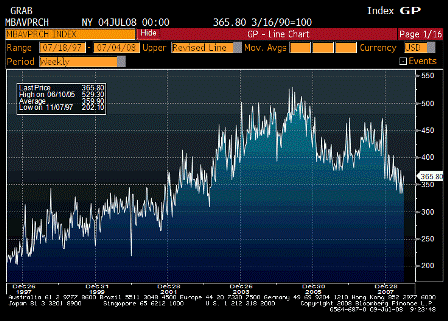
MBA Purchasing Index (Jul 4)

Survey n/a
Actual 365.8
Prior 342.8
Revised n/a

Moving back up some, still in the new lower range that used to coincide with maybe 1.5 million starts.

[top][end]


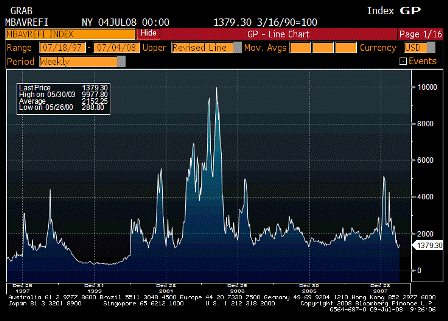
MBA Refinancing Index (Jul 4)

Survey n/a
Actual 1379.3
Prior 1269.2
Revised n/a

Not a lot going on here.


[top]

2008-07-08 US Economic Releases


[Skip to the end]


ICSC-UBS Store Sales YoY (Jul 8)

Survey n/a
Actual 2.3%
Prior 2.2%
Revised n/a

Holding up with the rebate checks.

[top][end]


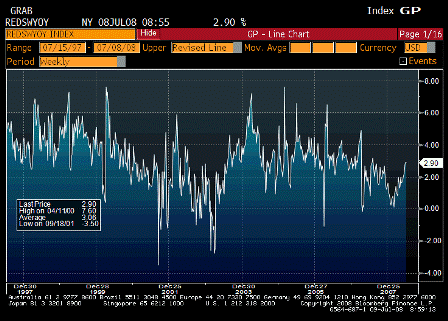
Redbook Sales YoY (Jul 8)

Survey n/a
Actual 2.9%
Prior 2.9%%
Revised n/a

Rebate checks doing their thing.

[top][end]


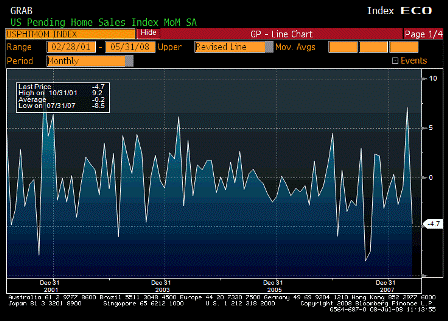
Pending Home Sales MoM (May)

Survey -3.0%
Actual -4.7%
Prior 6.3%
Revised 7.1%

[top][end]

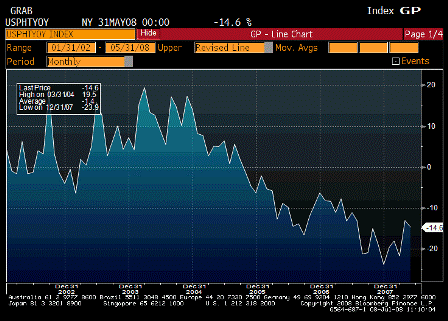
Pending Home Sales YoY (May)

Survey n/a
Actual -14.6%
Prior -13.0%
Revised n/a

Still looks like they may be moving back up to me.

[top][end]


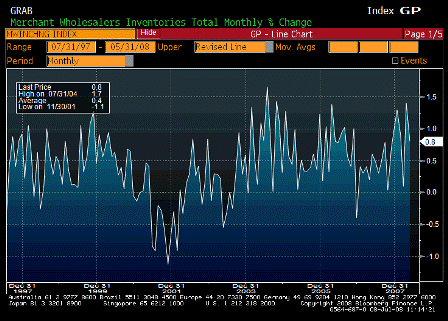
Wholesale Inventories MoM (May)

Survey 0.6%
Actual 0.8%
Prior 1.3%
Revised 1.4%

[top][end]

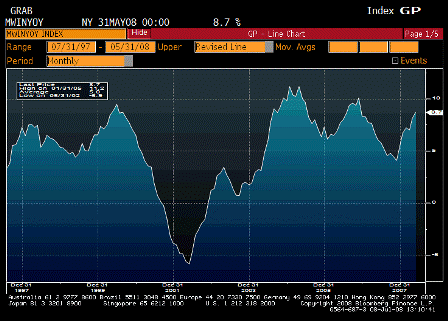
Wholesale Inventories YoY (May)

Survey n/a
Actual 8.7%
Prior 8.1%
Revised n/a

Moving up some but not problematic yet.

[top][end]


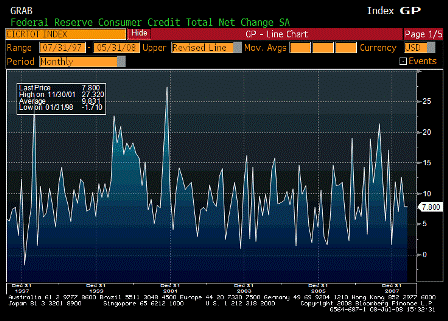
Consumer Credit (May)

Survey $7.5B
Actual $7.8B
Prior $8.9B
Revised $7.8B

[top][end]


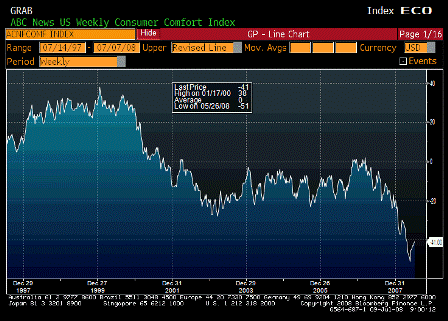
ABC Consumer Confidence (Jul 6)

Survey -43
Actual -41
Prior -43
Revised n/a

Still low but higher than expected and moving up with the rebates.


[top]

2008-07-08 China News Highlights


[Skip to the end]

Highlights:

Chinese entrepreneurs less confident in Q2
China’s Inflation Eased to 7.1% Last Month, Reuters Reports
China Home Prices to Drop More as Curbs Stay, Citic Ka Wah Says
Trade: China’s textile export growth drops significantly
Investors’ confidence in stock market remain

 
Perhaps coming apart with the approach of the Olympics as many have anticipated.

The crowd’s not always wrong!


[top]

Bernanke’s July 07 speech and today’s inflation issue


[Skip to the end]

From Chairman Bernanke’s July 07 speech:

As you know, the control of inflation is central to good monetary policy. Price stability, which is one leg of the Federal Reserve’s dual mandate from the Congress, is a good thing in itself, for reasons that economists understand much better today than they did a few decades ago. Inflation injects noise into the price system, makes long-term financial planning more complex, and interacts in perverse ways with imperfectly indexed tax and accounting rules. In the short-to-medium term, the maintenance of price stability helps avoid the pattern of stop-go monetary policies that were the source of much instability in output and employment in the past. More fundamentally, experience suggests that high and persistent inflation undermines public confidence in the economy and in the management of economic policy generally, with potentially adverse effects on risk-taking, investment, and other productive activities that are sensitive to the public’s assessments of the prospects for future economic stability. In the long term, low inflation promotes growth, efficiency, and stability–which, all else being equal, support maximum sustainable employment, the other leg of the mandate given to the Federal Reserve by the Congress.

Note that the current anti-‘inflation’ argument within the FOMC is that the high prices for imports take discretionary income from consumers that reduces domestic demand and reduces the ability to service domestic debt. There was no thought or mention of that reason for ‘inflation’ being a ‘bad thing’ a year ago.

I suppose one could argue that this problem is due to there not being inflation, as with wages ‘well-anchored’ there is only a relative value story. If we did have ‘real inflation’ with rising wages, we wouldn’t have the problem of insufficient consumer income to support domestic demand, but we would have the traditional negatives from inflation.

But Bernanke’s response to Congress was that exports are replacing domestic consumption and that is a ‘good thing’ as it brings the US trade back to ‘balance’ and restores ‘national savings’ – the old mercantilist, gold standard imperatives. But it does leave weak domestic demand and rising prices. That brings us back to the tail end of Bernanke’s statement:

Admittedly, measuring the long-term relationship between growth or productivity and inflation is difficult. For example, it may be that low inflation has accompanied good economic performance in part because countries that maintain low inflation tend to pursue other sound economic policies as well. Still, I think we can agree that, at a minimum, the opposite proposition–that inflationary policies promote employment growth in the long run–has been entirely discredited and, indeed, that policies based on this proposition have led to very bad outcomes whenever they have been applied.

Seems that either way you look at it, rising prices (whether you call it inflation or not) lead to ‘bad’ outcomes.

And it sure looks to the dissenters in the FOMC that this is exactly what is happening. Only time will tell, but all Fed speakers now agree the risk of inflation is elevated substantially, and we will soon see if they still agree the cost of letting the inflation cat out of the bag is far higher than letting a near-term recession run its course and (hopefully) contain prices and keep a relative value story from turning into an inflation story.

Also, not how the Fed continues to use ‘other tools’ for market functioning as Bernanke just now indicates they will keep lending directly to their primary dealers.


[top]