2008-12-09 USER


[Skip to the end]


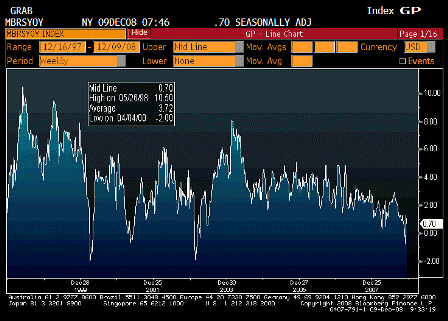
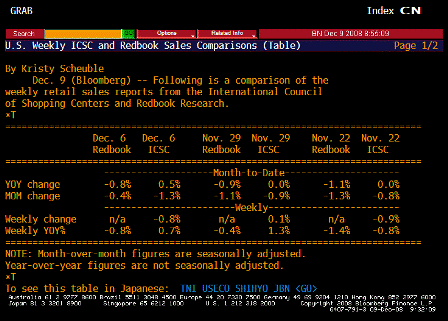
ICSC UBS Store Sales YoY (Dec 9)

Survey n/a
Actual -0.70%
Prior 1.30%
Revised n/a

[top][end]

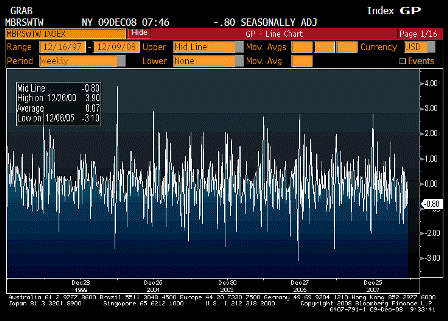
ICSC UBS Store Sales WoW (Dec 9)

Survey n/a
Actual -0.80%
Prior 0.10%
Revised n/a

[top][end]

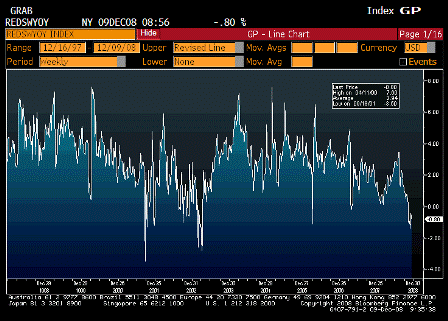
Redbook Store Sales Weekly YoY (Dec 9)

Survey n/a
Actual -0.80%
Prior -0.40%
Revised n/a

[top][end]

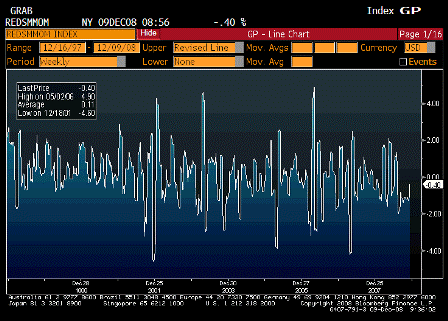
Redbook Store Sales MoM (Dec 9)

Survey n/a
Actual -0.40%
Prior -1.10%
Revised n/a

[top][end]

ICSC UBS Redbook Comparison TABLE (Dec 9)

[top][end]

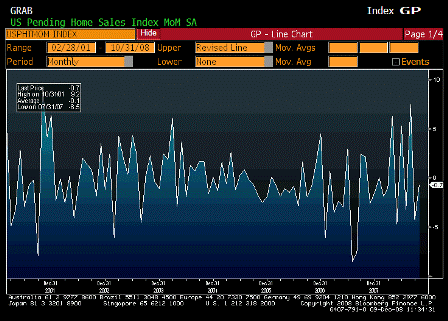
Pending Home Sales MoM (Oct)

Survey n/a
Actual -0.7%
Prior -4.3%
Revised n/a

[top][end]

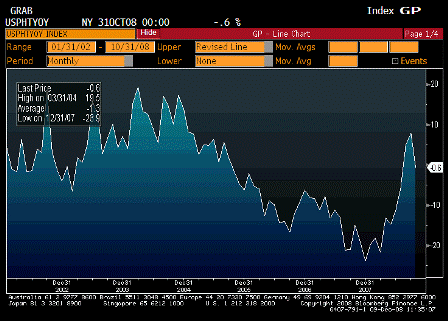
Pending Home Sales YoY (Oct)

Survey n/a
Actual -0.6%
Prior 7.9%
Revised n/a


[top]

Payrolls


[Skip to the end]

Karim writes:

  • -533k in payrolls, and downward revisions of -199k to prior 2 mths
  • Unemployment rate rises ‘only’ to 6.7% from 6.5% because 422k left the labor force
  • The 2 real shockers are:
    • Index of hours fell 0.9% for the month (after -0.4% prior mth); even adjusting for some productivity gwth, looks like real GDP in Q4 may be more like -7 to -8% vs the most recent range of estimates of -4 to -5%.
    • Diffusion index plunges from 37.8 to 27.6; support for job gwth increasingly narrow.
  • By sector
    • Mfg -85k
    • Construction -82k
    • Retail -91k
    • Finance -32k
    • Temp help -78k
    • Hospitality -76k
    • Education +52k
    • Govt +7k


[top]

ECB funding national government securities


[Skip to the end]

ECB cuts to 2.5pc and mulls “printing money”

By Ambrose Evans-Pritchard

The Maastricht Treaty prohibits the ECB from injecting stimulus by purchasing the government debt of the eurozone’s fifteen states debt — a method known as “monetizing the deficit” or, more crudely, as “printing money.”

But it can achieve the same effect

not quite

by mopping up sovereign debt, mortgage securities, or even company debt on the open market, as the Fed has already begun to do. At the moment the ECB accepts some of these assets as collateral in exchange for loans, but it has not yet hit the atomic button by buying them outright with its own freshly-minted fiat money.

When the ECB accepts collateral for loans, it doesn’t offer non recourse funding. The owner of the securities remains liable in the case of default.


[top]

Perspective


[Skip to the end]

>  
>  On 12/5/08, Jason wrote:
>  
>  Factoid for the weekend: 1yr ago RBS & co. paid 80bn for Abn, largely in cash.
>  
>  Today that’d buy you Citi (22.5bn), MS (10.5bn), GS (21bn), Mer
>  
>  (12.3bn), DB (13bn), Barclays (12.7bn) and leave you with 8bn
>  
>  in leftover change to shore up the b/s.
>  


[top]

California May Pay With IOUs for Second Time Since Depression


[Skip to the end]

(email exchange)

right,

as I’ve been suggesting for a long time, all states should always pay only with iou’s.

that way they spend first, then collect taxes, just like the federal govt.

and they can deficit spend without a funding imperative as well.

>  
>  On 12/5/08, Jason wrote:
>  
>  My opinion is that the next major round of the bailout will need to be for the states… I am
>  surprised there has not been more emergency loan news out from the government as of
>  yet. Or purchases of debt from the fed etc.
>  
>  They probably want them to exhaust every budget trimming avenue first and eliminate a lot
>  of the pork. But they can’t let that process go too far with the fragility of the economy.
>  

California May Pay With IOUs for Second Time Since Depression

By Michael B. Marois and William Selway

Dec. 5 (Bloomberg) — California, the world’s eighth largest economy, may pay vendors with IOUs for only the second time since the Great Depression, State Finance Director Mike Genest said.

In a letter to legislative leaders Dec. 2, Genest said the state “will begin delaying payments or paying in registered warrants in March” unless an $11.2 billion deficit is closed or reduced. California, which approved its budget less than three months ago, may run out of cash by March, state officials say.

Governor Arnold Schwarzenegger warned that he may issue the warrants, which are a promise to pay with interest, to suppliers and contractors as the seizure in credit markets may make it too costly to borrow.

“It’s getting worse very quickly,” Schwarzenegger, a 61-year-old Republican, told reporters Dec. 1 after declaring a fiscal emergency and ordering the Legislature into a special session to find ways to close the deficit. “It’s like an avalanche in that it gains momentum. And that’s what we’re in right now, so it’s a real crisis.”

California is reeling more than any other state from budget woes that pushed the nation’s governors to seek help from Congress. States say federal money is needed to ease the pain from spending cuts and tax increases that would be a further blow to an economy in the throes of a recession.

The warrants would be given to landscapers, carpet cleaners, construction firms, food services companies and other state vendors. They would pay an interest rate of as much as 5 percent, based on state law. California last issued the IOUs in 1992 when lawmakers and then-Governor Pete Wilson deadlocked on a budget for 61 days past the start of the fiscal year.

Higher Yields
Investors are souring on the state. California 10-year bonds yield 0.73 percentage point more than top-rated municipal bonds, according to Bloomberg indexes, the highest since the depths of the last budget crisis in Jan. 2004. By comparison, the difference for New York is 0.27 percentage point.

California Controller John Chiang said that the state’s cash account will decline to $882 million by February, below its preferred cushion of $2.5 billion, and will be negative $1.9 billion by March.

Tax collections have been hammered as the collapse of the real estate market eliminated 136,000 construction jobs in the past two years and caused consumers to curb spending. California leads the nation in home foreclosures, its 8.2 percent unemployment rate is the third-highest in the U.S., and the wealthiest 1 percent of citizens pay almost half its personal income taxes, making it sensitive to swings in the stock market.

Stock Losses
“When the market tanks those people sneeze and we in Sacramento get a cold,” said H.D. Palmer, a spokesman for Schwarzenegger’s finance department.

California’s two year budget shortfall is about $28 billion, accounting for one-third of the deficits faced by U.S. states, according to figures from the National Conference of State Legislatures in Denver.

“If the state’s having budget problems and they’re about to run out of cash, that limits their opportunity to raise money in the capital markets,” said Terry Goode, who heads up municipal bond research for Wells Capital Management in San Francisco.

The Port Authority of New York and New Jersey attracted no bids from investment banks to manage a $300 million taxable note offering this week.

Biggest Borrower
California, the biggest borrower in the municipal-bond market, has $51.9 billion in general-obligation debt. It’s rated A+ by Standard & Poor’s and Fitch Ratings, the fifth-highest grades, and an equivalent A1 at Moody’s Investors Service.

Even if the state runs out of cash, constitutional law stipulates that holders of California state general obligation bonds are first in line for payment by the treasury.

The budget deficit has grown even as California cut spending on health care, universities, and welfare programs. Schwarzenegger proposed a tax increase for the first time since he took office in 2003 as Democrats agreed to slash $8 billion in spending. Republicans, who have enough support to block a two-thirds majority needed to pass a tax increase, have made sure the measure has failed.

“This is not blind ideology on the part of Republicans, but our sincere belief that higher taxes will hurt the economy and lead to more uncontrolled spending,” said Assembly Republican leader Mike Villines.

Schwarzenegger’s declaration of a fiscal emergency gives lawmakers 45 days to plug the shortfall. If they fail to find a solution in that time, they are barred from doing any other legislative work until they do. The declaration came after lawmakers were unable to agree on a plan to close the gap during a three-week special session that expired Nov. 30.

“We’re just barely hanging on right now,” Chiang said. “We need strong legislative action immediately.”


[top]

Re: Harvard University to Sell Bonds to Repay Debt


[Skip to the end]

(email exchange)

>  
>  On 12/6/08, Jason wrote:
>  
>  This will be a bellweather for the muni cash market. Harvard is one of the best credits in
>  muni space outside the AAA state GOs. They plan to bring 500mm deal. if market can
>  not absorb this, it does not bode well for muni cash.
>  
>  It also potentially represents a very attractive buying opportunity for muni investors. This
>  very high quality deal may come at a big concession
>  
>  Lastly, Harvard is doing this to refinance there VRDNs. The VRDNS were most likely
>  originally on with pay fixed swaps. Thus as they pay off the VRDNs they are potentially
>  net receivers of BMA swaps. hence the move lower in ratios. More of this to come in my
>  opinion.

Hedging cash munis with BMA swaps has to be another large hedge gone bad.

It’s another mixed metaphor strategy, sort of like corporate basis.

The unwind side could easily result in serious overshooting in the other direction.

Harvard University to Sell Bonds to Repay Debt, Cancel Swaps

By Bryan Keogh

Dec. 5 (Bloomberg) — Harvard University, the oldest U.S. college, plans to sell taxable and non-taxable bonds to repay debt and terminate interest-rate swap agreements.

The university will offer $600 million of top-rated, tax-exempt bonds next week, Bloomberg data show. Cambridge, Massachusetts-based Harvard also plans a separate sale of 5-, 10- and 30-year debt as soon as today, according to a person familiar with the transaction.

And the big winner is:

JPMorgan Chase & Co., Goldman Sachs Group Inc. and Morgan Stanley are managing the bond sale. New York-based JPMorgan is managing the municipal sale.


[top]

China’s fiscal policy and the end of the Paulson era


[Skip to the end]

This sounds like they get it and are on it.

It also seems the weak yuan policy is back, as Paulson’s influence fades.

Paulson’s ‘beggar they neighbor’ weak dollar policy caused the US slowdown to spread worldwide.

Govt to increase spending power of rural residents

By Fu Yu

The Chinese government has reaffirmed its commitment to stabilizing the real estate and stock markets, and to boost auto sales.

The National Bureau of Statistics director Ma Jiantang said in a published article that the government would eliminate “consumption bottlenecks” to promote consumer demand. In the article published in Qiushi, a Communist Party journal, Ma wrote that the government would try to increase the spending power of lower income groups and to raise the desire to consume among the well-to-do.

The government has also planned to raise agricultural produce prices to help increase rural income levels. In addition, it will raise subsidies on seeding and farm machinery, and to increase some social benefits to farmers and low-salary rural workers.

In his analysis, Ma said consumers in rural areas have a strong potential demand for a wide range of consumer products and services.

He believes the $586 billion economic stimulus package will have the effect of encouraging increased spending by higher-income consumers, which will help boost investment.


[top]

Re: Emergency Liquidity Assistance in the euro area


[Skip to the end]

Very interesting.

Seems the ECB can use this facility to ‘replace’ lost deposits of any bank, which would seem to remove the ‘bank run’ risk.

However, it is supposed to be only for very short term liquidity needs.

>   
>   On Wed, Dec 3, 2008 at 2:54 AM, Dave wrote:
>   
>   Not sure if any of the following is new info but was an interesting read
>   
>   DV
>   

Emergency Liquidity Assistance in the euro area

A Belgian newspaper (La Libre Belgique) is currently running a fascinating series of articles on the collapse of Fortis and Dexia.

In one article (lalibre.be/economie/actualite/article/464148/chapitre-7-la-trahison-des-hollandais.html) it mentions that Fortis benefited from an Emergency Liquidity Assistance from the NBB at the end of September for an amount of about €50bn. This confirms our own findings that showed such a loan on the balance sheet of the NBB (most of it was in $, see NBB loans to Fortis: About €50bn at the end of September 2008, 16 October 2008).

What is interesting is that it sheds a bit more light on a mechanism that is available on a euro area basis, and that up until now had been referenced only infrequently by the ECB. For example, the December 2006 edition of the Financial Stability Review (p.171) has the following description:

“One of the specific tools available to central banks in a crisis situation is the provision of emergency liquidity assistance (ELA) to individual banks. Generally, this tool consists of the support given by central banks in exceptional circumstances and on a case-by-case basis to temporarily illiquid institutions and markets. This support may be warranted to ease an institution’s liquidity strains, as well as to prevent any potential systemic effects, or specific implications such as disruption of the smooth functioning of payment and settlement systems. However, the importance of ELA should not be over-emphasised. Central bank support should not be seen as a primary means of ensuring financial stability, since it bears the risk of moral hazard. Furthermore, ELA rarely needs to be provided, and is thus less significant than other elements of the financial safety net, which have increased in importance in the management of crises.”

Apparently, these credit lines can be given by the various national banks, against collateral (including all the buildings of the retail banks network, in the case of Fortis!) and a ‘high’ rate of interest. But these credit lines need to be approved first by the ECB Governing Council and all 15 governors of the individual central banks. According to press reports, in a few days at the end of September, there were no less than 15 ECB teleconference calls to approve such ELAs to Belgian banks (Fortis and Dexia) but also German and Irish banks (probably Hypo Re since the bailout was at about the same time).

Looking at the balance sheets of the individual central banks it is quite difficult to have a complete picture of how much of these ELAs have been extended: while it was relatively clearly identified on the NBB balance sheet, it does not look like it was the case on the Bundesbank balance sheet, and to our knowledge the ECB as such has not given any figure on such credit lines. It is interesting, though, that such a mechanism existed. It is still available if needed in case of emergency, even if to a certain extent the existence of the guarantee schemes (introduced after this) may make its use slightly less necessary.

In addition it seems that Trichet was quite involved in the discussions, warning that Fortis did not have enough liquidity even after the capital injection that occurred over the weekend of 27-28 September (the ELA was probably extended from the Monday onwards, and it was after the next weekend that the Fortis share price really took a dive to below 1).


[top]