Paulson weak dollar policy ends- MOF to resume intervention


[Skip to the end]

Before the body is cold the MOF has announced they are no longer going to be intimidated by being called ‘currency manipulators’ and ‘outlaws’ by Paulson and are resuming the building of the USD reserves to support their export industries.

Bernanke’s beggar thy neighbor policy is being matched by real action- direct intervention- rather than interest rate rhetoric.

The move in the yuan suggest China has been doing much the same.

This will leave the eurozone all the more vulnerable as they are the only nation not using fiscal policy and ideologically cant buy USD, so the combination of a relatively high euro and weak domestic demand will keep them on the ropes while others recover.

Yen Declines as Nakagawa Says Japan May Take Currency Action

By Kim-Mai Cutler and Stanley White

Dec. 18 (Bloomberg) — The yen weakened from near a 13-year high against the dollar after Japanese Finance Minister Shoichi Nakagawa signaled the nation is ready to intervene in the foreign-exchange market for the first time in four years.

“We will take necessary steps if needed” to limit the currency’s advance and protect the overseas earnings of Japanese exporters, Nakagawa told reporters in Tokyo. The dollar fell to an 11-week low against the euro on speculation the Federal Reserve’s near-zero interest rate policy will reduce the appeal of U.S. assets.


[top]

Obama package smaller than expected


[Skip to the end]

Obama team dismisses reports of trillion dollar stimulus

ByJessica Yellin

(CNN) – An Obama transition official says reports that the president-elect will release a stimulus plan with a trillion-dollar price tag are overblown, and that the actual figure being discussed is far smaller.

Some outside economists have pushed the trillion-dollar figure. One recent report suggested the transition team was working with an $850 billion plan. But this official describes the amount Obama advisors are currently considering as significantly lower than both.
Obama and his economic team met for four hours yesterday. They are still working on the package, which will not be announced before the president-elect returns from Hawaii later this month.


[top]

Fed’s powers of consequence


[Skip to the end]

Thanks, Jim.

Now consider this- the main thing interest rate policy does is move income between savers and borrowers.

For example, in the last year or so savers have gone from earning maybe 4.5% to something near 0 today. And borrowers (and lenders making larger spreads) have equally benefited.

So what I’m getting at is the Fed has the authority to shift mega sums from savers to borrowers, and vice versa.

That’s like giving the social security commissioner the authority to raise payroll taxes and pay out more benefits, etc.

Not to mention the swap line authority where the fed can lend unlimited sums to foreign governments, and on an unsecured basis as well.

The real ‘power’ of the Fed is with these powers of distribution, which far outweigh the generally perceived power of altering the macro economy via changes in interbank interest rates.


[top]

2008-12-18 USER


[Skip to the end]


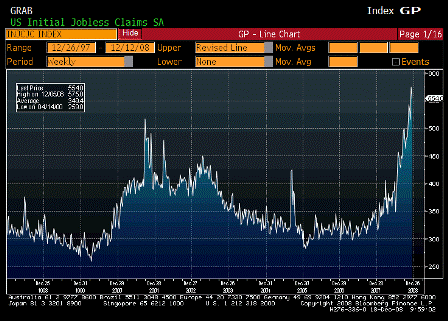
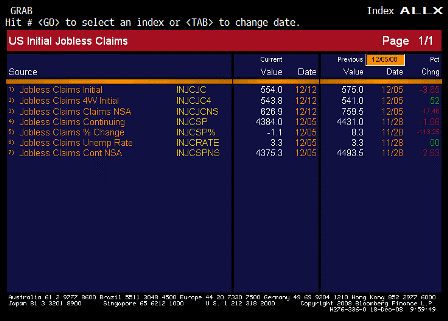
Initial Jobless Claims (Dec 13)

Survey 558K
Actual 554K
Prior 573K
Revised 575K

 
Down a bit but 4 week average still moving up.

[top][end]

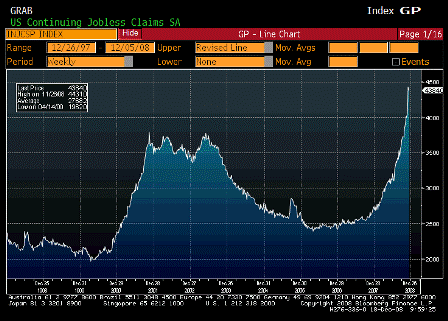
Continuing Claims (Dec 6)

Survey 4375K
Actual 4384K
Prior 4429K
Revised 4431K

 
Down a touch, but still going parabolic.

[top][end]

Jobless Claims ALLX (Dec 13)

[top][end]

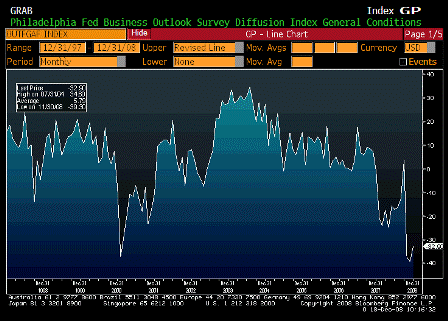
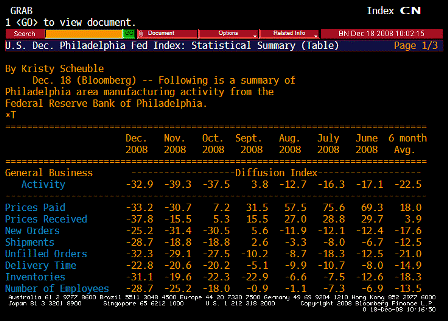
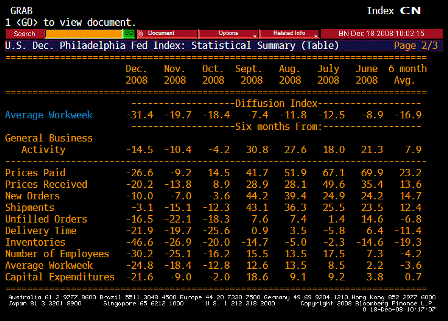
Philadelphia Fed (Dec)

Survey -40.5
Actual -32.9
Prior -39.3
Revised n/a

 
Better than expected, up a touch, but still at very low levels.

[top][end]

Philadelphia Fed TABLE 1 (Dec)

[top][end]

Philadelphia Fed TABLE 2 (Dec)

[top][end]

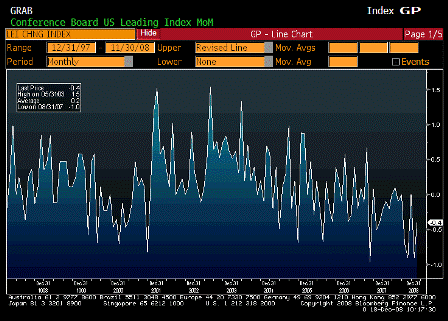
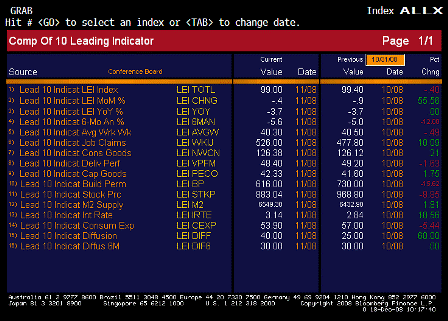
Leading Indicators (Nov)

Survey -0.4%
Actual -0.4%
Prior -0.8%
Revised -0.9%

 
Still looking soft.

[top][end]

Leading Indicators ALLX (Nov)


[top]

The Fed and Deleveraging, revisited


[Skip to the end]

Deleveraging involves nothing more than ‘reintermediation’ back to the banking system (as described in more detail previous posts).

The government has failed to facilitate this transition back to a banking model to allow it transpire in an orderly fashion.

All that needed to happen was for credit spreads to go to levels that represented competitive returns on equity for banks, as banks picked up loans and securities no longer wanted by the non bank entities.

The move to mark to market from mark to model for banks, however, effectively added ‘spread risk’ to holding longer term loans and securities.

This mark to market risk also effectively raised bank capital requirements (as required by bank investors) in order to invest in the suddenly higher volatility investments.

This also increased the risk to investors of banks already holding securities that were subject to mark to market accounting.

The Fed allowed this risk to interfere with banks ability to fund their liabilities, as the Fed lends to member banks only against specific collateral.

Faced with a potential liquidity crisis, banks were compelled to respond by restricting lending that would otherwise have been considered profitable.

This led to the (continuing) downward spiral of the real economy.

The downward spiral is also characterized by a general (deflationary) inventory liquidation of housing and commodities.

I have been proposing (for the last 15 years) the Fed as Congress to remove the collateral requirement for member bank borrowing (it’s redundant in any case).

I have also proposed they extend their lending to member banks to include longer dated lending to set the term structure of rates as desired.

The Fed continues to slowly move towards this ‘target’ with it’s ‘new lending facilities’ and polices, but it continues to fall short.

The failure to act on the mark to market issue keeps risk for bank shareholders ‘artificially’ elevated which keeps credit spreads wider than otherwise.

I have also stated that while taking the right steps to facilitate the ‘great repricing of risk’ and the reabsorbtion of lending by the banking system would end the ‘financial crisis,’ it does not address the accelerating shortage of aggregate demand that’s been evidenced by rising unemployment and the widening output gap.

The near universal belief that lower interest rates sufficiently add to aggregate demand to restore output and employment and the numerous ‘deficit myths’ have delayed the substantial fiscal adjustment required to sustain aggregate demand at full employment levels in the current environment.

I have therefore proposed a ‘payroll tax holiday’ where the Treasury makes all FICA, medicare, etc. payments for employees and employers, along with a $300 billion revenue sharing program for the States to immediately fund operations and infrastructure programs.

Additionally, any economic recovery not associated with a program to reduce crude oil consumption risks a sudden shortage of supply and re escalation of prices.

Our govt’s ongoing mismanagement of the economy since q2 08 can be entirely attributed to a fundamental lack of understanding of our monetary system by govt, the mainstream financial and academic economic community, and the media that promotes this misunderstanding to the political leadership and general public.


[top]

Quantitative Easing for Dummies


[Skip to the end]

FACTBOX: What is quantitative easing?

Tue Dec 16, 2008 3:30pm EST

NEW YORK (Reuters) – The Federal Reserve on Tuesday cut its target for overnight interest rates to zero to 0.25 percent, bringing it closer to unconventional action to lift the economy out of a year-long recession.

“The message is they’re instituting quantitative easing on a fairly large scale,” said Doug Roberts, chief investment strategist at Channel Capital Research.com.

Under quantitative easing, central banks flood the banking system with masses of money to promote lending.

Central banks exchange non or low interest bearing assets- reserve balances- for longer term higher yielding securities.

Since lending is in no case ‘reserve constrained’, the ‘extra’ reserves do nothing for lending.

The purchase of the longer dated securities results in lower longer term rates than otherwise. The lower borrowing rates may or may not alter aggregate demand.

The lower rates for savers definitely lowers aggregate demand.

They usually do this when lowering official interest rates no longer is effective because they already are at or near zero.

True!

The central banks add cash by buying up large quantities of securities — government debt, mortgages, commercial loans, even stocks — from banks’ balance sheets,

Yes.

giving them plenty of new money to lend.

No, they already and always have infinite ‘money to lend’.

Available funds are not a constraint for the banking system.

The constraints are regulated asset quality and capital requirements that are expressed in the rates bank charge.

Not the total quantity of funds available.

It is a tool used by Japan earlier this decade to combat deflation and stimulate the economy.

Didn’t work then either. It was fiscal policy that kept them afloat, though not a large enough deficit to sustain output at full employment levels.


[top]

FOMC Statement


[Skip to the end]

Federal Reserve Press Release


Release Date: December 16, 2008

The Federal Open Market Committee decided today to establish a target range for the federal funds rate of 0 to 1/4 percent.

Geitner ought to be able to hit that one..

Since the Committee’s last meeting, labor market conditions have deteriorated, and the available data indicate that consumer spending, business investment, and industrial production have declined. Financial markets remain quite strained and credit conditions tight. Overall, the outlook for economic activity has weakened further.

Aggregate demand continued to fall

Meanwhile, inflationary pressures have diminished appreciably. In light of the declines in the prices of energy and other commodities and the weaker prospects for economic activity, the Committee expects inflation to moderate further in coming quarters.

Inventory liquidations to continue and OPEC not expected to hike prices

The Federal Reserve will employ all available tools to promote the resumption of sustainable economic growth and to preserve price stability. In particular, the Committee anticipates that weak economic conditions are likely to warrant exceptionally low levels of the federal funds rate for some time.

Low interest rates per se are believed to promote growth and employment.

The focus of the Committee’s policy going forward will be to support the functioning of financial markets and stimulate the economy through open market operations and other measures that sustain the size of the Federal Reserve’s balance sheet at a high level.

A larger balance sheet promotes growth, employment, and marketing functioning.

As previously announced, over the next few quarters the Federal Reserve will purchase large quantities of agency debt and mortgage-backed securities to provide support to the mortgage and housing markets, and it stands ready to expand its purchases of agency debt and mortgage-backed securities as conditions warrant.

This implies the purchases have some benefit other than from keeping interest rates for these securities lower than otherwise, as it didn’t say the purpose was lowering mortgage interest rates.

The Committee is also evaluating the potential benefits of purchasing longer-term Treasury securities. Early next year, the Federal Reserve will also implement the Term Asset-Backed Securities Loan Facility to facilitate the extension of credit to households and small businesses. The Federal Reserve will continue to consider ways of using its balance sheet to further support credit markets and economic activity.

Seems they still don’t grasp that it’s about ‘price’ (interest rates) and not ‘quantity’.

Voting for the FOMC monetary policy action were: Ben S. Bernanke, Chairman; Christine M. Cumming; Elizabeth A. Duke; Richard W. Fisher; Donald L. Kohn; Randall S. Kroszner; Sandra Pianalto; Charles I. Plosser; Gary H. Stern; and Kevin M. Warsh.

In a related action, the Board of Governors unanimously approved a 75-basis-point decrease in the discount rate to 1/2 percent.

They are still keeping it higher than the Fed Funds rates and still demanding collateral.

In taking this action, the Board approved the requests submitted by the Boards of Directors of the Federal Reserve Banks of New York, Cleveland, Richmond, Atlanta, Minneapolis, and San Francisco. The Board also established interest rates on required and excess reserve balances of 1/4 percent.

No mention of the USD swap lines to foreign central bands that was last reported to be well over $600B.

Still no evidence of a working understanding of monetary operations and reserve accounting.


[top]

What happened in July?


[Skip to the end]

Through Q2 08 GDP was muddling through with modestly positive numbers.

Then it hit the wall in July as crude oil and the commodities in general broke down courtesy of Mike Masters and Joe Lieberman.

Soon afterward the main street credit crunch intensified.

What I now suspect happened is that the US energy/commodity industry got the rug pulled out from under it as the transfer of nominal wealth from pension funds to passive commodity strategies to energy and commodity producers fell?

The straw that broke the camel’s back?

This sector had been holding up well with the higher prices, and energy producing regions had been doing reasonably well.

Domestically, the US produces about 8 million bpd of crude plus a lot of natural gas and other commodities that fell in price.

While the fall in prices benefited consumers, they were/are slow to react with more spending.


[top]