Factory orders and ISM non manufacturing releases

First, factory orders
Always boring
;)

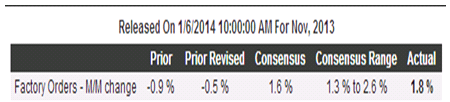
Factory Orders


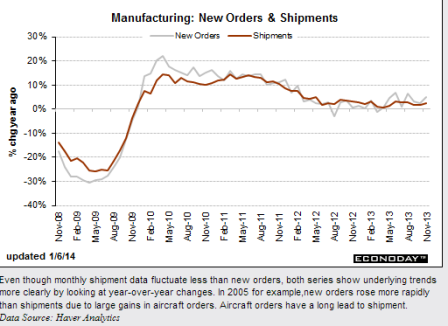
Solid domestic demand together with solid foreign markets appear to be giving a lift to the factory sector with factory orders up a very strong 1.8 percent in November. Another plus is a 4 tenths upward revision to October, to minus 0.5 percent. September orders are unrevised and very strong at plus 1.8 percent like November.

Excluding transportation, orders rose 0.6 percent in November vs an upward revised 0.1 percent gain in October. Orders for capital goods show a big surge, possibly boosted by year-end tax issues but also perhaps by rising business confidence.

Shipments were very strong in November, up 1.0 percent following incremental 0.1 percent gains in the two prior months. And there seems to be no risk of inventory overhang as inventories were unchanged to bring down the inventory/shipments ratio to 1.28 from 1.29.

Unfilled orders are a special plus, jumping 1.0 percent for an 8th straight gain. Last week’s ISM report, boosted by strength in construction-related and auto-related industries, points to another strong month in December for manufacturing which is once again a leading strength for the nation’s economy.


Full size image

ISM non manufacturing
Always more interesting
Downward slope since the peak a few months back has continued
Enough said…


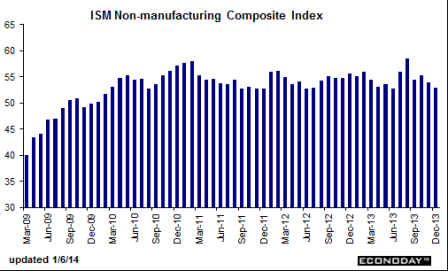
New orders moved suddenly into reverse for ISM’s non-manufacturing sample, pulling down the index which fell 9 tenths to 53.0. New orders, the leading indicator in this report, fell to 49.4 from 56.4 in November. This is the first sub-50 reading for new orders, which had been especially strong through much of the second half of last year, since July 2009.

But coincidental and lagging indications are positive including a steady reading for business activity and a big bounce back for employment, up 3.3 points to 55.8.

Other readings include a second straight contraction for backlog orders, a slight rise for input price pressures, and a slowing in export orders.

Today’s employment reading may lift expectations for Friday’s employment report but otherwise the report hints at an early 2014 slowdown for the economy.


Full size image

Car sales missing

Averaging October’s govt shutdown reduced report with November’s bounce back approx = today’s Dec releases. So levelish sales for the quarter, and a leveling off in general post Jan tax hikes vs a prior multi year upward slope.

* GM, Ford, Toyota, Chrysler December U.S. sales all miss

* Ford sales up 2 percent

* GM sales down 6 percent

* Toyota sales down 1.7 percent

* Chrysler sales up 6 percent

By Bernie Woodall and Ben Klayman

DETROIT, Jan 3 (Reuters) – The top four automakers in the U.S. market missed December sales expectations, but 2013 will still easily be the best year for the industry since before the recession.

General Motors Co said that the U.S. auto industry will have December U.S. auto sales at a 15.6 million-vehicle annualized selling rate, well below the 16 million vehicles expected by 27 economists surveyed by Thomson Reuters.

The late December holiday season is generally one of the heaviest sales periods at U.S. auto dealerships.

Sales that may have occurred in December were pulled ahead to November because of a late-month, four-day Thanksgiving weekend, said John Felice, head of sales at Ford Motor Co.

December auto sales were also hampered by snowy and icy weather over parts of the country late in the month, said Chrysler spokesman Ralph Kisiel.

Each month, auto sales are seen as an early indicator of consumer spending.

For all of 2013, U.S. auto sales are expected to finish near 15.6 million vehicles, up about 8 percent.

That would be the best sales year since pre-recession 2007, when 16.1 million vehicles were sold in the U.S. market. At the height of the recession in 2009 sales fell to 10.4 million.

GM’s sales fell 6 percent, to 230,157 new vehicles, below analysts’ expectations of a slight sales gain.

Sales of GM’s Chevrolet Silverado pickup truck fell 16 percent in the month.

Ford’s sales rose 2 percent, to 218,058, also below analysts’ expectations. Its F-Series pickup truck, the best-selling model in North America, had an 8 percent sales gain in December.

Toyota’s U.S. December sales fell 1.7 percent to 190,843 vehicles, versus expectations of a slight gain.

Chrysler expects the industry to show a December annualized selling rate of 15.8 million vehicles.

Full Interview, Econ Focus, John Cochrane – Federal Reserve Bank of Richmond

University of Chicago going MMT?

If you know him, point out that the micro foundation is the currency itself is a public monopoly, and all the implications thereof, particularly the idea that monopolists are inherently ‘price setters’ rather than ‘price takers’, and that unemployment as defined is necessarily the evidence that Federal spending isn’t sufficient to cover the need to pay taxes and desires to net save, etc. etc.

And direct him to my book and website, thanks!
;)

Econ Focus

last comment of the year on fiscal drag

Back in November my forecast for 2013 was 4%, which at the time was by far the highest around. The govt was spending more than its income by about 6% of GDP, which was about $900 billion if I recall correctly. But then it cut back, first with the year end FICA hike along with other expiring tax cuts, and then with the sequesters that began in April.

Consequently, the govt spent only about $680 billion more than its income, which lowered growth by maybe 2%. And today mainstream economists are saying much the same- growth would have been maybe 2% higher without the ‘fiscal drag’ of the tax hikes and spending cuts.

So far our narratives are the same.

But here’s where they begin to differ.

They say the GDP/private sector would have grown by 4% if the fiscal drag hadn’t taken away 2%, and so without the govt again taking away 2%, the private sector will resume its ‘underlying’ 4% rate of growth.

I say the GDP/private sector would have grown by 4% that included the 6%/$900 billion net spending contribution by govt, if govt hadn’t cut back that contribution to $600 billion.

That is, they say the govt ‘took away’ from the ‘underlying’ 4% growth rate, and I say the govt ‘failed to add’ to the ‘underlying’ 2% growth rate that still included a 4% contribution by net govt spending.

And, in fact, I say that if the govt had cut its deficit another 4% to 0, GDP growth might have been -2% (multipliers aside for purposes of this discussion), which is the actual ‘underlying’ private sector growth rate. And that’s due to the ‘unspent income’ of some agents not being sufficiently offset by other agents ‘spending more than their income’.

Furthermore, I say that unless the ‘borrowing to spend’ of the ‘non govt’ sectors steps up to the plate to ‘replace’ the reduced govt contribution, the output won’t get sold, as evidenced by unsold inventory and declining sales in general, throwing GDP growth into reverse, etc.

So because we have different narratives, we read the same data differently.

They see the 1.7% Q3 inventory build as anticipation of future sales, while I see it as evidence of a lack of demand.

They see the Chicago PMI’s large spike followed by 2 months of decline as a strong 3 month period, while I see it as a sharp fall off after the inventory build.

They see the fall off in mortgage purchase apps as a temporary pause, while I see it as a disturbing fall off in the critical ‘borrowing to spend’ growth maths.

They see October’s shut down limited 15.2 million rate of car sales followed by November’s spike to 16.4 million as a return of growth, while I see the two month average a sign that growth has flattened in this critical ‘borrowing to spend’ dynamic.

And likewise with the weakness in the Pending Home Sales, Credit Manager’s Index, Architectural billings, down then up durable goods releases, new home sales, the slowing rate of growth of corporate profits, personal income, etc. etc.

And they see positive survey responses as signs of improvement, while I see them as signs they all believe the mainstream forecasts.

;)

And not to forget they see the increase in jobs as evidence of solid growth given the rapidly growing % of sloths, and I see it flat as a % of the population.

;)

Happy New Year/ La Shona Tova to all!!!

Chicago PMI


Highlights
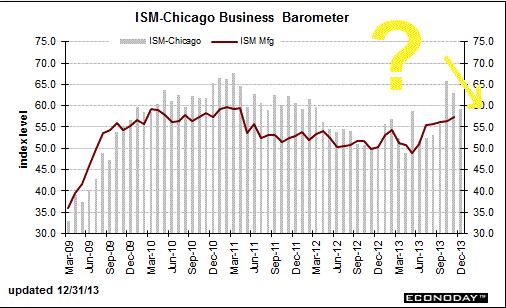
Growth slowed this month in the Chicago economy but from unsustainably high rates of growth in November and October. The Chicago PMI slowed to 59.1 vs 63.0 and 65.9 in the two prior months. Aside from November and October, the December reading is the best since March last year.

Order growth is strong but did slow with new orders at 60.7, down from 68.8 and 74.3 in the two prior months but still above September’s 58.9. This are all very strong rates of monthly growth for new orders which have been on the plus 50 side to show growth every month since November last year. And backlog orders are piling up, at 58.3 for a 3rd straight monthly build.

Employment is a special weakness in the December report, at 51.6 and not much above 50 to signal only modest monthly growth. This is the softest reading for this index since April.

Other readings include a strong though slowing rate of production, steady and moderate price pressures for raw materials, and a sharp slowing in deliveries that may point to the emergence of capacity constraints in the supply chain. In a plus, inventories, where high levels are a concern for the 4th quarter, fell sharply in the month.

This report, which covers all areas of the Chicago economy, points to another month of solid mid-50s growth for the coming ISM reports on manufacturing and non-manufacturing. The Dow is moving off opening highs following today’s report.