Retail sales, Consumer sentiment, Euro lending, Rail week

Better than expected and some upward revisions as well.

Retail Sales
me-5-13-1
Highlights
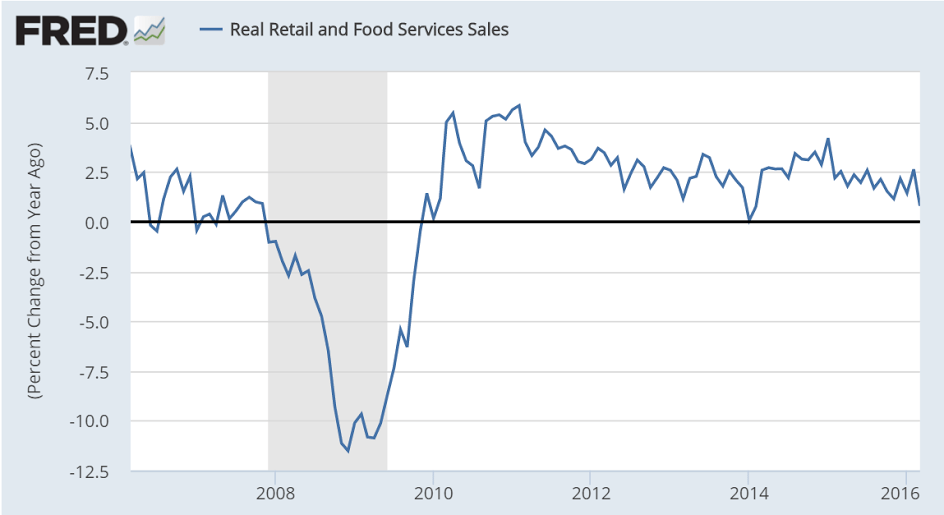
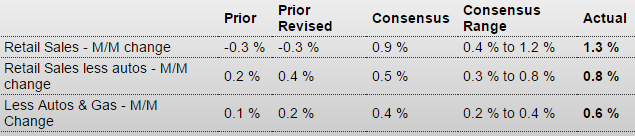
The consumer snapped back to life in April, driving retail sales 1.3 percent higher to beat Econoday’s consensus by 4 tenths and the high estimate by 1 tenth. Gains are spread throughout most of the report.

Autos are the key component, up a sharp 3.2 percent to reverse the prior month’s decline. Excluding autos, retail sales rose 0.8 percent.

Sales at gasoline stations, boosted by higher prices, also contributed strongly, up 2.2 percent in the month. But even excluding both autos and gasoline, sales still rose 0.6 percent for the third straight gain, two of which are very strong.

Apparel was a big contributor in April along with nonstore retailers and with restaurants also showing a gain. The only component in contraction was building materials & garden equipment which hints at a little cooling for what has been very solid residential investment.

Year-on-year rates all improved though total sales remain very soft at 3.0 percent. Auto sales, pulled down by tough comparisons with very strong sales this time last year, are up only 3.1 percent on the year. But other components show strength with the ex-auto ex-gas rate at a healthy 4.4 percent for a 5 tenths gain in the month.

Today’s report points to a solid start for the second quarter and gives some life to the possibility of a June FOMC rate hike.
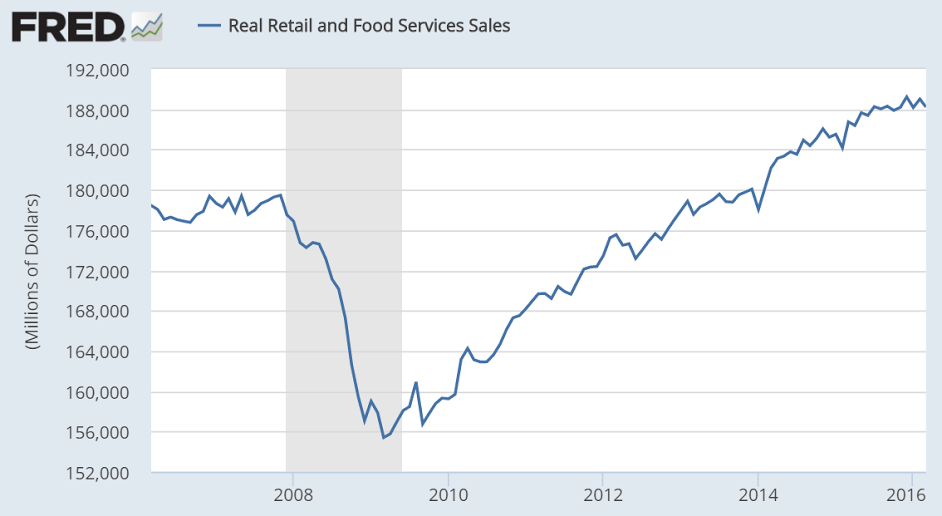
Notice how this has flattened (decelerated):
me-5-13-2
me-5-13-3
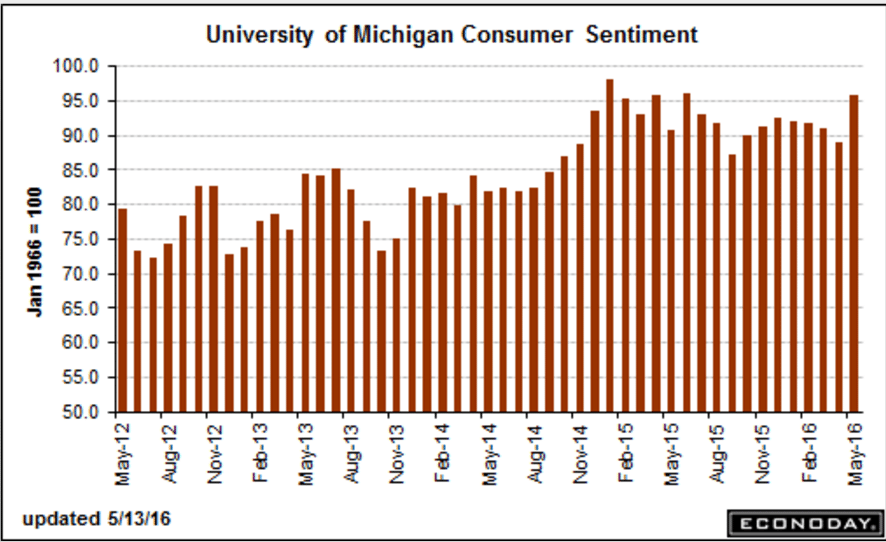
Welcome move back up here:
me-5-13-4
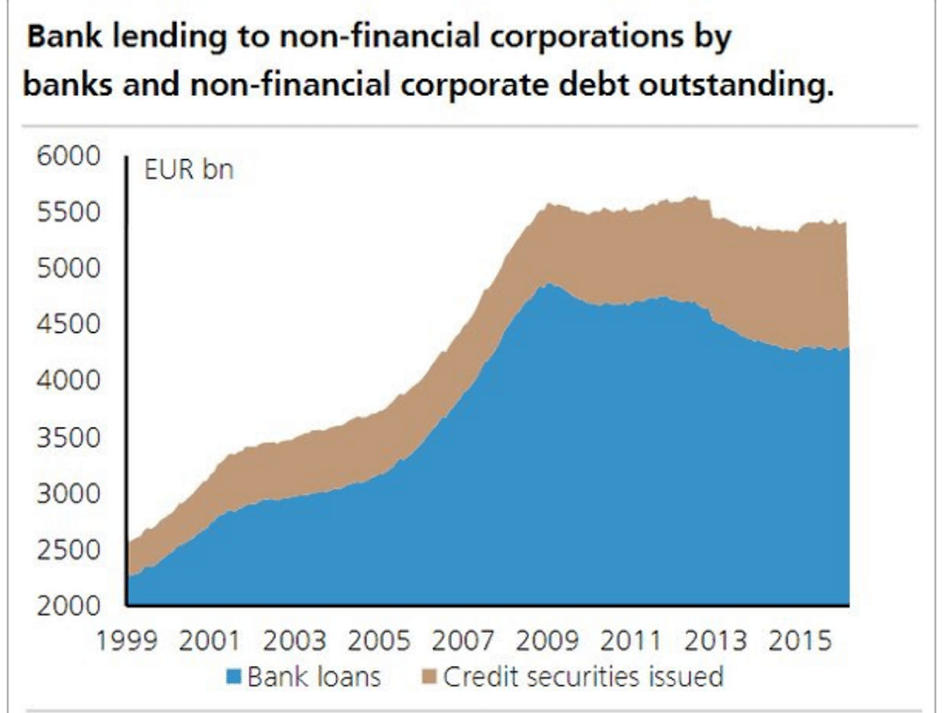
Note how in the euro area it was a sudden shortfall in private sector deficit spending that reduced aggregate demand, and has yet to recover or be ‘replaced’ by either lower taxes or more public spending:
me-5-13-5

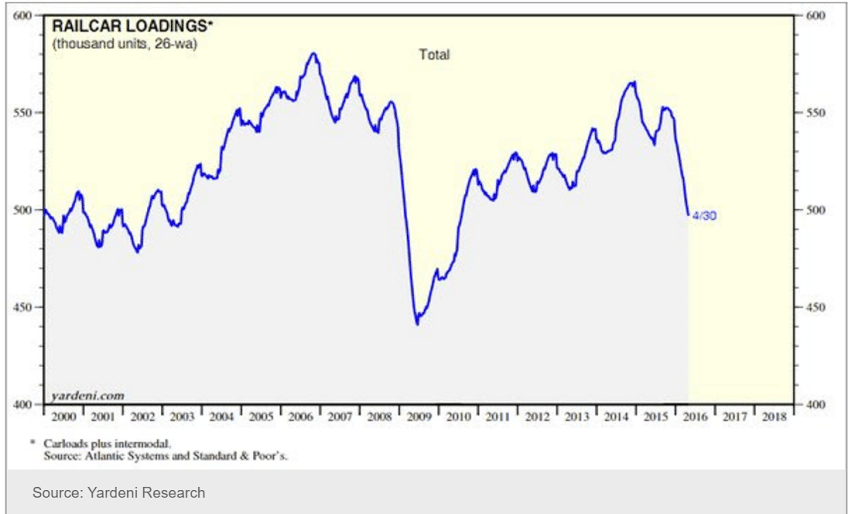
Rail Week Ending 07 May 2016: Rail Continues To Move Deeper Into Contraction

Week 18 of 2016 shows same week total rail traffic (from same week one year ago) declined according to the Association of American Railroads (AAR) traffic data. Rolling averages continue moving deeper into contraction.
Non performing loans, Working poor, China export policy, STX-STT ferry

Check out the second chart:

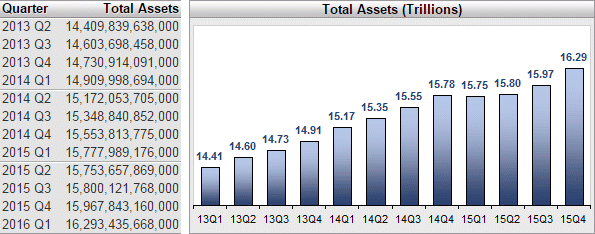
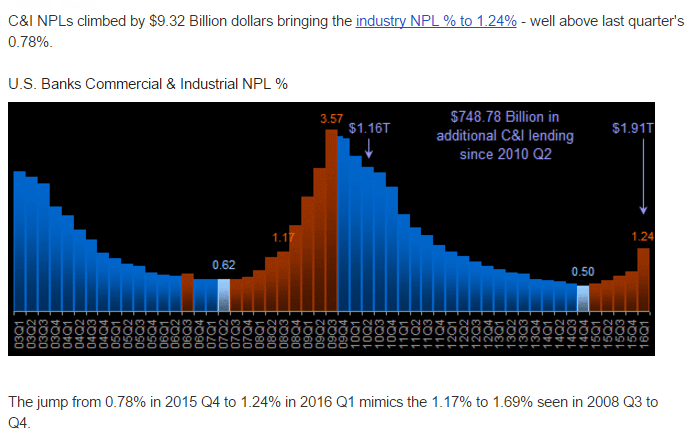
2016 Q1 call report data is available at BankRegData.com. Industry wide assets leapt to $16.293 Trillion adding an amazing $325.59 Billion (2.04%) in the 1st Quarter.
er-5-12-16-1
The $325.59 Billion increase is the largest since (you guessed it) the $337.96 Billion jump in 2008 Q1 – a span of 32 quarters.

er-5-12-16-2
What’s even more amazing is that the 1.24% would really be 1.28% if C&I lending had stayed flat. The jump to 1.24% was actually lower than it should have been due to the additional $71.168 Billion in additional C&I lending over last quarter.

I would caution that we’re beyond the “it’s Energy related” part of the commentary. C&I delinquencies are rising in most geographies and at most big banks.

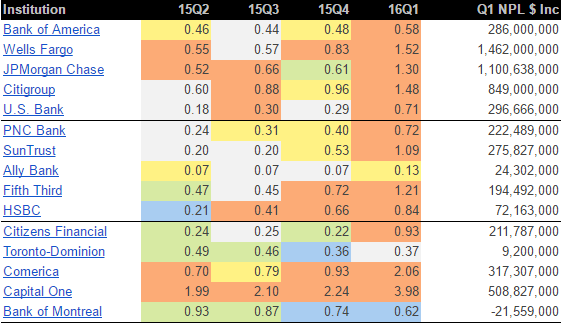
The following table lists the Top 15 C&I lenders top to bottom. At the top is Bank of America with $239.58 Billion in C&I (at an average Yield of 2.97%) and Bank of Montreal is #15 with $24.88 Billion in C&I.

C&I NPL % Heat Map Top 15 C&I Lenders
er-5-12-16-3
Wells Fargo has seen it’s C&I NPL % climb from 0.55% in 2015 Q2 to 1.52% in 2016 Q1 – NPL $ climbed $1.46 Billion in the quarter.

Take a gander at Capital One jumping from 2.24% to 3.98%. Even SunTrust which had been performing exceptionally well has seen rates go from 0.20% 3 quarters ago to 1.09% – a fivefold jump in the rate in 6 months.

The two standouts in the group are Toronto-Dominion and Bank of Montreal. Both banks have seen NPL % rates decline over the past year. I’m sure it’s just a coincidence that both are BankRegData clients. Yes, shameless plug and one I hope they’ll forgive me for.

Levity aside, C&I NPLs are getting worse and are likely to climb considerably higher in the next few quarters. We can’t add near $750 Billion in new lending in 6 years and not expect higher subsequent NPLs.

One in three US manufacturing workers are on welfare: Study

Philadonna Wade’s story plays out across middle America on a daily basis but is seldom told. It’s the story of the working poor who labor in tough jobs — like Wade’s position as an assembler for a Ford Motor plant — that don’t pay enough to keep them off public assistance.

In fact, fully 1 in 3 Americans who work in the manufacturing sector are receiving some form of public assistance, according to a study released this week by the UC Berkeley Center for Labor Research and Education. Of those who came to their positions through temp agencies, a category in which Wade falls, half are on some type of safety net program.

It’s not that Wade wants to be on food stamps and Medicaid, among other programs, it’s that the mother of four has no choice.

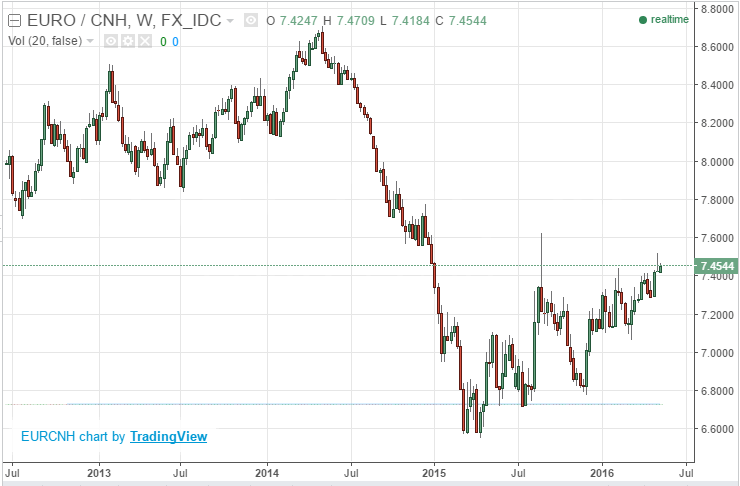
China continues to push exports, including what appears to me to be (re)targeting the euro area by buying euro a year or so after Draghi freightened them into lightening up on their euro reserves:

China Introduces Proposals to Boost Exports

May 9 (WSJ) — In policy guidelines released Monday, the State Council, the government’s cabinet, called for greater lending by banks to support small-scale and profitable exporters and said it would expand rebates of value-added taxes. It also promised to reduce short-term rates for export credit insurance, which protects exporters against nonpayment by foreign customers. “Presently, the foreign trade situation is complicated and severe, elements of uncertainty and instability are increasing and downstream pressures are continuously growing,” the State Council said.
er-5-12-16-4

Ferryboat Touches Water for First Time; Launch Trip Projected for Mid-June

China, Fed’s labor market index

More evidence global demand is slowing as both exports and imports fell. In any case the trade surplus continues, providing fundamental currency strength which probably translates into continuing fx reserve builds:

China’s exports drop again in April; imports also plunge
er-5-9-1
Highlights
Employment has been the economy’s central strength but has not been in the positive column for the labor market conditions index which remains in contraction for a 4th straight month, at minus 0.9 in April. Still, this is an improvement from March’s minus 2.1, a month when payroll growth and the participation rate were stronger but not other data that are tracked in this composite including the 12-month reading for average hourly earnings or the jobs-hard-to-get subcomponent of the consumer confidence report which both showed strength in April. The index, experimental in nature, is a broad composite of 19 separate indicators and, as yet at least, is rarely cited by policy makers.

Employment report, consumer credit

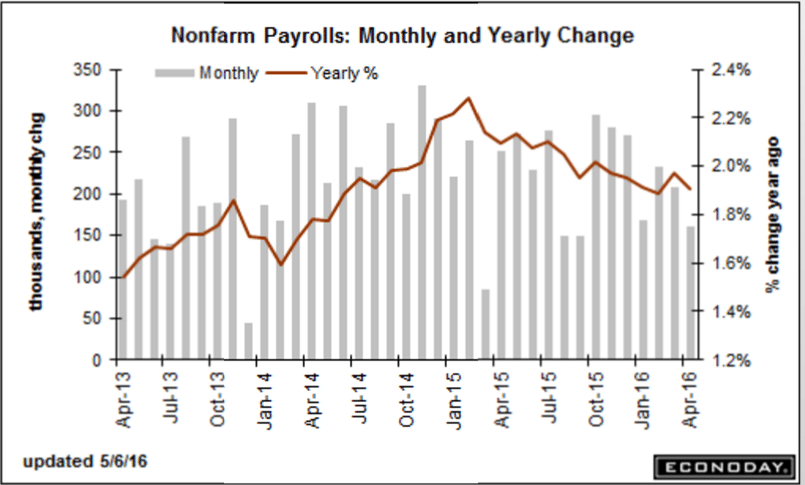
The chart shows the year over year and ongoing deceleration that in general began when oil capex collapsed.

Nor will there be a reversal until after deficit spending increases- public or private- and I see no evidence of that happening:

Employment Situation
er-5-8-1
Highlights
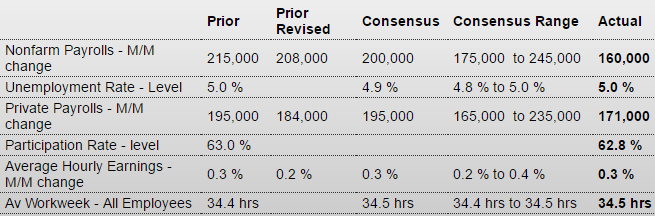
Add employment to those reports showing weakness, at least moderate weakness as nonfarm payrolls rose a lower-than-expected 160,000 in April. Revisions are minor, down a combined 19,000 in the two prior months with March now at 208,000. Government is a weak spot in April, down 11,000, with retail also showing weakness, down 3,000 after a series of outsized gains.

The unemployment rate is unchanged at 5.0 percent but the size of the labor force did fall in this reading. And the participation rate, which had been jumping, slipped 2 tenths to 62.8 percent.

Earnings are a positive, up 0.3 percent in the month with the year-on-year rate back on the climb at 2.5 percent for a 2 tenths gain. The workweek is also a positive up 1 tenth to 34.5 hours.

Turning back to industry sectors, mining extended its long trail of contraction with a 7,000 decline. But there is definitely strength especially for the closely watched professional & business services reading, up a very strong 65,000 and pointing to the need for additional permanent hiring in the months ahead. The temporary help services subcomponent of this reading is up 9,000 for a second month. Financial activities also show strength, up a very solid 20,000 with manufacturing back in the plus column but not by much with a 4,000 gain and reflecting a snap-back for the auto industry.

There’s give and take in the April data especially for labor participation which, however, is still trending higher, at least modestly. Employment is still the central strength of the economy but less so in what is less than a gangbuster opening to the second quarter. Though there’s still one more employment report to go ahead of the June FOMC, today’s report lowers whatever chances there are for a rate hike. Note that the ongoing strike by 40,000 Verizon workers do not appear to have affected April’s data.

er-5-8-2
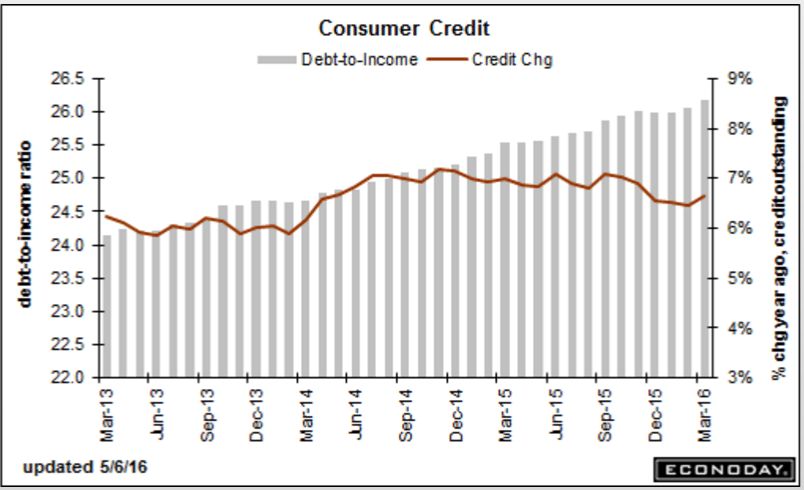
Up more than expected for the month, but the year over year didn’t move much. And note last month was revised down, so in any case best to withhold judgement regarding this series for at least a month. And a jump in borrowing can also indicate a fall off in income, particularly with retail sales growth as low as it is, with consumers borrowing to make ends meet. And check out how the debt to income level, also shown on the chart, continues to rise:

Consumer Credit
er-5-8-3
Highlights
The consumer may be showing limited enthusiasm for spending but certainly was borrowing in March. Consumer credit rose $29.7 billion in a surge that makes up for several months of prior weakness and includes a very strong $11.1 billion gain for revolving credit, indicating less reluctance to run up credit cards. Non-revolving credit rose $18.6 billion and once again reflects student loans and vehicle financing. The monthly headline is the strongest since a break in this series 5 years ago while the gain for the revolving component is the strongest since a prior break 10 years ago. The willingness to borrow hints at improved consumer confidence in the general outlook and reflects the strength of the labor market.

er-5-8-4

Euro reserves, Rail week, St. Louis Fed, China, Profits and Payrolls

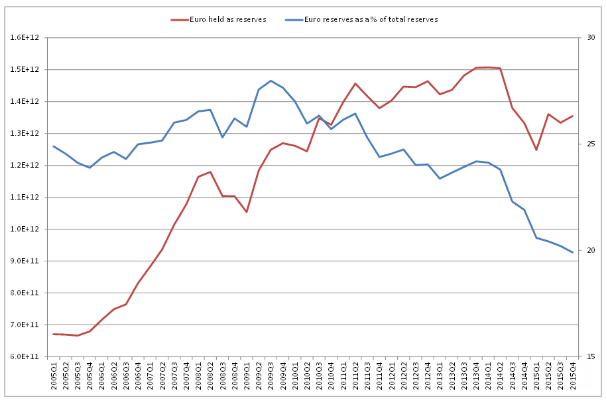
The euro level is in dollar terms, but in any case, as previously discussed, the chart shows that there was an exit from the euro when the ECB initiated its aggressive interest rate and QE policies. And the way I see it it was that selling that weakened the euro, not anything ‘fundamental’:
er-5-6-16-1

Rail Week Ending 30 April 2016: Rail Contracted 11.8 Percent From Same Month One Year Ago

Week 17 of 2016 shows same week total rail traffic (from same week one year ago) declined according to the Association of American Railroads (AAR) traffic data. All rolling averages moved deeper into contraction.
er-5-6-16-2

Negative Interest Rates: A Tax in Sheep’s Clothing

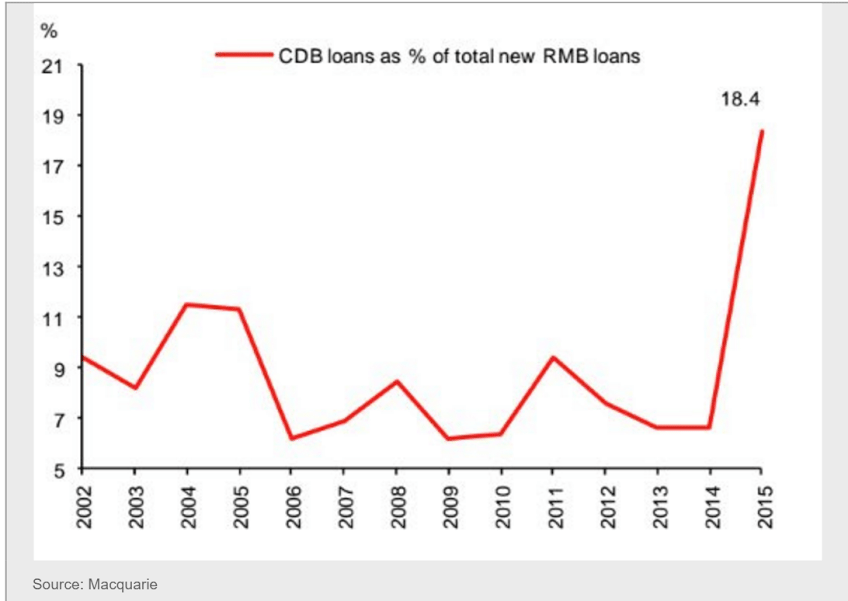
The Development Bank has been stepping up its ‘off balance sheet deficit spending’:
er-5-6-16-3
er-5-6-16-4

UK, health care costs, US labor force

er-5-5-16-1
As discussed back when the law was first proposed, this version of ‘moral hazard’ renders the entire program unworkable and to the best of my knowledge and understanding there is no ‘fix’:

Health Insurers Struggle to Offset New Costs

May 4 (WSJ) — Insurers have begun to propose big premium increases for coverage next year under the 2010 health law. The companies also have detailed the challenges in their Affordable Care Act business in a round of earnings releases. The health law instigated a sweeping overhaul to the way insurance is priced and sold in the U.S. Insurers can’t deny coverage to consumers with risky medical histories, or charge them more for plans. A number of popular insurers say the enrollees who bought plans through the exchanges have had higher health costs than they originally predicted—when they knew less about the impact of the law.

Seems to me they’ve always been there, but for one reason or another just now being ‘counted’?

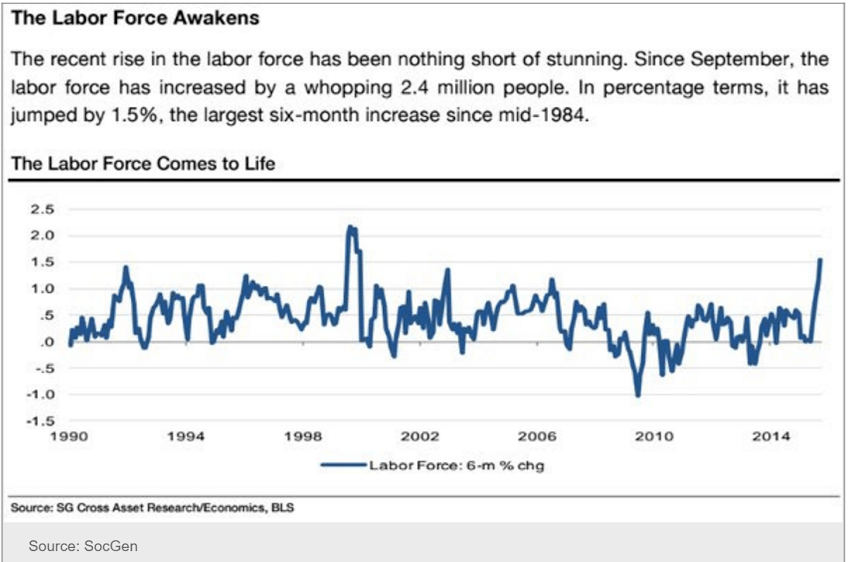
And seems to me there are lots more to come, as it’s always looked to me that the decline in the participation rate was suspect. If so, this means unemployment has, all along, been pushing 9-10%:
er-5-5-16-2
er-5-5-16-3
And this is exactly what you would expect if headline unemployment was 10%:
er-5-5-16-4

Saudi pricing, layoffs

If true, the $1.10 increase in the differential for Asia is substantial.

However the other, much smaller adjustments are not material, so it’s hard to say from this information whether or not this is a policy move designed to stabilize prices at current levels:

(Bloomberg) — Saudi Aramco raised prices for most crude grades sold to Northwest Europe, Mediterranean next month while lowering prices for most grades it sells to U.S.

  • Official pricing statement confirms increased prices for Asia reported earlier today by Bloomberg
  • Differential for Arab Light crude sold to U.S. kept unch at 35c/bbl premium to ASCI benchmark
    • Other grades sold to U.S. all lowered by 20c m/m, to $2.40 premium for Extra Light, $1.25 discount for Medium, $1.75 discount for Heavy
  • Light crude to NWE raised 15c to discount of $4.45 versus ICE Bwave marker; other grades raised except Extra Light
  • Light crude to Mediterranean raised 25c to discount of $3.95 versus ICE Bwave marker; other grades raised except Extra Light

Saudis Said to Boost Oil Pricing for Asia by Most in 14 Months

By Serene Cheong

May 5 (Bloomberg)

Arab Light said to be set at 25 cent premium to Oman-Dubai
That’s strongest differential for grade since September 2015

Saudi Arabia was said to raise its pricing for June oil sales to Asia by the most since April 2015, in a sign that the world’s biggest exporter is expecting demand to recover as the global crude market rebalances.

State-owned Saudi Arabian Oil Co. increased its official selling price for Arab Light crude to Asia by $1.10 a barrel to 25 cents more than regional benchmarks Oman and Dubai, said people with knowledge of the matter who asked not to be identified because the information is confidential. The company, known as Saudi Aramco, was predicted to raise its pricing for the grade by 65 cents a barrel, according to the median estimate in a Bloomberg survey of five refiners and traders.

Looks like this is continuing to trend higher, post oil capex collapse:
er-5-5-16-5

Mtg purchase apps, ADP, Trade, Factory orders

Same story, depressed and growing too slowly to matter:

MBA Mortgage Applications
er-5-4-16-1
Highlights
Purchase applications for home mortgages managed to rise 1.0 percent in the April 29 week, but refinancing continued to decline, down 6.0 percent after falling 5.0 percent in the prior week. Though purchase applications are 13 percent higher than the same week a year ago, the year-on-year gain has narrowed sharply from the 30 percent gains seen as recently as March. Rates crept slightly higher, with the average 30-year mortgage for conforming loans ($417,000 or less) up 2 basis points to 3.87 percent.

Weak:
er-5-4-16-2

ADP Employment Report
er-5-4-16-3
Highlights
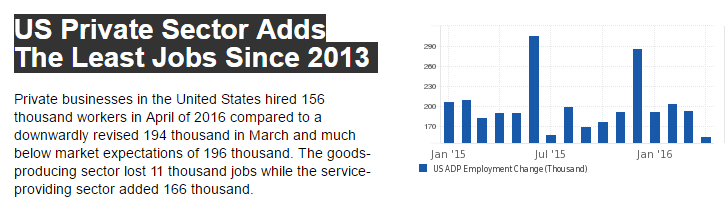
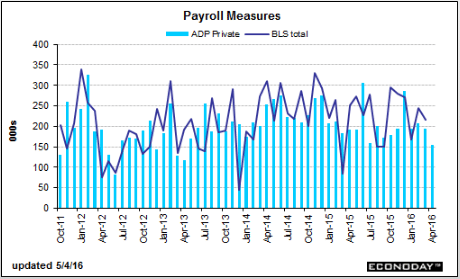
Consumer spending and economic growth are slowing and now the labor market, at least based on ADP’s estimate, is softening. ADP sees private payrolls rising only 156,000 in April for what would be one of the weakest prints of the economic cycle and the lowest since 142,000 in February 2014. ADP, whose reputation as a leading indicator isn’t perfect, has nevertheless been on a 4-month hot streak and today’s report is certain to raise talk of trouble for Friday’s employment report.

er-5-4-16-4
And here’s the year over year growth chart. Can you spot the point where oil capex collapsed? ;)
er-5-4-16-5

Global trade continues its collapse:

er-5-4-16-6
Highlights
The nation’s trade gap narrowed in March but, unfortunately, is not a positive for the economic outlook. The gap came in at $40.4 billion in March vs a revised $47.0 billion in February and largely reflects a downgrade for imports which fell 3.6 percent in the month vs the prior month’s 1.3 percent rise. Contraction in imports, though a positive for the gap, is however a negative indication for domestic demand, especially in this report as consumer goods show unusual weakness. And indications on foreign demand are also negative with exports, despite the positive effects of this year’s depreciation in the dollar, slipping 0.9 percent vs February’s 1.1 percent rise.

Imports of consumer goods fell a very steep $5.1 billion in the month followed, in yet another major negative, by core capital goods which fell $1.6 billion. The former points to weak consumer demand and the latter points to weakness in business expectations. Oil was not a factor on the import side, averaging $27.68 per barrel vs February’s $27.48 and making for a total petroleum deficit of $3.0 billion vs February’s $3.5 billion deficit.

Weakness on the export side is also concentrated in consumer goods, down $1.6 billion in the month, and includes a separate $0.7 billion decline for autos. Industrial supplies are also down. One positive is a $1.3 billion rise in core capital goods which, however, follows a long string of declines. A solid positive is a further gain for service exports, up 0.5 percent in the month and generally reflecting demand for the nation’s technical and managerial expertise.

The nation’s gap with China, reflecting the decline in imported consumer goods, narrowed very sharply, to $20.9 billion in March from February’s $28.1 billion. The narrowing with China offset widening gaps with the EU, at $13.1 billion, and with Mexico, at $5.4 billion, and also with Japan, at $6.7 billion.

Trade data are always very revealing, in this case pointing unfortunately to declining cross-border demand and showing little benefit, at least so far, from this year’s decline in the dollar.

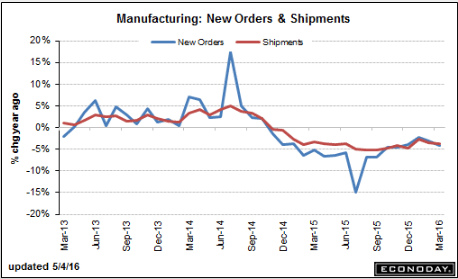
Factory orders and shipments continue in negative territory on a year over year basis:
er-5-4-16-7
A bit of improvement here but still looking like growth in this sector will be lower this year than it was last year, and may still be trending lower:
er-5-4-16-8

Car sales, Home prices

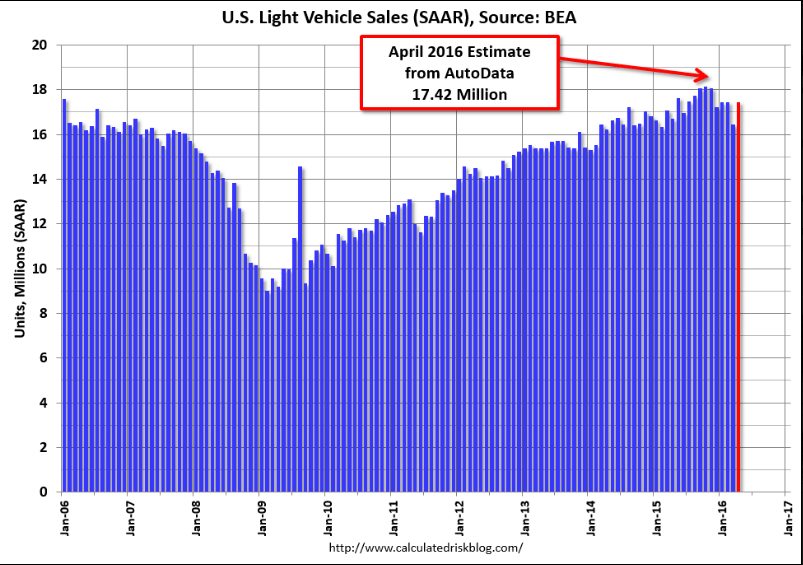
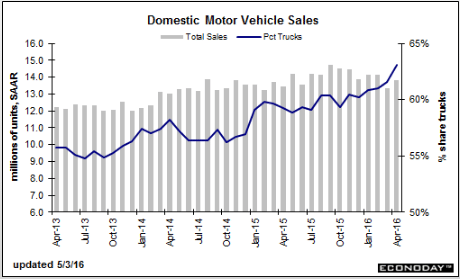
Car sales came in about as expected.

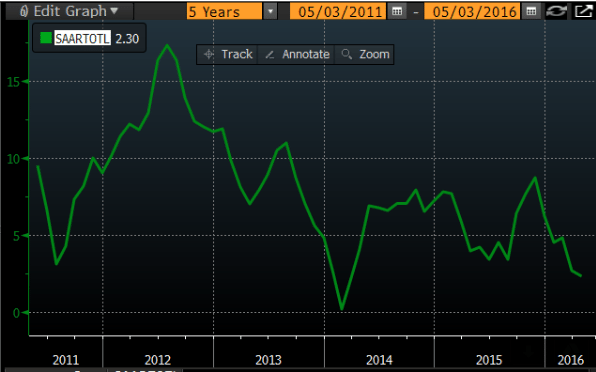
Note the year over year 3 month moving average continues its deceleration, and so far not adding as much to growth this year as last year:
er-5-3-5
er-5-3-6
er-5-3-7

The luxury home market may be losing some of its luster.

Average sales prices for homes listed at $1 million or more fell 1.1 percent in the first quarter compared with a year earlier, marking the biggest decline in more than two years, according to Redfin.

The decline at the top marks a stark contrast with the broader housing market, which continues to gain strength. The bottom 95 percent of the housing market saw prices jump 4.7 percent in the first quarter compared with a year ago.

Sales volume of homes priced at $1 million or more rose 4.9 percent — marking slower growth than the rest of the market, where sales volume grew 6 percent.

China, Redbook retail sales, UK manufacturing, yen comments

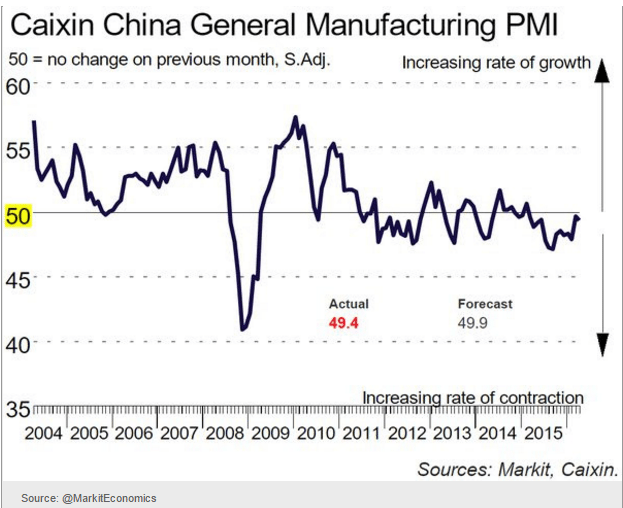
Still in negative territory:
er-5-3-1
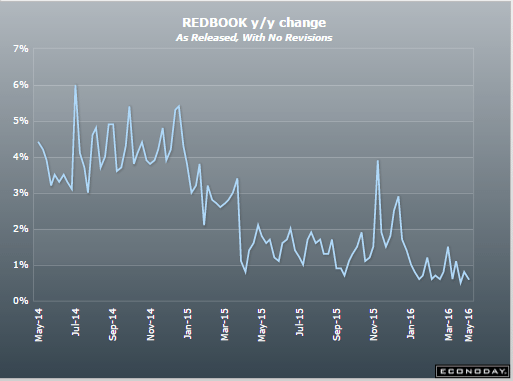
Still stone cold dead:
er-5-3-2
er-5-3-3
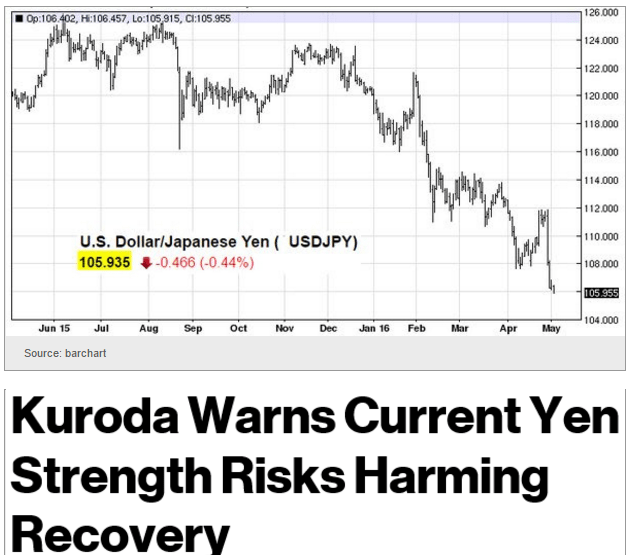
Exporters have serious clout over there.

Intervention on their behalf would be no surprise:

Japan exporters stand to take nearly $10bn hit from rising yen

The yen’s sharp appreciation threatens to undercut profits at major Japanese exporters by more than 1 trillion yen ($9.37 billion) this fiscal year, outweighing any benefits of a stronger home currency for some companies, estimates by The Nikkei show.

Even at exchange rates of 110 yen to the dollar and 125 yen to the euro — levels on which many companies are basing their fiscal 2016 earnings estimates — 25 of the country’s biggest exporters, including Toyota Motor and Komatsu, would see their combined operating profits fall 1.14 trillion yen on the year owing to currency movements alone.

er-5-3-4