The Center of the Universe

St Croix, United States Virgin Islands

MOSLER'S LAW: There is no financial crisis so deep that a sufficiently large tax cut or spending increase cannot deal with it.

Archive for the 'Obama' Category

The President’s Fairness Fiction

Posted by WARREN MOSLER on 12th April 2012

President Obama’s ‘Fairness’ Vision Would Bankrupt Nation

April 11 (IBD) — Economy: In two recent high-profile policy speeches, President Obama has struggled to make a case for his big-government, high-tax vision for the economy. But his comments reveal just how bankrupt his vision is.

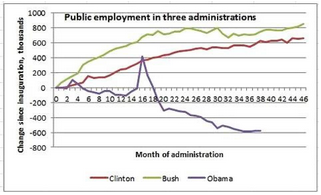
Last I read, he’s actually reduced govt head count for maybe the first time in history, and spending as a % of GDP is up only because of transfer payments due to the recession, with taxes as a % of GDP reaching extremely low levels as well.

It’s ironic that President Obama would make two speeches this week in Florida about “fairness,” sandwiched as they were between $10,000-a-plate fundraising dinners. But that’s the level of hypocrisy coming from the White House these days.

To be polite, most of the comments Obama makes these days about the economy, taxes and, especially, “fairness” stretch all credibility. Hearing the large number of outright falsehoods and partial truths he uses to support his argument, it’s impossible not to believe it’s simply a ploy to get votes from those who envy the rich and the successful.

A full unpacking of Obama’s whoppers would require a much larger space than we have here. Here are just a few examples:

“I believe the free market is the greatest force for economic progress in human history.”

If he believed that, he would not have signed the $787 billion stimulus bill.

That helped the private sector and ‘free markets’ even though I didn’t like the details.

He wouldn’t have imposed onerous new green regulations on businesses.

Without federal pollution regulation the states get into a race to the bottom where whoever allows the most pollution gets the most businesses.

He wouldn’t have taken over the auto and banking industries.

Banking with FDIC deposit insurance makes banking a 90/10 public private partnership. And he didn’t take over banking in any case.

Nor would he seek massive new tax hikes on businesses, or use the frightening power of government — including thousands of new IRS agents to enforce ObamaCare — to pursue his utopian vision of “fairness.”

First, I’m against corporate taxes in general. But even so, he cut payroll taxes for business and the proposed increases were about closing loopholes. And Obamacare took 500 billion out of medicare to give to insurance companies- hardly pro govt/anti business.

If Obama truly believed in the free market,

And remember, there is no ‘free market’ as by definitions markets operate only within institutional structure including contract law and enforcement.

he’d eliminate Fannie Mae, Freddie Mac, the EPA, the Energy Department and many other federal departments and agencies that distort free markets.

All govt and all taxation necessarily distorts markets. All govt works on coercion. Nor are there competitive markets when there is limited competition and monopoly power, which means some form of govt regulation is required.

He would roll back thousands of costly, ineffective regulations that estimates say cost the U.S. $1.8 trillion a year.

I’d have to see the specifics, which the rest of this article makes me doubtful of.

“The gap between those at the very, very top and everybody else keeps growing wider and wider and wider and wider.”

In fact, the top 1% have a lower share of total household income than they did in 1920 — just after World War I.

So maybe 1920 was a particularly high year because of the war? Don’t know his point, except pointing to 1920 is a smokescreen to disguise the fact that the share of income has been rising dramatically for a long time.

Though the top 1% have recently boosted their share, that’s largely due to the tech boom of the 1980s, 1990s and 2000s, which made all Americans richer.

I thought it was the financial sector??? But even so, a tech boom doesn’t necessarily do that to income distribution. It doesn’t explain why the football coach earns $10 million while the professor who cured cancer gets $100,000. It’s all about institutional structure.

Even so, the so-called Gini Coefficient — the federal government’s own measure of income inequality — is today lower than it was during the Clinton era.

“At the beginning of the last decade, the wealthiest Americans got two huge tax cuts, in 2001 and 2003.”

The rich, with everyone else, did get their top tax rates cut. But the actual taxes they paid rose sharply.

Right, because their incomes rose that much more. This is out of context writing throughout, laced with lies of omission.

Don’t believe it? Just before those tax cuts were passed, the top 1% earned 18% of all adjusted gross income and paid 34% of all federal taxes.

Only because they conveniently don’t include FICA when they talk about taxes like this. But they do include it when it’s going up or down- tax cut or tax hike. And it’s something approaching half of all federal income taxes.

By 2009, the last full year for which there are data, the top 1% share of AGI had fallen to 17%, according to IRS data. But they paid 37% of all taxes.

Not including FICA

As for the bottom 50% of income earners: In 2009 they took home 13% of income but paid less than 3% of federal income taxes. And today, nearly half of all Americans don’t pay taxes at all.

Not including FICA which is 7.6% of income from dollar one, with a cap at something like $105,000. Including FICA it could be something like 30% paid by lower income earners.

In short, during the 2000s, top earners took home a smaller share of the income pie but paid a larger share of the taxes. Is that what Obama means by “fairness?”

Does leaving out FICA count as fairness?

As for the so-called Buffett Rule that Obama wants, it would impose a minimum tax of 30% on millionaires to make them pay their “fair share.” It’s premised on investor Warren Buffett’s assertion that he pays a lower tax rate than his secretary.

Nonsense. Those with incomes over $1 million pay about 30% in taxes on average, about twice the average for those with middle incomes, like Buffett’s assistant.

Not counting FICA.

Simply put, this is class warfare. The tax would only raise $47 billion over the next decade — a drop in the bucket compared to the $45 trillion in spending and $9.6 trillion in deficits under Obama’s budget.

And just under $1 trillion per year of FICA taxes

Unfortunately, by raising the capital gains tax from 15% to over 30%, it would kill millions of American jobs and send small business creation into a tailspin.

Any tax hike can reduce aggregate demand. And not having income taxes and cap gains at the same rate merely causes income to shift to the lowest taxed category, and provide massive fees for the accounting firms and financial sector as well.

Who would that help?

“We tried (free market economics) for eight years before I took office. … We were told the same thing we’re being told now — this is going to lead to faster job growth, it’s going to lead to greater prosperity for everybody. Guess what? It didn’t.”

Obama has repeatedly suggested all the economy’s problems are due to President Bush.

But Bush, like Obama, entered office during a recession. Not only did he take over after the biggest stock market crash since the Depression, but the Fed had more than doubled interest rates, killing growth.

The Fed doubled rates from very low levels after the economy started growing from the combo Bush proactively expanding the deficit and from the up leg of the sub prime adventure. It ended with the shrinking of the deficit and the down leg of the sub prime adventure.

Worse, within eight months of entering office, the U.S. was hit with the 9/11 terrorist attacks — the first on the American homeland since World War II. Within the space of just 90 days, a million jobs were lost.

Jobs were lost because private sector credit expansion ended after being stretched past it’s limits during the late 90′s, with the govt budget surplus draining off hundreds of billions of dollars of net financial assets as well.

Obama’s right. President Bush did cut tax rates. What was the result? We had 52 straight months of job growth, with 8 million new jobs over six years.

Propelled by the larger deficit and the expansion phase of the sub prime adventure.

For Bush’s entire presidency, the unemployment rate averaged 5.3%. Under Obama, it’s not been below 8%.

Yes, because the deficit is too small, and both sides want to make it smaller. Good luck to us…

Real after-tax income per person rose more than 11% under Bush, while real GDP from 2000 to 2007 grew $2.1 trillion, or 17%. In 2007, the deficit fell to $162 billion — roughly 1% of GDP.

Yes, not large enough to support aggregate demand after support from the sub prime expansion phase ended.

Does Obama really want to compare himself to that? Since he’s entered office, we’ve lost 1.7 million jobs, and unemployment has averaged over 8%.

His deficits have averaged $1.4 trillion — about 8% of GDP, a record. On his watch, debt has soared from $10.7 trillion to $16 trillion. America now has more debt than the entire euro zone and Great Britain — combined.

And still not nearly enough to restore aggregate demand.

Under Obama spending has surged. The federal government now accounts for 25% of the economy, vs. the long-term average of 20%.

Due mainly to automatic counter cyclical transfer payments, not expanded regular spending.

Through his big-government policies, Obama took a bad recession and made sure our recovery would be the worst ever — and then blamed it on everyone but himself.

Meanwhile, get ready for “taxmageddon” — the $494 billion tax hike that hits in 2013 as the Bush tax cuts expire, something Obama is doing nothing about.

Wasn’t it the opposition trying to not allow the extension this year?

Our economy, in short, will never regain its old vitality until a new president is elected, and Obama’s top-down, government-centered policies are laid to rest.

I’ve been a harsh critic of Obama’s policies all along, but this is all a pile of intellectually dishonest propaganda.

Posted in Banking, Deficit, Fed, GDP, Government Spending, Interest Rates, Obama, Political, Recession | 74 Comments »

Romney: US could face ‘financial crisis’ like Greece, Italy if Obama is reelected

Posted by WARREN MOSLER on 21st December 2011

In case you had any respect whatsoever for Romney’s understanding of monetary operations and fiscal policy.

In fact, no one has been invoking Greece since the S&P downgrade when interest rates went down, and pundits from both sides pointed out the difference is we ‘print our own money.’

Romney: US could face ‘financial crisis’ like Greece, Italy if Obama is reelected

By Justin Sink

Dec 20 — Mitt Romney said that the United States would experience a financial crisis similar to that of Greece or Italy if President Obama were elected to a second term, and hit rival Newt Gingrich’s plan for the federal judiciary as unconstitutional during an interview Monday night with Fox News’s Bill O’Reilly.

“I think we hit a Greece-like wall. I think before the end of his second term, if he were reelected, there’s a very high risk that we would hit a financial crisis that Greece or Italy have faced,” Romney said.

“I think it’s also very possible that we would continue to see very high levels of unemployment. I think you would see industry in this country, entrepreneurs, big and small, decide to go elsewhere, to take their investment dollars to other nations. This president has put together the most anti-investment, anti-growth and anti-job series of policies that I’ve seen since Jimmy Carter,” he added.

Posted in Obama, Political | 12 Comments »

President Obama entering the fray

Posted by WARREN MOSLER on 3rd November 2011

More of the blind leading the blind. The one thing they all agree on, at great expense to global well being, is the budget deficits are all too large and the need for shared sacrifice and all that.

No chance for anything constructive to come out of any of this.

And these masters of their money machines don’t even know how to inflate, as they all desperately try to inflate with their versions of quantitative easing, which, functionally, is just another demand draining tax.

*DJ Merkel, Obama Discussed How To Boost EFSF Firepower Without ECB
*DJ Obama To Merkel: We Are Totally Invested In Your Success – Source
*DJ Geithner, Schaeuble May Meet To Discuss IMF Role In Euro Crisis -Source

Posted in CBs, Deficit, ECB, EU, Fed, Inflation, Interest Rates, Obama, Political, TREASURY | 8 Comments »

Obama to announce action on mortgages

Posted by WARREN MOSLER on 24th October 2011

About time!

Obama to announce action on mortgages

By Kate Mackenzie

October 24 (Financial Times) — US regulators on Monday plan to unveil a major overhaul of an under-used mortgage-refinance program designed to help millions of Americans whose home values have tumbled, the WSJ says. The plan will streamline the refinance process by eliminating appraisals and extensive underwriting requirements for most borrowers, as long as homeowners are current on their mortgage payments. The measures will not require congressional approval, says Reuters, and the first of the initiatives will be unveiled during Obama’s three-day trip to western states beginning Monday. He will discuss the changes in mortgage rules at a stop in Nevada, which has one of the hardest-hit housing markets in the country. The Obama administration has been working with the Federal Housing Finance Agency, the regulator for Fannie Mae and Freddie Mac, to find ways to make it easier for borrowers to switch to cheaper loans even if they have little to no equity in their homes.

Posted in Financial Times, Housing, Obama | 11 Comments »

Cain Beats Romney as GOP Frontrunner for Primary

Posted by WARREN MOSLER on 13th October 2011

Shows how quick Republicans are to ‘step up’ from Romney. Shows there’s a lot more than racism working against President Obama.

And shows translating Tea Party rhetoric into logically consistent policy proposals is highly problematic at best.

With Cain leading, his 999 proposal is suddenly getting more serious media attention, and getting ripped to shreds.

Leaves the Republicans, and the nation, without any headline proposals to debate, Romney holding on as the default candidate, and President Obama holding on to a narrow lead.

Cain Beats Romney as GOP Frontrunner for Primary

By John Harwood

October 12 (CNBC) — Business executive Herman Cain has jumped to the top of the volatile Republican presidential race in a campaign season dominated by economic anxiety.

Among Republican primary voters, Cain leads former Massachusetts Gov. Mitt Romney 27 percent to 23 percent, according to the latest NBC News/Wall Street Journal poll.

Texas Gov. Rick Perry, who led the August NBC/WSJ survey with 38 percent supported, plummeted to third place with 16 percent. He was followed by Rep. Ron Paul with 11 percent, former House Speaker Newt Gingrich with 8 percent, Rep. Michele Bachmann with 5 percent, former Utah Gov. Jon Huntsman with 3 percent and former Sen. Rick Santorum with 1 percent.

Cain’s rapid rise, from 5 percent in the previous poll, underscores the volatility of the 2012 GOP nomination contest. Like the rank-and-file’s earlier flirtations with Donald Trump, Michele Bachmann and Perry, this one, too, may not last.

Bill McInturff, the Republican pollster who conducts the Journal/NBC survey with his Democratic counterpart Peter Hart, cautioned that this latest “speculative bubble” reflects the Republican base sifting a presidential field without a dominant front-runner. Romney holds a lead in fund-raising and in New Hampshire’s first-in-the-nation primary, but has so far been unable to capture the heart of his party.

“He’s the remainder-man candidate for the Republicans,” Hart said. “Acceptable, but not their first choice.”

Posted in Obama, Political | 38 Comments »

President Obama comments

Posted by WARREN MOSLER on 7th October 2011

*DJ Obama: New Debit-Purchase Fees Not ‘Necessarily Fair To Consumers’

How about, US banks are public private partnerships, funded by govt. insured deposits, govt. regulated and supervised, established and sustained to provide public infrastructure for public purpose, and all permitted bank policies will be considered accordingly.

*DJ Obama: China Has Been Very Aggressive In ‘Gaming’ The Trading System
*DJ Obama: China Currency Appreciation Not Sufficient
*DJ Obama Expresses Concerns About China Currency Legislation
*DJ Obama Wants To Make Sure China Currency Bill Doesn’t Thwart WTO Rules

How about the fact that exports are real costs, imports real benefits, and optimizing real terms of trade and all that?

*DJ Obama: Biggest Headwind With US Economy Is Uncertainty With Europe

How about our biggest headwind is we are grossly overtaxed for the size govt. We have an immediate fiscal adjustment, a much larger deficit is in order?

Posted in Obama | 120 Comments »

How MMT sees the President’s speech

Posted by WARREN MOSLER on 9th September 2011

MMT sees the President’s speech the way New Yorker’s would see this speech
if it was given by a New York City Mayor back in the days when they still had subway tokens:

My fellow New Yorkers,

I have a proposal to help our retired NYC workers that you can all pass, and it will be fully paid for.

I propose that all retired NYC workers be given 20 subway tokens per month so that they can better afford to ride the trains.

And to pay for this program, I propose that for every 10 subway tokens we collect at the turnstiles, one token will be set aside to be given to the retirees.

Yes, I know we have a long term token deficit problem, as each year we issue many more tokens than we collect. And as you know, we have established a committee to deal with this by Thanksgiving.

But, as I said, this program will be fully paid for, with tokens set aside as we collect them….

Feel free to distribute.

Posted in Obama | 27 Comments »

Financial Times: Obama jobs plan to target payroll tax and states

Posted by WARREN MOSLER on 7th September 2011

Sounds vaguely familiar.

;)

Obama jobs plan to target payroll tax and states

By Stephanie Kirchgaessner and James Politi

Posted in Obama | 12 Comments »

HuffPost Blog Post – The Speech That President Obama Should Make

Posted by WARREN MOSLER on 6th September 2011

Link: HuffPost Blog Post – The Speech That President Obama Should Make

Posted in Employment, GDP, Government Spending, Obama | 249 Comments »

MMT to Obama- Use This Speech!

Posted by WARREN MOSLER on 2nd September 2011

This is the speech I would make if I were President Obama:

My fellow Americans, let me get right to the point.

I have three bold new proposals to get back all the jobs we lost, and then some.
In fact, we need at least 20 million new jobs to restore our lost prosperity and put America back on top.

First let me state that the reason private sector jobs are lost is always the same.
Jobs are lost when business sales go down.
Economists give that fancy words- they call it a lack of aggregate demand.

But it’s very simple.
A restaurant doesn’t lay anyone off when it’s full of paying customers,
no matter how much the owner might hate the government,
the paper work, and the health regulations.

A department store doesn’t lay off workers when it’s full of paying customers,
And an engineering firm doesn’t lay anyone off when it has a backlog of orders.

Restaurants and other businesses lay people off when their customers stop buying, for any reason. So the reason we lost 8 million jobs almost all at once back in 2008 wasn’t because all of a sudden all those people decided they’d rather collect unemployment than work.
The reason all those jobs were lost was because sales collapsed.
Car sales, for example, collapsed from a rate of almost 17 million cars a year to just over 9 million cars a year.
That’s a serious collapse that cost millions of jobs.

Let me repeat, and it’s very simple, when sales go down, jobs are lost,
and when sales go up, jobs go up, as business hires to service all their new customers.

So my three proposals are specifically designed to get sales up to make sure business has a good paying job for anyone willing and able to work.

That’s good for businesses and all the people who work for them.

And these proposals are bipartisan.
They are supported by Americans ranging from Tea Party supporters to the Progressive left, and everyone in between.

So listen up!

My first proposal if for a full payroll tax suspension.
That means no FICA taxes will be taken from both employees and employers.

These taxes are punishing, regressive taxes that no progressive should ever support.
And, of course, the Tea Party is against any tax.
So I expect full bipartisan support on this proposal.

Suspending these taxes adds hundreds of dollars a month to the incomes of people working for a living. This is big money, not just a few pennies as in previous measures.

These are the people doing the real work.
Allowing them to take home more of their pay supports their good efforts.
Right now take home pay is barely enough to pay for food, rent, and gasoline, with not much left over. When government stops taking FICA taxes out of their pockets, they’ll be able to get back to more normal levels of spending.

And many will be able to better make their mortgage payments and their car payments,
which, by the way, is what the banks really want- people who can make their payments.
That’s the bottom up way to fix the banks, and not the top down bailouts we’ve done in the past.

And the payroll tax holiday is also for business, which reduces costs for business, which, through competition, helps keep prices down for all of us. Which means our dollars buy more than otherwise.

So a full payroll tax holiday means more take home pay for people working for a living,
and lower costs for business to help keep prices and inflation down,
so sales can go up and we can finally create those 20 million private sector jobs we desperately need.

My second proposal is for a one time $150 billion Federal revenue distribution to the 50 state governments with no strings attached.
This will help the states to fill the financial hole created by the recession,
and stay afloat while the sales and jobs recovery spurred by the payroll tax holiday
restores their lost revenues.

Again, I expect bipartisan support.
The progressives will support this as it helps the states sustain essential services,
and the Tea Party believes money is better spent at the state level than the federal level.

My third proposal does not involve a lot of money, but it’s critical for the kind of recovery that fits our common vision of America.
My third proposal is for a federally funded $8/hr transition job for anyone willing and able to work, to help the transition from unemployment to private sector employment.

The problem is employers don’t like to hire the unemployed, and especially the long term unemployed. While at the same time, with the payroll tax holiday and the revenue distribution to the states,business is going to need to hire all the people it can get. The federally funded transition job allows the unemployed to get a transition job, and show that they are willing and able to go to work every day, which makes them good candidates for graduation to private sector employment.

Again, I expect this proposal to also get solid bipartisan support.
Progressives have always known the value of full employment,
while the Tea Party believes people should be able to work for a living, rather than collect unemployment.

Let me add here that nothing in these proposals expands the role or scope of the federal government.
The payroll tax holiday is a cut of a regressive, punishing tax,
that takes the government’s hand out of the pockets of both workers and business.

The revenue distribution to the states has no strings attached.
The federal government does nothing more than write a check.

And the transition job is designed to move the unemployed, who are in fact already in the public sector, to private sector jobs.

There is no question that these three proposals will drive the increase in sales we need to
usher in a new era of prosperity and full employment.

The remaining concern is the federal budget deficit.

Fortunately, with the bad news of the downgrade of US Treasury securities by Standard and Poors to AA+ from AAA, a very important lesson was learned.

Interest rates actually came down. And substantially.

And with that the financial and economic heavy weights from the 4 corners of the globe
made a very important point.

The markets are telling us something we should have known all along.
The US is not Greece for a very important reason that has been overlooked.
That reason is, the US federal government is the issuer of its own currency, the US dollar.
While Greece is not the issuer of the euro.

In fact, Greece, and all the other euro nations, have put themselves in the position of the US states. Like the US states, Greece and other euro nations are not the issuer of the currency that they spend. So they can run out of money and go broke, and are dependent on being able to tax and borrow to be able to spend.

But the issuer of its own currency, like the US, Japan, and the UK,
can always pay their bills.
There is no such thing as the US running out of dollars.
The US is not dependent on taxes or borrowing to be able to make all of its dollar payments.
The US federal government can not go broke like Greece.

That was the important lesson of the S&P downgrade,
and everyone has seen it up close and personal and they all now agree.
And now they all know why, with the deficit at record high levels, interest rates remain at record low levels.

Does that mean we should spend without limit and not tax at all?
Absolutely not!
Too much spending and not enough taxing will surely drive up prices and inflation.

But it does mean that right now,
with unemployment sky high and an economy on the verge of another recession,
we can immediately enact my 3 proposals to bring us back to
a strong economy with good jobs for people who want them.

And some day, if somehow there are too many jobs and it’s causing an inflation problem,
we can then take the measures needed to cool things down.

But meanwhile, as they say, to get out of hole we need to stop digging,
and instead implement my 3 proposals.

So in conclusion, let me repeat these three, simple, direct, bipartisan proposals
for a speedy recovery:

A full payroll tax holiday for employees and employers
A one time revenue distribution to the states
And an $8/hr transition job for anyone willing and able to work to facilitate
the transition from unemployment to private sector employment as the economy recovers.

Thank you.

Posted in Credit, Employment, GDP, Inflation, Obama, Political, Proposal | 194 Comments »

Nightmare on Main Street: Krueger – more financial regression from the Obama administration

Posted by WARREN MOSLER on 1st September 2011

The Obama administration continues on the path of financial regression with the addition of Alan Krueger (no relation to Freddy?).

Note below, how he favors the govt making the tough choice of hitting the poor harder than the rich with his proposed tax.

I have yet to see anything even remotely progressive from this administration, which has somehow managed to retain it’s ‘socialist’ label.

Factbox: Obama picks labor economist as top aide

Krueger argued in the New York Times in January 2009 for a 5 percent consumption tax, to take effect in 2011. he said this would boost revenues by $500 billion a year once it kicked in, and would spur spending in the meantime as consumers race to make their purchases before the tax was implemented. He warned it might dull economic activity, and could hit the poor harder because they spend a relatively higher share of their income than the rich. But he also noted that government was all about making tough choices and once the budget position had improved, thanks to the higher revenues, the impact of the tax could be offset by reforms to corporate and income taxes.

Posted in Obama, Uncategorized | 26 Comments »

President Obama’s ratings slipping

Posted by WARREN MOSLER on 17th August 2011

As bad as it’s ever been.
I could turn it all around over a two day weekend.
Full FICA suspension
One time revenue distribution to the state govts of $500 per capita
$8/hr Federally funded transition job for anyone willing and able to work
(see my ‘proposals’ on this website)

Unemployment starts falling towards 4%
Stocks double in short order bailing out pension funds

Strong approve would go to 65%
Strong disapprove would go to less than 35%…

chart

Posted in Employment, Obama | 94 Comments »

DeMint and Erickson to Boehner : HOLD THE LINE

Posted by WARREN MOSLER on 28th July 2011

Says it all:

Boehner-Reid Debt Plan

By Sen. Jim DeMint

July 26 — I have troubling news. I’m very careful about criticizing my party’s leaders, but what is happening in Washington right now cannot be ignored.

House Speaker John Boehner (R-OH) has abandoned the Cut-Cap-Balance Act and is now pushing a new plan that is nearly identical to the one proposed by Senate Majority Leader Harry Reid (D-NV).

The Boehner-Reid plan gives the President an immediate increase in the debt limit and only promises to cut spending in the future. It violates all three principles of the Cut-Cap-Balance Pledge because it does not substantially cut current spending, it does not truly cap future spending, and it does not require the passage of a strong Balanced Budget Amendment before raising the debt limit.

In short, I oppose the Boehner-Reid plan because it won’t balance the budget and stop the debt that is destroying our country.

The Boehner-Reid Plan

You will hear many claims about this plan over the next few days as it is pushed through the House and Senate. Some of these claims will be true, but many will be false. Here are the facts. The Boehner-Reid plan:

Provides two increases in the debt limit — $900 billion and $1.6 trillion — totaling $2.5 trillion. It gives the President an immediate $900 billion increase given that Congress does not vote to disapprove it. It gives the President another $1.6 trillion increase next year if a bill written by a new Super Committee passes both houses and becomes law.

Reduces spending by only $1.2 trillion over the next ten years. This amount won’t even come close to balancing the budget, as the debt is expected to grow by as much as $10 trillion over the next decade. The plan also reduces spending by only $6 billion in 2012. Considering that our government currently spends $10 billion a day, $6 billion is far too little to cut over the first year of the plan.

Calls for a vote on the Balanced Budget Amendment but does not require its passage. Without passage of a strong Balanced Budget Amendment, Congress will never break its addiction to spending.

Makes it virtually impossible to stop the debt limit from going up. The debt ceiling increases can only be stopped if Congress passes a resolution of disapproval and then votes to override the President’s veto with two-thirds support in the House and Senate.

Creates a new, 12-member Super Committee to write another “grand bargain” to reduce the deficit by at least $1.6 trillion. It does not, however, prohibit the Super Committee from writing a bill to raise taxes and destroy jobs. The bill can then be fast-tracked through the House and Senate with no amendments.

Why It Should Be Rejected

After reviewing the details of Boehner-Reid plan, I cannot support it.

It won’t balance the budget and stop the debt. Even if the cuts called for in the plan were real, the debt will still increase by $7 trillion over the next ten years.

It won’t protect our AAA bond rating. According to financial reports, this plan will not reduce long-term spending by enough to prevent a downgrade. If we lose our AAA rating, it will create higher interest rates and cause our debt to grow even faster.

It will likely result in higher taxes that will destroy even more jobs. The unemployment rate is over 9 percent. We cannot afford to lose more jobs when so many Americans are struggling to find work.

There are some in my party who think I should ignore the flaws of the Boehner-Reid plan, bite my tongue, and support my party’s leaders. If I thought this were a political game, that might make sense. But the future of our country is at stake, I don’t believe this plan will save it, and I have a moral obligation to say so.

The Way Forward

Fortunately, there is a much better solution.

The Cut-Cap-Balance Act would balance the budget, stop the debt, and protect our AAA bond rating. This legislation passed the House with bipartisan support but was blocked by Democrats in the Senate.

The votes in the Senate for Cut-Cap-Balance are there if Republicans stand firm. 23 Democrats in the Senate have expressed support for the Balanced Budget Amendment at some point in their careers. They’re blocking it now because they believe Republicans will blink and agree to something much less.

And that’s exactly what will happen if the Boehner-Reid plan is passed. It gives the big spenders in Washington everything they wanted — an increase in the debt limit, phony spending cuts, and a mechanism to pass tax increases.

Please call your senators today and urge them to oppose the Boehner-Reid plan and to demand passage of the Cut, Cap, Balance Act.

Respectfully,

Jim DeMint
United States Senator
Chairman, Senate Conservatives Fund

In Defense of Holding the Line

By Erick Erickson

July 26 — I’m getting beat to hell and back by conservatives for insisting the GOP hold the line on Cut, Cap, and Balance. Even here at RedState, I’m getting accused of “ideological intransigence.” Yeah, here at RedState. There’s a first time for everything.

People want a deal. People want John Boehner’s deal. People are upset with me for not liking John Boehner’s deal. People are telling me, “They only have one house, Erick. You can’t expect them to not compromise. They control nothing.”

I’ve said all along I expect a deal and a compromise. Here’s the problem and I need you to understand this from perspective, whether you agree with me or not.

See, I worked to send people to Washington, DC to solve problems, to make things right, to fix the things that were broken, and to send power back to the states. They are not doing that.

We all saw Democrats go to Washington in 2008 and take the whole thing. They controlled everything and they made everything worse. They passed a stimulus bill that killed or ruined hundreds of thousands of jobs in the private sector while growing the government. They increased dependency on the federal government. And then they passed Obamacare and socialized American healthcare. But it doesn’t fully take effect until 2014. We saw Democrats willing to lose their positions to lurch the nation left.

So we sent to Washington an army of conservatives to Washington to defund Obamacare and stop the White House. And now they’ve gotten there and have refused to fight. They promised and put in writing that they’d cut $100 billion from the federal government budget in 2011 and they ultimately cut only $38 billion. The Congressional Budget Office, when it was done scoring it, said they really were only cutting about $500 million and it would cost more money that it was worth it to actually cut those dollars.

So they said, “But we”ll stand firm on the debt ceiling. We’ll hold the line.” Everybody gave them a pass and said, “Okay, hold the line on the debt ceiling.”

Now here we are the week before the deadline. John Boehner laments they should have done it sooner, but he refused to do it sooner. The Speaker has prevented the Republicans from submitting legislation to ensure we would not default so that he would have leverage over his own members to force them to take a deal. And now they are dealing.

What is their deal?

Their deal creates another committee to look at spending — the 18th in the past 30 years. These 18 committees have never done anything except raise taxes. Their spending cuts are put off a decade and future congresses ignore them.

Boehner’s spending caps are easily waived as they’ll be rules, not laws. And they punt.

A lot of you are emailing and getting on twitter saying to take the deal. Take the compromise. Why should we compromise? That’s what we always do. Even when in the majority we compromise. The Democrats didn’t compromise on healthcare. But you people want to compromise. Republicans, whether in the majority or minority, are always compromising in favor of bigger government and imaginary spending cuts.

To make matters worse, why the hell are the Republicans the ones coming up with the plans if they only control one house of one branch of the federal government? Why are they doing it? We’re on the third damn plan. They aren’t even compromising with the Democrats. They are compromising with themselves.

The Democrats are holding their line. The GOP is splitting conservatives. The Democrats are saying “Raise the debt ceiling. Don’t cut anything.” And Boehner is saying okay and putting in cuts that take affect in year eight of ten so none of them will be around to be held accountable. Why?

The GOP came up with Paul Ryan’s plan. They passed it. They took bullets. The GOP put him in a witness protection program and dropped it like a hot potato.

So then the GOP passed Cut, Cap, and Balance and the Democrats beat them up and again accused the GOP of killing grandma. The leadership was lukewarm to it and never fought for it. And immediately after voting for it, the leadership said, “Now, let’s move on to the third plan.”

Are these all just symbolic votes? If so, I’d rather some substance. This symbolism is getting the GOP killed with nothing to show for it.

Why the hell are we on our third plan when the Democrats haven’t even come up with one plan? They haven’t even passed a budget in over 800 days. We’re in this mess because Harry Reid, in December of 2010, refused the raise the debt ceiling so the GOP could own the problem. The GOP fell into the trap with eyes wide open.

And the Republicans are falling for it yet again.

And now I’m being accused of thinking this is all a game even by long time RedState readers. I do not think this is all a game.

I know the credit rating is going to be downgraded and I don’t want it to happen. You people who want the deal are so worked up in emotion that you are ignoring all the facts. Here are the facts:

1. S&P says we need a deal of at least $4 trillion in cuts to avoid a credit rating drop.

2. Neither Boehner nor Reid get us there.

3. The only plan that gets us there is Cut, Cap, and Balance and the GOP is running away from it as fast as they can. The GOP already passed it and it just four votes shy of a majority in the Senate.

No one wants to fight. “No, we’ve already had that vote. It can’t pass the Senate,” they say.

There will be no default on August 2nd. We know it will not happen. How do we know? Because we have more money coming in each month than is needed to pay principle and interest on our national debt. And we have had multiple prior occasions where we have gone passed the deadline and the world did not suddenly end. It is all political rhetoric. Shame on you for succumbing to fear.

Barack Obama does not want to be remembered as the President on whose watch the nation defaulted. His leverage goes away on August 3rd and the GOP holds all the cards. We won’t default. We can improve our negotiating position.

The GOP could hold the line. And because they won’t hold the line, they are tanking our credit behind a bunch of smoke and mirrors. If the Democrats blame the GOP when the credit rating drops, the GOP will damn well deserve the blame if they stick with Boehner’s plan.

They could at least fight to turn the tide. They could at least hold the line.

Posted in Deficit, Government Spending, Obama, Political, TREASURY, USA | 18 Comments »

WSJ- Boehner pulls out of debt talks….

Posted by WARREN MOSLER on 22nd July 2011

As previously discussed, the President is no longer involved, and if Congress does get a bill to his desk he’ll sign it.

Grand Bargain Talks Collapse

By Carol E Lee and Janet Hook

July 22 (WSJ) — A high-stakes effort by President Barack Obama and House Speaker John Boehner to hatch a landmark deficit reduction deal collapsed in anger Friday, sending Washington into a weekend of negotiations over how the world’s top financial power can make good on its debt obligations.

In a letter to his colleagues, Mr. Boehner said he called off talks with the president. He informed Mr. Obama Friday night he planned to start negotiations with the Senate to seek what would likely be a smaller deal.

“In the end we couldn’t connect. Not because of different personalities, but because of different visions for our country,” Mr. Boehner wrote in the letter. Later, at a press conference, Mr. Boehner accused the president of “moving the goal post.”

Mr. Obama, visibly frustrated in his own news conference before Mr. Boehner’s, was critical of the GOP. He summoned Congressional leaders back to the White House Saturday morning where “they have to explain to me how it is we are going to avoid default.”

The president also sounded less optimistic than he has in recent weeks that congressional leaders could strike a deal that would avoid a government default. He said he has consulted with Treasury Secretary Tim Geithner about the consequences of default.

Mr. Boehner said talks broke down because Mr. Obama came back at the last minute and asked for $400 billion in additional revenues on top of the $800 billion he thought they had agreed to. “Dealing with this White House is like dealing with a bowl of Jell-O,” Mr. Boehner said.

Senior White House officials said Mr. Obama called Mr. Boehner Thursday and sought more revenues, saying they were needed to win Democratic votes. They said the president was willing to negotiate the matter. Mr. Obama followed up with two more phone calls to the speaker, the White House said, and they weren’t returned until Friday evening when Mr. Boehner called to say the talks were off.

The demise of the grand bargain, the latest twist in Washington’s months-long search for an agreement to raise the debt ceiling, left the next steps uncertain. Congressional aides say the outlines of a deal must be clear by Monday if Congress is to approve a deal that would prevent the U.S. government from defaulting Aug. 2.

Treasury Department officials say that without more borrowing authority by that date, the government will run out of cash to pay all its bills, including Social Security benefits, military pensions and payments to contractors.

Several smaller options have been discussed that would cut the deficit between $1 trillion and $2.5 trillion. Changes to big government programs and the tax code won’t likely be tackled. That could solve the debt-ceiling problem, but create a new one if credit-rating firms think the agreement doesn’t justify their triple-A ratings on U.S. debt.

A debt downgrade, while not as serious as a default, could send interests rates higher and cause investors to panic. Mr. Obama raised that prospect Friday night in making the case for a larger deal.

“If we can’t come up with a serious plan for actual deficit and debt reduction, and all we’re doing is extending the debt ceiling for another six, seven, eight months, then the probabilities of downgrading U.S. credit are increased, and that will be an additional cloud over the economy and make it more difficult for us and more difficult for businesses to create jobs that the American people so desperately need,” Mr. Obama said.

Mr. Obama also said as leaders work through the weekend, they should keep in mind that the stock markets will be opening Monday.

The debt ceiling whiplash, with lawmakers lurching from one proposal to the next, has put financial markets on edge. Bond investors still appear to believe a deal will be inked, but others are bracing for volatile markets if the weekend’s negotiations don’t produce results.

“If I were, particularly, a foreign holder of U.S. debt, I’d be asking myself, ‘Who is running that country,’” said John Fath, managing partner for BTG Pactual, a Brazil-based investment bank. “This is like riding on a motorcycle and going right in front of an 18-wheeler. Are they out of their minds?”

Messrs. Obama and Boehner had incentives to push for more. They were thinking in part about their legacies, while many of their followers were focused on sticking to what they saw as their parties’ basic principles. Mr. Obama may have been willing to accept changes to programs such as Medicare, and Mr. Boehner may have countenanced tax-revenue increases.

Liberal groups Friday called Mr. Obama’s re-election campaign and Democratic congressional offices attacking the grand bargain. Justin Ruben, executive director of MoveOn.org, said it would “betray the core Democratic commitment to the middle class.”

Senior Republican aides said disagreements over taxes and changes to entitlement programs became too large to overcome.

Rep. Steve LaTourette (R., Ohio), a close friend of Mr. Boehner’s, said after an afternoon meeting of the GOP caucus: “The speaker was the most melancholy I’ve ever seen him. He’s always been a tremendous optimist. He feels he’s getting nowhere fast.”

Messrs. Obama and Boehner were discussing a deal that would set the stage for $2.7 trillion in spending cuts over 10 years and $800 billion in revenues generated through the tax code—a figure Mr. Obama suggested increasing to $1.2 billion, both sides agree. The plan would have included some of the spending cuts up front, while deferring other cuts and a tax overhaul until later.

Senior White House officials said the first part of the package, which would have immediately become law, also included an extension of unemployment insurance and the payroll tax break for employees.

A hurdle that emerged Thursday was the mechanism that would ensure Congress made good on its promise. Republicans wanted the so-called trigger to be elimination of the individual mandate in Mr. Obama’s health-care law, people familiar with the matter said. The White House refused to include that as a trigger, but said Mr. Obama would consider other options.

A smaller deal cut between congressional leaders would be a poor political outcome for both parties. The cuts likely wouldn’t be deep enough to satisfy conservatives, but would be big enough to irk liberals, and neither could claim credit for putting the U.S. on a path to long-term fiscal stability.

Senior Republican aides said they don’t know what shape a deal will ultimately take, but they said they need to present House members with an agreement by Monday to have time to pass legislation in both chambers by Aug. 2.

House Republicans will not back down from their demand for dollar–for–dollar spending cuts accompanying the debt limit increase. They have increasingly discussed a short-term debt increase, accompanied by the $1.5 trillion in spending cuts identified by budget negotiators. House Majority Leader Eric Cantor (R.,Va.) said the GOP would offer such a plan for avoiding default “in the coming days.”

“America will pay its bills and meet its obligations, and in coming days we will offer a path forward that meets the president’s request for a debt-limit increase, manages down the debt and achieves serious spending cuts,” Mr. Cantor said.

Getting a substantial deal matters as much for financial markets as the political fate of the nation’s leaders. Standard & Poor’s has said it could lower its AAA rating on U.S. government debt if it believes any deficit-reduction agreement is inadequate or the triggers put in place aren’t credible. A lower rating would boost borrowing costs for the government, businesses and households, possibly harming the recovery and roiling financial markets.

“What we mean by credible is something that we think people are actually going to do,” David T. Beers, managing director of sovereign and public finance ratings, said in a recent interview.

Posted in Congress, Government Spending, Obama, Political | 18 Comments »

Debt ceiling dynamics: President Obama now irrelevant

Posted by WARREN MOSLER on 22nd July 2011

It now seems to me the President will sign anything Congress sends to him for final approval.

So the question is whether the Senate and House can agree to anything they can both pass and send to the President.

And there is no point in further discussion with the President.

It’s all up to the Congress and it’s not looking promising.

Especially when deep down most probably think:

“It’s a good thing for the govt, like a drug addict, to get it’s credit card taken away and go cold turkey and be forced to limit spending to current tax revenue.

Yes, bad things might happen- stocks might go down, interest rates and unemployment might go up, and tens of thousands of businesses fail as GDP falls.

But with govt out of the way, the pain will pass and the private sector then flourish as never before.
Best to take that medicine now, suffer that pain now, and get by it to the promised land.

Not getting the debt under control will mean far worse consequences for all of us and especially for our posterity.”

So it’s the entire mindset that’s working against getting any bill to the President’s desk.

The last time I felt this was was during the Cuban Missile crisis.
Fortunately, back then, Russia blinked.

Obama

July 22 (Bloomberg) — House of Representatives Speaker John Boehner broke off talks with President Barack Obama on Friday and said he will begin negotiations with Senate leaders aimed at meeting an Aug. 2 deadline to avert an unprecedented U.S. debt default.

In a dramatic turn of events with the deadline to raise the U.S. debt ceiling just 11 days away, a stern-faced Obama expressed frustration at the Republican leader’s move, saying it was “hard to understand why Speaker Boehner would walk away from this kind of deal.”

In a letter to congressional colleagues, Boehner, the top U.S. Republican, said talks with the Democratic president had become futile, citing Obama’s demand to raise taxes.

Putting the onus on Obama, Boehner said: “The president is emphatic that taxes have to be raised. As a former small businessman, I know tax increases destroy jobs.

In a press conference, Boehner said the White House “moved the goal posts” at the last minute. He said, “Dealing with the White House is like dealing with a bowl of Jell-O.”

“We put plan after plan on the table,” Boehner said, adding that the president never brought a plan to the table.

Still, he said he’ll attend the Saturday morning meeting President Obama called of all the congressional leaders, adding that he doesn’t believe the relationship with the White House is permanently damaged.

“I’m confident that Congress can act next week,” he told reporters.

Lawmakers will need to have a deal in place by early next week in order to make sure it can be passed by both houses by the Aug. 2 deadline.

President Obama held a press conference to announce the news. He said Boehner’s decision came after the president offered to cut discretionary spending by $1 trillion. He said he thought he was offering an “extraordinarily fair” deal.

The president said the talks broke down over tax revenue but that both sides had been only about $10 billion apart on spending cuts.

Obama told reporters “there does not seem to be a capacity” for Republicans to agree to a debt limit deal.

Obama said he has summoned Boehner and other congressional leaders—Senate Majority Leader Harry Reid, Senate Minority Leader Mitch McConnell and House Minority Leader Nancy Pelosi—to the White House for a meeting at 11 a.m. ET Saturday.

“We have run out of time and they are going to have to explain to me how it is that we are going to avoid default and ask them to do the tough thing but the right thing,” the president said.

Both the president and Rep. Boehner said they were confident that the U.S. wouldn’t default on its obligations.

“We have never defaulted on our debt and we’re not about to do it now,” Obama said.

Obama said he was confident the $14.3 trillion limit on U.S. borrowing would be raised by the Aug. 2 deadline.

Mohamed El-Erian, co-chief investment officer at Pacific Investment Management Co., which oversees $1.2 trillion in assets, told Reuters: “If not reversed within the next few days through crisis negotiations, this breakdown will be highly detrimental to the already-fragile health of both the US and global economies.”

Obama has faced increasingly vocal complaints from his own Democrats on a deal-in-the-making that could mean painful curbs in popular health and retirement programs but no immediate increase in taxes.

“I’ve never seen frustration higher,” Democratic Senator Dianne Feinstein said after a week of sometimes chaotic efforts to sort through conflicting options and stave off a potentially devastating default on the nation’s financial obligations.

Republicans and many Democrats are refusing to raise the debt limit unless it is accompanied by steep spending cuts to tackle rising budget deficits.

Attention now turns to the Senate, where negotiations are likely to resume on a convoluted plan put forth by Republican Senate leader Mitch McConnell that intended as a fallback option if all else failed.

An unprecedented national default could push the United States back into recession and trigger global financial chaos.

Treasury Secretary Timothy Geithner met Friday with Federal Reserve Chairman Ben Bernanke and New York Fed President William Dudley to talk about the implications for the U.S. economy if Congress failed to raise the debt.

They remained confident Congress would act in time, they said in a joint statement.

The hope in Washington is that a wide-ranging, 10-year package of deficit cuts being worked out will be enough to save America’s triple-A credit rating.

Rating agencies have threatened a U.S. bond downgrade without a comprehensive deficit-cutting deal.

Seeking to ratchet up pressure on lawmakers, Obama said the consequences if they failed to act on the debt limit would include higher interest rates and greater reluctance by businesses to hire and invest.

“If we don’t solve it, every American will suffer,” he said.

Casting himself as a centrist in the bitter debate, Obama is trying to appeal to moderate independent voters he needs to win re-election in 2012.

Still the two sides remain far apart on the main issues.

Obama and Boehner took discussions on a so-called “grand bargain” behind closed doors this week.

Talks have whipsawed and stalled over raising tax revenue, which Democrats insist must be a part of any spending cut deal while Republicans reject tax increases.

Posted in Congress, Deficit, Government Spending, Obama | 10 Comments »

Debt ceiling comments update

Posted by WARREN MOSLER on 21st July 2011

I see three ‘dug in’ groups:

There are those pledged never to cut Social Security benefits or eligibility. I personally heard Senator Blumethal pledge this while running for office. And Barney Frank was on saying much he same thing.

There are those pledged to never increase taxes.

There are those who believe it’s in the best interest of out economy to ‘cut off it’s credit card’ and, like a drug addict, go ‘cold turkey’ to a balanced budget. They believe that govt is the problem, and that getting govt ‘out of the way’ it will make room for the private sector to flourish. In other words this third group believes they are doing right by America by voting against any increase in the debt ceiling.

This makes getting any bill to the President to sign highly problematic.

And in this case, doing nothing is the worst case scenario.

Posted in Congress, Obama, Political | 66 Comments »

Debt ceiling dynamics revisited

Posted by WARREN MOSLER on 19th July 2011

First, I’d guess the President will sign anything Congress passes, including short term measures.

But he might not.

And yes, there are options that allow the executive branch to continue to deficit spend if it wanted to, ranging from issuing a multi trillion dollar platinum coin to spending under cover of the 14th amendment.

However, there’s a real possibility Congress won’t pass anything for the President to sign, or that the President vetos what they do pass, and that the Treasury honora the current debt ceiling and limits spending to tax revenue.

Should that be the case, the US govt, as widely discussed, immediately goes to a ‘balanced budget’ mode, prioritizing interest payments, so there is no default by the US Treasury.

That means a lot of other bills won’t get paid.

Chairman Bernanke said that this could cut 6% off of GDP and send the US into a recession with GDP going from positive to negative.

However, falling GDP means falling revenues which means more spending cuts, and revenues falling further.

It also means the automatic fiscal stabilizers of rising transfer payments will not be funded by deficit spending and therefore not provide the support they have provided in all prior downturns.

In other words, for the first time the US would experience an unchecked downward spiral, which could make the downturn that much more severe than the Fed Chairman suggested.

And as difficult as it might be for the US, the euro member nations may be looking at something even more catastrophic.

The drop in US consumer, business, and govt spending will mean a drop in sales for euro zone exporters, possibly sending that region into negative GDP growth and falling govt revenues.

This means their current solvency and funding issues further deteriorate as the entire euro zone could experience a funding barrier and general default.

While the ECB can, operationally, write any size check required to fund the entire region, it doesn’t want to do that, and can be expected to wait until things deteriorate sufficiently to the point were there is no other choice.

Ironically, the US debt ceiling, a seemingly innocuous relic of the gold standard, where it once served to protect the nation’s gold supply and should have been eliminated when the US dollar ceased to be officially convertible into gold, could now bring down the entire world economy, and threaten the world social order as well.

Posted in Deficit, EU, Government Spending, Obama, USA | 75 Comments »

President Obama believes in the Confidence Fairy

Posted by WARREN MOSLER on 11th July 2011

What I heard:

Deficit reduction will increase business confidence and create jobs

We need to address our infrastructure but ‘we don’t have that kind of money’

‘this is how we operate in a smart way’

As before, because we think we can be the next Greece, we continue to turn ourselves into the next Japan

(thanks to Joe Firestone for the title)

Posted in Deficit, Government Spending, Obama | 13 Comments »

Obama links debt ceiling debate to unemployment

Posted by WARREN MOSLER on 8th July 2011

And when they agree to the deficit cuts, then unemployment will fall…

“The sooner we get this done, the sooner that the markets know that the debt limit ceiling will have been raised and that we have a serious plan to deal with our debt and deficit, the sooner that we give our businesses the certainty that will need in order to make additional investments to grow and hire,” Obama said.

He made his remarks just hours after the government reported anemic job growth for June and a new, higher unemployment rate of 9.2 percent.

Posted in Employment, Obama | 12 Comments »

Obama on deficit reduction and jobs

Posted by WARREN MOSLER on 16th June 2011

He has to tax where there is negative propensity to spend and cut where there is negative propensity to save.

>   
>   (email exchange)
>   
>   On Thu, Jun 16, 2011 at 8:15 AM, Stephanie wrote:
>   

Obama’s White House Press Secretary says, ”Obama approaches the deficit talks with a “singular concern, which is that the outcome of the deficit reduction talks produce a result that significantly reduces the deficit while doing no damage to the economic recovery and no damage to our progress in creating jobs.”

Posted in Deficit, Obama, Political | 20 Comments »