2001 Quantitative-easing letter- nothing has changed


[Skip to the end]

Quantitative Easing is Simply a ‘Bank Tax’

Letters to the Editor- Financial Times; Feb 23, 2001

by Warren B. Mosler

From Mr. Warren B. Mosler

Sir, The Group of Seven’s call for monetary easing to solve Japan’s economic problems seems to misunderstand bank mechanics. I suspect that most who advocate quantitative easing do not recognize that it is but a “bank tax”. The purchase of securities by the Bank of Japan reduces private sector holdings of Japanese government bonds and increases member bank reserve account balances at the BOJ. As reserve accounts do not earn interest, banks are left holding a higher percentage of their capital in these non- interest-bearing BOJ accounts.

Quantitative easing would reduce the interbank rate in Japan from 0.25 per cent back to 0 per cent. But, since lending is not reserve constrained, loans would increase only to the extent that lower interest rates would attract additional borrowers. Recent experience shows that to be negligible. Furthermore, since Japan is a large net payer of interest on its public debt, cutting rates reduces government interest payments and therefore private sector income.

Warren B. Mosler, Principal, AVM LP, 250 So Australian Avenue, W Palm Beach, FL 33401, US.


[top]

“Lessons from the Global Crisis: A New Paradigm?”


[Skip to the end]

2nd Mecpoc Symposium


LESSONS FROM THE GLOBAL CRISIS: A NEW PARADIGM?


Sponsored by the Mosler Economic Policy Center

Each year the Mosler Economic Policy Center at Franklin College Switzerland is the proud sponsor of the annual Mecpoc Symposium.

This year’s Mecpoc Symposium, Lessons from the Global Crisis: A New Paradigm?, will take place in Franklin College’s Kaletsch campus auditorium on Tuesday, April 21, 2009 from 2:00 – 7:00 pm. For a complete program of the symposium and the guest speakers’ biographies, please visit Franklin College’s Conference site at www.fc.edu/mecpoc.

Thanks to the Mosler Economic Policy Center this conference is free of charge.

Kindly let us know if you will be able to attend by sending an email to mecpoc_symposium@fc.edu or by calling us in Lugano (Tel. +41 91 986-3609 or
Fax. +41 91 986-3640) at your earliest convenience

Mecpoc, the Mosler Economic Policy Center, at Franklin College Switzerland promotes and encourages education and research in new concepts and methods of economic policy analysis. For more information about Mecpoc please visit www.mecpoc.org.

Conference Details:

Tuesday, April 21, 2009
14.00 – 19.00
Franklin College Auditorium
Kaletsch Campus
Via Ponte Tresa 29, Sorengo (Lugano Switzerland)


[top]

The latest from our Treasury


[Skip to the end]

  • TREASURY AIMING TO NOT HAVE BANK STRESS TEST RESULTS REVEALED UNTIL END OF APRIL AT EARLIEST–SOURCE FAMILIAR WITH TREASURY TALKS
  • TREASURY WANTS TO DELAY ANY PUBLIC RESULTS OF COMPLETED TESTS SO AS NOT TO COMPLICATE MARKET’S REACTION TO BANKS’ Q1 EARNINGS–SOURCE

This is most peculiar. This administration continues to make one blunder after another.

Feeling a lot like the Carter days.

  • TREASURY STILL DISCUSSING HOW THE BANK STRESS TEST RESULTS WILL BE REVEALED

  • TREASURY CONSIDERING RELEASING RESULTS IN SOME AGGREGATE FORM, NOT INSTITUTION-SPECIFIC RESULTS–SOURCE


[top]

PPIP- everyone wants in- “at least 15 states”


[Skip to the end]

This gets worse by the day, from a variety of angles.

That’s what happens with an administration that doesn’t understand their own monetary system.

The US government doesn’t have any use for private or state funds.

If they want the states to have more money better to simply write them a check.

State pension funds weigh toxic assets: report

by James Kelleher

Apr 5 (International Business Times) — New Jersey’s beleaguered pension fund would buy troubled loans and securities – so-called “toxic assets” – as part of a Wall Street recovery plan discussed Friday with the head of the Federal Deposit Insurance Fund.

Bill Clark, director of the state’s Division of Investment, was among officials from at least 15 states who discussed the proposal with FDIC chairwoman Sheila Bair on Friday.

Present at the midday meeting were pension officials from New York City, New York State and Connecticut, said Orin Kramer, chairman of the New Jersey State Investment Council, who helped coordinate the meeting.

Representatives of 12 other states, including Pennsylvania, California and Florida, participated in the meeting by phone, Kramer said.

The states are interested in investing in the Public-Private Investment Program for Legacy Assets, believing it could provide a good return on investment, Kramer said. Bair is open to the idea, but the details need to be worked out, Kramer said.

The program, unveiled by the U.S. Treasury on Mar. 23, would provide federal funding to form public-private partnerships that would buy up so called “legacy assets,” including commercial and residential mortgages and securities. The intent is to reduce the bad assets on the balance sheets of banks, and free them to lend more.

Kramer said Governor Corzine believes the program could provide a lucrative opportunity for New Jersey’s pension fund, which has been battered in recent months by the general problems in the financial markets.

In a statement, Corzine’s spokesman Robert Corrales said the meeting was a “good opportunity” for federal officials and states to develop a plan to involve pension funds “without having to accept the traditional fee structure charged by private sector managers to invest in these types of assets.”

The latest available valuation report for the state pension fund, dated Feb. 27, 2009, listed the total value at $56.3 billion, down $3 billion from the report released at the end of January. Last year, the fund was valued at more than $80 billion.

Crozine, Kramer and Brown have also faced criticism over the last several months over the fund’s losses.

Andrew Gray, Director of Public Affairs at the FDIC, said “Chairman Bair met with a broad range of investor groups today as another step in the ongoing dialogue with stakeholders as the FDIC develops the Legacy Loans Program.”


[top]

Re: dangerous stupidity?


[Skip to the end]

Reich is right on things replacing demand but doesn’t know operationally how the monetary system works so we winds up losing the debate.

That’s why the media likes to have him on.

>   
>   On Fri, Apr 3, 2009 at 3:10 PM, Roger wrote:
>   
>   Where do they find these people?
>   
>   Unfortunately, on prime time news (& in both political parties)
>   

Robert Reich’s Dangerously Simplistic Economic View

by Joe Weisenthal

Apr 3 (Business Insider) — “Larry Kudlow’s favorite liberal says the key is for the government to replace lost demand. Turns out, there’s no such thing.” [that’s news!]

Listening to newscasters, pundits & politicians is like choosing your poison. Each waves their brand of dangerous simplicity – each of which is precisely wrong, or at best partially right.


[top]

We are NOT anywhere near a depression!


[Skip to the end]


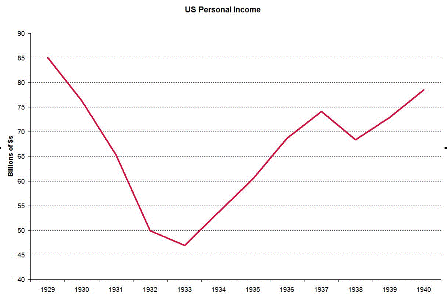
Personal Income from 1929-1940


Nothing remotely like this is currently in the cards.

It was the last gold standard collapse.

The US gold standard was abandoned domestically in 1934.


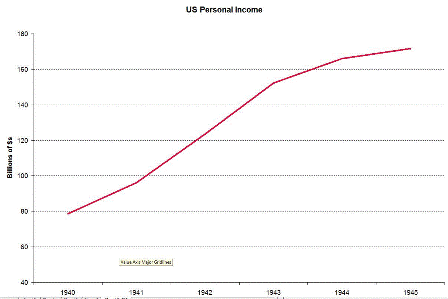
Personal Income from 1940-1945

Nothing remotely like this will happen this time around.

World War II deficits exceeded 20% of GDP annually.

Currently Personal Income is muddling through with flat to modestly positive gains month over month.


[top]

Claims/G20


[Skip to the end]

Factory orders rise in February

by Emily Kaiser

Apr 2 (Reuters) —The IMF was told its war chest will be boosted by $500 billion and it will receive another $250 billion in special drawing rights, the agency’s synthetic currency.

Multilateral development banks including the World Bank will be enabled to lend at least $100 billion more.

Thanks, IMF funding functions very much much like deficit spending.

Hearing talk of flat q2 GDP.

The great Mike Masters inventory liquidation that triggered the sudden negative growth ended late December.

The rising deficit spending and the new quarter seems to be bringing new buyers into equities and the rest of the credit structure.

The Obamaboom seems in progress- strong financial markets, rising energy costs, and painfully high unemployment.

Hardly the outcome they are shooting for.

Karim writes:

  • Initial claims up 12k to new high for the cycle (4wk avg moves from 650k to 657k)
  • Rise in continuing claims continues to astound-up another 161k this week to another all-time high-cumulative rise in past 4 weeks is 654k
  • May signify upside risk to consensus on unemployment rate tomorrow (consensus at 8.5% vs prior 8.1%)

Some early snippets out of G20:

  • Greater funding for IMF to be targeted at EM countries and trade finance has EM risk on fire in past 24hrs
  • Agreement that OECD will publish list of ‘tax havens’ and that Swiss will be on the black list has Chf quite a bit weaker
  • Russia proposal that IMF or G20 conduct a study on creating a new intl reserve currency generating headlines and some USD weakness; but IMF and OECE both state they see no change in USD status (1 interpretation that Russia went into meeting long Eur/Usd)

New orders received by U.S. factories rose in February, government data showed on Thursday, breaking a six-month streak of declines and bolstering hopes the economy may be beginning to crawl out of the depths of a recession.

The Commerce Department said factory orders rose 1.8 percent in February after a revised 3.5 percent drop in January, initially reported as a 1.9 percent decline.

Economists polled by Reuters had expected a February increase of 1.5 percent.

Orders for non-defense capital goods excluding aircraft, seen as a measure of business confidence, jumped 7.1 percent after a steep 12.3 percent drop in January.

Orders for durable goods rose 3.5 percent, revised from the previously published 3.4 percent increase, while orders for nondurable goods edged up 0.3 percent.

Inventories decreased 1.2 percent, down for a sixth consecutive month. That was the longest streak since March 2003-January 2004.


[top]

Eurozone- quantitative easing VS fiscal adjustment


[Skip to the end]

Thanks, they all have it wrong regarding quantitative easing.

Net financial assets of the non government sectors remain unchanged.

There is no ‘monetary’ consequence apart from the resulting somewhat lower long term interest rates.

And the idea that it helps delays fiscal responses that do help.

Europe needs its politicians to drive a new fiscal stimulus

by Julian Callow

Mar 31 (FT) — As international pressure intensifies on the European Central Bank to print money by adopting a programme of aggressive asset purchases, it is worth questioning whether Europe has got its priorities in the right order. So far, the ECB has been doing most of the heavy lifting in terms of injecting stimulus into the euro area.

Looking ahead, it is preferable that opportun- ities to undertake radically further fiscal easing are fully exploited before requiring the ECB to go down the route taken by the Federal Reserve, Bank of England and Swiss National Bank (ie. undertaking “pure” quantitative easing via extensive asset purchases financed by the creation of new central bank money).

This implies quantitative easing is more powerful than fiscal and should be saved for last. Not true.

In short, if the euro area is to err on the side of being a little reckless in terms of policy,

Quantitative easing is totally tame, not reckless. It’s just part of the CBs role in setting the term structure of risk free rates.

it is preferable this be in a fiscal, rather than monetary, direction.

For the eurozone, with the national governments credit sensitive agents, fiscal is unfortunately the reckless pass under current institutional arrangements.

This is for three reasons.

First, well devised and appropriately targeted fiscal incentives can prove very efficient, both in terms of stimulating demand and even in timeliness. For example, a modest €1.5bn scheme to encourage new car purchases via subsidies to scrap older cars (just 0.06 per cent of German GDP) has already led to about 350,000 new orders being placed in Germany. That represents 11 per cent of German registrations last year.

Yes, fiscal works!

Second, the fiscal framework is much better established, including a possible exit strategy.

Just the thought of an exit strategy shows a lack of understanding of how aggregate demand works and is managed by fiscal policy. It also shows deficit myths are behind the statement.

For decades, economists have built up a good understanding of fiscal multipliers and lags. The cost of such measures is transparent,

There is no ‘cost’, only nominal ‘outlays’ by government.

unlike a strategy of central bank asset purchases, where the impact and exit strategy are uncertain and future costs are obscured.

Yes, few understand this simply thing. It’s about price (interest rates) and not quantities.

Third, for the euro area there is a particular reason why aggressive quantitative easing could prove hazardous.

It can’t be hazardous.

This results from the unique status of the ECB and euro as icons of European integration. Even though it may have happened more than 80 years ago, the collective memory of the hyperinflation experienced by Germany and Austria during the 1920s – and of its consequences, which ultimately gave birth to the euro – still casts a long shadow over European perceptions of paper money.

The mainstream believe that it is inflation expectations that cause inflation, and we pay the price via their errant analysis.

Here, we should not forget that, in contrast to the dollar, the pound and the Swiss franc, the euro has been in physical cash circulation for only seven years. As well, it is worth noting that the proportion of EU citizens saying they tend not to trust the ECB has tended to shift upwards – to 31 per cent in the most recent survey (autumn 2008), the highest in EMU’s history. This compares with 48 per cent saying that they tend to trust the ECB (source: Eurobarometer 70).

In short, were the ECB to adopt a strategy of aggressively printing money through an extensive asset purchase programme, this would risk significantly undermining the euro’s credibility, particularly if this strategy was not well communicated.

Credibility is way overrated!

That said, the ECB is in a neighbourhood where most of its peers have embarked on a strategy of aggressively printing money.

The term ‘printing money’ is a throwback to the gold standard and fixed FX in general where the CB prints convertible currency in excess of reserves. This has no applications with today’s non convertible currency.

This risks pushing up the euro on a trade-weighted basis further, at least in nominal terms, which would represent another negative shock to euro area exporters. In this context, if fiscal policy was used more aggressively as a means of providing new stimulus to the economy, it should seek in part to compensate businesses whose outlook could be further weakened by currency appreciation.

Increasing deficits does not strengthen a currency. If it did Zimbabwe would have the word’s strongest currency.

Without doubt, reaching agreement on sufficiently robust fiscal stimulus in Europe is harder to accomplish than a policy of leaving the bulk of policy stimulus up to the ECB.

True. And too bad the ECB doesn’t have any policy variables at hand to add to aggregate demand.

The measures, rather than having a small committee to determine the appropriate level of stimulus, must be decided by politicians, who face political constraints and competing interests. But the transparency that gives a strategy of fiscal stimulus its rel>ative appeal also hampers the ability of politicians to execute it. Also, we are presented with an adverse starting position, with the euro area budget deficit likely this year to be close to 6 per cent of GDP.

That’s the good news. The automatic stabilizers are causing the deficits to grow to the point where they will trigger a recovery. Hopefully before the point where the national governments become insolvent trying to fund themselves.

Nonetheless, this should not mean that the aggressive use of additional fiscal stimulus is insuperable. We have lived through desperate times, which call for desperate measures. Central banks, including the ECB, have already responded with far-reaching measures. In order to stimulate economic recovery in Europe, its political leaders need to take up the baton.

Europe could also assist its cause by several other measures. For one thing, it seems odd that the European Commission has launched “soft” excessive deficit procedures against several euro area countries. As well, European governments, including the European Commission, could do a much better job of outlining to the rest of the world, in a clear and concise way, the details of their stimulus actions so far. For, encompassing the full range of monetary and financial system support measures, these are far from being negligible – with the discretionary fiscal stimulus measures alone amounting to about 1 per cent of euro area GDP in 2009.

Julian Callow is chief European economist at Barclays Capital


[top]

Mosler plan vs Geithner plan


[Skip to the end]

The Mosler plan to better accomplish what the Geithner plan has attempted to do:

Targeted credit default insurance between the FDIC and the banks

Here’s how it works:

Any bank could apply for FDIC credit default insurance.

The bank would submit the securities it wants insured to the FDIC for approval.

The FDIC would calculate a risk adjusted cash flow value for those securities (for a fee to cover expenses).

The bank then has the option of buying credit default insurance from the FDIC at perhaps a 1% annual premium of the average balance outstanding.

The FDIC credit default insurance would cover any bank losses on those securities.

This utilizes the FDIC as the ‘bad bank’ as is its intended purpose.

The FDIC should already have the capability to assess the risk adjusted value of all bank securities, as it does that to perform its normal audit functions.

The purchase of FDIC credit default insurance eliminates all capital charges and risk considerations for the bank for those securities.


[top]