PCE health care, Bank lending survey, Consumer credit

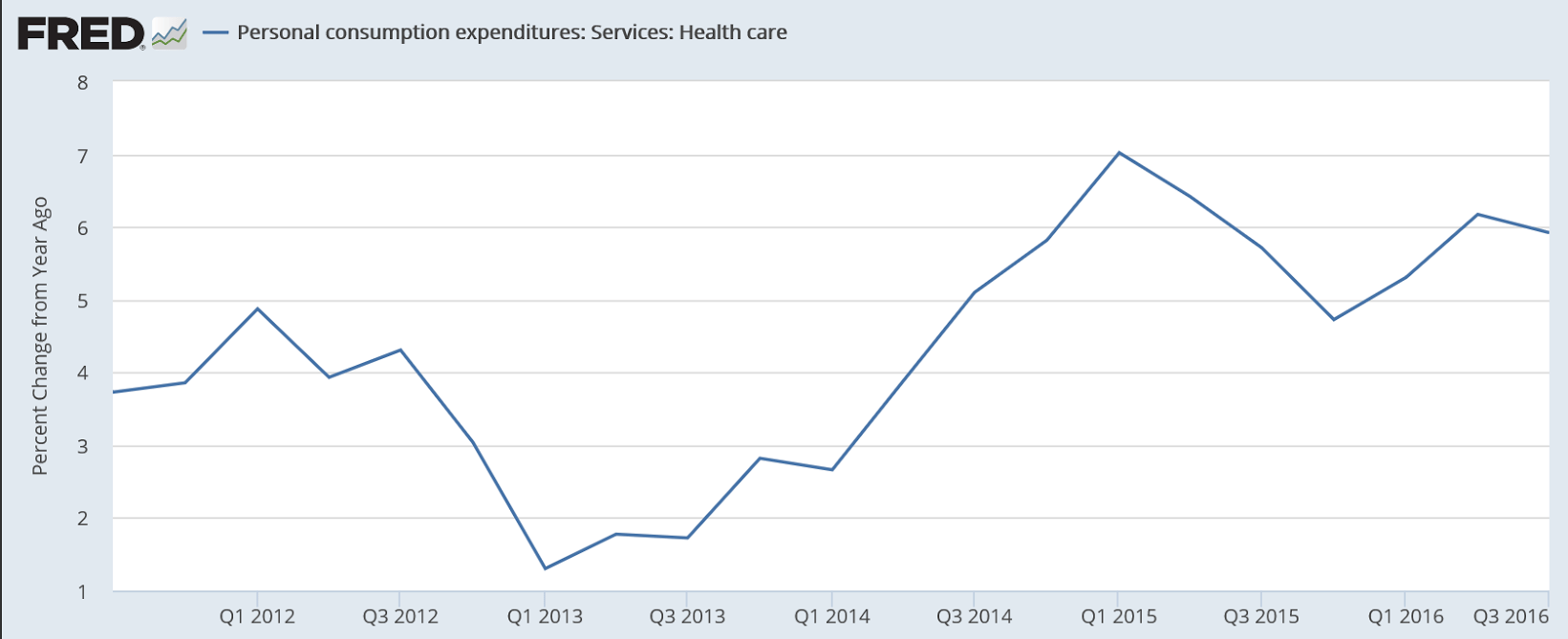
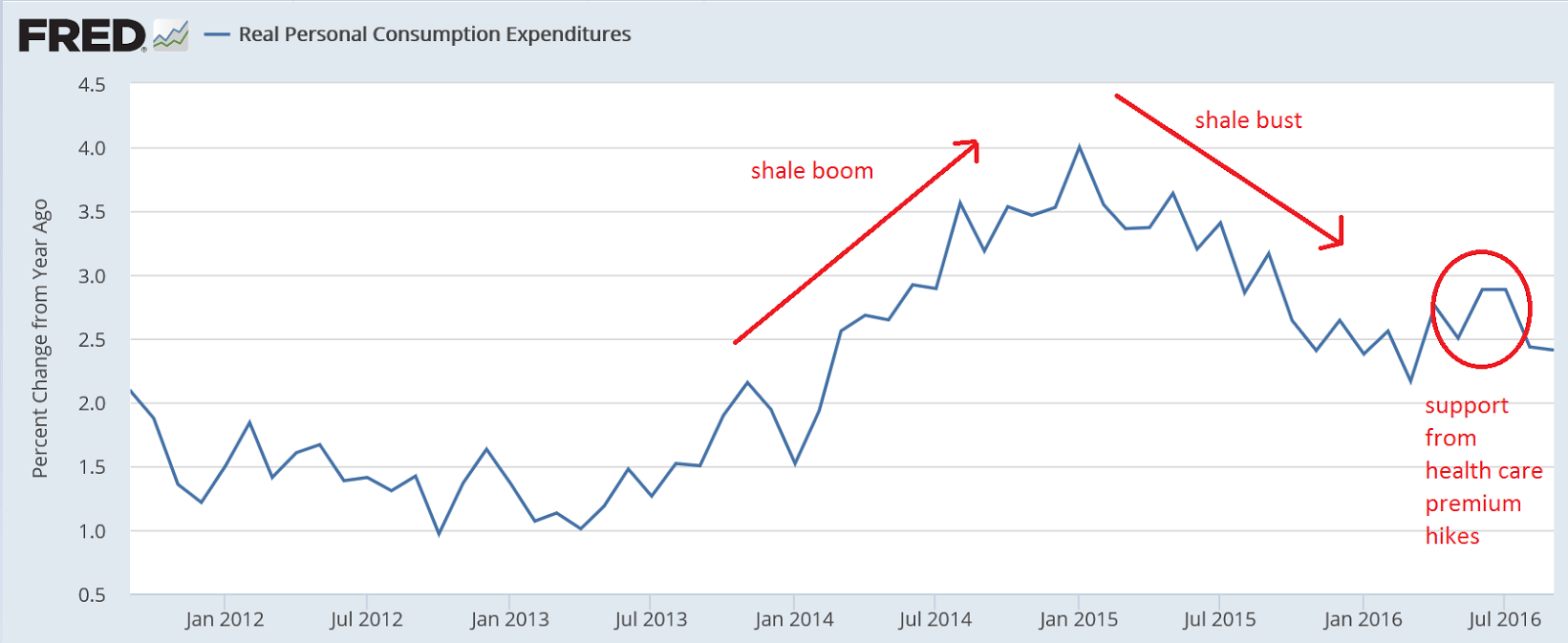
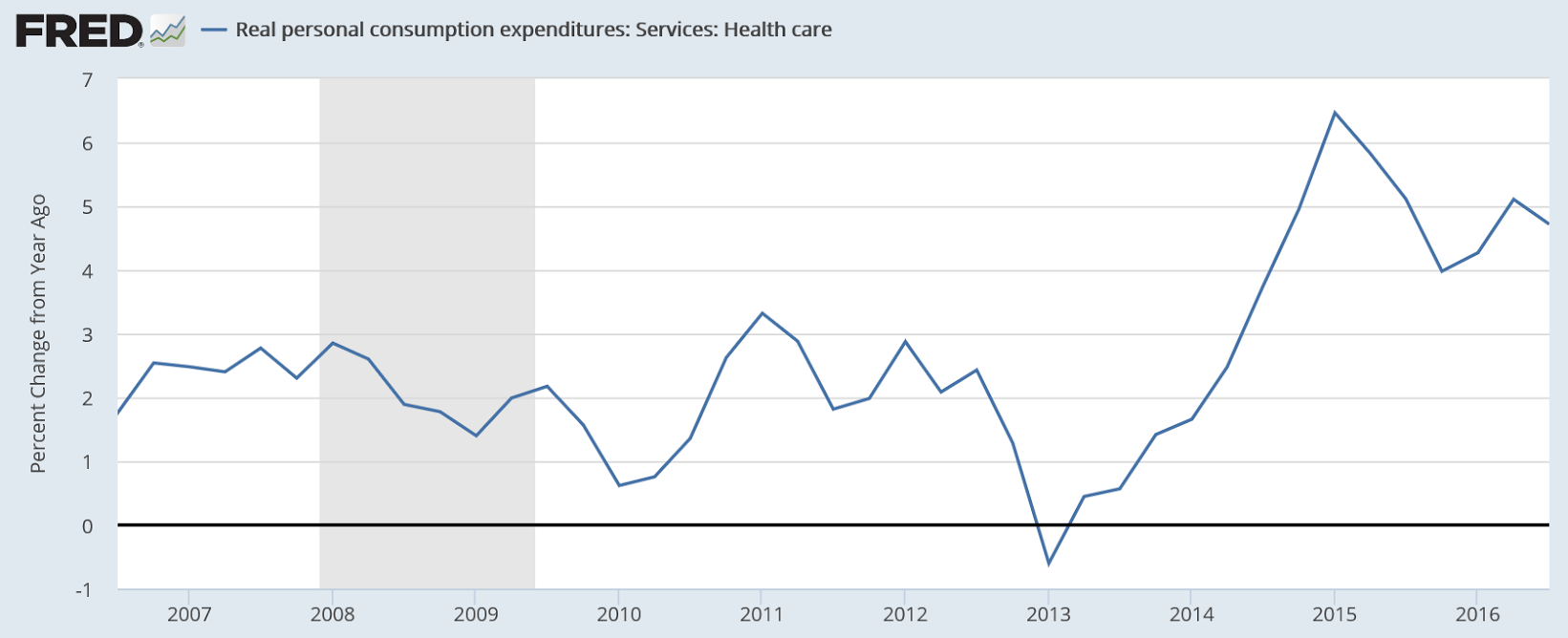
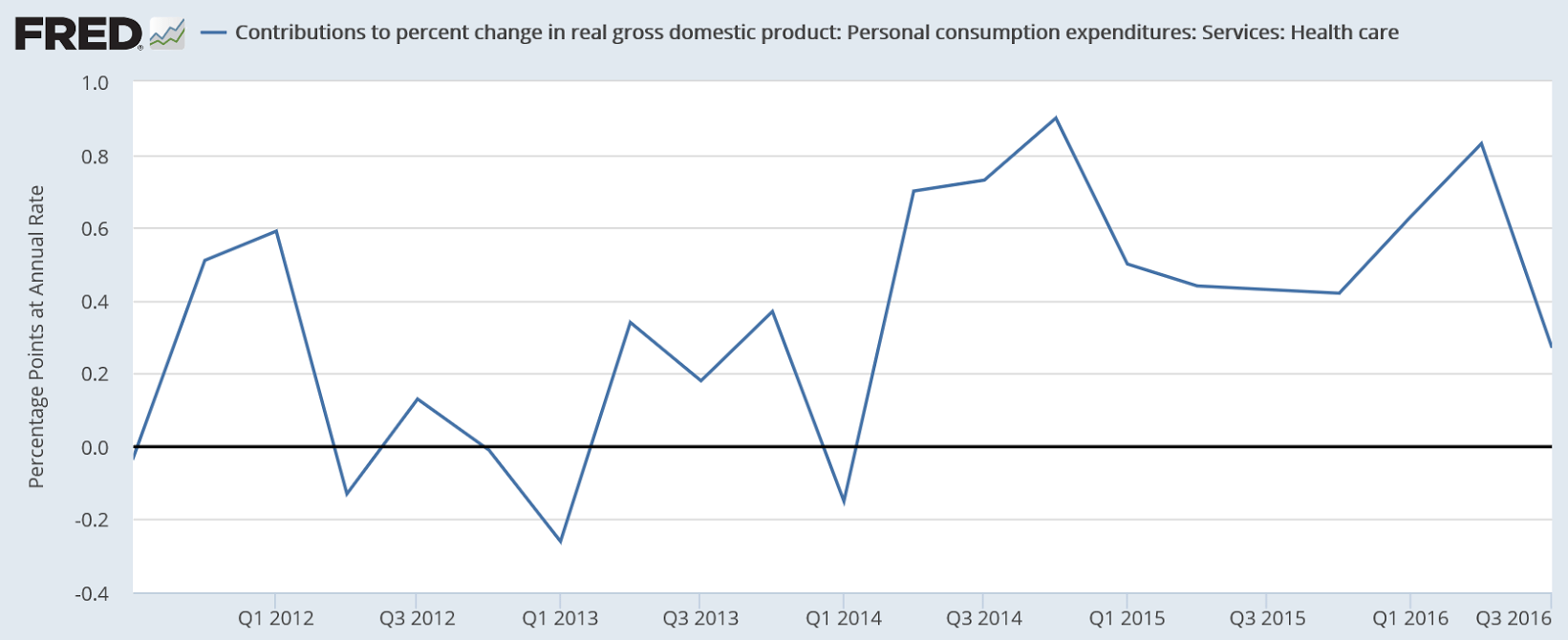
Best I can tell this is mainly about health care insurance premiums, which ‘count’ as personal consumption expenditures and have been adding support to GDP:

Inflation adjusted:
110701

Not inflation adjusted:
110702

Looks like the support is starting to fade:
110703

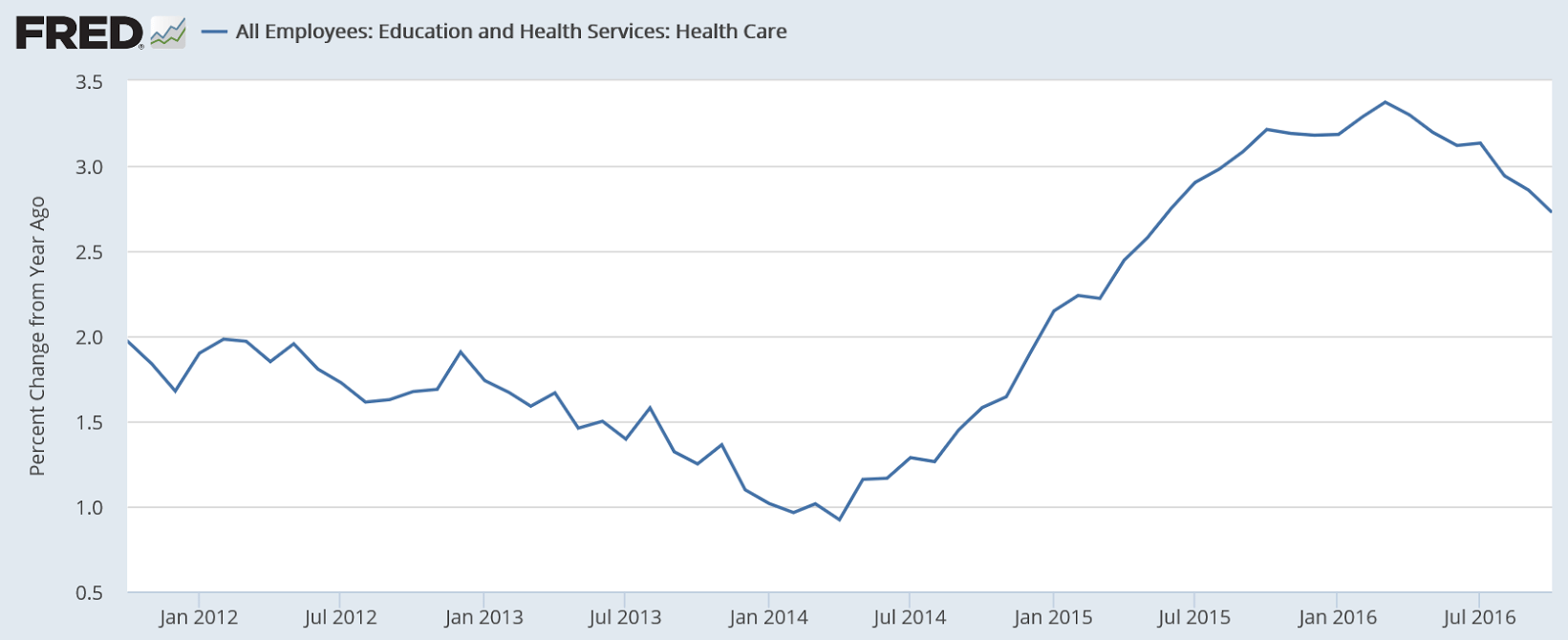
The ‘one time’ adjustment for Obamacare may have passed, along with it’s support
for GDP. And note the growth of employment was well below the growth in costs:
110704

110705
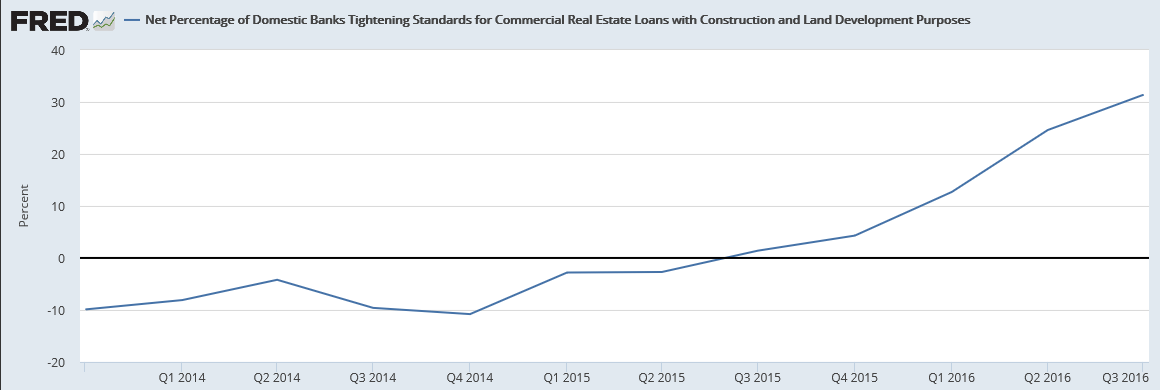
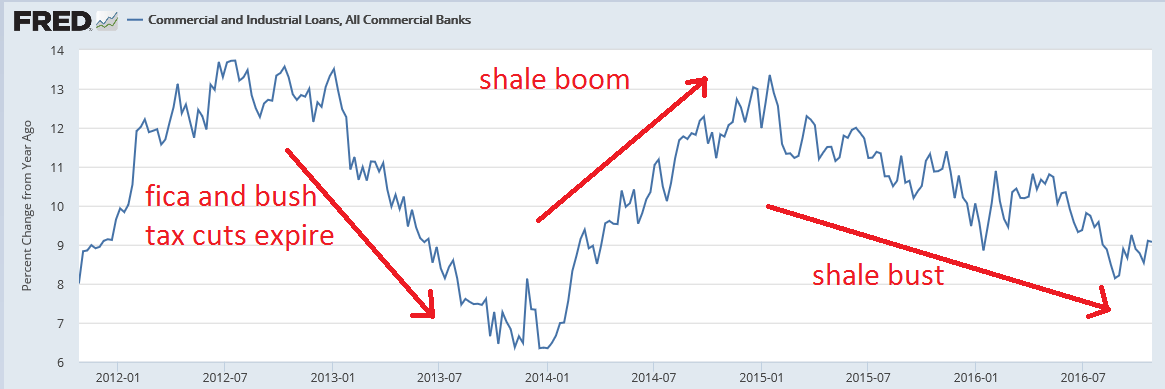
Bank credit tends to tighten up as the economy slows, which slows lending and makes matters worse.
The buzz word is ‘pro cyclical’:

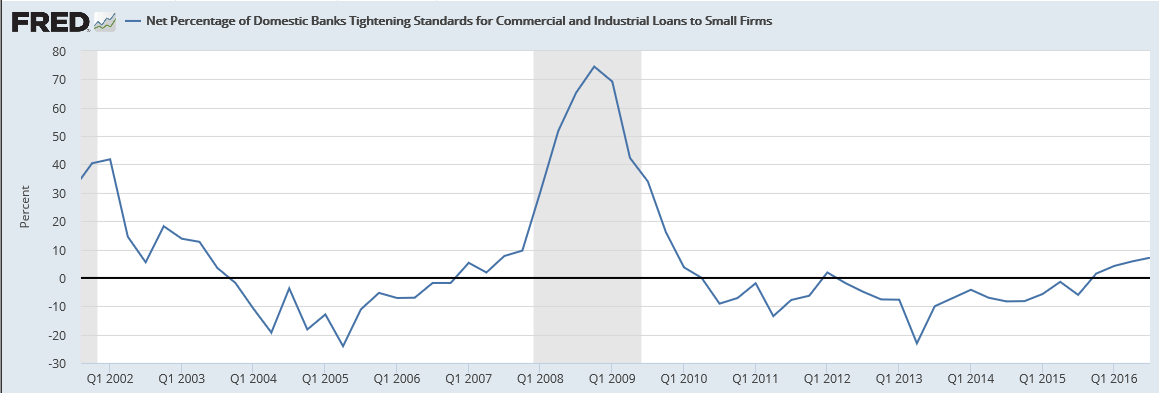
On net, domestic survey respondents generally indicated that their lending standards for CRE loans of all types tightened during the third quarter.6 In particular, a moderate net fraction of banks reported tightening standards for loans secured by nonfarm nonresidential properties, whereas significant net fractions of banks reported tightening standards for construction and land development loans and loans secured by multifamily residential properties.

Read more at http://www.calculatedriskblog.com/#7PGBE67aLF27XSQ1.99
110706
These are as of August 1, and have moved higher since as per the above text:
110707

110708
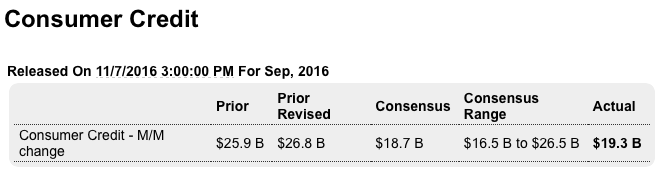
Close to expectations, no sign of any kind of meaningful increase in consumer spending:
110709
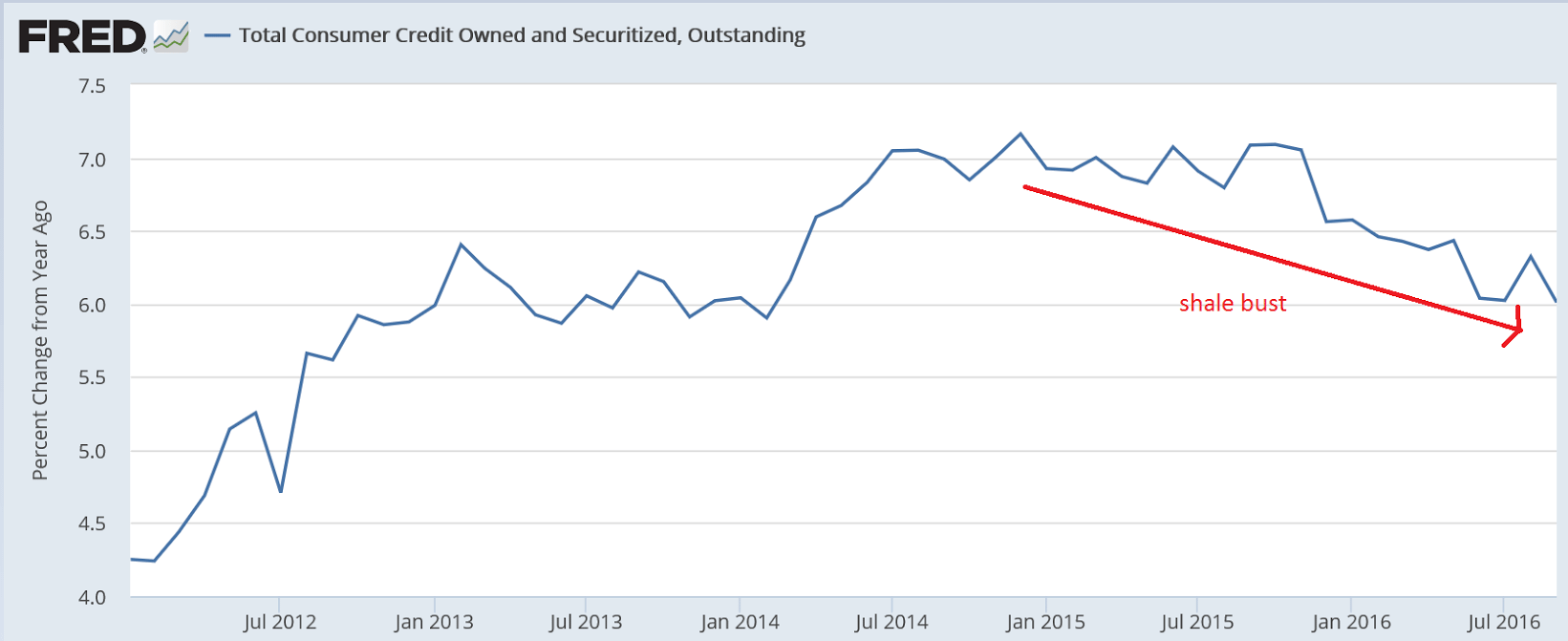
Remember, for GDP to grow just as fast as last year, on average the pieces have to grow just as fast. This one is decelerating to the extent it represents sales it is therefore subtracting from growth:
110710

Payrolls, Tax receipts, Saudi price hikes

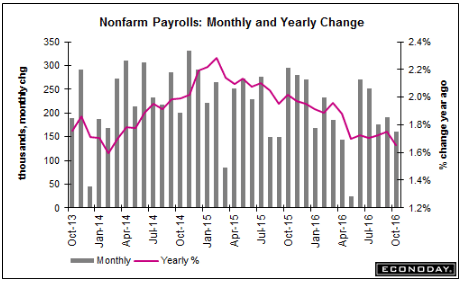
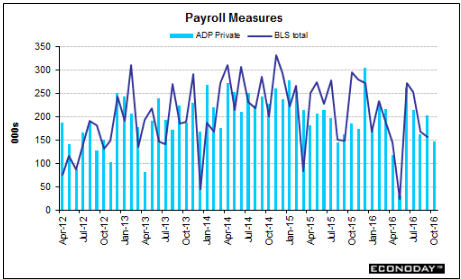
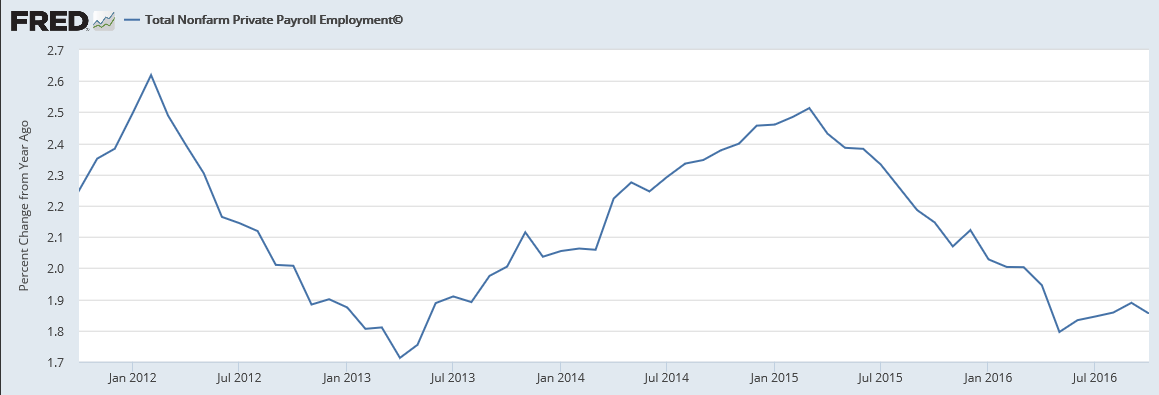
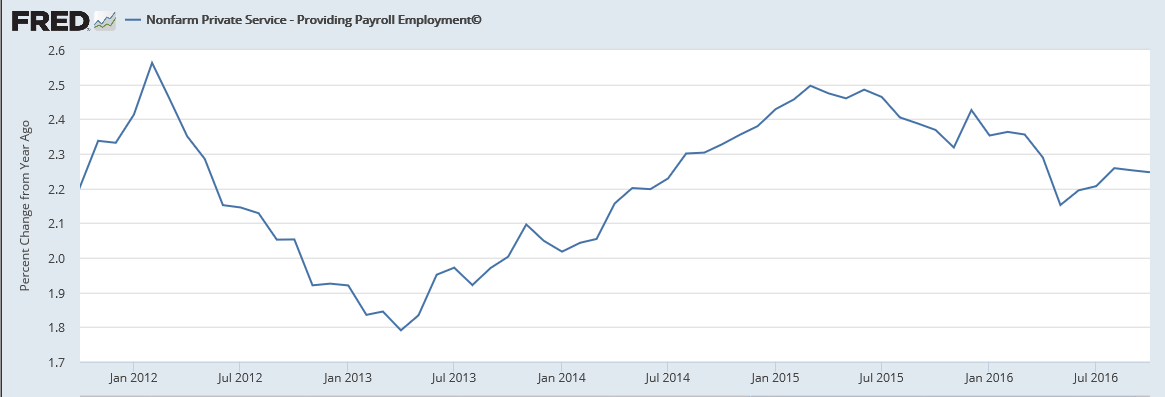
As per the chart, the deceleration of employment growth continues in what’s now been a very steady decline going on 2 years. And with employment growth decelerating at this rate it’s likely the unemployment rate will remain elevated indefinitely:

110401

Highlights

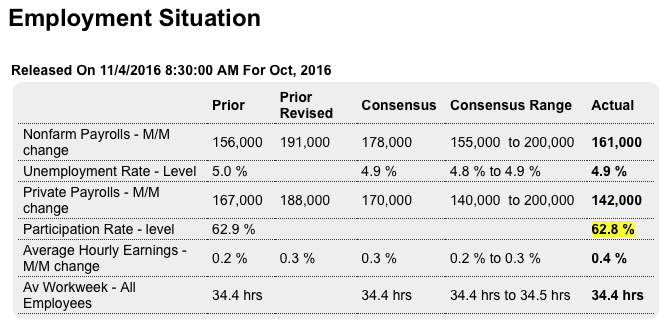
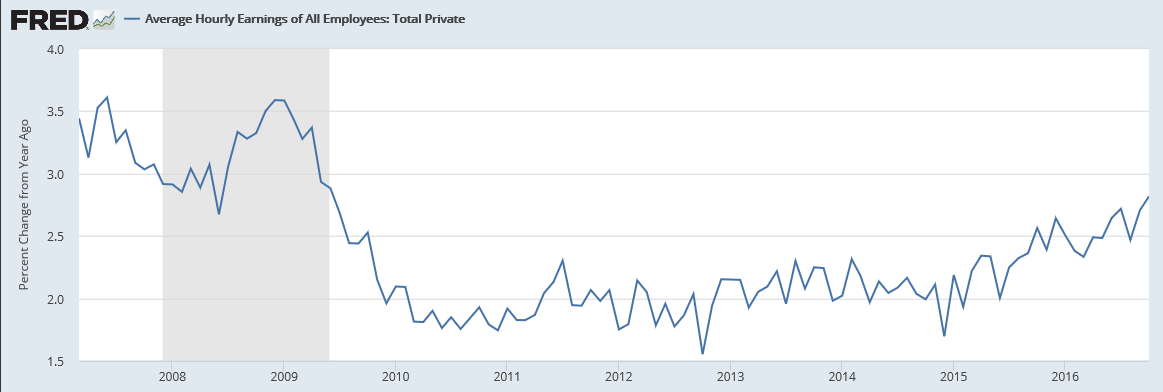
Solid payroll growth is not the whole story of the October employment report. Average hourly earnings are rising, up an outsized 0.4 percent in the month with the year-on-year rate, at 2.8 percent, suddenly near 3.0 percent and at its recovery peak. Nonfarm payroll growth is very respectable, up 161,000 for nonfarm payrolls with upward revisions adding a net total 44,000 to September (191,000) and August (156,000). The unemployment rate is down 1 tenth to 4.9 percent and, for some, is already signaling full employment for the labor market.

Government payrolls rose a moderate 19,000 in October, excluding which private payrolls came in at 142,000 vs September’s 188,000. Construction, adding 11,000, is a highlight after adding 23,000 in the prior month, and professional services along with temporary services extended their gains. Manufacturing once again posted a decline.

But negatives are scarce in this report, where strength is emphatically underscored by the unexpected acceleration in average hourly earnings which further includes an upward revision to September. Today’s report marks a solid opening to fourth-quarter data and will raise talk of a wage-inflation flashpoint and a rate hike for the December FOMC.

110402
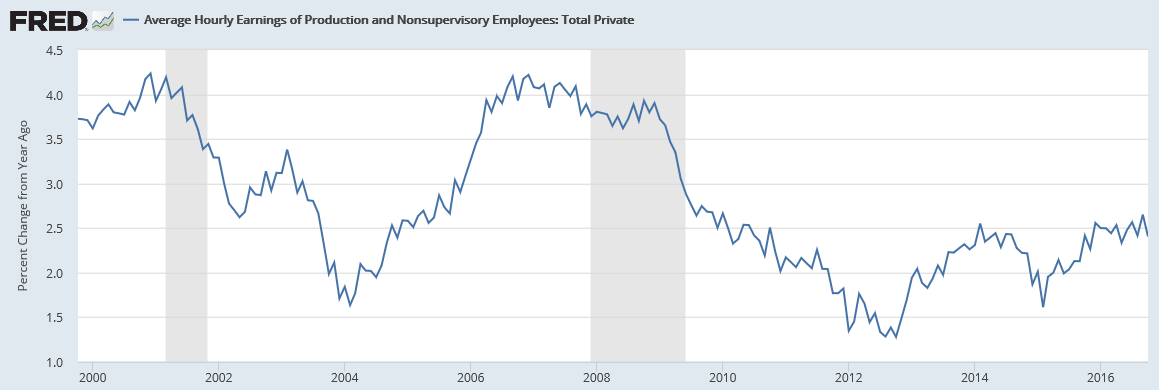
Sound the alarm over this?

110403
This includes ‘supervisors’ and remains below levels of the prior recession:

110404

110405

They are price setters, not price takers:

Saudi Aramco Increases Oil Pricing to Asia on Rise in Demand

By Sam Welkin

Nov 3 (Bloomberg) — Saudi Aramco increases Dec. pricing for Arab Light to Asia by 90c/bbl to premium of 45c over regional benchmark, state-owned co. says in e-mailed statement.

  • Aramco raises Arab Light pricing to NW Europe by 70c/bbl, to Mediterranean region by 15c/bbl compared w/ benchmarks
  • Co. leaves pricing for U.S. sales of Extra Light, Arab Light, Medium grades unchanged for Dec.; cuts pricing for Arab Heavy to U.S. by 40c/bbl
  • NOTE: Saudis Said to Raise Arab Light Oil Pricing to Asia for December
  • Jobless claims, PMI services, ISM services, Factory orders

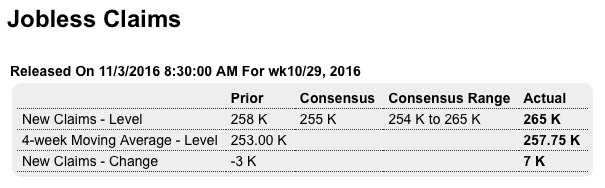
    As previously discussed, jobless claims are down largely because they are a lot harder to get:
    https://www.bloomberg.com/view/articles/2016-11-02/the-good-news-on-jobs-isn-t-all-that-good

    And now they are going up a bit, though still very low historically:
    110301

    Highlights

    Jobless claims are holding at or near record lows, with initial claims up only 7,000 in the October 29 week and continuing claims down 14,000 in the October 22 week. The 4-week average for initial claims, now at 257,750, has trended for the last two months in the 255,000 area. Continuing claims have likewise been trending lower, at a new record low of 2.026 million. There are no special factors in today’s report where trends are pointing to strength in the labor market and suggest that employers are holding tightly onto their employees.

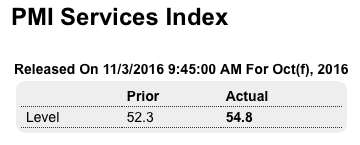
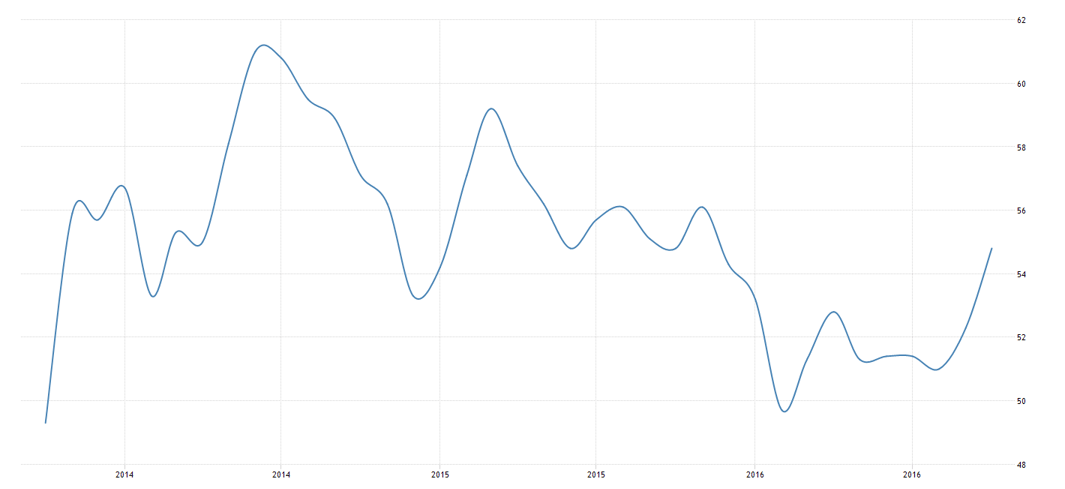
    This is the new one that tends to overstate:

    110302

    Highlights

    Growth in the nation’s service sector accelerated sharply in October based on Markit Economics’ U.S. sample where the final composite score is 54.8, unchanged from mid-month and up sharply from September’s 52.3. Strength in consumer spending is what respondents reported as well as a rise in both input costs and selling prices. New orders are at an 11-month high as is business activity while year-ahead expectations are at their best level in a year-and-a-half. Backlogs are also piling up. This report points to a very solid fourth-quarter start for the bulk of the economy. Coming up next this morning will be ISM non-manufacturing which last month reported a very solid ending for the third-quarter.

    110303
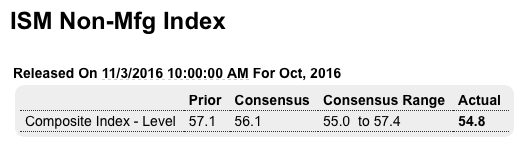
    This is the older, more respected series:

    110304

    Highlights

    Much of the ISM non-manufacturing report, at a composite of 54.8, is strong with employment, however, an exception, down 4.1 points from September to a 53.1 level that points to a slower pace of hiring in October. But new orders are very solid, at 57.7 but again now from September’s 60.6. Business activity is also at 57.7 but is also down from September. Backlog orders grew for a second month and export orders remained solid and costs for the sample are up in another positive indication on demand. Employment growth may be down, but this report, like the services PMI earlier this morning, is pointing to a solid fourth-quarter start for the bulk of the economy.

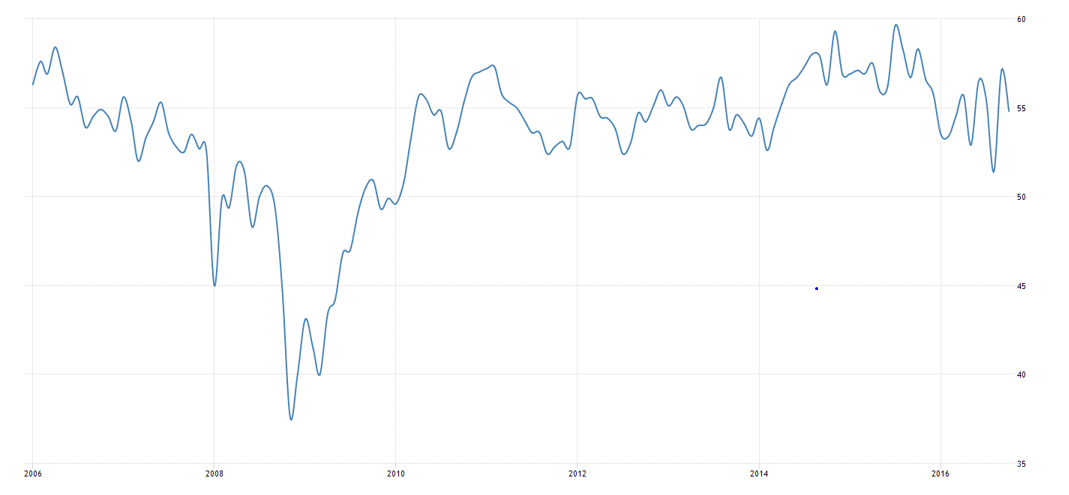
    United States ISM Non Manufacturing PMI

    The ISM Non-Manufacturing PMI index fell to 54.8 in October of 2016 from 57.1 in September and below market expectations of 56. Activity, new orders and employment grew at a sloer pace while prices increased for the seventh straight month.

    110305
    As previously discussed, I expect the manufacturing sector to muddle through at its current, lower levels, as spending cuts shift to the service sector:

    110306

    Highlights

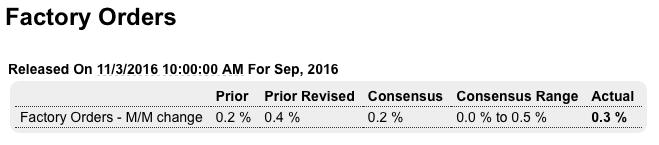
    Good news is hard to find in the September factory orders report which is best described as flat. New orders did rise, up a moderate 0.3 percent in the month, and the prior month’s gain is revised 2 tenths higher to 0.4 percent, but core capital goods orders (nondefense ex-aircraft) are down a sharp 1.3 percent and total unfilled orders keep contracting, down 0.4 percent for a fourth straight decline. Maybe the best news is that manufacturers are keeping their inventories down, unchanged in the month and down relative to shipments, to 1.34 from 1.35. Monday’s advance indications on October from the ISM don’t point to much change for a factory sector that continues to be held down by generally weak global demand and by weak investment in new equipment.

    US Auto sales, Atlanta Fed, ISM NY

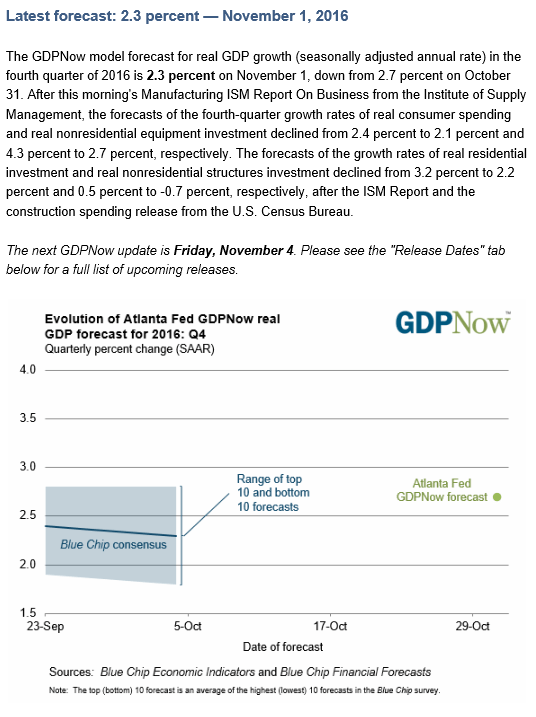
    The Fed is looking for ‘some improvement’ Let me know if you see any! ;)

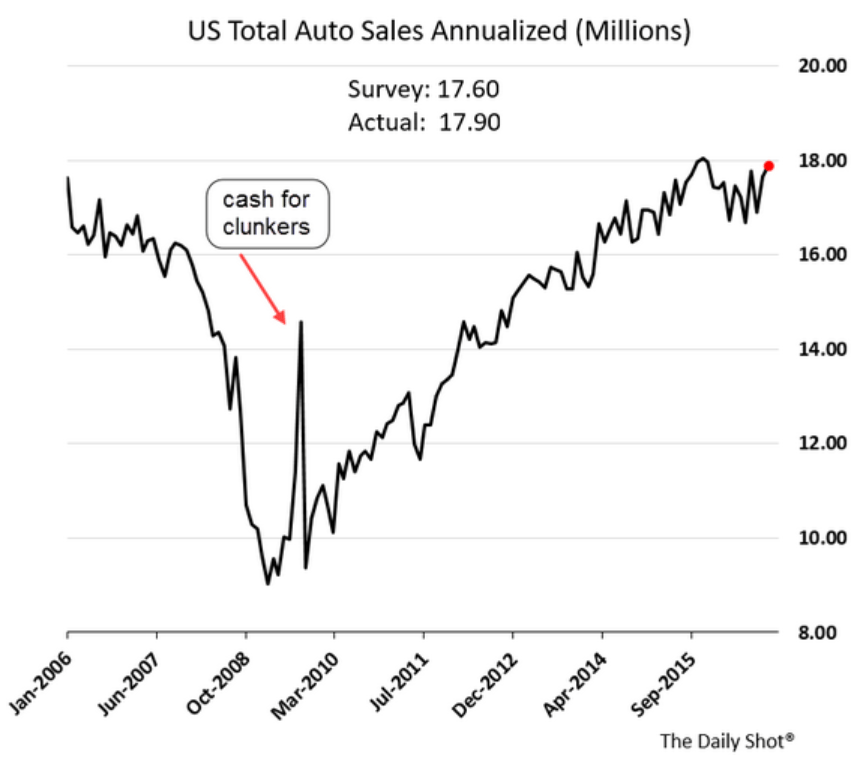
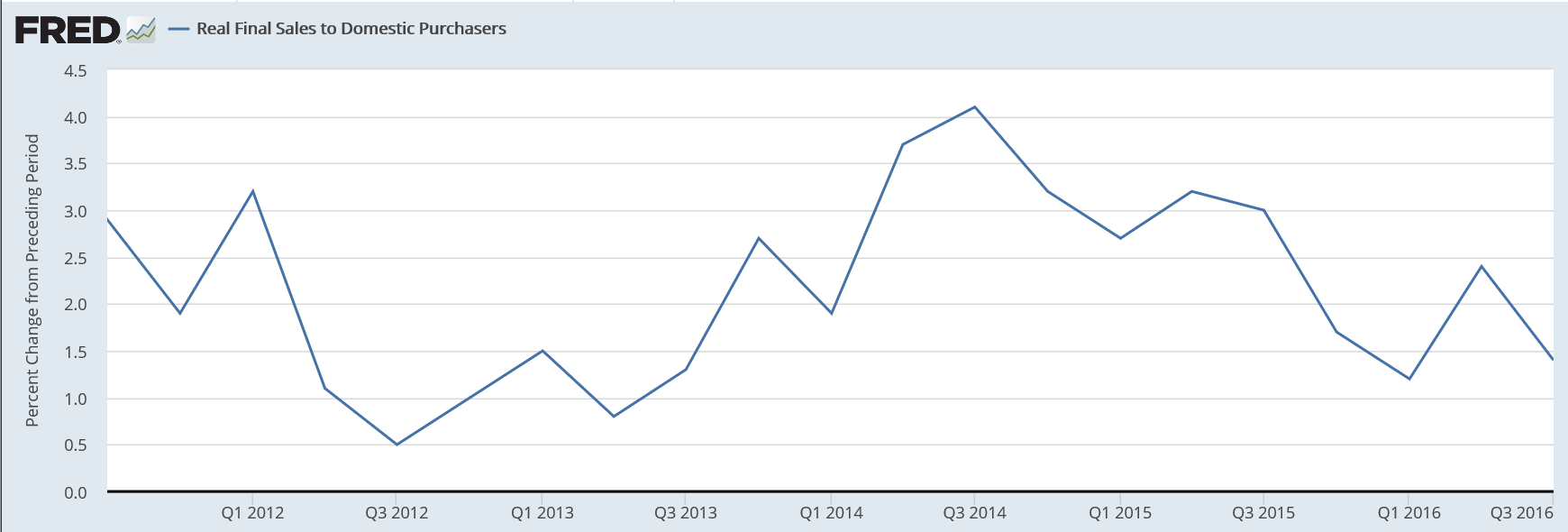
    Sideways at best as this prior source of growth is no longer contributing:
    110215b
    After just one day it’s come down a bunch:
    110216

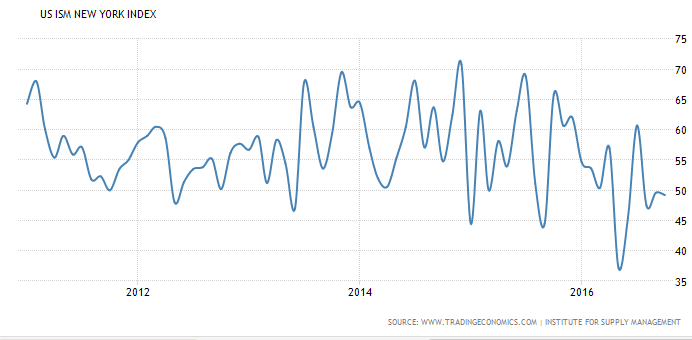
    United States ISM New York Index

    The ISM NY Current Business Conditions Index fell to 49.2 in October 2016 from 49.6 in September. Volume of purchases continued to fall (44.3 from 47.1 the previous month) and current revenues went up at a slower pace (51.4 from 51.6). By contrast, employment returned to growth after falling to the lowest in eight years in September (50.6 from 33.9) and expected revenues grew further (60.3 from 56.7). The Six-Month Outlook fell for the second month in a row, coming in at 56.9 in October from 59.6 in September.

    110217

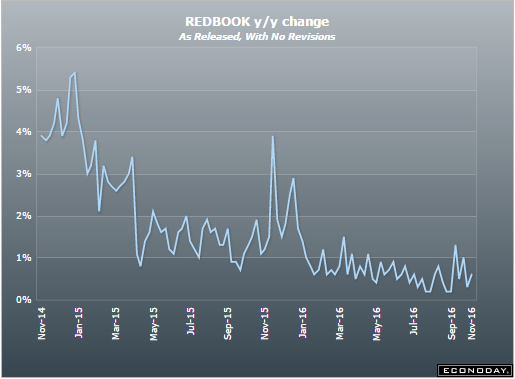
    Personal consumption, Swiss retail sales, Redbook retail sales, PMI manufacturing, ISM manufacturing, Construction spending

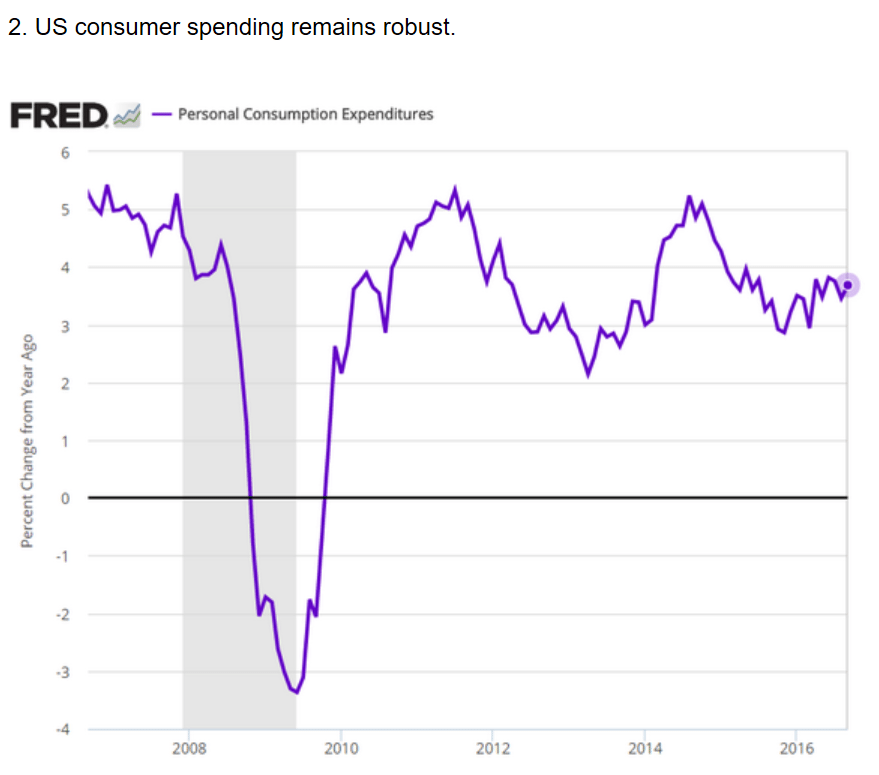
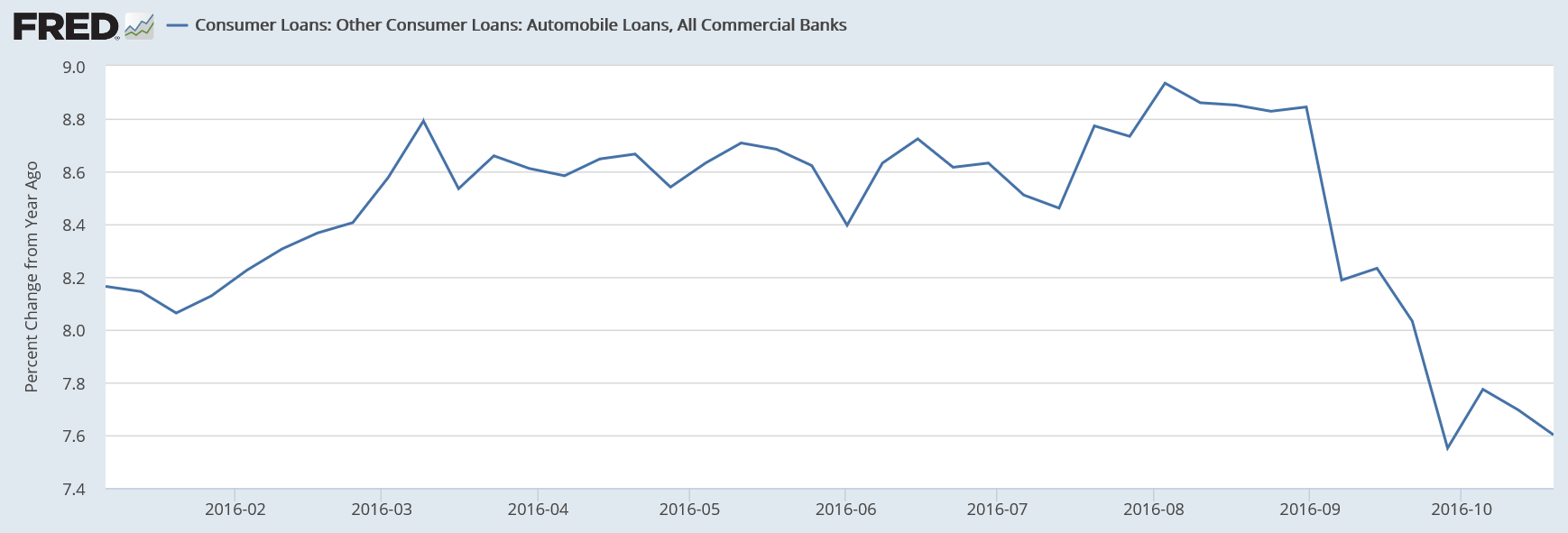
    Gotta like the headlines. The growth rate remains below where it was during the beginning of the last recession… That is, we could already be well into recession:
    110201
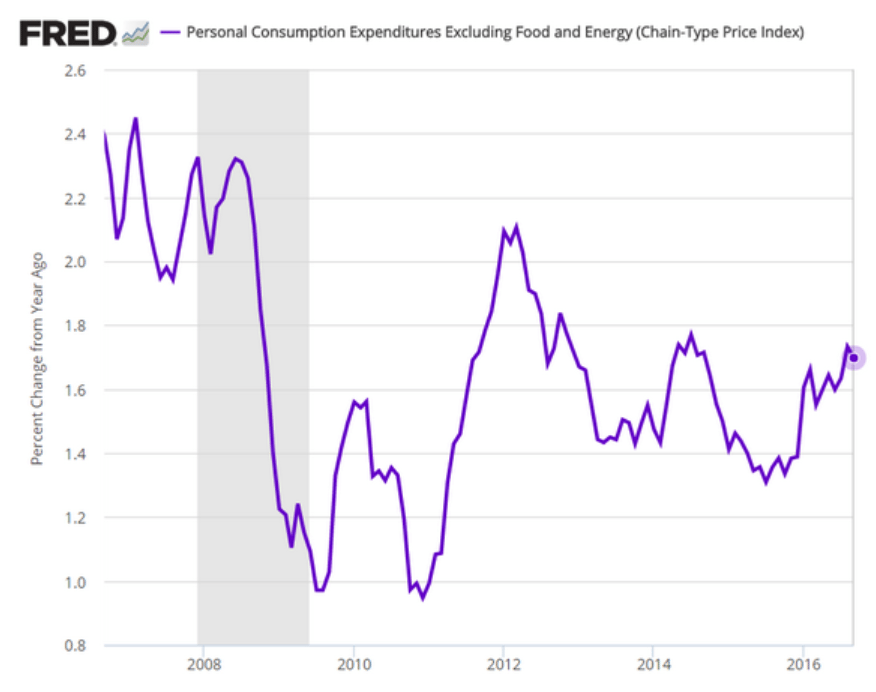
    Adjusted for inflation, also below prior recession levels:

    110202
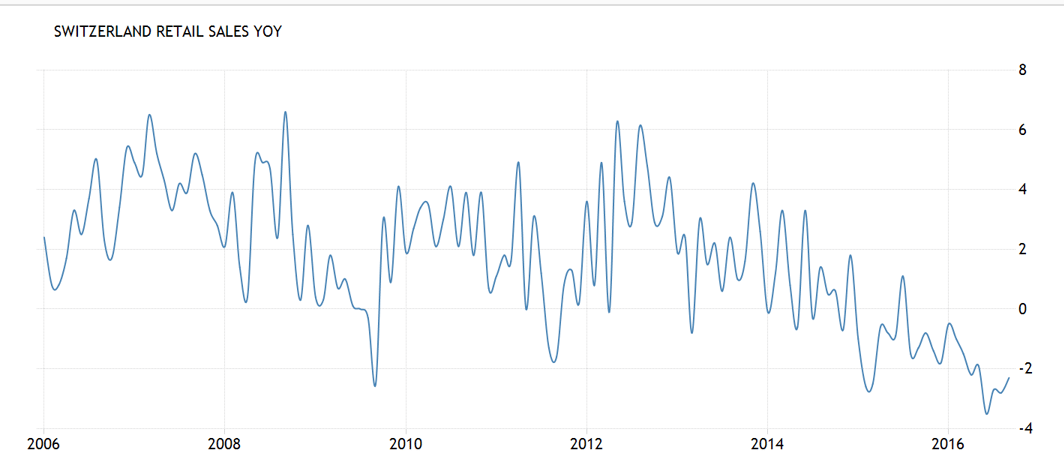
    And it doesn’t seem like building $600 billion of reserves, buying US stocks, and a negative rate policy have done much for the Swiss consumer:

    110203
    Not even a hint of improvement here:

    110204
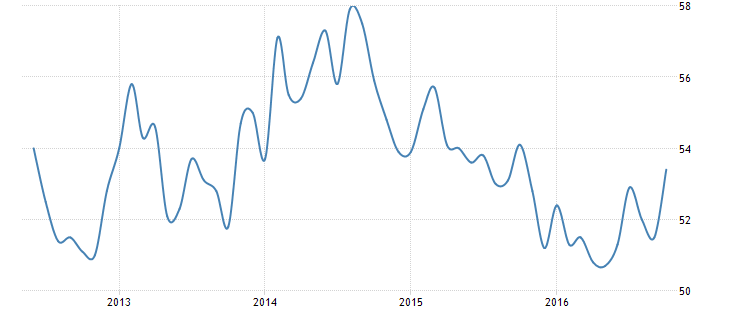
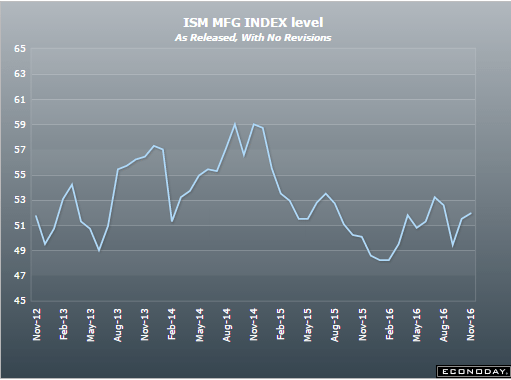
    As previously discussed, manufacturing seems to be leveling off at reduced and modest levels:

    110205

    110206

    Highlights

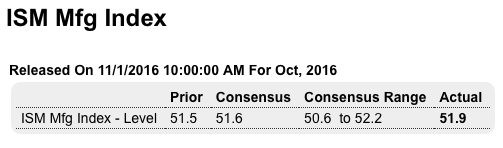
    ISM’s manufacturing sample reported no better than moderate conditions in October with the composite index at 51.9 which however is still 3 tenths better than Econoday’s consensus. But new orders are a disappointment, still showing monthly growth but, at 52.1 vs September’s 55.1, at a much slower rate. Backlog orders, at 45.5, are even softer, holding below 50 for a 4th month in a row to indicate contraction. A positive for orders is a steady though moderate rate of growth for new export orders, at 52.5 for a 1/2 point gain.

    Production did pick up speed in the month, up 1.6 points to 54.6, while employment moved from 49.7 and back over 50 for the first time since June, to 52.9. Input costs also point to steady demand, rising 1.5 points to 54.5.

    Yet this report tells a very different story from the manufacturing PMI released earlier this morning where readings, especially new orders, are accelerating sharply. Combining the two probably offers the most reliable indication on the factory sector, that is moderate and respectable growth going into year end.

    110207
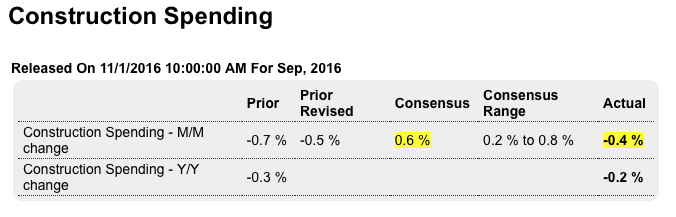
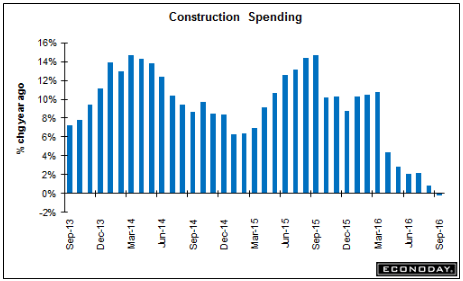
    Construction continues to head south with no relief in sight.
    And watch for downward revisions to q3 and q4 GDP growth estimates:

    110208

    Highlights

    Construction spending remains weak but indications on housing do show limited improvement. Total construction spending fell 0.4 percent in September for a year-on-year decline of 0.2 percent. But residential spending rose 0.5 percent in the month with this year-on-year rate at plus 0.9 percent. The breakdown here though is mixed as the key single-family category could muster only a monthly rise of 0.1 percent. Multi-family construction is once again the strength, rising 2.0 percent in the month to extend an upward trend that reflects gains in current rental rates.

    The real weak area is in the non-residential side of the report where spending on private construction fell 1.0 percent in the month and with public construction down 1.1 percent for its poorest showing since March 2014. Nearly all components on the nonresidential side show monthly declines with commercial, down 2.4 percent, and Federal spending, down 1.9 percent, showing the most weakness.

    The construction sector, despite unusually low mortgage rates, has been struggling this year with the softness in single-family housing posing continued challenges for what is otherwise a strong new home market.

    110209

    Personal Income and Spending, Chicago PMI, Dallas Fed

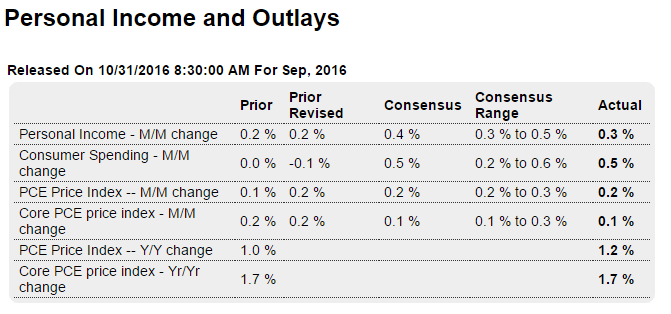
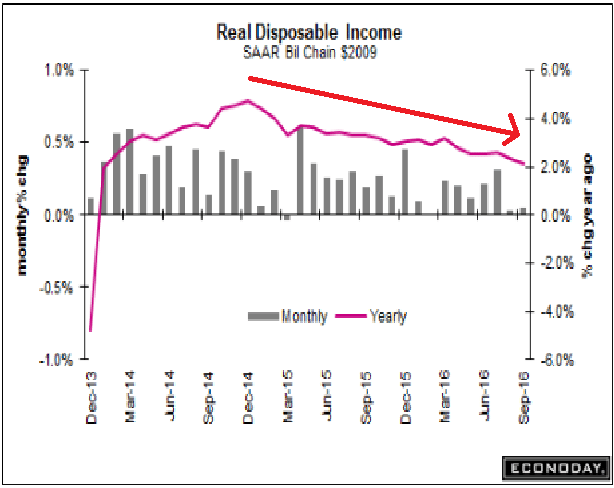
    Personal income a bit below expectations, spending met expectations but last month revised down a bit. And the GDP report already had consumer spending way down and less than expected and we already know auto sales are falling behind last year’s totals:

    103101

    Highlights

    Personal income rose a solid but slightly lower-than-expected 0.3 percent in September with the wages & salaries component, which weakened in August, also at plus 0.3 percent. Consumer spending was especially solid in September, up an as-expected 0.5 percent and reflecting the month’s strength in vehicle sales.

    Inflation data are mixed to soft. The overall price index rose 0.2 percent with the year-on-year rate at plus 1.2 percent. This is the strongest yearly showing since November 2014 and is 2 tenths closer to the Federal Reserve’s 2 percent target.

    Yet the core rate, which excludes food & energy, failed to show much lift, up only 0.1 percent on the month with the year-on-year rate unchanged at 1.7 percent. This rate has been stuck between 1.6 and 1.7 percent all year though is up from 2015’s average of 1.4 percent.

    The consumer wasn’t putting September’s increase in income into savings as the savings rate edged 1 tenth lower to what is a still respectable 5.7 percent.

    Overall, the consumer ended the third quarter in respectable fashion, pointing to moderate economic momentum going into the fourth quarter.

    Income growth continues it’s deceleration that began with the collapse in oil capex:

    103102
    A setback here, as previously discussed was likely:

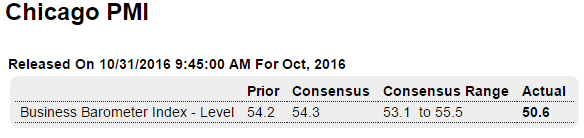
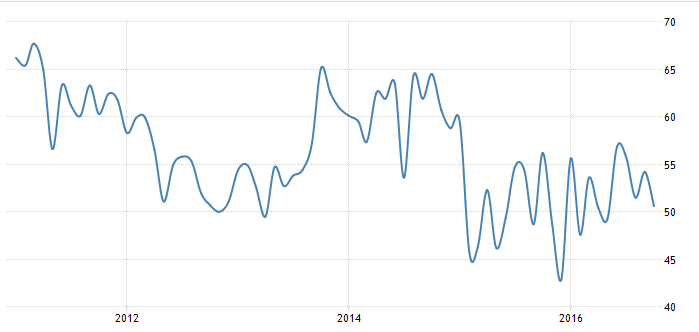
    103103

    Highlights

    The Chicago PMI has been bumpy all year and is once again for the October report, down 3.6 points at 50.6 to indicate abrupt month-to-month slowing in composite activity. New orders are part of the slowing as is production. Signs of strength come from employment, which is back into the expansion column, and from prices paid which show the most pressure since November 2014. Though uneven and mostly soft, this report points to continued expansion for the area’s economy. The Chicago PMI covers both the manufacturing and nonmanufacturing sectors.

    103104
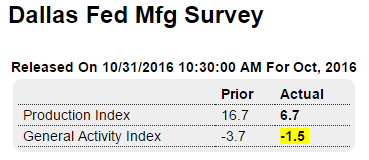
    Still in contraction:

    103105

    United States Dallas Fed Manufacturing Index

    The Federal Reserve Bank of Dallas’ general business activity index for manufacturing in Texas rose to -1.5 in October 2016 from -3.7 in September, but below market expectations of 2. The capital expenditures index moved up to 8.7 (from 3.1 in September), reaching its highest reading in nearly two years. In contrast, the production index declined 10 points to 6.7, suggesting output rose but at a slower pace this month; and the capacity utilization and shipments indexes fell notably after spiking last month, coming in at 0.8 (13.5 in September) and 1.9 (20.1 in September), respectively. The employment index came in at 0.2 (2.3 in September), suggesting little change in headcounts, and the hours worked index fell into negative territory (-1.8 from 3.7 in September). Also, the new orders declined to -3.5 from -2.9. Meanwhile, expectations regarding future business conditions improved again with the index of future general business activity posting a fifth positive reading in a row.

    Not looking like any meaningful improvement is developing:

    103106

    Consumer sentiment, GDP comments and charts

    Doesn’t look like ‘improvement’ the way I see it?

    102901
    Looks like others are seeing it my way as well this time:

    Sorry, but the economy’s growth spurt isn’t going to last

    By Jeff Cox

    Oct 28 (CNBC) — Excluding “transitory” effects, the actual growth rate would have been closer to the 1.5 percent rate of the past four quarters.

    Still decelerating since the collapse of oil capex (and the presumed windfall for the consumer…):

    102902

    102903
    This is a relatively new series. so don’t know if it means much:

    102904

    102905

    Gasoline demand, Durable goods shipments, Pending home sales, Soybean exports

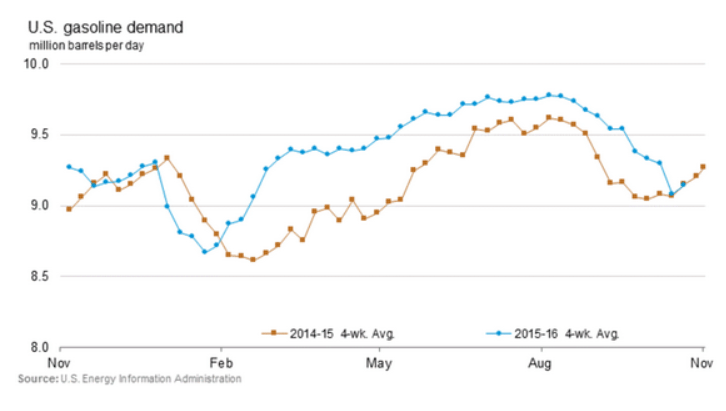
    Miles driven had been rising. Fuel efficiency is part of this decline but probably more to it:

    102801
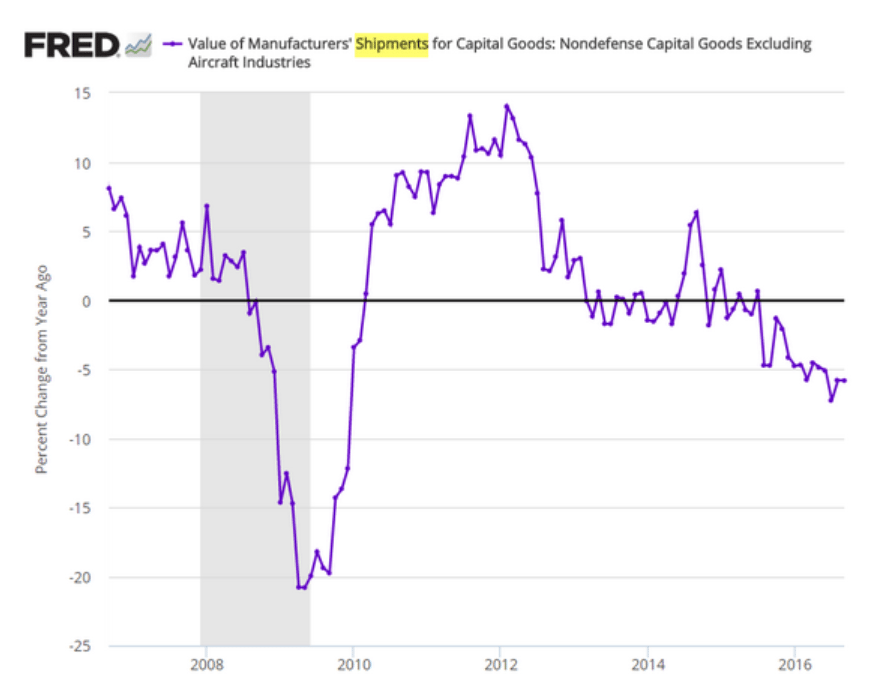
    From yesterday’s durable goods report. GDP is about shipments:

    102802
    As per the chart, this series is not doing well:

    102803

    102804

    A surge in soybean exports likely helped to shrink the trade deficit in the third quarter. As a result, economists expect that trade contributed a full percentage point to GDP growth in the third quarter after adding a mere 0.18 percentage point in the April-June quarter. There are concerns that the soybean-driven export growth spurt could reverse in the fourth quarter.

    Durable goods orders, Philly Fed state coincident index, Labor force additions

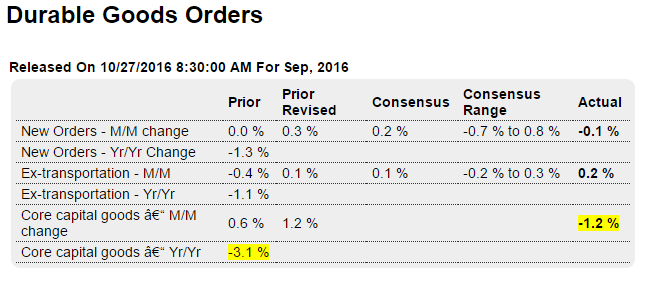
    This should have been doing better by now, indicating that, in general, unspent income is still not being sufficiently offset by deficit spending, public or private:

    102701

    Highlights

    Flat is the takeaway from the September durable goods report where orders slipped 0.1 percent, a lower-than-expected result offset however by an upward revision to August which now stands at plus 0.3 percent. A 45 percent monthly downswing for defense aircraft is a special factor in the September data, offsetting a 13 percent rise in civilian aircraft and, for the transportation reading, a solid 1.2 percent gain in vehicle orders. Excluding transportation, orders inched 0.2 percent higher for a third straight gain.

    Capital goods data are mixed. The good news is a 0.3 percent rise in core shipments (nondefense ex-aircraft) and an upward revision to August which is now unchanged. These results should give a boost to the business investment component of tomorrow’s third-quarter GDP report. But the bad news is the indication on future core shipments as orders fell a very steep 1.2 percent though an upward revision to August, now at plus 1.2 percent, is a partial offset.

    A concern in the report is continuing contraction in unfilled orders, down 0.4 percent for a 4th straight decline. Factories have been drawing down unfilled orders to keep shipments going which rose 0.8 percent in the month which, however, follows two months of unchanged readings. Inventories rose 0.1 percent in the month, well under the rise in shipments to pull down the inventory-to-shipments ratio to 1.64 from two months at 1.65.

    September’s data point to more of the same for the factory sector, a flat path reflecting weakness in global demand and specific weakness in business investment.

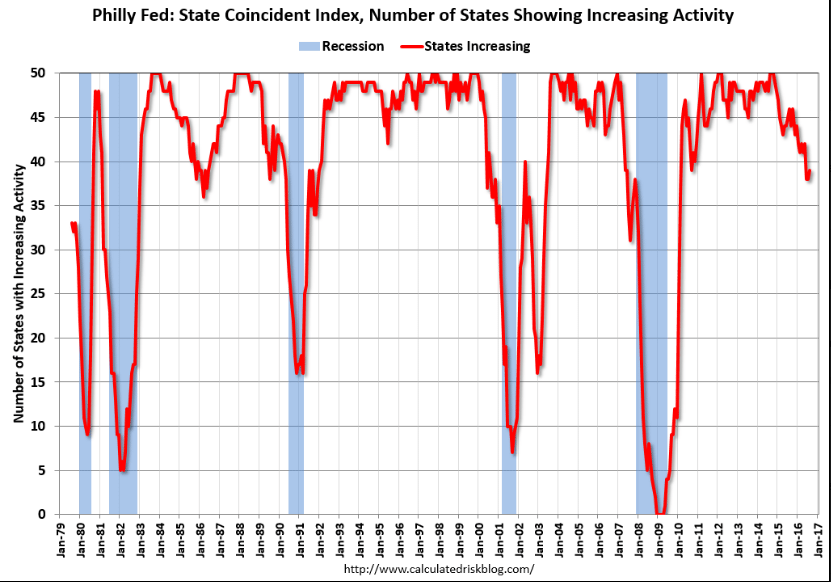
    Past the point of no return? Indicates the recession started a while ago?

    102702
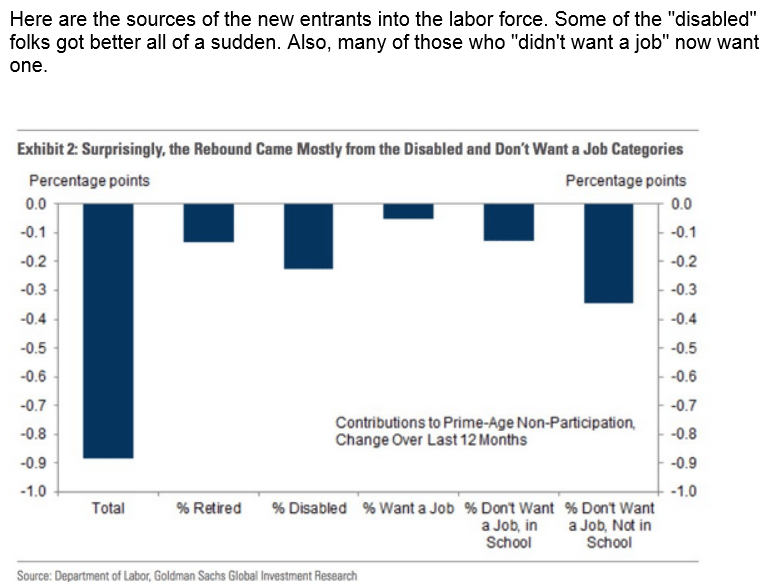
    As suspected, there has been a lot more ‘slack’ in the ‘labor market’ than the mainstream has asserted:

    102703