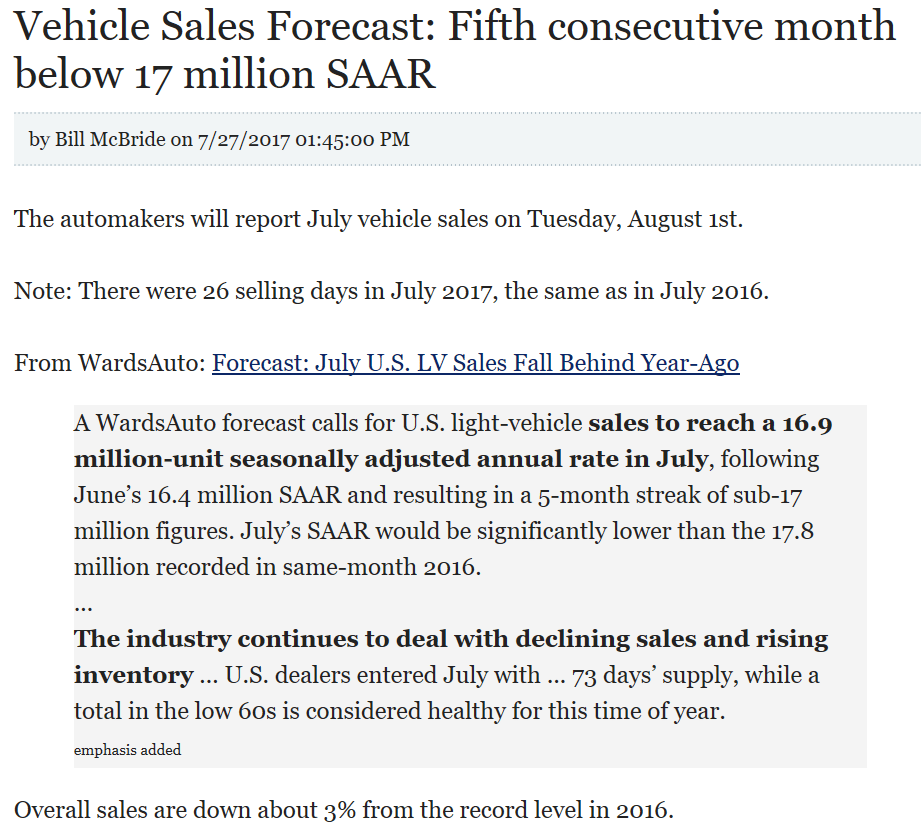
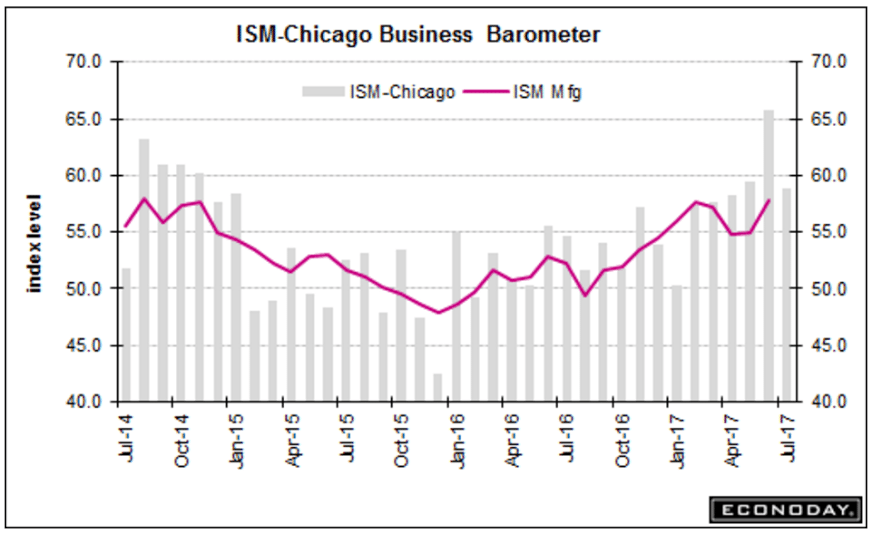
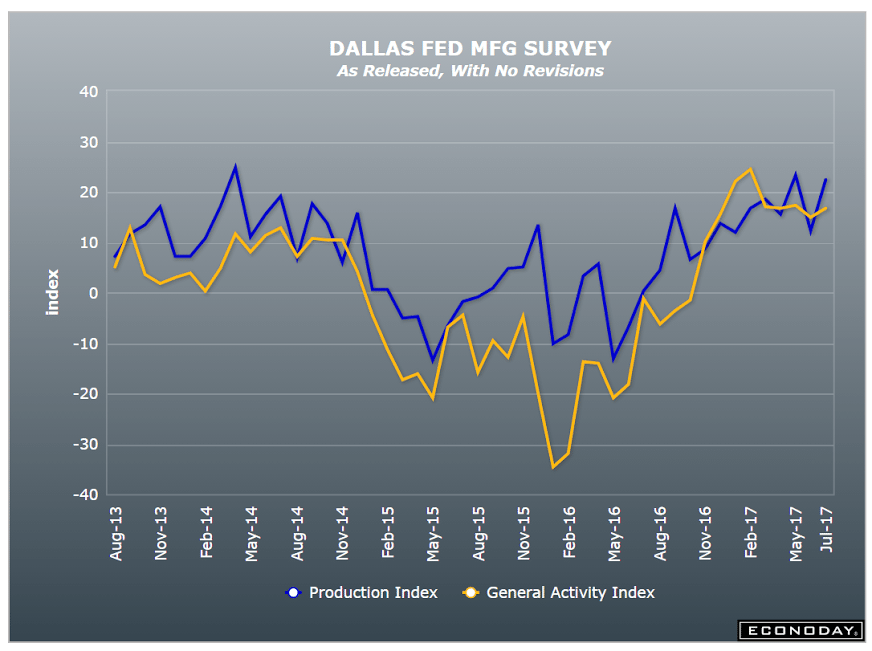
Chicago PMI, Dallas Fed, Pending home sales, Swiss reserve tax

The PMC annual bike ride is this weekend, so much appreciate that those of you who haven’t yet done so
get your donations in, thanks, and if any of you will be there, let me know and I’ll be looking for you!

http://www2.pmc.org/profile/WM0015

Settling down a bit:


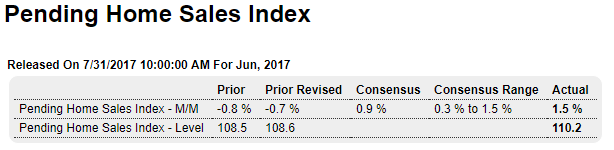
Better than expected:


Better than expected, lots of volatility, and anticipates existing home sales by a couple of months, which have flattened this year:

Highlights

After three straight declines, the pending home sales index posts a gain and a strong one, at 1.5 percent in June data that signal a long needed bounce for final sales of existing homes. Regional data show little variation with the West leading in June and the Midwest trailing. Pending sales take a month or two to close which points to strength for existing home sales in July and August. The housing sector struggled through the Spring season but, with second-half acceleration driven by low mortgage rates and high employment levels, can still post a solid year.

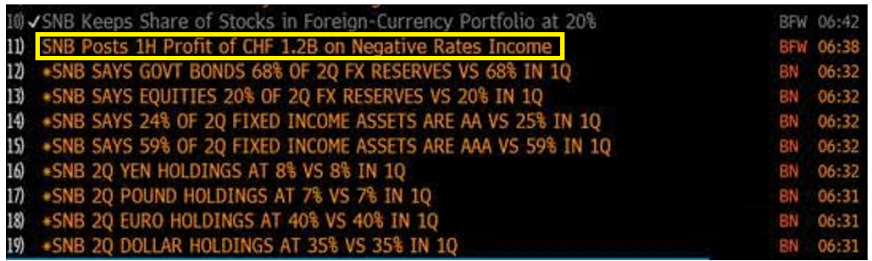
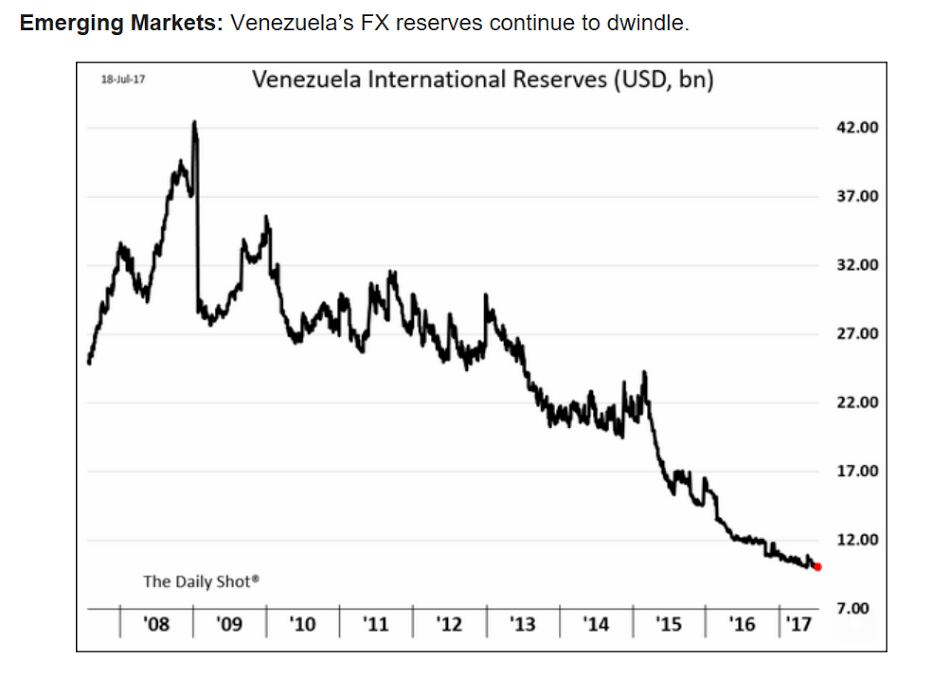
So the Swiss National Bank bought hundreds of billions of $ worth of foreign currencies, paying for them with ‘new’ swiss franc balances on their own books, which are subject to a negative interest rate. That means the SNB is gradually removing those funds it used to buy its fx reserves. Nice trade!!!
;)

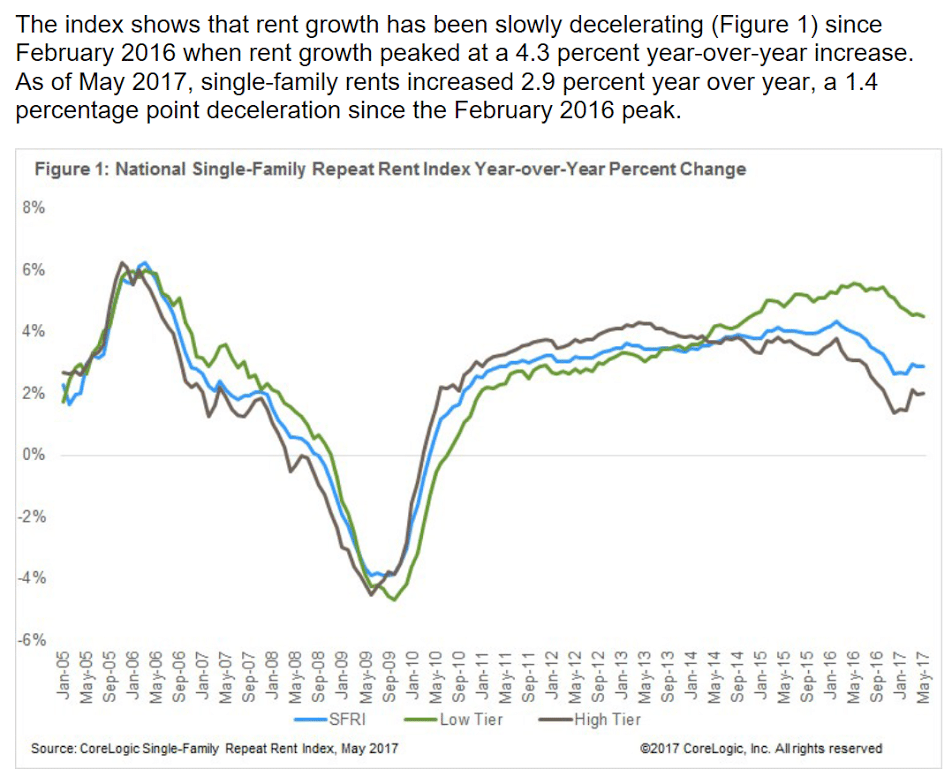
GDP personal income, Employment growth, Agricultural states performance, Rent growth, Chief of staff

In line with low aggregate demand:

http://econintersect.com/a/blogs/blog1.php/gdp-growth-seems-to-be-normalizing

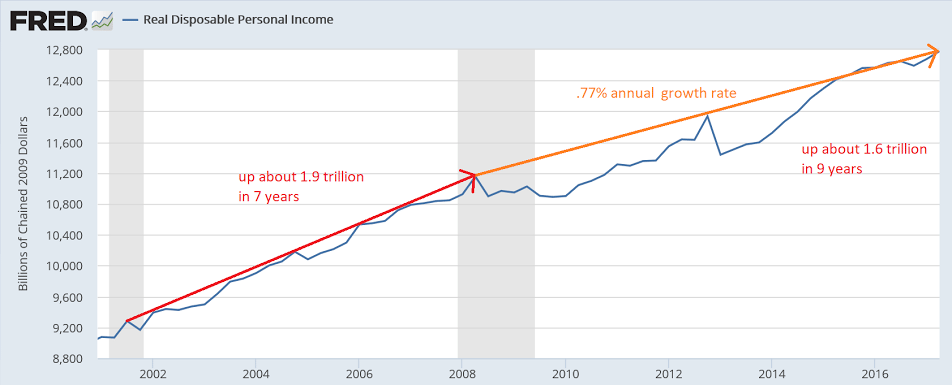
As mentioned above, real per-capita annual disposable income dropped materially (by $74 per annum). At the same time the household savings rate was reported to have dropped by -0.1% from a sharp downward revision (-1.2%) to the prior quarter. It is important to keep this line item in perspective: real per-capita annual disposable income is up only +7.11% in aggregate since the second quarter of 2008 — a meager annualized +0.77% growth rate over the past 36 quarters.


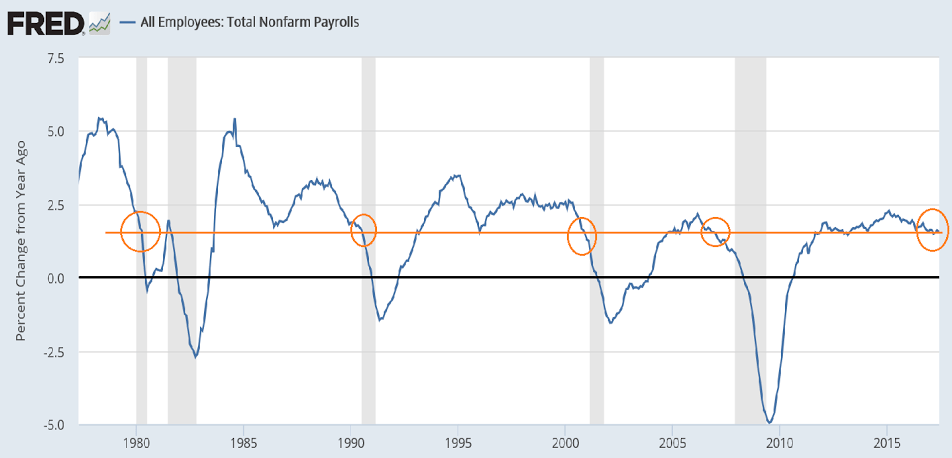
Historically, when employment growth drops to current levels the party’s over?

States with economies tied to agriculture suffering

ASSOCIATED PRESS

OMAHA, Neb. – The economies of Nebraska, Iowa and South Dakota logged the worst performance in the U.S. in the beginning of 2017, with economic output declining in all three states, according to a report from a federal commerce bureau.

Data from the Bureau of Economic Analysis shows that from January through March, Nebraska’s economic output declined by 4 percent from the final quarter of the previous year, making it the worst of any state. South Dakota ranked second-worst with a 3.8 percent decline, followed by Iowa with a 3.2 percent decline.

The bureau is a federal agency from the U.S. Department of Commerce, the Omaha World-Herald reported. It measures a state’s “real” gross domestic product, which is the market value of goods and services produced in-state.

Creighton University economist Ernie Goss conducted a survey of rural bankers earlier this month that shows a dimming outlook for the broader region as the year continues.

The bureau’s report said that economies most closely tied to agriculture are suffering the worst. It said that 43 states and Washington, D.C., saw growth in the first three months of the year when compared with the last three months of 2016.


;)

GDP, Consumer sentiment, Rail traffic, Vehicle sales, Credit check

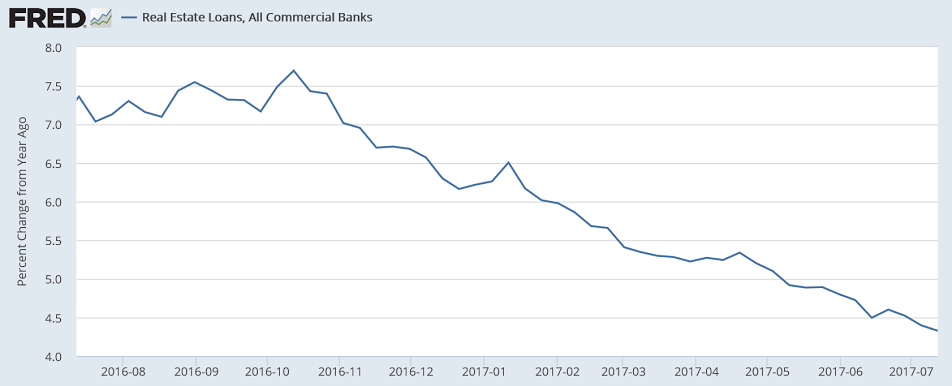
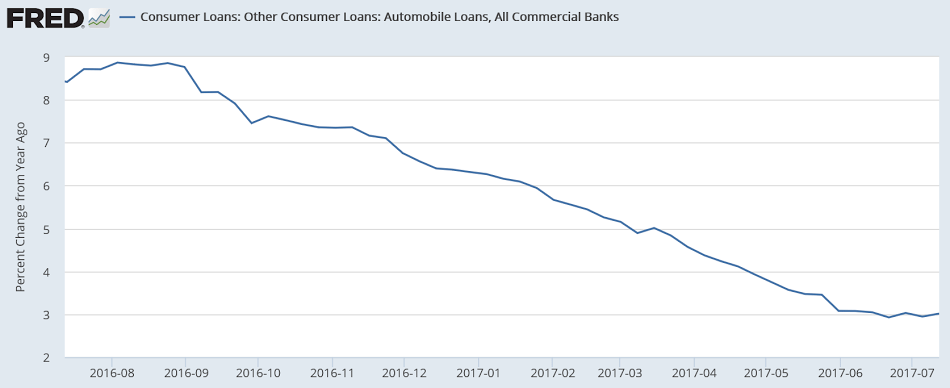
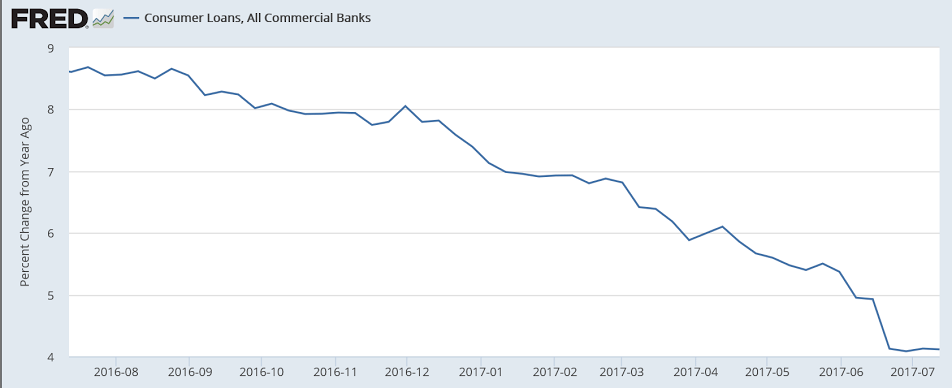
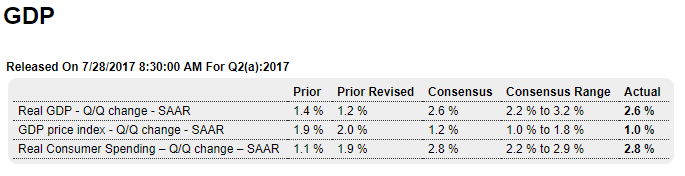
Up as expected though way down from initial forecasts as data deteriorated, and q1 was revised lower. More q2 data will be released over the next month when the first revision will be released. Consumer spending up vs prior quarter (but down year over year) even as consumer credit numbers decelerate, with ‘goods’ contributing over 1% to growth. Residential investment fell, in line with the deceleration in real estate lending, as did auto related spending, in line with decelerating auto related lending.

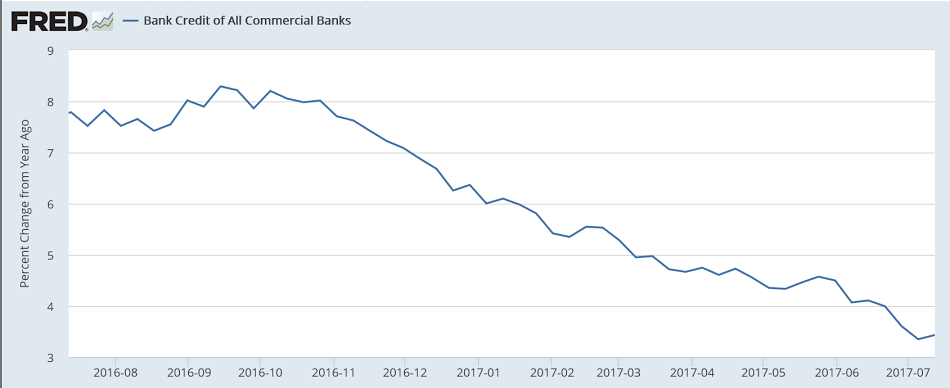
So with the decelerating lending reports somehow not seemingly reflecting a similar deceleration in total spending, there is either some other source of credit expansion I’m missing, or q2 will ultimately be revised a lot lower.
Highlights

The second quarter was healthy, growing at an as-expected 2.6 percent annualized rate with the consumer spending component also healthy and as expected, at a 2.8 percent rate. Business investment, at 5.2 percent, was once again very strong and offset a bounce lower for residential investment which fell at a 6.8 percent rate. Inventories were slightly negative for the quarter while net exports improved and proved a slight positive. Government purchases added slightly to the quarter. Inflation was very weak, at only a 1.0 percent rate. The core is similar, at 1.1 percent and down from 2.4 percent in the first quarter.

Turning back to consumer spending, durables were very strong at 6.3 percent despite the quarter’s weakness in vehicle sales. Nondurables rose 3.8 percent which is also strong and coming despite weakness in gasoline prices. Pulling down the consumer component was service spending, up a moderate 1.9 percent.

Benchmark revisions are included in the report, having little overall effect over the last 3 years but pulling down full-year 2016 slightly, by 1 tenth to 1.5 percent, and also the first-quarter by 2 tenths to 1.2 percent. There are no surprises in this report, one consistent with solid growth but also underscoring this year’s unexpected trouble for inflation.

Large gain in ‘goods’ sales pushed up GDP by about 1% in this first release:

Personal Income (table 10)

Current-dollar personal income increased $118.9 billion in the second quarter, compared with an
increase of $217.6 billion in the first quarter (revised). The deceleration in personal income primarily
reflected decelerations in wages and salaries, in government social benefits, in nonfarm proprietors’
income, and in rental income, and downturns in personal interest income and in farm proprietors’
income. These movements were offset by an upturn in personal dividend income.

Disposable personal income increased $122.1 billion, or 3.5 percent, in the second quarter, compared
with an increase of $176.3 billion, or 5.1 percent, in the first quarter (revised). Real disposable personal
income increased 3.2 percent, compared with an increase of 2.8 percent.

Personal saving was $546.8 billion in the second quarter, compared with $553.0 billion in the first
quarter (revised). The personal saving rate — personal saving as a percentage of disposable personal
income — was 3.8 percent in the second quarter, compared with 3.9 percent in the first.

These ares inflation adjusted and so are directly influenced by the deflator calculation.
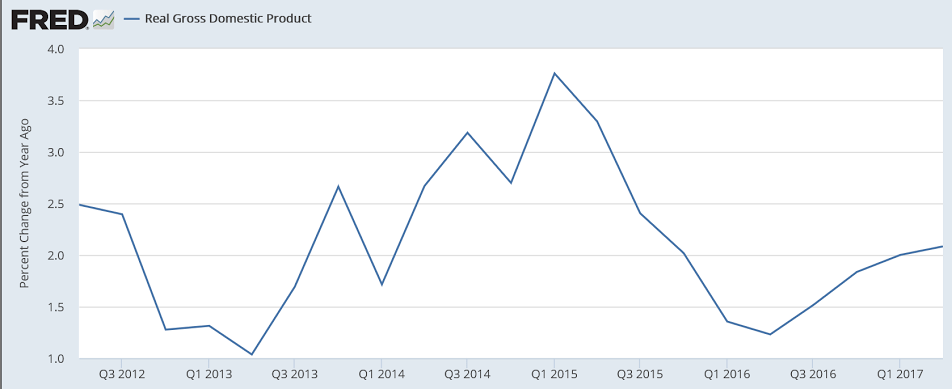

From Morgan Stanley. Note comments about how some of the data is generally associated only with recessions. And I’m not so sure inventories will reverse, as retail sales, for example, have generally been decelerating:

  • Inventories subtracted fractionally from Q2 growth v. our +0.7pp expectation after cutting 1.5pp from Q1. In real dollar terms, inventory accumulation was close to zero in both Q1 and Q2, the lowest back-to-back quarters outside of recessions since 1986. Final sales (GDP ex inventories) gained 2.6% in Q2, better than our 2.4% forecast, and final private domestic demand (consumption and business and residential investment combined) grew 2.7%, matching our expectation.
  • Consumption picked up to 2.8% from an upwardly revised 1.9% in Q1 (previous surprising weakness in Q1 was largely smoothed out as seasonal factors were updated in annual revisions), business investment gained 5.2% on top of a 7.1% Q1 gain, residential investment fell 6.8% as supply-side restraints hurt after an 11.1% Q1 gain, and government spending rose 0.7% after a 0.6% drop, as federal spending rebounded to offset a further drag from state and local infrastructure investment. Within business investment, equipment was surprisingly strong, accelerating to 8.2% growth from 4.4% in Q1, turning higher after a 3.7% drop in 2016, one of the worst nonrecession years ever. The drilling rebound also continued, boosting mining investment to a 117% gain on top of 272% rise in Q1. Ex mining structures investment was weak dropping 9%, a third straight decline with more weakness to come based on our non-resi permits tracker. Intellectual property products investment also slowed on less robust growth in R&D investment largely.
  • The synchronized global growth recovery that’s taken hold this year and a little bit of early impact of the weaker dollar (which would be expected to have a maximum impact one to two years out) helped boost exports to a 4.1% gain on top of a 7.3% rise in Q1, putting 2017 on pace for the best annual result since 2013. With imports up a more muted 2.1%, net exports added 0.2pp to GDP growth after also adding 0.2pp in Q1, a big improvement from persistent drags through 2014-16 that averaged -0.5pp a quarter.
  • Core PCE came in at 0.9% Q/Q annualized, a terrible result to be sure, but higher than the 0.7% implied by previously reported April and May monthly numbers and expectations for June based on the CPI and PPI reports. That should result in the year/year pace in June (which will be reported Monday) coming in at 1.5% instead of our previous expectation of 1.4%.
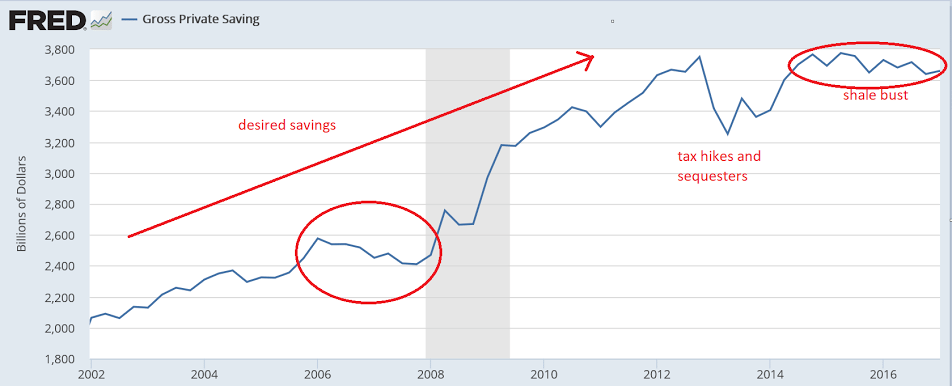
  • When savings desires can’t be met spending suffers and distressed voters respond:

    Fading:
    Highlights

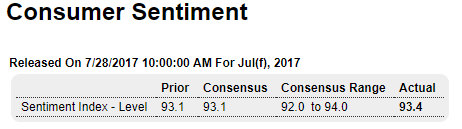
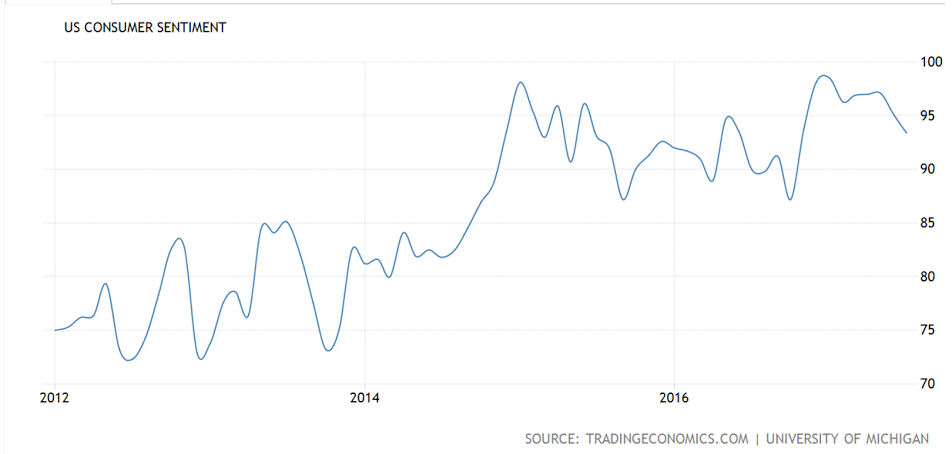
    Consumer sentiment edged higher the last two weeks of this month, producing a final reading of 93.4 vs 93.1 at mid-month. Still, the result is noticeably lower from June’s 95.1 and reflects weakening in expectations, down 3.4 points to 80.5, that contrasts with strengthening in the current assessment, up nearly 1 point to 113.4. The report warns that this divergence hints at a shift lower for current conditions and the total index in the months ahead. Inflation expectations remain very subdued, at 2.6 percent for both the 1-year and 5-year outlooks.

    This report has been moving south in contrast to the consumer confidence report which has been holding firm at 17-year highs. But throwing the weekly consumer comfort index into the mix, which has also been moderating, points to slightly less optimism than earlier in the year.

    Note how the red line has stopped improving and flattened:
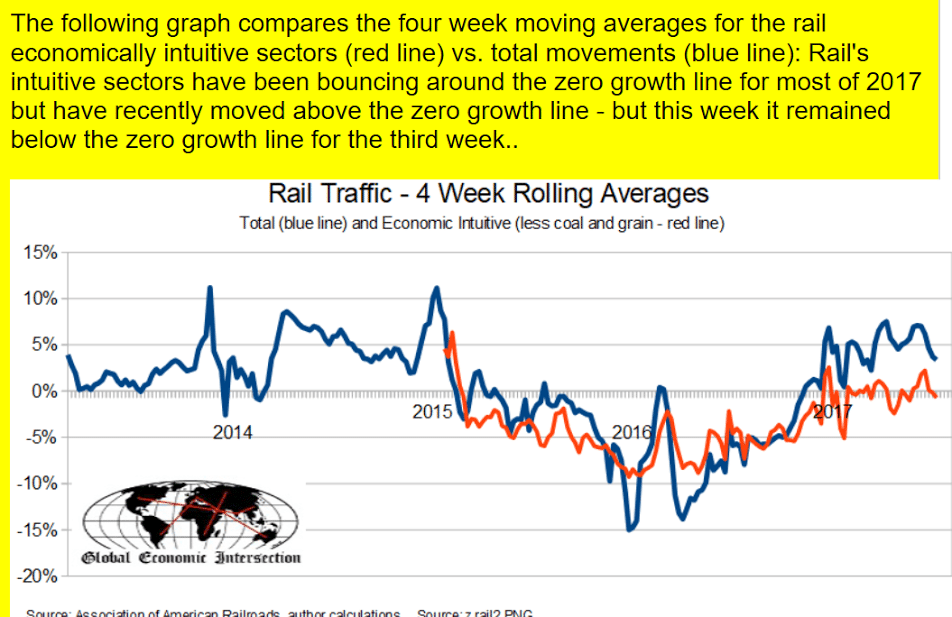

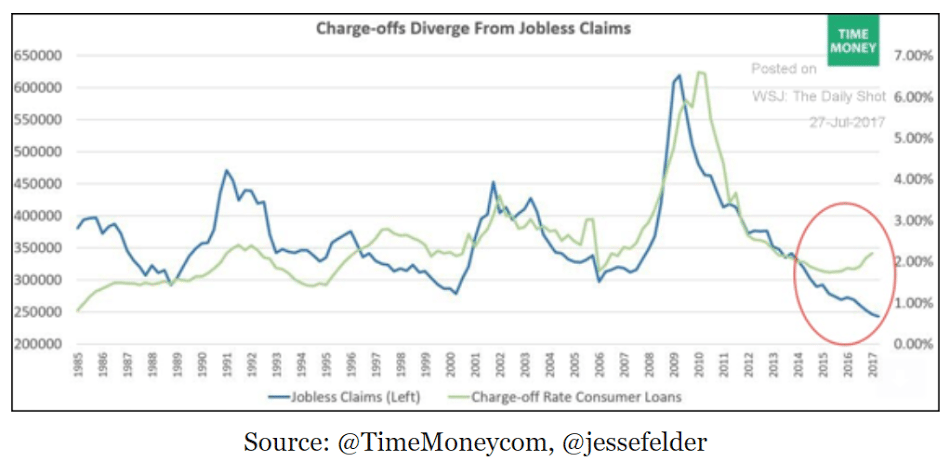
    Still looking ominous:
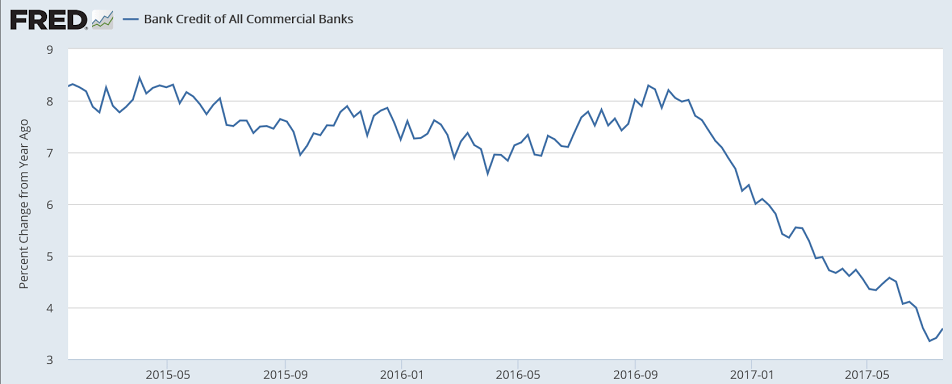

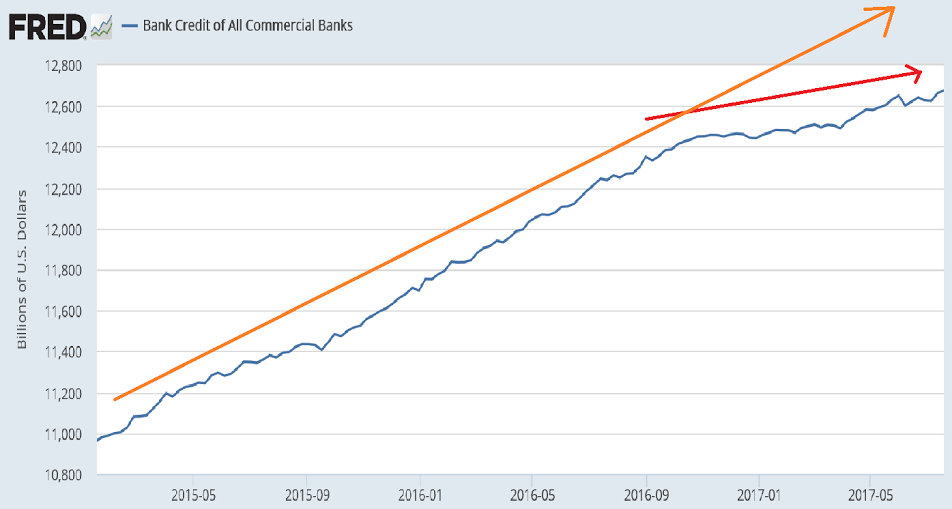
    You can see here how much more lending there would have been had the growth not suddenly flattened last November:

    Durable goods orders, Inventories, Trade, Consumer charge offs, Euro lending

    The theme of today’s data seems to be higher q2 gdp than otherwise, but for the wrong reason- over production- as spending weakened and unwanted inventories rose.

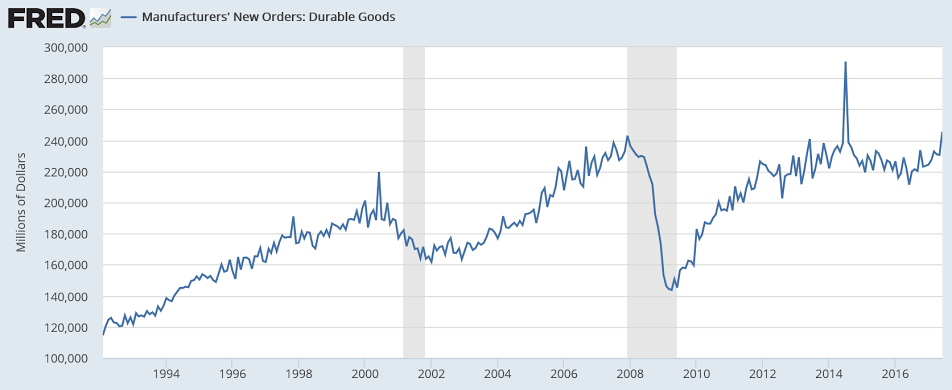
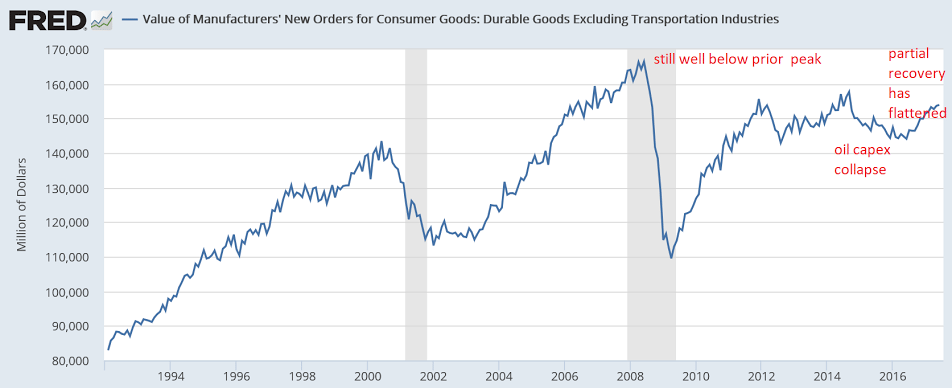
    Nice headline number for durable goods orders but most of the gain was in civilian aircraft which happens every year about this time. However, as previously discussed, the manufacturing sector is chugging along at modest levels after the large dip from the drop in oil related capital expenditures about 2.5 years ago:
    Highlights

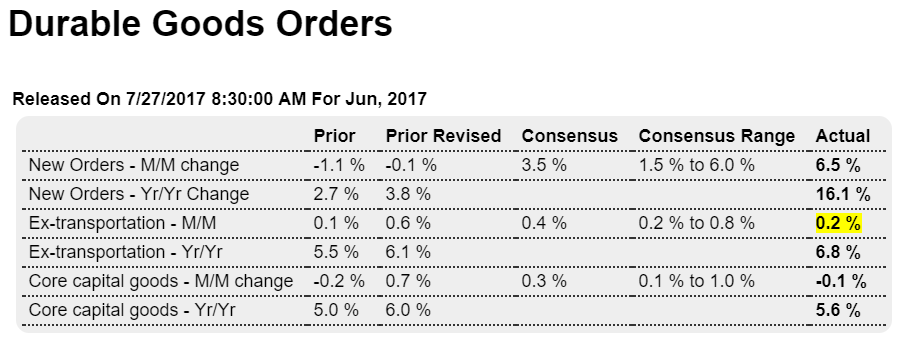
    Aircraft orders don’t dribble out day by day, they come in big monthly batches and an especially big one in June that masks otherwise mixed results. Total orders surged 6.5 percent to top Econoday’s consensus for a 3.5 percent gain and high estimate for 6.0 percent. But when excluding transportation equipment that includes a 131 percent surge in civilian aircraft, orders could manage only a 0.2 percent gain which is below the 0.4 percent consensus and just making the low estimate.

    But tipping the balance back in favor of strength is a 1 point upward revision to May where the decline is now only 0.1 percent. The ex-transportation reading gets a 1/2 point upward revision to a 0.6 percent gain with core capital goods (nondefense ex-aircraft) really showing strength, now at plus 0.7 percent vs a small initially reported decline.

    But the readings for June aren’t that great with core capital goods moving back into the negative column at minus 0.1 percent. Other areas of weakness include motor vehicles which have been suffering and where the June decline is a sizable 0.6 percent.

    For the second-quarter as a whole, however, June’s non-aircraft weakness is offset by the big gains in May. And specifically for Friday’s GDP report, a 0.4 percent June rise in inventories will be a solid plus with a 0.2 percent rise for shipments of core capital goods, that follows 0.4 and 0.2 percent gains in May and April, a modest plus.

    But for forward momentum, the weakness in June doesn’t point to building strength for July. Durable orders have not been consistently strong this year though there are more favorable aspects to today’s report than unfavorable with the second-half outlook for the up-and-down factory sector now a bit more upbeat.

    This chart is not adjusted for inflation:


    Not including aircraft orders:


    Looks like spending shortfalls are resulting in unsold inventories (not good):

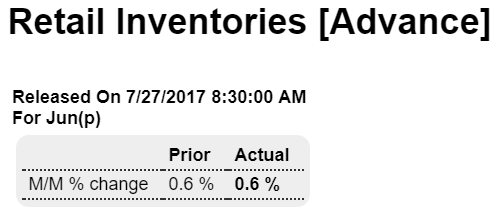
    Highlights

    Retail inventories will be adding to second-quarter GDP, rising 0.6 percent in both June and May. Rising inventories are a plus for GDP but a challenge for retailers where sales have been flat and suggest that the inventory build may be unwanted.

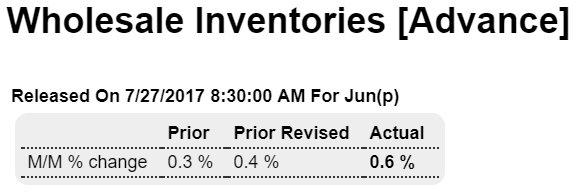
    Same here:

    Highlights

    Wholesale inventories in June are a plus for second-quarter GDP, rising a sizable 0.6 percent following May’s revised 0.4 percent build.

    More signs of a weakening US consumer, as imports of consumer goods fell as domestic
    inventories rose:

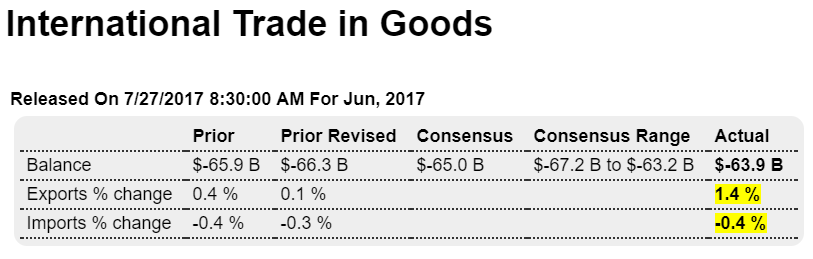
    Highlights

    Net exports in second-quarter GDP look to get a break as June’s goods deficit is a smaller-than-expected $63.9 billion vs expectations for $65.0 billion. Exports surged 1.4 percent in June led by food products but also including a big gain for capital goods exports and also vehicle exports. Imports of goods fell 0.4 percent with sizable declines for industrial supplies and consumer goods.

    In another plus for second-quarter GDP, advance data on wholesale and retail inventories, which were also released with the goods report, both rose 0.6 percent.

    The burst in exports is a positive not only for GDP but for a factory sector which, as reflected by this morning’s durables report, is still mixed but looking better.

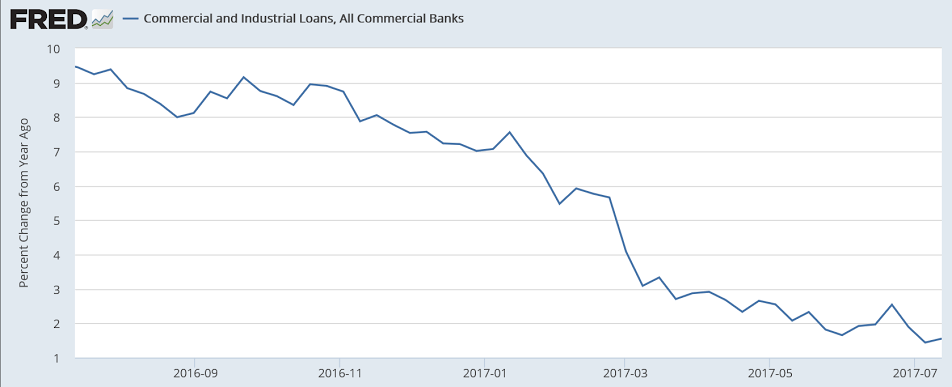
    Weaker lending here as well as the US:

    Euro zone corporate lending slows from post-crisis high

    By Jason Lange and Lindsay Dunsmuir

    Jul 26 (Reuters) — Corporate lending in the 19-country currency bloc grew by 2.1 percent in June, a big slowdown from the previous month’s 2.5 percent when growth was at its best pace since 2009. “The decline in the annual growth rate of loans to non-financial corporations in June reflects to a significant extent intragroup transactions,” the ECB said about the data. Lending to households meanwhile grew by 2.6 percent in June, unchanged from the previous month when it hit its highest pace since March 2009. The annual growth rate of the M3 measure of money circulating in the euro zone rose to 5.0 percent last month from 4.9 percent in May.

    New home sales, CAB, house prices

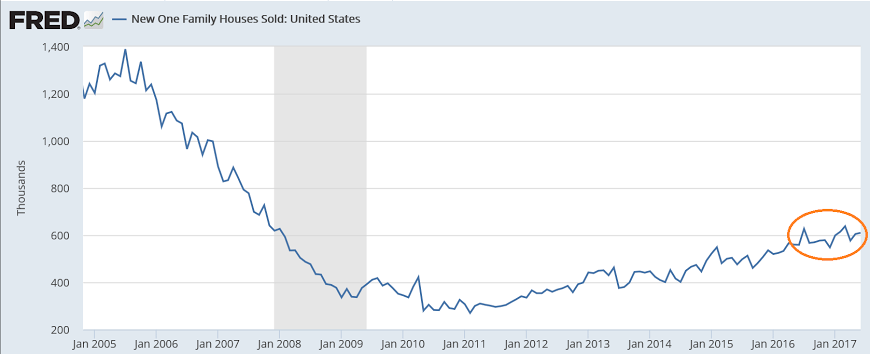
    New homes aren’t built without permits, which have flattened as well, and are therefore not adding as much to growth:

    Highlights

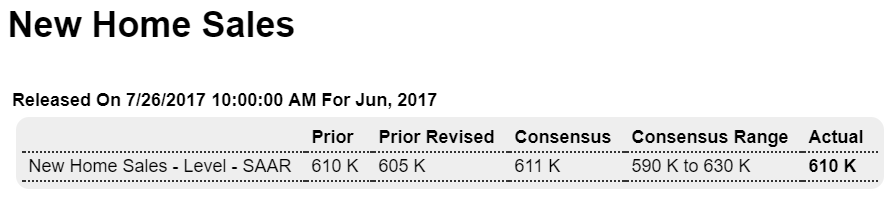
    New home sales are steady near the best levels of the expansion, at a 610,000 annualized rate in June. The 3-month average is 597,000 which is, however, noticeably below the first-quarter cycle peak of 617,000. This is a negative for second-quarter residential investment in Friday’s GDP report.

    But the upshot of today’s report is mostly positive. Sales are very strong in the West which is a key region for new homes. Sales in the region rose 12.5 percent in the month to a 180,000 pace and are up 33 percent year-on-year. But sales in the South, another key region and the largest one, fell in June, down 6.1 percent to a 323,000 pace. June sales were up in the Midwest, at a 66,000 rate, and flat in the Northeast at 41,000.

    Sales got a lift from lower prices in the month, down 4.2 percent for the median to a still imposing $310,800. Year-on-year, the median is down 3.4 percent and looks low compared to the 9.1 percent gain for on-year sales.

    Supply offers limited good news, rising but only slightly at a 1.1 percent monthly gain to 272,000 units. Relative to sales, supply is steady at 5.4 months vs 5.3 and 5.5 in the prior two months.

    New home sales at least didn’t move backwards as did Monday’s existing home sales data. Low mortgage rates and high levels of employment are important positives for the sector which, despite up-and-down readings since the Spring, is still a positive force for the economy.

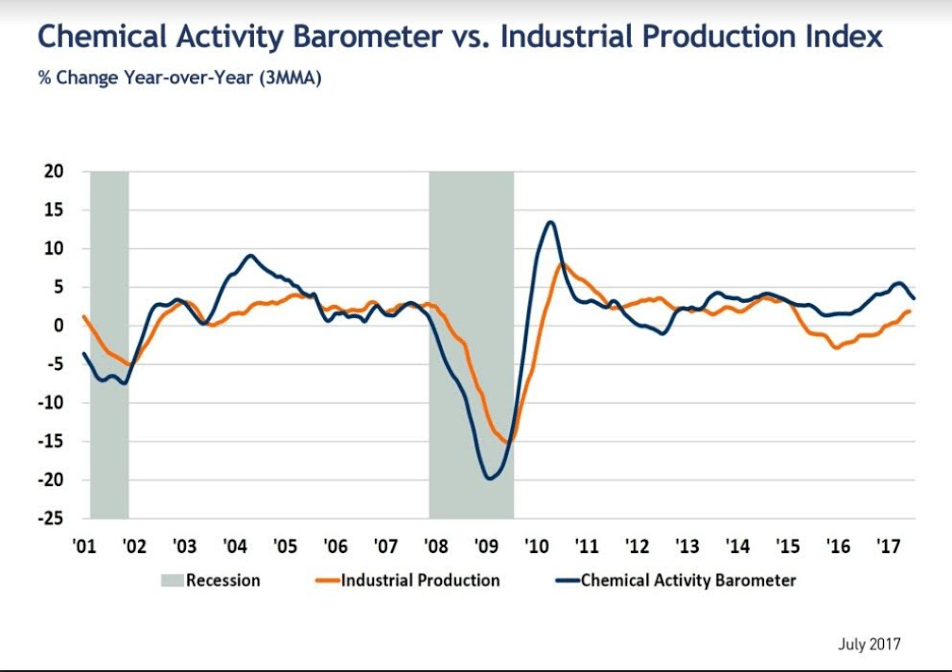
    This tends to lead industrial production:


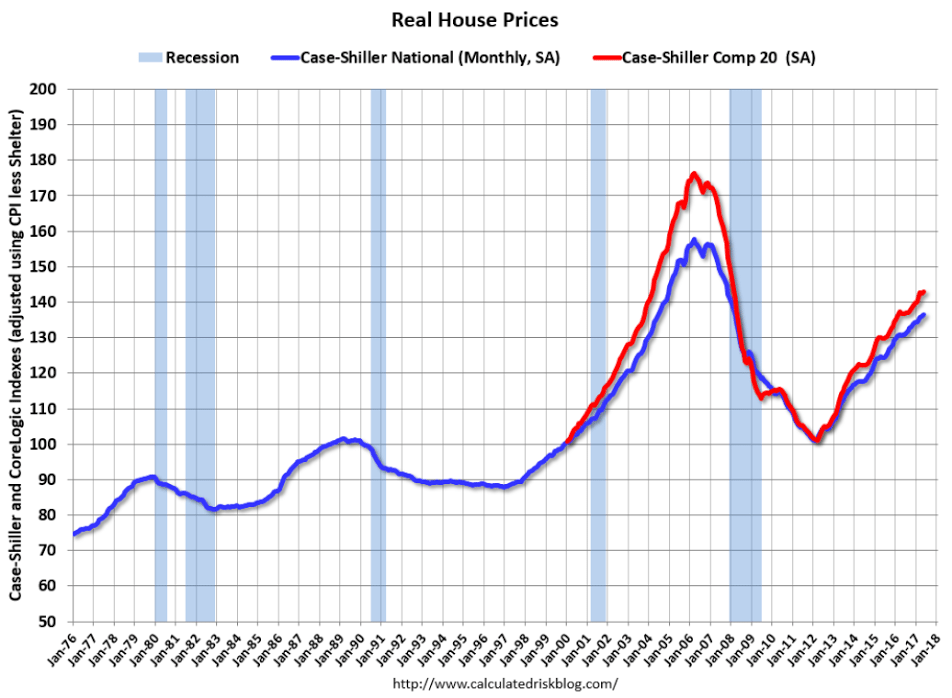
    These house prices are inflation adjusted, and you can see they are still well below the prior peak:

    Consumer confidence, Euro zone comments

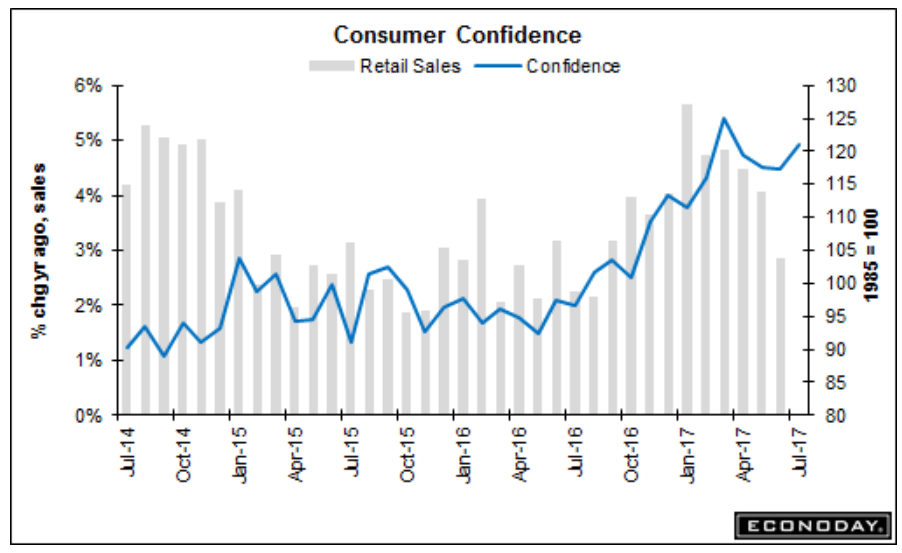
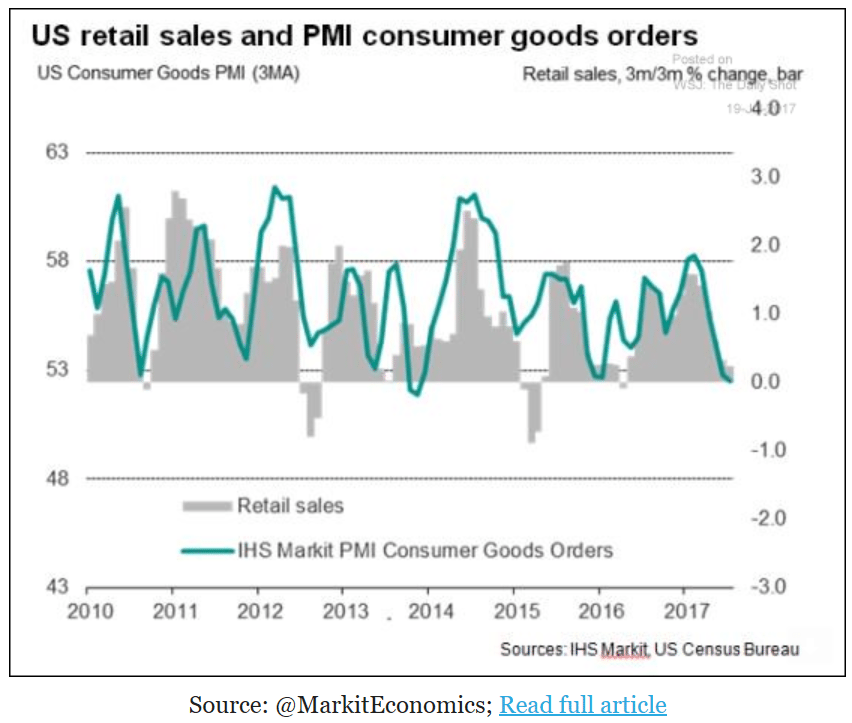
    Consumer confidence (soft data) up for the month but retail sales (hard data) continue to decelerate:

    No one talking about how this reduced what would have been private sector income and net financial assets by exactly that much, as the savings on interest was not spent by the governments but instead went towards deficit reduction:

    Euro zone budget savings could complicate ECB rate hikes: Bundesbank

    By Balazs Koranyi

    Jul 24 (Reuters) — Euro zone countries have saved nearly a trillion euros ($1.17 trillion) in debt costs since the global financial crisis and governments may now try to pressure the ECB to keep borrowing costs low, the Bundesbank said on Monday. Germany saved around 240 billion euros compared with pre-crisis levels, the Bundesbank said. “If rates on average were still at their pre-crisis levels, interest expense last year alone would have increased by nearly 2 percent of the nominal gross domestic product,” the Bundesbank said. “Since 2008, savings have totaled almost 1 trillion euros or almost 9 percent of euro area GDP.”

    Existing home sales, Services pmi

    Mirrors the deceleration in mortgage lending:

    Highlights

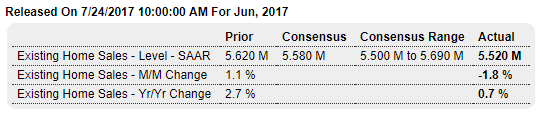
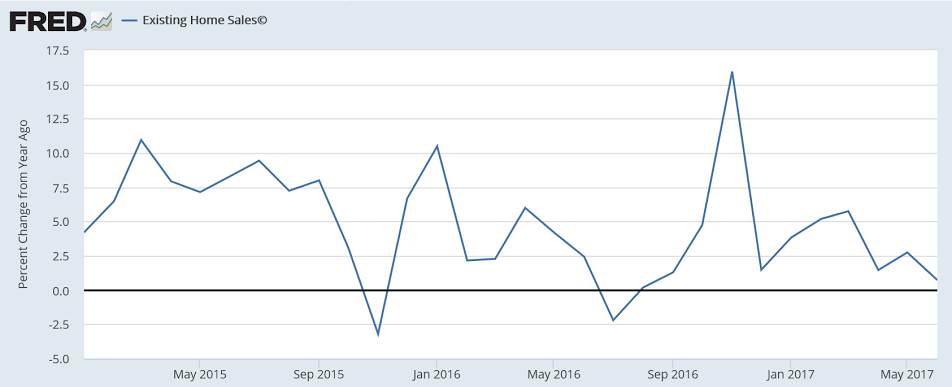
    The slip in pending home sales was no false signal as existing home sales fell 1.8 percent in June to a lower-than-expected annualized rate of 5.520 million. Year-on-year, sales are still in the plus column but not by much, at 0.7 percent which is the lowest reading since February.

    Compared to sales, prices are rich with the median of $263,800 up 6.5 percent from a year ago. Another negative for sales is supply which fell 0.5 percent in the month to 1.96 million for an on-year decline of 7.1 percent. Relative to sales, supply is at 4.3 months vs 4.2 months in May.

    High prices appear to be keeping first-time buyers out of the market with the group representing 32 percent of sales vs 33 percent in May and 35 percent for all of last year.

    Rising prices and thin supply, not to mention low wages, are offsetting favorable mortgage rates and holding down sales. Housing data have been up and down and unable to find convincing traction so far this year. Watch for new home sales on Wednesday where general strength is the expectation.

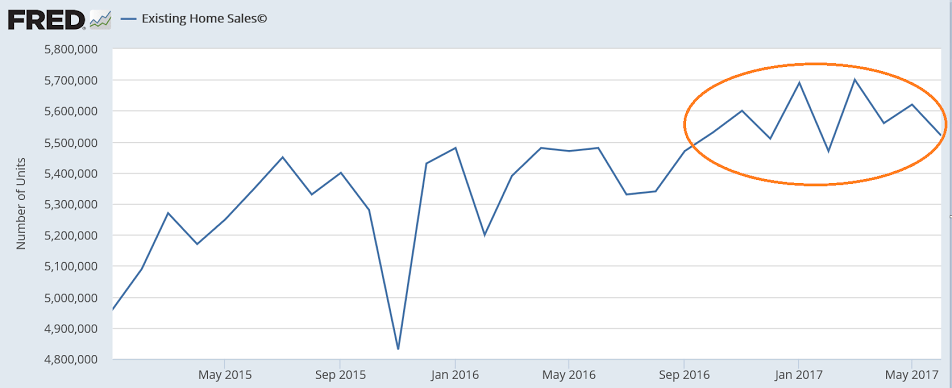
    looks like sales have gone flat since the election:


    Surveys like this generally spiked up with the presidential election while ‘hard data’ releases generally decelerated:

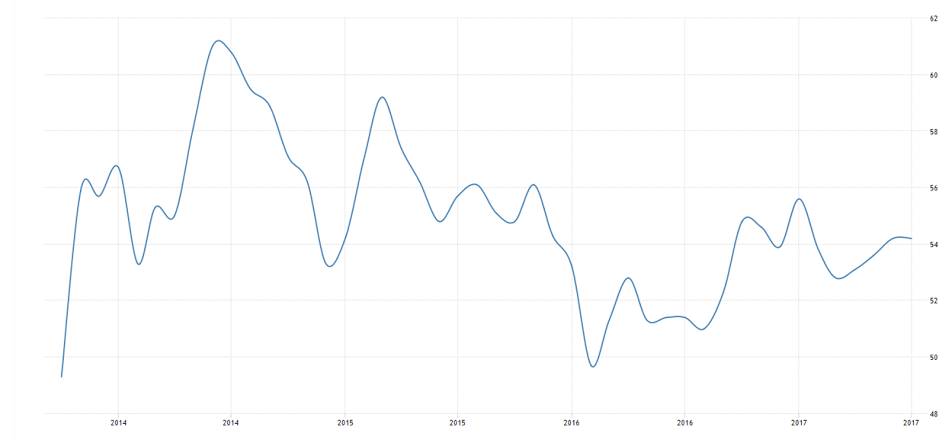
    “The seasonally adjusted IHS Markit Flash US Services PMI Business Activity Index came in at 54.2 in July 2017, unchanged from the previous month’s five-month high and slightly above market expectations of 54.1. New work increased the most since July 2015 amid an improving economic backdrop and greater willingness to spend among clients. leading to stronger job creation and a sustained rise in volumes of work outstanding. On the price front, input cost inflation eased from June’s peak while average prices charged rose the least in three months. Services PMI in the United States is reported by Markit Economics.”

    Philly Fed, Bloomberg consumer comfort index, Housing permits, Jobless claims, Euro comments, Trump comment

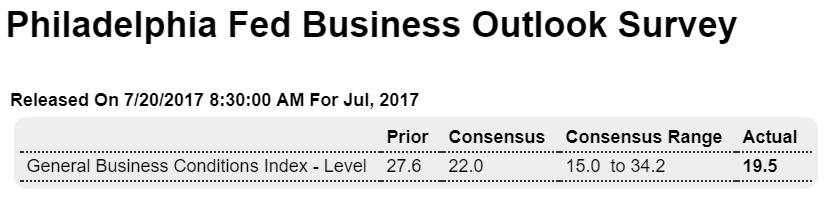
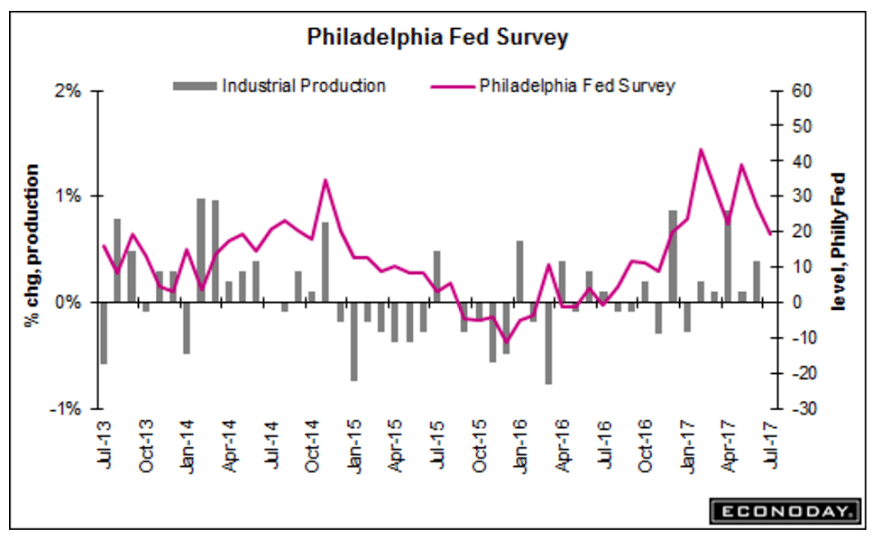
    Trumped up expectations as reflected in the various surveys continue to fade, and fall in line with the decelerating ‘hard data’:

    Highlights

    There finally may be cracks appearing in Philly Fed which has, since the election, been signaling break-out strength for the Mid-Atlantic manufacturing sector. The general conditions index looks solid at 19.5, still very strong though down from 27.6 in June and the least robust result since November. But details — which in this report are not reflected in the headline index — are the flattest since late last year.

    New orders, at only 2.1, are down more than 20 points in the month for the worst reading since August last year. Unfilled orders show better strength at 7.2 but are still the weakest since December. Employment, at 10.9, is also the softest since December as are selling prices, at 9.0. Shipments, still strong at 12.2, are at the lowest rate of month-to-month growth since September last year with the workweek, still positive at 3.8, the lowest since November.

    This report has been a puzzle all along, signaling post-election strength that was not matched at all by the national factory sector where growth has been no better than moderate. Though indications in today’s data still point to growth, they definitely are pointing to slowing which could either signal that this report is falling into line with actual national growth or, possibly, that national growth may be pivoting lower. In any case, this report is based on a small volunteer sample from only one area of the country.

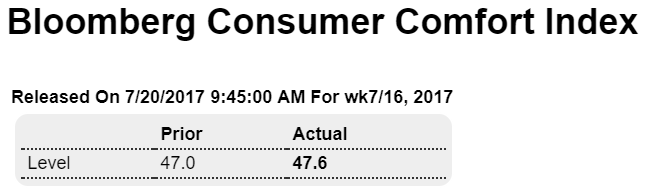
    Highlights

    The consumer comfort index, which fell to a post-election low in the prior week, rebounded 6 tenths in the July 16 week to a 47.6 level that is still, however, the lowest since February. Confidence readings appear to be leveling out after their post-election surge.

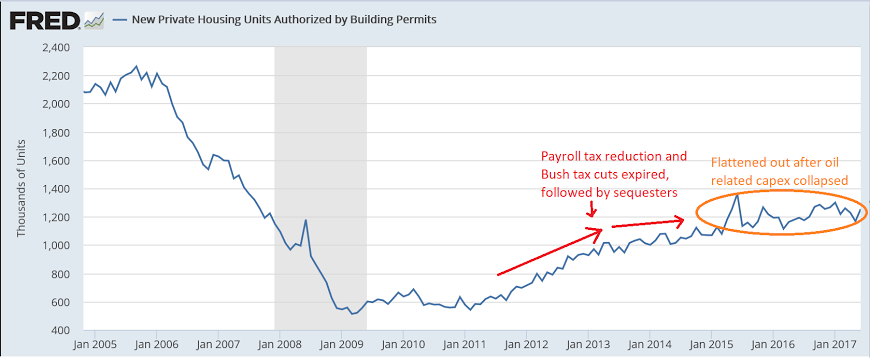
    No homes built without permits, so this is the real thing. Note how permits are just over half of what they were at last cycles highs, and how they’ve nearly entirely stopped growing going on 2 years now:

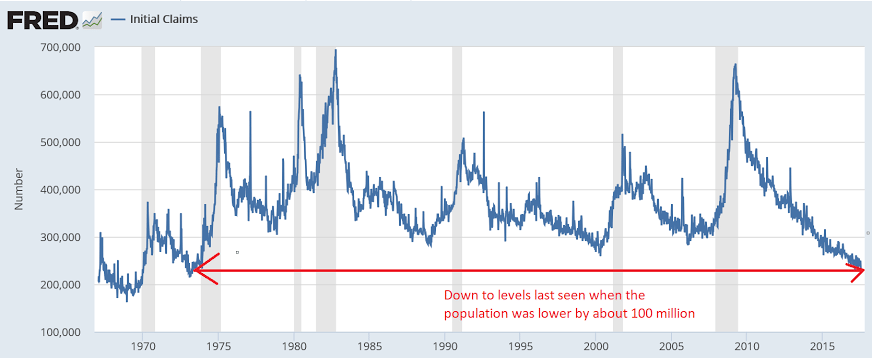
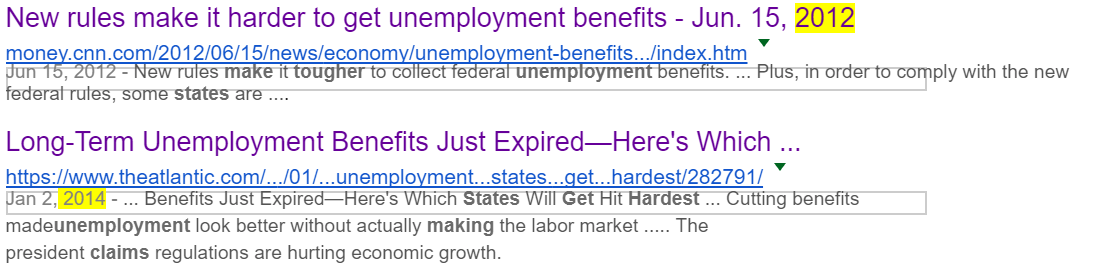
    I still suspect it’s all about said benefits having been made much harder to get, especially with states working with employers to help them let people go in a way that denies them benefits which are an expense to both the state and the employer. So I remain cautious about reading this as a sign of economic strength:

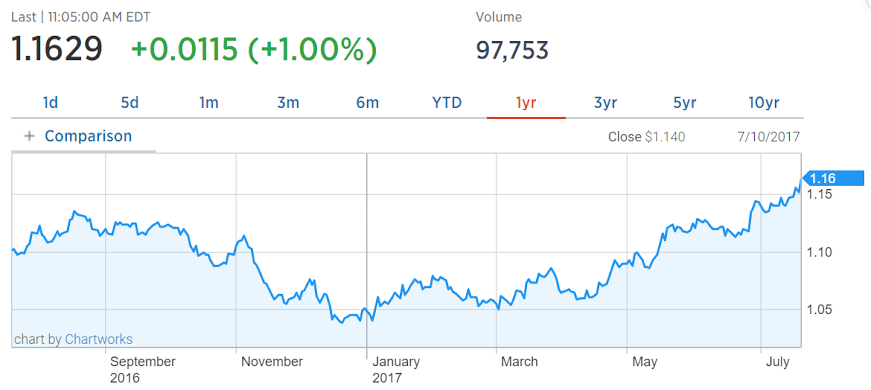
    The weak euro, which was entirely due to portfolio shifting rather than trade flows, was an inflationary bias that worked to prevent unwanted deflation, and at the same time supported the growth of the trade surplus, which has been supporting positive GDP growth. With the euro now reversing the ECB could find it that much more difficult meeting it’s inflation target, and any reversal of the trade surplus risks negative growth for the entire euro area:

    This is not looking constructive:

    Housing starts, Consumer spending chart

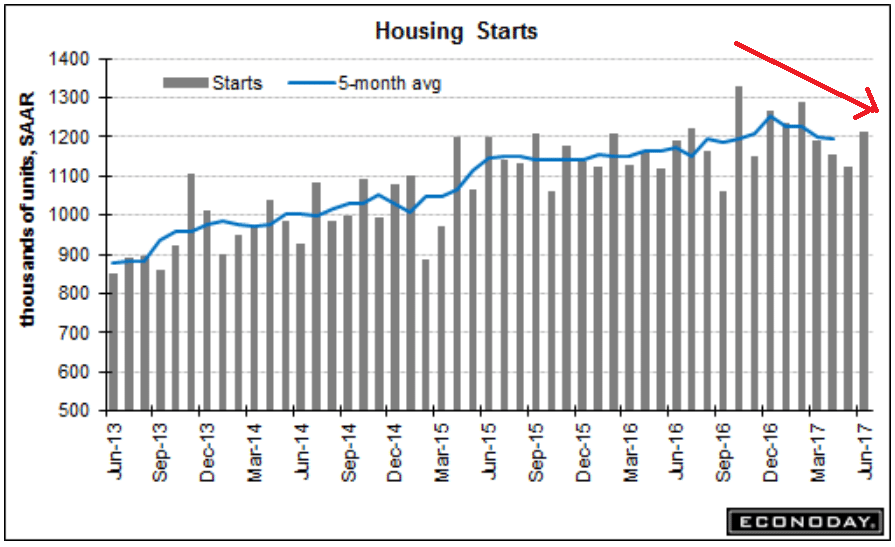
    Better than expected, but not enough to reverse this year’s downtrend, as per the chart, and housing is adding less to q2 gdp than it did to q1 gdp:

    Highlights

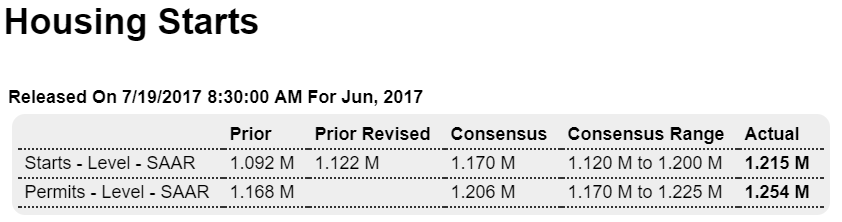
    Housing data have been up and down and are now back up as both housing starts and permits easily beat Econoday’s top estimates. Starts jumped 8.3 percent in June to a 1.215 million annualized rate with permits up 7.4 percent to a 1.254 million rate.

    As weak as the details were in the prior report is how strong they are in the latest. Looking at permits first, the single-family category rose 4.1 percent to an 811,000 rate with multi-family permits up 13.9 percent to 443,000. Permits are strongest in the Midwest followed by the West and South. Permits in the Northeast are the weakest.

    Starts for single-family homes rose 6.3 percent in June’s report to 849,000 with multi-family up 13.3 percent to 366,000. Here the regional breakdown shows the Northeast out in front followed by the Midwest. Starts in the West are up slightly and are down noticeably in the South.

    Completions offer further good news, up 5.2 percent overall to a 1.203 million rate led here by multi-family units. Homes under construction are unchanged at 1.070 million.

    Despite June’s gains and in a negative for GDP, second-quarter rates are below those of the first quarter averaging 1.164 million for starts vs 1.238 million. Permits are also down, at 1.217 million vs 1.260 million.

    Quarterly comparisons aside, this is a solid report that puts the housing sector back at the front of the economy. Watch next week for existing home sales and new home sales, both of which recovered in May after stumbling in April.

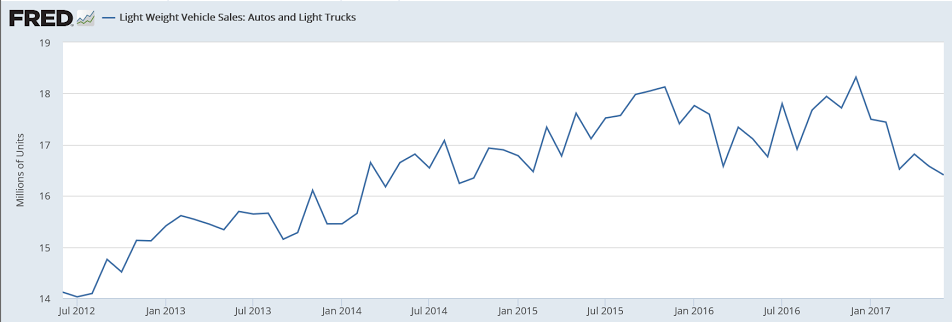
    Lower highs and lower lows, as the 5 month moving average works its way lower: