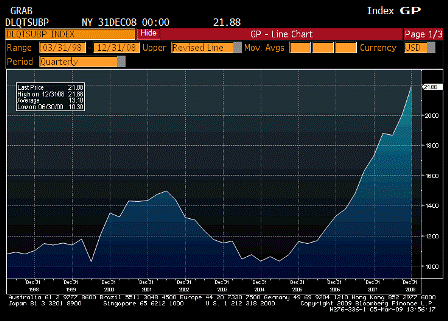
Treasury news


[Skip to the end]

Yes, but this would help world demand.

But it’s throwing away a major opportunity to increase our standard of living by supporting domestic demand unilaterally and letting the rest of the world rely on exports to us:

Interesting news from Treasury:

  1. Propose to increase IMF standy funds from $50 Billion to $500 Billion (major positive for emerging market credit).
  2. Calling for all G20 countries to spend 2% of GDP in stimulus in both 2009 and 2010.
  3. Calling for some kind of global trade finance initiative.


[top]
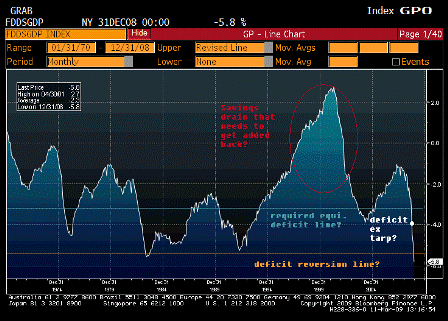
Deficit large enough to turn the economy?


[Skip to the end]

Given our counter cyclical tax structure, a weak economy causes the deficit to rise until it adds sufficient income and net financial assets to turn things around.

It then goes the other way, with the strong economy driving up revenues faster than even the government can spend, until the falling deficit ends the cycle.

In the past, when the deficit got in the range of 5% of GDP that proved sufficient to cause the turn.

It might be higher this time around.

The surplus years did a lot of damage as they removed substantial net financial assets that only deficits can replace.

The proactive Bush fiscal package reversed the economy earlier than otherwise.

Also, government purchases of financial assets don’t ‘count’ for purposes of this analysis.

So ex TARP, the deficit is maybe 2% or more smaller than the headline deficit number.


[top]

Iraq and Iran holding hands


[Skip to the end]

Well done- we facilitated the realization of the dream of the Iraq-Iran Shiite super state Saddam had been keeping apart.

Iraqi president meets top Iranian leaders

Feb 28 (AFP) — Iraqi President Jalal Talabani is meeting top Iranian leaders on Friday on his second trip to the Islamic republic in almost two years, the offical IRAN news agency reported.

Talabani, a Kurd, will hold talks with his Iranian counterpart, Mahmoud Ahmadinejad, the head of Iran’s Expediency Council Akbar Hashemi Rafsanjani and others.

Other media reports said Talabani is also expected to meet Iran’s supreme leader Ayatollah Ali Khamenei.

The Iraqi leader arrived in Iran on Thursday on his way home from a trip to South Korea. He is accompanied by a high-level delegation from the ministries of foreign affairs, trade and electricity.

He previously visited Iran in June 2007.

Ahmadinejad travelled to Iraq in March 2008 in the first ever visit by an Iranian president to the former arch-foe, symbolizing the flourishing ties between Tehran and the Shiite-led government in Baghdad.

The two Shiite-majority countries fought a war between 1980 and 1988 in which around one million people died.

Relations have warmed considerably since the 2003 overthrow of Saddam Hussein’s Sunni-dominated regime in Iraq by US-led forces.

Iraqi Prime Minister Nuri al-Maliki visited Tehran in January to seek Iran’s help in rebuilding the country and the two neighbours agreed to establish a high-ranking joint committee to improve cooperation.


[top]

Summers on stimulus


[Skip to the end]

World Coordinated Stimulus Needed: White House

Mar 9 (Reuters)

NOT!!!

We are much better of doing it all unilaterally.

This is the cost of having leadership that does not understand our monetary system.

Summer’s comments, ahead of next month’s G20 summit in London, suggest the U.S. administration wants all industrialised nations to pull together to engineer a demand-led recovery.

That will be music to the ears of British Prime Minister Gordon Brown who has trumpeted internationally-coordinated stimulus measures as the best way to tackle the downturn.

Him too.

“The right macro-economic focus for the G20 is on global demand and the world needs more global demand,” said Summers.

Yes, but we are better off if the demand is here and they export to us.

Summers, who served as Treasury secretary under the Clinton administration in the 1980s, said the view that the market was inherently self-stabilising had been dealt a “fatal blow.”

“This notion that the economy is self-stabilising is usually right but it is wrong a few times a century. And this is one of those times,” he said.

No, it is self correcting, but the ugly way as the automatic stabilizers increase the deficit via falling revenue and rising transfer payments until the deficit gets large enough to turn it all around.


[top]

Comments on Krugman


[Skip to the end]

Yes, but unspoken is the automatic stabilizers are quietly adding to the deficit with each move down, and the curves will cross and the economy start to improve when the deficit gets large enough, whether it’s the ugly way via falling revenues and rising transfer payments, or proactively via a proactive fiscal adjustment.

With income and spending turning mildly positive in January and other indicators such as the commodities also beginning to move sideways as the deficit passes through 5% before the latest fiscal adjustment kicks in, we may be seeing GDP headed towards 0 by q3 or sooner as most forecasters now predict. Unemployment, however, will continue to rise until real growth exceeds productivity growth.

Bottom line, there will be a recovery with or without a proactive fiscal adjustment. the difference is how bad it gets before it turns north.

Behind the Curve

by Paul Krugman

Mar 8 (NYT) — President Obama’s plan to stimulate the economy was a massive, giant, enormous. So the American people were told, especially by TV news, during the run-up to the stimulus vote. Watching the news, you might have thought that the only question was whether the plan was too big, too ambitious.

Yet many economists, myself included, actually argued that the plan was too small and too cautious. The latest data confirm those worries  and suggest that the Obama administration’s economic policies are already falling behind the curve.


[top]

SOV CDS Indicative Level


[Skip to the end]

Starting this week off higher as equity markets sag.

Systemic risk in the eurozone remains elevated.

Wide spreads in the US, UK, Sweden, etc. show markets misunderstand the risks of governments with their own non-convertible currency and floating FX policy.

SOV CDS Indicative Levels

Country 5yr CDS/10yr CDS Change Curve Euro/USD
Austria 260/278 +5 -20/-5 8/16
Belgium 142/156 +5 -10/-2 4/11
Finland 85/95 +3 -3/0 4/9
France 91/98 +3 -4/0 4/9
Germany 88/94 +3 -4/0 5/9
Greece 260/272 unch -25/-8 8/15
Ireland 348/368 unch -30/-10 8/18
Italy 195/205 unch -12/-2 7/10
Netherland 127/134 unch -8/0 5/12
Norway 55/65 +5 -2/2 n/a
Portugal 133/143 unch -12/0 7/12
Spain 150/155 unch -8/-1 7/12
Sweden 140/155 unch -8/-1 n/a
UK 152/162 unch -8/-2 6/12
US 88/98 unch -4/0 3/6


[top]

Fed beige book


[Skip to the end]

A tad more evidence consumption started moving sideways after year end?

Given the savings rate/budget deficit got through 5% this is not impossible.

(0% GDP growth still means rising unemployment as productivity continues to increase)

Consumer Spending and Tourism

Consumer spending remained very weak on balance, albeit with slight firming noted by many Districts, particularly compared with holiday-season sales that were very disappointing. About half of the Districts reported that consumer demand was softer than during recent reporting periods or fell significantly below levels twelve months earlier. However, compared with the preceding reporting period that included the holiday season, retail spending was described as “mixed” in the Boston and Richmond Districts, “nearly steady” in Philadelphia, and slightly improved in Cleveland and Dallas, while New York reported a reduced rate of decline compared with the “steep” pace in December. But San Francisco characterized retail sales as “anemic” and pointed to double-digit sales declines relative to twelve months earlier for many retail outlets. As reported by Richmond, Chicago, and San Francisco, discount chains fared much better than traditional department stores and specialized retailers, recording sales gains in many cases as consumers continued to switch away from discretionary spending and luxury items and toward basic necessities.


[top]

BOE’s King says rate easing over


[Skip to the end]

>   
>   On Thu, Mar 5, 2009 at 2:05 PM, EDWARD wrote:
>   
>   Though at 0.50% there’s not much more room to fall in any event and he is trying to
>   establish support for the new quantitative easing policy announced today.
>   

*KING SAYS WE’VE SEEN SUDDEN, SEVERE DOWNTURN ACROSS THE WORLD
*KING SAYS `WE’RE VERY CLOSE TO ZERO’
*KING SAYS BOE IS INJECTING MONEY DIRECTLY INTO THE ECONOMY

>   
>   This perhaps is ‘injecting money’ but only by narrow definitions of ‘money’ that do not
>   include the securities purchased by the BOE.
>   
>   They are simply buying financial assets, which is the exchange of one financial asset
>   (balances at the BOE) for another- securities held by the private sector.
>   
>   Net financial assets held by the private sector remain unchanged.
>   
>   While these purchases can put downward pressure on interest rates for the asset class and
>   maturity purchased, any ‘profits’ the BOE makes from interest earned on the securities it
>   buys vs its cost of funding represent interest income removed from the private sector.
>   
>   Note his interest in helping ‘savers’ which means higher rates:
>   

*KING SAYS KEY RATE IS AS LOW AS IT’S SENSIBLE TO GO
*KING SAYS HE’S KEEN TO GET BACK TO POSITION TO HELP SAVERS
*KING SAYS VERY UNLIKELY U.K. INTEREST RATES WILL GO ANY LOWER
*KING SAYS VERY UNLIKELY INTEREST RATES WILL GO ANY LOWER
*KING SAYS SAVERS SEEM TO BE SUFFERING THROUGH LOW RATES
*KING SAYS HE HAS ENORMOUS SYMPATHY FOR SAVERS


[top]

Sub prime delinquencies


[Skip to the end]

Sub prime delinquencies still headed north.

Some of it attributable to government assistance that requires borrowers to be delinquent?

Also, while 20% is certainly a high delinquency rate, and includes several years with 2006 higher and others lower,
it is still substantially lower than markets seem to be discounting, as evidenced by the discounts on very senior AAA pieces.


[top]