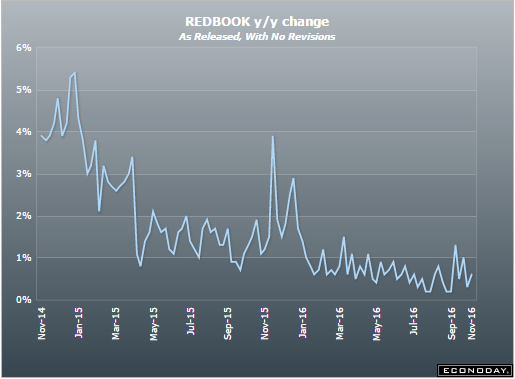
Personal consumption, Swiss retail sales, Redbook retail sales, PMI manufacturing, ISM manufacturing, Construction spending

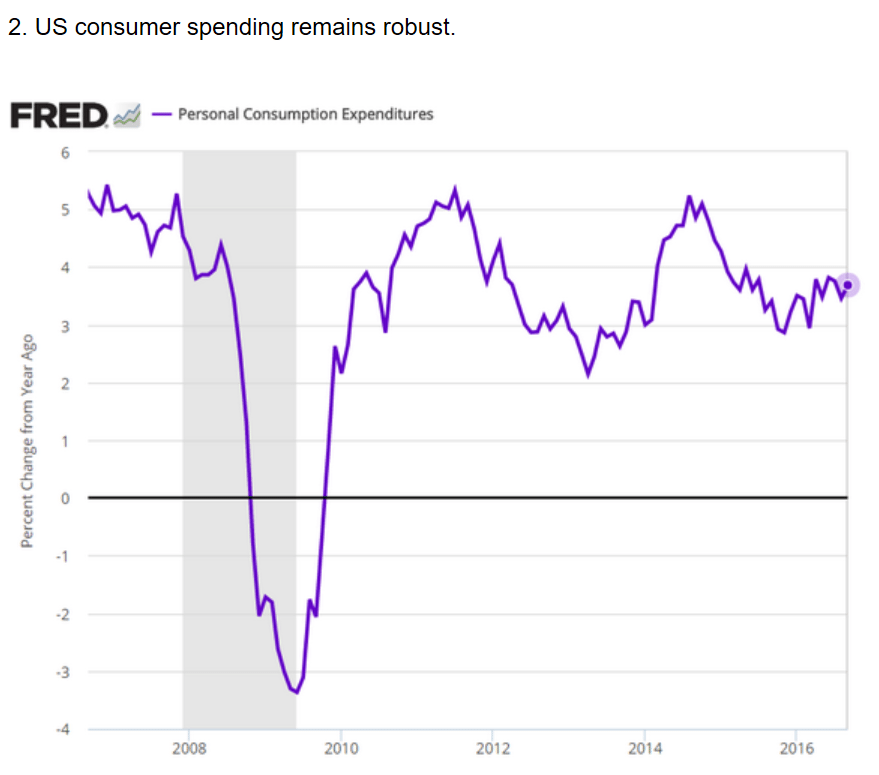
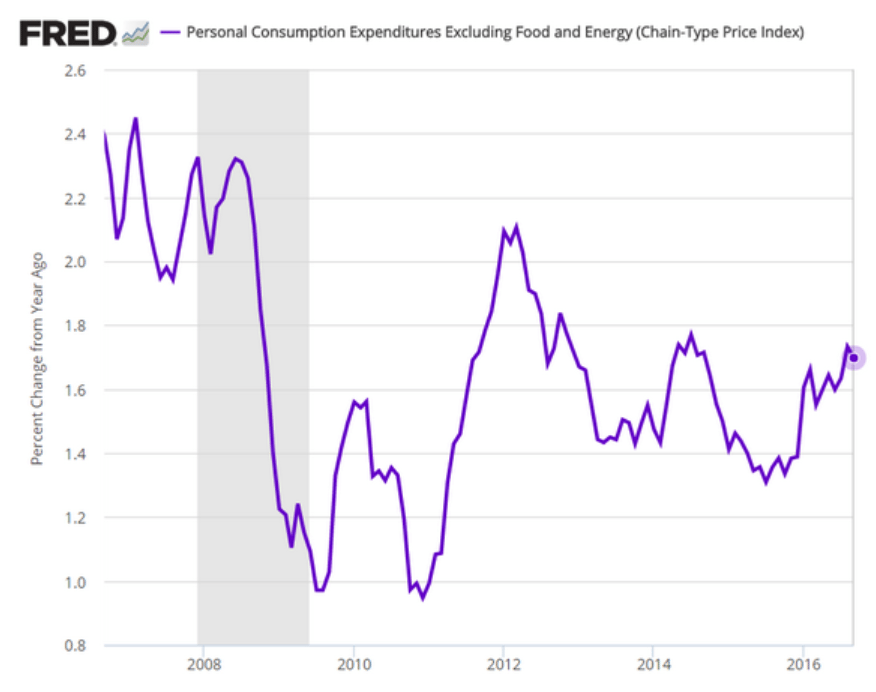
Gotta like the headlines. The growth rate remains below where it was during the beginning of the last recession… That is, we could already be well into recession:
110201
Adjusted for inflation, also below prior recession levels:
110202
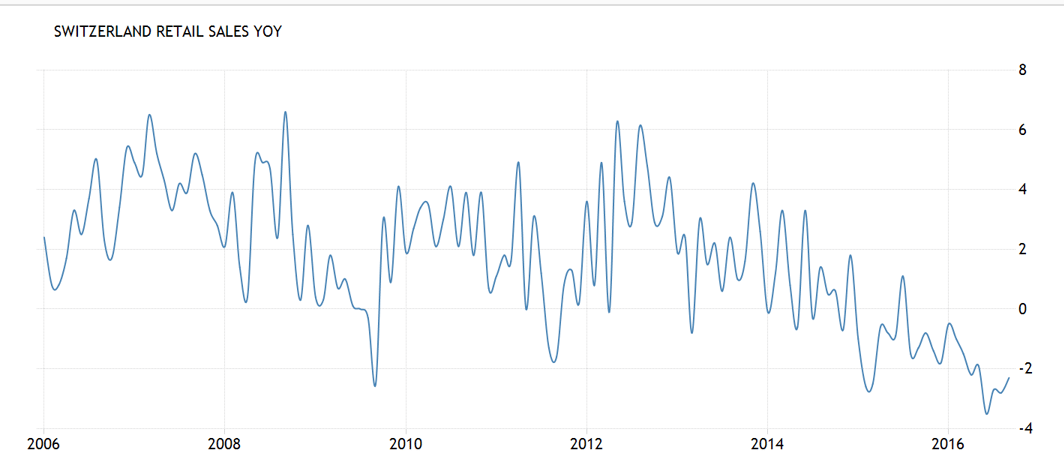
And it doesn’t seem like building $600 billion of reserves, buying US stocks, and a negative rate policy have done much for the Swiss consumer:
110203
Not even a hint of improvement here:

110204
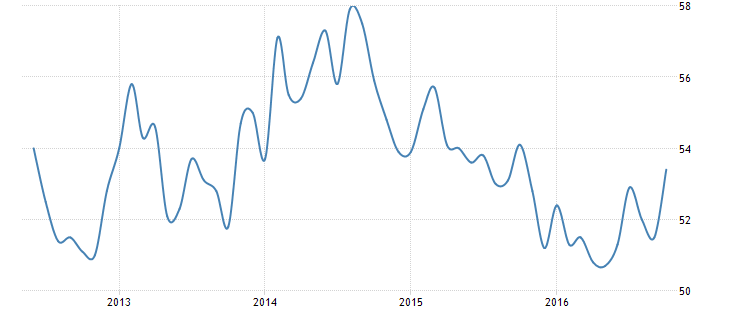
As previously discussed, manufacturing seems to be leveling off at reduced and modest levels:
110205

110206

Highlights

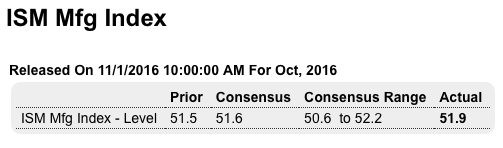
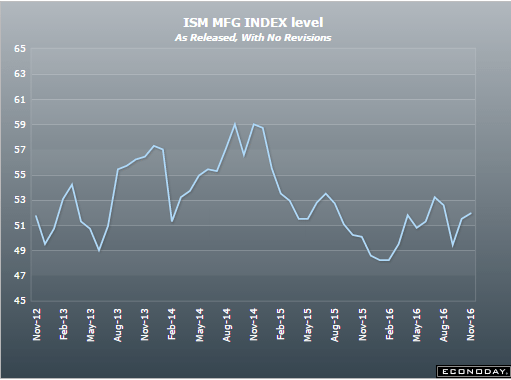
ISM’s manufacturing sample reported no better than moderate conditions in October with the composite index at 51.9 which however is still 3 tenths better than Econoday’s consensus. But new orders are a disappointment, still showing monthly growth but, at 52.1 vs September’s 55.1, at a much slower rate. Backlog orders, at 45.5, are even softer, holding below 50 for a 4th month in a row to indicate contraction. A positive for orders is a steady though moderate rate of growth for new export orders, at 52.5 for a 1/2 point gain.

Production did pick up speed in the month, up 1.6 points to 54.6, while employment moved from 49.7 and back over 50 for the first time since June, to 52.9. Input costs also point to steady demand, rising 1.5 points to 54.5.

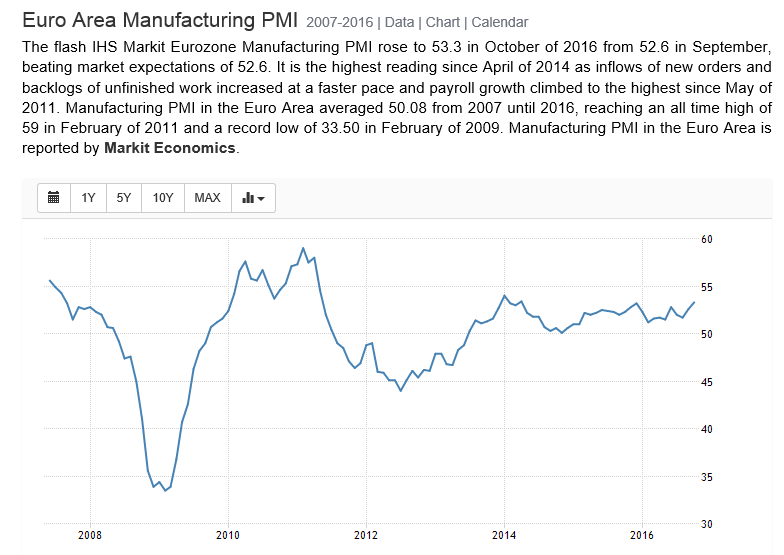
Yet this report tells a very different story from the manufacturing PMI released earlier this morning where readings, especially new orders, are accelerating sharply. Combining the two probably offers the most reliable indication on the factory sector, that is moderate and respectable growth going into year end.
110207
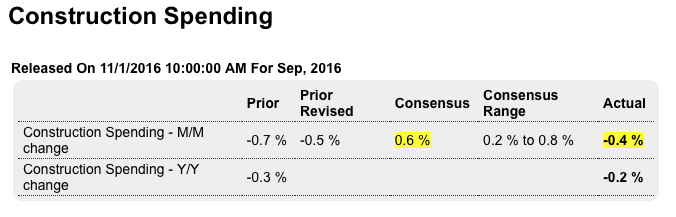
Construction continues to head south with no relief in sight.
And watch for downward revisions to q3 and q4 GDP growth estimates:
110208

Highlights

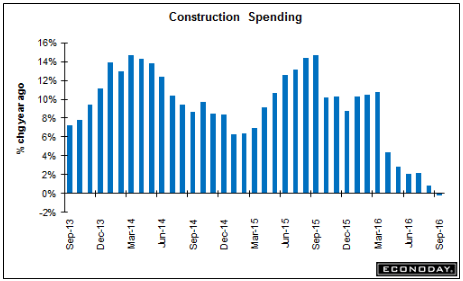
Construction spending remains weak but indications on housing do show limited improvement. Total construction spending fell 0.4 percent in September for a year-on-year decline of 0.2 percent. But residential spending rose 0.5 percent in the month with this year-on-year rate at plus 0.9 percent. The breakdown here though is mixed as the key single-family category could muster only a monthly rise of 0.1 percent. Multi-family construction is once again the strength, rising 2.0 percent in the month to extend an upward trend that reflects gains in current rental rates.

The real weak area is in the non-residential side of the report where spending on private construction fell 1.0 percent in the month and with public construction down 1.1 percent for its poorest showing since March 2014. Nearly all components on the nonresidential side show monthly declines with commercial, down 2.4 percent, and Federal spending, down 1.9 percent, showing the most weakness.

The construction sector, despite unusually low mortgage rates, has been struggling this year with the softness in single-family housing posing continued challenges for what is otherwise a strong new home market.
110209

US balance of trade, New home sales, PMI health care premiums, ECB statement, German consumer morale

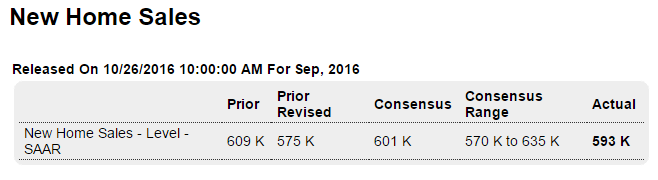
A bit fewer than expected and prior month revised down bringing it more in line with permits:

102607
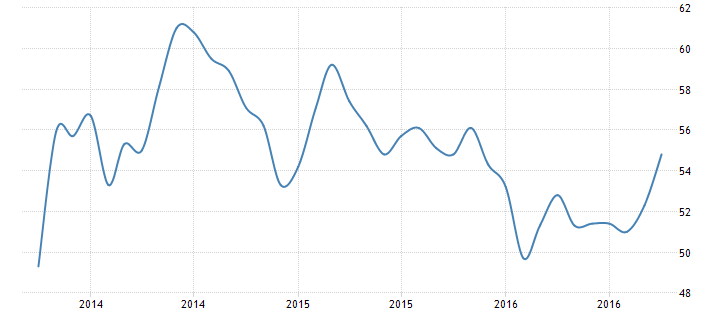
A nice uptick here, but as per the chart too soon to say the downtrend has reversed. And notice, again, how employment is faltering as has been the case in most of the surveys:

102608

Highlights

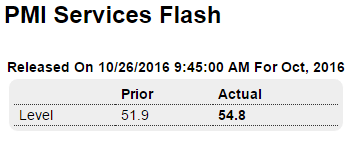
Markit Economics’ U.S. samples are reporting a sharp upturn in business this month, first with Monday’s manufacturing report and now with the service flash where the headline index is up nearly 3 points to 54.8 for the strongest rate of composite growth this year. New orders are at an 11-month high as is business activity, and year-ahead expectations are at their best level since August last year. The rise in demand is being reflected in inflation readings with input costs moving up from a nearly 2-year low and with selling prices also moving higher. Not showing much life, at least yet, is employment where job creation did improve but still remains near a 3-1/2 year low. The report attributes this month’s strength to rising hopes for improvement in the domestic economy. The sharp gains for Markit’s samples are a surprise but are still only anecdotal indications. Definitive data on October will be posted next week with the month’s unit auto sales and of course the monthly employment report.

102609
August revised higher which lowers GDP estimates, Sept higher than expected which increases estimates. I suspect Sept (like August) will be revised lower next month when October is released. And note the highlighted details that don’t bode well for domestic demand:

102610

Highlights

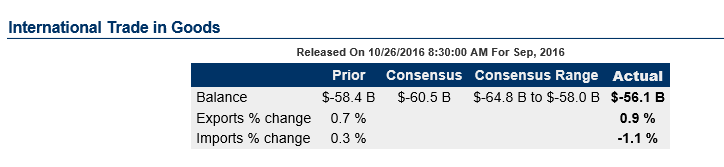
In a positive for Friday’s third-quarter GDP report, the nation’s trade gap in goods narrowed sharply in September, to $56.1 billion vs a revised $59.2 billion in August. Exports in September rose a solid 0.9 percent led by the largest component, capital goods, which rose 3.8 percent in what is a positive indication for global business investment. Exports of consumer goods also rose, up 4.4 percent, with industrial supplies up 2.3 percent. Also helping the deficit is a 1.1 percent decline in imports where most components fell with the exceptions of autos, up 4.3 percent, and other goods, up 0.8 percent. In a negative indication of retail expectations for the holidays, imports of consumer goods fell 1.8 percent following a 0.6 percent decline in August. And in a negative indication for domestic business investment, imports of capital goods fell 3.6 percent. Also released this morning are advance data on September inventories in the wholesale and retail sectors, up 0.2 percent for the former and up 0.3 percent for the latter.

This will be counted as increased consumption, but will take away from other consumption:

U.S. government says benchmark 2017 Healthcare.gov premiums up 25 percent

By Caroline Humer

Oct 24 (Reuters) — The average premium for benchmark 2017 Obamacare insurance plans sold on Healthcare.gov rose 25 percent compared with 2016. The average monthly premium for the benchmark plan is rising to $302 from $242 in 2016, the Department of Health and Human Services said. The government provides income-based subsidies to about 85 percent of people enrolled, and those credits will increase with the higher premiums. It said 72 percent of consumers on HealthCare.gov will find plans with a premium of less than $75 per month.

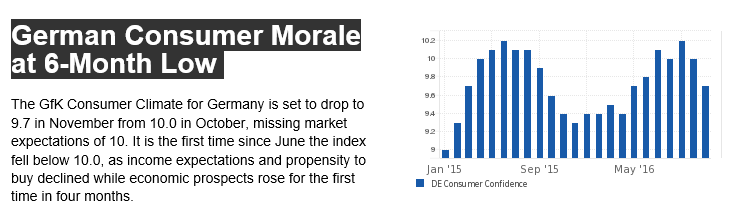
If anything, it’s the weak euro that’s added some support to GDP, but not to consumption:

Draghi hits back at critics of QE and negative rates

By Claire Jones

Oct 25 (FT) — “We have every reason to believe that, with the impetus provided by our recent measures, monetary policy is working as expected: by boosting consumption and investment and creating jobs, which is always socially progressive,” ECB president Mario Draghi said. “I find it hard to reach the conclusion that, over a longer timeframe, the outcome of our policies has been — or will be — to redistribute wealth and income in an unfair or unequal way,” the ECB president said. “That is certainly not true across countries, and there is not much to suggest it is true within countries either.”

102611

Germany Inc. Sits on $500 Billion in Cash Amid Weak Outlook

By Nina Adam

Oct 25 (WSJ) — Germany’s nonfinancial businesses have saved more than they have invested for the past seven years, piling up about €455 billion ($500.4 billion) in cash and deposits, German central bank data show. Of 11 companies in the DAX-30 stock index that disclosed their investment plans, five said they plan no increase in capital expenditure this year or next. Five others said they plan increases, but mostly outside Germany. Volkswagen said it was canceling or delaying all investment projects that it doesn’t consider “core.”

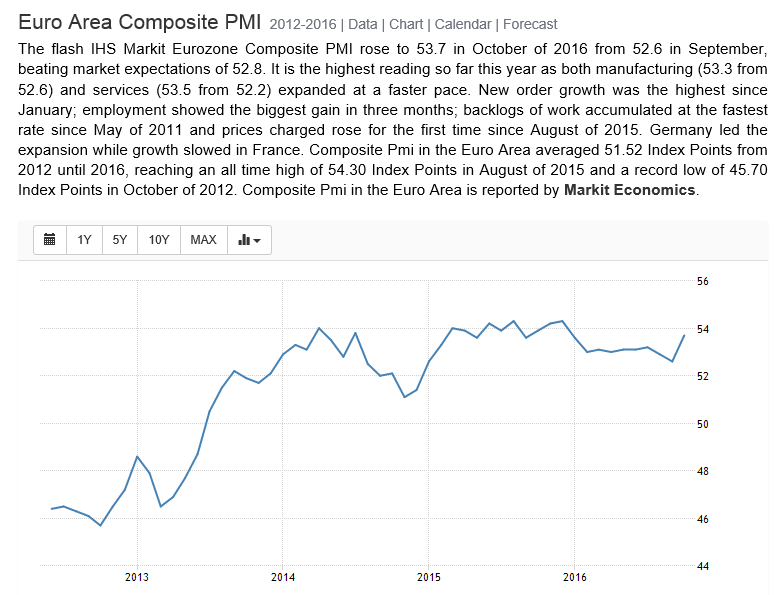
Auto sales forecast, Euro area manufacturing and composite PMI, Redbook retail sales, Consumer confidence, Richmond Fed

Still negative:

102601
Should hold up as long as the euro stays relatively weak due to portfolio selling, which has been all but continuous for the last couple of years or so. At some point ‘fundamentals’ including relative prices and the current account surplus ‘drain the swamp’ and take over:

102602

102603
Back down again:

102604
Back down:

102605
Still negative:

102606

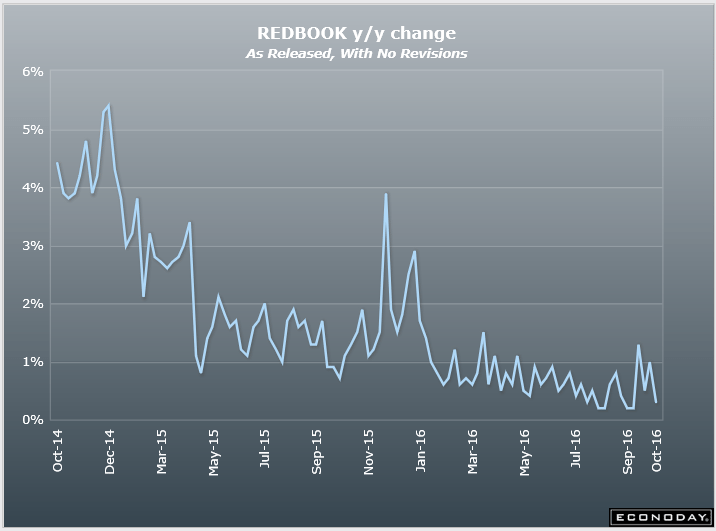
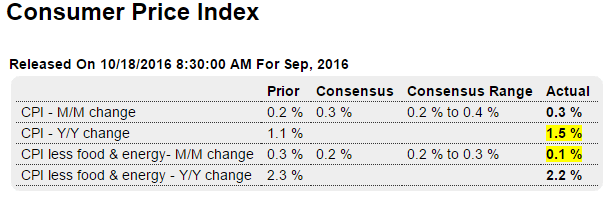
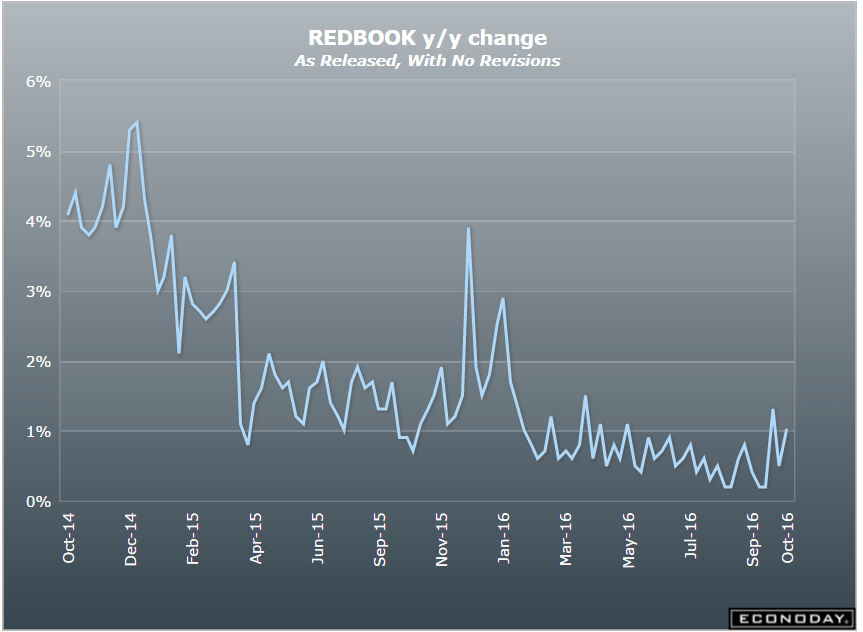
CPI, Redbook retail sales, Consumer spending comments, Voter turnout comments

Fed continues to fail to achieve it’s 2% target:

101901

101902
No sign here of housing growth picking up from where it’s been:

101903

Highlights

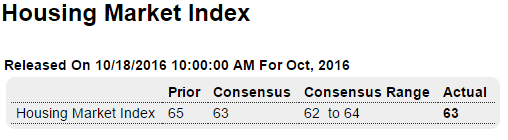
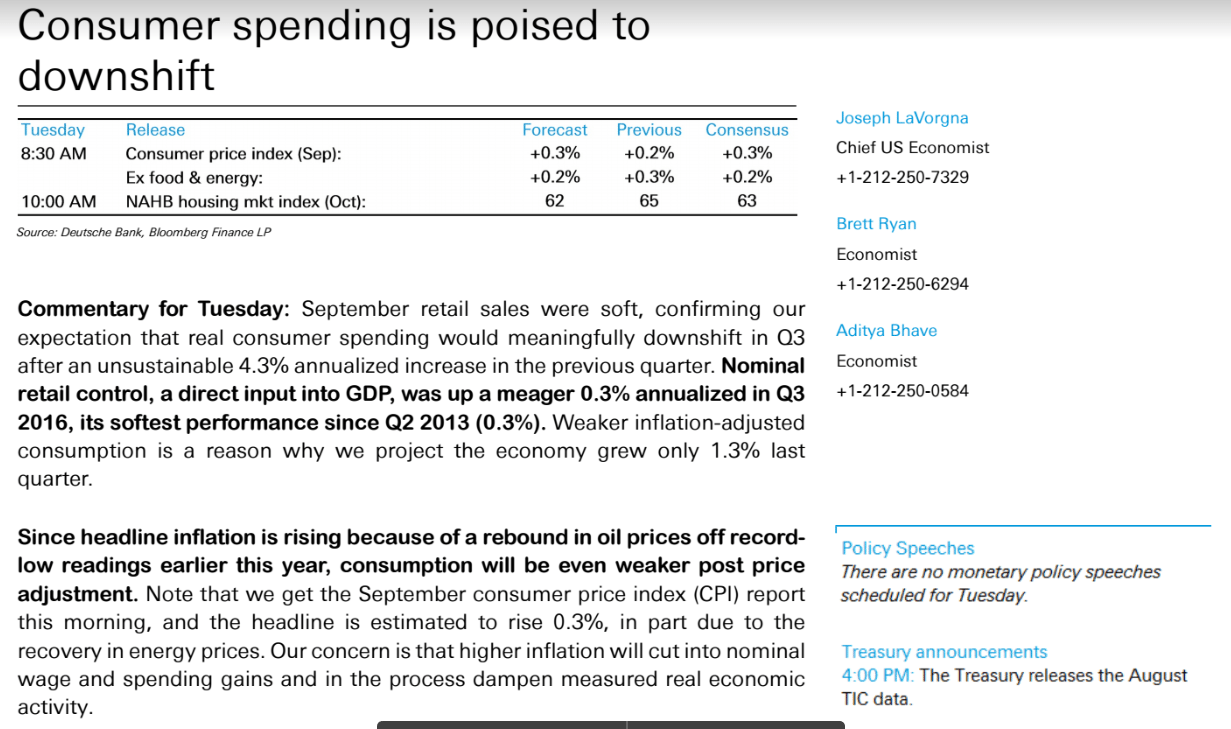
The new home sector picked up steam in the third quarter and looks to end the second half with strength. The housing market index held on to the bulk of its 6-point surge in September, coming in at 63 for October in only a 2 point slip. Home builders are very optimistic about future sales, the leading component of the report which is at 72 and up 1 point in the month. Current sales are down 2 points but are very strong at 69. Traffic continues to lag, down 1 point to 46 but with the trend still showing slight improvement.

Regional data show the West out in front, at a 3-month composite average of 75 followed by the South at 65. These two regions are top priorities for the nation’s home builders. The Midwest is also positive at 56 while the Northeast, which is already densely developed, remains well below the break-even line, at 43.

The lack of traffic is a concern, perhaps reflecting the lack of new homes coming on the market and also a lack of prospective first-time buyers many of whom are content to rent. But the new home market is a major highlight of the economy right now, where expansion is being limited by construction constraints but is still pointing to spillover into the still muted resale market.
101904

As Voters Tune Out, Worries Grow About Turnout

By Aaron Zitner

Oct 17 (WSJ) — Overall, 72% of registered voters rate themselves highly interested in the election, down 4 percentage points from this point in 2012 and 15 points from 2008. Some 65% of African-Americans rate themselves as highly interested in the election, down 18 points from the 2012 election and down 28 points from 2008, the Journal/NBC News survey found. Only 54% of voters under age 35 say they have high interest in the election, down 6 points from the 2012 election and nearly 30 points from 2008. Some 69% of Hispanic voters rate themselves as highly interested in the campaign, up 1 point from 2012 and nearly equal to the electorate overall.

Retail sales, Atlanta Fed, Consumer sentiment, Business inventories, Unemployment claims, Freight transportation services

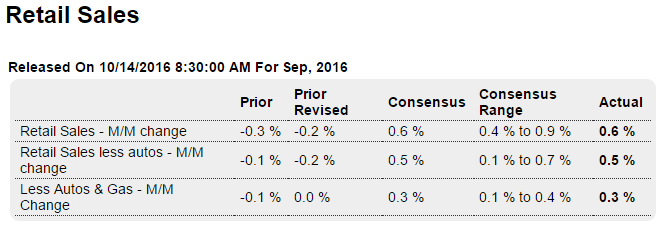
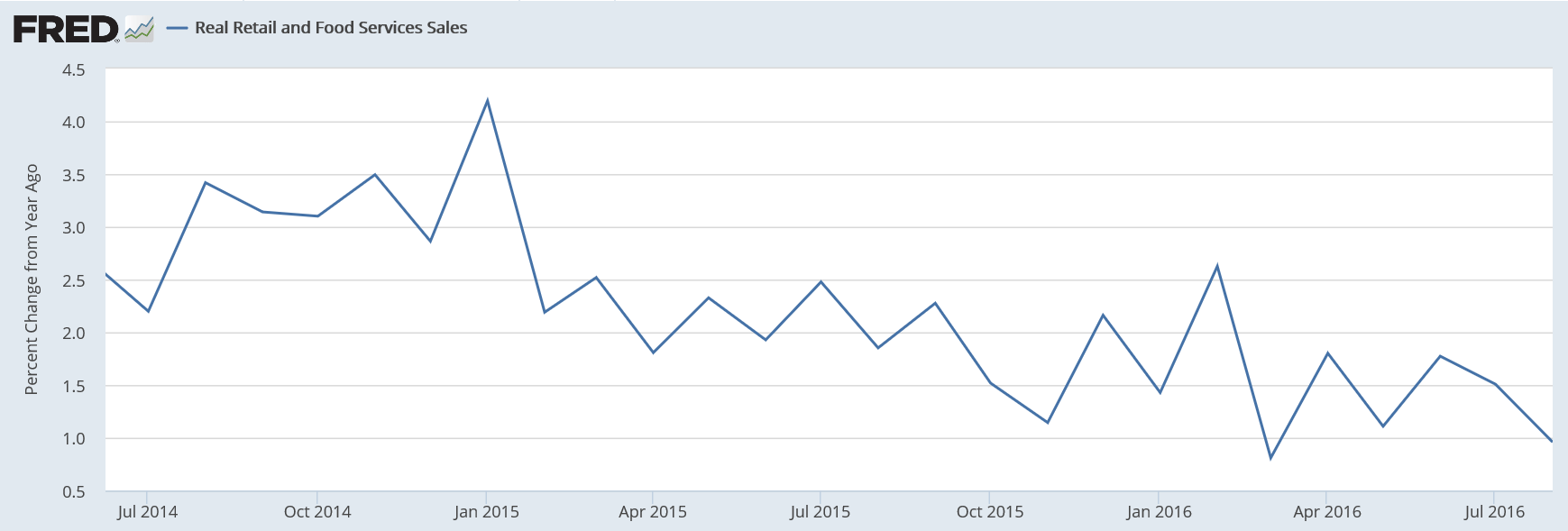
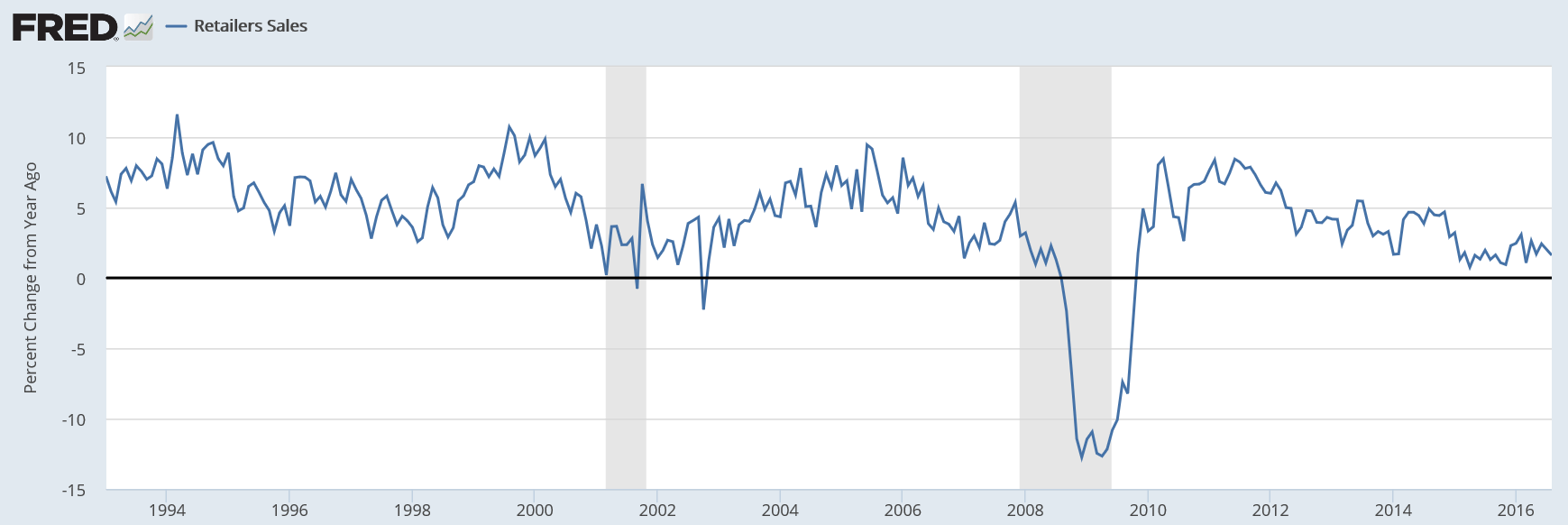
All numbers as expected. Notice the use of the word ‘solid’ for all the reports? And no one talking about year over year, which eliminates much of the seasonal factors and month to month volatility. Nor do they mention that these numbers are not adjusted for inflation, which pushes the year over year numbers down to stall speed. See charts below:

101401

Highlights

Retail sales proved solid in September hitting the Econoday consensus across the board: total up 0.6 percent, ex-auto up 0.5 percent, ex-auto ex-gas up 0.3 percent. Auto sales as expected are the highlight of the report, up 1.1 percent to reverse the prior month’s 0.3 percent decline. Auto sales, a discretionary category, have been solid this year though down from last year’s peak. Restaurants, another discretionary category, are also strong, up 0.8 percent to add to August’s 0.7 percent gain.

Other positives include two related to housing, furniture which rose 1.0 percent and building materials & garden equipment, up 1.4 percent. This latter reading will give a boost to the residential investment component of the third-quarter GDP report.

This whole report in fact will give a lift to GDP, providing a quarter-end pop to consumer spending which was soft in the quarter’s first two months. Strength in retail sales ultimately reflects strength in the labor market and today’s report will further build expectations for an FOMC rate hike at the December meeting.

101402
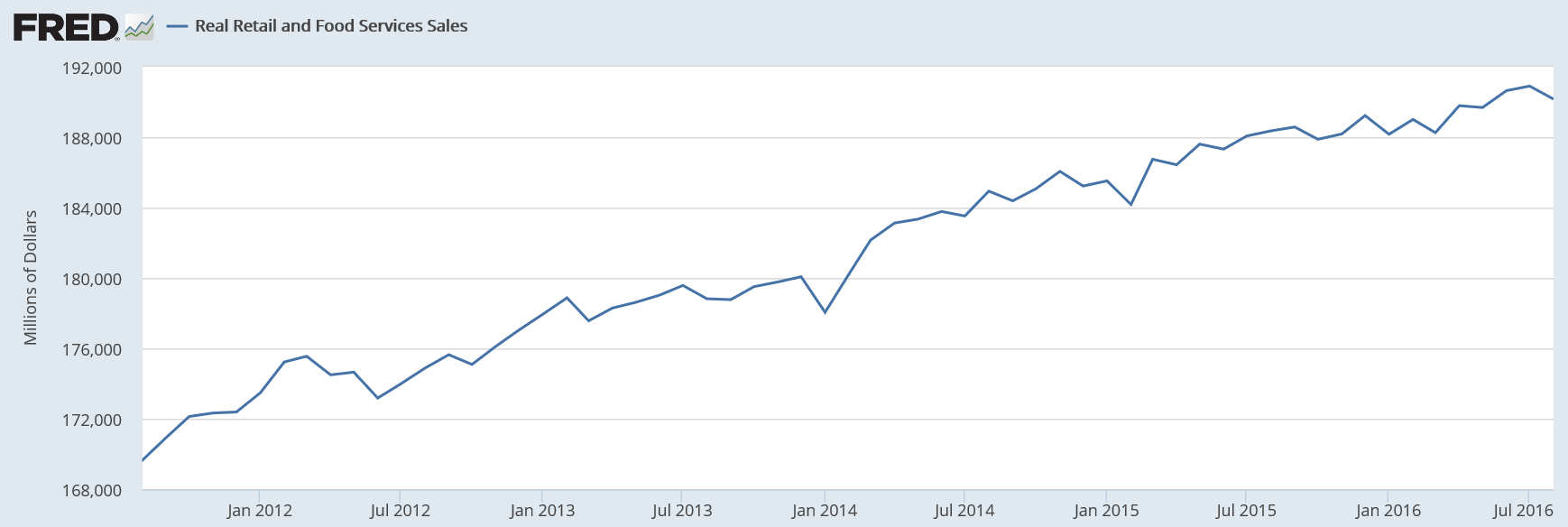
How ‘solid’ do these look?

Inflation adjusted:

101403
Not adjusted for inflation doesn’t look good either:

101404
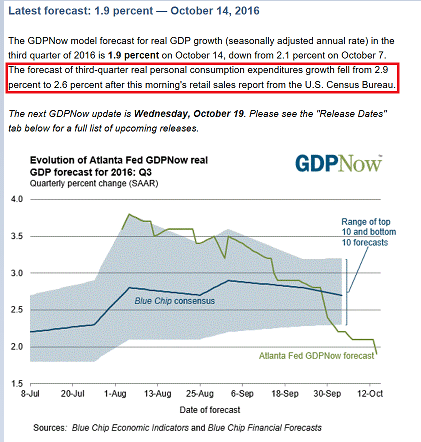
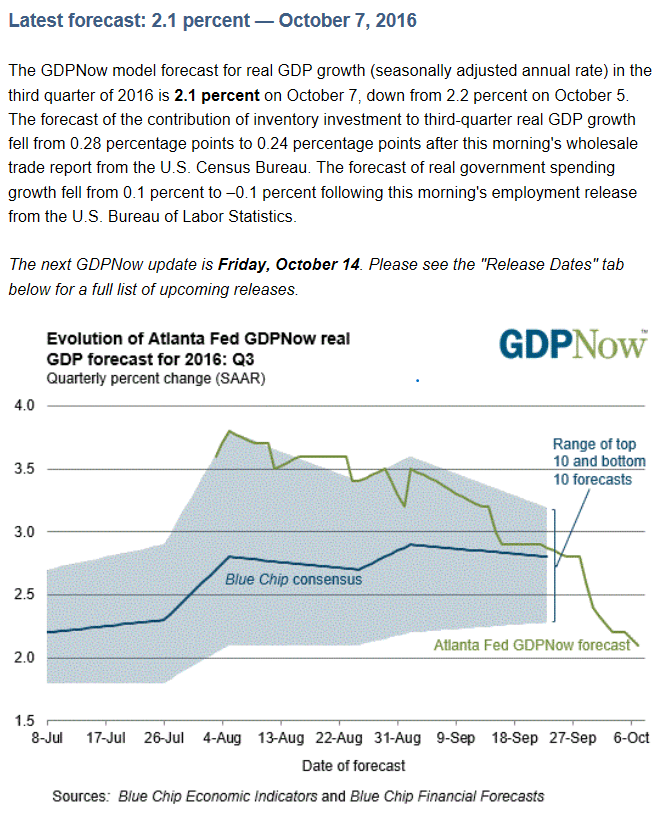
The Atlanta Fed lowered their q3 estimates further on today’s news:

101405
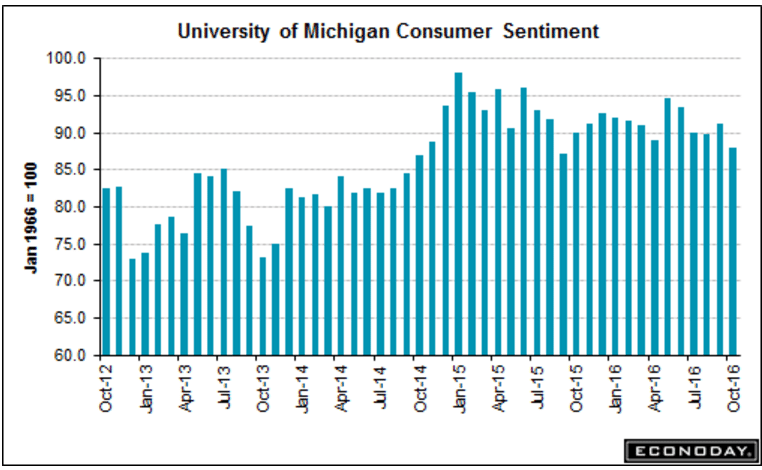
Looks like last month’s move higher that lifted hopes has more than reversed to instead follow the down trend of the last several months:

101406
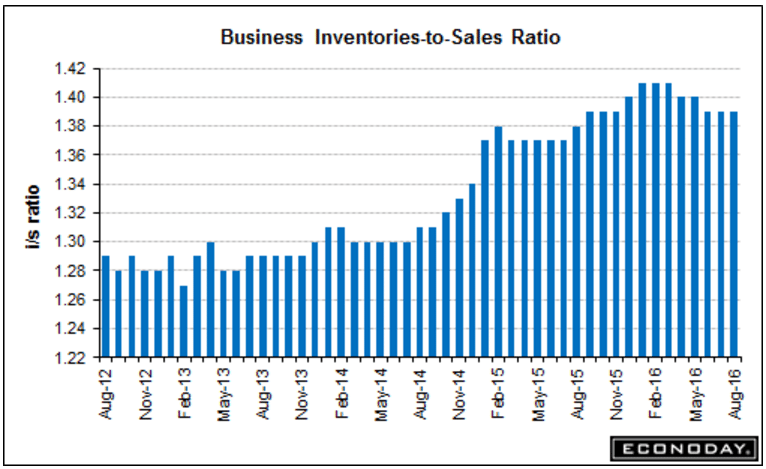
Inventories remain elevated and are keeping a lid on output:

101407

Highlights

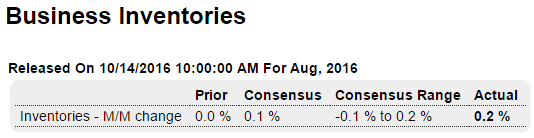
Inventories continue to edge incrementally higher, up 0.2 percent in August and in line with a 0.2 percent rise in sales to keep the inventory-to-sales ratio unchanged for a third month at a lean 1.39. Inventories at wholesalers fell 0.2 percent in August while inventories at manufacturers rose 0.2 percent. Inventories at retailers, boosted by swelling at auto dealers, rose a sharp 0.6 percent in a build, however, that looks manageable given this morning’s solid retail sales report for September, one that is headed by strength in vehicle sales.

An inventory correction to the 1.30 level isn’t out of the question:

101408
Wondering when they begin to suspect this is more about being made a lot harder to get, and less about labor market conditions:

101409

Highlights

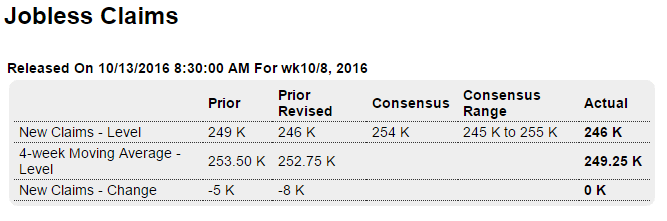
Unemployment claims remain at or near historic lows, indicating a lack of layoffs and quick turnaround for those who do lose their jobs. Initial claims came in near the low end of expectations in the October 8 week, at 246,000 with the 4-week average at 249,250. Both of these averages are down roughly 10,000 from a month-ago, comparisons that offer early indications of strength for the October employment report. Continuing claims are trending roughly 100,000 below a month ago, at 2.046 million and a 16,000 decline in the latest data which are for the October 1 week. Hurricane Matthew had only limited impact on initial claims with only one state in the affected area, Virginia, having to be estimated. Louisiana was also estimated in this report. Records of note in this report is a 43-year low for the weekly level of initial claims and an 8th straight decline for the 4-week average which is also at a 43-year low.

Looks like the move up was only a blip, but too soon to tell:

101410

NFIB small business index, Hotel occupancy, Redbook retail sales

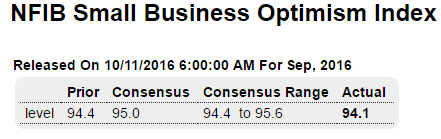
Went down when consensus expectations were for an increase:

101101
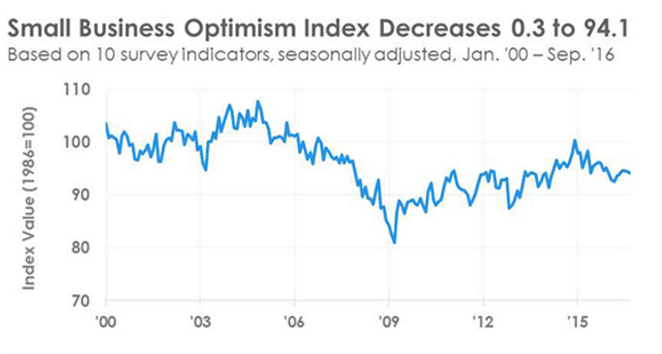
Note that it peaked and then fell when oil capex collapsed:

The NFIB Index of Small Business Optimism dipped 0.03 points in September for the second consecutive month. Increased inventories fell seven points while hard-to-fill job openings plunged six points landing at 24 percent. Six of the 10 indices dropped, washing away the rise in expected business conditions.

101102
Interesting way of saying its going to be down from last year:

Hotels: Occupancy Rate on Track to be 2nd Best Year

Oct 9 by Bill McBride

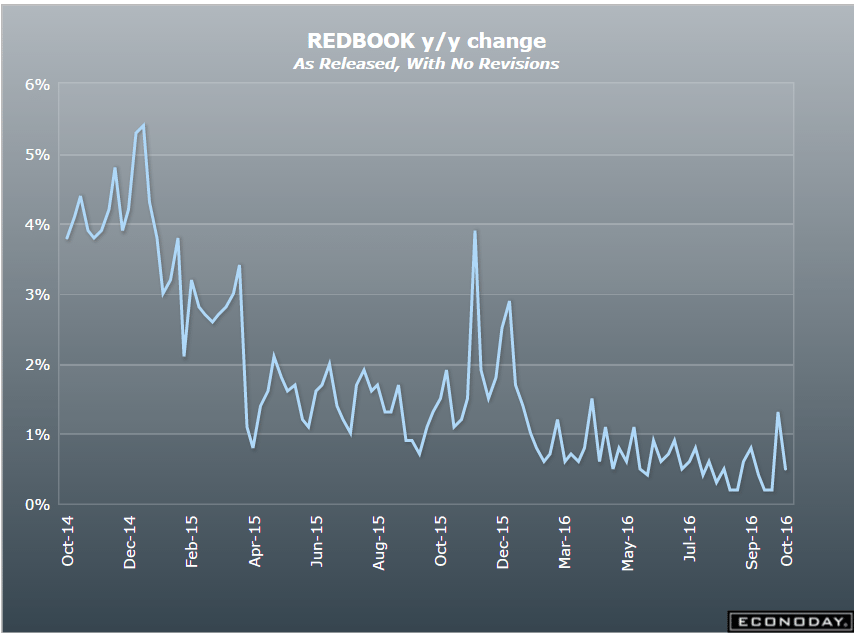
Back down. Before the oil capex collapse 3-4% year over year growth was the norm:

101103

Jobs, Wholesalers sales and inventories, Atlanta Fed GDP forecast

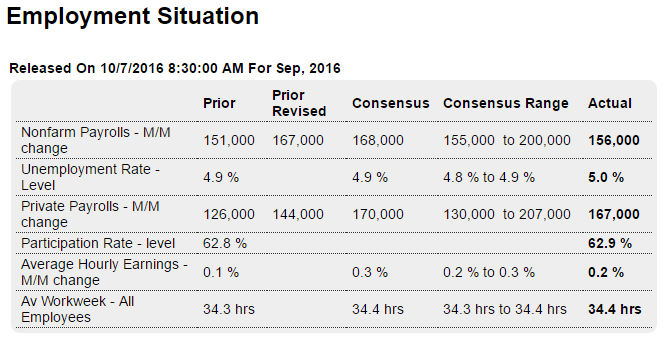
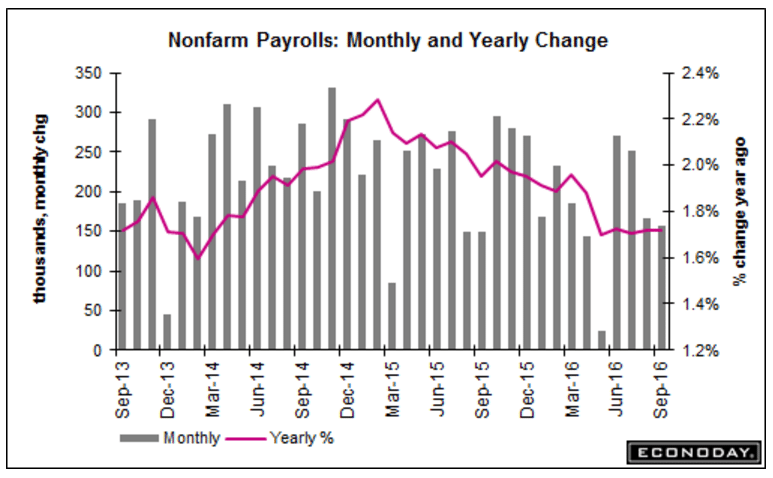
Less than expected, July/August total revised down, earnings gain less than expected. Yes, unemployment was up because the labor force increased, but arguably it was functionally that large in the months before, etc, which means, functionally, unemployment had been that much higher all along, etc. etc. and all to my suspicions that the drop in the participation rate might be close to entirely cyclical, meaning the ‘slack’ might be equiv. to a headline unemployment rate well north of 7%, and the U6 rate well north of 12%. Also recall that the birth/death’ model that estimates jobs from new business formations tends to overstate employment growth when employment growth is declining, so don’t be surprised by more downward revisions:

100701

Highlights

The September employment report is not that strong and the sigh of relief you hear is coming from the Fed which won’t be faced with a pre-election rate hike. Non-farm payrolls rose 156,000, which is at the low end of expectations, while average hourly earnings don’t look that inflationary, at least not on a monthly basis which is up only 0.2 percent and again at the low end of expectations.

But there are definitely positives including a rise in the labor participation rate, up 1 tenth to 62.9 percent, which gave a deceptive lift to the unemployment rate that is 1 tenth higher at 5.0 percent. The increasing inclusion of discouraged workers is one of the Fed’s policy objectives and the participation rate points to improvement. Another positive is a rise in the workweek, up to 34.4 hours from 34.3 hours with the manufacturing week also slightly higher in what is a positive indication for September industrial production.

Manufacturing employment, however, is one of the weak spots in the report, down 13,000 following August’s 16,000 decline. Government payrolls are also a negative, down 11,000 but following a long string of gains. Otherwise the industry breakdown offers mostly good news including a gain for construction, up 23,000 following prior weakness, a 22,000 gain for retail which extends a run of similar gains, and especially a 67,000 rise in professional & business services that includes an outsized gain of 23,000 in temporary help services. This last detail confirms other evidence that employers are having a hard time filling positions.

And there is another positive, and that is movement higher in the year-on-year rate for average hourly earnings, up 2 tenths to 2.6 percent which is still, however, 1 tenth under where it was in July. And with an election coming around, the positives are tame enough. November may be out for a rate hike but today’s report will build expectations, at least for now, for a rate hike at the December FOMC.

100702
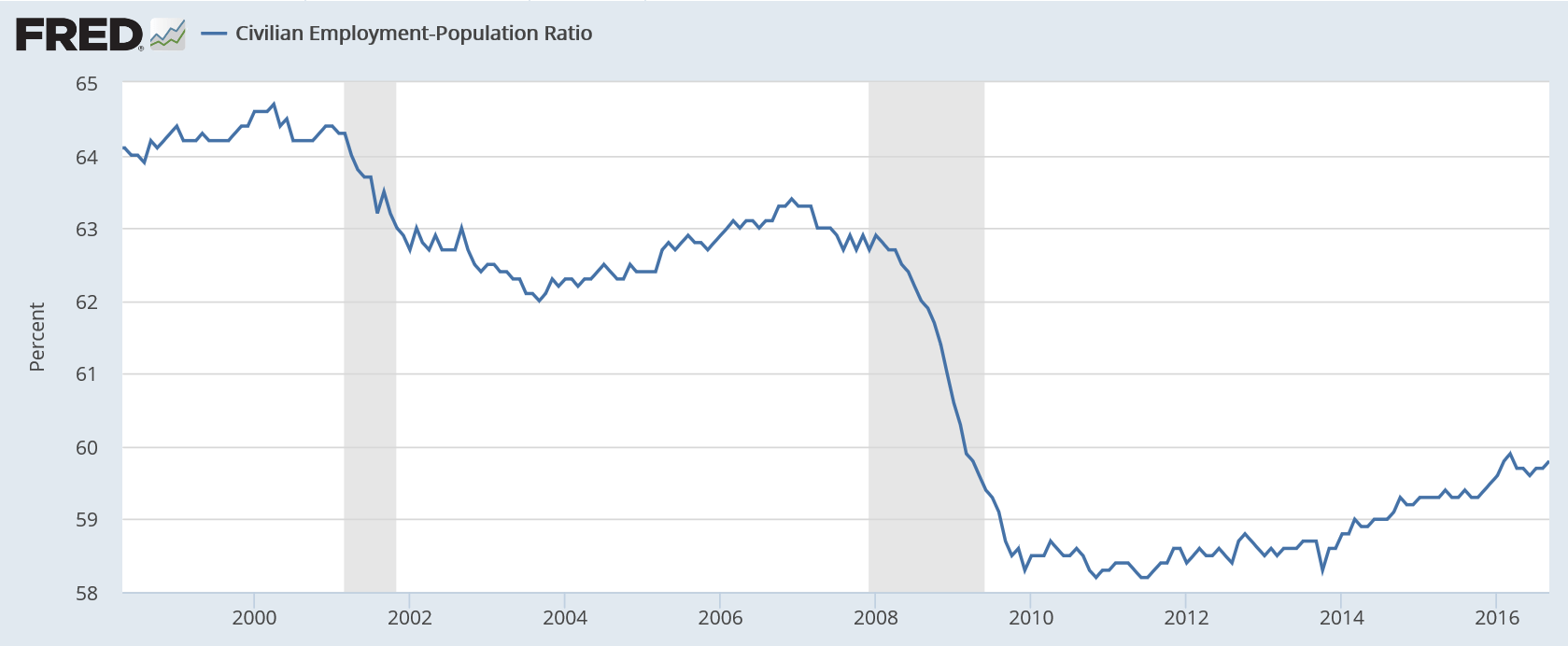
Employment growth not much ahead of population growth, with a long way to go to catch up to prior levels if in fact the drop was largely cyclical:

100703
Down again:

100704

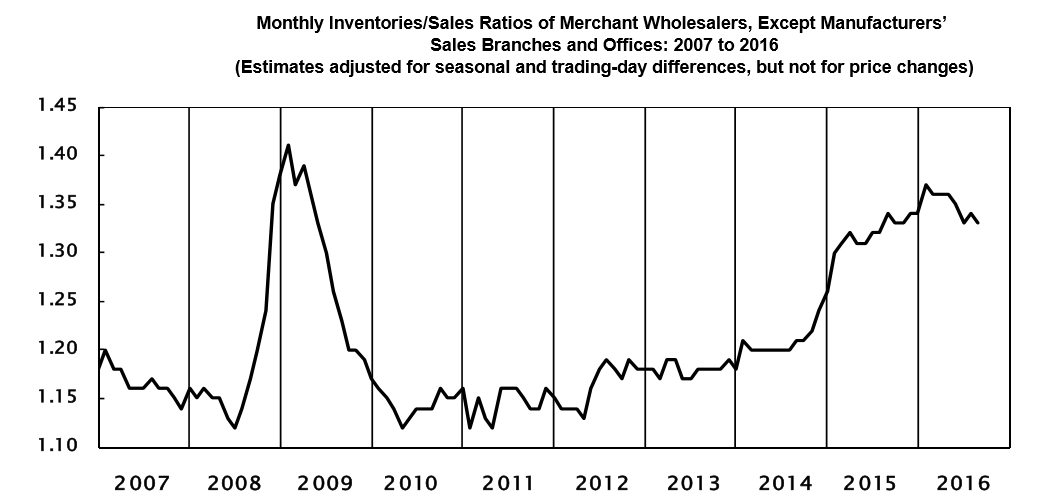
So it looks like August sales were up a bit but July sales were revised down. And inventories continued to decline, contrary to mainstream forecasts, as the inventory to sales ratio came down .1 but remained elevated:

MONTHLY WHOLESALE TRADE: SALES AND INVENTORIES August 2016

Sales.

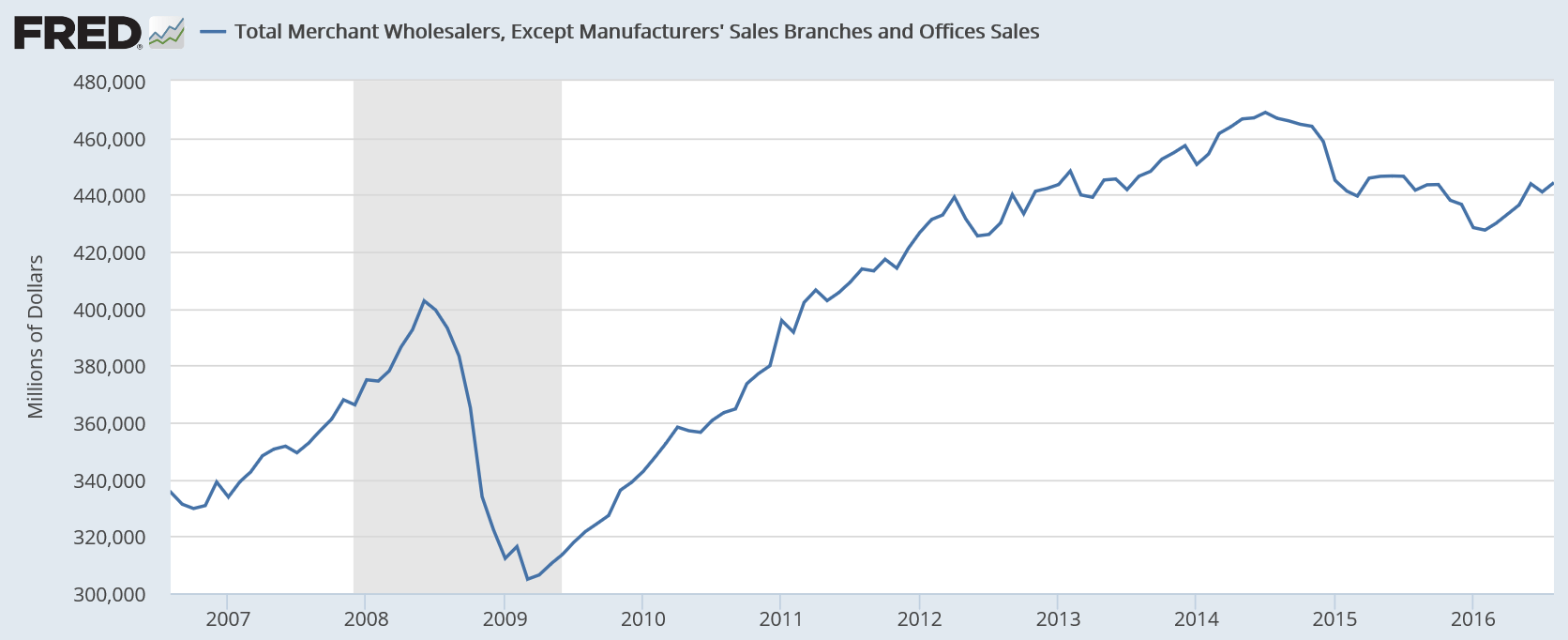
The U.S. Census Bureau announced today that August 2016 sales of merchant wholesalers, except manufacturers’ sales branches and offices, after adjustment for seasonal variations and trading-day differences but not for price changes, were $444.3 billion, up 0.7 percent (+/-0.5%) from the revised July level and were up 0.6 percent (+/-1.2%)* from the August 2015 level.

The June 2016 to July 2016 percent change was revised from the preliminary estimate of down 0.4 percent (+/-0.4%)* to down 0.6 percent (+/-0.4%).

August sales of durable goods were down 0.5 percent (+/-0.7%)* from last month, but were up 0.7 percent (+/-1.8%)* from a year ago.

Sales of machinery, equipment, and supplies were down 2.7 percent from July.

Sales of nondurable goods were up 2.0 percent (+/-0.7%) from July and were up 0.5 percent (+/-1.8%)* from last August.

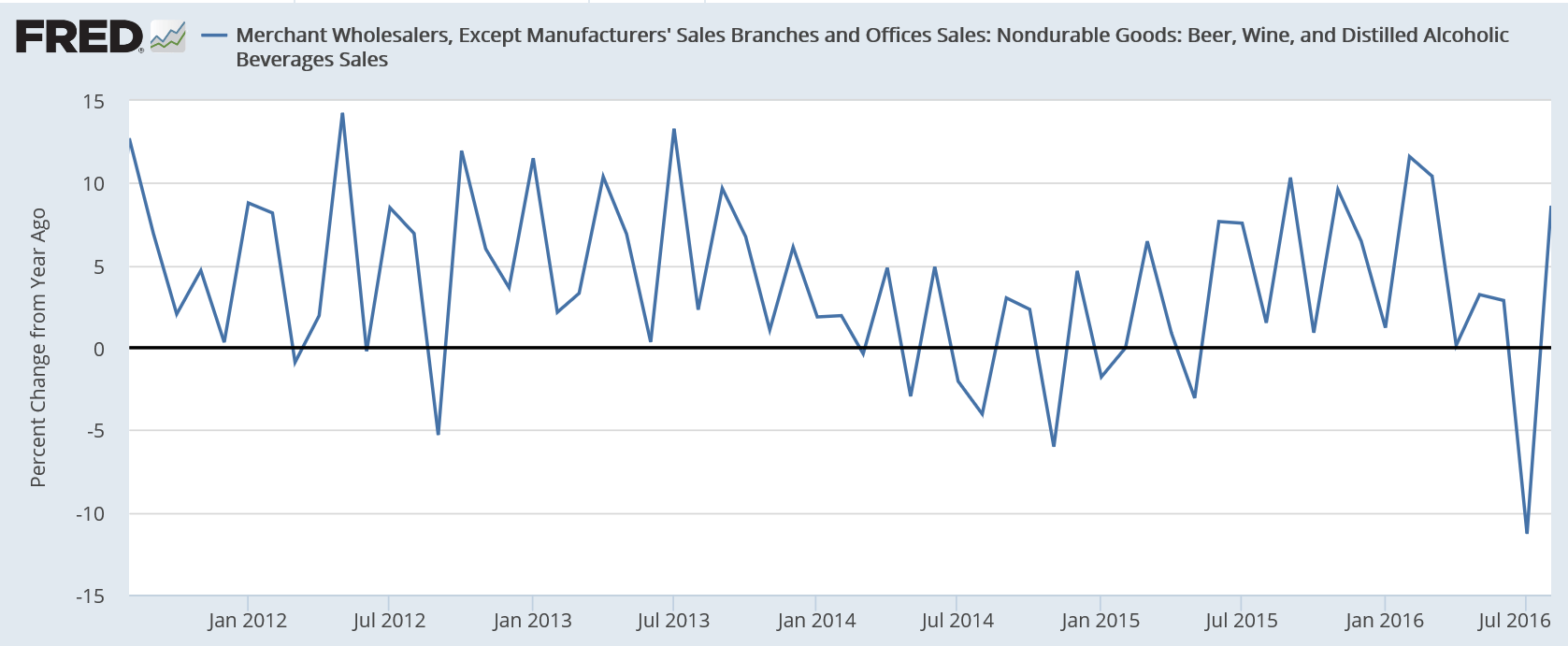
Sales of farm product raw materials were up 6.7 percent from last month and sales of beer, wine, and distilled alcoholic beverages were up 2.2 percent.

Inventories.

Total inventories of merchant wholesalers, except manufacturers’ sales branches and offices, after adjustment for seasonal variations but not for price changes, were $589.1 billion at the end of August, down 0.2 percent (+/-0.4%)* from the revised July level.

Total inventories are down 0.1 percent (+/-1.8%)* from the revised August 2015 level.

The July 2016 to August 2016 percent change was revised from the advance estimate of down 0.1 percent (+/-0.4%)* to down 0.2 percent (+/-0.4%)*.

August inventories of durable goods were up 0.2 percent (+/-0.4%)* from last month, but were down 1.9 percent (+/-1.8%) from a year ago. Inventories of computer and computer peripheral equipment and software were up 1.9 percent from last month. Inventories of nondurable goods were down 0.7 percent (+/-0.5%) from July, but were up 2.8 percent (+/-3.0%)* from last August. Inventories of farm product raw materials were down 7.8 percent from last month and inventories of apparel, piece goods, and notions were down 2.1 percent.

Inventories/Sales Ratio. The August inventories/sales ratio for merchant wholesalers, except manufacturers’ sales branches and offices, based on seasonally adjusted data, was 1.33. The August 2015 ratio was 1.34.

100705
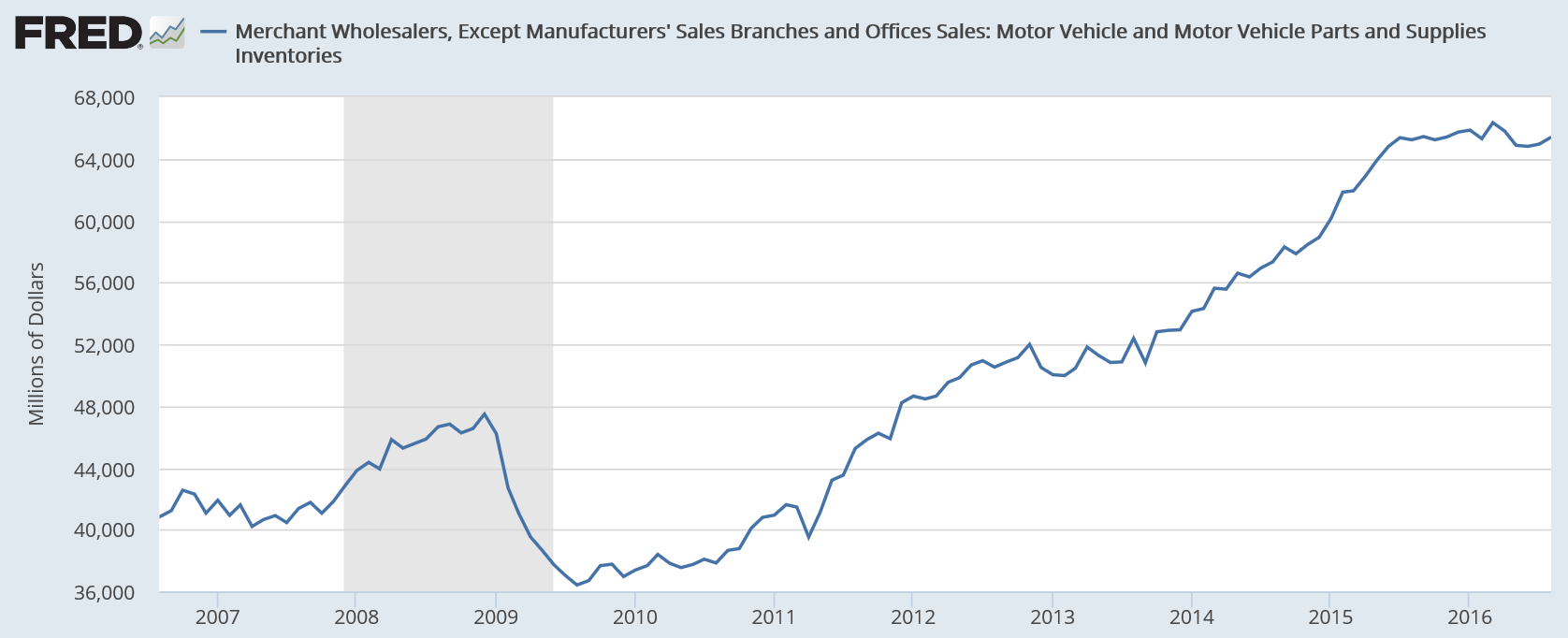
Sales down about 11.5% in July then up about 8.5 in August, so the ‘average’ for the last two months in this volatile series is looking lower vs last year:

100706
This is just sales, not adjusted for inflation:

100707
Auto related inventories are no longer adding to GDP growth:

100708

Vehicle sales, Manhattan apartment sales, ISM NY, Redbook retail sales

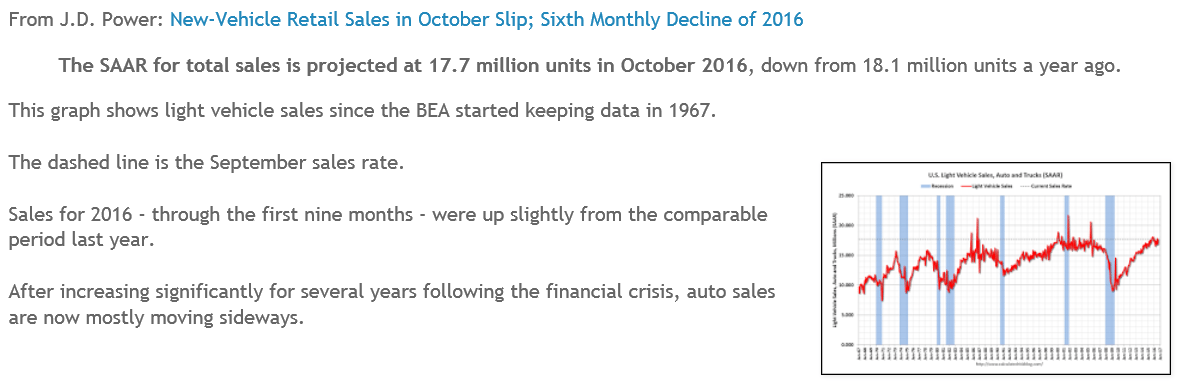
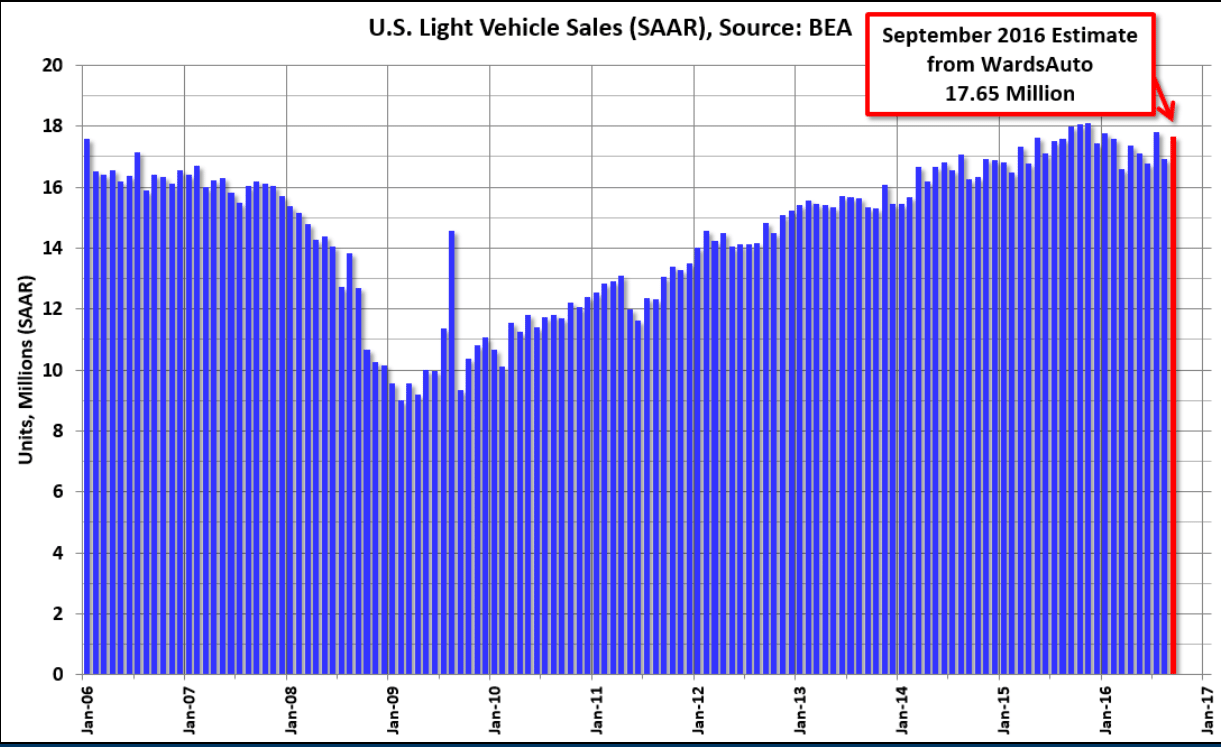
Based on a preliminary estimate from WardsAuto, light vehicle sales were at a 17.65 million SAAR in September.

That is down about 2% from September 2015, and up 4.3% from the 16.92 million annual sales rate last month.

Read more at http://www.calculatedriskblog.com/#ycdZ4cVpGQLvjHoI.99

100401

100402

Manhattan apartment sales plunge 19 percent

By Robert Frank

ISM New York Report On Business September 2016

ISM New York 49.6 in September. New York City business activity largely held steady from August to September -with one notable exception. While minor adjustments were observed in all of the indices this month, Employment plummeted, dropping to the lowest level since the Great Recession of 2008 and its after effects in 2009.

100403

Pending home sales, Auto sales, Wholesale trade

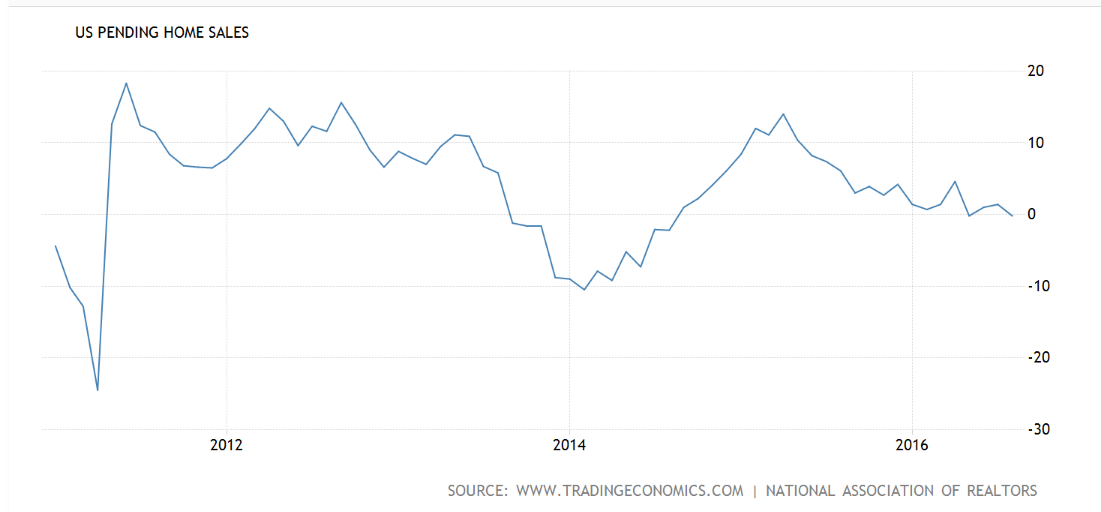
Still on the downward glide path since the collapse in oil capex:

92901

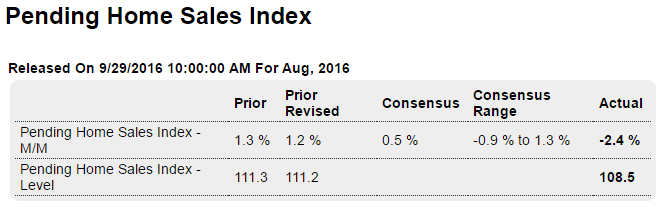
Highlights

Existing home sales, in sharp contrast to new home sales, haven’t been able to build any strength this year and today’s pending home sales report points to outright weakness in the coming months. The pending index fell a very steep 2.4 percent in August with 3 of 4 regions positing monthly declines. The exception is the Northeast which rose 1.3 percent in the month and is the only region in the plus column for the year-on-year rate, at 5.9 percent. But this report is not about strength but weakness, weakness that persists despite very low mortgage rates and strength in the labor market.
92902
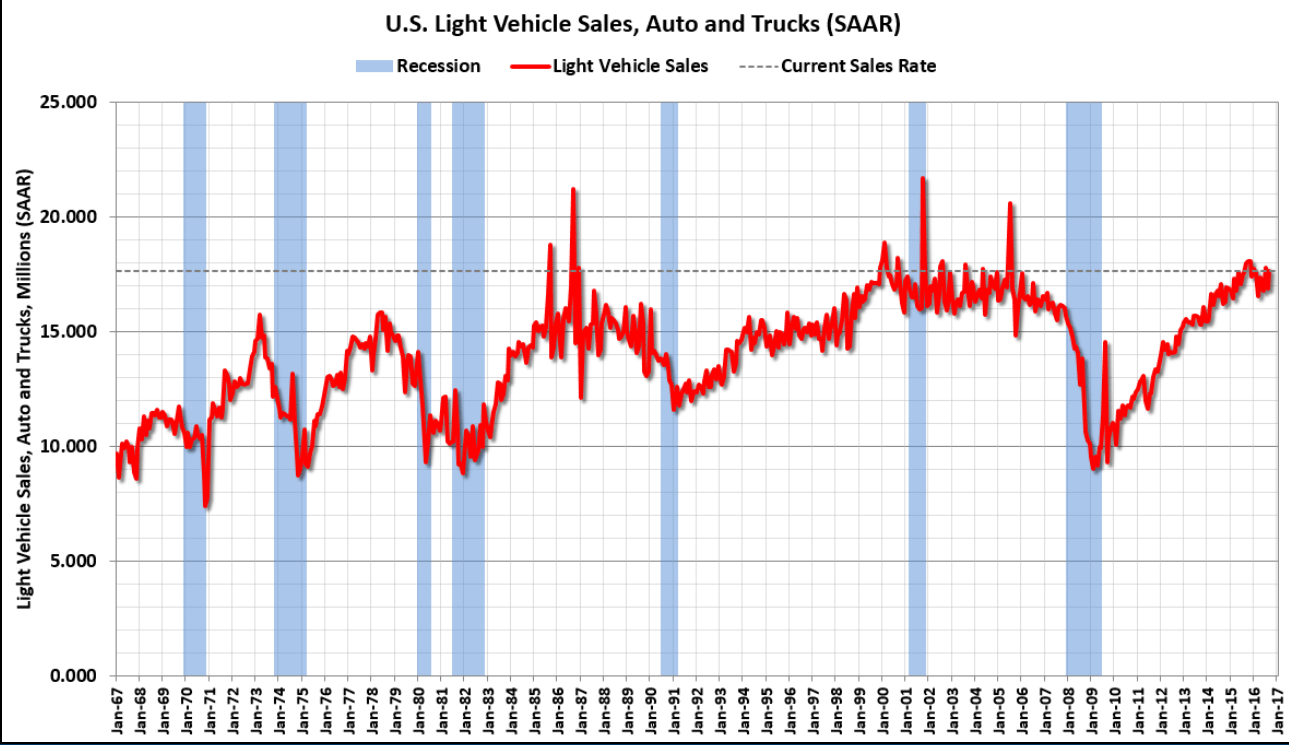
Housing and autos are the two main sources of consumer credit growth and neither looking so good:

Kelley Blue Book sees September U.S. auto sales down 2 percent
By Bernie Woodall

Sept 28 (Reuters) — Auto industry consultancy Kelley Blue Book said on Wednesday that it expected that September U.S. auto sales fell 2 percent from a year ago, at 1.41 million vehicles, for a seasonally adjusted annualized rate of 17.4 million vehicles. Major auto manufacturers will report U.S. sales for September on Monday.

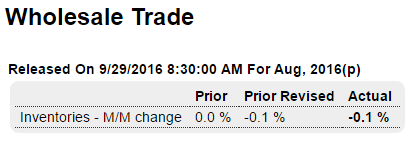
Inventories still coming down, with no sign yet of the reversal most have forecast for q3:

92903

Highlights

Wholesale inventories fell a preliminary 0.1 percent in August with nondurables down 0.6 percent in what likely reflects price weakness for energy products. Inventories of durables in the wholesale sector rose 0.1 percent in the month. This report also includes preliminary data on retail inventories which rose 0.5 percent in the month and reflecting a 1.0 percent jump in vehicles.

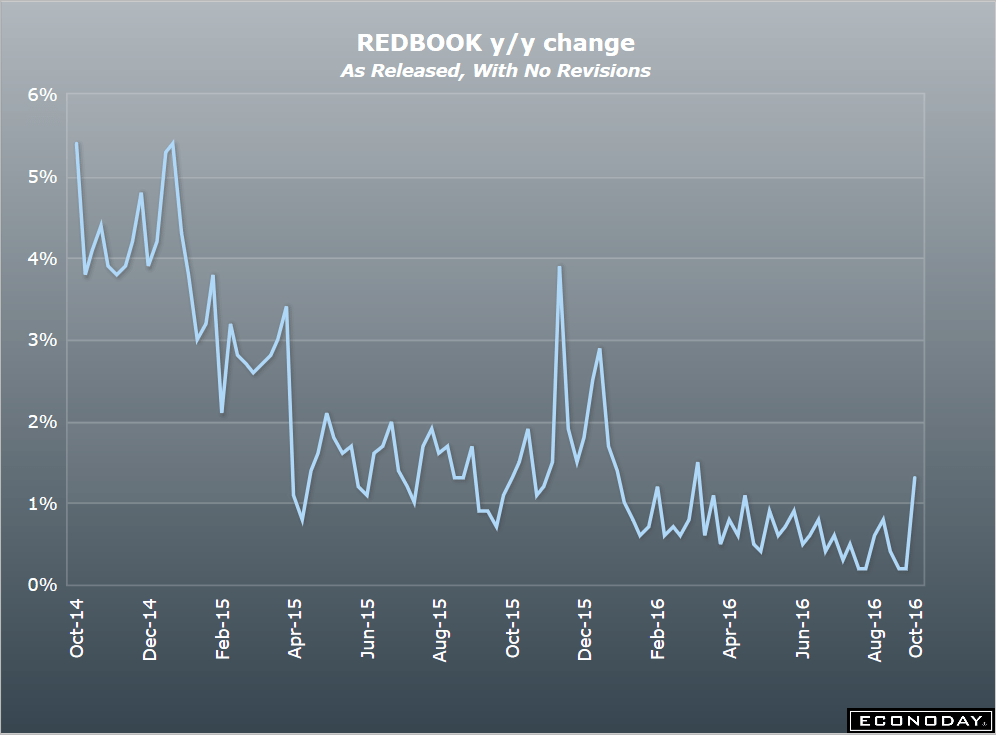
State tax receipts, Redbook retail sales, Case-Shiller house prices, PMI services, Richmond Fed manufacturing, consumer confidence

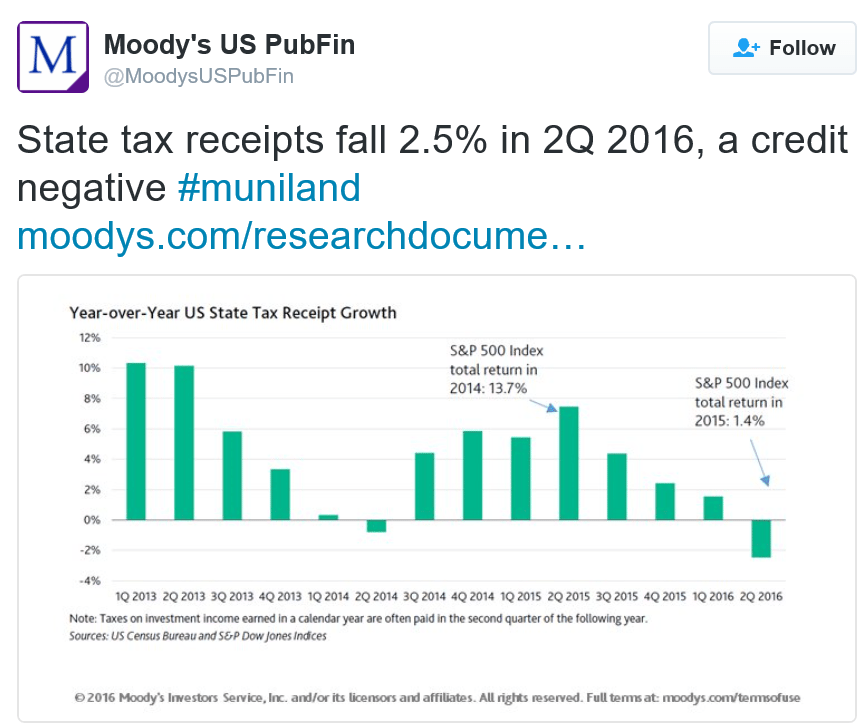
This too has followed the shale boom/bust cycle and is headed lower:

92701
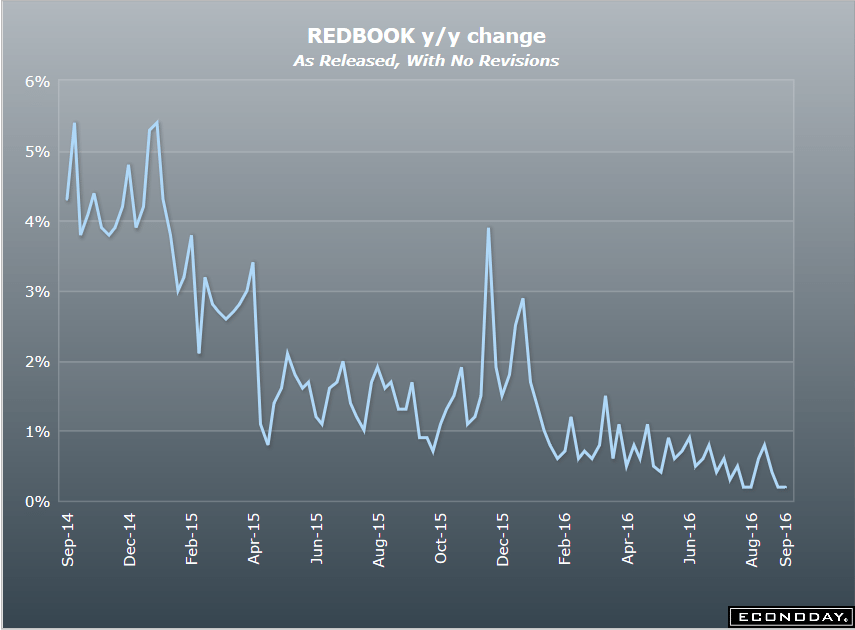
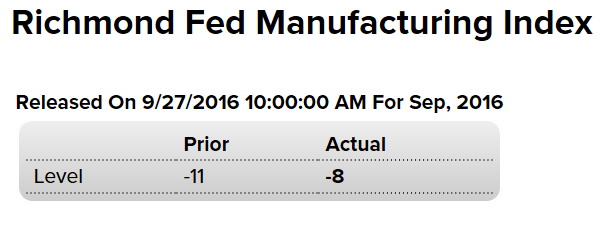
No recovery here:

92702
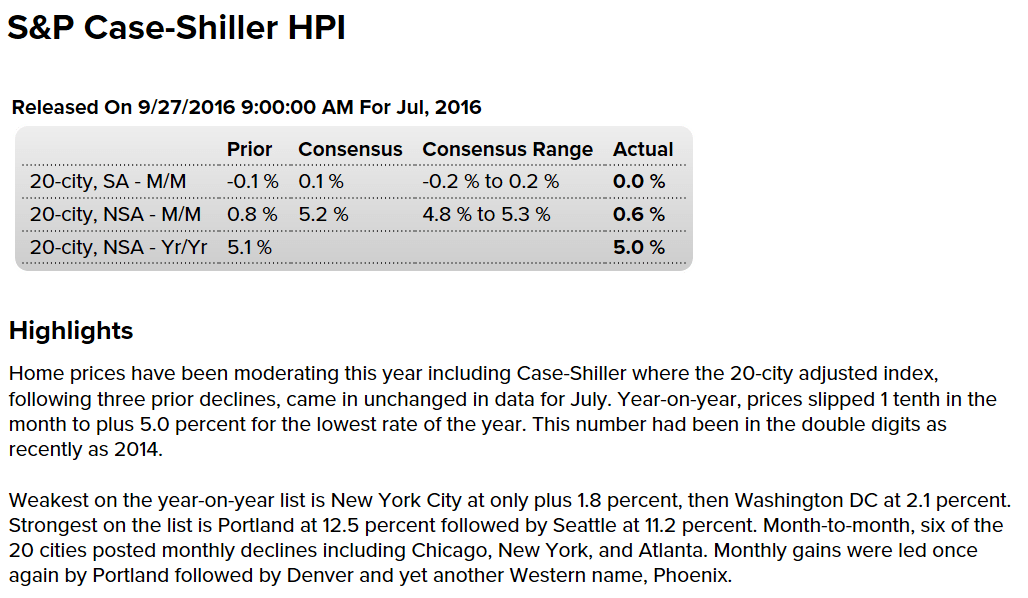
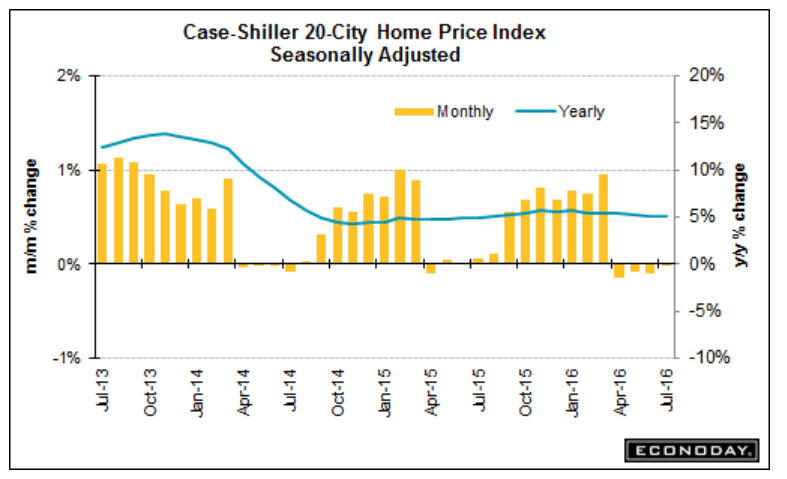
This looks back over the last three months and seems to be decelerating from already modest levels:

92703

92704
Up a bit but still low:

92705
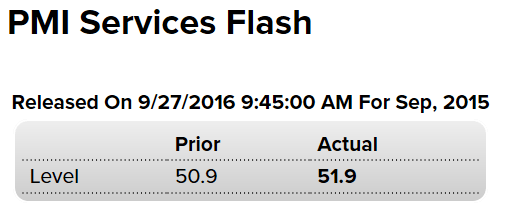
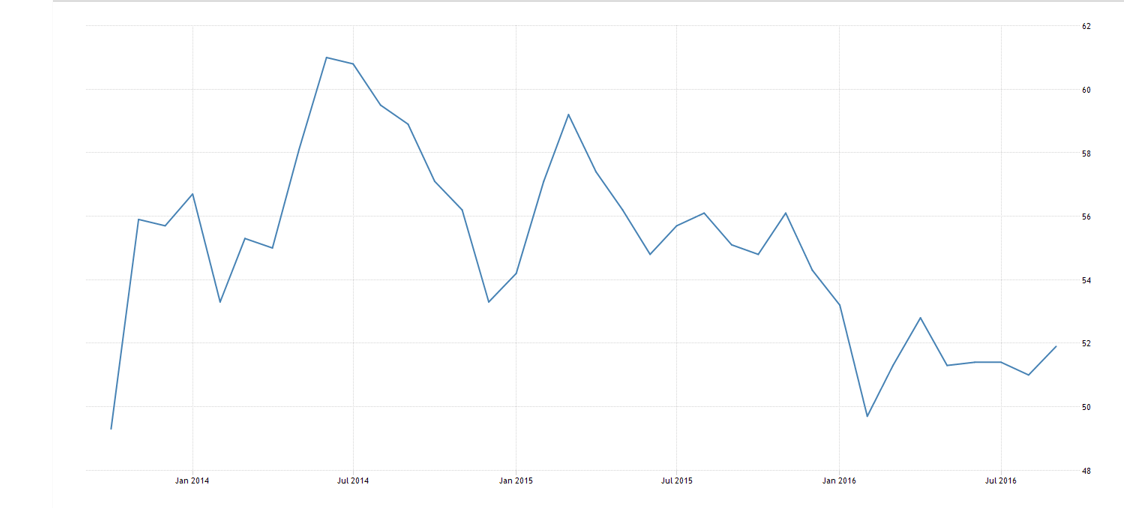
The flash Markit US Services PMI came in at 51.9 in September of 2016 from 51 in August, reaching the highest figure in five months and above market expectations of 51.1. Activity picked up for the first time in three months due to ongoing new business growth while new orders, employment and inflationary pressures eased.
92706
Still contracting:

92707
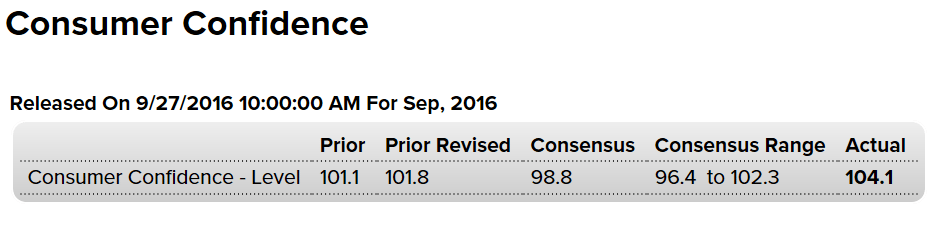
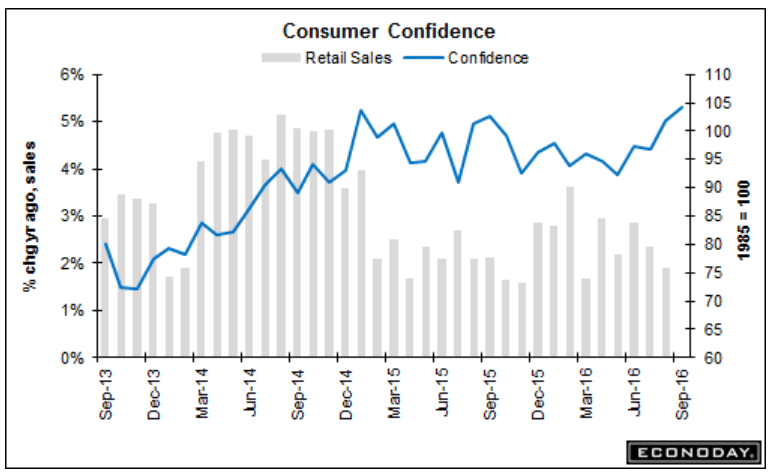
Here some good news! But as per the chart something changed after the collapse in oil capex? Maybe because confidence is one man, one vote, not one dollar, one vote?
92709

92708