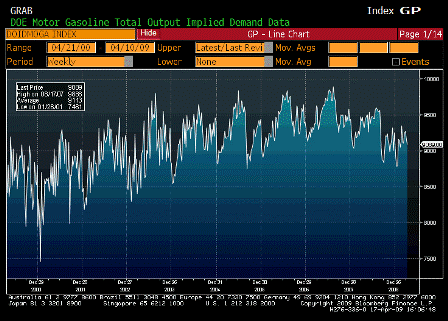
Looks to me like it didn’t fall all that much with high prices or the recession and has begun to firm.

[top]

Looks to me like it didn’t fall all that much with high prices or the recession and has begun to firm.
[top]
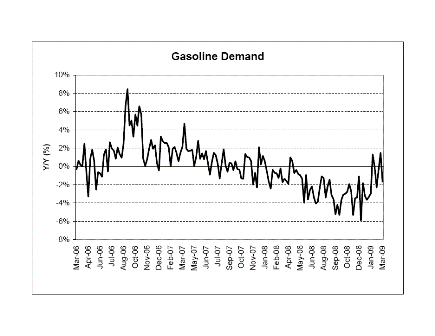
Largest year over year drop in a while after hovering around flat year over year.
Might be why Saudis decided to cut prices recently.
I’m looking for consumption to increase as GDP stabilizes and then return to positive territory as global automatic stabilizers and proactive fiscal policies add net financial assets.
Crude Oil Rises After Unexpected Decline in U.S. Jobless Claims
by Mark Shenk
April 16 (Bloomberg) — Daily fuel demand averaged over the past four weeks was 18.7 million barrels, down 5.2 percent from a year earlier, according to the department.
[top]
This should keep a lid on crude prices, as Saudis decide to set lower prices:
Saudi Arabia cuts oil prices for US, Europe for May
by Timothy Coulter and Diana ben-Aaron
Apr 6 (Tehran Times) — Saudi Aramco, the world’s largest state-owned oil company, cut its official selling prices for all grades for customers in the U.S., Northwestern and Mediterranean Europe.
Saudi Arabia slashed the U.S. price of its Arab Heavy Crude the most, cutting it by $5.50 a barrel to $4.85 below the price of the West Texas Intermediate grade made in the U.S., the state oil company said in a faxed statement today. That wiped out its April price premium of 65 cents more than WTI, the first time Saudi heavy oil traded for more than the U.S. benchmark in at least 10 years.
Saudi Arab Light Crude was reduced by $4.15 a barrel in the U.S. and will sell for $2.25 less than WTI, Saudi Aramco said. Its April price was $1.90 more than WTI.
In Northwest Europe, Saudi light crude will be priced at $4.05 less than the IPE benchmark, a cut of $1.60 from a $2.45 discount last month, according to the statement. Heavy crude from Saudi Arabia for Europe declined $2.10, putting it $5.80 below the IPE equivalent.
Mediterranean, Asian Prices
Oil for Mediterranean destinations also cheapened, with Saudi light oil declining 90 cents to $3.05 below the IPE benchmark, and heavy oil falling $1.75 to $5.55 below the Brent weighted average equivalent as listed on IPE.
Saudi Arabia increased Asian prices for light grades. Saudi Arab Light Crude will sell in Asia for 80 cents more than crude from Dubai and Oman, a reduction of 10 cents from the 90 cent- per-barrel premium last month. The Saudi heavy crude price was cut $1.20 to fall $1.85 below Dubai/Oman crude.
[top]
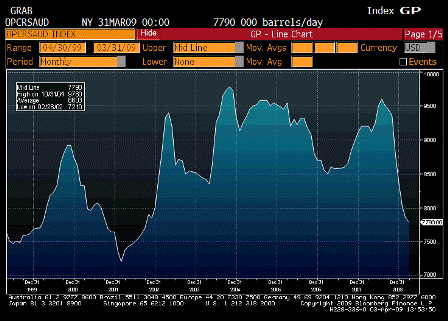
Seems to be leveling off at levels that are comfortable for them as they set price and let quantity adjust.
[top]
lower confidence = less private sector spending = less aggregate demand = lower taxes or higher federal spending to sustain output and employment
[top]
Year over year gasoline demand (in gallons) was down a bit this week still looks to be working its way higher since December.
Year over year changes are now very small, indicating little or no ‘demand destruction.’
[top]
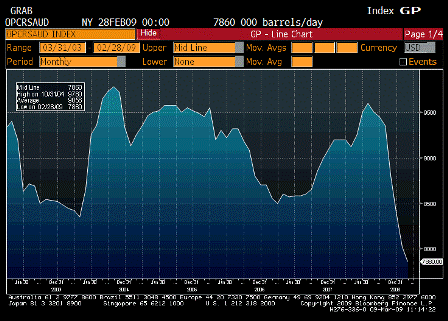
The Saudis are back to being swing producer as they set price and let output adjust.
World inventories are estimated to be falling by over 1.4 million barrels per day, as confirmed by the contango quickly fading to backwardation as we pass the ‘roll period’ for the passive funds.
With demand holding up better than markets anticipated and world non OPEC supply stagnant as well, I would expect demand for Saudi output to rise even as they keep prices firm.
I also expect the Fed to see this as a threat to growth rather than inflationary, and therefore continue to keep rates low.
OPEC February Crude Output down 770,000 Bdl/Day to 27.775 Mln
Mar 5 (Bloomberg) — Crude-oil production from the 12 OPEC members in February declined 770,000 barrels a day from January, the latest Bloomberg survey of producers, oil companies and industry analysts shows. Figures are in the thousands of barrels a day.
Opec Production
February 2009
Opec Country Feb Est. Jan Monthly Output Feb. 1 Change Est. vs. Target* Est. Target Est. Cap. (@) Algeria 1,245 1,275 –30 1,203 42 1,450 Angola 1,670 1,740 -70 1,517 153 2,000 Ecuador 445 475 -30 434 11 500 Iran 3,690 3,780r -90 3,336 354 4,100 Iraq* 2,385 2,365 20 – – 2,500 Kuwait# 2,140 2,280 -140 2,222 -82 2,650 Libya 1,605 1,630r -25 1,469 136 1,800 Nigeria 1,765 1,810 -45 1,673 92 2,500 Qatar 695 725 -30 731 -36 900 Saudi Arabia# 7,860 8,025 -165 8,051 -191 10,800 U.A.E 2,210 2,290 -80 2,223 79 2,800 Venezuela 2,065 2,150 -85 1,986 79 2,500 Total OPEC-12 27,775 28,545r -770 — — 34,500 Total OPEC-11* 25,390 26,180r -790 24,845 545 32,000 *Quotas effective Jan. 1, 2009. OPEC agreed at its Dec. 17 meeting in Algeria to cut its quota target by 2.463 million barrels a day from the previous level, to 24.845 million barrels daily from Jan. 1. The quota target excludes Iraq, which has no formal quota. Indonesia left OPEC at end-2008.
Totals rounded.
r = revised @ = Capacity attainable within 30 days and sustainable for 90 days. # Includes Neutral Zone production shared equally between Saudi Arabia & Kuwait.
[top]
Higher crude prices means dollars are easier to get overseas and will tend to weaken the dollar.
And the talk is higher oil prices will give the Fed more reason to keep rates low as the higher prices tend to slow growth.
And don’t immediately impact core price measures.
Oil at $50 as OPEC Plans Cut, Keeps to Quota
by Grant Smith
Mar 9 (Bloomberg) — OPEC’s record production cuts are draining the glut in world oil markets, leading traders to bet that $50 crude is two months away.
Ever since oil began its 69 percent plunge from a record $147.27 a barrel in July, traders have been looking for a bottom. Now that the Organization of Petroleum Exporting Countries reduced supplies 13 percent since September, inventories are falling 1.4 million barrels a day, according to PVM Oil Associates Ltd., the world’s biggest broker of energy trades between banks. OPEC will limit exports again when the group meets March 15, according to a survey by Bloomberg News
[top]
Saudi price hikes should continue until they get to their price target, whatever that might be.
Saudi’s formula changes which effectively raise prices. Aramco’s formula changes for April sales basically amounted to a price hike. Sales to US refiners are set against WTI prices. European refiners get priced off of Brent and Asia buyers are priced off a spread to Dubai and Oman. Essentially Saudi Arabia made it more expensive on a relative basis with the goal of taking crude off the market to counter the effect of weak demand.
[top]
It’s not a lot but seems private inventories are low and were probably liquidated in the last 6 months.
China to bolster oil reserves
by Sun Xiaohua
Mar 2 (China Daily) — China is accelerating the build-up of its oil reserves to avoid the economic dislocations the country suffered in 2008 from fluctuations in the world oil price.
China’s National Energy Administration (NEA) recently released a plan to build nine large refining bases in coastal areas over the next three years, sources with the China Petroleum and Chemical Industry Association said last week.
The plan involves building three 30-million-ton refinery bases in three cities (Shanghai, Ningbo and Nanjing) in China’s economically dynamic Yangtze Delta and six 20-million-ton bases in other coastal areas from Tianjin in the north to Guangzhou in the south. It will also facilitate major joint-venture refinery projects between Chinese companies and partners from oil-producing countries such as Venezuela,Qatar and Russia.
The refinery scheme is part of China’s plan to bolster its oil inventories. The NEA announced at a national energy conference in early February that China will, in addition to the current four strategic petroleum reserve (SPR) bases, build eight new ones by 2011. The program will increase China’s strategic crude reserve capacity to 44.6 million cu m, or 281 million barrels.
The country will also increase its refined oil reserve to 10 million tons by 2011, a source familiar with the stockpile plan told China Daily in February.
“China’s attentiveness to its oil reserve capacity has grown in tandem with its rising dependence on imported oil,” said Pan Jiahua, an expert with the Chinese petroleum society.
China, the world’s second largest oil consumer, relies on imports for about half of its oil needs. It imported 178.9 million tons of crude oil in 2008, up 9.6 percent from the previous year, according to the National Development and Reform Commission.
But China cannot simply take advantage of attractive prices and store as much oil as it wants because its current reserve capacity is not commensurate with its energy appetite.
Customs statistics shows China’s crude imports in January even fell 7.99 percent year-on-year. A slowing economy bears most of the blame but analysts said the country’s limited capacity also played a role.
Zhao Youshan, head of the petroleum distribution committee of the China General Chamber of Commerce, an industry group, recently submitted a proposal to oil-related government agencies, calling for using tanks controlled by private companies to store more cheap oil.
Zhou said in his proposal that China’s more than 600 private oil companies have 230 million tons worth of storage tanks, almost ten times the capacity of the eight new SPR tanks combined.
China has massive private oil storage facilities, built up by oil companies since China opened its oil markets to private operators in the mid-1990s. But State companies, mainly China National Petroleum Corp (CNPC) and China PetroChemical Corp (Sinopec), basically control oil-importing licenses and hundreds of private oil distributors and refiners are currently sitting on empty tanks.
Zhou said in his report that the industry slump last year has left many private oil companies broke and that some of the survivors are struggling with the high maintenance cost of empty tanks.
[top]