fiscal update

No talk yet of waiving the sequesters?

McConnell: Stand Firm on Spending

November 19 (WSJ) — With budget negotiations stalled, Senate Minority Leader Mitch McConnell is pushing his GOP colleagues to resist efforts to ease across-the-board spending cuts due to take effect in mid-January. Mr. McConnell has argued it is better to let the cuts take effect than to agree to a budget deal that would allow overall spending to increase or revenues to rise. House Budget Committee Chairman Paul Ryan, also speaking at the Journal event, said he would continue negotiating with Democrats to reach an agreement but didn’t express optimism. Mr. Ryan, who chairs the conference, said if necessary Republicans would pass a bill to keep the government open and allow the sequester’s new spending cuts to take effect.

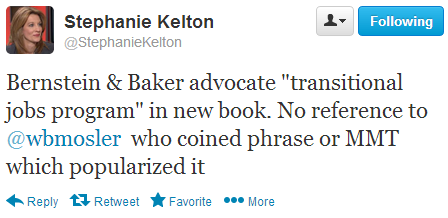
Comments on Baker/Bernstein book

Seems there’s new full court press on for full employment by the headline left. And they lifted it directly out of what I’ve been posting and publishing at least since ‘Soft Currency Economics’ written in 1993, with editorial assistance by Art Laffer and Mark McNary. And even earlier Professor Bill Mitchell had been independently writing about and urging what he then called buffer stock employment, which he has continued to promote on his widely read blog as the Job Guarantee. In fact, throughout the later 1990’s we co authored and published numerous times on exactly this topic.

In 1996 with the urging and intellectual support of Professor Paul Davidson, I wrote ‘Full Employment and Price Stability’ that was published in the Journal of Post Keynesian Economics and gives a full outline of the current Baker/Bernstein proposal in full detail, including the debits and credits at the Fed that support it. And, at the same time, a supporting math model was published by Professor Pavlina Tcherneva.

In 1998 Professor Randall Wray, a student of Hyman Minsky and one of our original ‘MMT family’, published ‘Understanding Modern Money’ which again outlined the same proposal, which he called ‘the employer of last resort’ (ELR), a term believed to be first used by Professor Minsky.

In 2010, I published ‘The 7 Deadly Innocent Frauds of Economic Policy’ that again promotes an employed labor buffer stock policy, vs today’s policy of using an unemployed labor buffer stock. By that time I had begun framing it as a ‘transition job’ policy, to facilitate the transition from unemployment to private sector employment, recognizing that employers prefer to hire people already working. And directly to the point of this post, a few years ago I met with Dean Baker for at least two hours in his office, after he had read my book, discussing the fine points of the various proposals. Not to mention the continuous stream of research and publications on full employment and the transition job concept by UMKC Professors Mat Forstater and Stephanie Kelton, Professor Scott Fullwiler, and all the UMCK PhD alumni now teaching and publishing globally. Additionally, Professor Jan Kregel published a similar proposal for the euro zone.

I apologize in advance to everyone I’ve inadvertently omitted who have also worked to advance this proposal over the last 20 years.

So with this context please note the following from the new Baker/Bernstein book:

Page 73:

” The second policy idea is to launch a system of publicly funded jobs that can ramp up and down, expand and contract, as needed, in tandem with the business cycle. Under such a system the federal government, working through local intermediaries, would supply funds to subsidize hiring in the private sector as well as in important community services like education, child care, and recreation.”

Page 81:

“Thus, a transitional jobs program, which could offer extra services to hard to employ populations or simply provide a temporary public or subsidized private job to a long term unemployed person, would be a useful component of a strategy of publicly funded jobs. For the long term unemployed, it will be easier to find a permanent job if theyve already got a temporary one”

The promotional page can be found here.

The full book can be found here.

But don’t bother to read the text. It’s highly flawed and ‘out of paradigm’ throughout, and wouldn’t get anywhere near a passing grade in any UMKC classroom.

The only interesting part and the point of this post is the shameless lack of any attribution whatsoever to any of the above mentioned MMT economists for ideas and language ‘copied and pasted’, so to speak.

I recall the critical outcry when MLK was found out to have plagiarized some paper when he was in school and suspect in this case we’ll see the old double standard at work leaving this stone unturned.

Corporate Results Expose Lack of Confidence

Corporate Results Expose Lack of Confidence

November 18 (WSJ) — Though corporate profits were higher overall, companies slashed their spending on factories, equipment and other performance-enhancing investments by 16% from year-earlier levels, according to an analysis by REL Consultancy for The Wall Street Journal. Almost 90% of the companies that have given financial forecasts for the final quarter of the year have prompted Wall Street analysts to lower their numbers. Only a dozen companies have painted rosier pictures, according to data tracker FactSet. With more than 90% of companies in the S&P 500 index having posted results for the quarter, blended earnings were up 3.5% from a year earlier, and profit remained in record territory, according to FactSet. Profit margins, at 9.6%, were near records, thanks to cost cutting, automation and lower commodity prices. But revenue growth was a tepid 2.9% from a year earlier.

Housing Market index down a bit

I imagine the Fed is concerned about mortgage rates that have come down some but remain elevated from earlier in the year. About all that’s left is ‘unconditional forward guidance’ which has yet to be considered, at least not in public.

Also, while I was away impersonating an economics professor in Italy ;), where I stated that all the regulations sprouted from Brussels :( and reminding Cliff about the merits of lateral motion (congrats again to Cliff!), and getting past a pink grip on a tennis racket Francis loaned me, several posts were not emailed but can be viewed at www.moslereconomics.com

NAHB Housing Market Index

qe letter reprinted

Thanks!

And I’m sure Barry remembers who was on the other side of that trade!
;)

2010 Reminder: QE = Currency Debasement and Inflation

By Barry Ritholtz

November 15 — One of my biggest complaints about the media is the lack of accountability. People say things on TV in print an on radio, and then . . . Poof! No consequences. They influence public perception of issues, affect policy debates, drive legislation.

This is a perfect example of a stern warning of currency debasement and inflation due to QE. Let me point out this was made 3 years ago today hence, it has been terribly wrong.

I wont give you advice but I keep track of who is consistently wrong, whose histrionic forecasts are both silly and wrong. Their future comments are valued accordingly.

e21 Team | 11/15/2010

To: Chairman Ben Bernanke
Federal Reserve
Washington, DC

Dear Mr. Chairman:

We believe the Federal Reserves large-scale asset purchase plan (so-called quantitative easing) should be reconsidered and discontinued. We do not believe such a plan is necessary or advisable under current circumstances. The planned asset purchases risk currency debasement and inflation, and we do not think they will achieve the Feds objective of promoting employment.

We subscribe to your statement in The Washington Post on November 4 that the Federal Reserve cannot solve all the economys problems on its own. In this case, we think improvements in tax, spending and regulatory policies must take precedence in a national growth program, not further monetary stimulus.

We disagree with the view that inflation needs to be pushed higher, and worry that another round of asset purchases, with interest rates still near zero over a year into the recovery, will distort financial markets and greatly complicate future Fed efforts to normalize monetary policy.

The Feds purchase program has also met broad opposition from other central banks and we share their concerns that quantitative easing by the Fed is neither warranted nor helpful in addressing either U.S. or global economic problems.

Respectfully,

Cliff Asness
AQR Capital

Michael J. Boskin
Hoover Institution, Stanford University
Former Chairman, Presidents Council of Economic Advisors

Richard X. Bove
Rochdale Securities

Charles W. Calomiris
Columbia University Graduate School of Business

Jim Chanos
Kynikos Associates

John F. Cogan
Hoover Institution, Stanford University
Former Associate Director, U.S. Office of Management and Budget

Niall Ferguson
Harvard University
Author, The Ascent of Money: A Financial History of the World

Nicole Gelinas
Manhattan Institute & e21
Author, After the Fall: Saving Capitalism from Wall Streetand Washington

James Grant
Grants Interest Rate Observer

Kevin A. Hassett
American Enterprise Institute
Former Senior Economist, Board of Governors of the Federal Reserve

Roger Hertog
Hertog Foundation

Gregory Hess
Claremont McKenna College

Douglas Holtz-Eakin
Former Director, Congressional Budget Office

Seth Klarman
Baupost Group

William Kristol
Editor, The Weekly Standard

David Malpass
GrowPac, Encima Global
Former Deputy Assistant Treasury Secretary

Ronald I. McKinnon
Stanford University

Joshua Rosner
Graham Fisher & Co., Inc.

Dan Senor
Council on Foreign Relations
Co-Author, Start-Up Nation: The Story of Israels Economic Miracle

Amity Shlaes
Council on Foreign Relations
Author, The Forgotten Man: A New History of the Great Depression

Paul E. Singer
Elliott Management Corporation

John B. Taylor
Hoover Institution, Stanford University
Former Undersecretary of Treasury for International Affairs

Peter J. Wallison
American Enterprise Institute
Former Treasury and White House Counsel

Geoffrey Wood
Cass Business School at City University London

(Institutional Affiliations are for Information Only)

NY Fed: Empire State Manufacturing Activity declines in November

First Nov regional.

Stocks all bulled up on Yellen rates low for longer thing which of course just stepping on the brake harder ;)

IP cap util also down a tad as well. Weak yen can’t be helping US exports any as yesterday’s trade data hinted.

Claims as high as they are and 1.9 productivity growth could mean softer jobs ahead.

Mtg prch apps continue down yoy.

Good thing gas is down!

NY Fed: Empire State Manufacturing Activity declines in November