Recent charts

I’m starting to believe my own narrative…
;)

Soft for the winter, up some, then moderating again.

All under the ongoing macro constraint of aggressive automatic stabilizers that brought the deficit down even with a negative GDP quarter, and some degree of path dependency with weakness taking something away from subsequent periods.

Not to mention the story about 1.2 million who lost benefits at year end taking menial jobs, boosting headline employment, not adding to personal income as their pay was about the same as the lost benefits, and front loading job growth as ultimately more headcount isn’t a function of benefits lost. We’ll see.

And a world getting tougher to export to. Weaker CNY isn’t helping, for example.

First, another firm revises Q1 down further, and Q2 up some as well:

GOLDMAN: “… we are taking our tracking estimate for Q1 [GDP] down to -1.9% [and] raising our tracking estimate for Q2 by 0.3pp to 3.8%”

If these turn out to be correct, it implies H1 GDP will come in under 1%, and also implies 2014 somewhere around 2% of H2 can print over 3%.

The fiscal noose tightens. If the deficit is going to average 2.8% of GDP for the year and started higher than that and has been coming down, it means it’s running lower than that ‘instantaneously’- maybe around 2% of GDP or so:

Treasury: Budget Deficit declined in May 2014 compared to May 2013

By Bill McBride

June 11 (Calculated Risk) — The Treasury released the May Monthly Treasury Statement today. The Treasury reported a $130 billion deficit in May 2014, down from $138 billion in May 2013. For fiscal year 2014 through May, the deficit was $436 billion compared to $626 billion for the same period in fiscal 2013.

In April, the Congressional Budget Office (CBO) released their new Updated Budget Projections: 2014 to 2024. The projected budget deficits were reduced for each of the next ten years, and the projected deficit for 2014 was revised down from 3.0% to 2.8%. Based on the Treasury release today, I expect the deficit for fiscal 2014 to be lower than the current CBO projection.

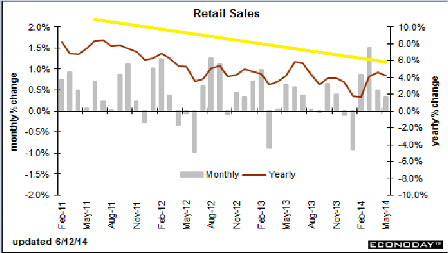
Retail sales showing the down for the winter, up, then lower growth pattern, in the context of the longer term drift lower in growth:

Full size image

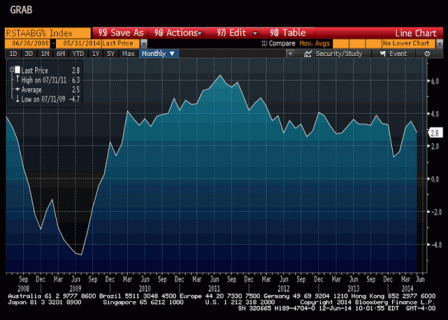
The retail sales ‘control group’ (ex food, autos, building materials, and gas stations) shows the same pattern even more clearly:

Full size image

Lastly, keep an eye on crude prices. Looked to me like the spike in 2008 might have been the catalyst for the collapse in demand…
Nomura revises Q1 down to -2.4%

And the risk is we may be more path dependent than most realize with the deficit this low. That is, for example, if income dips due to ‘weakness’ such as weather, there is then that much less income to spend in the next period.

>   
>   (email exchange)
>   
>   In the race to see who can revise their Q1 estimates the lowest, I think Nomura is in the
>   lead so far at -2.4%…
>   

Nomura Economists revise down First Quarter US GDP to -2.4%

Incorporating relevant information from Quarterly Service Survey which was released today, we revised down our Q1 GDP tracking estimate by a full percentage point to -2.4% from -1.4%. Personal consumption on services was much weaker than BEA has assumed. We haven’t revised Q2 GDP tracking estimate because we don’t know how the montyly profile of personal consumption for Q1 will be revised in reaction to QSS. That being said, the fact that personal consumption lost some traction in Q1 appears to be negative.

Posted in GDP

downward revisions for Q1

FYI
who would have thought?
;)

U.S. Economy’s First-Quarter Contraction Could Be Even Worse Than You Thought

By Ben Leubsdorf

June 11 (WSJ) — The U.S. economy may have contracted more than previously thought during the first three months of 2014, private economists said Wednesday based on new health care-sector data from the government.

One analyst said economic output may have contracted at a 2% pace in the first quarter. That would be its worst performance since the recession.

The Commerce Department’s latest estimate of gross domestic product, the broadest measure of output across the economy, said GDP shrank at a seasonally adjusted annual rate of 1% in the first quarter. A revised estimate will be released June 25, and it could show an even larger contraction.

That’s based on the Commerce Department’s Quarterly Estimates for Selected Service Industries report for the first quarter, released Wednesday. It showed that revenue in the U.S. health-care and social-assistance sector fell 2% in the first quarter from the fourth quarter of 2013, not adjusted for seasonal variations or price changes. Hospital revenue fell a seasonally adjusted 1.3% from the prior quarter.

The Commerce Department’s last GDP report, though, said inflation-adjusted spending on health-care services surged to a seasonally adjusted annual level of $1.848 trillion in the first quarter from $1.808 trillion in the fourth quarter of 2013. That estimate for spending on health care boosted overall GDP growth by 1.01 percentage point, keeping the 1% contraction from being even worse.

J.P. Morgan Chase economist Daniel Silver and Pierpont Securities economist Stephen Stanley both cautioned that it’s not clear exactly how the Commerce Department will adjust GDP to account for the new data.

But they both downgraded their estimates for the first quarter based on the new survey, as well as other recently released data. Mr. Silver predicted GDP declined at a 1.6% pace in the first three months of the year, and Mr. Stanley predicted contraction at a 2% pace.

“Ouch,” Mr. Stanley said in a note to clients.

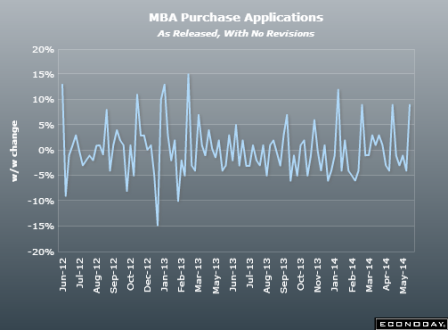
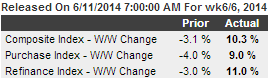
MBA Purchase Applications June 11, 2014

Up 9% for the week!

Over 500% annualized!!!!

;)

(And now only down 13% yoy)

Highlights

Demand for both purchase and refinancing applications, which had been soft in prior weeks, surged in the June 6 week, up 9.0 percent and 11.0 percent respectively. The average 30-year rate for conforming loan balances ($417,500 or higher) moved up from recent lows, jumping 8 basis points in the week to 4.34 percent.

Today’s charts

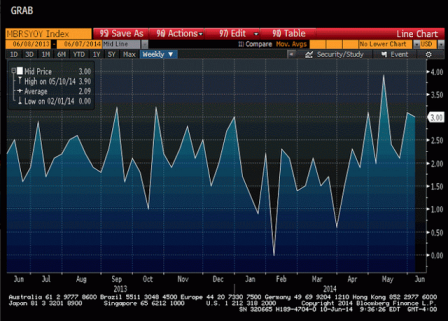
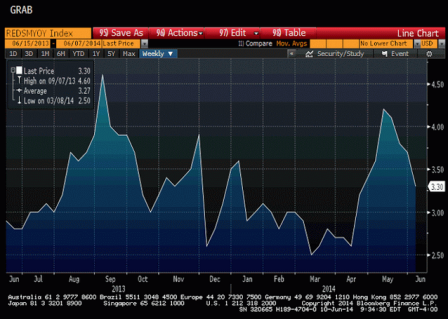
Couple of lesser indicators showing a familiar pattern- lower growth for the winter then higher growth then growth slowing some.

Goldman ICSC chain store sales index:


Full size image

Redbook retail sales, monthly, yoy:


Full size image

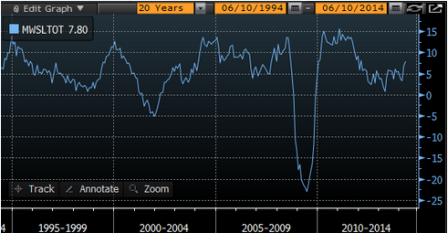
And looks like a spike up in wholesale sales causes recessions?
;)


Full size image

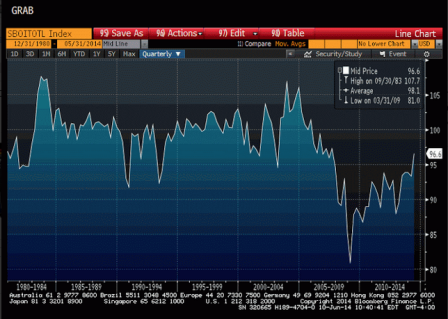
Small biz optimism now back up to prior recession lows!!!
Time to tighten up quick before the hyper inflation takes hold!!!
;)


Full size image

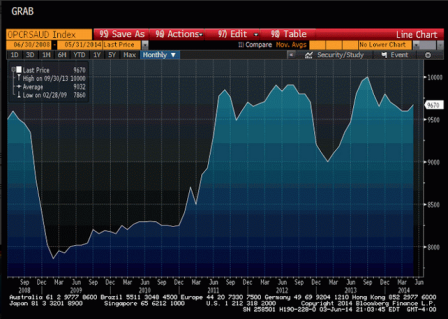
World Needs Record Saudi Oil Supply as OPEC Convenes

It wasn’t supposed to happen this way. All the talk last year was about new supply driving down prices. And every US ‘inflation’ of consequence I’ve seen has been oil related.

World Needs Record Saudi Oil Supply as OPEC Convenes

By Grant Smith

June 9 (Bloomberg) — OPEC ministers say they will almost certainly leave their oil-production ceiling unchanged when the group meets this week. What really matters for markets is whether Saudi Arabia will respond to global supply shortfalls by pumping a record amount of crude.

Just six months ago, energy analysts predicted output from the Organization of Petroleum Exporting Countries would climb too high and Saudi Arabia needed to cut to make room for other suppliers. They changed their minds after production from Libya, Iran and Iraq failed to rebound as anticipated, and industrialized nations’ stockpiles fell to the lowest for the time of year since 2008. Saudi Arabia may need to pump a record 11 million barrels a day by December to cover the other member nations, says Energy Aspects Ltd., a consultant.

“Now it’s not whether the Saudis will make room, but whether they’ll keep it going and maintain enough spare capacity,” said Jamie Webster, a Washington-based analyst at IHS Inc., an industry researcher. “OPEC is increasingly having a hard time just doing its job of bringing all the barrels needed.”

Even as the North American shale revolution propels U.S. production to a three-decade peak, supply in other parts of the world is faltering. A battle for political control in Libya, pipeline attacks in Iraq and prolonged sanctions against Iran are preventing those nations from reviving output. While U.S. crude inventories rose to a record in April, restrictions on exports are keeping those supplies in the country, tempering forecasts that global oil prices will decline this year.

Supply Risks

Deutsche Bank AG, Morgan Stanley, Barclays Plc and Citigroup Inc. raised their 2014 Brent price forecasts over the past three months, citing supply risks. The median estimate of the four banks climbed to $107.75 a barrel, from $100.25 as of Dec. 31. The grade has averaged $108.24 a barrel this year.

OPEC, which produces about 40 percent of the world’s oil, will meet in Vienna on June 11 to discuss its 30 million barrel daily production target. Ministers from Saudi Arabia, Angola and Kuwait said they expect no change, as did 22 of 23 analysts and traders surveyed by Bloomberg News.

OPEC’s Economic Commission Board, a panel that reviews supply and demand levels before the meeting, concluded on June 5 that the current production level is adequate, according to two OPEC delegates.

Low Inventories

The International Energy Agency, the Paris-based adviser to 29 nations, recommended on May 15 a “significant rise in OPEC production” to meet demand of 30.7 million barrels a day in the second half of the year. Oil inventories in advanced nations were at 2.62 billion barrels in April, the lowest for that month since 2008, the year Brent reached a record $147.50 a barrel, IEA data show.

Boosting output that high would be “a Herculean task for the group to surmount given that production has been below 30 million barrels a day for the last five months,” London-based Energy Aspects said in a May 27 research note.

The situation has reversed since OPEC last met in December. At that time, the IEA indicated the group would need to reduce output by about 3 percent in the first half of 2014 to make way for North America’s booming shale oil supplies.

U.S. oil production rose to 8.47 million barrels a day in the week ended May 23, the highest since 1986, according to the Energy Information Administration. The nation’s crude inventories were at 399.4 million barrels through April 25, the highest in data beginning in 1982, the EIA estimates.

December Meeting

Several OPEC nations have failed to boost output as their ministers suggested at the group’s last meeting in December. Iraq was aiming for a surge of about 30 percent in 2014 to 4 million barrels a day, Oil Minister Abdul Kareem al-Luaibi said. Libya intended to restore within 10 days full daily capacity of almost 1.6 million barrels, from less than 20 percent previously, Oil Minister Abdulbari al-Arusi said. Iran had secured six months of relief from sanctions imposed by western governments and was seeking its highest output in five years, Oil Minister Bijan Namdar Zanganeh said.

Iraq’s daily production contracted 8 percent since reaching a 35-year peak of 3.6 million barrels in February amid political disputes and pipeline bombings, according to the IEA. In Libya, output has fallen to a 10th of capacity because of protests at oilfields and strikes at export terminals. Iranian supply is little changed, while an end to sanctions relief looms in July if it cannot reach a broader deal on its nuclear program.

Expectations Fade

As a result, inventories of crude and refined oil in Europe were 86 million barrels below their five-year average at the end of March, according to the IEA. U.S. benchmark West Texas Intermediate is about $6 a barrel cheaper than North Sea Brent.

“At the start of this year, expectations around the return of Libyan, and subsequently Iranian, barrels were high,” Amrita Sen, chief oil market strategist at Energy Aspects, said by e-mail on May 20. “Today those possibilities have diminished substantially. The real question concerns how OPEC will meet higher demand for its crude in the third quarter. The onus falls on Saudi Arabia to do much of the heavy lifting.”

Saudi Oil Minister Ali Al-Naimi told reporters in Seoul on May 12 that any supply shortage in the oil market can be covered. The kingdom is capable of producing as much as 12.5 million barrels a day of crude oil and pumped 9.67 million in May, according to data compiled by Bloomberg. Media officials at Saudi Arabia’s oil ministry in Riyadh weren’t available to comment when contacted by Bloomberg on June 6 and yesterday. There was no response to an e-mail to Saudi Aramco’s media department yesterday.

Estimates vary on how much Saudi Arabia needs to produce before the end of the year. IHS projects about 10.3 million and while Societe Generale says between 10.2 million barrels and 10.5 million barres a day in the third quarter. The high of 11 million that Energy Aspects says could be needed from Saudi Arabia would be higher than the quarterly peak of 10.1 million reached in late 1980, according to OPEC data.

“At the time of the last OPEC meeting, there was a fair amount of concern about what would happen if disrupted production in key countries starts to come back in a big way,” said Mike Wittner, the head of oil market research at Societe Generale SA in New York. “It’s not all happening in a big way. It means the market needs the Saudis to produce more crude.”


Full size image

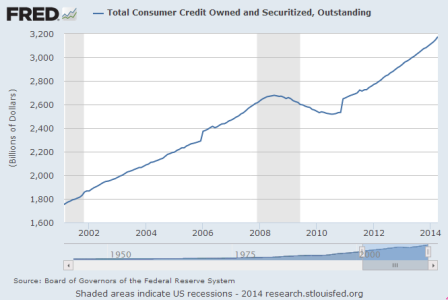
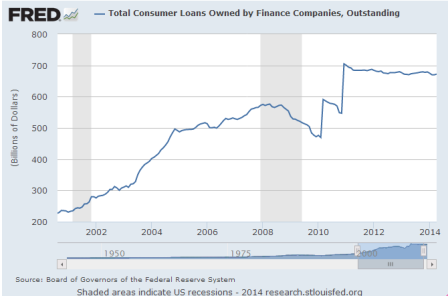
Recent credit boom…

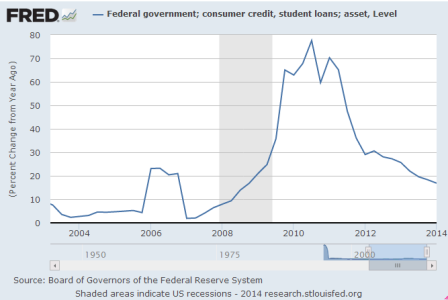
Growth of govt lending continues to slow:


Full size image

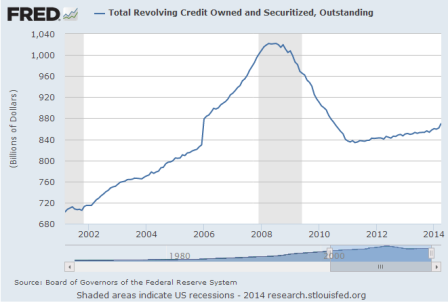
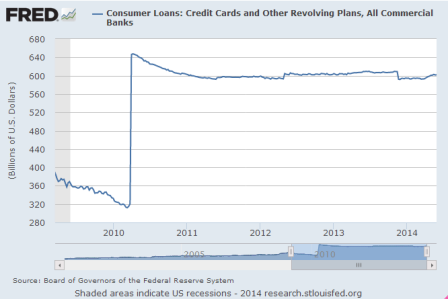
Fearsome revolving credit acceleration underway:


Full size image

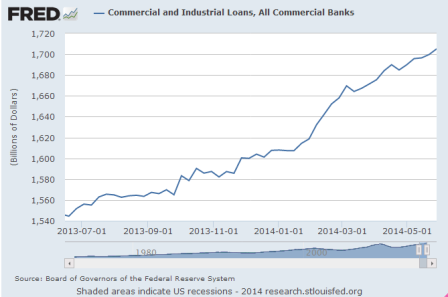
Sudden breakout here?


Full size image

Escape velocity?


Full size image

Here it is!

Loans increased when the economy suddenly slowed due to the weather, then continued to increase at about the prior pace:


Full size image

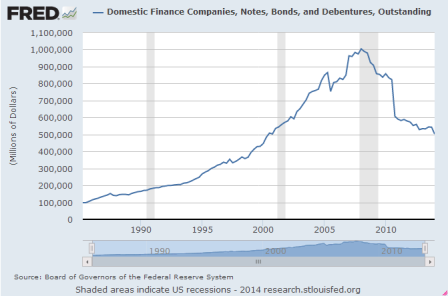
And someone’s picking up the slack from these types of lenders?


Full size image


Full size image

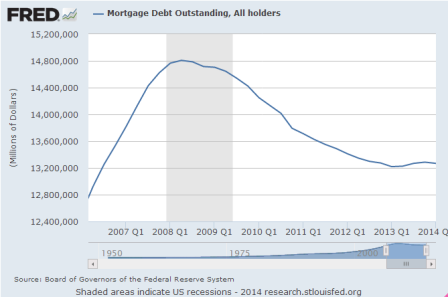
And, of course, the big guy, mortgage debt, started to move up a tad but unfortunately seems to have settled back some:


Full size image

But with the 0 rate policy, we’re sitting on a powder keg, always on the edge of hyper inflation…

:(

Income distribution stats

This is for household incomes- generally two people working…

You might be surprised to learn that the top 20 percent of income earners bring in a household income of just over $100,000. The top 10 percent of earners have a household income of more than $148,687. To be considered in the top 1 percent, household income is at least $521,411.

This is for individuals (from 2010 data)- only $114,000 to get into the top 10%!

WHAT THE TOP 1%, 5%, 10%, 25% and 50% MAKE IN AMERICA

Based on the Internal Revenue Service’s 2010 database below, here’s how much the top Americans make:

Top 1%: $380,354

Top 5%: $159,619

Top 10%: $113,799

Top 25%: $67,280

Top 50%: >$33,048

Abenomics Spurs Most Misery Since ’81 as Senior Scrimps

As previously discussed, it’s a case of ‘bad inflation’…

Abenomics Spurs Most Misery Since ’81 as Senior Scrimps

By Isabel Reynolds and Chikako Mogi

June 6 (Bloomberg) — Mieko Tatsunami finds Prime Minister Shinzo Abe’s drive to reflate Japan’s economy hard to digest.

“The price of everything we eat on a daily basis is going up,” Tatsunami, 70, a retired kimono dresser, said while shopping in Tokyo’s Sugamo area. “I’m making do by halving the amount of meat I serve and adding more vegetables.”

Tatsunami’s concerns stem from the price of food soaring at the fastest pace in 23 years after April’s sales-tax increase. Rising prices helped push the nation’s misery index to the highest level since 1981, while wages adjusted for inflation fell the most in more than four years.

With food accounting for one quarter of the consumer price index and the central bank looking to drive inflation higher, a squeeze on household budgets threatens consumption as Abe weighs a further boost in the sales levy. The prime minister may be forced to ease the pain with economic stimulus, cash handouts or tax exemptions championed by his coalition partner.

“Price hikes without confidence that wages are going to rise will hurt appetite for spending,” said Masamichi Adachi, senior economist at JPMorgan Chase & Co. in Tokyo. “Abe has to raise people’s belief that the economy will improve.”

Food prices rose 5 percent in April from a year earlier, with fresh food climbing 10 percent. Onions soared 37 percent, and salmon — a staple of the nation’s lunch boxes — jumped 30 percent. Abe lifted the sales tax by 3 percentage points on April 1.

Greenhouse Vegetables

The yen’s 5 percent fall against the dollar over the year through April boosted the cost of imports in a nation that is only 39 percent self-sufficient on a calorie basis and more reliant on inbound shipments of fossil fuels after a nuclear disaster in 2011.

The cost of imported beef rose to 230 yen ($2.24) for 100 grams at stores in central Tokyo in April from 187 yen a year earlier, government data show. Growing vegetables in greenhouses is more expensive as a result of increased energy prices, according to Naoyuki Yoshino, the Tokyo-based dean of the Asian Development Bank Institute.

Yasunari Ueno, chief market economist at Mizuho Securities Co. in Tokyo, said food inflation likely accelerated in May and will remain high.

As Abe aims to create a “virtuous cycle” of rising production, incomes and spending, the Bank of Japan is targeting 2 percent inflation — stripped of the impact of the higher sales tax. Its key gauge of prices excluding fresh food rose 3.2 percent in April from a year earlier.

Tax Exemptions

Even so, the prime minister’s drive to fatten paychecks more than inflation is at risk of stalling, with wages excluding overtime and bonus payments falling for a 23rd straight month in April.

Goldman Sachs Group Inc. sees base wages rising about 0.5 percent on year from May as salary gains from spring labor negotiations take effect — lagging the median forecast for 2.6 percent inflation this year in a Bloomberg News survey of economists.

The misery index, which adds the jobless rate — 3.6 percent — to overall inflation — 3.4 percent — climbed in April to 7, a 33-year high.

The squeeze on households could damage support for Abe’s administration, whose approval rating fell to 53 percent in a Nikkei survey in May from 62 percent when he took power in December 2012.

“The effects of Abe’s policies are kicking in and very soon people will start to take notice,” said Koichi Nakano, a professor of political science at Sophia University in Tokyo. Abenomics isn’t really trickling down to their wallets, he said.

Economic Stimulus

As Abe considers corporate tax cuts, he faces pressure from his coalition ally New Komeito to exempt food should he go ahead with plans to raise the sales levy further to 10 percent in October next year from 8 percent.

Mizuho’s Ueno said an option for Abe would be to provide more cash handouts to help low-income households, which would run counter to the government’s effort to reel in the world’s largest debt burden.

With higher food prices, people will cut back on durables, luxury goods and eating out as they did after the sales tax was last increased in 1997, the ADBI’s Yoshino said. “A government stimulus package is needed to compensate for the consumption decline.”

The elderly, many of whom are on fixed incomes, may be hit the hardest, said Hideo Kumano, executive chief economist at Dai-ichi Life Research Institute in Tokyo. Kumano estimates households headed by people over age 60 accounted for nearly half the nation’s consumption last year.

“If prices keep rising, there is a risk that consumption by seniors may be damped as they don’t enjoy the benefit of wage increases,” Kumano said.

Kumano’s concerns are reflected in Sugamo, an area of northern Tokyo bustling with elderly shoppers like Tatsunami.

“Abenomics may be helping the big corporations, but life’s tough for people like me,” said Tatsunami, who has seen her pension shrink. “We don’t go out as much as we did — we’re having to cut back.”