IMF’s Lagarde hints at world growth forecast cut – Reuters

And remains ‘part of the problem’ vs ‘part of the solution’

Reuters noted comments from IMF chief Christine Lagarde, who said that global economic activity should strengthen in the second half of the year and accelerate through 2015, although momentum could be weaker than expected.

She said that central banks’ accommodative policies may only have limited impact on demand and that countries should boost growth by investing in infrastructure, education and health, provided their debt is sustainable.

She highlighted that the IMF’s update of its global economic outlook, expected later this month, will be “very slightly different” from the forecasts published in April. In addition, she noted that the US economy was rebounding after a disappointing first quarter, while it did not anticipate a brutal slowdown in China but rather a slight slowdown in output.
Abenomics= ‘bad’ inflation

Squeaking By on Abenomics

By Joseph Sternberg

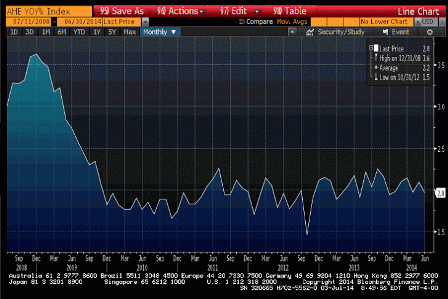
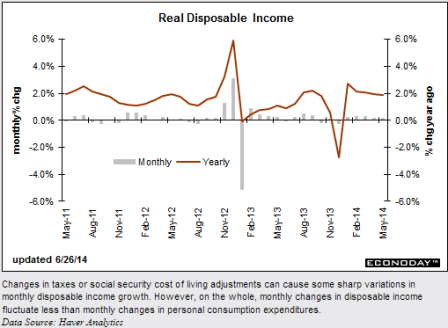
July 2 (WSJ) — Preliminary data show cash earnings, including bonuses, rising by 0.8% year-on-year in May. Base pay increased 0.2%, its first rise in around two years. This looks like the “wage surprise” Japanese workers’ purchasing power fell another 3.6% year-on-year in May, after declines throughout much of Mr. Abe’s tenure. This is partly due to the price effects of the consumption-tax hike, and partly due to the import-price inflation stimulated by Mr. Abe’s weak-yen policy. Because Mr. Abe has yet to generate meaningful economic growth, the consumption tax merely redistributes income away from households and toward other government purposes.

Vehicle sales hit 17 million

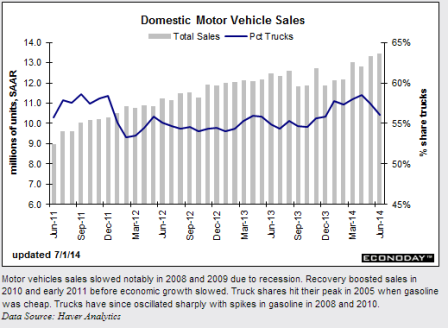
This is above expectations, a high for the year, and brings the 2014 average up to just over 16 million annual rate, making up for the winter slowdown.

Motor Vehicle Sales


Highlights
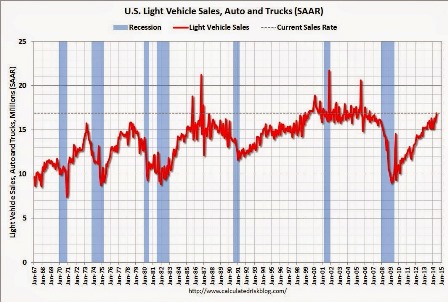
In an early signal of strength for June economic data, vehicle sales rose 1.2 percent in June to a 17.0 million annual rate which is the strongest rate since way back in July 2006. Sales of both North American-made and foreign-made vehicles rose in the month with domestic cars and imported trucks showing special strength. Today’s data point to yet another strong gain for the motor vehicle component of the retail sales report which rose 1.4 percent in May.

U.S. Light Vehicle Sales increase to 16.9 million annual rate in June, Highest since July 2006

By Bill McBride

Based on an WardsAuto estimate, light vehicle sales were at a 16.9 million SAAR in June. That is up 7% from June 2013, and up 1% from the 16.7 million annual sales rate last month.

This was above the consensus forecast of 16.4 million SAAR (seasonally adjusted annual rate).


Full size image

German unemployment at 6.7%

Shows how far economic expectations have deteriorated when this kind of a whopping output gap is considered to be an unquestioned success and the envy of the euro zone, as well as most of the world.

Taxation creates unemployment (people seeking paid work), by design, as a simple point of logic.

So what sense does it make for a government to create more unemployed than it wants to hire to provision itself, and then let all those people remain unemployed?

Seems they would either hire the rest of the unemployed their tax created, or lower the tax. But that’s just me…

German Unemployment Unexpectedly Rises for Second Month

By Stefan Riecher and Alessandro Speciale

July 1 (Bloomberg) — German unemployment unexpectedly increased for a second month amid signs of a slowdown in Europe’s largest economy.

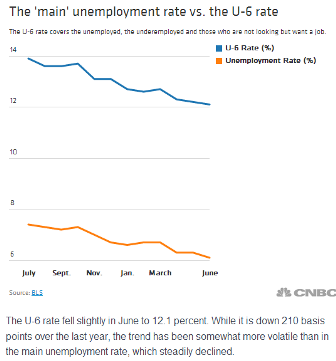
The number of people out of work rose a seasonally adjusted 9,000 to 2.916 million in June, the Nuremberg-based Federal Labor Agency said today. Economists forecast a decline of 10,000, according to the median of 24 estimates in a Bloomberg News survey. The adjusted jobless rate was unchanged at 6.7 percent, the lowest level in more than two decades.

Big snap back in second quarter growth less likely

No mention yet of the deficit being too small…

At sub 3% we comply with the Maastricht limits.
Maybe the plan is to join the euro?
Why else would we allow this?
;)

Big snap back in second quarter growth less likely

By Patti Domm

(CNBC) — After a shocking contraction in first quarter GDP, economists on Thursday pared back growth forecasts for the second quarter due to weaker consumer spending.

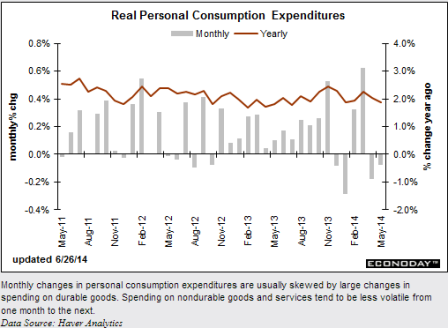
Consumer spending in May rose just 0.2 percent, half of what was expected, after being flat in April. Spending by consumers accounts for more than two-thirds of U.S. economic activity, and the lowered growth forecasts now raise concerns that the economy will not be able to rebound to the more than a 3 percent growth rate widely expected for the balance of the year.

Goldman Sachs economists trimmed second quarter tracking GDP to 3.5 percent from 4.1 percent, and Barclays economists said tracking GDP for the second quarter fell to 2.9 percent from 4 percent. At a pace below 3 percent, the economy could show contraction for the first half due to the steep first quarter decline of 2.9 percent.

The median estimate for second quarter GDP fell by a half percent to 3 percent, according to the CNBC Rapid Update of economists forecasts.

Consumer spending, personal income, PCE prices

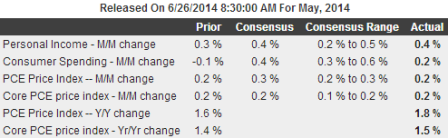
The Commerce Department said consumer spending increased 0.2 percent after being flat in April. Spending, which accounts for more than two-thirds of U.S. economic activity, had been forecast rising 0.4 percent after a previously reported 0.1 percent dip in April.

When adjusted for inflation, consumer spending fell for a second straight month, suggesting spending this quarter could struggle to regain momentum after growing at its slowest pace in nearly five years in the first quarter.

Spending in May was probably constrained by weak healthcare spending as outlays on services barely rose for a second month.

While reports ranging from employment to manufacturing and the services industries suggest the economy has rebounded after sinking in the January-March period, the consumer spending data indicated that growth would probably fall short of the 4.0 percent annual pace that some economists are expecting in the second quarter.

Personal Income and Outlays

From Calculated Risk

Real PCE — PCE adjusted to remove price changes — decreased 0.1 percent in May, compared with a decrease of 0.2 percent in April. … The price index for PCE increased 0.2 percent in May, the same increase as in April. The PCE price index, excluding food and energy, increased 0.2 percent in May, the same increase as in April. … The May price index for PCE increased 1.8 percent from May a year ago. The May PCE price index, excluding food and energy, increased 1.5 percent from May a year ago.

Note: Usually the two-month and mid-month methods can be used to estimate PCE growth for the quarter (using the first two months and mid-month of the quarter). However this isn’t very effective if there was an “event”, and in Q1 PCE was especially weak in January and February – and then surged in March.

Still, using the two-month method to estimate Q2 PCE growth, PCE was increasing at a 2.3% annual rate in Q2 2014 (using the mid-month method, PCE was increasing less than 1.5%). Since the comparison to March will be difficult, it appears PCE growth will be below 2% in Q2 (another weak quarter).

Note the now familiar down into winter, up some, and then settling down again pattern: