
Poll: Public opposed to raising debt ceiling
By Jordan Fabian
May 13 — The public remains opposed to raising the nation’s debt ceiling as lawmakers struggle to develop a plan to hike the legal borrowing limit, a new poll released Friday shows.
Forty-seven percent say they don’t want their member of Congress to vote to raise the limit, compared to 19 percent who do. Thirty-four percent say they don’t know enough to say, according to a Gallup poll.
Daily Archives: May 19, 2011 @ 4:32 pm (Thursday)
Debt Ceiling dynamics- no chance of US default
Republican Senator Pat Toomey is now making the point that with debt payment an executive priority,
and with tax receipts more than sufficient for interest payments,
not raising the debt ceiling will not mean default,
instead it will mean other federal spending will get cut,
which he pronounced analogous to a partial government shut down.
While this has always been factually correct, it is only very recently that this has become the lead response from the Republicans, in direct response to warnings by the Democrats of a US default.
With the Democrats being exposed as factually wrong and guilty of at least innocent fear mongering, their entire negotiating position is weakened by both the facts and their reduced credibility in general.
So I have to conclude the end result will be dramatic spending cuts,
no tax increases, a large reduction in long term aggregate demand,
and most likely reductions in short term aggregate demand as well.
The Democrats are now left with fighting for alternative spending cuts, with the military a prime target.
In fact, they may already be cutting military spending, as the executive branch is not necessarily compelled to spend the funds authorized by Congress, but can selective not fund or delay funding in the normal course of business. So, for example, they may be able to cut $150 billion a year from actual military spending and score it as something over $2 trillion in savings over 10 years, which would reduce the need for other cuts currently under consideration. And this might be the motivation for brining as many troops back home as possible, from all over the globe.
These kinds of cuts would remove maybe 1-2% of nominal gdp from 2012, support unemployment and the dollar, help keep the Fed on hold, as, in general, fear of becoming the next Greece continues to cause us to work to turn ourselves into the next Japan.
Philadelphia Fed survey, existing home sales, leading indicators all disappoint
Typical street review of today’s numbers from Goldman.
As suspected, look for continued downward revisions to initial 4% Q2 estimates.
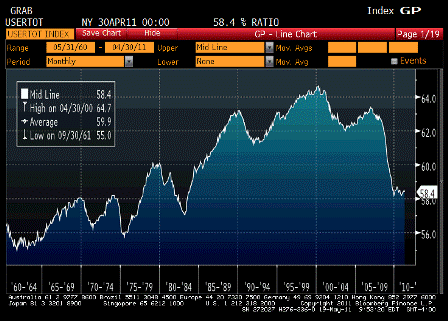
And note the graph below showing employment as a % of the population.
The economy continues to be demand constrained at very low levels.
(That is, for the size govt we have, we are grossly over taxed.)
There could be as many as 30 million additional people gainfully employed in a good economy.
And a general prosperity far beyond what anyone might imagine.
But not to be with Congress, mistakenly fearful of the US facing a financial crisis like Greece,
moving forward with their death by 1000 cuts agenda.
USA: Philadelphia Fed Survey – Another Decline
Actual: 3.9
Previous: 18.5
Consensus: 20.0
Released: 19 May 2011 at 10:00 (New York time)
Another Decline
BOTTOM LINE: More signs of slower growth from the Philly Fed index and existing home sales.
US-MAP
Existing home sales -2 (2, -1)
Philadelphia Fed index -12 (4, -3)
KEY NUMBERS:
Existing home sales -0.8% in Apr (mom) vs. GS +2.0%, median forecast +2.0%.
Philadelphia Fed index +3.9 in May vs. GS +22.0, median forecast +20.0.
Leading indicators -0.3% in Apr (mom) vs. median forecast +0.1%.
MAIN POINTS:
1. The Philadelphia Fed’s monthly manufacturing survey weakened sharply for the second month in a row. The headline index of “general business activity” fell to 3.9, from 18.5 in April and 43.4 in March. This still suggests factory sector growth, but only barely. Most of the detailed activity indexes also weakened – the new orders index fell to 5.4 from 18.8, the shipments index to 6.5 from 29.1, and the unfilled orders index to -7.8 from 12.9 – with the exception of employment, which rose to 22.1 from 12.3 in April. (We have no information on how much of the drop in the Philly survey over the past two months could have been related to supply chain issues associated with the Japanese earthquake, but this is not a region with an especially high concentration of vehicle manufacturing.) Price pressures eased a little but remain high in historical terms.
2. Existing home sales declined by 0.8% mom in April to an annualized rate of 5.05 million units. Consensus forecasts had expected a moderate increase. Home sales dropped in three of the four Census regions during the month, with the largest declines in the Northeast. The number of homes currently offered for sales was about unchanged after seasonal adjustment, at about 3.7 million units (the months supply of homes increased, but this was likely due to seasonal variation). The median sales price of existing homes increased by about 0.5% mom on a seasonally-adjusted basis-an encouraging turn after several months of weakness. Existing home sales prices are down 5% year-over-year.
3. Rounding out the weaker-than-expected data, the index of leading economic indicators fell by 0.3% mom in April. The consensus had expected a 0.1% increase.

Saudi Arabia Worried About Speculators’ Interest in Oil
Is this a signal for lower prices?
Or just talk to disguise the fact that they are the price setters?
Trying to figure out what they are going to do next is much like Fed watching.
Saudi Arabia Worried About Speculators’ Interest in Oil
By Jackie DeAngelis
May 19 (CNBC) — Saudi Arabia will take a cautious approach to opening up its stock markets to international investors, and the country is concerned about speculative interest in oil markets, finance minister Ibrahim Al-Assaf told CNBC.
Al-Assaf said in an interview that the Kingdom worries about high oil prices, and that he believes that speculators are currently propping up the market.