Services and manufacturing PMI, Durable goods orders, Atlanta Fed

Trumped up expectations fading, as weakness in the service sector continues, And if Trump loses today’s health care vote, I expect those expectations to fade that much faster:
Highlights

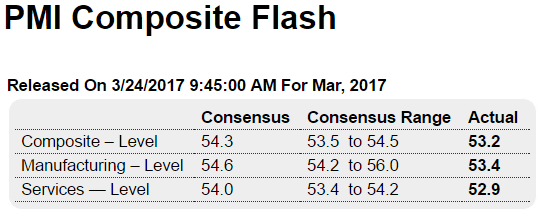
All in the mid-to-low 50s and at 6-month lows, a significant moderation in growth is the signal from Markit Economics’ U.S. diffusion indexes. The composite flash for March is 53.2 which is more than 1 point below the consensus. The manufacturing flash, at 53.4, is also about 1 point below expectations as is the services flash at 52.9.

Respondents are citing customer caution this month and are reporting slowing in employment, especially in the service sector where job creation is at a 3-year low. And in a negative for future hiring, backlog orders are starting to fall. Inventories at manufacturers, in another sign of slowing, are being cut back. Input prices are described as subdued.

The weakness in the manufacturing flash is notable, as it contrasts with extraordinary strength in regional factory reports and also the rival ISM where readings have been in the mid-to-high 50s. The weakness for this report, however, does correspond to mixed readings in hard economic data coming out of Washington.

If the economy does begin to slow, March would be the pivotal month and today’s report will have proven its worth as an advance indicator.

Services:

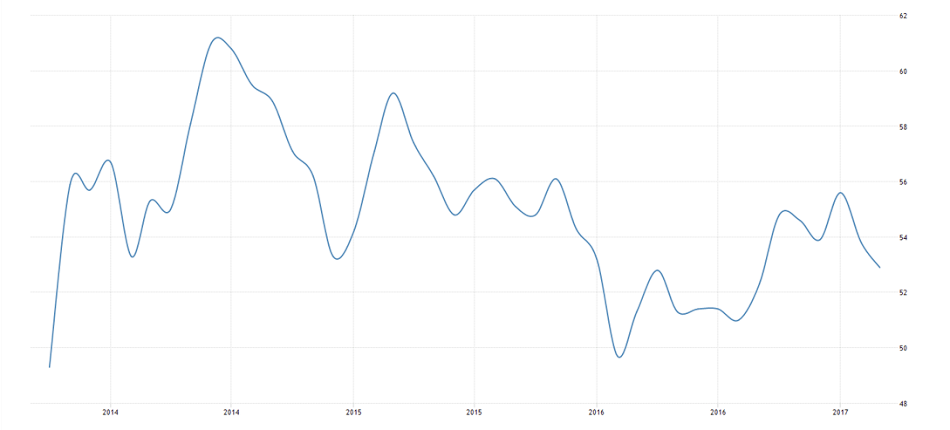
The Markit flash US services PMI decreased to 52.9 in March of 2017 from 53.8 in February and well below expectations of 54.2. It is the lowest value in six months, as new work was the lowest in 12 months and employment eased. Yet, job creation in March was one of the weakest reported over the past three years. Input cost inflation was relatively subdued.

Manufacturing:

The Markit flash US manufacturing PMI fell to 53.4 in March of 2017 from 54.2 in February and well below expectations of 54.8. It is the lowest reading since October of 2016, mainly due to a slowdown in new orders and lower stocks while input cost inflation picked up.
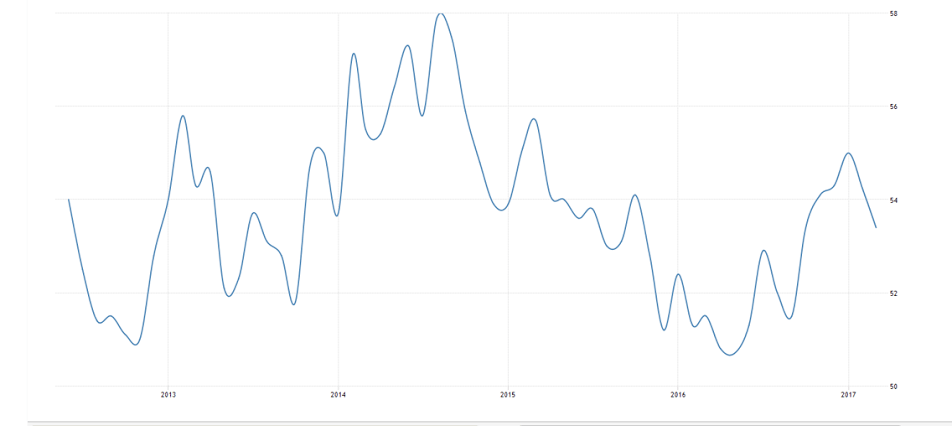

As previously discussed, muddling through with modest growth as weakness has shifted to the service sector:
Highlights

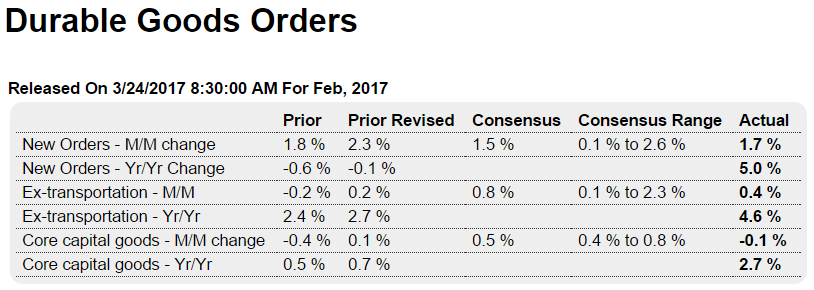
Aircraft has been giving a significant boost so far this year to durable goods orders which otherwise are soft. Durable goods orders jumped 1.7 percent in February to beat Econoday’s consensus by 2 tenths. The data include an upward revision to January which now stands at a very strong 2.3 percent. But when excluding transportation equipment, which is where aircraft are tracked, durable orders slow to a 0.4 percent February gain which is well under the 0.8 percent consensus.

The weakest part of the report is perhaps the most important part, that is core capital goods (nondefense ex-aircraft) where orders slipped 0.1 percent in February vs expectations for a 0.5 percent jump and following January’s revised 0.1 percent gain. This points to continued weakness in business investment and eventual trouble for GDP. Yet for the first quarter, core shipments in January and February, which are inputs into GDP, are a net positive, as a 1.0 percent February gain offsets a 0.3 percent January dip. Also unfilled orders for core capital goods are building, up 0.2 percent following gains of 0.5 and 0.4 percent in the two prior months.

Total unfilled orders for durables, however, are unchanged and follow a long string of declines. Inventory growth is modest at 0.2 percent with total shipments up 0.3 percent which keeps the inventory-to-shipments ratio unchanged at a stable 1.61.

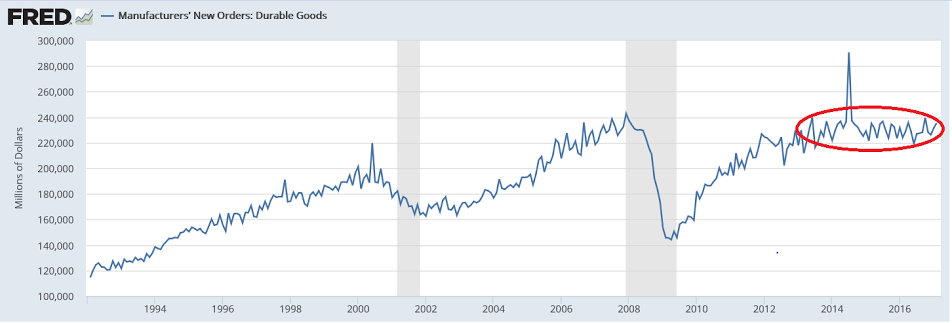
Durables activity is improving but the strength has been tied largely to aircraft where sustained month-to-month gains are uncertain. And the strength also does not include new orders for capital goods. The major spikes for advance manufacturing readings have yet to translate to similar gains for government data.

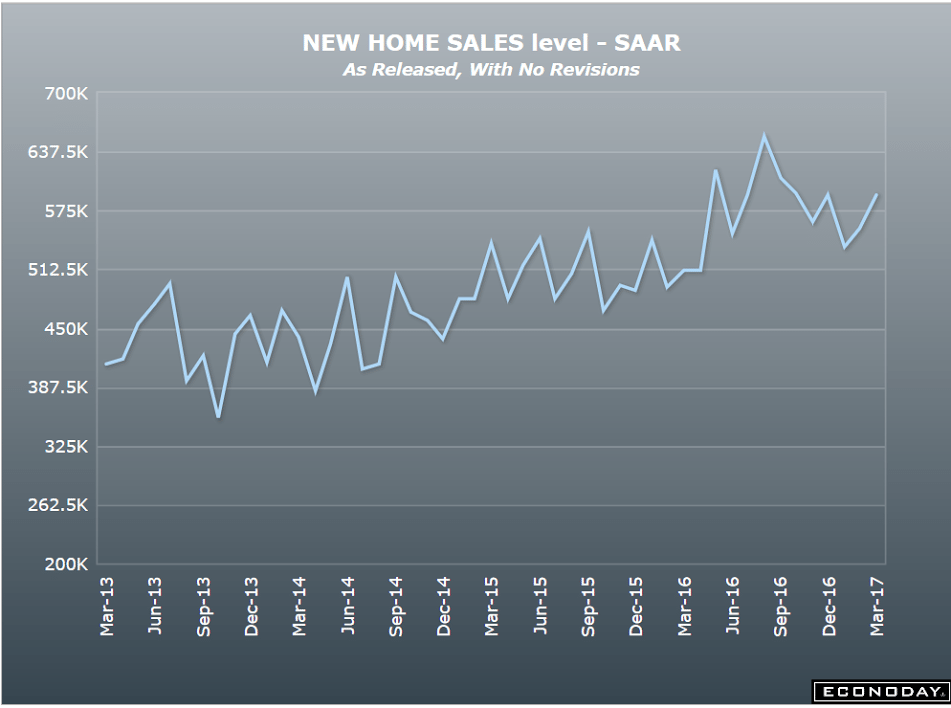
Not much has happened here in quite a while, and the numbers are not inflation adjusted:
New home sales

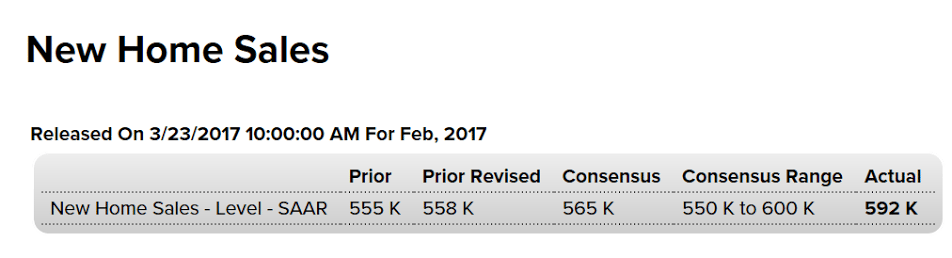
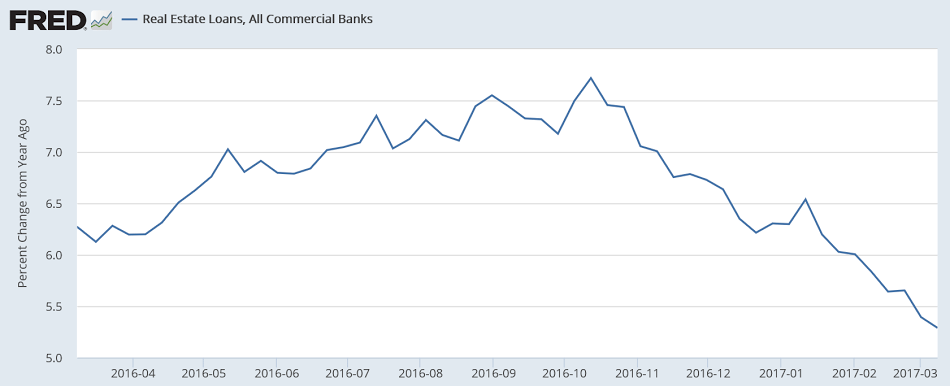
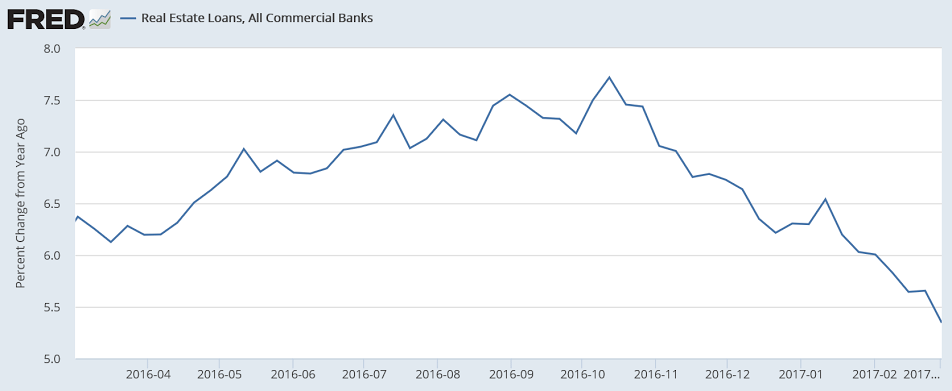
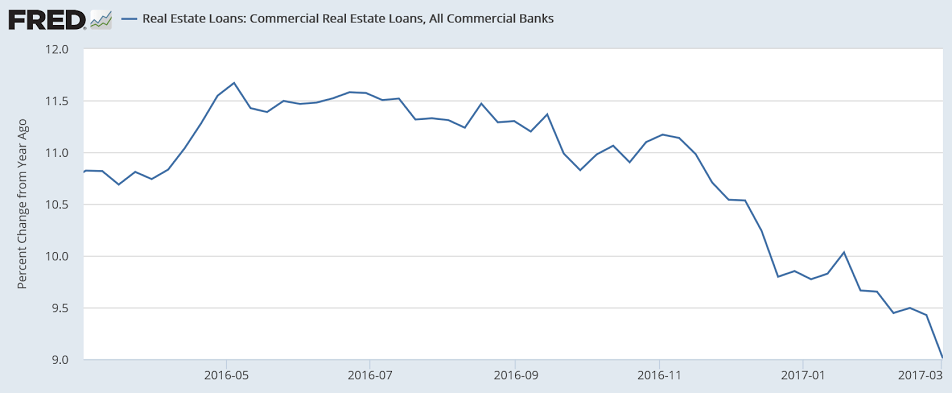
More than expected but as per the chart it looks like they’ve peaked and are working their way lower. And as no house is built without a permit, and permits are also soft, I don’t see anything good happening. Also, bank lending for real estate has been decelerating and mortgage applications are going sideways:


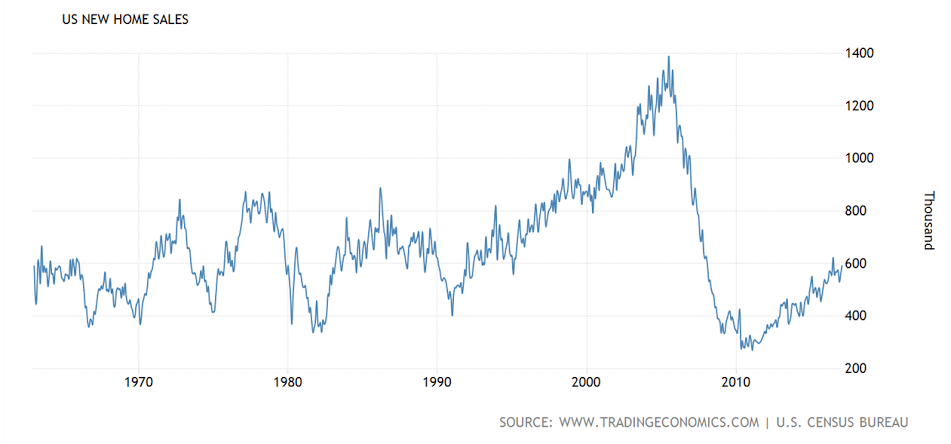
The longer term chart shows that recent weakness might just be part of the ‘pattern’ of the longer term uptrend, albeit from very depressed levels and at a slower rate of growth (And not population adjusted):

FHA house price index, Existing home sales, Industrial production

This was a surprise:

Highlights

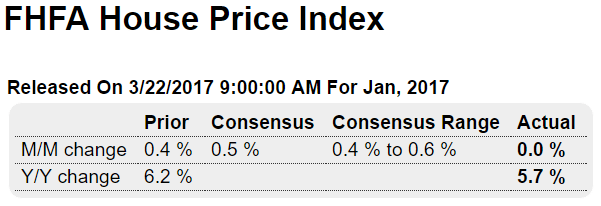
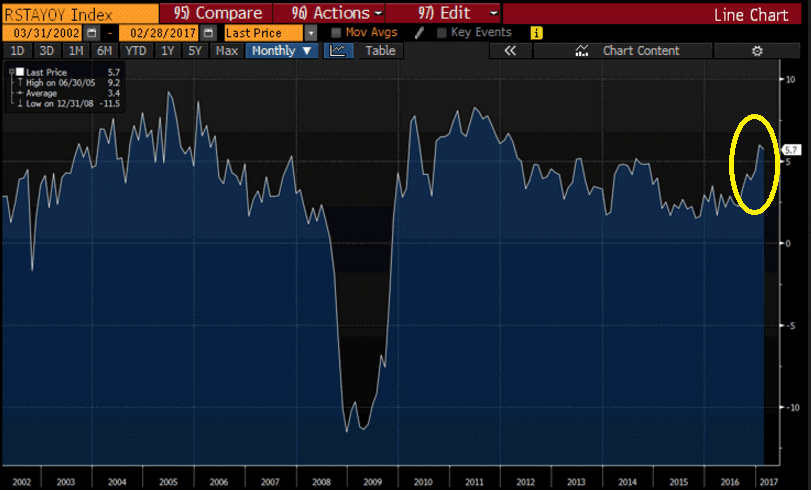
In an unusually weak showing, the FHFA house price index came in unchanged in January with year-on-year appreciation falling a steep 5 tenths to 5.7 percent. This is the weakest month-to-month showing in more than 4 years and the weakest year-on-year rate in 2-1/2 years.

Also weak:

Highlights

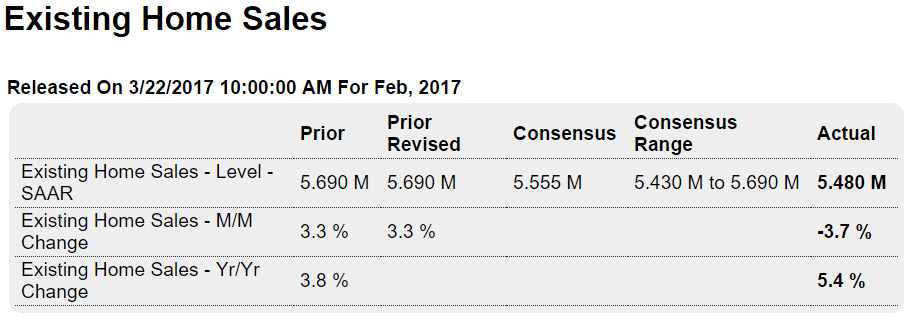
Existing home sales are on the soft side of expectations, down 3.7 percent in February to a 5.480 million annualized rate and below the Econoday consensus for 5.555 million. Details are mostly weak including a 3.0 percent decline for single-family sales to a 4.890 million rate and a sharp 9.2 percent drop for condos to a 590,000 rate. Year-on-year, single-family sales are up 5.8 percent with condos fading and barely over zero at 1.7 percent.

But total year-on-year sales are up a solid 5.4 percent and still below pricing where the median, at $228,400, is up a healthy 7.7 percent. Supply has been very thin but is improving, with 1.750 million resales on the market for a 4.2 percent gain from January. And relative to sales, supply is at 3.8 months vs January’s 3.5 months. Days on the market are very short, at 45 vs 59 days a year ago.

By region, the Northeast had a very weak February, down 13.8 percent to a 690,000 rate. And there is also weakness in the Midwest, with a 7.0 percent monthly decline to a 1.200 million rate, and the West, down 3.1 percent to 1.250 million. But the West is showing the most yearly strength at plus 9.6 percent while the Northeast brings up the rear at plus 1.5 percent.

The pending home sales index, which tracks initial contract signings for resales, accurately anticipated weakness in today’s report, one that underscores the still hesitant activity in the housing sector. Watch for new home sales on tomorrow’s calendar where, unlike this report, improvement is the call for February.

This was released a few days ago.

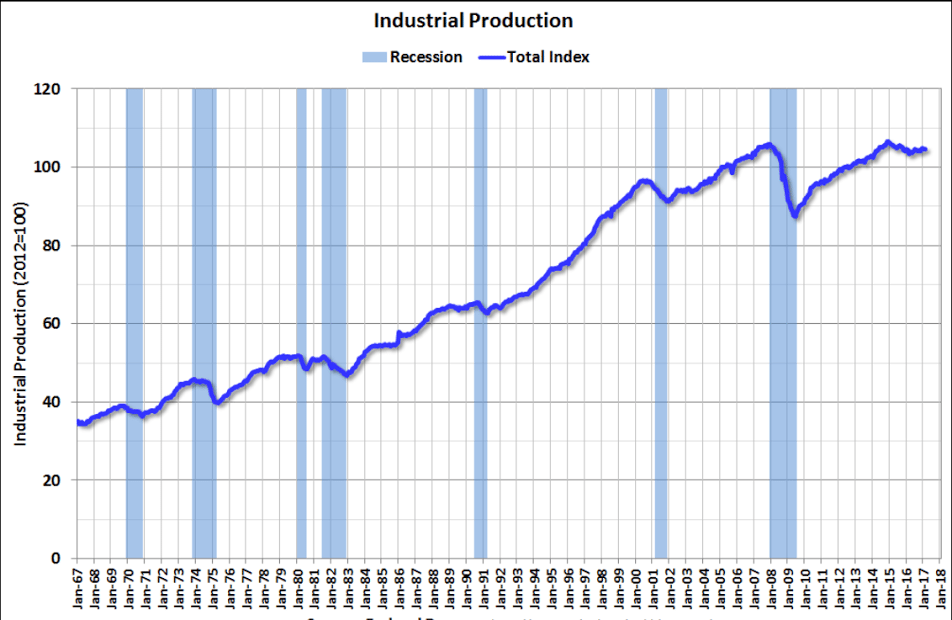
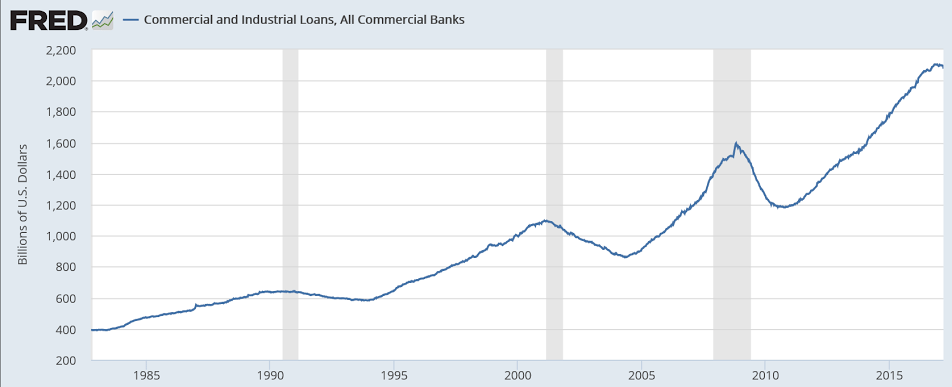
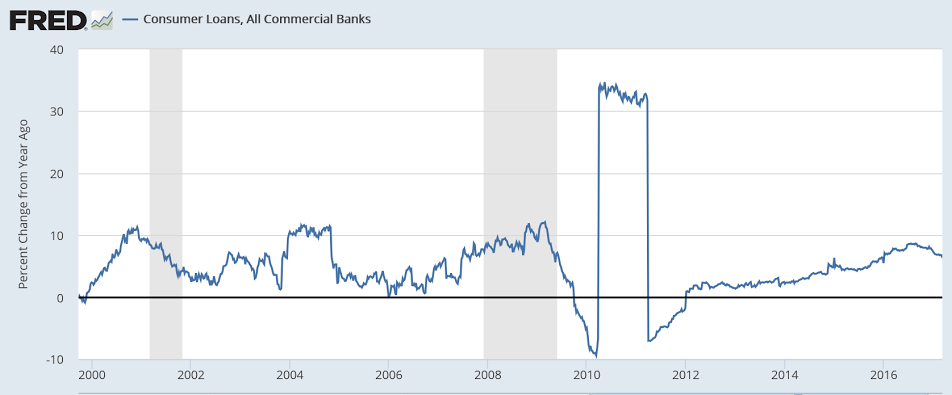
Note how the move down historically has coincided with recessions:

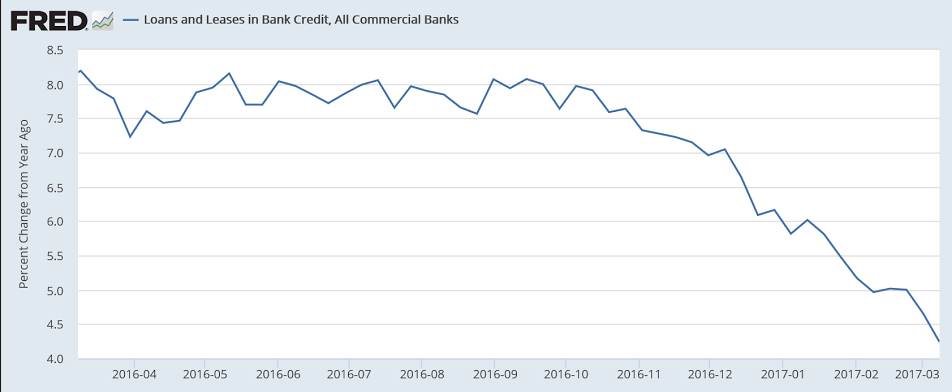
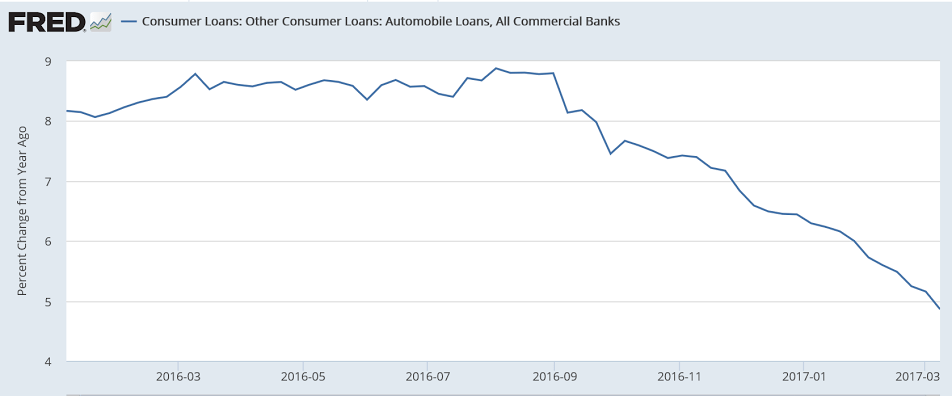
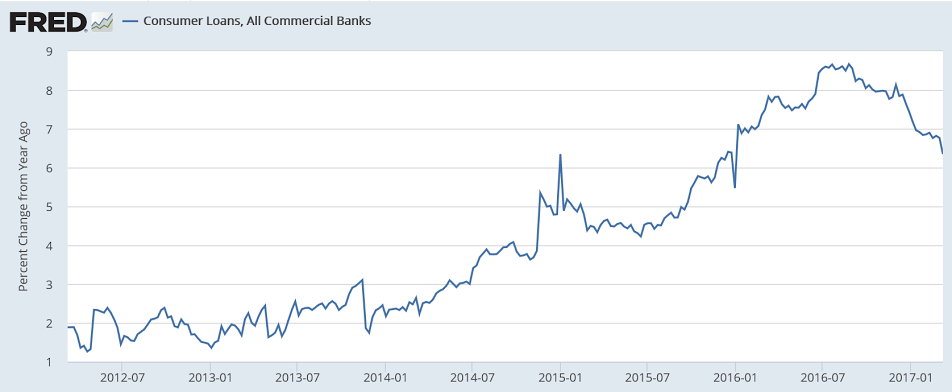
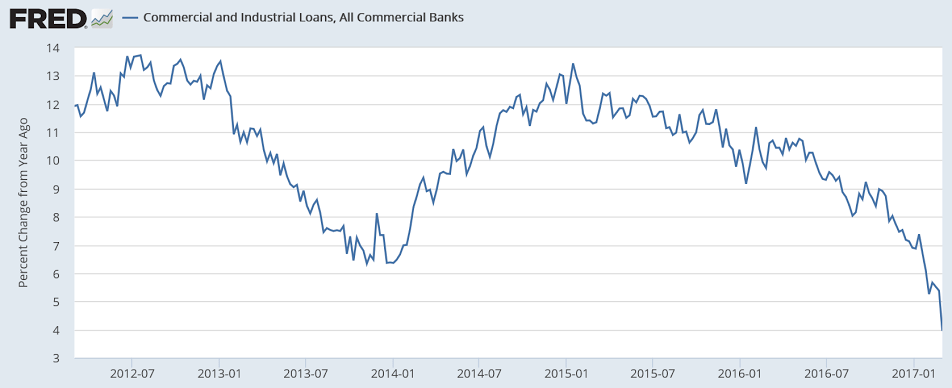
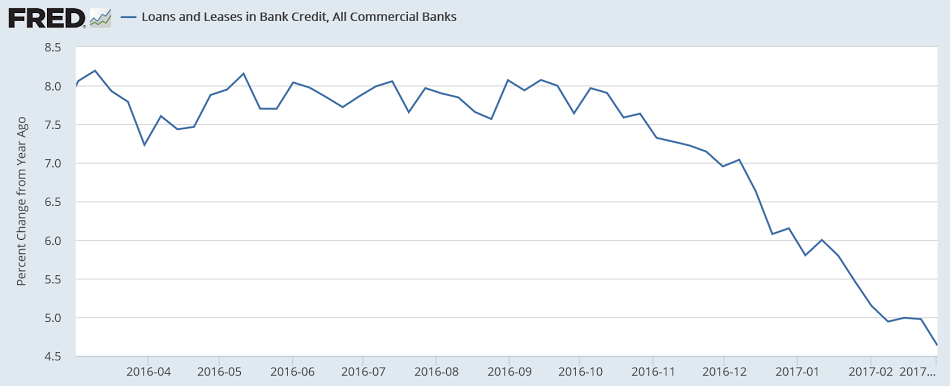
Credit check

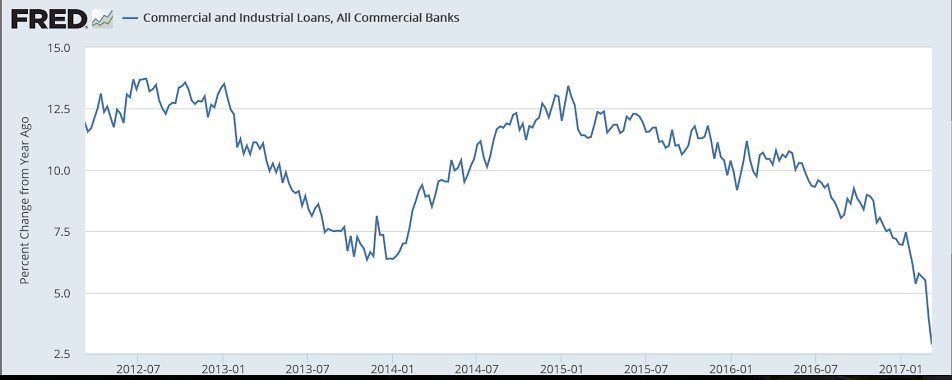
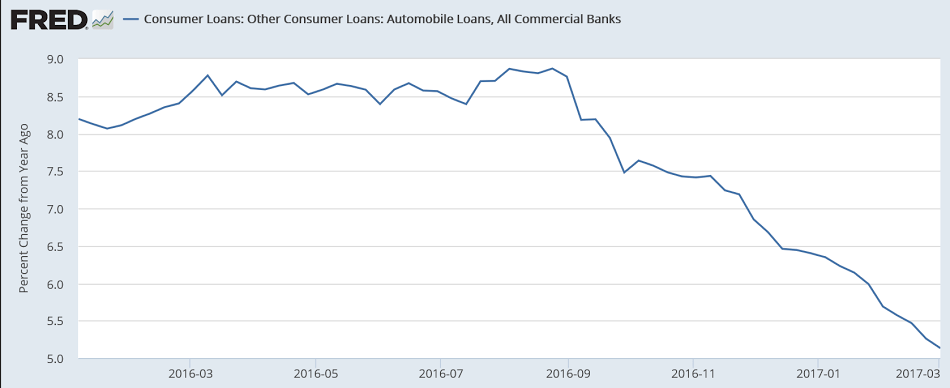
Note how it’s all been decelerating since the collapse in oil capex, and most recently the deceleration has
intensified:
This is the absolute level of loans outstanding, which seems to only go negative like this in recessions

This is the annual growth rate which appears to be in a state of collapse:


Note the pattern of accelerating into recession, then decelerating:

Housing starts, Atlanta Fed Q1 GDP forecast

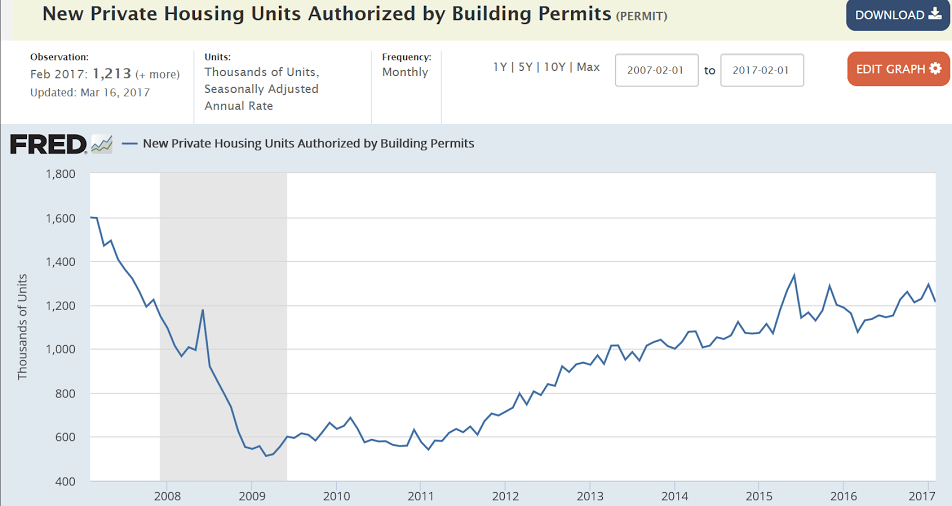
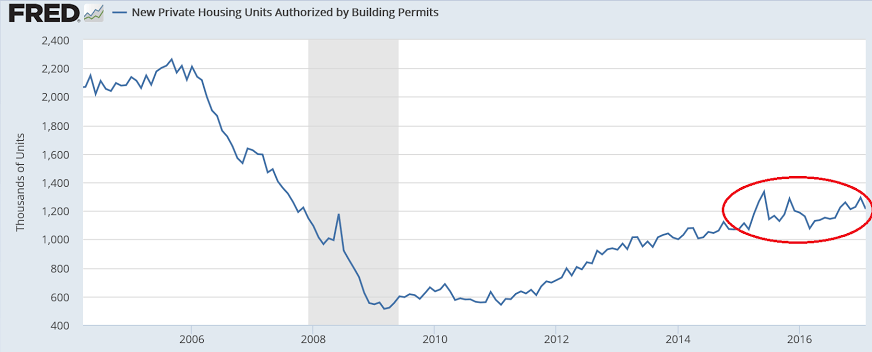
No houses built without a permit:

Highlights

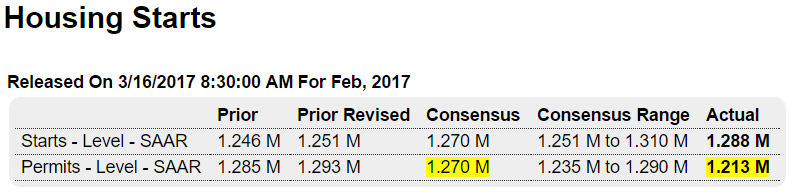
Strength in single-family permits leads a mostly favorable housing starts report for February where however the headlines are mixed, at a 1.288 million annualized rate for starts and a 1.213 million rate for total permits. The results compare with Econoday expectations of 1.270 million for both.

Permits for single-family homes, where building costs and sale prices are the highest, rose 3.1 percent in February to an 832,000 rate that, in good news for a thinly supplied new home market, is up 13.5 percent year-on-year. This is offset, however, by a downturn in multi-family units where permits fell 22 percent in the month to a 381,000 rate that is down a yearly 11.2 percent.

Starts for single-family homes, like permits, are also favorable, up 6.5 percent to an 872,000 rate and a 3.2 percent on-year gain. Multi-family starts fell 3.7 percent in the month to 416,000 but are still up 13.0 percent on the year.

Regional data for total permits show special strength in the Midwest, a region where starts have been on a sharp decline. Starts in the Northeast are especially strong with the South also showing strength.

Yet supply relief for single-family homes is still in the offing as completions, in a detail that home builders will note, fell 6.5 percent to a 754,000 rate. Nevertheless, new supply is coming as homes under construction rose 1.3 percent to 1.091 million for the highest reading since the great bubble in October 2007.

Permits still seriously depressed vs last cycle and going nowhere for over a year now:


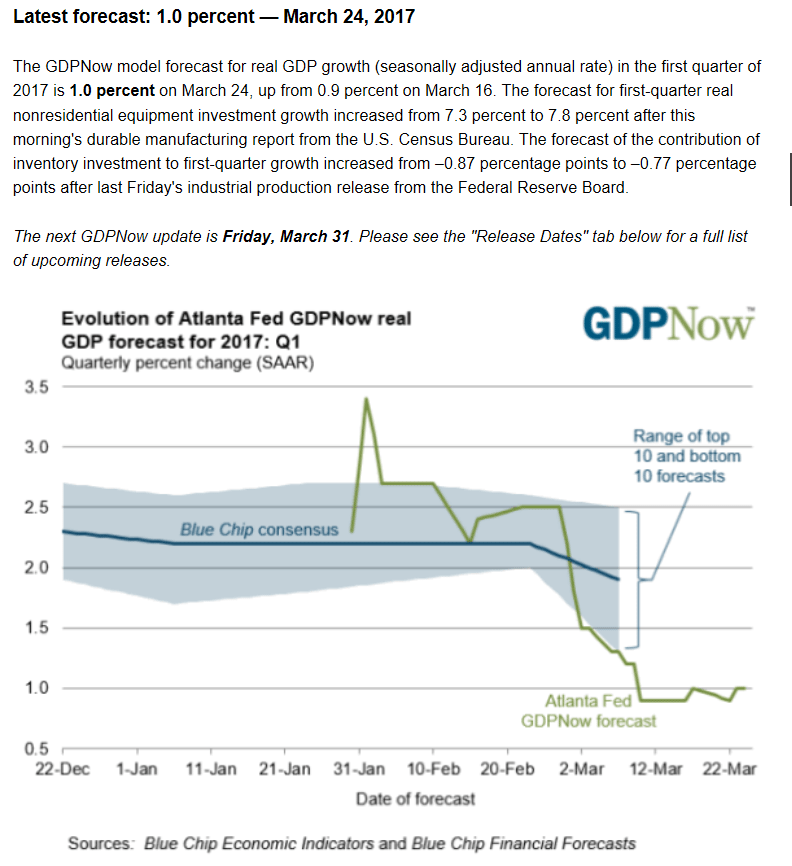
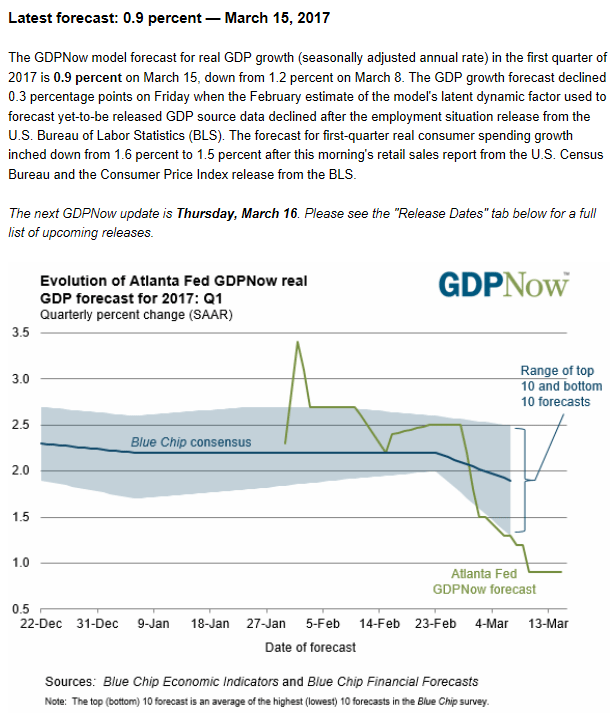
Down again, as is the ‘blue chip consensus’:

Mtg purchase apps, Retail sales, Business inventories, Housing index

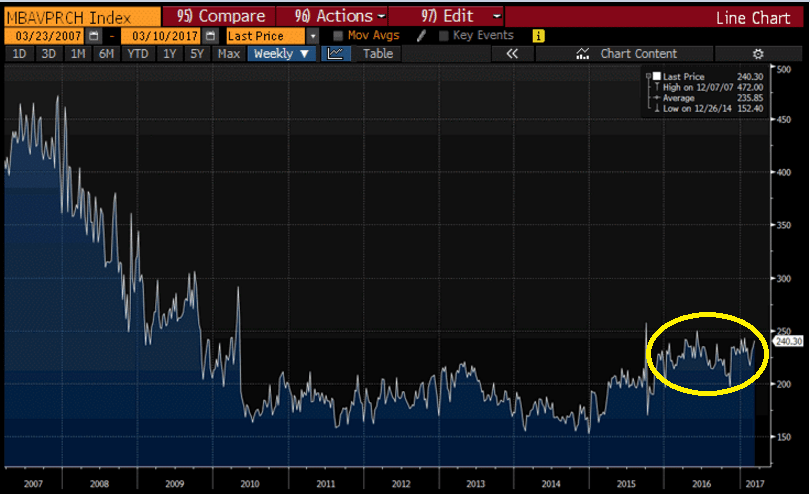
The seasonally adjusted Purchase Index increased 2 percent from one week earlier. The unadjusted Purchase Index increased 3 percent compared with the previous week and was 6 percent higher than the same week one year ago.
Read more at http://www.calculatedriskblog.com/#rYAGsCBZRKvRLYa4.99

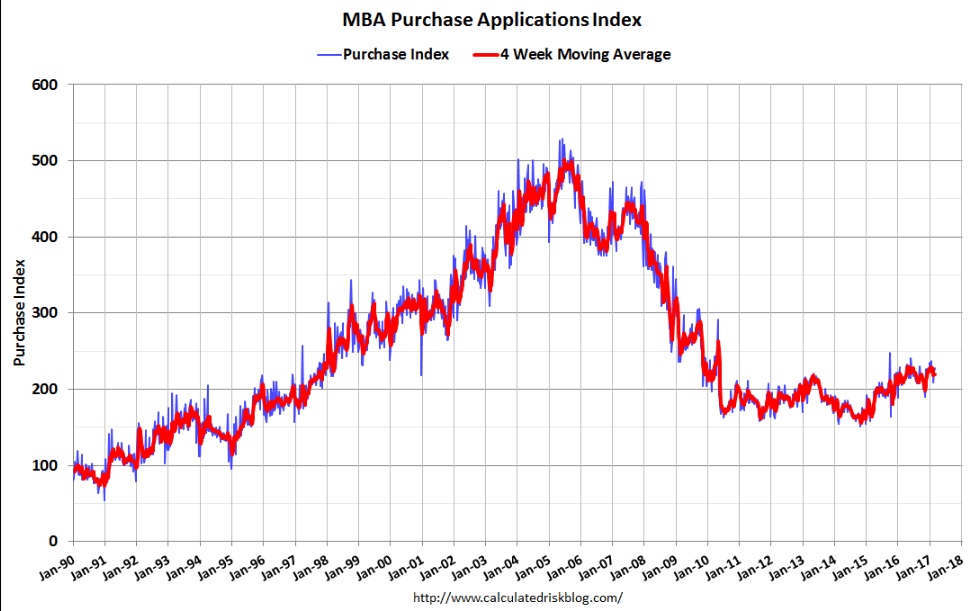
Depressed and moving sideways for over a year:

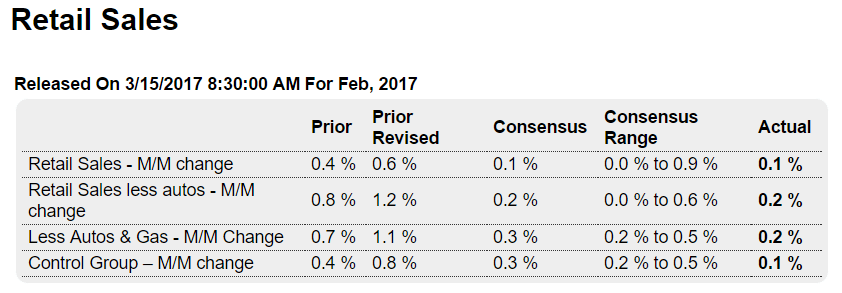
Prior month revised up, but current month worse than expected, and I suspect the seasonal adjustments a nominally small increase in sales to translate into a much larger seasonally adjusted number, to be reversed later in the year:

Highlights

February and January have to be averaged but together they confirm strength in the consumer. Retail spending could manage only a 0.1 percent gain in February but January, which was already solid, is now revised 2 tenths higher to 0.6 percent.

A surprising point in this report is that these headline gains, though less than astonishing, were made despite weakness in the motor vehicle component which had been strong late last year and makes up about 1/5 of total retail spending. Auto sales fell 0.2 percent in February and 1.3 percent in January. Excluding autos, February retail sales rose 0.2 percent with January showing a standout 1.2 percent surge which is the strongest monthly gain in 5 years, since February 2012.

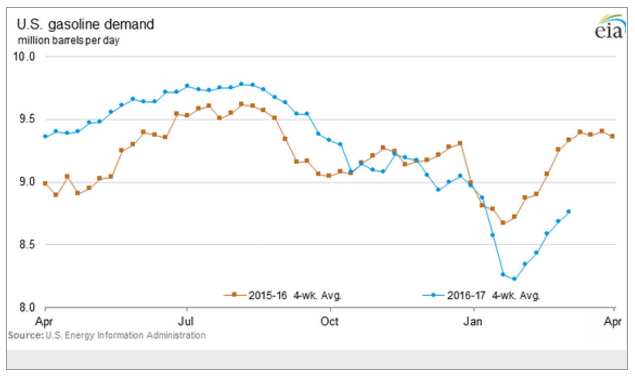
Gasoline pulled down February’s results, falling 0.6 percent after rising 2.1 percent in January. When excluding both autos and gasoline, sales rose 0.2 percent vs January’s very strong 1.1 percent. And control group sales, which are another core measure, inched only 0.1 percent in the month but follow an outstanding 0.8 percent gain in January, one that initially posted at 0.4 percent.

It’s the January revision that is most striking and which points to an upward revision for total consumer spending in the national accounts, one that came in at only 0.2 percent in the initial January report. Yet even the two months together, retail sales, though solid, are far from the astonishingly strong readings underway in consumer confidence, a mismatch that will play out in the months ahead. Another factor to note is that January and February are the two slowest months for retail sales, which makes for an outsized effect from seasonal adjustments.


Still high and still coming down and thereby weakening output and gdp. Auto inventories are particularly bloated due to lower sales:

Highlights

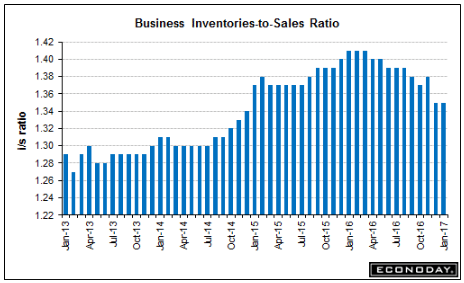
Inventory growth looks moderate and stable, at an expected 0.3 percent in January and roughly in line with underlying sales growth which came in at an even more moderate 0.2 percent. The inventory-to-sales ratio is unchanged at 1.35.

Heavy auto inventories at dealerships are key right now in the inventory picture, and weakness in auto sales (posted this morning in the retail sales report) doesn’t point to much of a draw for auto inventories in February. Dealership inventories in January surged 2.4 percent with total retailer inventories at plus 0.8 percent. Excluding autos, however, retail inventories were unchanged. Manufacturer inventories rose a steady 0.2 percent in January with wholesalers reporting a 0.2 percent draw.


Trumped up expectations:

Highlights

Strong optimism is the theme of so many reports including the housing market index which is up a very sharp 6 points in March to 71 for the best reading of the economic cycle. Home builders peg current sales at an index of 78, up 7 points from February, and see future sales also at 78, for a 5 point gain. And their assessment of traffic is perhaps most telling, at 54 for an 8 point gain. This is the 3rd plus 50 score for this reading in the last 4 months and it suggests that first-time buyers, who have held down the housing sector this cycle, are also optimistic and are looking to buy a new home.

This report points to strength for permit data in tomorrow’s housing starts report and also to strength in next week’s report on new home sales. But optimism doesn’t always translate into immediate strength for hard economic data and it’s important to remember that new home sales have been struggling in recent months.

NFIB index, Redbook retail sales, Oil

Trumped up expectations falling off some,
and the details don’t look so good:

Highlights
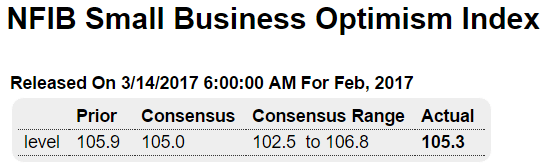
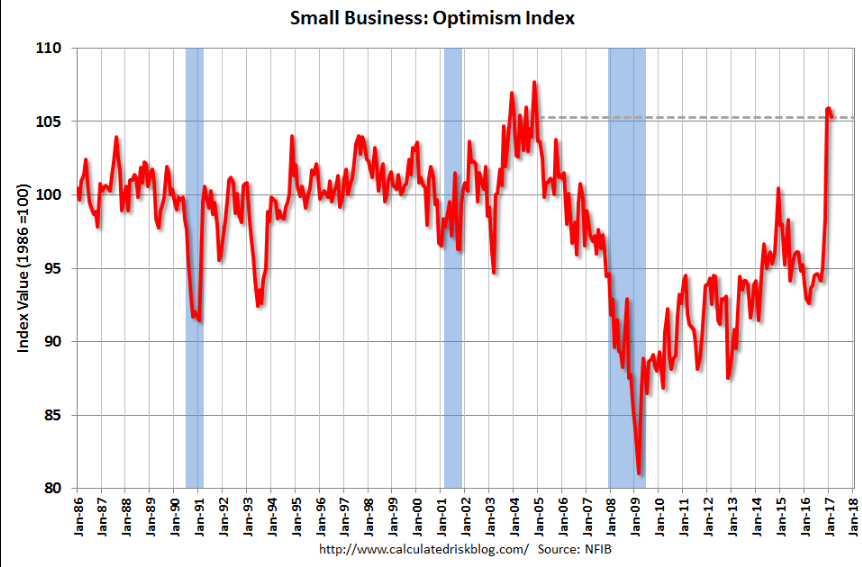
The small business optimism index fell 0.6 points in February to 105.3, retreating slightly from the lofty levels reached in the previous months after the post-election surge in November and the largest increase in the history of the survey in December that shot the index to the highest reading since December 2004. The small decrease was in line with expectations and the fact of the index remaining above 105 for three consecutive months indicates the continuation of a very high level of optimism for small business owners.

Of the 10 components of the index, 3 slightly increased, 6 modestly declined and 1 remained unchanged. Current inventories rose 3 points to minus 2 and plans to increase inventories increased by 1 point to 3. Current job openings also rose by 1 point to 32, the highest level since December 2000. But plans to increase employment fell 3 points to 15, as did expectations of higher real sales, which fell to 26, and the view that now is a good time to expand, which also dropped 3 points to 22.

NFIB noted that business owners are being squeezed, on the one side by historically tight labor markets, where the scarcity of qualified workers pressured 26 percent of owners to raise compensation, the highest reading in 10 years. At the same time, owners are limited in how much they can increase compensation since they are not so confident of their ability to pass on the costs by raising prices for consumers. Although business owners reported higher sales in February, which rose to the first positive reading since early 2015, expectations of future higher sales did fall 3 points. And earnings trends, the outlier negative among the components, remain quite weak and weakened further in the month by 1 point to minus 13.

Though an exceptionally large net 47 percent of small business owners still expect the economy to improve, a decrease of only 1 point from the January survey, the question remains whether small business owners will turn their optimism into action. According to NFIB, this will happen when their two biggest priorities, health care and taxes, are addressed.


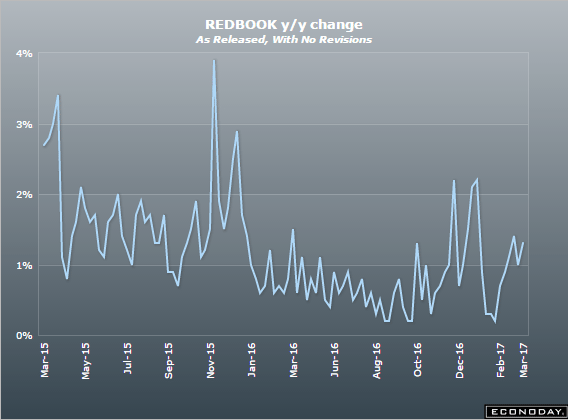
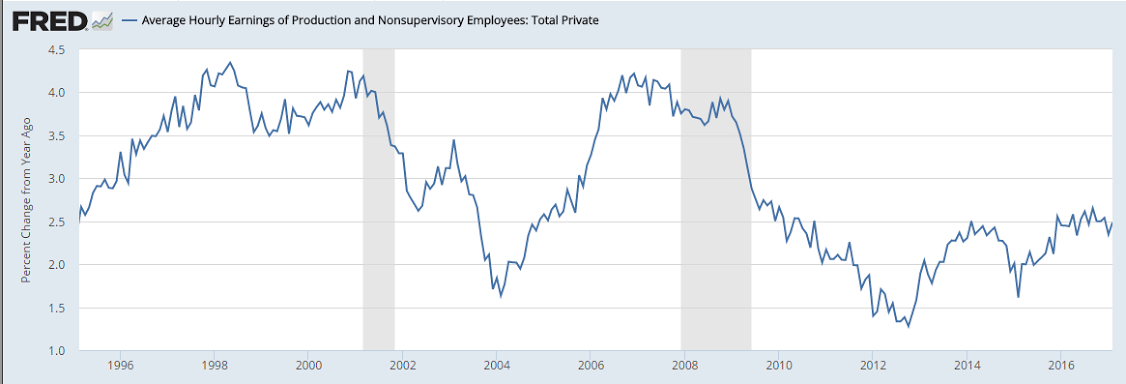
Marginally better but nowhere near the 3-4% gains from before oil capex collapsed:

No telling what they might do next:

Payrolls, Gasoline demand

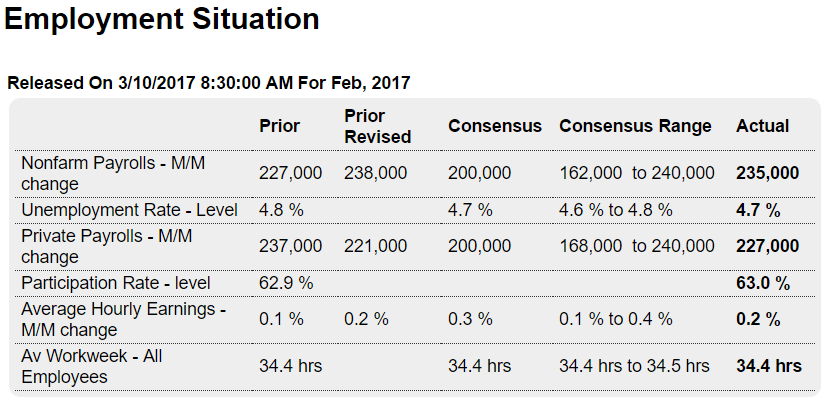
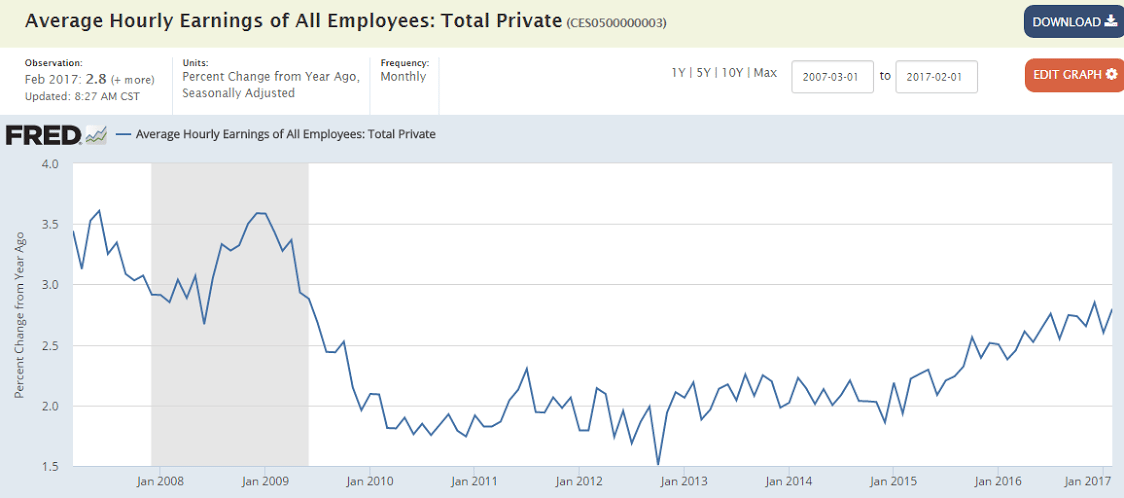
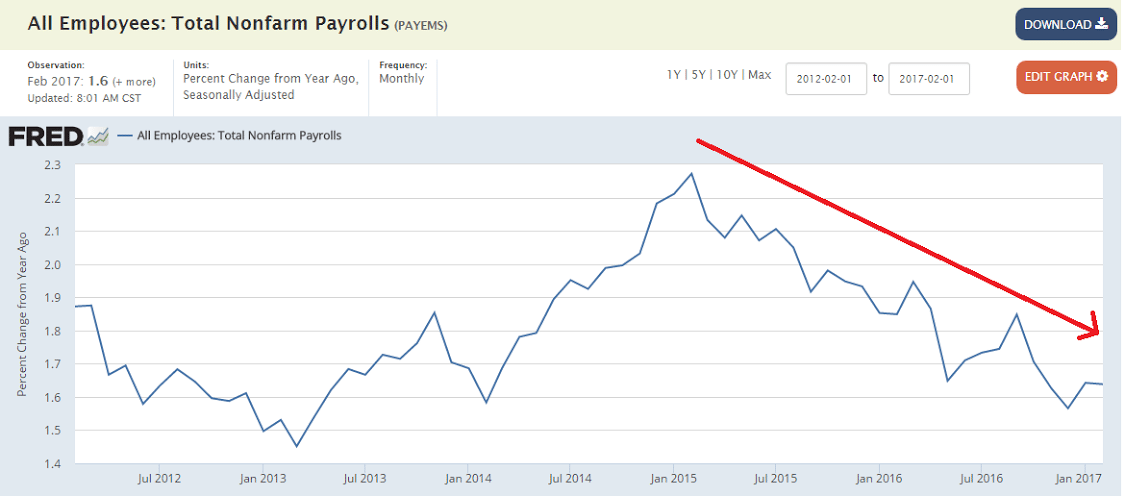
Better than expected, but not nearly enough to even begin to conclude that the multi year deceleration has reversed:


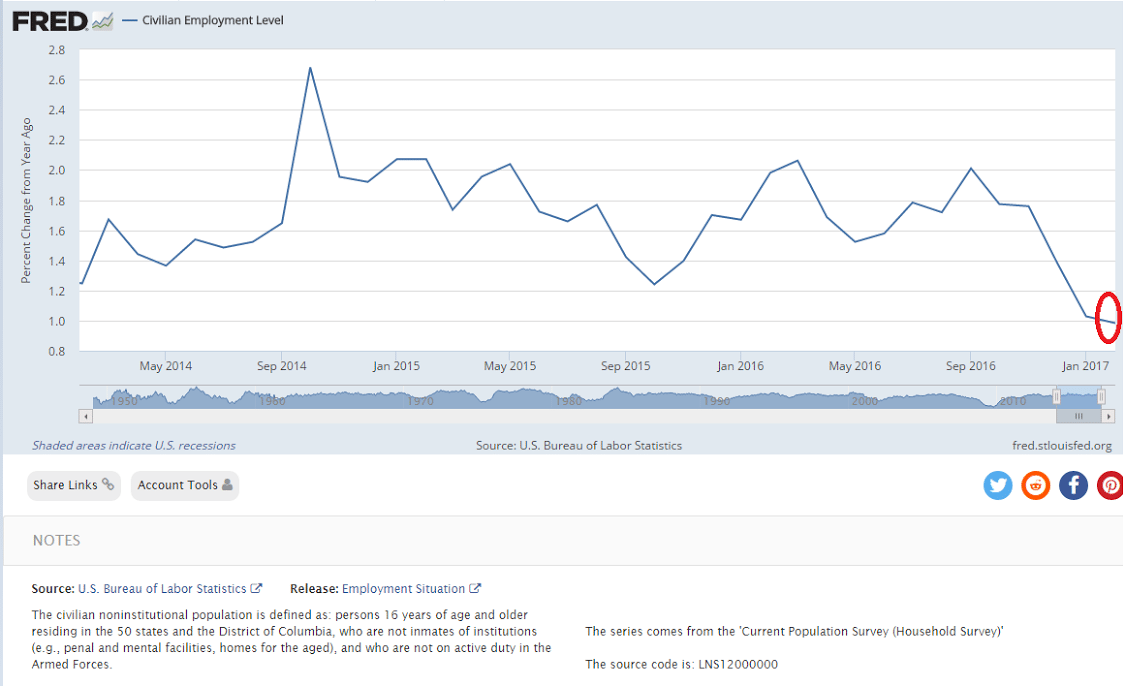
This chart does not tell me this multi year downtrend has been broken:


And growth of the household survey is down to 1% year over year:


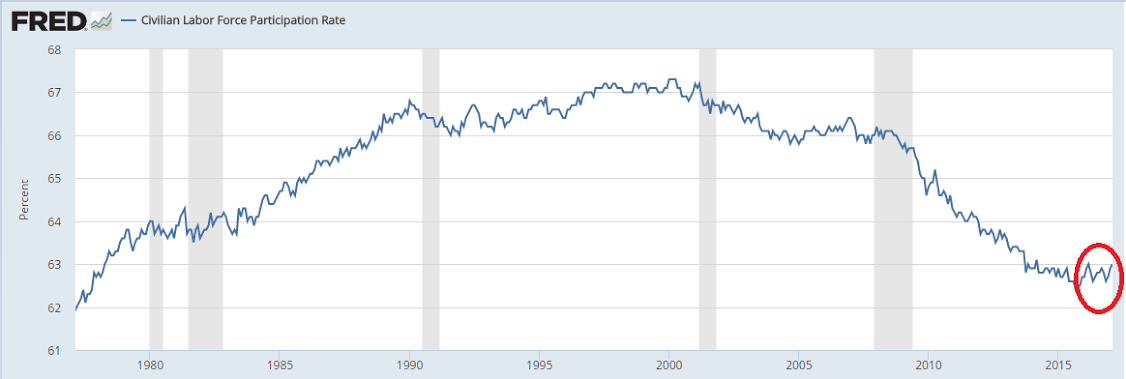
Participation seems to be settling in at depressed levels not seen since before women started entering the labor force:


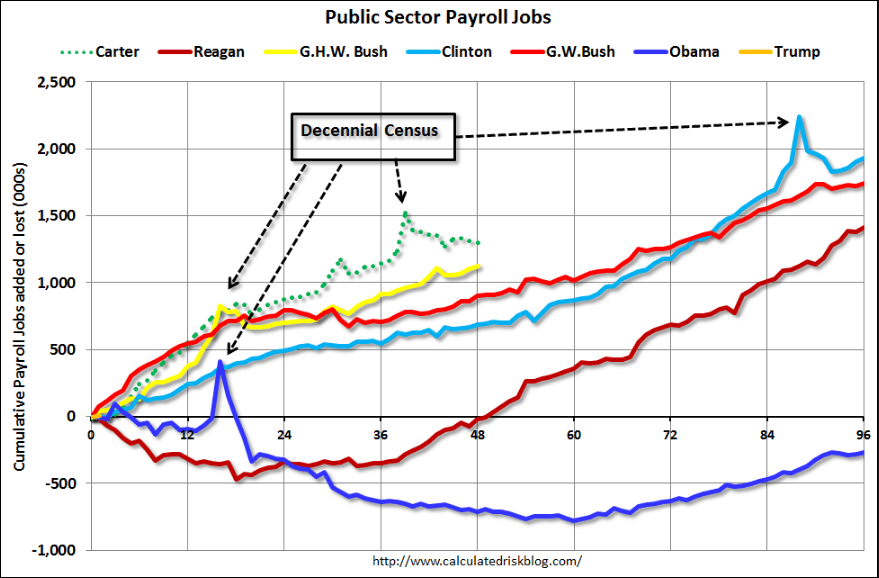
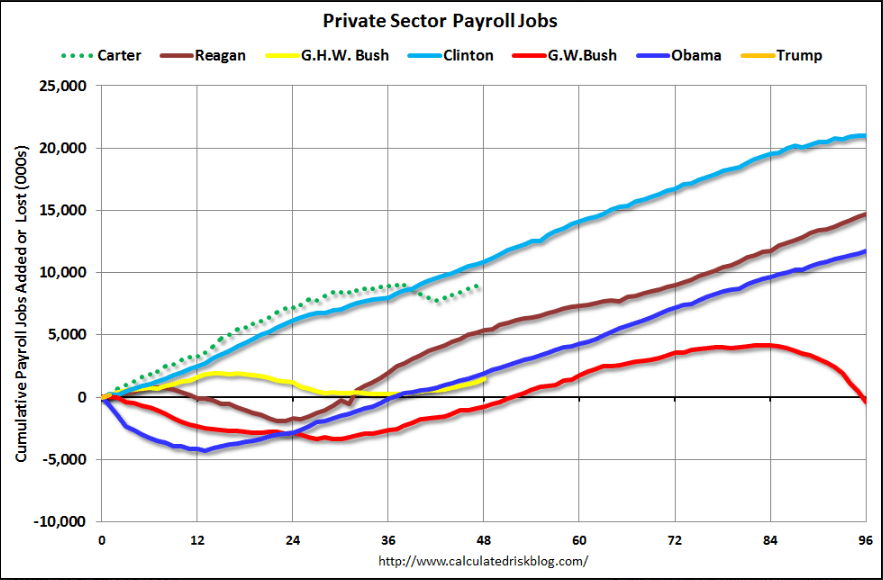
Compare the recent gains with those of prior cycles:


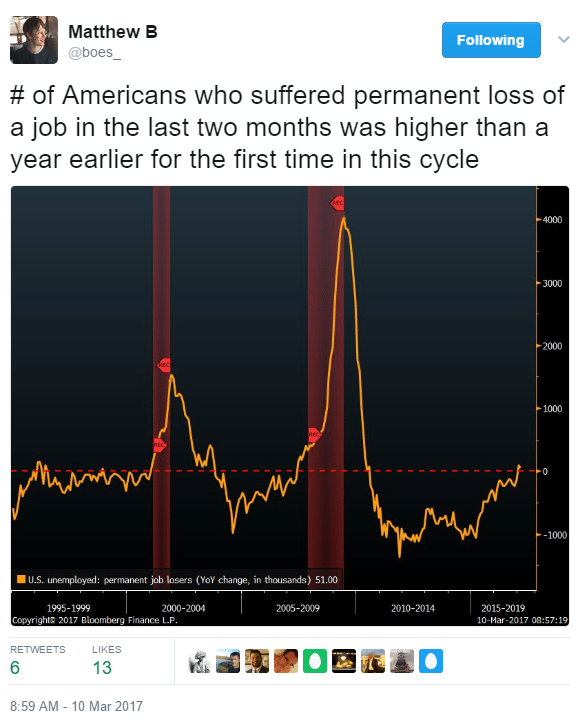
Above 0 has coincided with recession:


Obama the Tea Party hero:


Substantial drop:

Mtg apps, ADP payrolls, Wholesale trade, Atlanta Fed GDP forecast, Tax refund delays

The growth rate has slowed and the level of apps remains depressed:


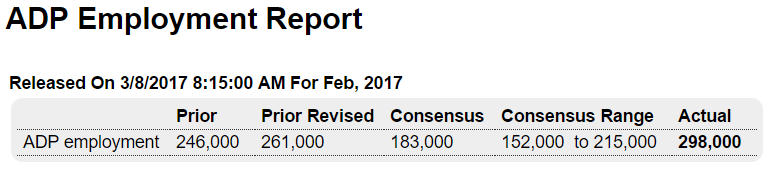
Nice move up. This is just a forecast of Friday’s number:

Highlights

The February employment report looks to be a blockbuster based on ADP’s estimate for giant growth of 298,000 in private payrolls. This would be the biggest gain since October 2015 and one of the very largest of the cycle. ADP isn’t always followed closely but its call last month for outsized growth in January payrolls did prove correct.

Mark Zandi, chief economist of Moody’s Analytics said, “February was a very good month for workers. Powering job growth were the construction, mining and manufacturing industries. Unseasonably mild winter weather undoubtedly played a role. But near record high job openings and record low layoffs underpin the entire job market.”
Read more at http://www.calculatedriskblog.com/#Gvm71i5cM1idEJoW.99

Highlights

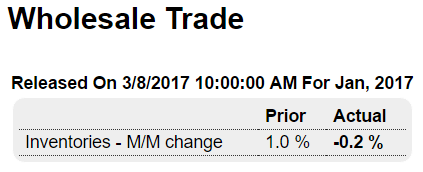
Wholesale inventories fell 0.2 percent in January while sales declined 0.1 percent, a comparison that keeps stock-to-sales at a healthy 1.29 ratio. Auto inventories at the wholesale level were depleted in the month, down 3.1 percent against a 3.2 percent rise in sales which points to restocking and a gain for auto production.

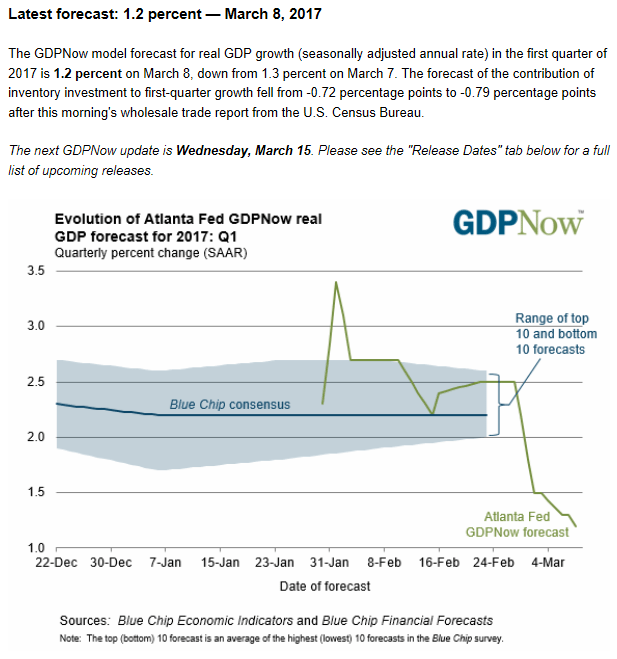
Wholesale inventories have been steady as have factory inventories, though retail inventories have been less lean. Low inventories are a plus for the economy but a negative for the GDP calculation which makes today’s report an early negative for first-quarter GDP. January data on February retail inventories will be posted next week with the business inventories report.

Trumped up surveys while the hard data continues to head way south:

Might explain the recent weakness…

A new law prevented the Internal Revenue Service from paying out refunds for tax returns claiming those credits until mid-February, and the agency warned those households not to expect access to their money until Feb. 27 due to processing and other delays.

The law, intended to prevent fraud by giving the IRS time to double-check income data, caused many refund payments to go out later than usual this year. As of Feb. 10, the IRS said it sent out 14.1 million refunds totaling $28.93 billion—down sharply from 2016, when 29.2 million refunds totaling $94 billion were sent through Feb. 12. The tax agency began to release those postponed payments around the middle of the month and by Feb. 17, the IRS said it had sent 32.9 million refunds totaling $103.24 billion.