Industrial production, China retail sales, Miles driven, Federal interest payments, Budget charts

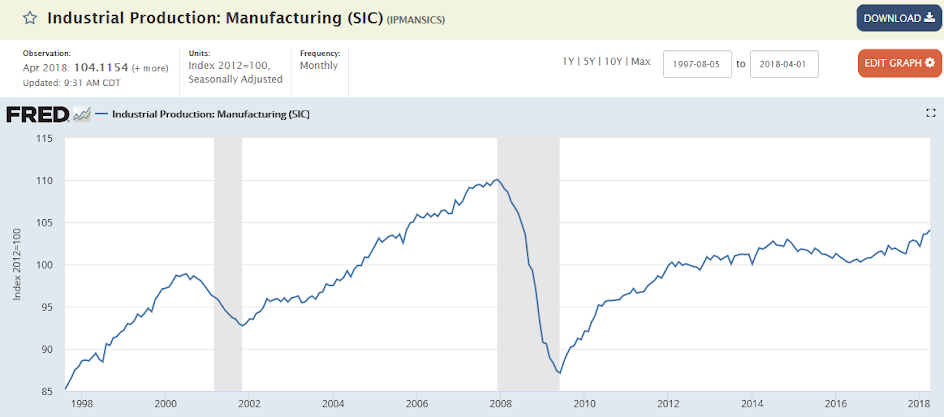
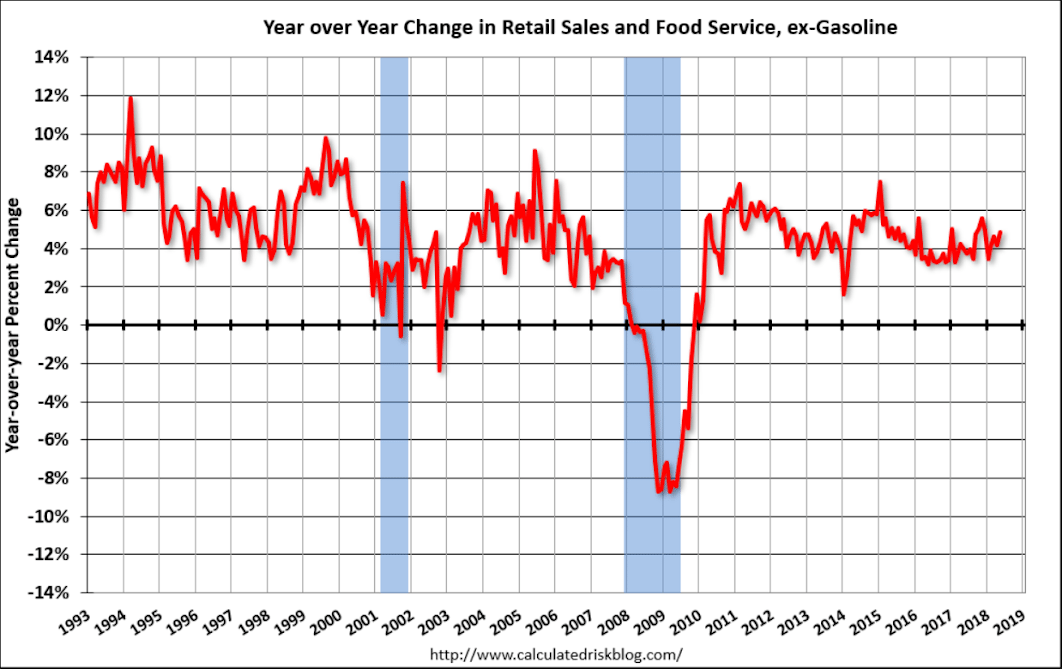
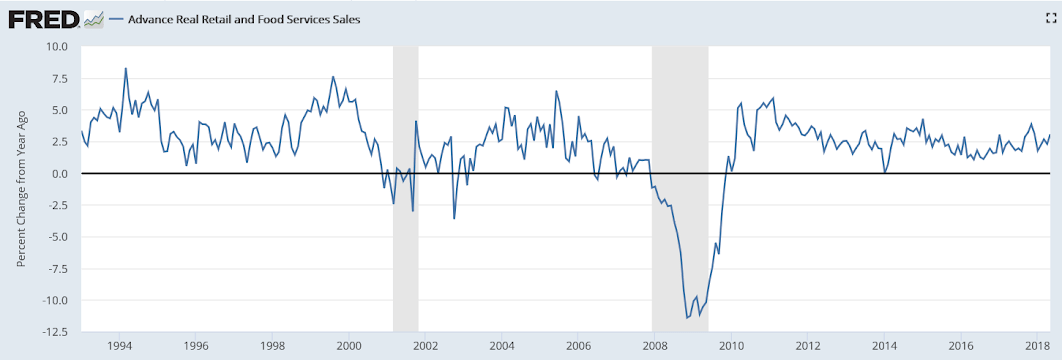
A weaker than expected print due to auto sales which have been volatile, but charts show it’s still chugging along at a modest pace:

Highlights

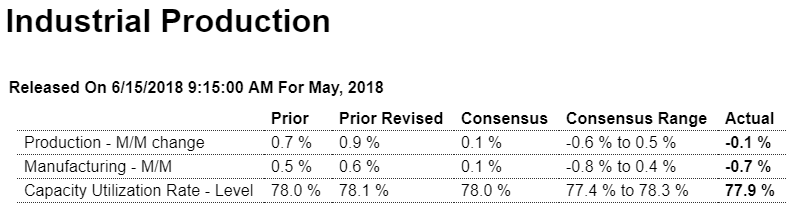
A big drop in autos skewed industrial production lower in May, slipping 0.1 percent and missing what was an already soft consensus by 2 tenths. Manufacturing volumes fell a very steep 0.7 percent, pulled down by a 6.5 percent monthly drop in motor vehicles that itself reflected the effects of a fire early in the month at a supplier in Michigan.

Yet readings outside autos are also soft with hi-tech production up only 0.2 percent and production of business equipment down 1.1 percent. Excluding autos, manufacturing production fell 0.2 percent in the month. The manufacturing component of this report never really has shown the kind of strength being posted by factory shipments or factory orders.

Manufacturing makes up the great bulk of industrial production and once again is overshadowing another standout month for mining which surged 1.8 percent. Year-on-year mining production is up 12.6 percent vs only a 1.7 percent rate for manufacturing. Utility production has been mixed, up 1.1 percent in May for 4.0 percent yearly growth.

Capacity utilization is over 90 percent for mining at 92.4 percent vs 79.4 percent for utilities and 75.3 percent for manufacturing. Utilization overall, down 2 tenths to 77.9 percent, is not extreme and points to available slack in the industrial sector.

Putting mining and utilities aside, industrial production is once again an anomaly, not pointing as other reports to building strength and a rising tempo for the nation’s factory sector.

Note that traditional non-NAICS numbers for industrial production may differ marginally from NAICS basis figures.


Growth slowing:

Will the tax cuts and spending increases save us?

Jobless claims, Retail sales, Bank lending, Fed comments

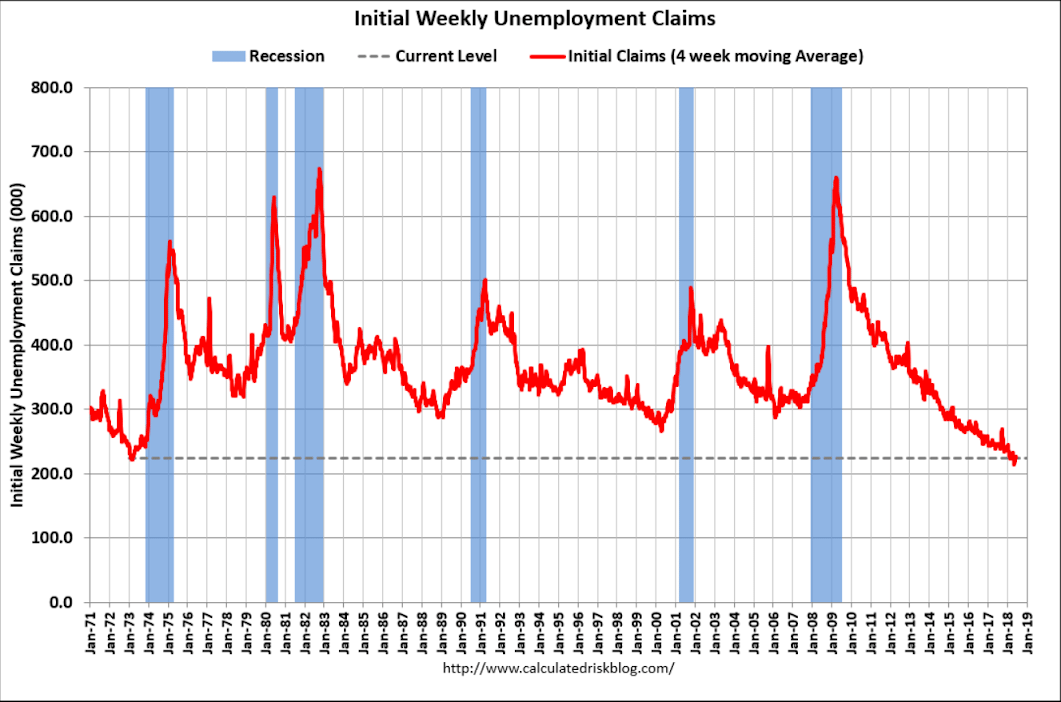
Just a reminder (from 2015) as to why claims are this low:


This is not population adjusted:


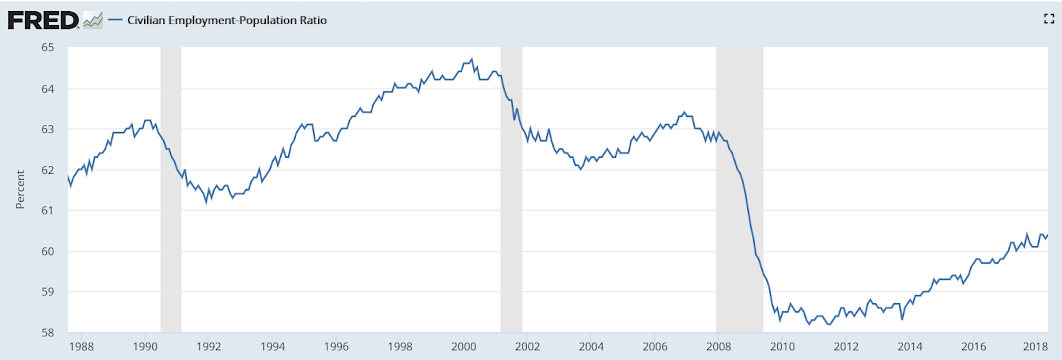
We haven’t yet to recover from the last recession, in my opinion due to an ongoing lack of demand:

Highlights

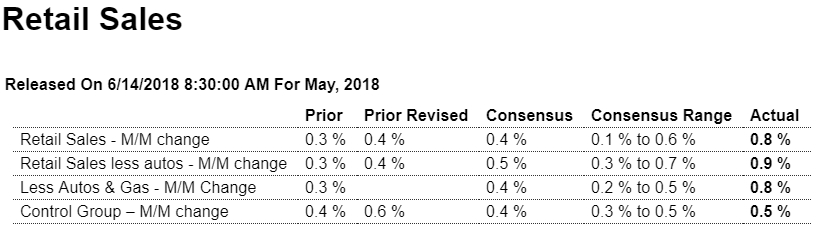
The FOMC said yesterday that household spending has picked up and indeed it has. Retail sales jumped 0.8 percent in May which easily tops Econoday’s high estimate. And the results include an upward revision to April which now stands at a 0.4 percent gain.

The report shows balanced gains including a 1.3 percent jump at restaurants and a 0.5 percent increase for motor vehicles, both pointing to rising discretionary demand. Building materials, which have been soft, surged 2.4 percent in what will be a plus for residential investment. Department stores have been very weak but have now put together back-to-back gains of 1.5 percent in May and 0.7 percent in April. Clothing stores, at 1.3 and 1.2 percent, have likewise bounced back with sizable gains the last two months. Gasoline sales have risen 2.0 and 1.0 percent in May and April on higher prices. Disappointments include a decline for furniture in May and only a 0.1 percent rise for nonstore retailers (e-commerce).

It was only a few weeks ago that the Fed’s Beige Book had downgraded consumer spending to “soft” which highlights the importance of today’s report, one that, as far as the Fed at least, marks a pivot upward. Consumer spending so far this year has been mixed but given the strength of the jobs market, improvement should be no surprise.


Muddling through at rates of growth that exceed personal income growth, so seems unsustainable:


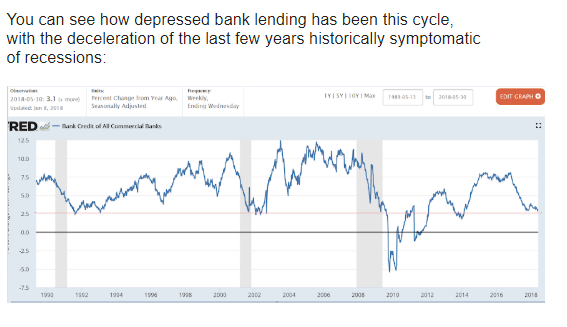
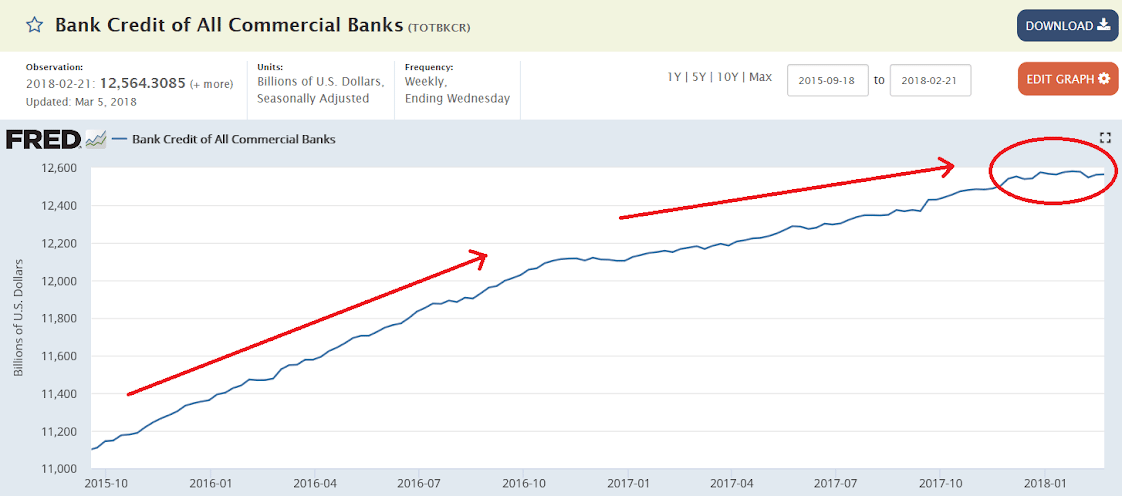
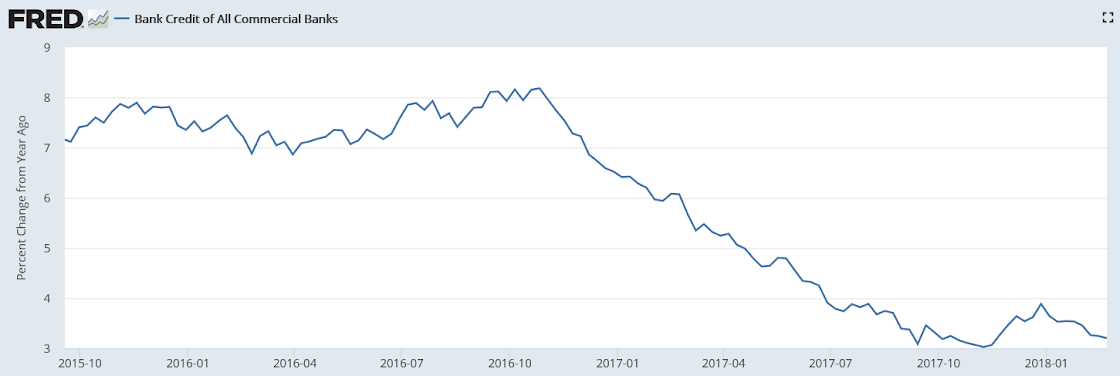
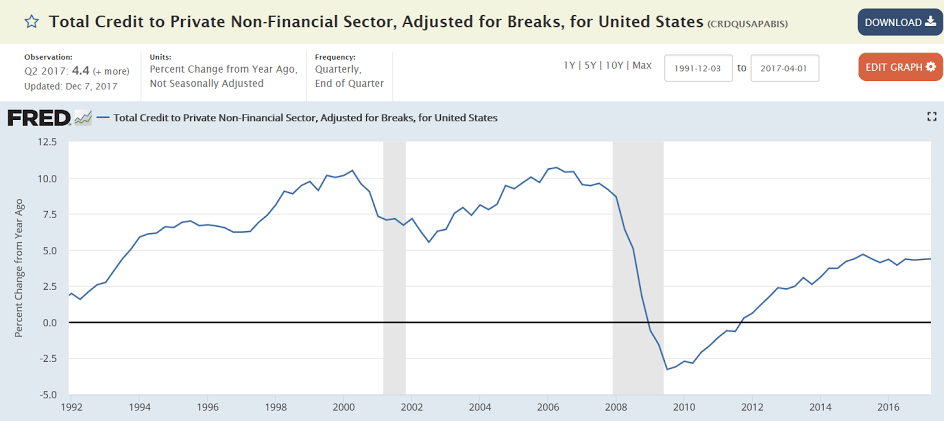
Bank lending:

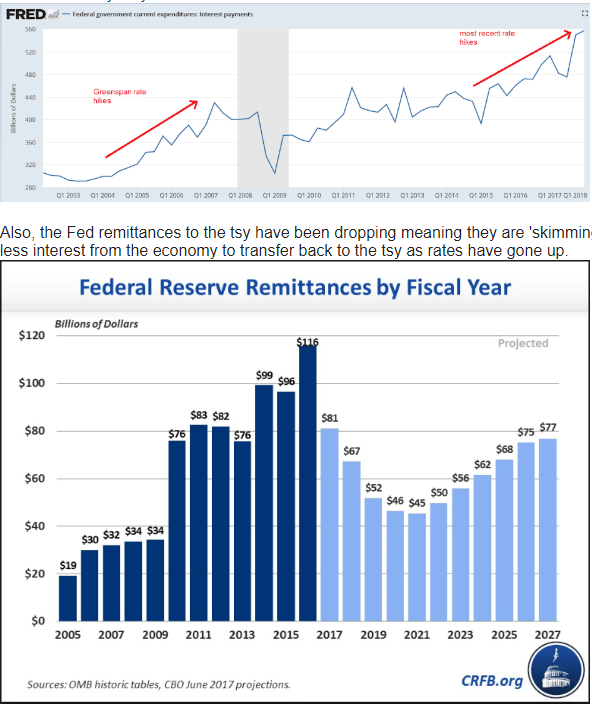
Like the hair dresser said, ‘no matter how much I cut off, it’s still too short.’ Raising rates supports the economy via the interest income channels, and the higher the debt to gdp ratio the larger the effect. (Paying interest is like basic income for people who already have $…) That is, the Fed has it backwards. They think they are stepping on the brakes when they are stepping on the accelerator with regards to the economy and inflation:

Fed Raises Interest Rates, Sets Stage for Two More Increases in 2018

(WSJ) Eight of 15 officials now expect at least four rate increases will be needed this year, up from seven in March and four in December. Most officials expect the Fed would need to raise rates at least three more times next year and at least once more in 2020, leaving rates in a range between 3.25% and 3.5% by the end of 2020, the same end point officials projected in March. The statement dropped language added four years ago that said officials expected to hold their benchmark rate “for some time” below a neutral setting. Nine of 14 officials putting neutral at either 2.75% or 3%.

Trade, Consumer credit

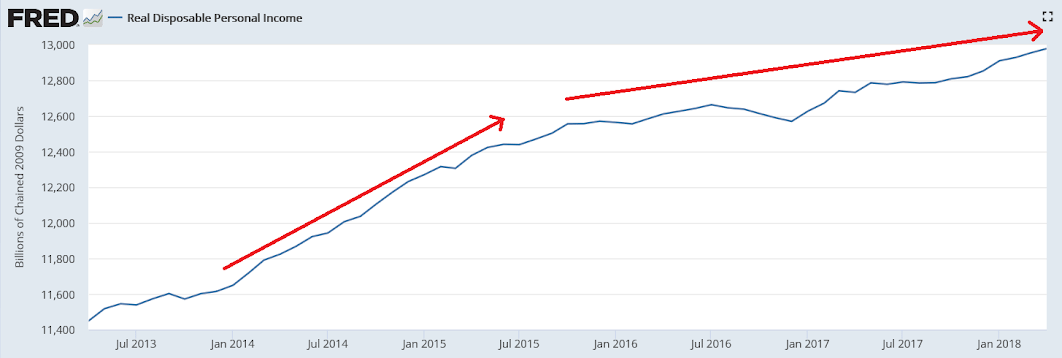
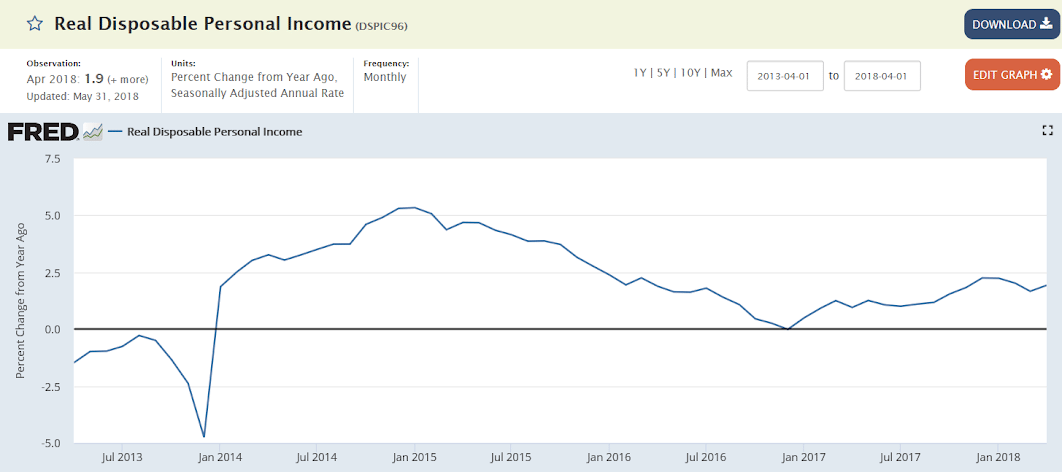
The trade deficit narrowed but due to a drop in consumer spending on imported cell phones, which doesn’t bode well for retail sales, which are under pressure from the reduced growth of real disposable personal income. And the widening trade gap with the euro area is fundamentally euro friendly even as fears of Italian politics are frightening portfolio managers:

Highlights

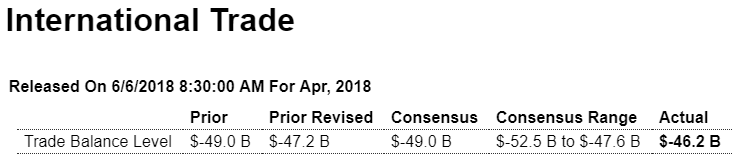
Helped by a dip in cellphone imports, the nation’s trade gap narrowed sharply in April to a much lower-than-expected $46.2 billion. Cellphone imports fell $2.2 billion to pull down the consumer-goods deficit which narrowed by $2.8 billion in the month.

Despite the improvement for consumer goods, the bilateral gap with China rose a noticeable $2.1 billion to an unadjusted $28.0 billion in results that probably won’t ease ongoing trade friction. Note that country data, unlike other data in this report, are traditionally tracked in unadjusted terms due to small monthly totals yet adjusted data for China are available and tell a different story with the gap at a higher level of $30.8 billion but down in month-to-month terms from an adjusted $34.2 billion in March.

Turning back to unadjusted country data, the gap with Europe also deepened, by $2.5 billion in April to $14.6 billion with the Japanese gap little changed at $6.3 billion. Turning to North America, the gap with Mexico narrowed by $2.4 billion to a deficit of $5.7 billion while a small March surplus with Canada turned into a $785 million deficit in April.

Imports of iron and steel mill products rose $228 million to $2.1 billion with imports of bauxite and aluminum up slightly to $1.5 billion. It will be interesting to watch whether these totals, due to U.S. tariffs on steel and aluminum, begin to slide in the month’s ahead.

Overall, exports rose 0.3 percent in the month to $221.2 billion with goods, led by a gain for industrial supplies and also food, up 0.2 percent at $141.3 billion and despite a 0.1 percent slip in service exports which totaled $70 billion. Imports fell 0.2 percent with goods, again reflecting the weakness in cellphones, down 0.3 percent to $209.5 billion and services up 0.6 percent to $47.9 billion.

April’s deficit is more than $1 billion narrower than March and far under the $53.1 billion monthly average of the first quarter. This points to a big net-export lift for second-quarter GDP.

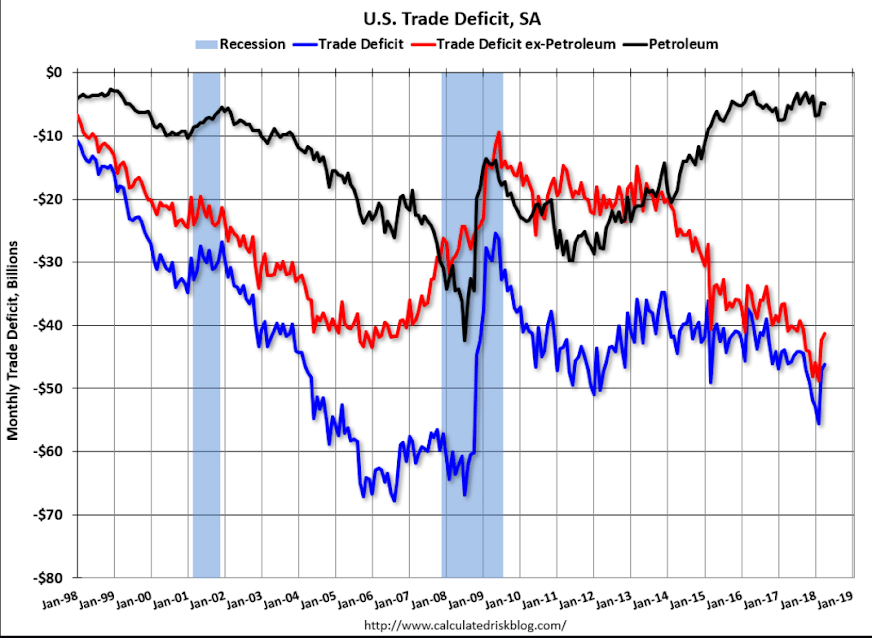
The petroleum deficit appears to have leveled off, while trade overall still looks to be trending further into deficit, recognizing the volatility around year end:


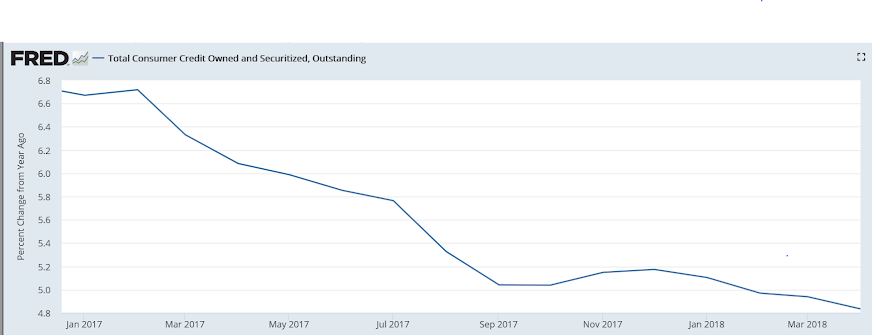
Deceleration continues:

Highlights

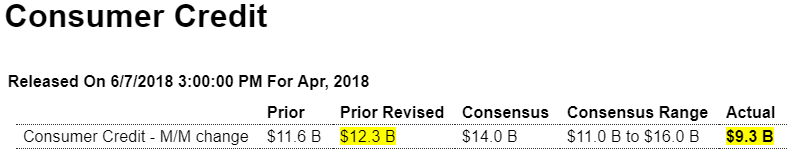
Consumer credit rose a lower-than-expected $9.3 billion in April though consumers did run up their credit-card debt slightly as revolving credit, which was in the negative column the last two reports, rose $2.3 billion in the month. Nonrevolving credit, which includes student loans and also vehicle financing and which often posts double-digit gains, rose only $7.0 billion in the month.

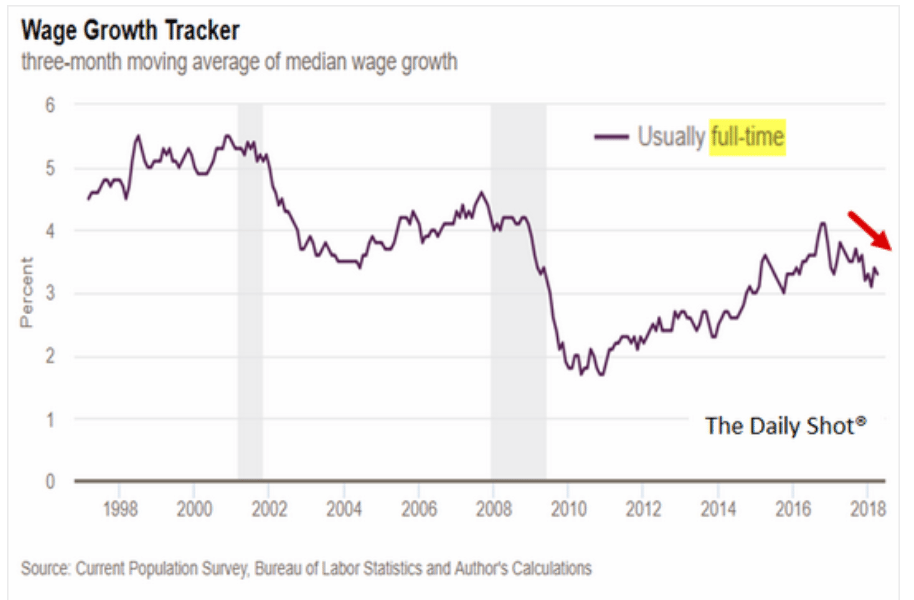
Retail sales, Mtg apps, Housing starts, Industrial production, Wage growth tracker

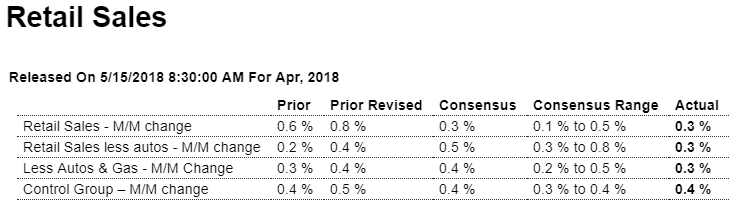
Pretty much as expected. These numbers are not adjusted for inflation, which is running around 2%:
Highlights

Consumer spending was weak in the first quarter and the first look at the second quarter is no better than moderate. Total sales rose an as-expected 0.3 percent in April which pretty much tells the story of the month. Vehicle sales, despite a decline in previously reported unit sales, did post a rise of 0.1 percent in the month which is very respectable given the oversized comparison with March when sales jumped 2.1 percent. Gasoline sales rose an outsized 0.8 percent on higher prices in the month and when excluding both vehicles and gas, retail sales matched the 0.3 percent showing at the headline level.

Details throughout the report are mixed: furniture, which offers a reading on housing demand, extended recent strength with a 0.8 percent gain but restaurants, and their indication on discretionary spending, fell 0.3 percent but following a sharp gain in February. Apparel sales, which have been mixed, surged 1.4 percent but sales at department stores, which have been very weak, managed only a 0.2 percent gain. Building materials rose 0.4 percent in another positive sign for residential investment while nonstore retailers, the report’s strongest component, posted a solid 0.6 percent gain.

Control group sales, which are another core measure and a direct input into GDP, rose 0.4 percent which, given the weak comparison in the first quarter, does point to an early lift for second-quarter consumer spending. But the lift is not dramatic especially considering this year’s tax cut, which has raised disposable income, and of course the enormous demand in the labor market. Note that today’s report includes upward revisions to March, up another 2 tenths to 0.8 percent, and a 1 tenth upward revision to February which now stands at unchanged. These revisions will help limit the weakness of consumer spending in the second estimate for first-quarter GDP.

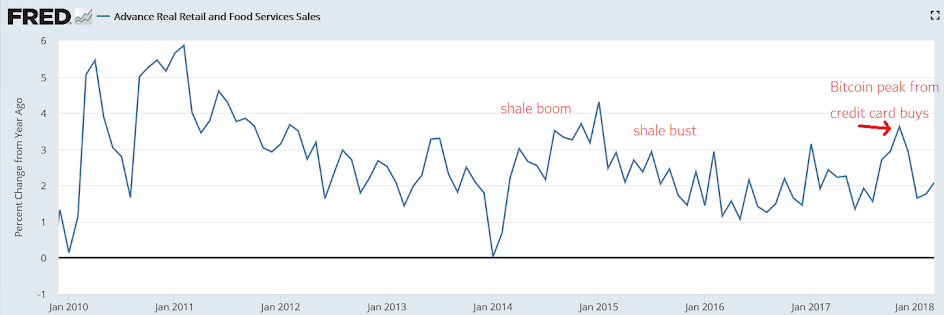
The December spike coincided with a spike in credit card balances, as well as the peak in Bitcoin prices. Seems to have leveled off since then?
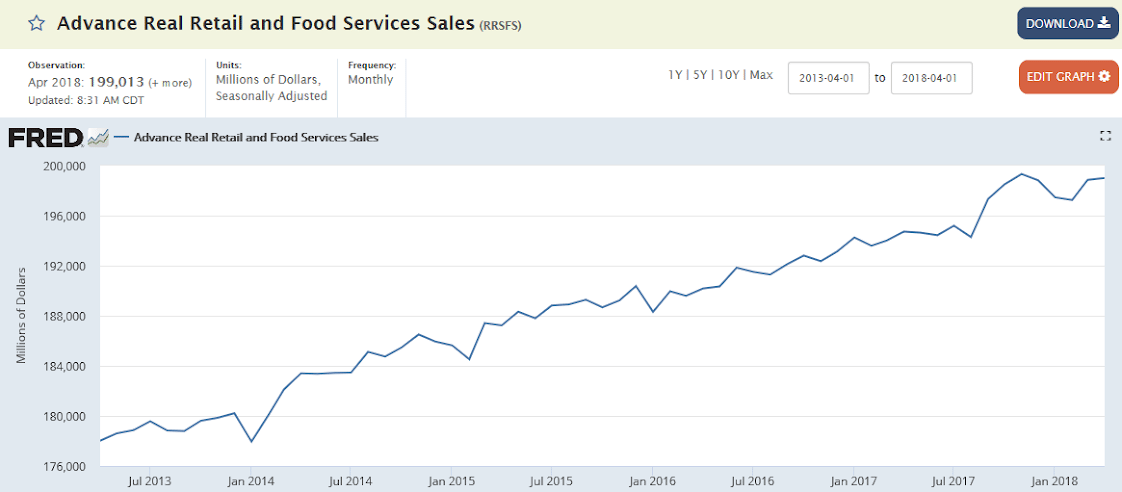
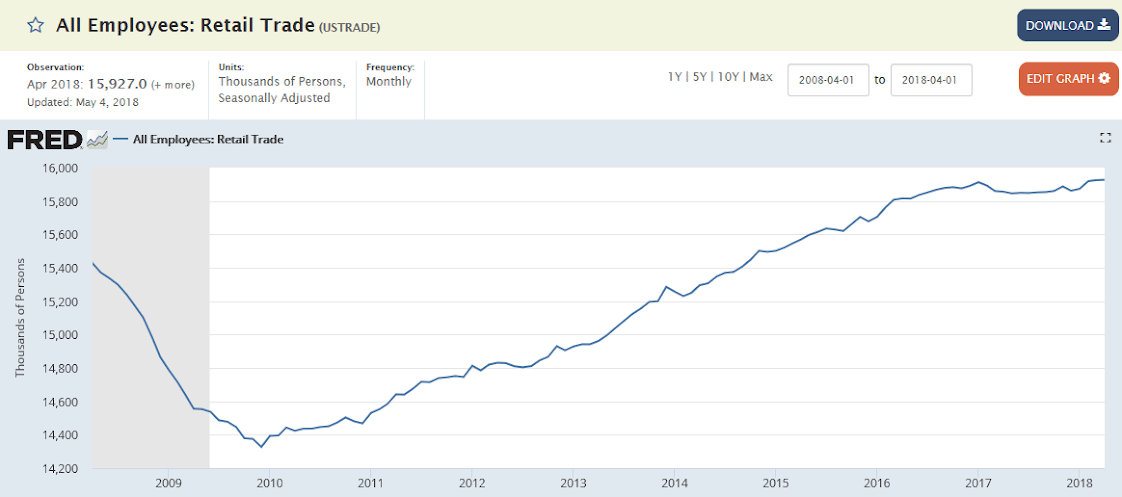
From very modest growth to nearly no growth and only about half what it was some 10 years ago:
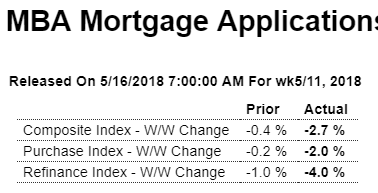
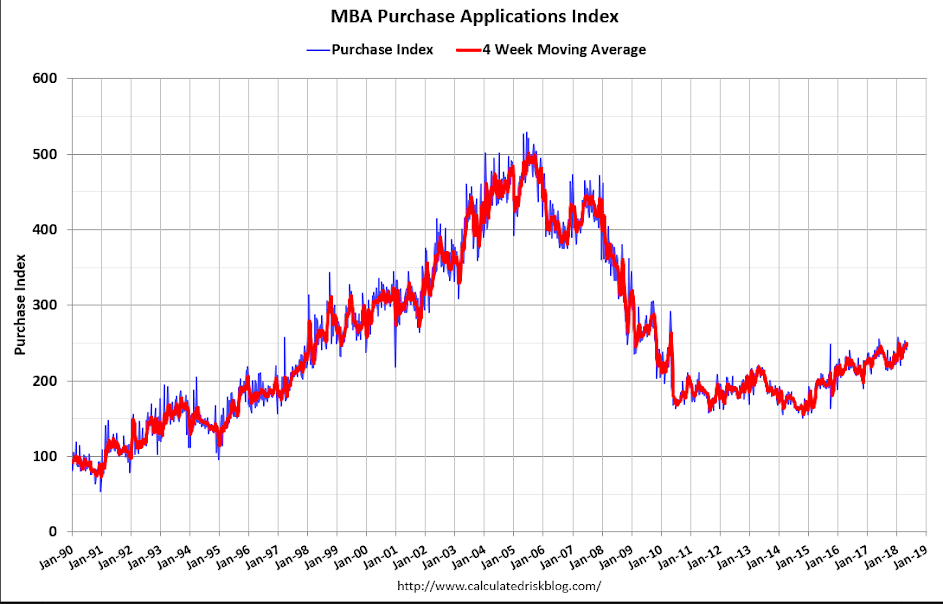
Looks to me like a serious lack of aggregate demand:
Highlights

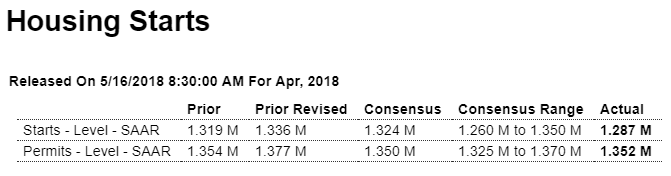
Despite headline declines, the housing starts and permits report for April is mostly positive. First the negatives: starts fell 3.7 percent in the month to a lower-than-expected 1.287 million annualized rate while permits fell 1.8 percent to an as-expected 1.352 million rate. The decline for both starts and permits reflects give back from multi-units which fell sharply in April after rising sharply in March.

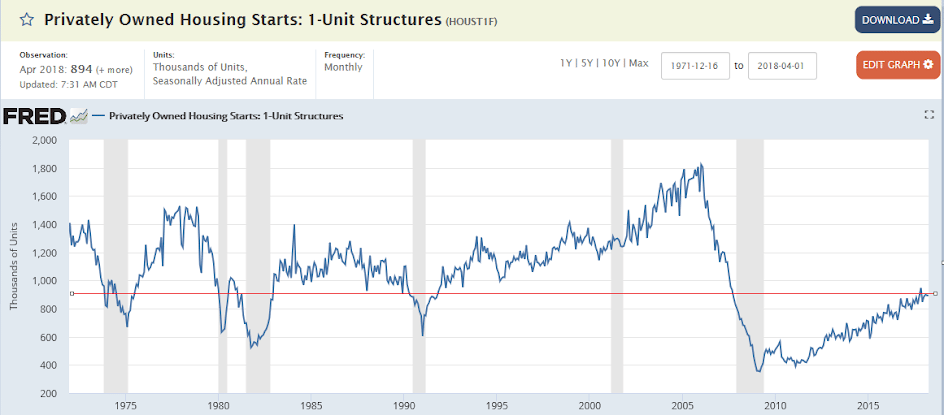
Steady readings for single-family homes are the positives in today’s data. Starts here posted a 0.1 percent increase to an 894,000 rate while single-family permits, which are the best news in the report, rose 0.9 percent to an 859,000 rate. But not all the single-family news is positive as completions fell 4.0 percent in the month to an 820,000 rate for a decline that is not welcome in a housing market starved of supply.

But behind all the volatility in the numbers is a housing sector that continues to climb at a solid rate, reflected in year-on-year change that shows total starts up 10.5 percent and permits up 7.7 percent.

Slowly climbing back to levels historically seen only in recessions, and these numbers are not population adjusted:

No growth here since oil capex collapsed about 2 1/2 years ago;
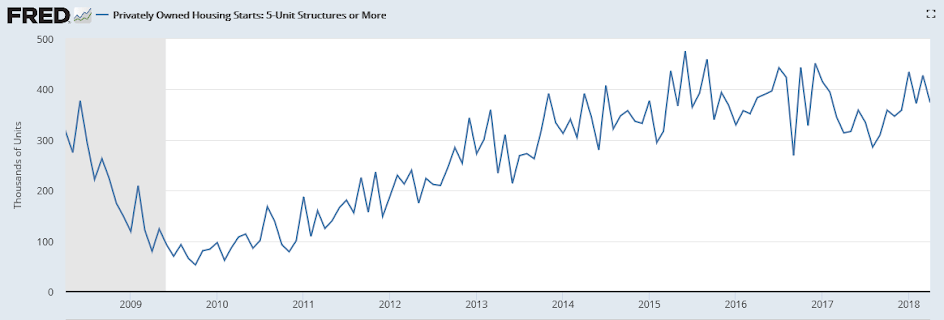

Back through the 2015 highs, growing at modest rates;
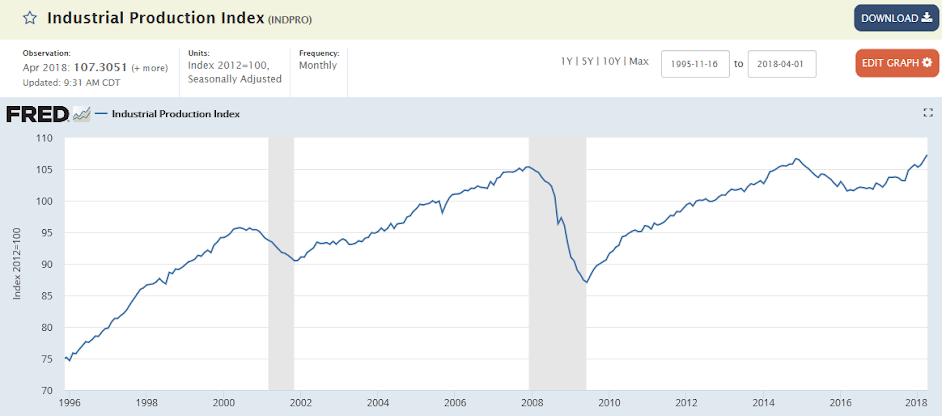

Led by oil, though oil related capital expenditures aren’t back to where they were:
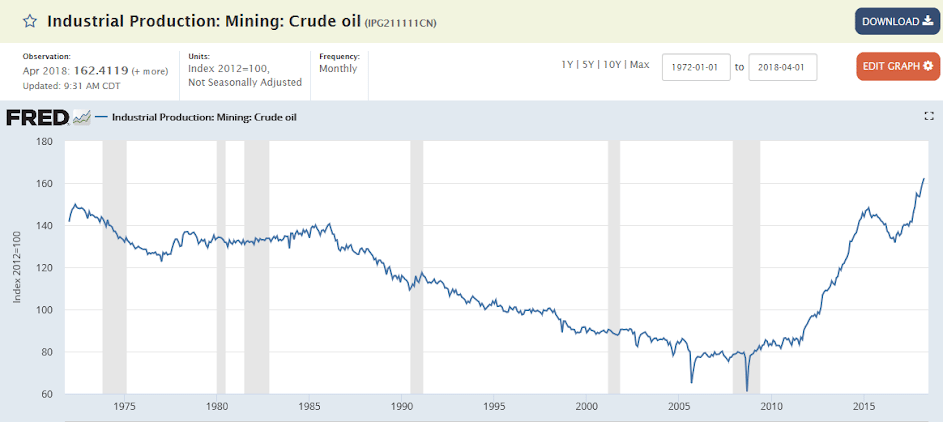

This more general categories have been going mostly sideways since the oil capex collapse:
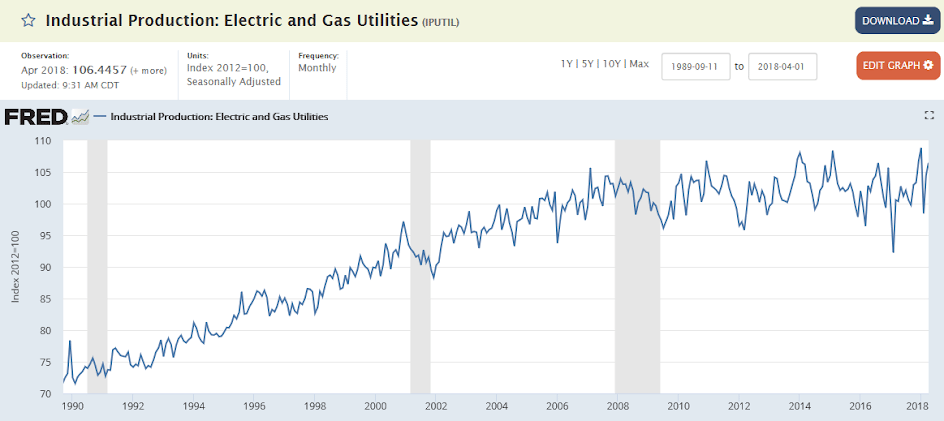

Looks to me like a serious lack of aggregate demand:

Retail sales, Business inventories, Port traffic, Infrastructure

Propped up by autos, as the rest continues weak, and autos aren’t looking so good longer term either:

Highlights

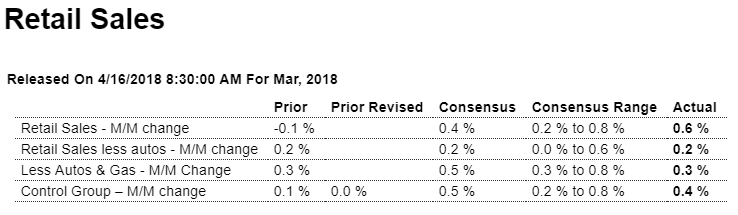
In a slight reversal of expectations, retail sales proved stronger at the headline level, up 0.6 percent in March, than the core readings which did however still post respectable gains at 0.3 percent less autos and gas and 0.4 percent for the control group.

Autos are the big story in March, jumping 2.0 percent and finally shaking off the long lull following the replacement surge of September’s hurricanes. Excluding autos, retail sales managed only a 0.2 percent gain following only 0.2 percent and 0.1 percent gains in the prior two months in results that do not point to much consumer strength.

Department stores are having a very hard time, falling 0.3 percent after February’s 0.9 percent plunge. Clothing stores also posted a big decline in the month, at 0.8 percent, as did building materials at minus 0.6 percent and sporting goods at 1.8 percent. Gasoline proved a bit of a wildcard in this report, falling only 0.3 percent which is less severe than many expected.

But there are positives in the report including a second straight 0.4 percent gain for restaurants and a second straight solid rise, at 0.7 percent, for furniture stores. And nonstore retailers are once again at the top of the data, at a 0.8 percent gain following February’s 0.9 percent jump.

But this report, after two soft showings in January and February, doesn’t show the fundamental acceleration that was expected for March, evident in the year-on-year growth rates for the core readings: down 2 tenths to 3.9 percent ex-gas ex-auto and down 3 tenths for the control group at 3.8 percent. Though service spending may very well bail out the first quarter, consumer spending doesn’t look to be much of a contributor to first-quarter GDP.

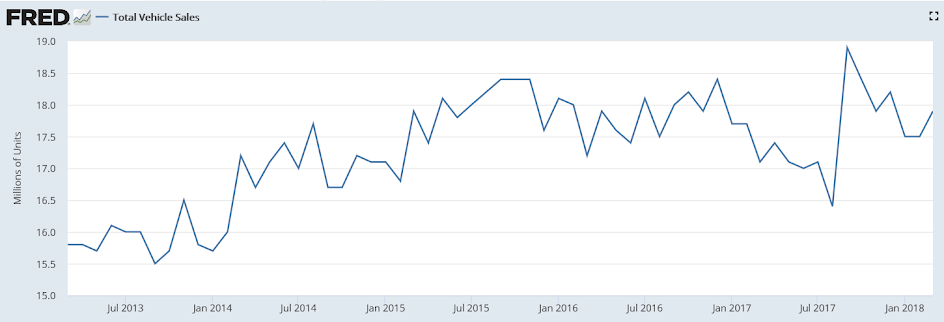
Last months small move up in vehicle sales was what caused retail sales to be better than expected:

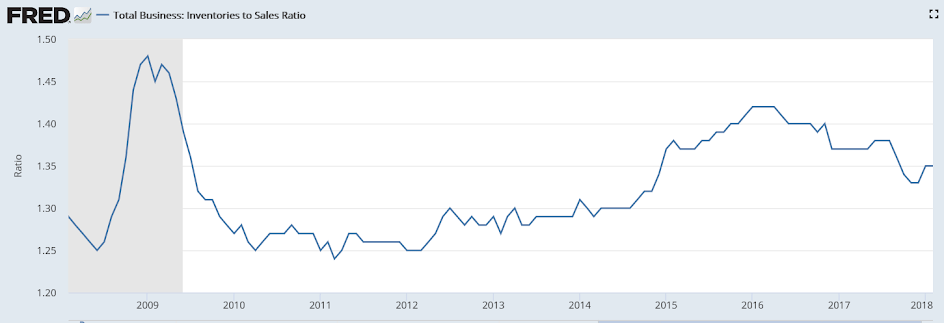
Inventories are still elevated relative to sales:
Retail Sales, Fed Atlanta

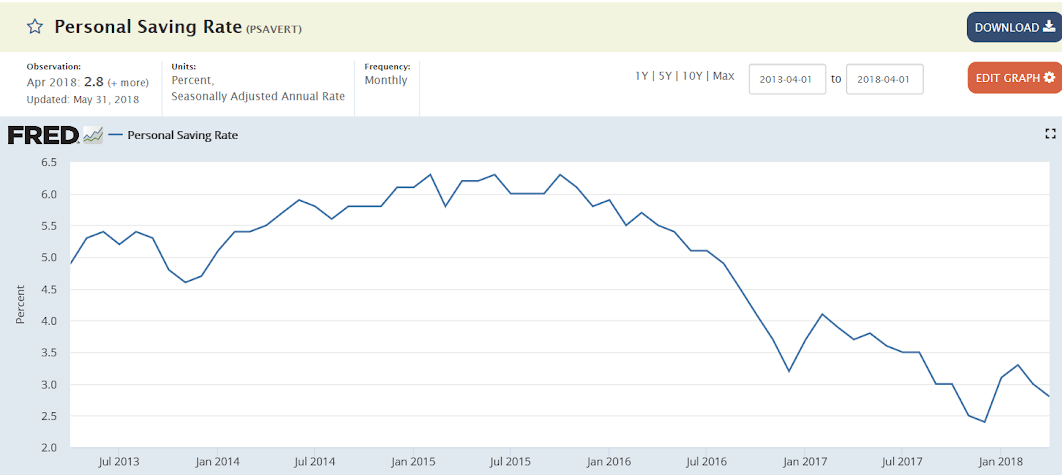
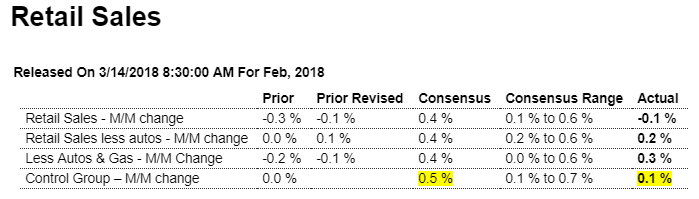
Worse than expected and now down for the last three months, not adjusted for inflation. And all in line with the narrative about personal income going flat and the falling savings rate:

Highlights

The big tax cut isn’t being passed to the nation’s retailers. Retail sales once again missed expectations badly, at minus 0.1 percent in February vs Econoday’s consensus for a 0.4 percent gain and a low estimate for a 0.1 percent gain. The job market may be high and confidence near long-term time highs but the consumer is definitely not on a spending spree.

Department stores were especially weak in February, down 0.9 percent with furniture store sales also weak, down 0.8 percent and sales at health & personal care stores down 0.4 percent. What isn’t a surprise is a 4th straight month of decline at vehicle dealers, down a very sharp 0.9 percent in a drop that re-emphasizes the effect of the spike in the hurricane season which pulled sales forward. Sales at gasoline stores are also a negative, down 1.2 percent with food sales down 0.1 percent.

Now the positives and these are led by nonretailers where sales, after a sharp January fall that followed a positive holiday season, jumped a monthly 1 percent. Building materials are also positive, up 1.9 percent that reverses a 1.7 percent decline in January. Restaurants are another positive but only barely at a 0.2 percent monthly gain which follows January’s marginal 0.1 percent improvement.

But there really should be no alarm on the consumer as retail sales in fact remain positive, evident in the total year-on-year rate which is up 1 tenth to a respectable 4.0 percent with the control group up 3 tenths to 4.2 percent. Should spending on services continue to show strength, consumer spending can still post passable first-quarter results.

Trade with China, Bank loans, Chain store sales

Killing the goose that’s laying the golden eggs:

Trump says China has been asked for plan to cut trade imbalance with U.S.

Mar 7 (Reuters) — U.S. President Donald Trump said on Wednesday that China has been asked to develop a plan to reduce its trade surplus with the United States. Trump is pressing to implement campaign promises of hardening the U.S. stance on trade. Last week, he announced that he planned to impose heavy tariffs on imported steel and aluminum. “China has been asked to develop a plan for the year of a One Billion Dollar reduction in their massive Trade Deficit (surplus) with the United States,” Trump tweeted. “We look forward to seeing what ideas they come back with,” Trump wrote.

Looks like it’s flattened further recently?

Highlights

Retail sales proved weak in both December and January and today’s chain-store results, which are no better than mixed, point to another soft month for February. Unit vehicle sales for February, released last week, proved flat and are also pointing to retail disappointment.

Mtg purchase apps, CPI, Retail sales

Still depressed and going nowhere:

Highlights

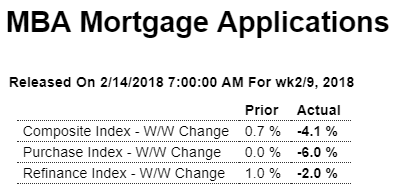
Amid rising interest rates, purchase applications for home mortgages fell by a seasonally adjusted 6.0 percent in the February 9 week. Unadjusted, the year-on-year gain in the volume of purchase applications fell 4.0 percentage points to 4.0 percent. Applications for refinancing fell just 2.0 percent in the week, putting the refinancing share of mortgage applications up 0.1 percentage points to 46.5 percent. Mortgages rates rose to the highest level since January 2014, with the average interest on 30-year fixed rate conforming mortgages ($453,100 or less) up 8 basis points from the prior week to 4.57 percent.

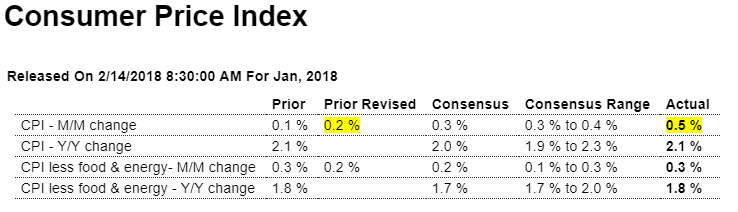
Higher than expected which elevates expectations of Fed rate hikes:

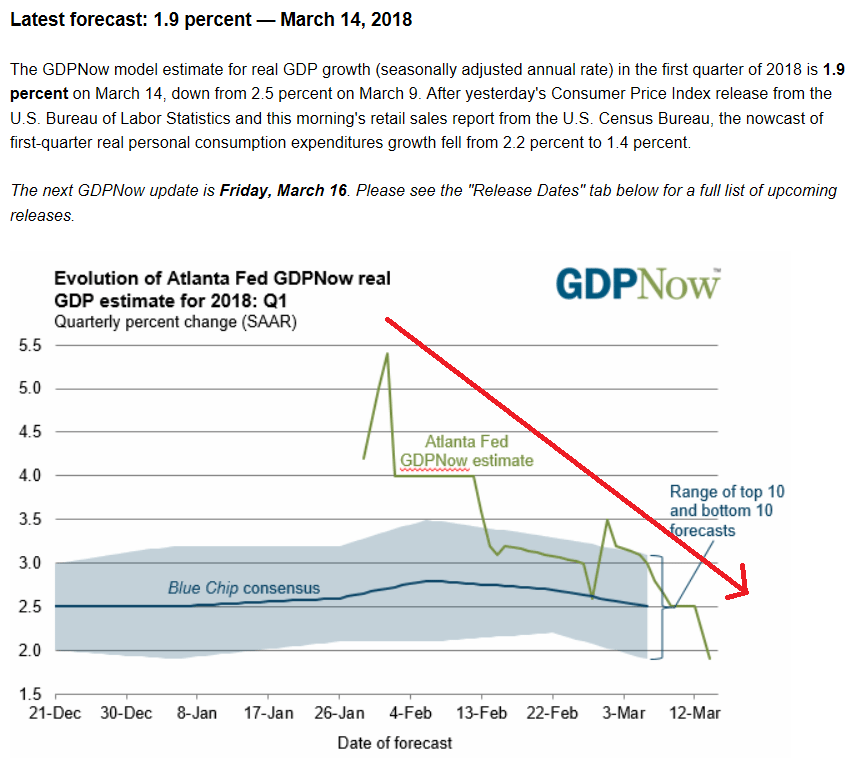
But the Fed may also be looking at this evidence of weakness:

Worse than expected with prior month revised lower as well, ties in with previous discussion about low personal income growth, with this report now indicating personal savings wasn’t quite so low because spending was that much lower than first reported:

Highlights

Retail sales not only proved very soft in January, but a sharp downward revision to December looks certain to pull down what had been outstanding strength for consumer spending in fourth-quarter GDP. Retail sales fell 0.3 percent in January compared to Econoday’s low estimate for no change. December is revised down 4 tenths to unchanged with November, adding insult to injury, also revised down, 1 tenth lower to what is still an outstanding gain of 0.8 percent.

All three months show declines for the leading component which is motor vehicles, falling a very sharp 1.3 percent in January. The weakness here no doubt is the result of replacement demand following the hurricane season which pulled sales forward. Building materials are also weak, down 2.4 percent and in this case possibly reflecting January’s unusually severe weather. But however bad the weather was it didn’t help nonstore retailers, a component that is dominated by e-commerce and which proved dead flat in January with December’s initial surge of 1.2 percent revised down to a much more moderate looking 0.5 percent.

Clothing sales, which had been very soft, rose 1.2 percent in the month, echoing this morning’s consumer price report where apparel prices posted a sudden jump. Restaurant sales, which had been strong, were unchanged while furniture sales wobbled for a second month, down 0.4 percent.

The downward revision to December turns what had been a solid holiday shopping season into a so-so season. Control group sales, which are a direct input into GDP, did rise a very strong 1.2 percent in November but are now down 0.2 percent for December with January limping in at no change. After today’s report, the consumer sector gets a one-notch downgrade from strong to solid.

Unemployment benefits, Debt/GDP, Same store sales

Unemployment benefits are harder to get, as previously discussed:

The Next Recession Is Gonna Really Suck

As a result, the rate at which unemployed Americans receive layoff compensation overall has fallen from about 36 percent in 2007 to about 28 percent in 2017, according to data from The Department of Labor. Wayne Vroman, an associate with the Urban Institute, said a big reason for the decline is that states are finding ways to kick unemployed people off benefits after they’ve already been deemed eligible. His research shows a big increase in “nonseparation determinations.” These are instances of states investigating whether someone is continuing to meet eligibility requirements by doing things like writing down the names and addresses of businesses where they’ve applied for work on forms to state work agencies.

In Florida, it’s not an easy process. The state overhauled its unemployment system in 2011, requiring layoff victims to file claims online and even (for a time) take a math and reading test. Since 2007, before the last recession started, the percentage of unemployed Floridians who receive compensation plunged from 32 percent to 9 percent, almost the lowest rate of coverage in the nation.

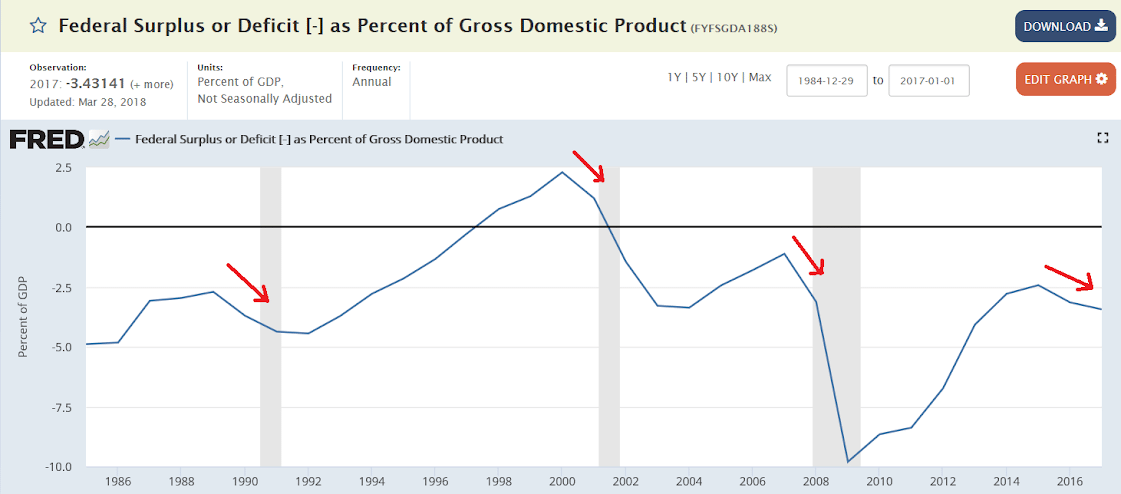
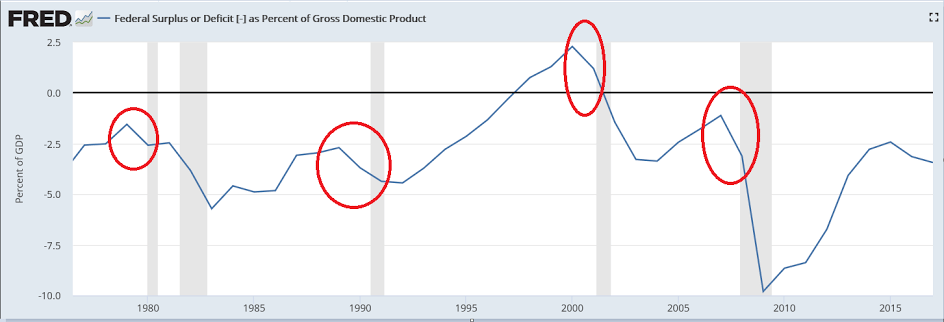
While the annual deficit to gdp ratio is higher than the last two cycles, it’s been looking to me that the ‘neutral’ deficit to gdp ratio has been going up as well. This is likely because the unspent income (pension fund and other retirement accounts, corporate reserves including insurance reserves, cash in circulation, $US foreign central bank holdings and other non resident ‘savings’, etc.) is growing at ever higher rates, while private sector deficit spending has been subdued. Consequently, even with what may seem to be what historically has been a sufficiently high Federal deficit, GDP can retreat:

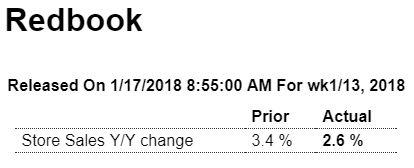
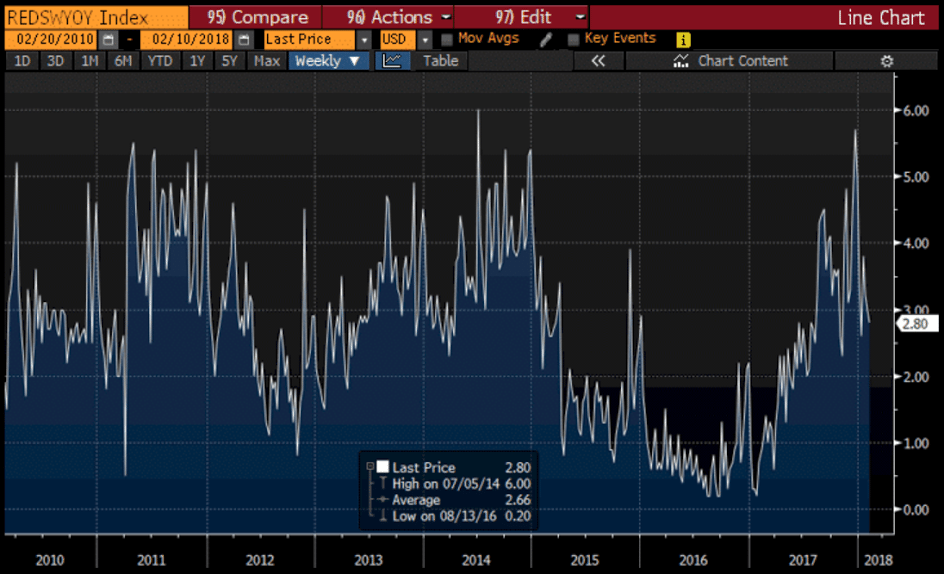
Redbook same store retail sales (not inflation adjusted) fell several years ago, and as stores were closed, same store sales growth eventually resumed, but has been softening lately and is still shy of earlier levels:

Housing index, Industrial production, Redbook same store sales, Healthcare comments


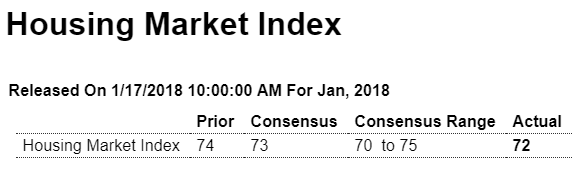
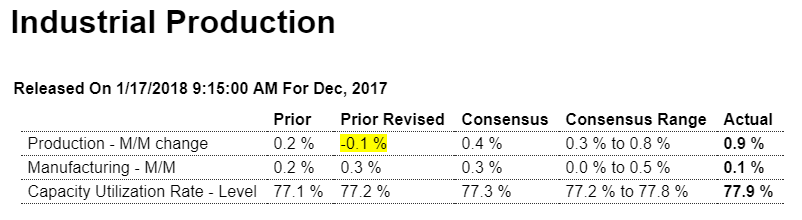
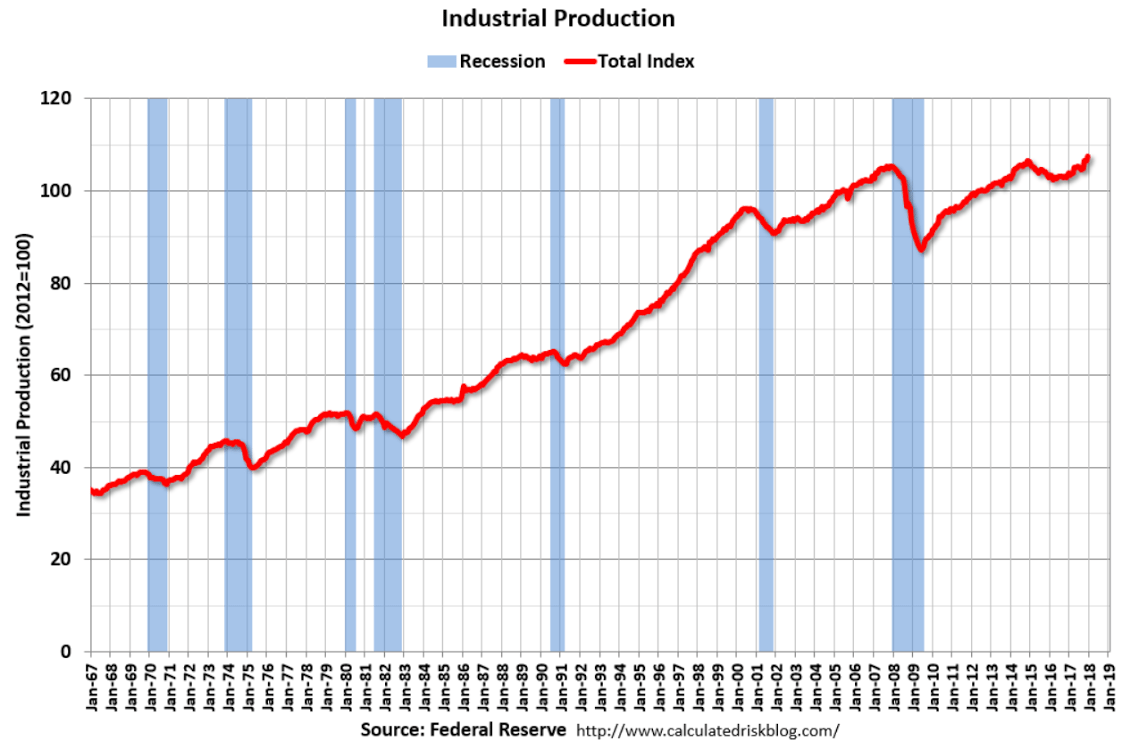
Up more than expected this month, but last month revised down, inline with a recent pattern of reporting a better than expected number that subsequently gets revised down to where it no longer looks so good:


The year end blip up, funded by out sized credit card advances, may have reversed:

Highlights

Same store sales were up 2.6 percent year-on-year in the January 13 week, continuing the deceleration seen in the prior two weeks to fall to the smallest year-on-year weekly gain since November 11. Month-to-date sales versus the prior month were down 0.3 percent, the first negative reading in four weeks, while the full month year-on-year gain dropped 0.4 percentage points to 3.0 percent, matching the weakest pace since November 11. The second week of the year extends the weakening in sales metrics seen in the first week by retailers in Redbook’s same-store sample, suggesting a cooling in ex-auto ex-gas retail sales in January following December’s strength.

So you have a Fed policy of maintaining some minimum unemployment rate to meet their price stability mandate, which now means that many people won’t qualify for Medicaid?

Political risk looms over Republicans’ welfare tinkering (Reuters) Republicans are seeking tougher work and job training requirements for those helped by assistance programs. Kentucky on Friday became the first U.S. state to get approval from Washington to impose work requirements on recipients of Medicaid. The approval came a day after the Trump administration said states could move toward putting work or job training conditions on Medicaid.

They are inching their way towards single payer, as once you’ve decided not to let people die in the streets the “process” will get you there, one way or another:

Ryan suggests room for bipartisanship on ObamaCare (The Hill) House Speaker Paul Ryan said Friday there might be an opportunity for a bipartisan deal to shore up ObamaCare’s insurance markets. Ryan expressed optimism that Congress could pass a bill similar to one sponsored by Sens. Susan Collins and Bill Nelson. The bill would provide billions of dollars to states to help establish high-risk pools or reinsurance programs. “I’ve talked to Susan Collins and Democrats about this … It’s basically different ways of saying, let’s all agree a person with a catastrophic illness shouldn’t go bankrupt if they get sick,” Ryan said.