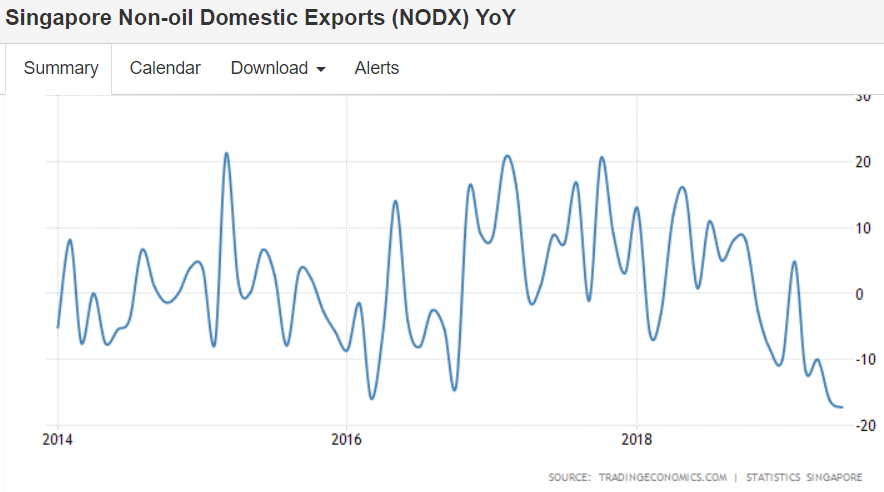
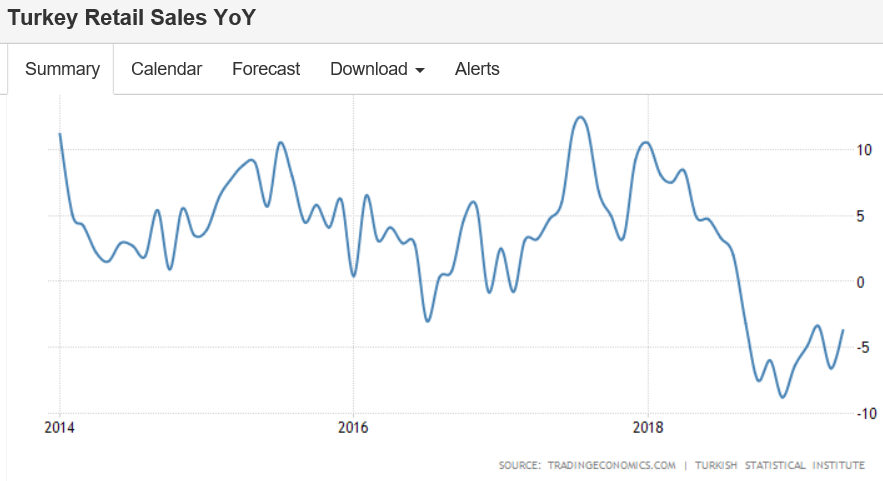
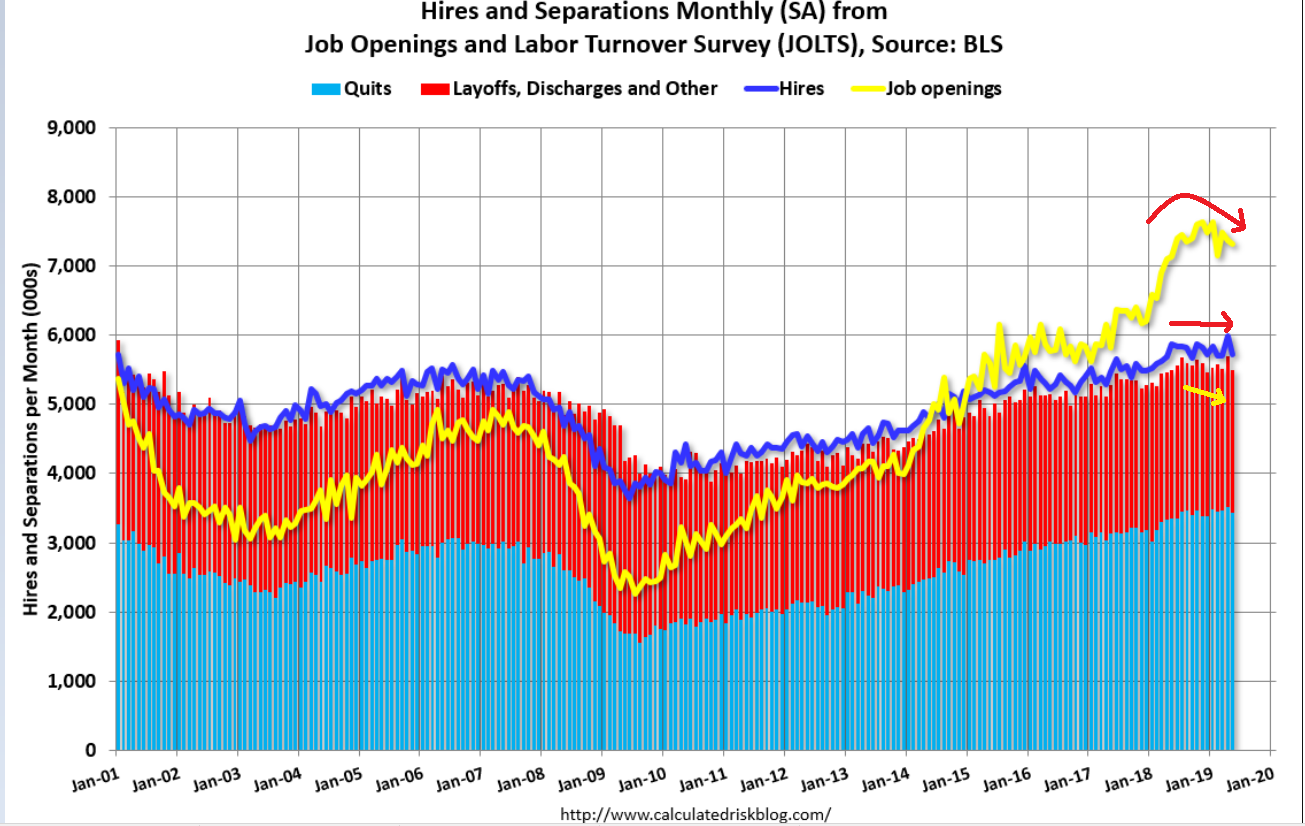
Trucking index, Tariffs, Singapore exports, Turkey retail sales

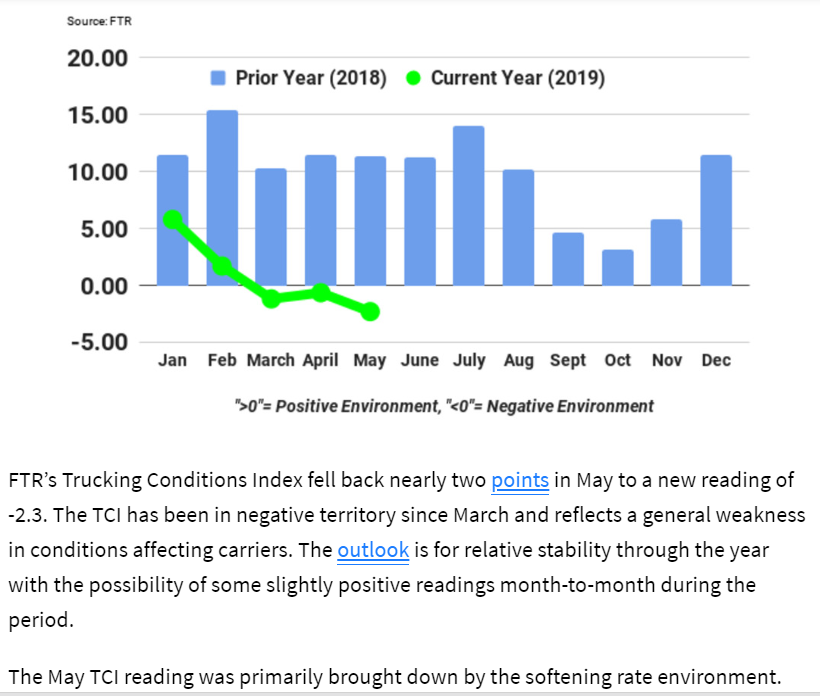
FTR Trucking Conditions Index weakens in May


The President is in no hurry because he narrowly views the some $5 billion/mo in tariff revenues as a profit for the US at China’s expense, totally insensitive to the global economic downturn this ‘tax hike’ has created:

Trade war to drag on as Trump says long way to go and China strikes hard-line tone

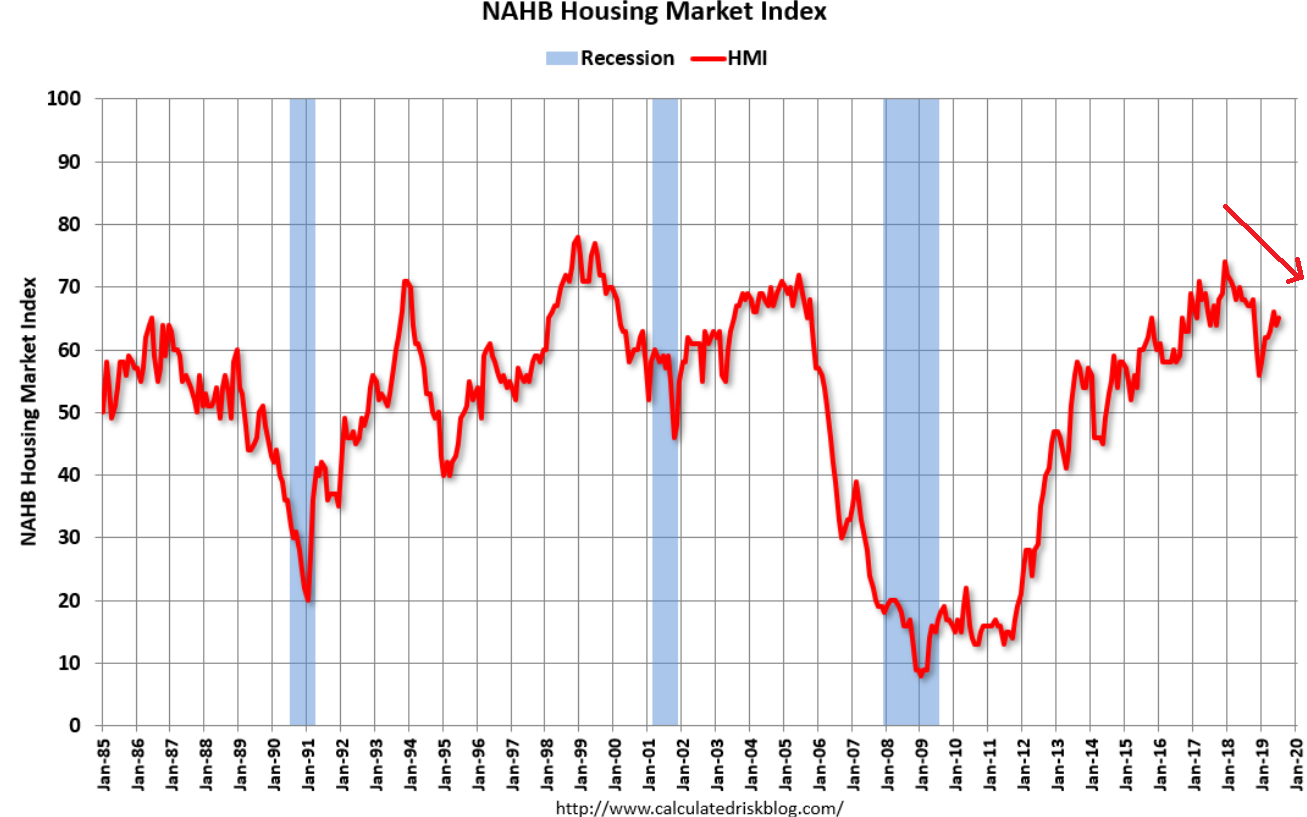
Retail sales, Industrial production, Housing index, Business inventories

Better than expected:

Highlights
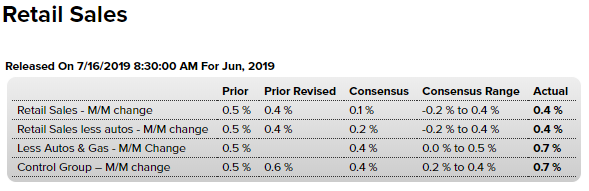
Taking out a policy-insurance rate cut when the main driver of the economy is booming sounds a little counter-intuitive, in retail sales results that came in much stronger than expected in June. Total sales rose 0.4 percent in the month with ex-auto sales also up 0.4 percent — both of these hit the top end of Econoday’s consensus range. Easily surpassing the top end of the consensus range are two of the report’s key core readings with less auto & less gas and also the control group up very sharply at 0.7 percent gains on the month.

Strength abounds in this report with the isolated weak points led by gasoline stations, where price effects tied to lower oil prices pulled down sales by 2.8 percent, and also department stores, an ailing segment of the retail sector that seems to be devolving.

The most surprising strength in the report, at least for forecasters, is a 0.7 percent jump in auto sales that conflicts with what was a flat month for unit sales (a series, however, that is clouded with special factors). Not surprising is a another surge, this time 1.7 percent for a second month in a row, for nonretailers which continue to feed off of traditional retailers such as department stores.

A key strength, and one that underscores discretionary power, is yet another strong gain for restaurants, up 0.9 percent following prior gains of 1.0 percent, 0.7 percent, and 0.8 percent. This shows that consumers, flush with confidence and fully employed, are enjoying themselves.

The list of strength goes on with both furniture and building materials snapping back with 0.5 percent gains that point to strength for residential investment. Clothing stores saw sales rise 0.5 percent as did health & personal care stores.

The Federal Reserve may be looking across the oceans for reasons to justify a rate cut, but any justifications aren’t coming from the US consumer which makes up the vast bulk of GDP. And however much inflation may be flat, consumer spending is not to blame.

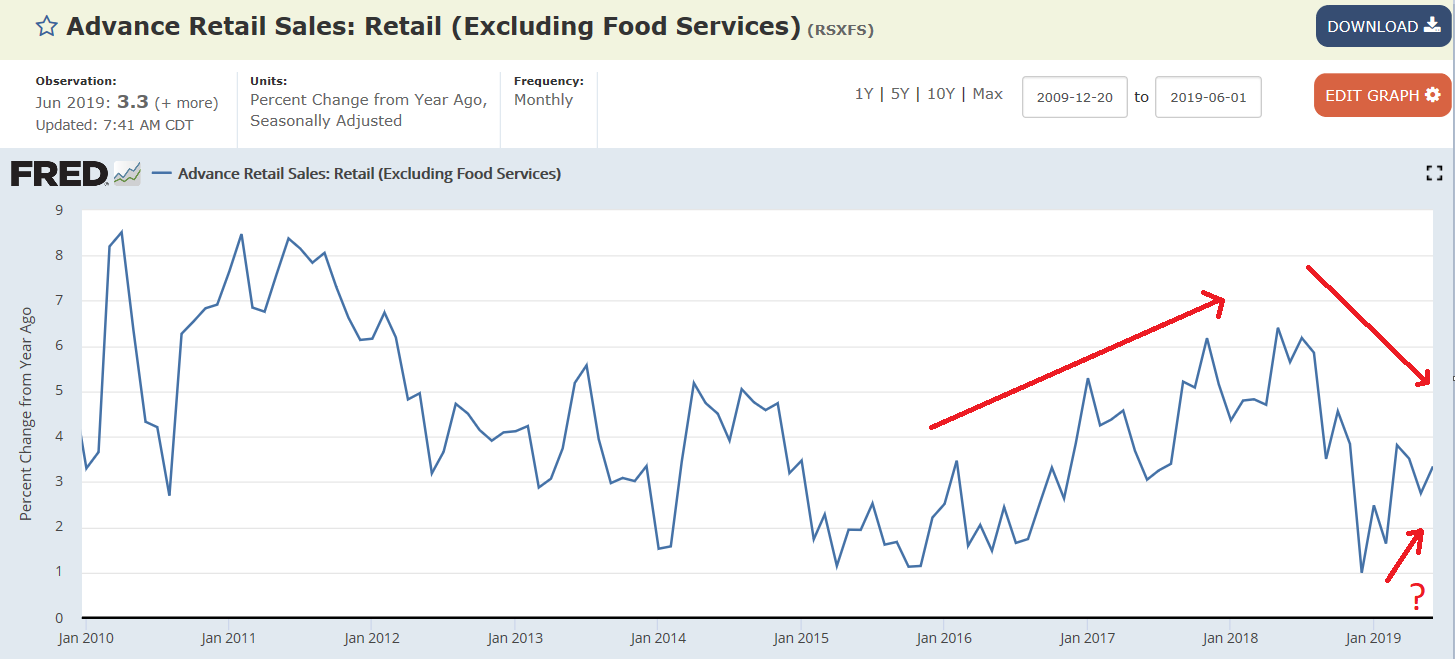
Not inflation adjusted and June subject to revision next month:


Worse than expected:


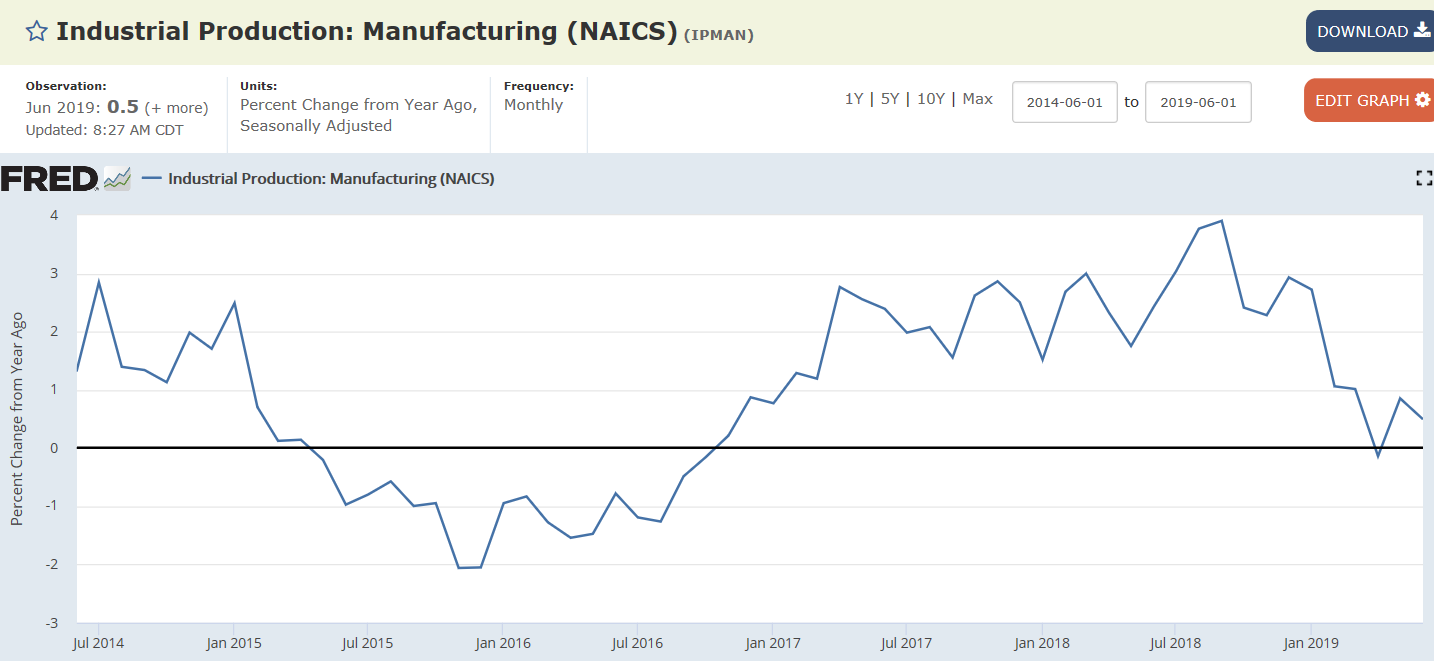
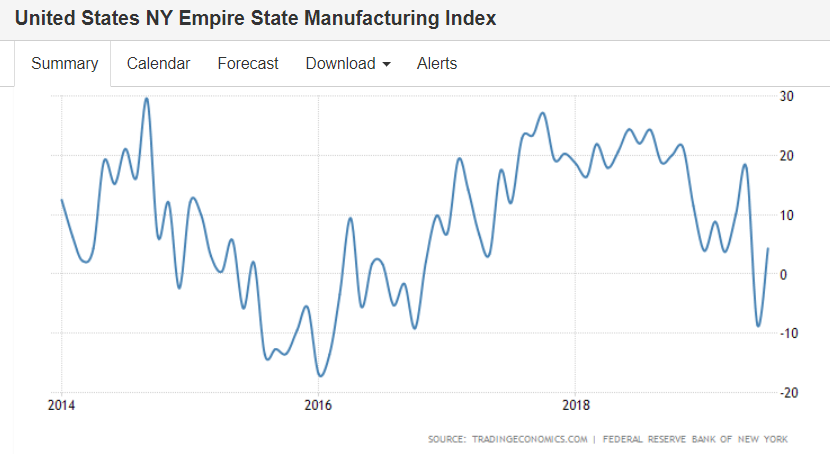
Manufacturing:


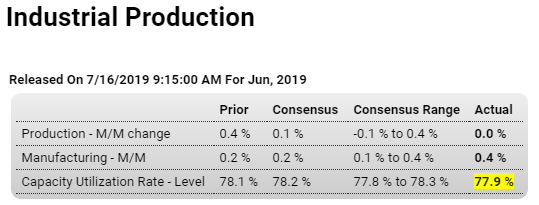
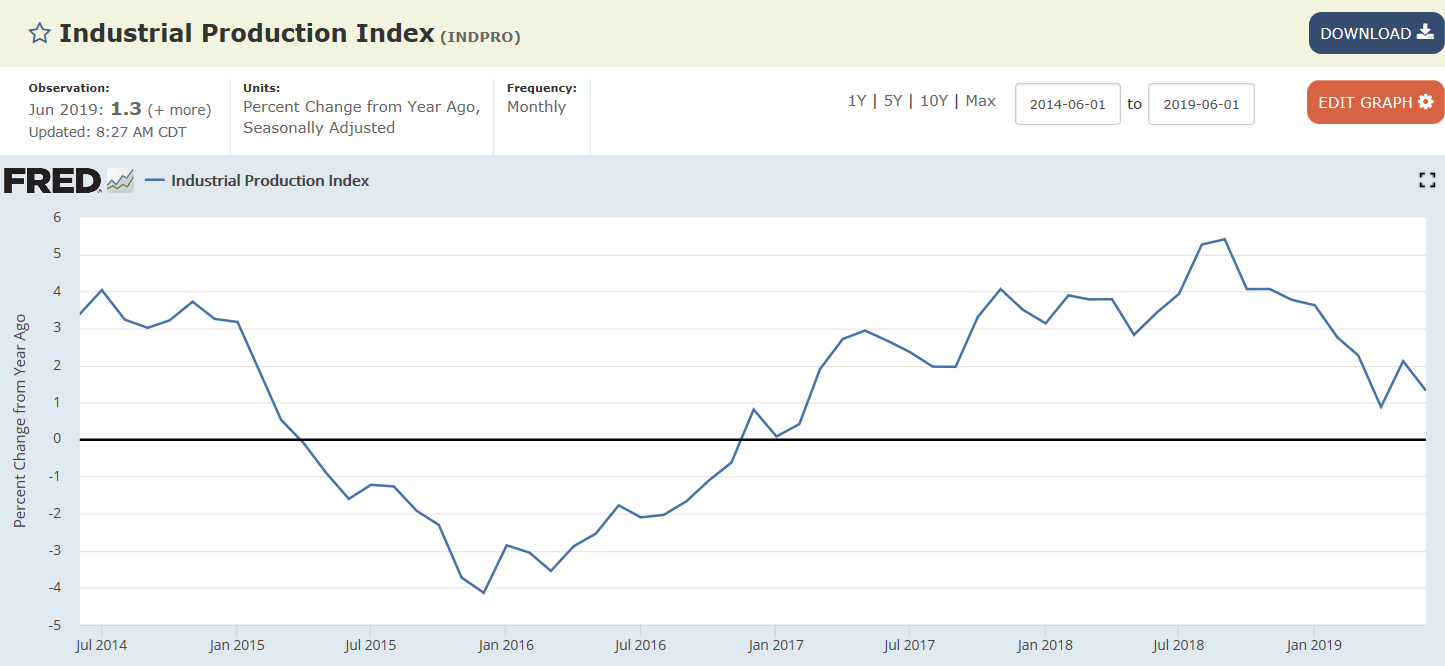
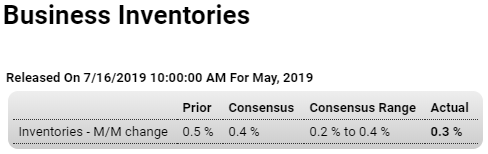
As expected, and still looking like it’s rolled over:

Highlights

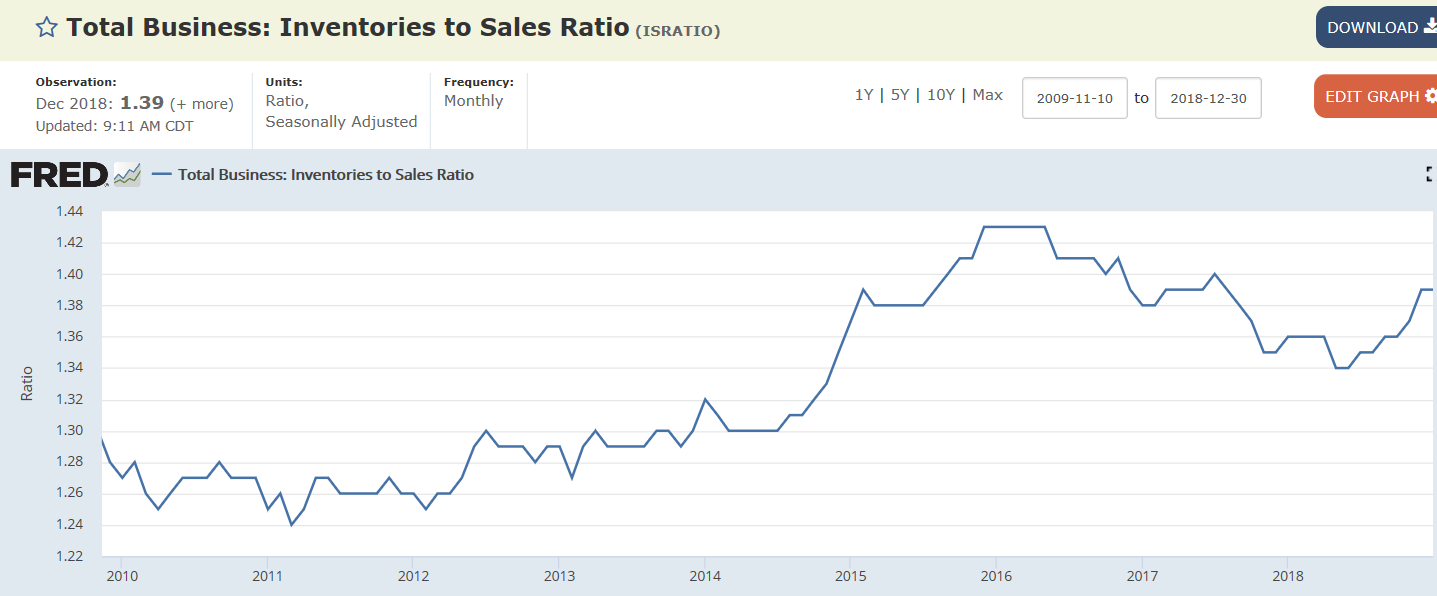
Business inventories rose a slightly lower-than-expected 0.3 percent in May but follow a 0.5 percent rise in April in results that put the outlook for inventory contribution to second-quarter GDP at roughly flat. There are hints that inventory growth is exceeding underlying demand as 5.3 percent year-on-year growth for inventories is well above the 1.5 percent rise for business sales. Yet any imbalances aren’t increasing as the inventory-to-sales ratio in May held steady at 1.39.

Inventory remains high relative to sales:

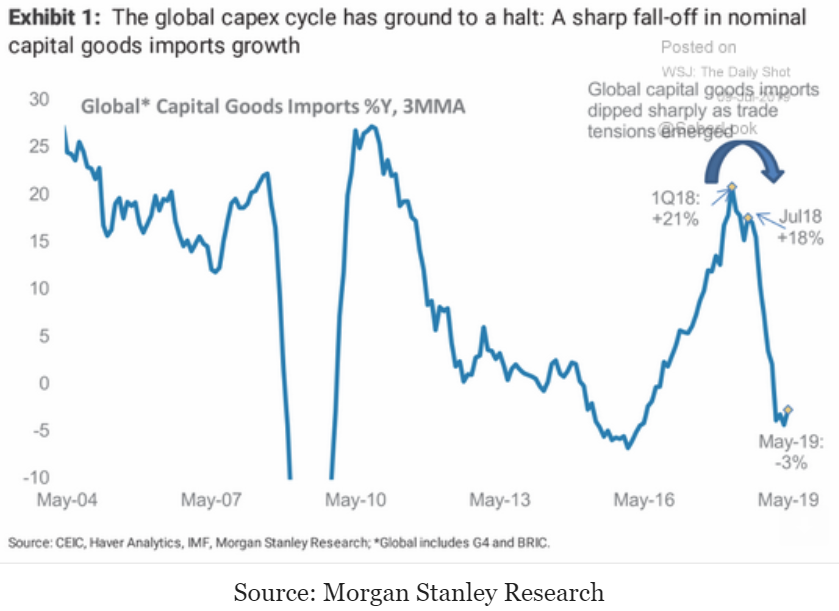
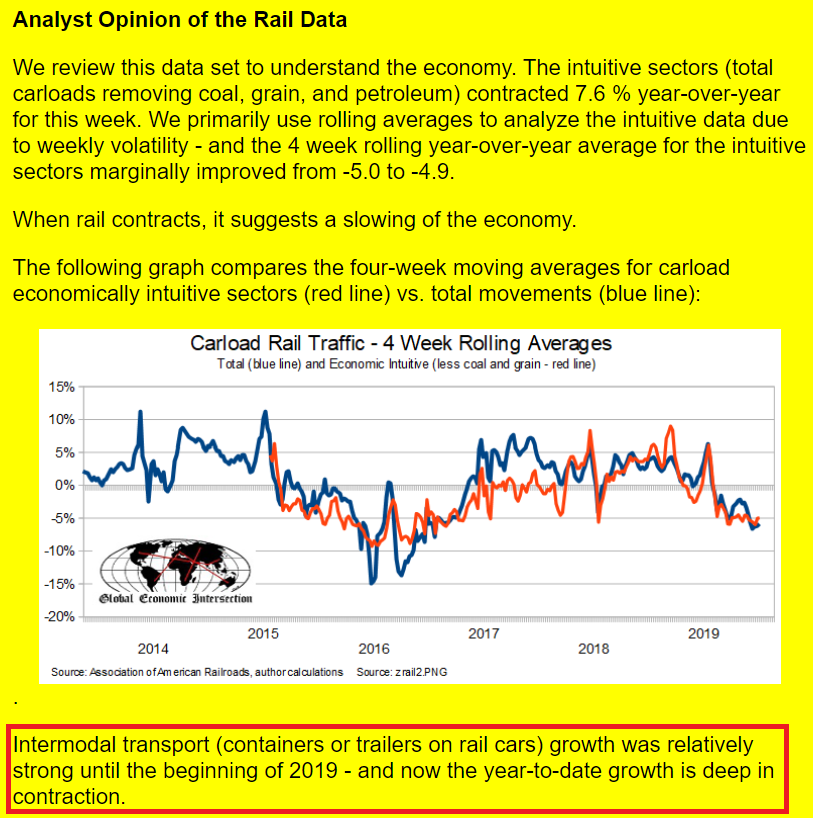
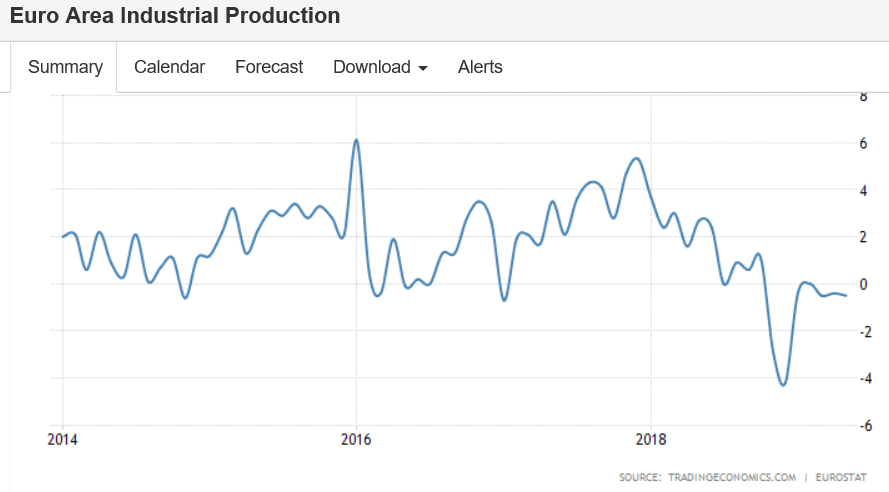
Manhattan home prices, Capital goods imports, Rails, Euro area industrial production, China imports


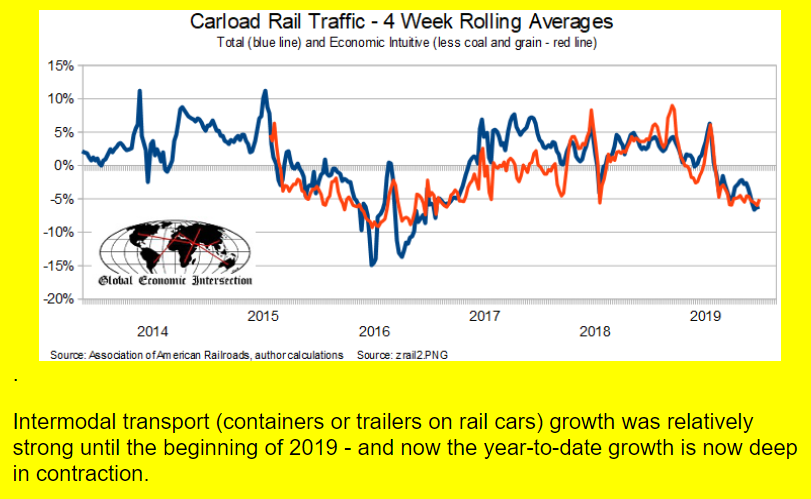
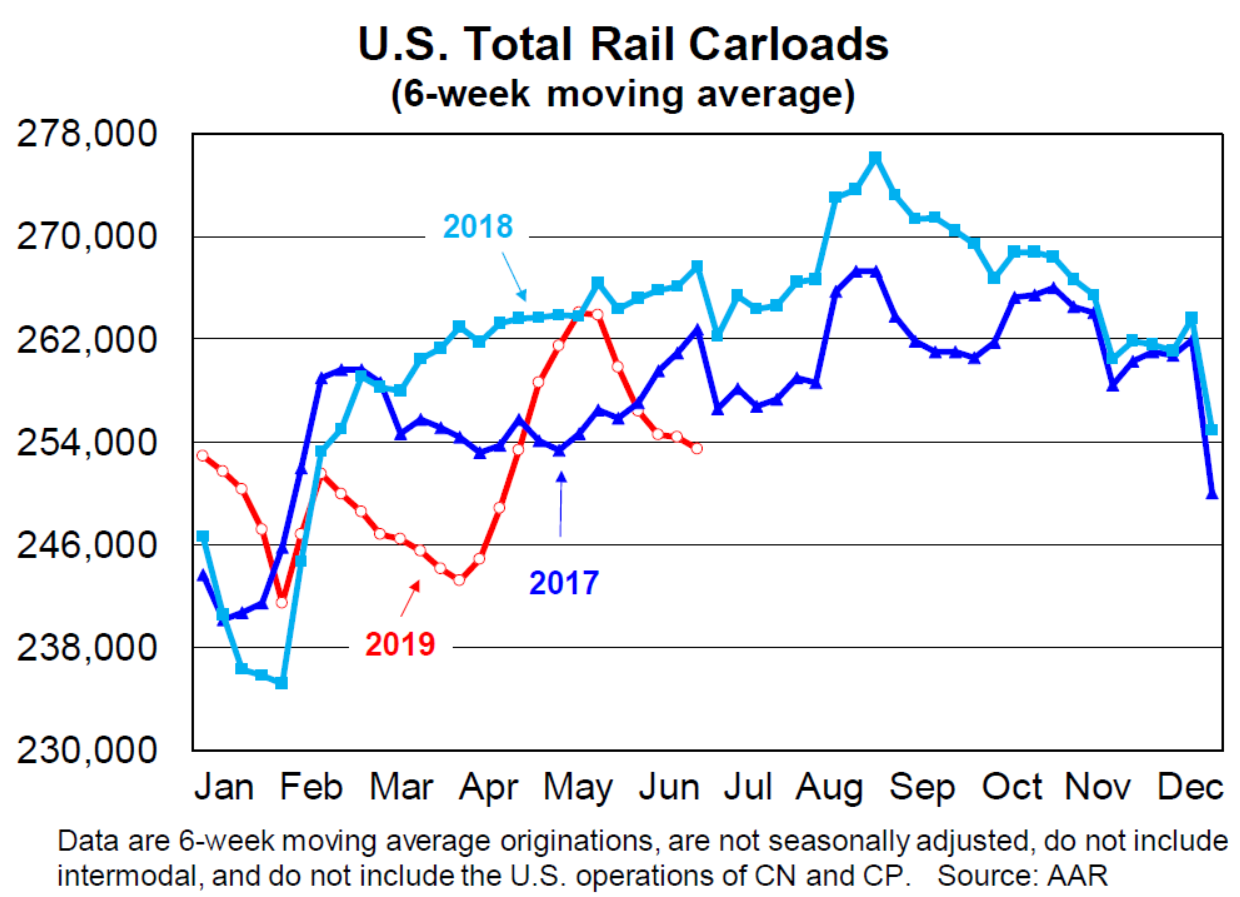
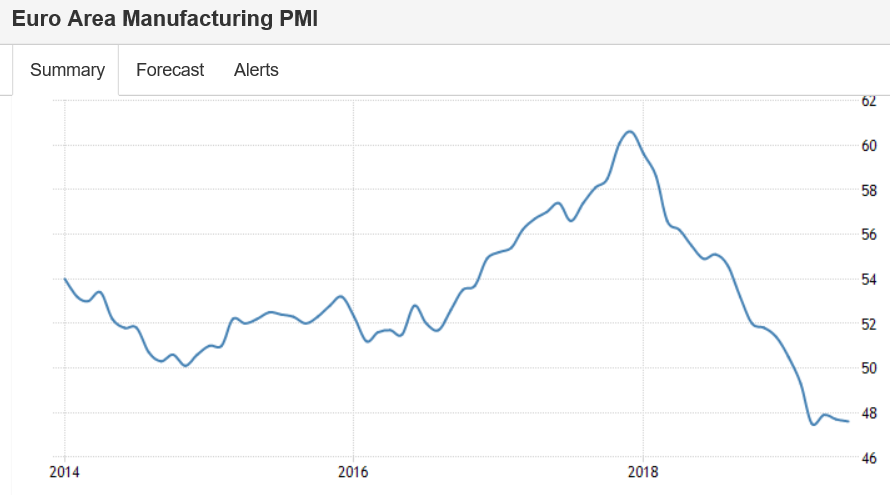
Still in contraction:

China Imports Tumble in June

Imports to China plunged 7.3 percent from a year earlier to USD 161.86 billion in June 2019, much worse than forecasts of a 4.5 percent drop, a further sign of weak domestic demand that could lead Beijing to add more stimulus. Purchases fell for: unwrought copper (-27.2 percent); iron ore (-9.7 percent); and soybeans (-25.1 percent) amid higher tariff on US cargoes and following outbreaks of African swine fever. By contrast, increases were seen in imports of crude oil (15.2 percent) and coal (6.4 percent). Among China’s largest trade partners, imports fell from the US (-31.4 percent), South Korea (-21.9 percent), Taiwan (-7.4 percent) and Japan (-5 percent), but grew from the EU (8.6 percent), Australia (8.8 percent) and ASEAN (0.4 percent).

Employment, China, Trump speech

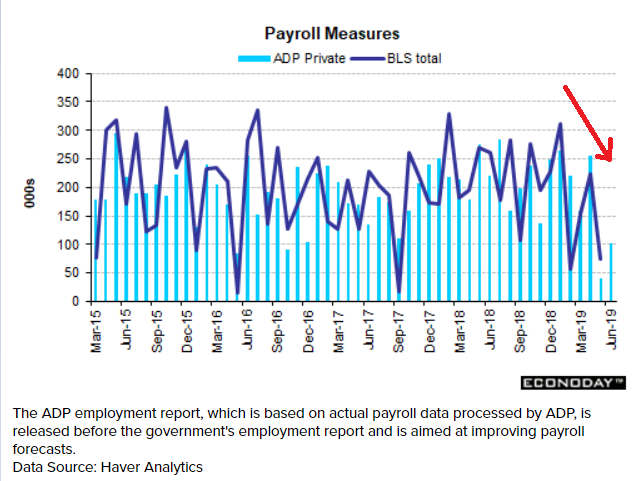
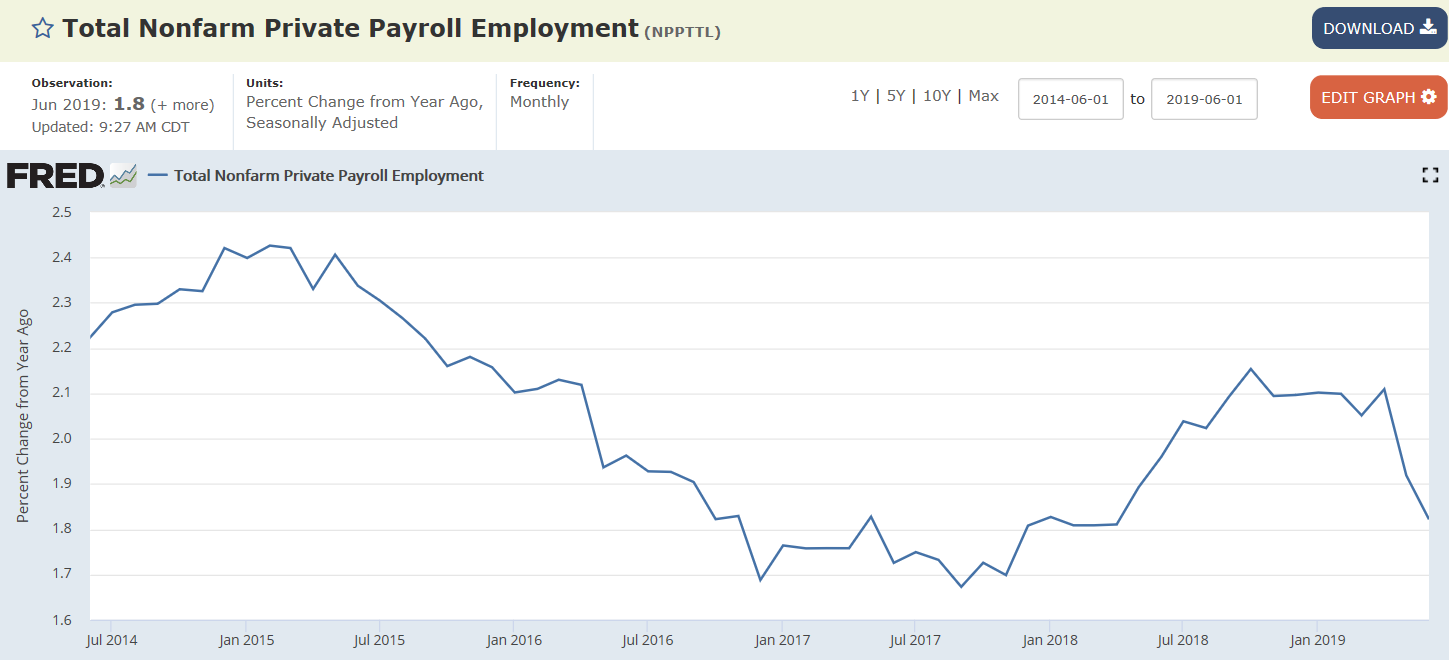
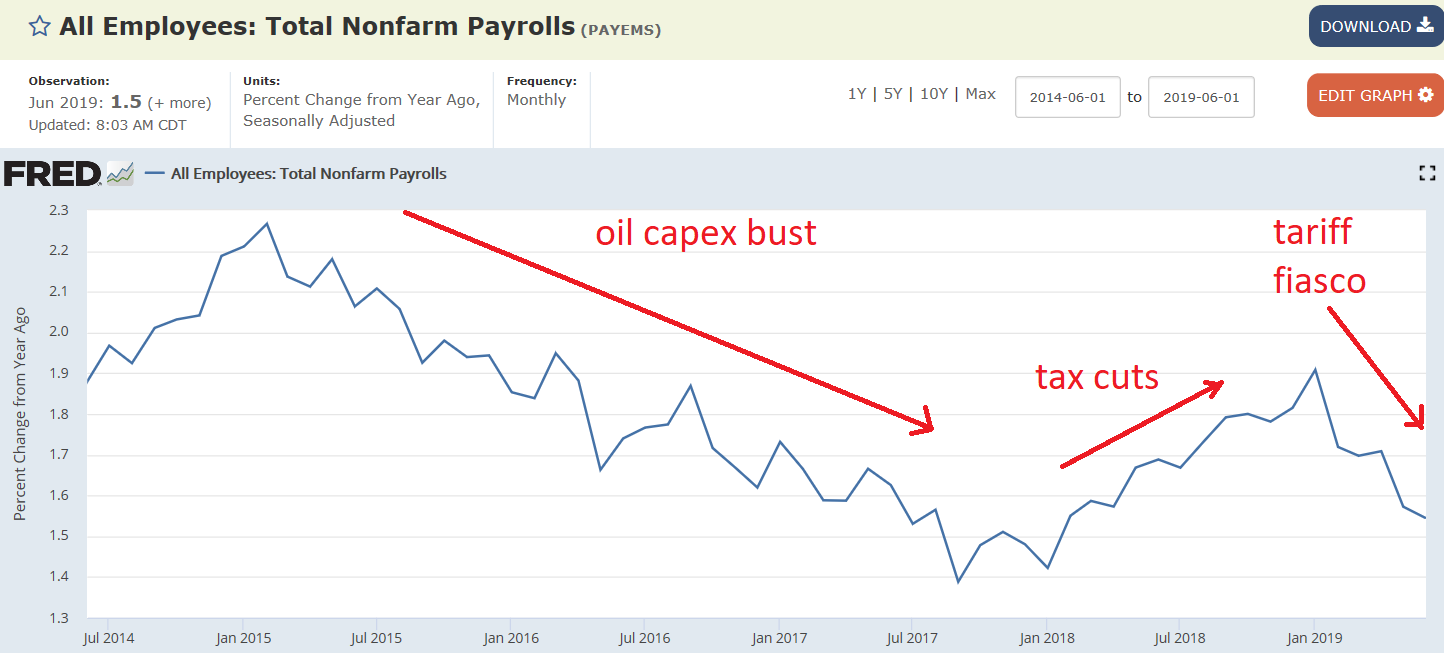
The annual rate of change continues to take a dive:
Highlights

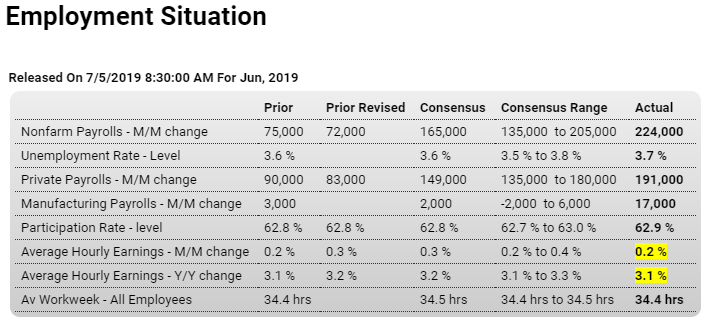
There’s still time to cancel your rate-cut party. Nonfarm payrolls shot 224,000 higher in June and well beyond Econoday’s consensus range where the high forecast was 205,000. There are no flukes in this report underscored by a 17,000 jump for what has been an uneven manufacturing sector that Federal Reserve policy makers are watching with concern. Payrolls at professional & business services jumped 51,000 as employers scramble to meet demand with contractors. Government payrolls, up 33,000, were also a large contributor to June’s growth.
China says there will be no trade deal unless existing tariffs are stripped

Continuing evidence that dementia is setting in:

“In June of 1775, the Continental Congress created a unified Army out of the Revolutionary Forces encamped around Boston and New York, and named after the great George Washington, commander in chief. The Continental Army suffered a bitter winter of Valley Forge, found glory across the waters of the Delaware and seized victory from Cornwallis of Yorktown.

“Our Army manned the air, it rammed the ramparts, it took over the airports, it did everything it had to do, and at Fort McHenry, under the rocket’s red glare it had nothing but victory. And when dawn came, their star-spangled banner waved defiant.”

Why Trump and Judy Shelton want the US back on the gold standard

‘In 2016, before his election, Trump suggested it might be time to stage a return: “Bringing back the gold standard would be very hard to do—but boy, would it be wonderful. We’d have a standard on which to base our money.” This might be dismissed as a throwaway comment, if not for Trump’s desire to put the likes of Cain, Moore, and now Shelton on the Fed board, giving a goldbug a seat at the table to steer the most powerful country’s monetary policy.’

Small business indicators, China business survey, Car sales, FDI, Euro retail sales


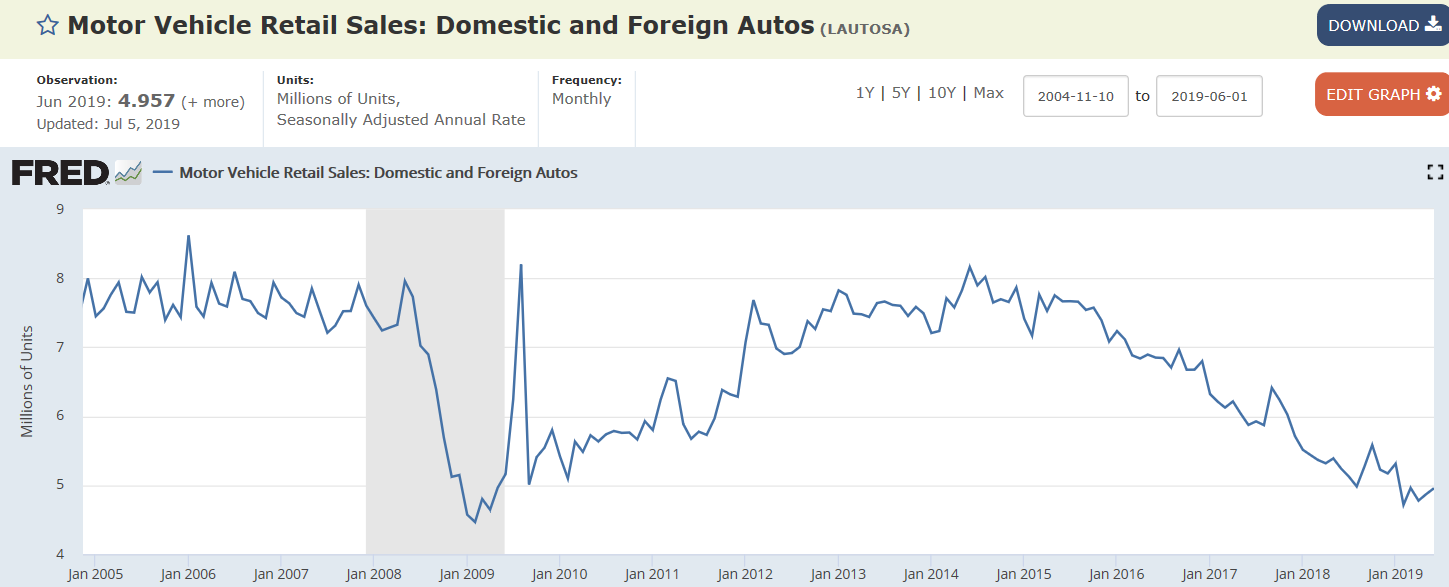
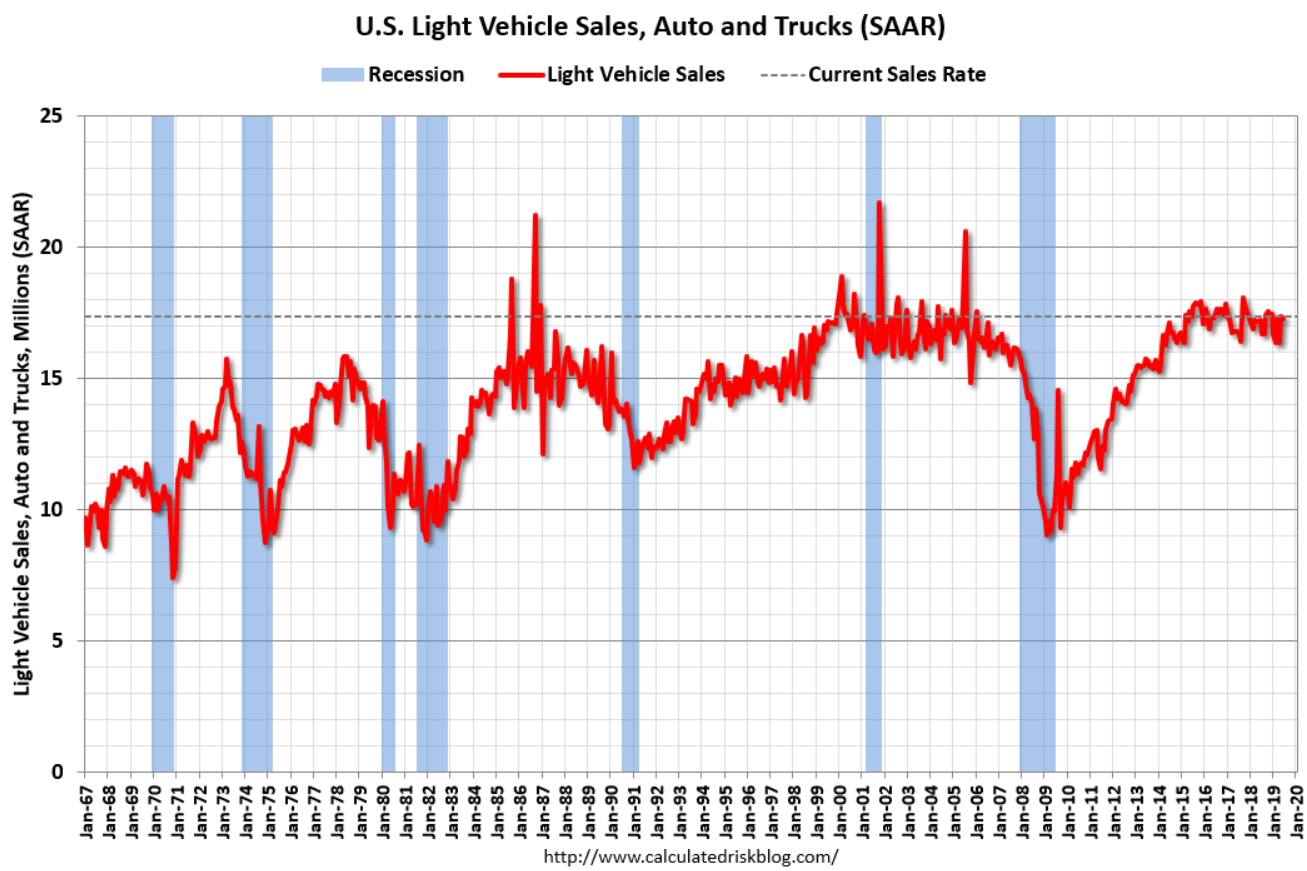
Light vehicle sales peaked a while back:


Been helping to support the $US:

Eurozone Retail Sales Fall Unexpectedly

Retail trade in the Euro Area fell 0.3% in May, following a 0.1% drop in April and missing expectations of a 0.3% growth, as sales declined for all main categories. Among the bloc’s largest economies, Germany’s retail trade decreased for the second month, while gains were recorded in France and Spain. Year-on-year, retail sales rose 1.3%, also missing forecasts of 1.6%.

Payrolls, Durable goods, ISM services, CEO confidence, Fed comment, Trump comment on currencies

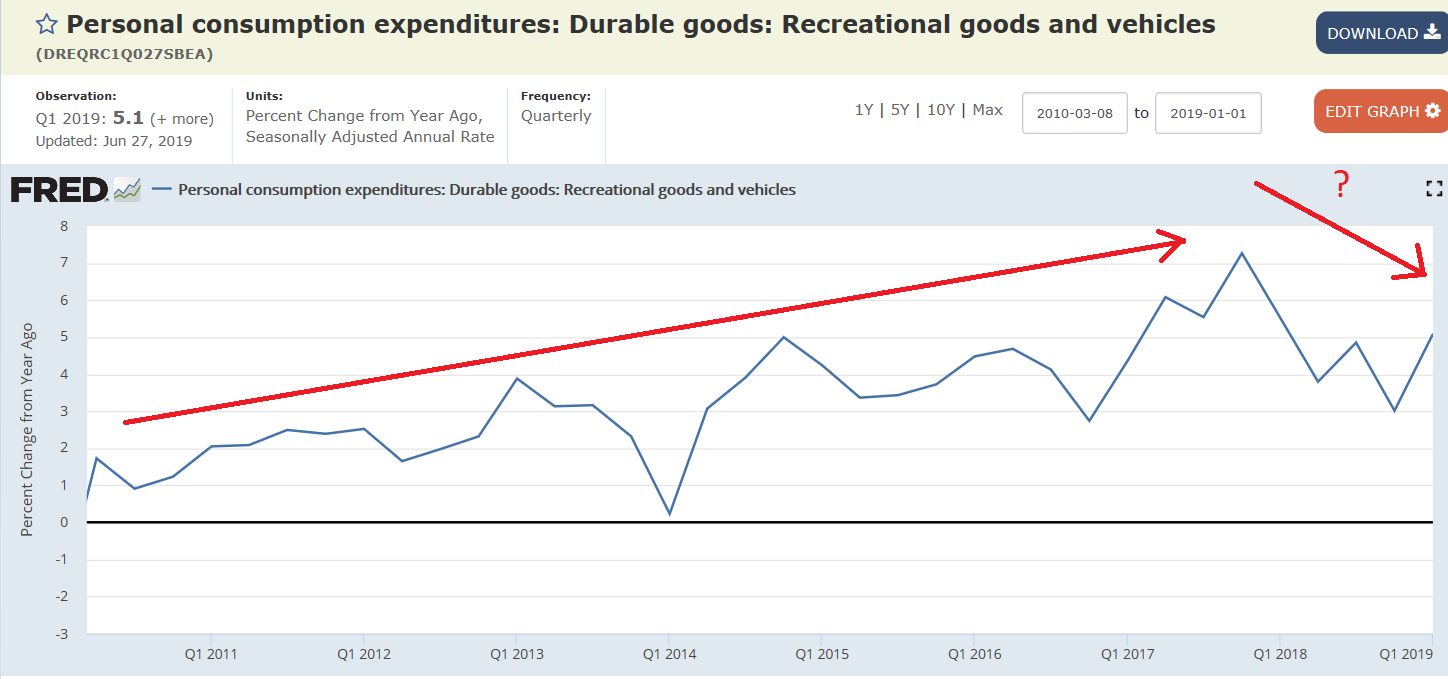
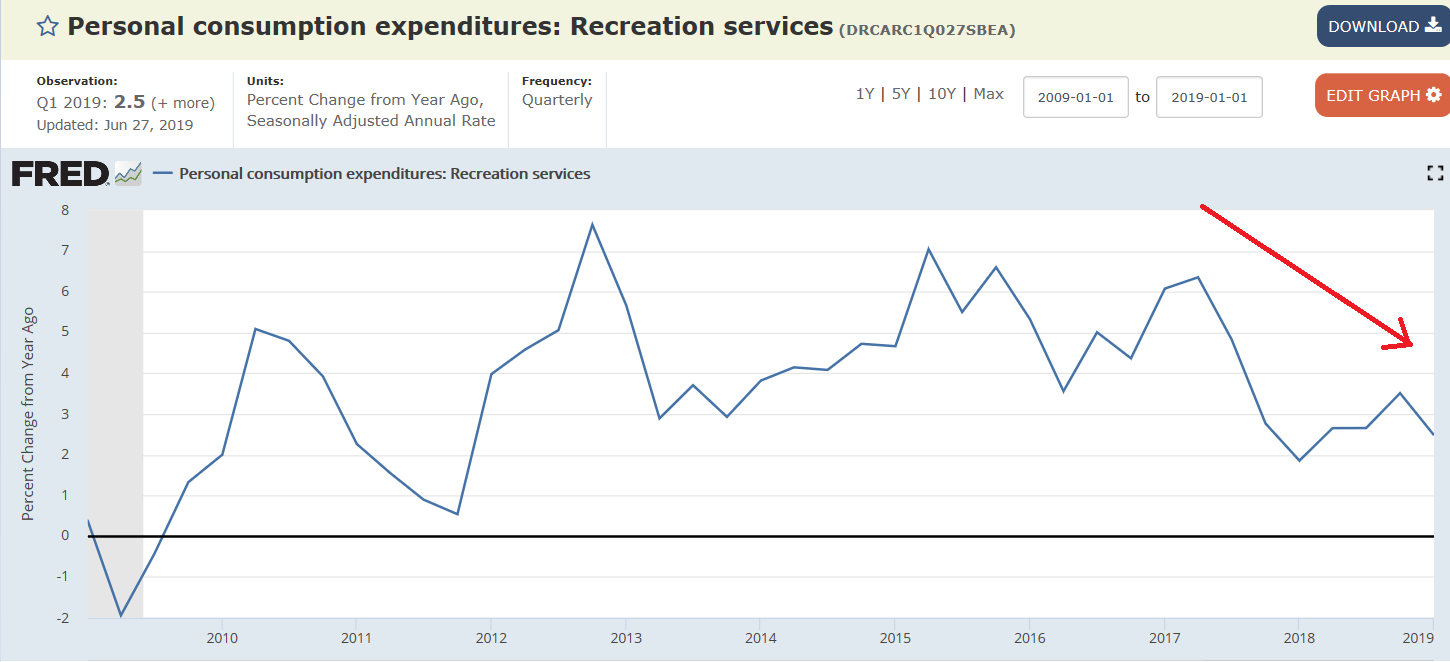
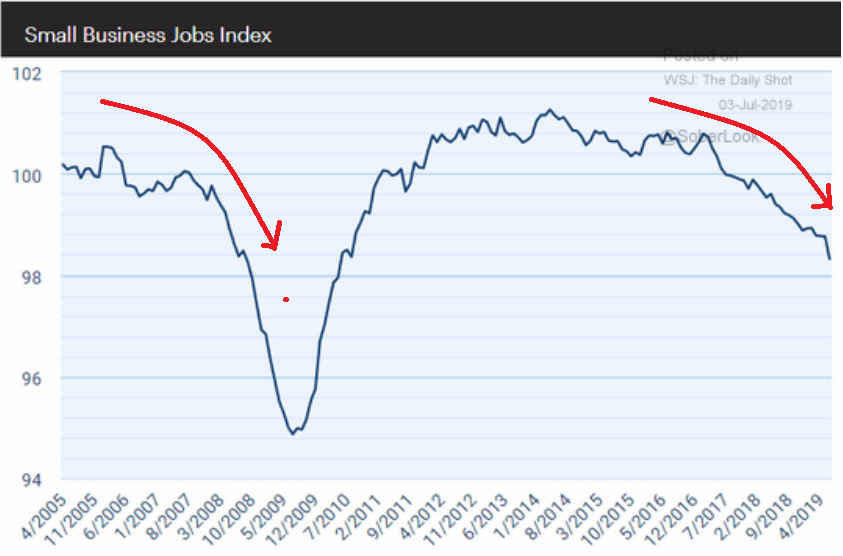
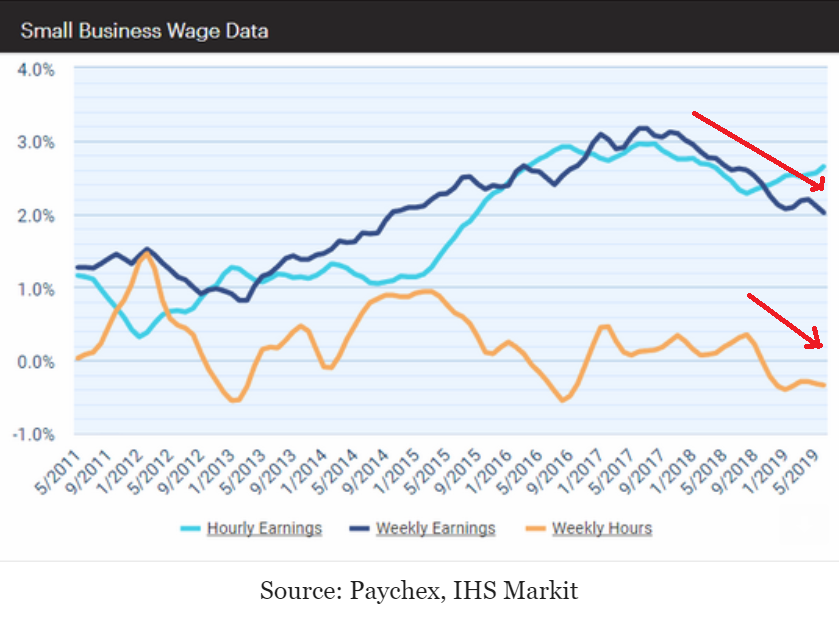
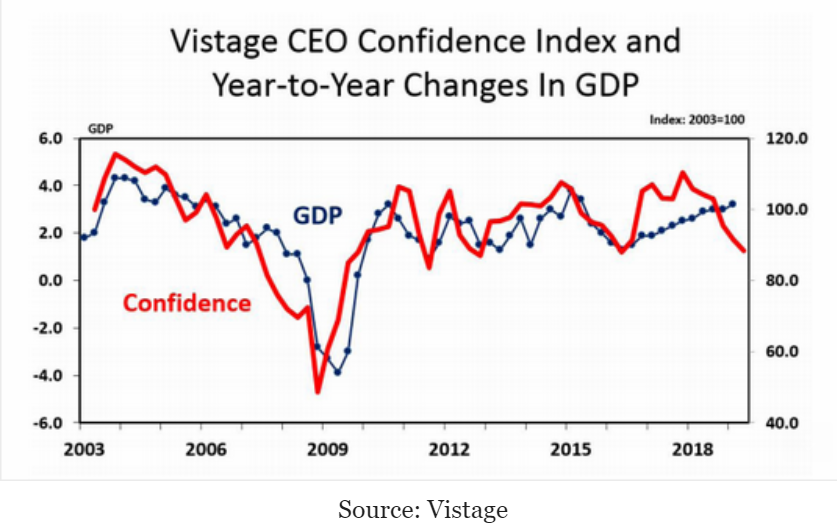
Another indicator turning south, and this is a big one, as it’s the source of most consumer income:

Familiar pattern?

As if rate cuts would help output, employment, or earnings, all of which are decelerating:

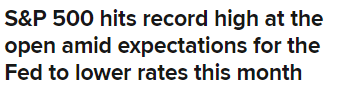
Dow rises 100 points and heads for record close amid expectations for the Fed to lower rates

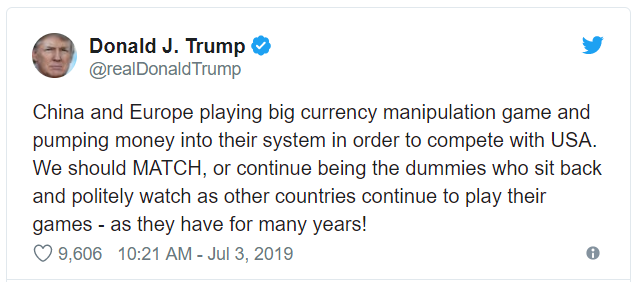
He’s the dummy, of course, along with the all the others, including all of the Presidential contenders, who don’t understand that imports are real economic benefits, and exports are real economic costs, and that unemployment and weak demand are unspent income stories, etc. etc. So with that kind of consensus there’s no telling what might happen…

Construction, Bank loans, Earnings

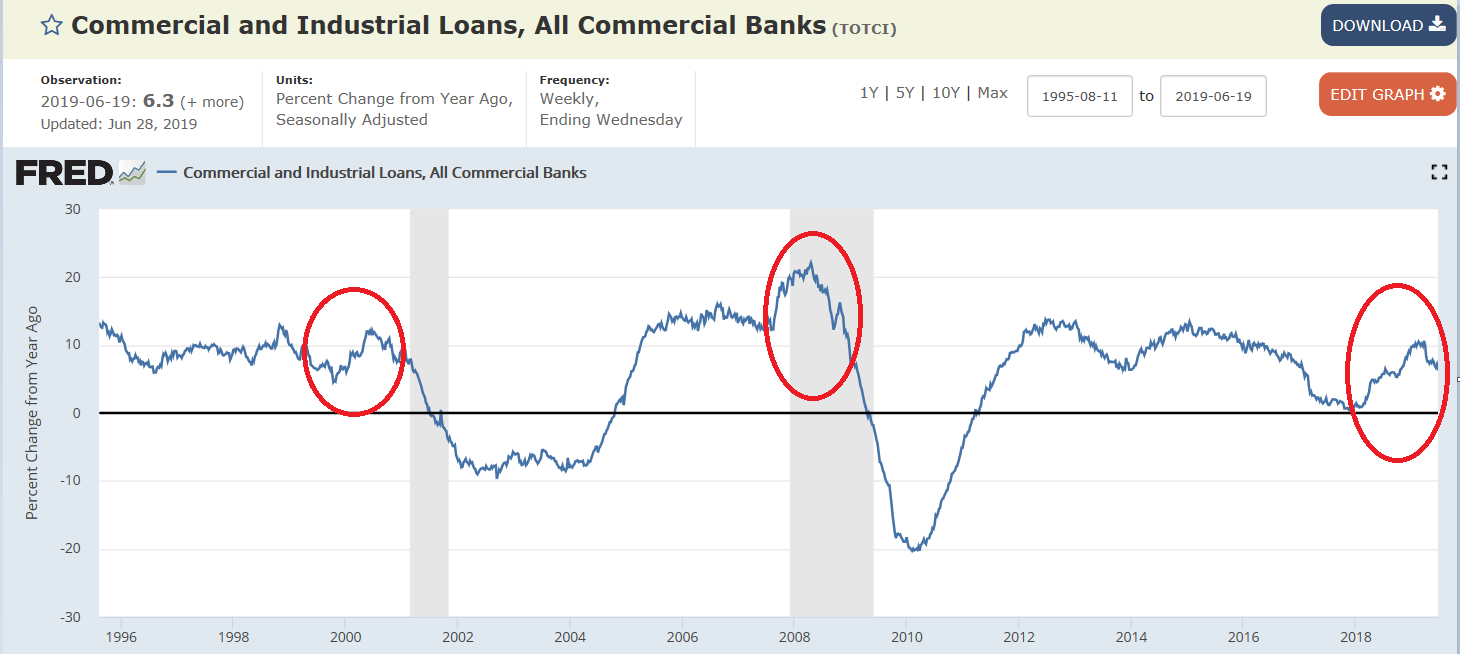
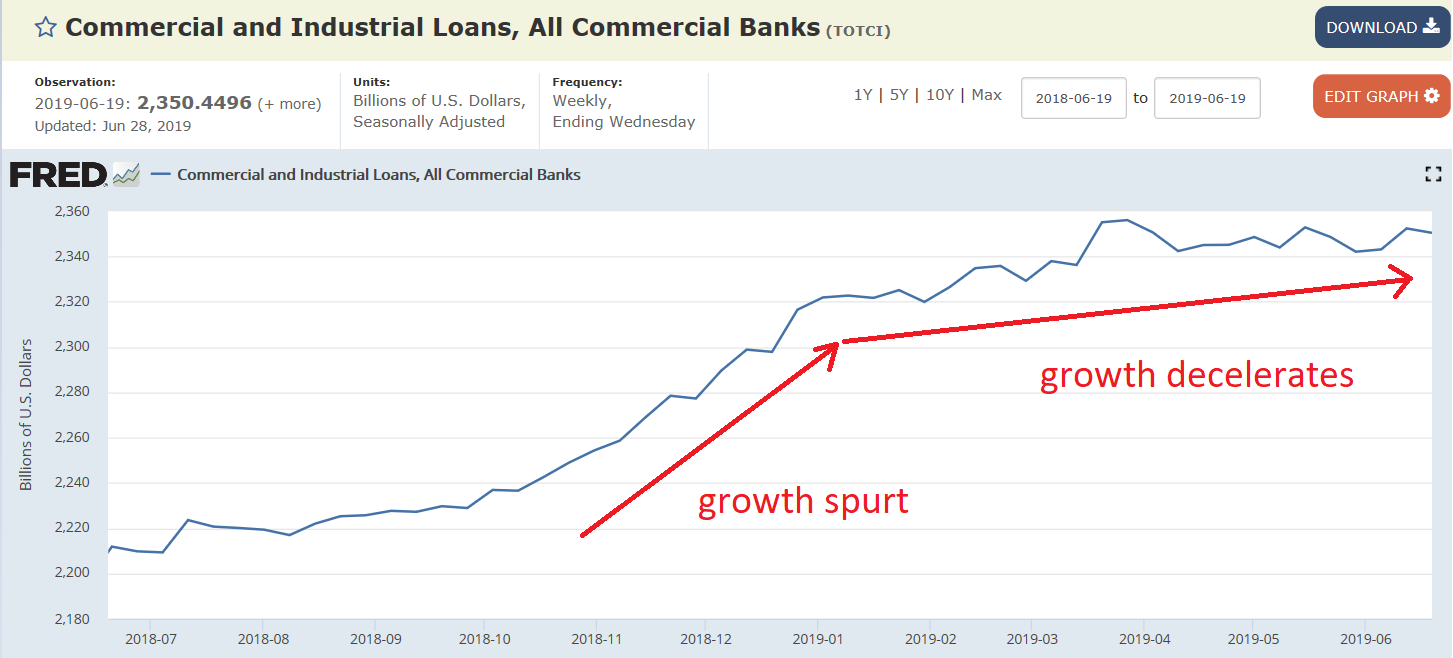
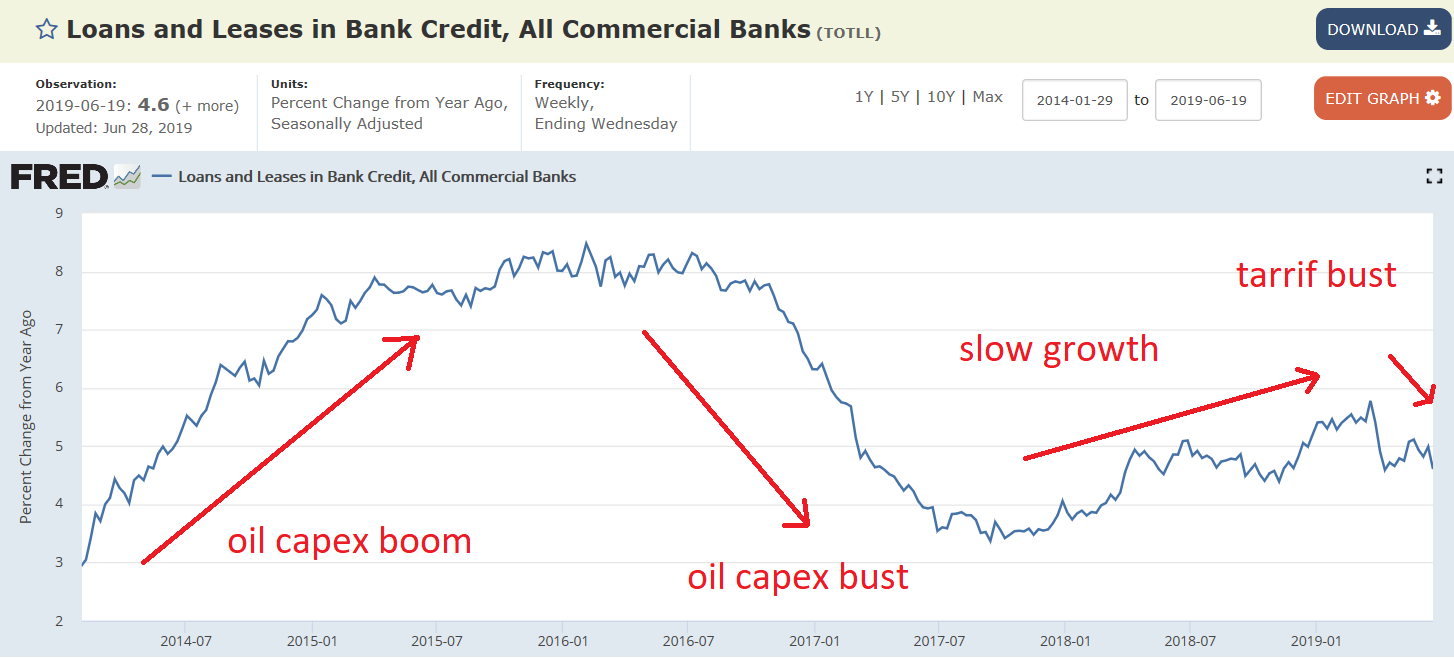
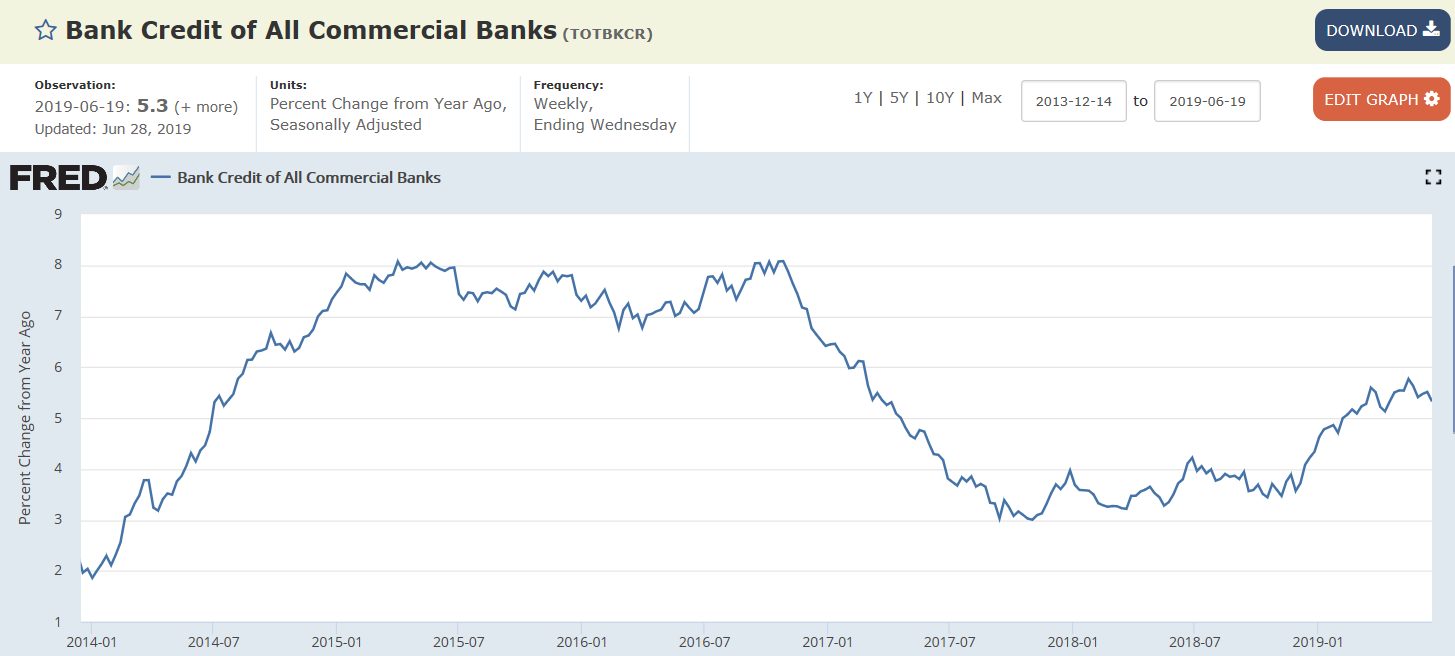
Been working its way lower and into contraction ever since the collapse in oil capital expenditures late in 2015, like a slow motion train wreck:

There’s been a history of getting a spike up before the collapse:

Companies are warning that earnings results are going to be brutal

KEY POINTS
With earnings season looming, 77% of companies issuing pre-announcements say their profit picture will be worse than Wall Street is expecting.
That’s the second-worst quarter on record going back to 2006, according to FactSet.
Two tariff-sensitive sectors, tech and health care, have seen the highest amounts of negative announcements.

Stocks may have brushed up against record highs Monday. However, a looming threat is just a couple weeks away once profit reports from the second quarter hit.

Analysts have been taking a dimmer view of what is ahead for earnings. They’ve already forecast a decline for the first three quarters of 2019. Now companies are echoing those concerns with a level of pessimism not often seen from corporate America.

China, UK, US, Euro zone

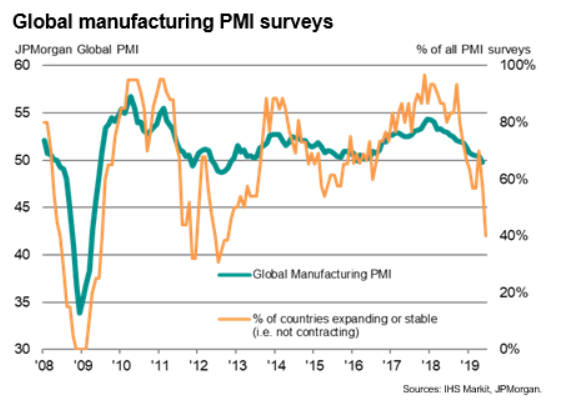
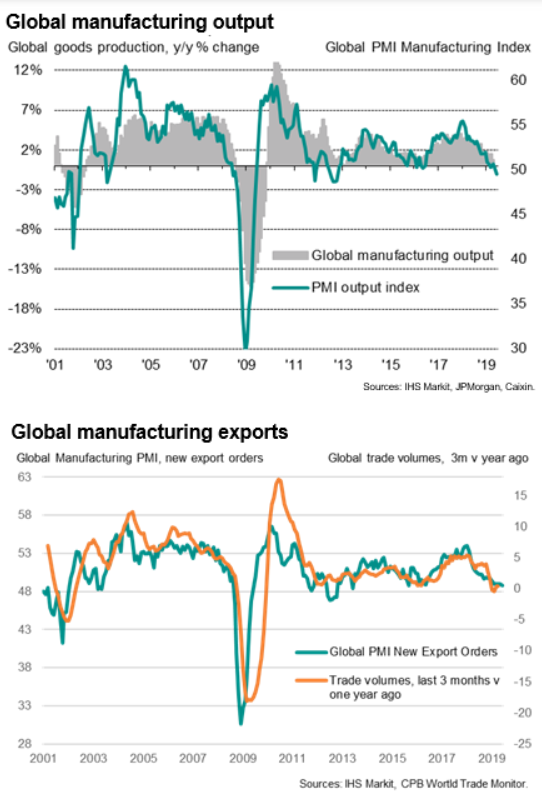
Global collapse continues, though you’d never know it watching the stock market:

China Inflation Rate Slows to 6-Month Low

The official Non-Manufacturing PMI in China unexpectedly inched lower to 54.2 in June, the lowest in six months, from 54.3 in the previous month and missing market consensus of

China Factory Activity Shrinks More than Estimated

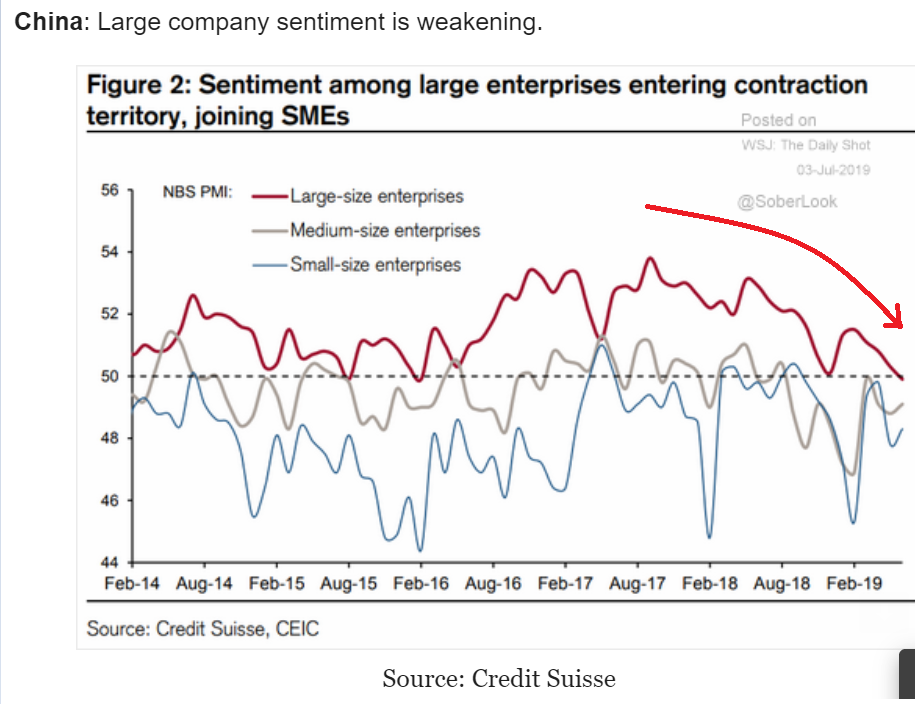
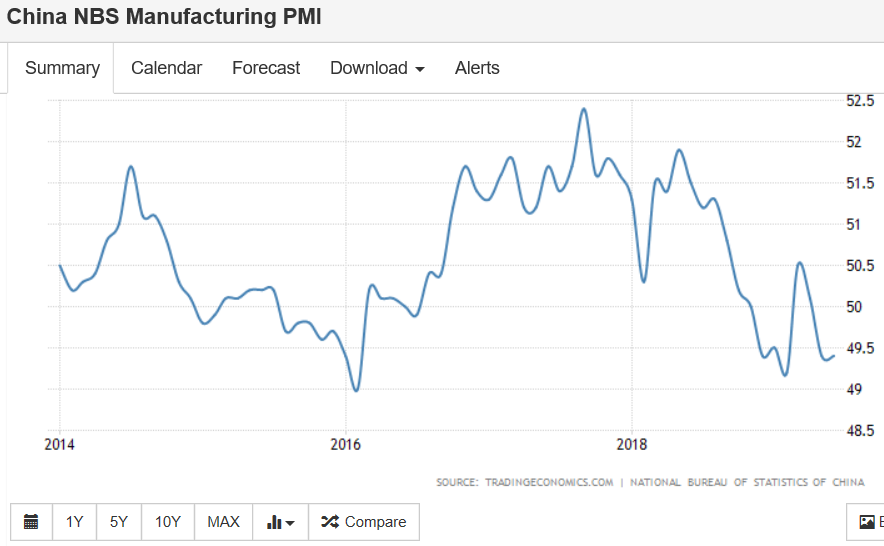
The Official NBS Manufacturing PMI in China unexpectedly was unchanged at 49.4 in June 2019 and missing market expectations of 49.5. This marked the second straight month of contraction in manufacturing activity

UK Manufacturing PMI Slumps to 6-Year Low

The IHS Markit/CIPS UK Manufacturing PMI fell to 48 in June, the lowest since February 2013 and well below forecasts of 49.2. Production contracted at the fastest pace since October 2012 and new orders dropped the most for almost seven years, amid high stock levels, ongoing Brexit uncertainty, the economic slowdown and rising competition.

US Manufacturing Growth Drops to New 2-1/2-Year Low: ISM

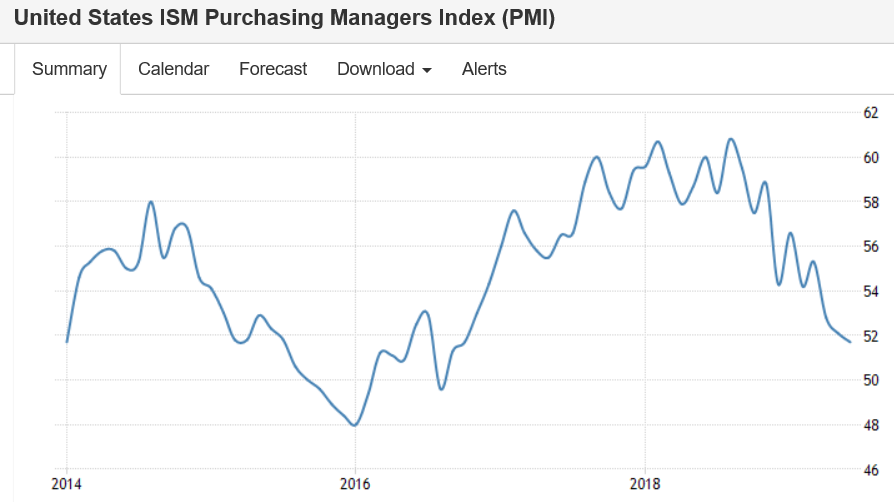
The ISM Manufacturing PMI in the US fell to 51.7 in June 2019 from 52.1 in the previous month, beating market expectations of 51.0. Still, the latest reading pointed to weakest pace of

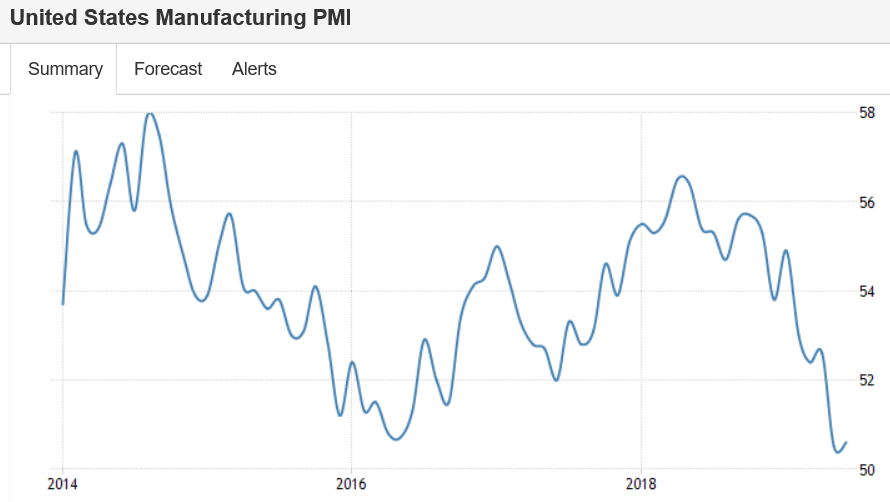
Markit:

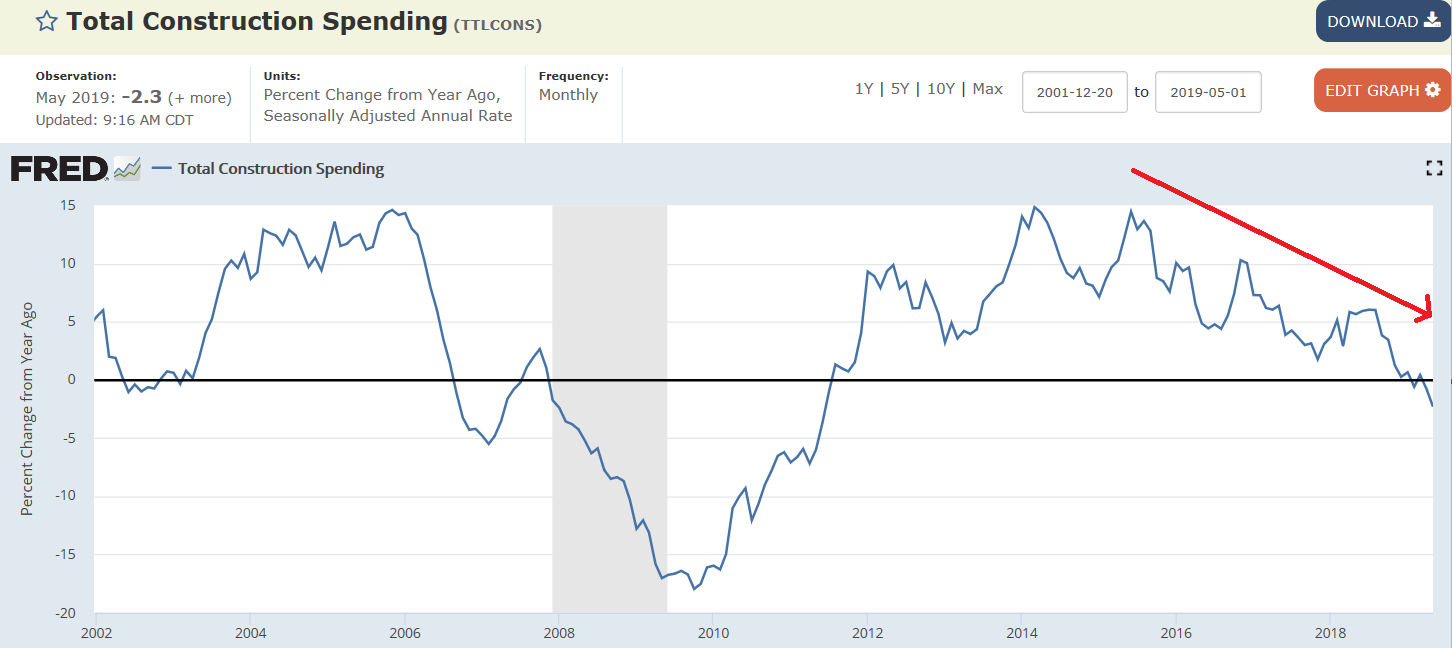
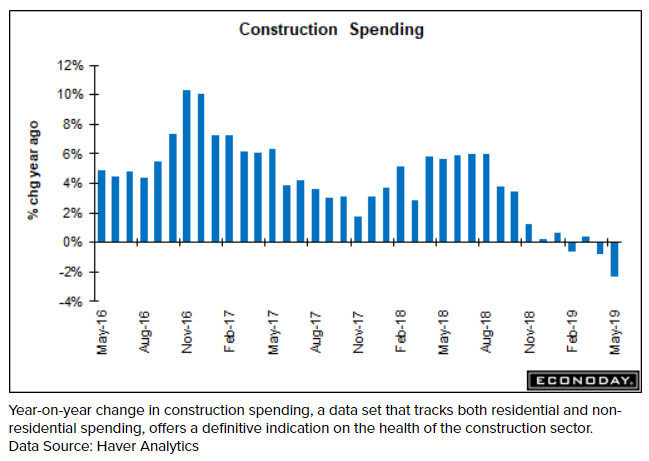
US Construction Spending Unexpectedly Falls in May

US construction spending fell 0.8 percent from a month earlier at a seasonally adjusted annual rate of USD 1.29 trillion in May 2019, after an upwardly revised 0.4 percent increase in the previous…

Deeper into contraction: