Obama Accepting Sequestration as Deficit Shrinks

President Barack Obama has stopped worrying and learned to live with sequestration.

By Mark Deen

May 27 (Bloomberg) — Gone are the cold February predictions of mass layoffs, family upheaval and the prospect of a new recession because of the automatic, across-the-board spending cuts. Cabinet secretaries no longer visit the White House briefing room to offer dire forecasts about teacher firings or unsecured borders.

With the economy growing, unemployment falling, Republicans unmoved in resisting tax increases and little sign of the public backlash the White House expected, Obama is adjusting to the spending curbs he once derided as “just dumb.” Attacks on sequestration have receded as a major theme of his speeches.

“He probably has concluded that he can’t change it,” said Stan Greenberg, a Democrat who was a pollster for former President Bill Clinton. “He’s moved away from it because he thinks it’s giving Republicans leverage by focusing on it.”

As the president’s criticism of sequestration wanes, so do prospects for a budget deal big enough to address the U.S.’s long-term fiscal debt, a goal central to helping cement Obama’s legacy that has eluded him since midway through his first term.

Sequestration was designed to be so intolerable to both Republicans and Democrats that the parties would be motivated to reach a broad budget accord to avert the cuts, which would slash spending by $1.2 trillion over nine years. Republicans were supposed to come to the table to stop reductions in defense outlays — which are targeted for about half the cuts — and Democrats to restore funding for domestic programs such as special education, jobless benefits and medical research.

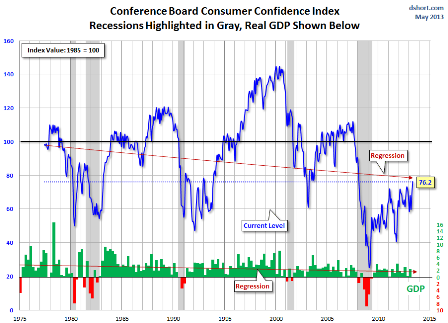
Conference Board’s Consumer Confidence Index

Confidence up but still at levels typical of prior recessions, and note regression analysis.

And seems to lag the Optimism index?


Full size image


Karim responds:

What matters is the rate of change, not the index level. Have been in recession at 120 level on the index and have had 4% growth at 50.
Same reason why you we can have rate cuts priced at 5.5% unemployment (if coming from 4%) and rate hikes priced in at 7.5% (if coming from 10%).
 

When it comes to the Fed’s reaction function, don’t fight Karim!!!!

Boom Is Back: US Home Prices Jump Most in Seven Years

I’m sure stocks will surge on this report, which means little or nothing for output and profits, as it’s that kind of market.

As you know, if prices go down, say, 50%, they have to go up 100% to get back to where they started.
So comparing these kinds of % increases from current, depressed levels, to % increases of 7 years ago and calling it a ‘boom’ is highly misleading.

Also, home prices fell below replacement cost during the liquidation phase, so a recovery from those levels happens even in a very slow growth economy.

Boom Is Back: US Home Prices Jump Most in Seven Years

May 28 (Reuters) &#8212 U.S. single-family home prices rose in March, racking up their best annual gain in nearly seven years as the housing recovery continues to provide a source of strength for the economy, a closely watched survey showed on Tuesday.

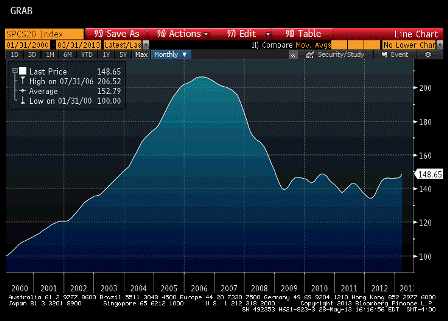
The S&P/Case-Shiller composite index of 20 metropolitan areas gained 1.1 percent in March on a seasonally adjusted basis, topping economists’ forecasts for 1 percent.

Prices in the 20 cities jumped 10.9 percent year over year, beating expectations for 10.2 percent and the biggest increase since April 2006.

All 20 cities covered by the index saw yearly gains for the third month in a row. Average prices in March were back at their late-2003 levels.

For the first quarter of this year, the seasonally adjusted national index rose 3.9 percent, stronger than the 2.4 percent gain that was seen in the final quarter of last year.

China Plans to Reduce the State’s Role in the Economy

More evidence the western educated kids have taken over.

:(

China Plans to Reduce the State’s Role in the Economy

By David Barboza and Chris Buckley

May 24 (NYT) &#8212 The Chinese government is planning for private businesses and market forces to play a larger role in its economy, in a major policy shift intended to improve living conditions for the middle class and to make China an even stronger competitor on the global stage.